
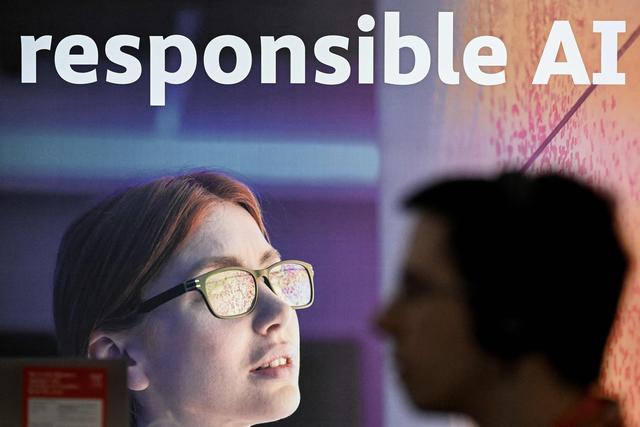
On October 16, at the Frankfurt Book Fair in Germany, readers walked past a banner with the artificial intelligence logo.
The French newspaper "Le Figaro" recently wrote an article that with the rapid development of new technologies and artificial intelligence in the field of recruitment, recruitment work is changing. Applicants are using AI to assist their application procedures, while recruiters are using AI to improve their application process. Recruitment efficiency and identify whether candidates have inappropriately used AI.
"Le Figaro" believes that recruiting employees plays a key role in the future of the company, so it is crucial to prevent applicants from improperly using AI to falsify their work abilities. Software solutions company Capterra has conducted research specifically on this thorny problem.
Emilie AuduBERT, content analyst at Capterra, believes that more and more companies are using AI to write job ads, screen candidates, identify potential candidates, assist with interviews, and make hiring decisions. Therefore, we can foresee that candidates may use AI to improve their job search efficiency or even falsify their resumes in the future.
This means recruiters must use precautions. First, companies need to take a clear stance on the use of AI, inform candidates of the specific rules for using AI to apply, and reflect this in their own recruitment processes. For example, they can publish relevant information on the company website and publish advertisements on third-party platforms, making it clear that illegal use of AI will result in disqualification from applying.
Capterra's research believes that in terms of helping recruiters, AI can promote the improvement of the selection process. Recruiters can use technical tools and software to conduct preliminary resume screening, or use plagiarism detection software to optimize the evaluation process of job applications. In terms of interviews, AI can design questions based on the specific requirements of the company's positions, assess the candidates' true personality and skills, and even design situational interview sessions to accurately assess the candidates' actual abilities. AI can also accurately design group discussion sessions and serve as intelligent judges. The interview format of group discussion sessions often consists of multiple real interviewers forming an evaluation team. The addition of AI not only reduces the risk of biased evaluation, but also limits candidates’ attempts to pass language. The potential for design to mislead human interviewers.