worldcuisines
1.0.0

Introducing ? WorldCuisines, a massive-scale multilingual and multicultural VQA benchmark that challenges Vision-Language Models (VLMs) to understand cultural food diversity in over 30 languages and dialects, across 9 language families, with over 1 million data points available generated from 2.4k dishes with 6k images. As benchmark, we have three sets:
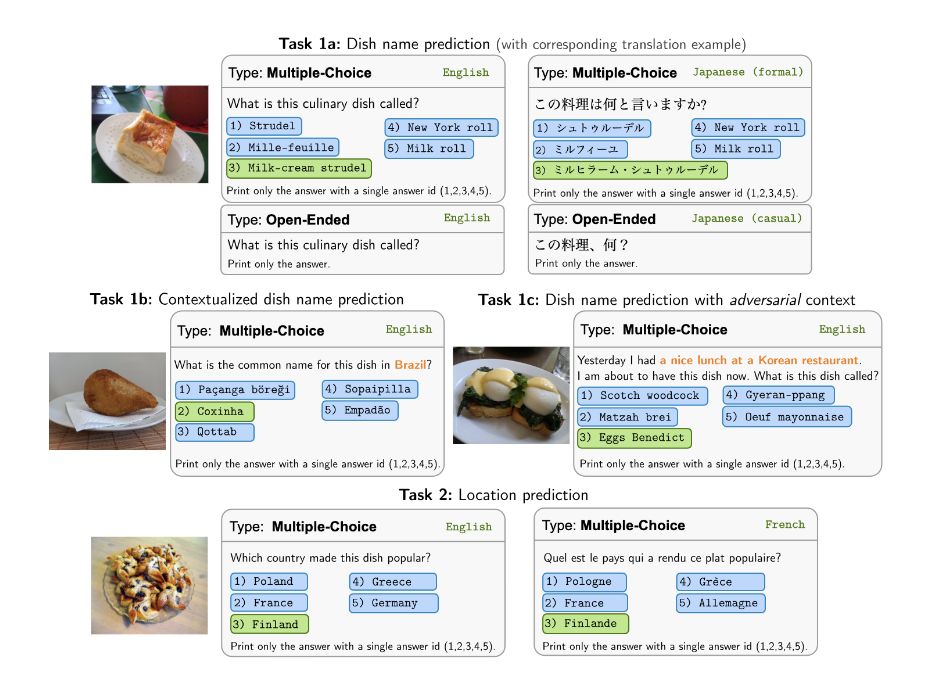
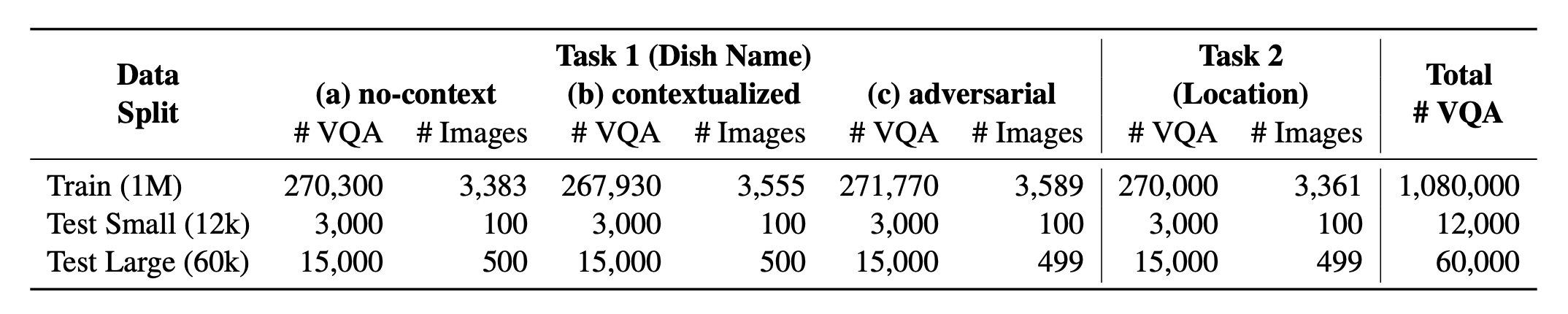
? WorldCuisines ? comprises a balanced proportion of its 2 supported tasks. We provide over 1M training data and a 60k evaluation data. Our benchmark evaluates VLMs on two tasks: dish name prediction and dish location prediction. The settings include no-context, contextualized, and adversarial infused prompt as the model's input.
Our dataset is available at ? Hugging Face Dataset. The supporting KB data can be found at ? Hugging Face Dataset.
This is the source code of the paper [Arxiv]. This code has been written using Python. If you use any code or datasets from this toolkit in your research, please cite the associated paper.
@article{winata2024worldcuisines,
  title={WorldCuisines: A Massive-Scale Benchmark for Multilingual and Multicultural Visual Question Answering on Global Cuisines},
  author={Winata, Genta Indra and Hudi, Frederikus and Irawan, Patrick Amadeus and Anugraha, David and Putri, Rifki Afina and Wang, Yutong and Nohejl, Adam and Prathama, Ubaidillah Ariq and Ousidhoum, Nedjma and Amriani, Afifa and others},
  journal={arXiv preprint arXiv:2410.12705},
  year={2024}
}If you wish to get the final result for all VLLMs that we evaluate, please refer to this leaderboard for the summary. The raw results are placed in the evaluation/score/json directory.
Please run the following command to install the required libraries to reproduce the benchmark results.
pippip install -r requirements.txt
condaconda env create -f env.yml
For pangea, please run the following
pip install -e "git+https://github.com/gentaiscool/LLaVA-NeXT@79ef45a6d8b89b92d7a8525f077c3a3a9894a87d#egg=llava[train]"
All experiment results will be stored in the evaluation/result/ directory. The results are evaluated using accuracy for all tasks, specifically for open-ended task (OEQ), we use accuracy computed using multi-reference. You can execute each experiment using the following commands:
cd evaluation/
python run.py --model_path {model_path} --task {task} --type {type}
| Argument | Description | Example / Default |
|---|---|---|
--task |
Task number to evaluate (1 or 2) | 1 (default), 2 |
--type |
Type of question to evaluate (oe or mc) |
mc (default), oe |
--model_path |
Path to the model | Qwen/Qwen2-VL-72B-Instruct (default) + others |
--fp32 |
Use float32 instead of float16/bfloat16 |
False (default) |
--multi_gpu |
Use multiple GPUs | False (default) |
-n, --chunk_num |
Number of chunks to split the data into | 1 (default) |
-k, --chunk_id |
Chunk ID (0-based) | 0 (default) |
-s, --st_idx |
Start index for slicing data (inclusive) | None (default) |
-e, --ed_idx |
End index for slicing data (exclusive) | None (default) |
We support the following models (you can modify our code to run evaluation with other models).
rhymes-ai/Ariameta-llama/Llama-3.2-11B-Vision-Instructmeta-llama/Llama-3.2-90B-Vision-Instructllava-hf/llava-v1.6-vicuna-7b-hfllava-hf/llava-v1.6-vicuna-13b-hfallenai/MolmoE-1B-0924allenai/Molmo-7B-D-0924allenai/Molmo-7B-O-0924microsoft/Phi-3.5-vision-instructQwen/Qwen2-VL-2B-InstructQwen/Qwen2-VL-7B-InstructQwen/Qwen2-VL-72B-Instructmistralai/Pixtral-12B-2409neulab/Pangea-7B (please install Llava as mentioned in ⚡ Environment Setup)Edit evaluation/score/score.yml to determine scoring mode, evaluation set, and evaluated VLMs. Note that mc means multiple-choice and oe means open-ended.
mode: all # {all, mc, oe}  all = mc + oe
oe_mode: multi # {single, dual, multi}
subset: large # {large, small}
models:
- llava-1.6-7b
- llava-1.6-13b
- qwen-vl-2b
- qwen2-vl-7b-instruct
- qwen2-vl-72b
- llama-3.2-11b
- llama-3.2-90b
- molmoe-1b
- molmo-7b-d
- molmo-7b-o
- aria-25B-moe-4B
- Phi-3.5-vision-instruct
- pixtral-12b
- nvlm
- pangea-7b
- gpt-4o-2024-08-06
- gpt-4o-mini-2024-07-18
- gemini-1.5-flash
In addition to the multi mode for generating the oe score, which compares the answer to the golden labels across all languages, we also support other golden label referencing settings:
single reference: compares the answer only to the golden label in the original language.dual reference: compares the answer to the golden label in the original language and English.Once set, run this command:
cd evaluation/score/
python score.pyWe provide radar, scatter, and connected scatter-line plots to visualize scoring results for all VLMs in evaluation/score/plot/.
To generate all radar plot, use:
python evaluation/score/plot/visualization.py
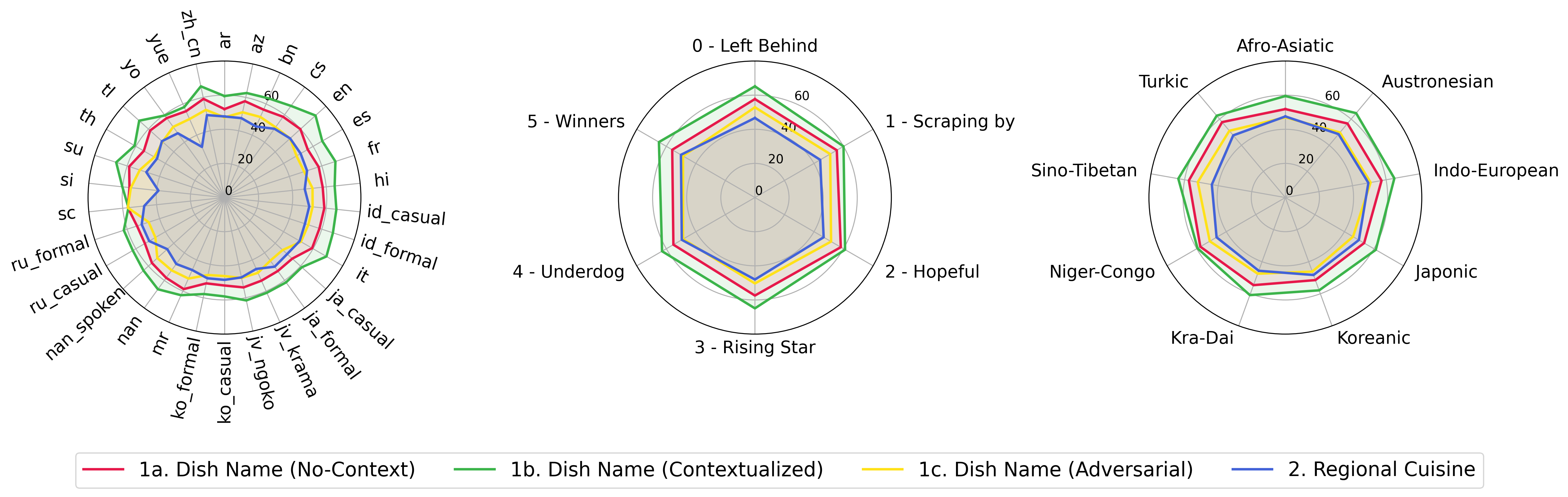
You can also modify evaluation/score/score.yml to select which VLMs to visualize and adjust plot labels in plot_mapper.yml.
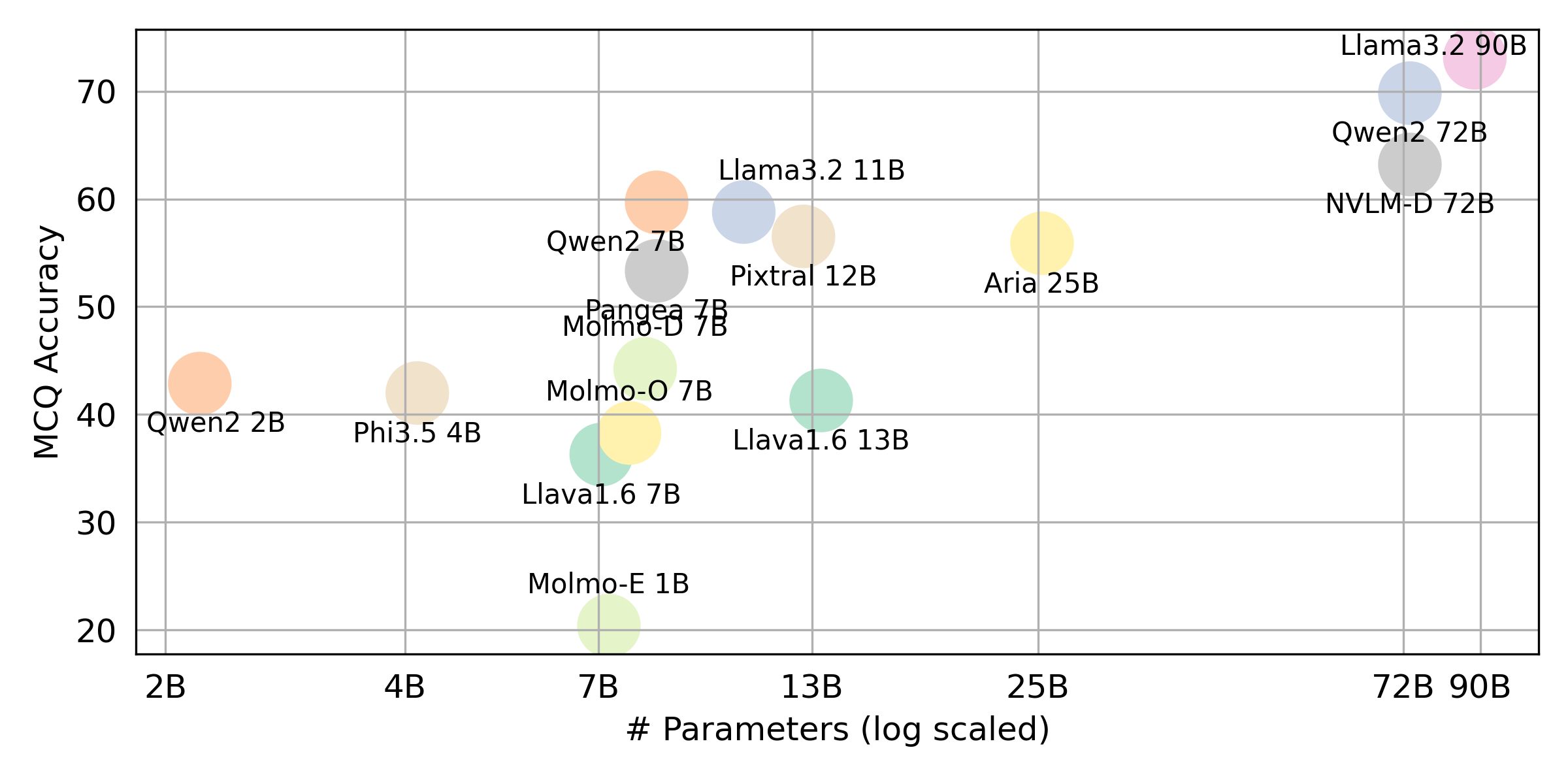
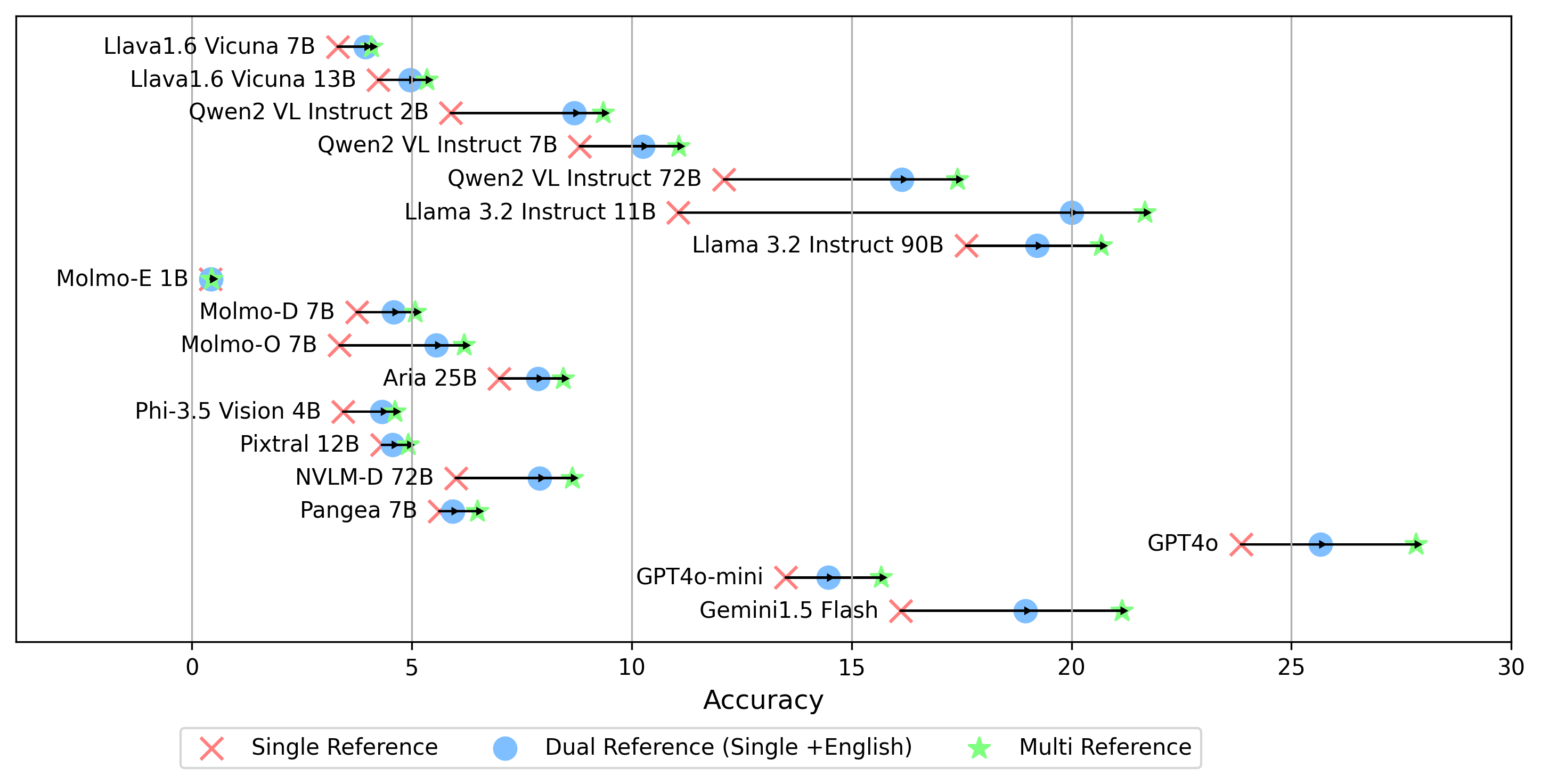
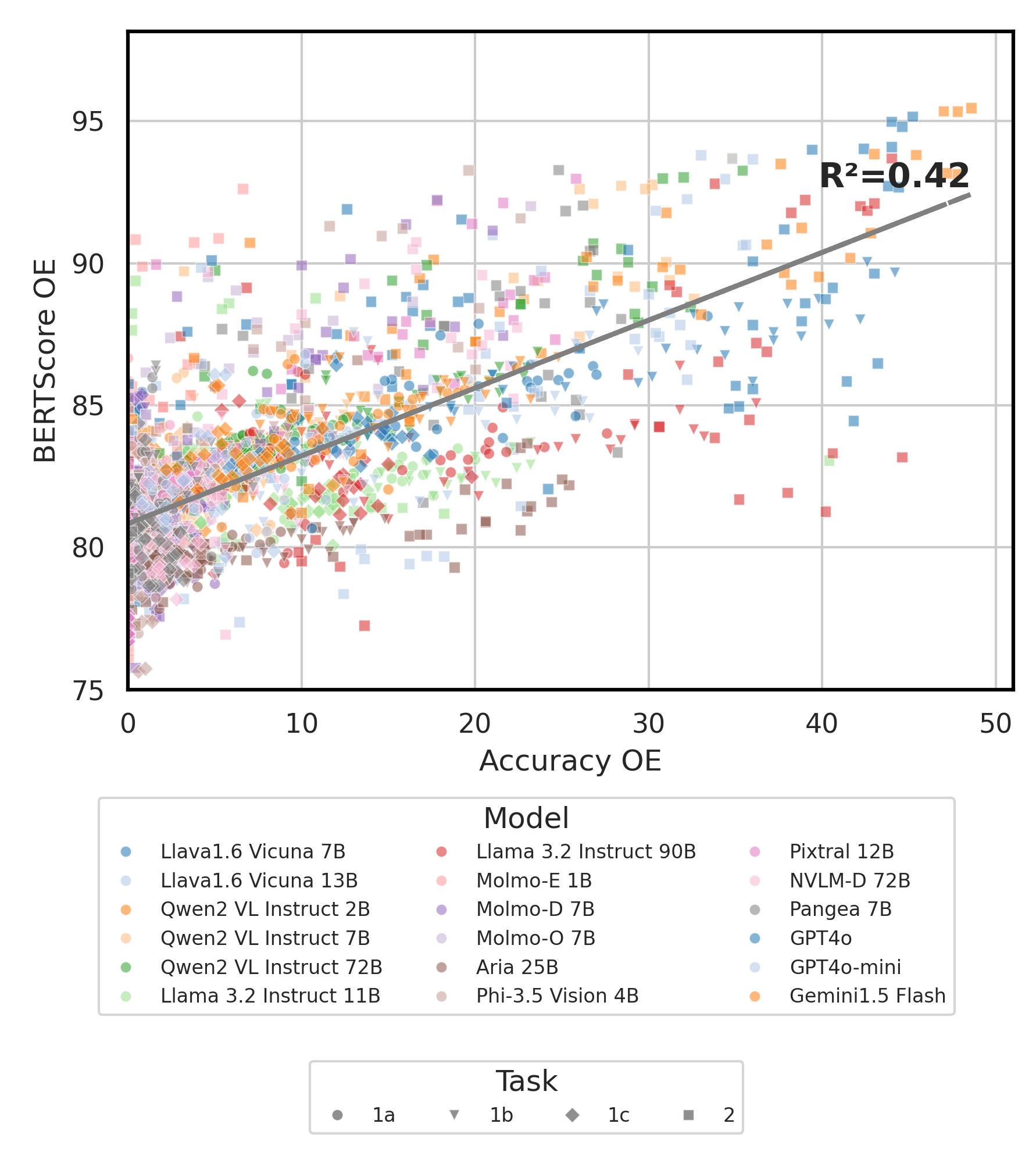
Other plot generation scripts are available in the *.ipynb files within the same directory.
Our codebase supports the usage of multiple models for the experiments, providing flexibility for customization of the list shown below:
(last tested as of October 2024)
To generate a VQA dataset from the knowledge base, you can refer to the generate_vqa/sampling.py script. This script generates the dataset for various tasks in both training and testing sets.
Example Commands: To generate datasets for Test Small, Test Large, and Train sets, run the following commands:
cd generate_vqa
mkdir -p generated_data

# Test Small Task 1
python3 sampling.py -o "generated_data/test_small_task1.csv" -n 9000 -nd 100 -np1a 1 -np1b 0 -np1c 1 -npb 1 --is-eval

# Test Small Task 2
python3 sampling.py -o "generated_data/test_small_task2.csv" -n 3000 -nd 100 -np1a 0 -np1b 1 -np1c 0 -npb 0 --is-eval

# Test Large Task 1
python3 sampling.py -o "generated_data/test_large_task1.csv" -n 45000 -nd 500 -np1a 1 -np1b 0 -np1c 1 -npb 1 --is-eval

# Test Large Task 2
python3 sampling.py -o "generated_data/test_large_task2.csv" -n 15000 -nd 500 -np1a 0 -np1b 1 -np1c 0 -npb 0 --i-eval

# Train Task 1
python3 sampling.py -o "generated_data/train_task1.csv" -n 810000 -nd 1800 -np1a 5 -np1b 0 -np1c 5 -npb 5 --no-is-eval

# Train Task 2
python3 sampling.py -o "generated_data/train_task2.csv" -n 270000 -nd 1800 -np1a 0 -np1b 5 -np1c 0 -npb 0 --no-is-eval| Argument | Description | Example |
|---|---|---|
-o, --output-csv |
Output CSV path where the generated VQA dataset will be saved. | generated_data/test_small_task1.csv |
-n, --num-samples |
Maximum number of instances to be generated. If more samples are requested than possible, the script will adjust. | 9000 |
-nd, --n-dish-max |
Maximum unique number of dishes to sample from. | 100 |
-np1a, --n-prompt-max-type1a |
Maximum unique prompts from Task 1(a) (no-context) to sample per dish in each iteration. | 1 |
-np1b, --n-prompt-max-type1b |
Maximum unique prompts from Task 1(b) (contextualized) to sample per dish in each iteration. | 1 |
-np1c, --n-prompt-max-type1c |
Maximum unique prompts from Task 1(c) (adversarial) to sample per dish in each iteration. | 1 |
-np2, --n-prompt-max-type2 |
Maximum unique prompts from Task 2 to sample per dish in each iteration. | 1 |
--is-eval, --no-is-eval |
Whether to generate evaluation (test) or training datasets. | --is-eval for test, --no-is-eval for train |
| Argument | Description | Example |
|---|---|---|
-fr, --food-raw-path |
Path to the raw food data CSV. | food_raw_6oct.csv |
-fc, --food-cleaned-path |
Path to the cleaned food data CSV. | food_cleaned.csv |
-q, --query-context-path |
Path to the query context CSV. | query_ctx.csv |
-l, --loc-cuis-path |
Path to the location and cuisine CSV. | location_and_cuisine.csv |
-ll, --list-of-languages |
Specify languages to be used as a list of strings. | '["en", "id_formal"]' |
-aw, --alias-aware |
Enable adversarial answers with parallel aliases instead of replacing dishes without translation with English | --alias-aware for the requirement to find answers that contain parallel translation across all languages, --no-alias-aware for relaxing the parallel dishes name requirement |
Feel free to create an issue if you have any questions. And, create a PR for fixing bugs or adding improvements.
If you are interested to create an extension of this work, feel free to reach out to us!
Support our open source effort
We are improving the code, especially on inference part to generate evaluation/result and scoring visualization code unification, to make it more user-friendly and customizable.







