sapbert
1.0.0

[新闻| 2021年8月22日] Sapbert被整合到Nvidia的深度学习工具包Nemo中,作为其实体链接模块(谢谢Nvidia!)。您可以在Google Colab中使用它。
该仓库拥有(1)我们NAACL 2021论文中提出的Sapbert模型的代码,数据和预处理的权重:生物医学实体表示的自我调整预审计; (2)在我们的ACL 2021论文中提出的基准( XL-BEL )的跨语性Sapbert和一个跨语性的生物医学实体:学习域特殊的表示跨语性生物医学实体链接的表示。
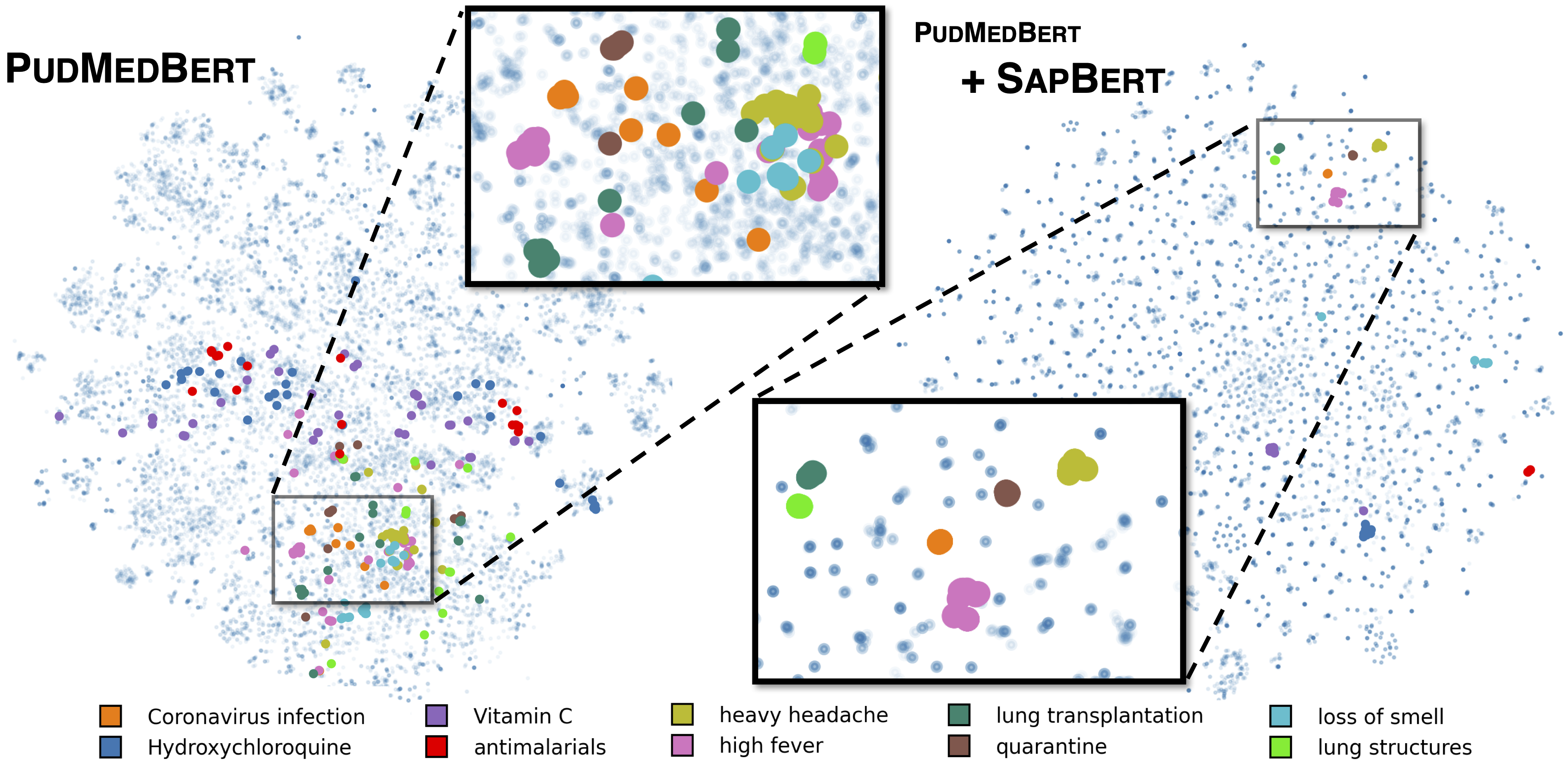
如[Liu等人,NAACL 2021]中所述的标准Sapbert。使用microsoft/BiomedNLP-PubMedBERT-base-uncased-abstract-fulltext作为基本模型,接受了UMLS 2020AA(仅英语)培训。对于[Sapbert],请使用[CLS] (池之前)作为输入的表示;对于[Sapbert-Mean-Token],请在所有令牌中使用平均泵。
如[Liu等人,ACL 2021]中所述的跨语性Sapbert。使用xlm-roberta-base / xlm-roberta-large作为基本模型,接受了UMLS 2020AB(所有语言)培训。使用[CLS] (池之前)作为输入的表示。
该代码用Python 3.8,Torch 1.7.0和HuggingFace Transferes 4.4.2进行了测试。请查看requirements.txt以获取更多详细信息。
以下脚本将字符串(实体名称)列表转换为嵌入。
 import numpy as np
import torch
from tqdm . auto import tqdm
from transformers import AutoTokenizer , AutoModel

tokenizer = AutoTokenizer . from_pretrained ( "cambridgeltl/SapBERT-from-PubMedBERT-fulltext" )
model = AutoModel . from_pretrained ( "cambridgeltl/SapBERT-from-PubMedBERT-fulltext" ). cuda ()

# replace with your own list of entity names
all_names = [ "covid-19" , "Coronavirus infection" , "high fever" , "Tumor of posterior wall of oropharynx" ]

bs = 128 # batch size during inference
all_embs = []
for i in tqdm ( np . arange ( 0 , len ( all_names ), bs )):
    toks = tokenizer . batch_encode_plus ( all_names [ i : i + bs ],
                                       padding = "max_length" ,
                                       max_length = 25 ,
                                       truncation = True ,
                                       return_tensors = "pt" )
    toks_cuda = {}
    for k , v in toks . items ():
        toks_cuda [ k ] = v . cuda ()
    cls_rep = model ( ** toks_cuda )[ 0 ][:, 0 ,:] # use CLS representation as the embedding
    all_embs . append ( cls_rep . cpu (). detach (). numpy ())

all_embs = np . concatenate ( all_embs , axis = 0 )
有关更广泛的推理示例,请参见推理/inperion_on_snomed.ipynb。
从training_data/generate_pretraining_data.ipynb中提取umls的培训数据(由于许可问题,我们无法直接发布培训文件)。
跑步:
 >> cd train/
>> ./pretrain.sh 0,1 其中0,1指定GPU设备。
要在您的自定义数据集中进行填充,请以
 concept_id || entity_name_1 || entity_name_2
...
其中entity_name_1和entity_name_2是从给定标记的数据集采样的同义词对(属于同一概念概念concept_id )。如果一个概念与数据集中的多个实体名称相关联,则可以穿越所有成对组合。
对于使用通用域并行数据(MUSE,Wiki标题或两者)的跨语性SAP调整,可以在training_data/general_domain_parallel_data/中找到数据。示例脚本: train/xling_train.sh 。
要进行评估(无论是弦词还是跨语言),请查看evaluation/README.md了解详细信息。 evaluation/xl_bel/包含[Liu等,ACL 2021]中提出的XL-BEL基准。
萨普伯特:
 @inproceedings { liu2021self ,
	title = { Self-Alignment Pretraining for Biomedical Entity Representations } ,
	author = { Liu, Fangyu and Shareghi, Ehsan and Meng, Zaiqiao and Basaldella, Marco and Collier, Nigel } ,
	booktitle = { Proceedings of the 2021 Conference of the North American Chapter of the Association for Computational Linguistics: Human Language Technologies } ,
	pages = { 4228--4238 } ,
	month = jun,
	year = { 2021 }
}
跨语言Sapbert和XL-Bel:
 @inproceedings { liu2021learning ,
	title = { Learning Domain-Specialised Representations for Cross-Lingual Biomedical Entity Linking } ,
	author = { Liu, Fangyu and Vuli{'c}, Ivan and Korhonen, Anna and Collier, Nigel } ,
	booktitle = { Proceedings of ACL-IJCNLP 2021 } ,
	pages = { 565--574 } ,
	month = aug,
	year = { 2021 }
}该代码的一部分是从Biosyn修改的。我们感谢作者将Biosyn开源。
Sapbert已获得麻省理工学院的许可。有关详细信息,请参见许可证文件。







