
The research team at the University of California, Berkeley recently released a breakthrough research result - the TULIP (Towards Unified Language-Image Pretraining) model. This model aims to improve the performance of visual language pre-training, especially in vision-centric tasks requiring high-fidelity understanding, and successfully overcomes the limitations of existing contrast learning models (such as CLIP).
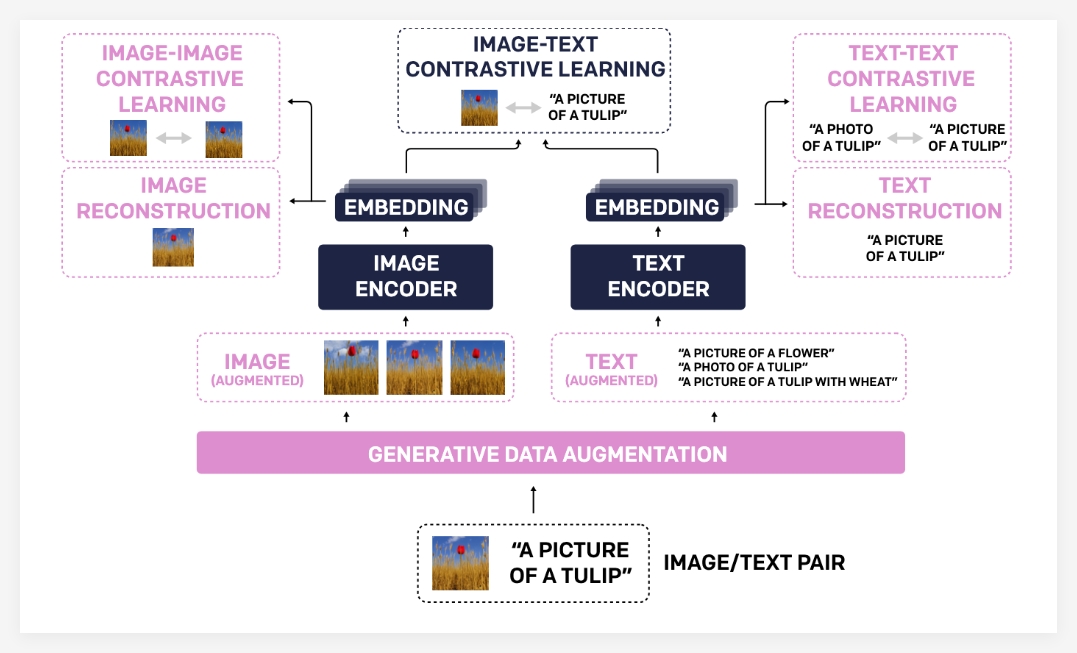
The TULIP model significantly improves the alignment between vision and language through innovative technologies such as integrated generative data augmentation, enhanced contrast learning, and reconstruction regularization. Experimental results show that TULIP has achieved state-of-the-art performance in multiple benchmarks, setting a new benchmark for zero-sample classification and visual language reasoning.
The reason why the TULIP model has achieved such significant progress is mainly due to its unique technology portfolio. First, Generative Data Augmentation uses generative models to augment training data, thereby improving the robustness and generalization capabilities of the model. By synthesizing more diverse image-text pairs, the model can learn more comprehensive visual and linguistic knowledge.
Secondly, Enhanced Contrastive Learning is different from traditional contrast learning methods. TULIP not only focuses on the matching between images and text, but also introduces image-image and text-text comparison learning goals. This enhanced contrast learning method can help models better understand visual similarities between different images and semantic associations between different text descriptions, thereby improving their understanding of fine-grained information.
Finally, Reconstruction Regularization further strengthens the alignment of visual and linguistic features. This method enables the model to reconstruct the corresponding text description from the image features or the corresponding images from the text features, thus forcing the model to learn deeper cross-modal associations.
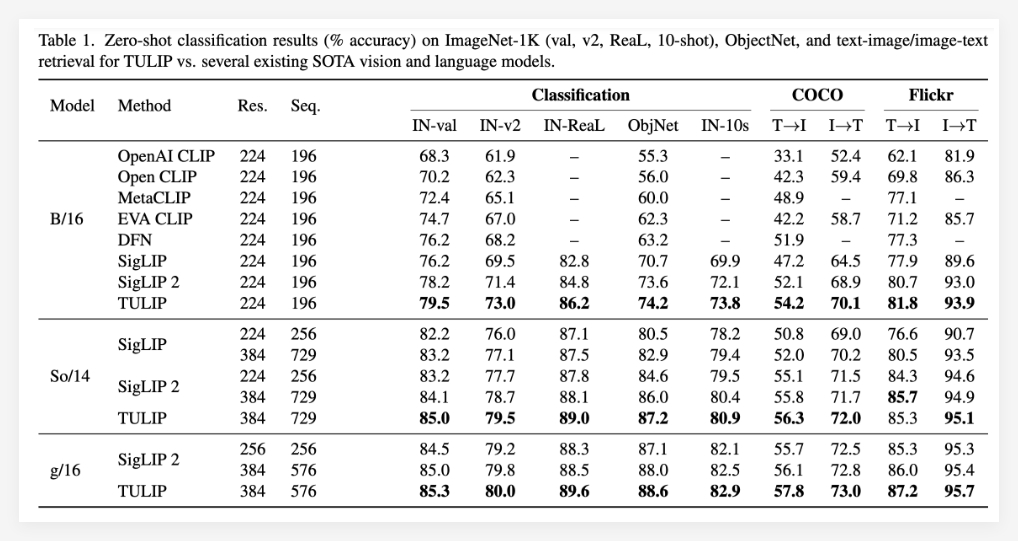
The experimental results fully prove the superiority of the TULIP model. TULIP has been reported to have achieved current optimal levels in multiple important visual and visual language benchmarks (state-of-the-art). Specific performances include: significant improvement in ImageNet-1K zero-sample classification, enhanced fine-grained object recognition capabilities, and improved multimodal inference scores.
It is particularly worth mentioning that compared with existing methods, TULIP has achieved up to 3 times performance improvements in MMVP benchmarks, and has also achieved 2 times performance improvements in fine-tuned visual tasks. These data fully demonstrate the great potential of TULIP in improving model performance.
Project: https://tulip-berkeley.github.io/