
Recently, the successful launch of the VLM-R1 project has brought new dawn to the field of visual language models. This project is the successful migration of the DeepSeek team's R1 method in the visual language model, marking that AI's understanding of visual content will enter a completely new stage. The launch of VLM-R1 not only demonstrates technological breakthroughs, but also opens up new directions for the research of multimodal AI.
VLM-R1 was inspired by the R1 method that the DeepSeek team opened source last year. This method adopts GRPO (Generated Reward Processing Optimization) reinforcement learning technology, and has achieved remarkable results in the field of plain text processing. Today, the VLM-R1 team has successfully applied this method to visual language models, further expanding its scope of application. This innovation provides new ideas for the research of multimodal AI and lays a solid foundation for future technological development.
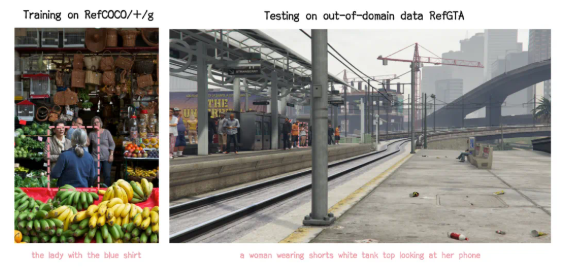
During the project verification process, the performance of VLM-R1 was amazing. First of all, the R1 method shows extremely high stability in complex scenarios, which is particularly important in practical applications. Second, the model performs excellently in generalization capabilities. In comparison experiments, the performance of the traditional SFT (Supervised Fine-Tuning) model gradually declines with the increase in the number of training steps on the test data outside the field, while the R1 model can continue to improve during training. This shows that the R1 method allows the model to truly master the ability to understand visual content rather than relying solely on memory.
In addition, the VLM-R1 project is extremely difficult to get started, and the team provides developers with a complete training and evaluation process, so that developers can get started quickly. In a practical case, the model was asked to find the food with the highest protein content in a hearty food picture. The result was not only the answer was accurate, but also the egg cake with the highest protein content was selected in the picture accurately box. This case fully demonstrates the outstanding performance of VLM-R1 in visual comprehension and reasoning abilities.
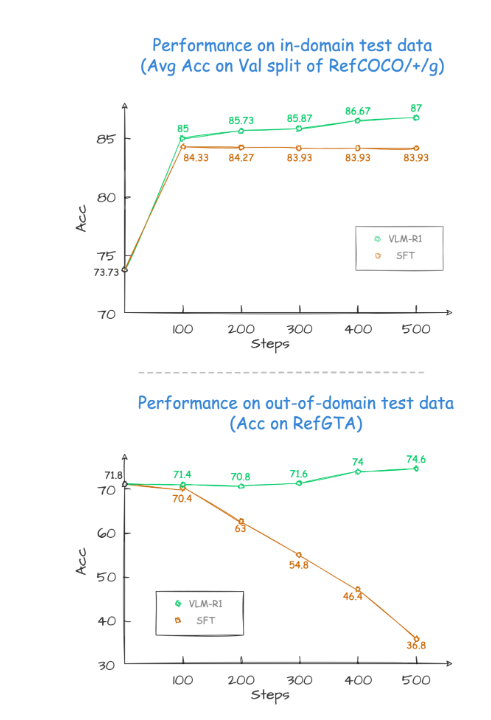
The successful launch of VLM-R1 not only proves the versatility of the R1 method, but also provides new ideas for the training of multimodal models, indicating the arrival of a new trend of visual language model training. What is even more exciting is that the project is completely open source and interested developers can find relevant information on GitHub. This open source measure will undoubtedly attract more developers to participate and jointly promote the advancement of multimodal AI technology.

In short, the advent of VLM-R1 has injected new vitality into the research of visual language models. It not only demonstrates technological breakthroughs, but also provides new directions for future research. We look forward to more developers participating in it, jointly promoting the continuous progress of multimodal AI technology, and bringing more innovations and breakthroughs to the field of artificial intelligence.