
Figure has recently taken an important step in the field of robotics. Company founder and CEO Brett Adcock announced an innovative machine learning model called Helix. This breakthrough technology aims to significantly enhance the practicality and adaptability of humanoid robots in home environments. It is worth noting that this release coincides with just two weeks after the end of the cooperation between Figure and OpenAI, fully demonstrating the company's firm determination and independent innovation capabilities in the field of robotics technology research and development.
The core of the Helix model lies in its "universal" vision-language-action (VLA) architecture. This innovative design enables robots to achieve real-time control through visual perception and language instructions, creating a new paradigm for human-computer interaction. From a technical perspective, Helix has similarities with Google DeepMind's RT-2 model, but it has achieved a major breakthrough in functionality. The most eye-catching feature of Helix is its superior object recognition ability, the ability to accurately identify and operate thousands of household items that have never been exposed during training, all of which can be accomplished only through the user's natural language instructions.
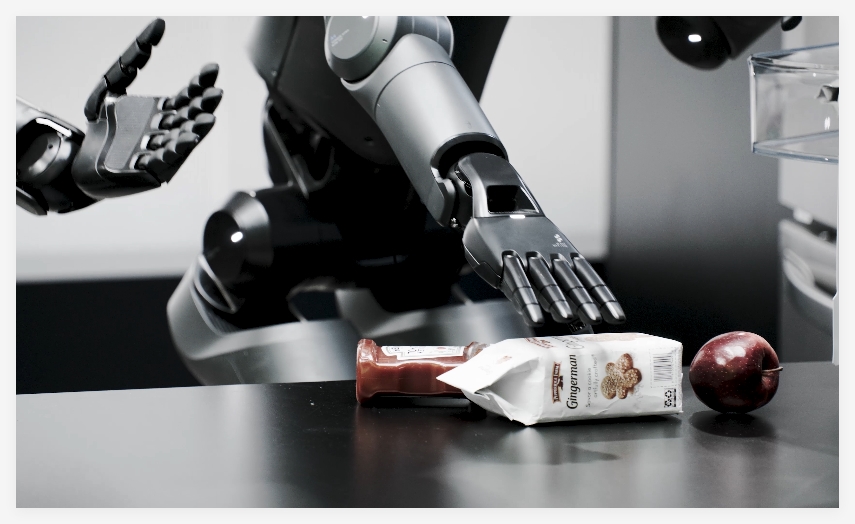
In practical application scenarios, Helix demonstrates impressive multitasking capabilities. The demo video provided by Figure shows that users can complete complex collaborative tasks through simple voice commands such as "hand me the cookie bag on the right" or "take the cookie bag from the robot on the left and put it in an open drawer". This ability of multi-robots to work collaboratively marks a new step in home service robotics technology.
Despite Helix's huge potential, the field of home service robots still faces many challenges. Figure notes that the complexity and unpredictability of the home environment are major technical barriers. Compared with the industrial environment, there are many types of objects in the home and the spatial layout is varied, which puts higher requirements on the robot's perception and decision-making ability. In addition, the high R&D costs are also an important factor restricting the popularity of home robots. Currently, most robot companies choose to focus on the industrial market first and then expand into the home field after the technology is mature.
Looking back at the development history of Figure Company, when TechCrunch reporters visited its Bay Area office in 2024, the company's focus was mainly on enterprise-level projects. However, with the launch of Helix, Figure clearly stated that it will take the home environment as an important direction for future technology research and development. This strategic shift reflects the company's deep understanding of the market potential of home robots.
At present, Helix is still in its early stages of development. Figure hopes to attract more outstanding engineers to join through this innovative technology to accelerate the progress of the project. For home service robots, being able to generate intelligent behavior in complex environments is crucial, which requires a lot of data training and algorithm optimization. With the continuous advancement of technology, we have reason to believe that Helix will bring revolutionary changes to the field of home service robots.
Official introduction: https://www.figure.ai/news/helix
Key points:
Helix is a new vision-language-action model that can control robots to perform housework tasks through natural language instructions.
The model demonstrates powerful object recognition capabilities, capable of picking up unseen household items.
Figure hopes to focus on the home environment as a focus of robotics development to solve the complex challenges faced by household robots.