folderify
v4.0.1

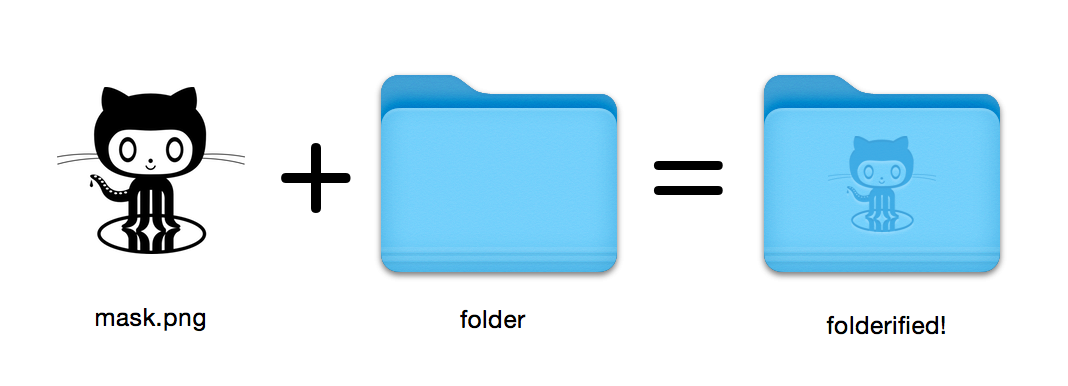
Genere iconos de carpeta MacOS perfectos de píxel en el estilo nativo.
16x16 a 512x512@2x . ¿Usando folderify ? ¡Avísame o avísame y me encantaría presentar algunos usos del mundo real!
Instalar folderify usando HomeBrew:
brew install folderify Se recomienda la instalación de HomeBrew e instala automáticamente las finalizaciones de argumentos folderify para su shell.
Consulte a continuación para otras opciones de instalación.
Use una máscara para asignar un icono a una carpeta:
folderify mask.png /path/to/folder Genere mask.icns y mask.iconset Files:
folderify mask.png De forma predeterminada, folderify utiliza el modo de luz/oscuro actual de su sistema. Use --color-scheme para anular esto:
folderify --color-scheme dark mask.pngNota:
Para mejores resultados:
.png .--no-trim y use una máscara: Los estilos de carpeta de OS X / MacOS 10 ya no son compatibles con folderify a partir de V3:
Para generarlos, use folderify V2. Por ejemplo:
pip3 install folderify
python3 -m folderify --macOS 10.5 path/to/icon.png Si no tiene HomeBrew pero ya tiene ImageMagick (el binario magick ) en su sistema, puede usar lo siguiente:
cargo install folderifyO descargue el código directamente:
git clone https://github.com/lgarron/folderify && cd folderify

# Run directly
cargo run -- --reveal examples/src/folder_outline.png .

# Install (assuming the `cargo` bin is in your path)
cargo install --path .
folderify --reveal examples/src/folder_outline.png .
La carpeta del repositorio ahora debe tener un icono personalizado.
 for file in examples/src/ * .png ; do cargo run -- $file ; done
open examples/src/
Debería ver un montón de nuevas carpetas .iconset y archivos .icns que se generaron automáticamente a partir de las máscaras .png .
magick e identify en la línea de comandos).iconutilfileiconsips , DeRez , Rez , SetFile (necesita herramientas de línea de comandos Xcode para algunos de estos). Generate a native-style macOS folder icon from a mask file.
Usage: folderify [OPTIONS] [MASK] [TARGET]
Arguments:
[MASK]
Mask image file. For best results:
- Use a .png mask.
- Use a solid black design over a transparent background.
- Make sure the corner pixels of the mask image are transparent. They are used for empty margins.
- Make sure the non-transparent pixels span a height of 384px, using a 16px grid.
If the height is 384px and the width is a multiple of 128px, each 64x64 tile will exactly align with 1 pixel at the smallest folder size.
[TARGET]
Target file or folder. If a target is specified, the resulting icon will
be applied to the target file/folder. Else (unless --output-icns or
--output-iconset is specified), a .iconset folder and .icns file will be
created in the same folder as the mask (you can use "Get Info" in Finder
to copy the icon from the .icns file).
Options:
--output-icns <ICNS_FILE>
Write the `.icns` file to the given path.
(Will be written even if a target is also specified.)
--output-iconset <ICONSET_FOLDER>
Write the `.iconset` folder to the given path.
(Will be written even if a target is also specified.)
-r, --reveal
Reveal either the target, `.icns`, or `.iconset` (in that order of preference) in Finder
--macOS <MACOS_VERSION>
Version of the macOS folder icon, e.g. "14.2.1". Defaults to the version currently running
--color-scheme <COLOR_SCHEME>
Color scheme — auto matches the current system value
[default: auto]
[possible values: auto, light, dark]
--no-trim
Don't trim margins from the mask.
By default (i.e. without this flag), transparent margins are trimmed from all 4 sides.
--no-progress
Don't show progress bars
--badge <BADGE>
Add a badge to the icon. Currently only supports one badge at a time
[possible values: alias, locked]
-v, --verbose
Detailed output. Also sets `--no-progress`
--completions <SHELL>
Print completions for the given shell (instead of generating any icons).
These can be loaded/stored permanently (e.g. when using Homebrew), but they can also be sourced directly, e.g.:
folderify --completions fish | source # fish
source <(folderify --completions zsh) # zsh
[possible values: bash, elvish, fish, powershell, zsh]
-h, --help
Print help (see a summary with '-h')
-V, --version
Print version
Ejemplo generado a partir del logotipo de Apple: