pytorch ts
Version 0.6.0

Pytorchts是一种Pytorch概率时间序列预测框架,它通过将Gluonts用作后端API并用于加载,转换和背面测试时间序列数据集,从而提供最先进的Pytorch时间序列模型。
$ pip3 install pytorchts
在这里,我们突出显示了API通过Gluonts Readme的变化。
 import matplotlib . pyplot as plt
import pandas as pd
import torch

from gluonts . dataset . common import ListDataset
from gluonts . dataset . util import to_pandas

from pts . model . deepar import DeepAREstimator
from pts import Trainer
这个简单的示例说明了如何在某些数据上训练模型,然后使用它来做出预测。作为第一步,我们需要收集一些数据:在此示例中,我们将使用提及AMZN股票符号的推文卷。
 url = "https://raw.githubusercontent.com/numenta/NAB/master/data/realTweets/Twitter_volume_AMZN.csv"
df = pd . read_csv ( url , header = 0 , index_col = 0 , parse_dates = True )
前100个数据点看起来如下:
 df [: 100 ]. plot ( linewidth = 2 )
plt . grid ( which = 'both' )
plt . show ()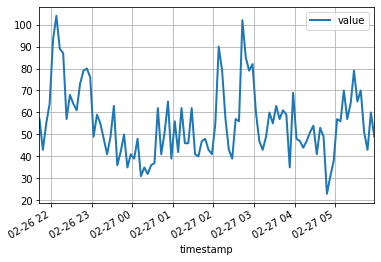
现在,我们可以准备一个培训数据集供我们的模型进行培训。数据集本质上是词典的集合:每个字典代表具有可能相关特征的时间序列。在此示例中,我们只有一个条目,由"start"字段指定,即第一个数据点的时间戳,以及包含时间序列数据的"target"字段。对于培训,我们将在2015年4月5日午夜使用数据。
 training_data = ListDataset (
    [{ "start" : df . index [ 0 ], "target" : df . value [: "2015-04-05 00:00:00" ]}],
    freq = "5min"
)预测模型是预测对象。获得预测因子的一种方法是训练通讯估计器。实例化估计器需要指定将处理的时间序列的频率以及预测的时间步骤的数量。在我们的示例中,我们使用5分钟数据,因此req="5min" ,我们将训练一个模型以预测下一个小时,因此prediction_length=12 。该模型的输入将是每个时间点的大小input_size=43的向量。我们还指定了一些最小的培训选项,特别是在device上的培训epoch=10 。
 device = torch . device ( "cuda" if torch . cuda . is_available () else "cpu" )

estimator = DeepAREstimator ( freq = "5min" ,
                            prediction_length = 12 ,
                            input_size = 19 ,
                            trainer = Trainer ( epochs = 10 ,
                                            device = device ))
predictor = estimator . train ( training_data = training_data , num_workers = 4 )
45it [00:01, 37.60it/s, avg_epoch_loss=4.64, epoch=0]
48it [00:01, 39.56it/s, avg_epoch_loss=4.2, epoch=1]
45it [00:01, 38.11it/s, avg_epoch_loss=4.1, epoch=2]
43it [00:01, 36.29it/s, avg_epoch_loss=4.05, epoch=3]
44it [00:01, 35.98it/s, avg_epoch_loss=4.03, epoch=4]
48it [00:01, 39.48it/s, avg_epoch_loss=4.01, epoch=5]
48it [00:01, 38.65it/s, avg_epoch_loss=4, epoch=6]
46it [00:01, 37.12it/s, avg_epoch_loss=3.99, epoch=7]
48it [00:01, 38.86it/s, avg_epoch_loss=3.98, epoch=8]
48it [00:01, 39.49it/s, avg_epoch_loss=3.97, epoch=9]
在培训期间,将显示有关进度的有用信息。要全面概述可用选项,请参阅DeepAREstimator (或其他估算器)和Trainer的源代码。
我们现在准备做出预测:我们将预测2015年4月15日午夜之后的小时。
 test_data = ListDataset (
    [{ "start" : df . index [ 0 ], "target" : df . value [: "2015-04-15 00:00:00" ]}],
    freq = "5min"
)
for test_entry , forecast in zip ( test_data , predictor . predict ( test_data )):
to_pandas ( test_entry )[ - 60 :]. plot ( linewidth = 2 )
forecast . plot ( color = 'g' , prediction_intervals = [ 50.0 , 90.0 ])
plt . grid ( which = 'both' )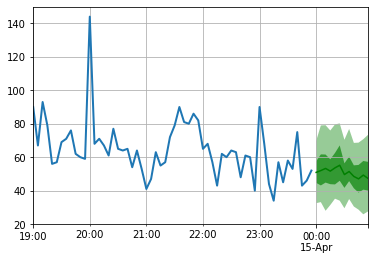
请注意,该预测是根据概率分布来显示的:阴影区域分别代表50%和90%的预测间隔,围绕中位数(深绿色线)。
 pip install -e .
pytest test
引用这个存储库:
@software{pytorchgithub,
    author = {Kashif Rasul},
    title = {{P}yTorch{TS}},
    url = {https://github.com/zalandoresearch/pytorch-ts},
    version = {0.6.x},
    year = {2021},
}我们使用此框架实现了以下模型:
@INPROCEEDINGS{rasul2020tempflow,
  author = {Kashif Rasul and  Abdul-Saboor Sheikh and  Ingmar Schuster and Urs Bergmann and Roland Vollgraf},
  title = {{M}ultivariate {P}robabilistic {T}ime {S}eries {F}orecasting via {C}onditioned {N}ormalizing {F}lows},
  year = {2021},
  url = {https://openreview.net/forum?id=WiGQBFuVRv},
  booktitle = {International Conference on Learning Representations 2021},
}@InProceedings{pmlr-v139-rasul21a,
title = {{A}utoregressive {D}enoising {D}iffusion {M}odels for {M}ultivariate {P}robabilistic {T}ime {S}eries {F}orecasting},
author = {Rasul, Kashif and Seward, Calvin and Schuster, Ingmar and Vollgraf, Roland},
booktitle = {Proceedings of the 38th International Conference on Machine Learning},
pages = {8857--8868},
year = {2021},
editor = {Meila, Marina and Zhang, Tong},
volume = {139},
series = {Proceedings of Machine Learning Research},
month = {18--24 Jul},
publisher = {PMLR},
pdf = {http://proceedings.mlr.press/v139/rasul21a/rasul21a.pdf},
url = {http://proceedings.mlr.press/v139/rasul21a.html},
}@misc{gouttes2021probabilistic,
title={{P}robabilistic {T}ime {S}eries {F}orecasting with {I}mplicit {Q}uantile {N}etworks},
author={Adèle Gouttes and Kashif Rasul and Mateusz Koren and Johannes Stephan and Tofigh Naghibi},
year={2021},
eprint={2107.03743},
archivePrefix={arXiv},
primaryClass={cs.LG}
}