
In the field of artificial intelligence, Alibaba Tongyi Laboratory team recently announced the open source of its latest multimodal model - R1-Omni. This model combines reinforcement learning with a validated reward (RLVR) approach, demonstrating outstanding abilities in processing audio and video information. The highlight of R1-Omni is its transparency, allowing us to understand the role of various modalities in the decision-making process, especially in tasks such as emotion recognition.
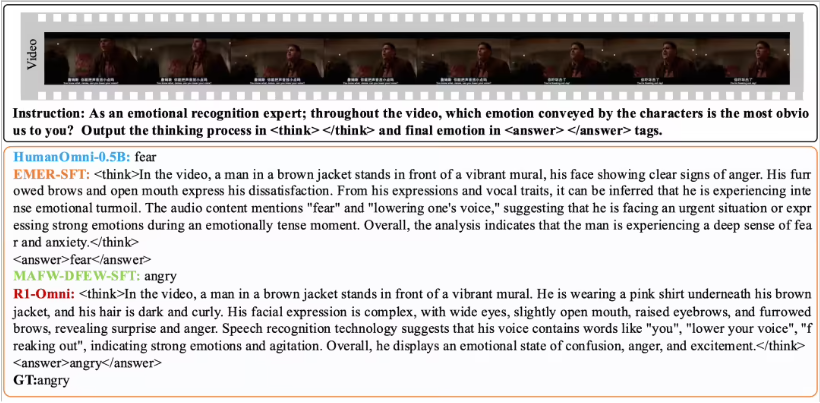
With the launch of DeepSeek R1, the application potential of reinforcement learning in large models has been continuously explored. The RLVR method brings new optimization ideas to multimodal tasks, which can effectively handle complex tasks such as geometric inference and visual counting. Although the current research focuses on the combination of images and text, the latest exploration of Tongyi Laboratory has expanded this field, combining RLVR with video full-modal model, fully demonstrating the wide application prospects of technology.
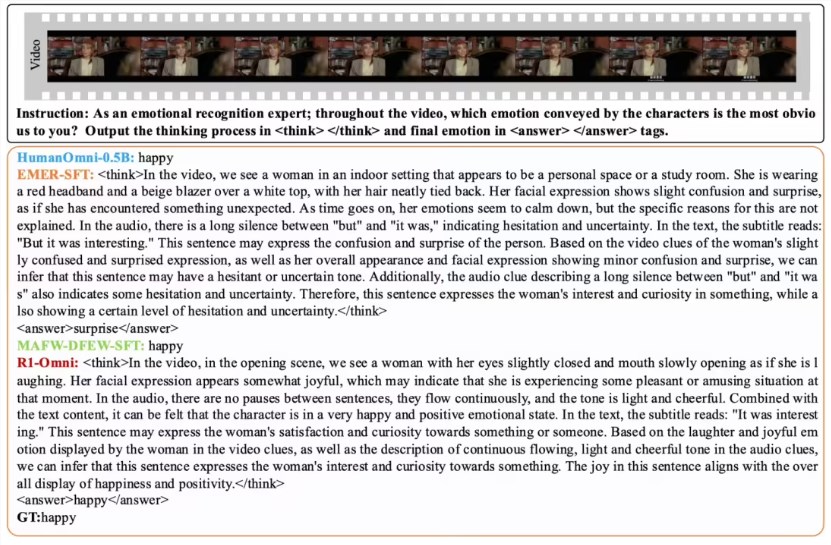
R1-Omni makes the influence of audio and video information more intuitive through the RLVR method. For example, in the emotion recognition task, the model can clearly show which audio and video signals play a key role in emotional judgment. This transparency not only improves the reliability of the model, but also provides researchers and developers with better insights.
In terms of performance verification, the Tongyi Laboratory team conducted a comparative experiment on R1-Omni with the original HumanOmni-0.5B model. The results show that R1-Omni's performance on both DFEW and MAFW datasets has significantly improved, with an average increase of more than 35%. In addition, compared with the traditional supervised fine-tuning (SFT) model, R1-Omni also improves by more than 10% in unsupervised learning (UAR). R1-Omni demonstrates excellent generalization capabilities on different distributed test sets (such as RAVDESS), with both WAR and UAR improvements of more than 13%. These achievements not only prove the advantages of RLVR in improving reasoning capabilities, but also provide new ideas and directions for future multimodal model research.
The open source of R1-Omni will facilitate more researchers and developers, and we look forward to this model bringing more innovations and breakthroughs in future applications.