
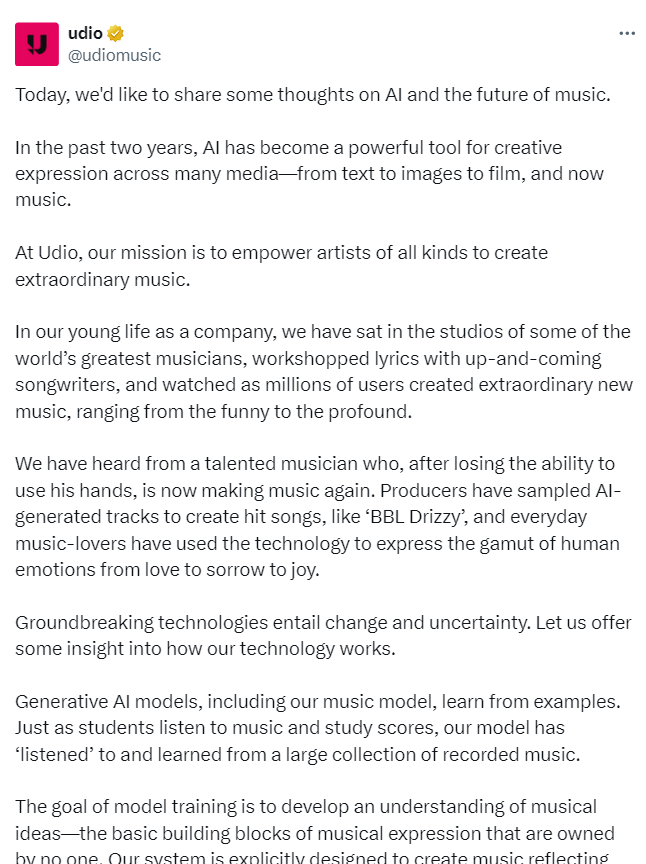
AI music startup Udio has responded head-on to a huge copyright infringement lawsuit filed against it by the three major record companies Universal, Sony and Warner. The lawsuit is unprecedented in scale, accusing Udio and its competitor Suno of using a large amount of copyrighted music to train an AI model, generating music that is highly similar to the original work and even copying the unique style of a specific artist. Udio issued a statement on the X platform, insisting that its technology is designed to create original music, not copy existing works, and that it has taken measures to filter copyrighted content. The core of this lawsuit is the legality of AI music generation technology and how to define the boundaries between training data and output results.
"Generative AI models, including our music model, learn from examples. Just like students listen to music and learn sheet music, our models 'hear' and learn from a large collection of recorded music. The goal of model training is to develop an understanding of musical ideas—the basic building blocks of musical expression that are not owned by any one person. Our system is explicitly designed to create music that reflects new musical ideas. . We are not at all interested in copying content in our training set, and in fact, we have implemented and continuously refined state-of-the-art filters to ensure that our models do not copy copyrighted works or artists' voices. We stand behind ours. technology and believe that generative AI will become the mainstream of modern society.”

Picture source note: The picture is generated by AI, and the picture is authorized by the service provider Midjourney
The lawsuits from the major record labels accuse the AI startup of using large amounts of copyrighted songs to train its models and producing infringing output that closely resembles the original copyrighted training data. The companies argue that Suno and Udio's AI models produce output that closely resembles the original work and replicates characteristics of specific artists, including Jason Derulo's unique habit of singing his own name at the beginning of songs.
Suno CEO Mikey Shulman defended the technology in an interview with Wired, saying it creates new content rather than duplicating existing music. The rapid rise of AI music generation has led to conflicts over training data and output that show no sign of resolution.
Highlights:
- Udio responds to copyright infringement lawsuits from major record labels, claiming their technology does not copy copyrighted works.
- Record labels accuse AI music startup of using copyrighted songs to train models and generate infringing output similar to the originals.
- The rapid rise of AI music generation has sparked conflicts over training data and output that are still unresolved.
The battle over AI music copyright is intensifying, and Udio’s response is just the tip of the iceberg. This lawsuit will have a profound impact on the future development of the AI music industry and may prompt the improvement of relevant laws and regulations. The core of this dispute lies in how to balance innovation and copyright protection. The final verdict is worth looking forward to.