
A new survey from Bank of America (BofA) shows that generative artificial intelligence (Gen AI) is expected to significantly increase corporate profits. The survey, based on interviews with 130 equity research analysts covering more than 3,400 companies, predicts that enterprise AI implementation will boost S&P 500 operating margins by 200 basis points over the next five years, which equates to about $55 billion annually. Dollar cost savings. The editor of Downcodes will interpret this report in detail and analyze the meaning and potential challenges behind it.
Amid widespread corporate skepticism about generative artificial intelligence (Gen AI), consulting firm Deloitte said corporate projects are struggling to get into production, and research firm Gartner predicts many projects will be abandoned. However, a new survey from investment bank Bank of America (BofA) shows that Gen AI could significantly increase corporate profits.
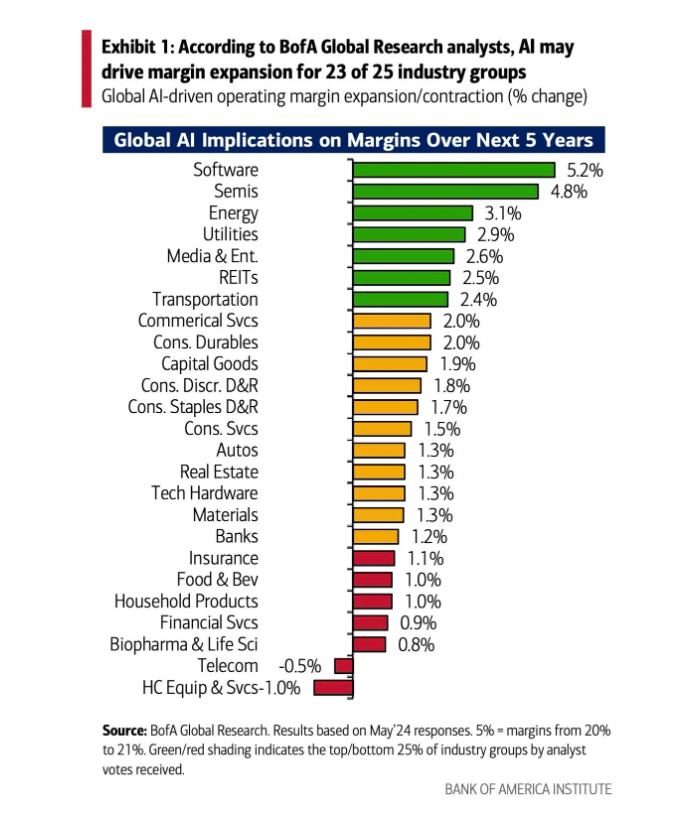
Analysts at BofA Global Research found that enterprise AI implementations are moving from pilots to production, which could boost S&P 500 operating margins by 200 basis points (bps) over the next five years, equivalent to about $55 billion per year. Cost savings. Lead author Vanessa Cook and her team wrote in the report "AI: From Evolution to Revolution?"
The survey, conducted in August, asked 130 Bank of America equity research analysts, who prepare financial forecasts for public companies. Analysts cover more than 3,400 companies across 25 industries, from software to insurance to food and beverage.
The software industry is likely to see the largest product margin expansion (5.2%) due to enterprise Gen AI, followed by the semiconductor and energy industries. According to the bank, the sectors least likely to benefit are medical equipment and services and telecommunications, where profit margins are likely to decline.
The report did not detail how the cost savings would occur. The report presents some examples of entities that have seen or may see cost savings in the near future.
For example, a utility company might achieve a 75% reduction in pole inspection costs by installing AI-powered autonomous smart cameras on fleet vehicles. Insurers may speed up the property underwriting process by replacing manual web searches with AI-powered aerial imagery and web scraping to determine the condition of a roof or whether hazards exist nearby.
In another example, an e-commerce service provider used an AI-powered customer service bot to reduce the need for 700 (human) customer service agents, which could increase the company's profits by $40 million this year. The company also internalized some marketing operations using Gen AI applications, which reduced external agency spending by 25% in the first quarter of 2024, the report said.
The authors caution that significant infrastructure needs to be built before each industry can realize profits, and this will take time.
The authors write: Gen AI may catalyze an evolution in enterprise efficiency, but application development and enterprise adoption will take time. Infrastructure investments and consequent model advancements are prerequisites for transformative and revenue-generating Gen AI applications, which are still very much at version 1.0.
Because it requires a large upfront investment, the authors recommend that investors do not underestimate the cost savings and revenue generation potential of Gen AI before use begins.
While this survey is encouraging, skepticism about Gen AI is likely to persist until there is clearer evidence of widespread cost savings and productivity gains.
Highlight:
A Bank of America survey predicts that enterprise AI applications will significantly improve profit margins over the next five years.
?The software industry is likely to see the greatest profit growth, while the healthcare and telecommunications sectors may face challenges.
?️ Infrastructure construction and technological advancement are key to realizing the potential of Gen AI.
All in all, the Bank of America report provides an optimistic outlook on the potential for enterprises to apply Gen AI, but also emphasizes the importance of infrastructure construction and technological progress. Although the future is bright, we still need to be cautiously optimistic and continue to pay attention to the actual application effects of Gen AI.