taranis ai
1.0.1

Taranis AI is an advanced Open-Source Intelligence (OSINT) tool, leveraging Artificial Intelligence to revolutionize information gathering and situational analysis.
Taranis navigates through diverse data sources like websites to collect unstructured news articles, utilizing Natural Language Processing and Artificial Intelligence to enhance content quality. Analysts then refine these AI-augmented articles into structured reports that serve as the foundation for deliverables such as PDF files, which are ultimately published.
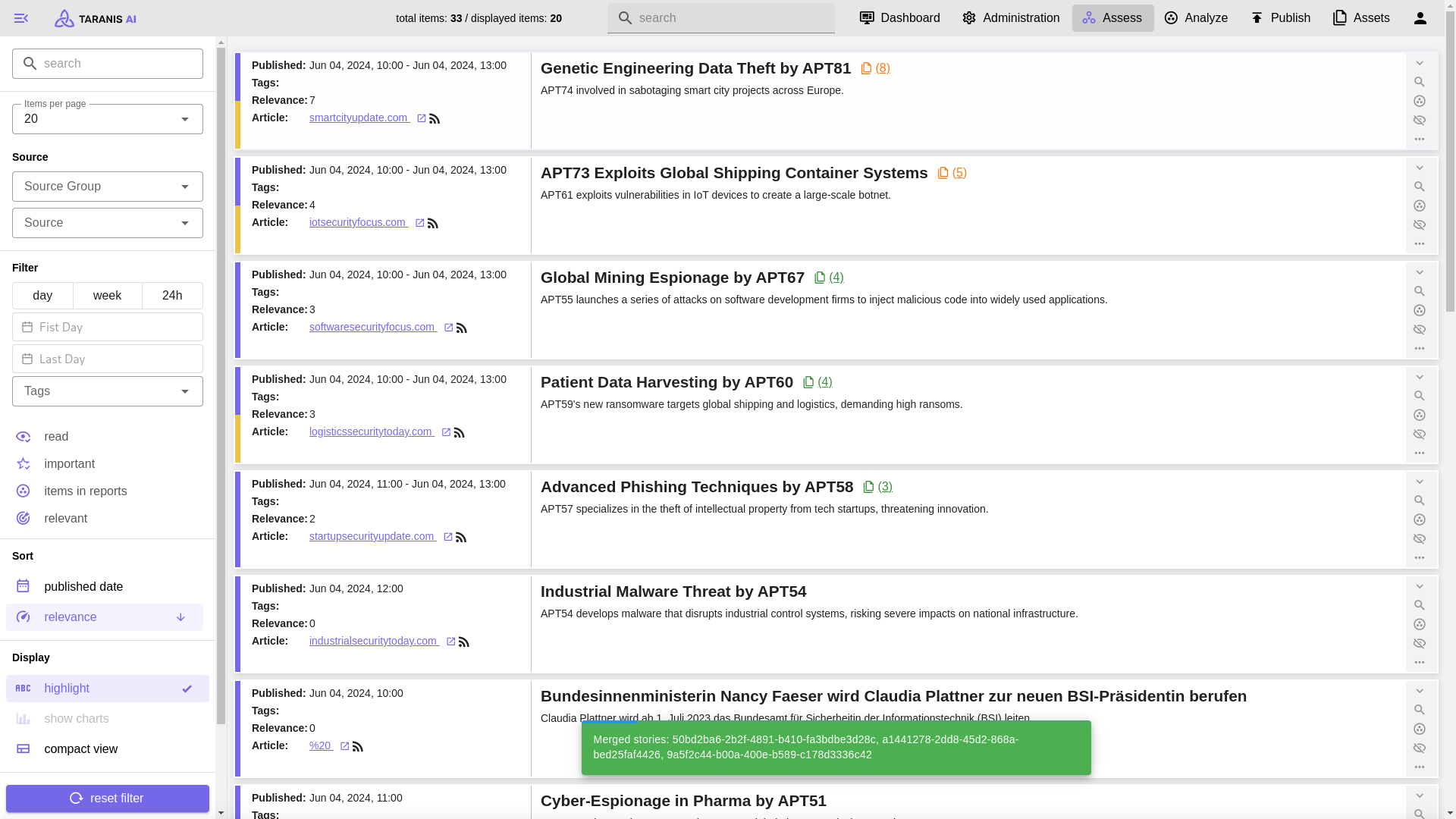
For production deployments see our Deployment Guide using docker compose
We welcome contributions from the community! If you're interested in contributing to Taranis AI, please read our Development Setup Guide to get started.
See ADVANCED OSINT ANALYSIS FOR NIS AUTHORITIES, CSIRT TEAMS AND ORGANISATIONS for a presentation about the current features.
See taranis.ai for documentation of user stories and deployment guides.
| Type | Name | Description |
|---|---|---|
| Backend | core | Backend for communication with the Database and offering REST Endpoints to workers and frontend |
| Frontend | gui | Vuejs3 based Frontend |
| Worker | worker | Celery Worker offering collectors, bots, presenters and publisher features |
| Type | Name | Description |
|---|---|---|
| Database | database | Supported are PostgreSQL and SQLite with PostgreSQL as our primary citizen |
| Message-broker | rabbitmq | Message Broker for distribution of Workers and Publish Subscribe Queue Management |
| SSE | sse | SSE Broker |
| Scheduler | scheduler | taranis-scheduler |
An OpenAPI spec for the REST API is included and can be accessed in a running installation under config/openapi.
To use all NLP features make sure to have at least: 16 GB RAM, 4 CPU cores and 50GB of disk storage.
Without NLP: 2 GB of RAM, 2 CPU cores and 20 GB of disk storage
This project was inspired by Taranis3, as well as by Taranis-NG. It is released under terms of the European Union Public Licence.





