DNABERT_2
1.0.0

存儲庫包含:
我們發布了DNABERT-S,這是一種基於DNABERT-2的基礎模型,專門設計用於生成嵌入的DNA嵌入,該DNA自然簇和分離嵌入空間中不同物種的基因組。如果您有興趣,請在此處查看。
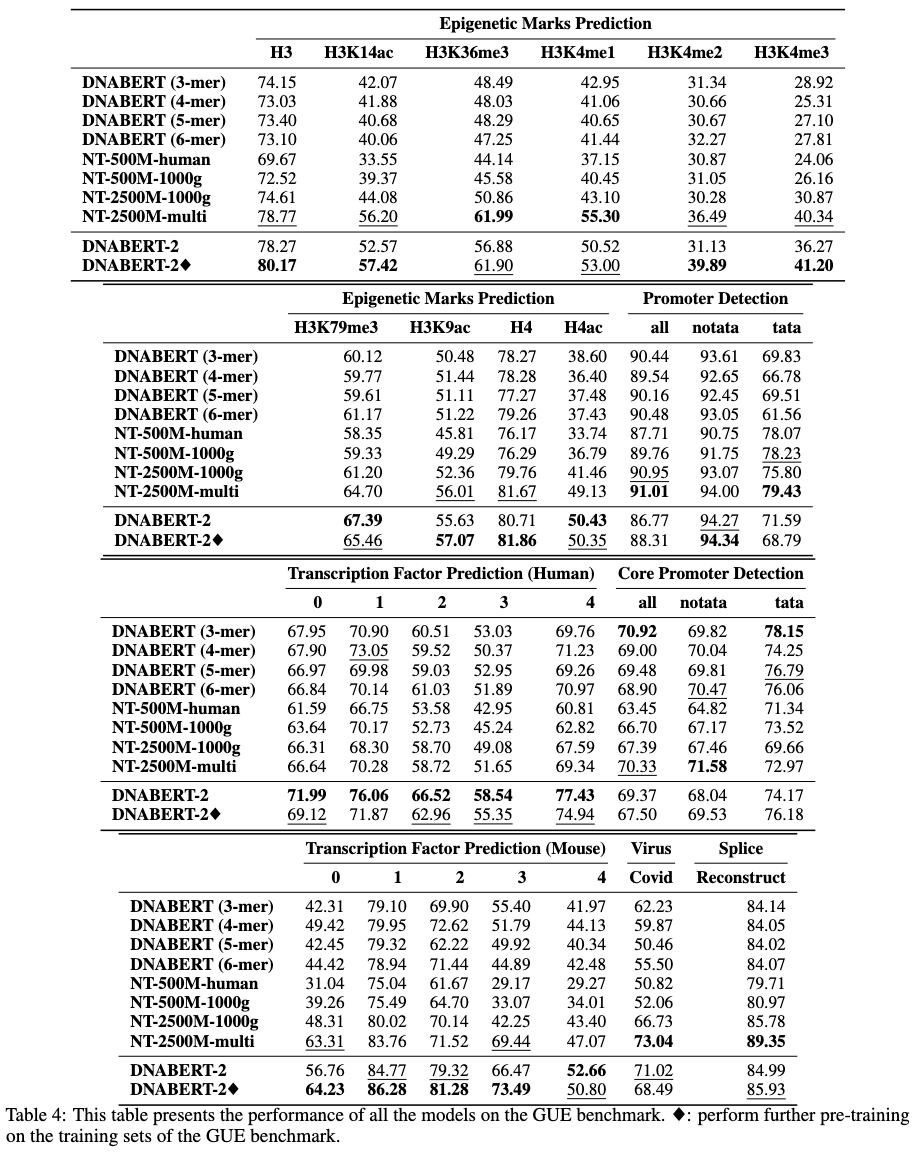
DNABERT-2是一種基金會模型,該模型訓練了大規模多種物種基因組,可實現最先進的性能
預先訓練的模型可在Huggingface上使用zhihan1996/DNABERT-2-117M 。鏈接到HuggingFace ModelHub。鏈接直接下載。
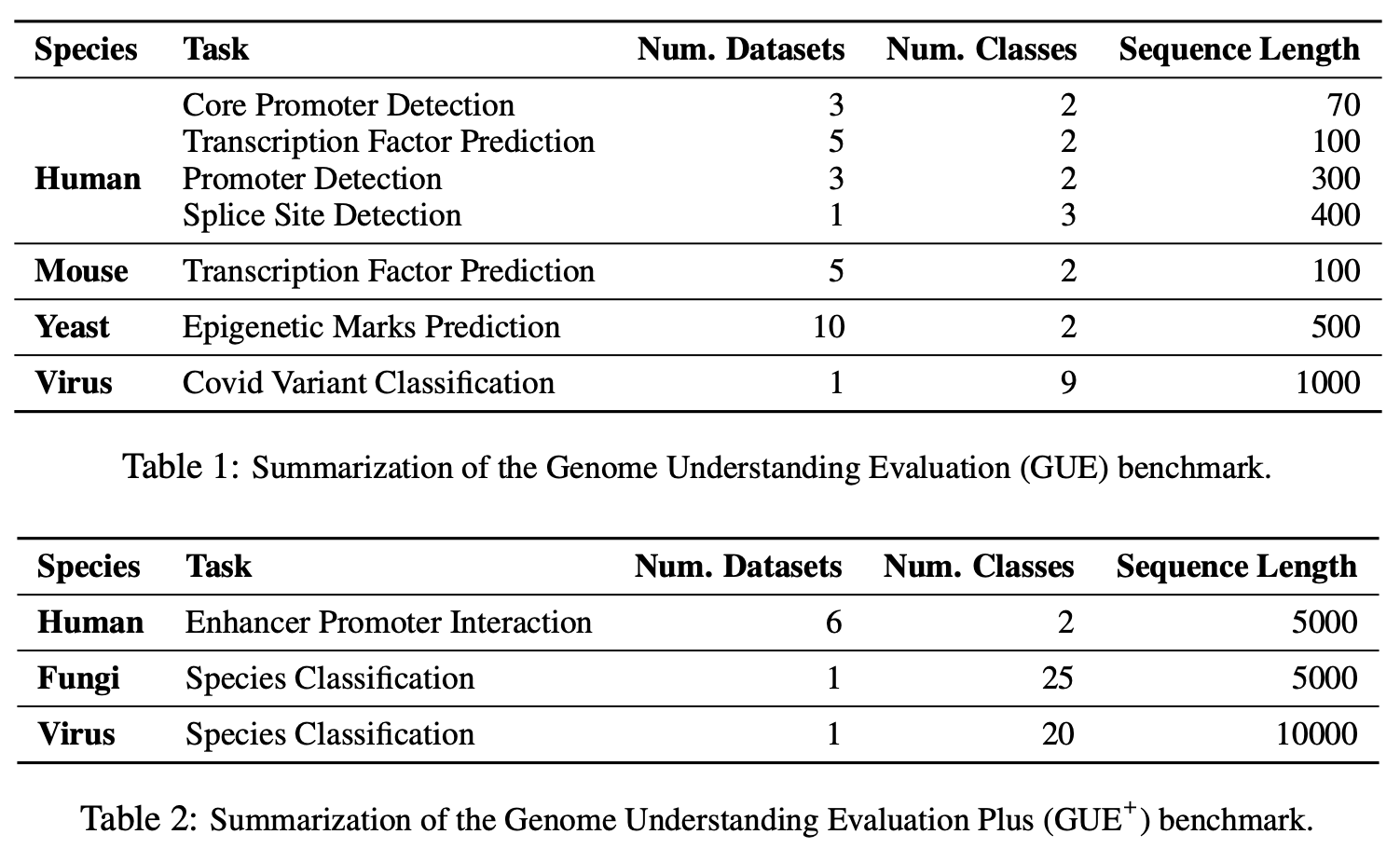
Gue是基因組理解的全面基準
 # create and activate virtual python environment
conda create -n dna python=3.8
conda activate dna

# (optional if you would like to use flash attention)
# install triton from source
git clone https://github.com/openai/triton.git;
cd triton/python;
pip install cmake; # build-time dependency
pip install -e .

# install required packages
python3 -m pip install -r requirements.txt
我們的模型易於與Transformers軟件包一起使用。
從HuggingFace(版本4.28)加載模型:
 import torch
from transformers import AutoTokenizer , AutoModel

tokenizer = AutoTokenizer . from_pretrained ( "zhihan1996/DNABERT-2-117M" , trust_remote_code = True )
model = AutoModel . from_pretrained ( "zhihan1996/DNABERT-2-117M" , trust_remote_code = True )
從HuggingFace(版本> 4.28)加載模型:
 from transformers . models . bert . configuration_bert import BertConfig

config = BertConfig . from_pretrained ( "zhihan1996/DNABERT-2-117M" )
model = AutoModel . from_pretrained ( "zhihan1996/DNABERT-2-117M" , trust_remote_code = True , config = config )
計算DNA序列的嵌入
 dna = "ACGTAGCATCGGATCTATCTATCGACACTTGGTTATCGATCTACGAGCATCTCGTTAGC"
inputs = tokenizer(dna, return_tensors = 'pt')["input_ids"]
hidden_states = model(inputs)[0] # [1, sequence_length, 768]

# embedding with mean pooling
embedding_mean = torch.mean(hidden_states[0], dim=0)
print(embedding_mean.shape) # expect to be 768

# embedding with max pooling
embedding_max = torch.max(hidden_states[0], dim=0)[0]
print(embedding_max.shape) # expect to be 768
我們使用並稍微修改了Mosaicbert實施,用於DNABERT-2 https://github.com/mosaicml/examples/tree/main/main/main/examples/benchmarks/bert。您應該能夠按照說明復制模型培訓。
或者,您可以在https://github.com/huggingface/transformers/tree/main/main/examples/pytorch/language-modeling上使用Run_mlm.py它應該產生非常相似的模型。
培訓數據可在此處獲得。
請首先從此處下載GUE數據集。然後運行腳本以評估所有任務。
當前的腳本設置為使用DataParallel進行4個GPU進行培訓。如果您有不同數量的GPU,請更改per_device_train_batch_size和gradient_accumulation_steps以相應地將全局批次大小調整為32,以復制論文中的結果。如果您想執行分佈式的多GPU培訓(例如,使用DistributedDataParallel ),只需將python更改為torchrun --nproc_per_node ${n_gpu}即可。
 export DATA_PATH=/path/to/GUE #(e.g., /home/user)
cd finetune

# Evaluate DNABERT-2 on GUE
sh scripts/run_dnabert2.sh DATA_PATH

# Evaluate DNABERT (e.g., DNABERT with 3-mer) on GUE
# 3 for 3-mer, 4 for 4-mer, 5 for 5-mer, 6 for 6-mer
sh scripts/run_dnabert1.sh DATA_PATH 3

# Evaluate Nucleotide Transformers on GUE
# 0 for 500m-1000g, 1 for 500m-human-ref, 2 for 2.5b-1000g, 3 for 2.5b-multi-species
sh scripts/run_nt.sh DATA_PATH 0
在這裡,我們提供了您自己數據集上微調DNABERT2的示例。
首先,請從數據集生成3個csv文件: train.csv , dev.csv和test.csv 。在培訓過程中,該模型在train.csv上進行了培訓,並在dev.csv文件上進行了評估。訓練後,如果完成,則加載了dev.csv文件上最小損失的檢查點,並在test.csv上進行評估。如果您沒有驗證集,請進行dev.csv和test.csv相同。
請參閱sample_data文件夾以獲取數據格式示例。每個文件應採用相同的格式,第一行作為文檔頭名sequence, label 。以下每個行應包含由, (例如, ACGTCAGTCAGCGTACGT, 1 )串聯的DNA序列和數值標記。
然後,您可以使用以下代碼在您自己的數據集上進行Finetune dnabert-2:
 cd finetune

export DATA_PATH=$path/to/data/folder  # e.g., ./sample_data
export MAX_LENGTH=100 # Please set the number as 0.25 * your sequence length.
											# e.g., set it as 250 if your DNA sequences have 1000 nucleotide bases
											# This is because the tokenized will reduce the sequence length by about 5 times
export LR=3e-5

# Training use DataParallel
python train.py
    --model_name_or_path zhihan1996/DNABERT-2-117M
    --data_path  ${DATA_PATH}
    --kmer -1
    --run_name DNABERT2_${DATA_PATH}
    --model_max_length ${MAX_LENGTH}
    --per_device_train_batch_size 8
    --per_device_eval_batch_size 16
    --gradient_accumulation_steps 1
    --learning_rate ${LR}
    --num_train_epochs 5
    --fp16
    --save_steps 200
    --output_dir output/dnabert2
    --evaluation_strategy steps
    --eval_steps 200
    --warmup_steps 50
    --logging_steps 100
    --overwrite_output_dir True
    --log_level info
    --find_unused_parameters False

# Training use DistributedDataParallel (more efficient)
export num_gpu=4 # please change the value based on your setup

torchrun --nproc_per_node=${num_gpu} train.py
    --model_name_or_path zhihan1996/DNABERT-2-117M
    --data_path  ${DATA_PATH}
    --kmer -1
    --run_name DNABERT2_${DATA_PATH}
    --model_max_length ${MAX_LENGTH}
    --per_device_train_batch_size 8
    --per_device_eval_batch_size 16
    --gradient_accumulation_steps 1
    --learning_rate ${LR}
    --num_train_epochs 5
    --fp16
    --save_steps 200
    --output_dir output/dnabert2
    --evaluation_strategy steps
    --eval_steps 200
    --warmup_steps 50
    --logging_steps 100
    --overwrite_output_dir True
    --log_level info
    --find_unused_parameters False
如果您對我們的紙張或代碼有任何疑問,請隨時開始發行問題或發送電子郵件([email protected])。
如果您在工作中使用DNABERT-2,請請我們的論文:
DNABERT-2
 @misc{zhou2023dnabert2,
      title={DNABERT-2: Efficient Foundation Model and Benchmark For Multi-Species Genome},
      author={Zhihan Zhou and Yanrong Ji and Weijian Li and Pratik Dutta and Ramana Davuluri and Han Liu},
      year={2023},
      eprint={2306.15006},
      archivePrefix={arXiv},
      primaryClass={q-bio.GN}
}
dnabert
 @article{ji2021dnabert,
    author = {Ji, Yanrong and Zhou, Zhihan and Liu, Han and Davuluri, Ramana V},
    title = "{DNABERT: pre-trained Bidirectional Encoder Representations from Transformers model for DNA-language in genome}",
    journal = {Bioinformatics},
    volume = {37},
    number = {15},
    pages = {2112-2120},
    year = {2021},
    month = {02},
    issn = {1367-4803},
    doi = {10.1093/bioinformatics/btab083},
    url = {https://doi.org/10.1093/bioinformatics/btab083},
    eprint = {https://academic.oup.com/bioinformatics/article-pdf/37/15/2112/50578892/btab083.pdf},
}







