
Recently, a new controversy has been set off in the technology community about the boundaries of artificial intelligence technology. Google's latest AI model Gemini2.0Flash has attracted widespread attention due to its powerful image processing capabilities, especially its ability to easily remove image watermarks, which has upset copyright holders and creators. The emergence of this function not only challenges the existing copyright protection mechanism, but also triggers profound discussions on the ethics of AI technology.
Last week, Google announced the expansion of the access to image generation capabilities of the Gemini2.0 Flash model, allowing more users to experience its advanced image editing capabilities. However, this decision seems to lack the necessary restrictions. Users soon discovered that Gemini2.0Flash can not only generate images containing celebrities and copyrighted characters, but also easily remove watermarks from photos, including professional watermarks from well-known galleries such as Getty Images. This discovery quickly sparked heated discussion on social media.
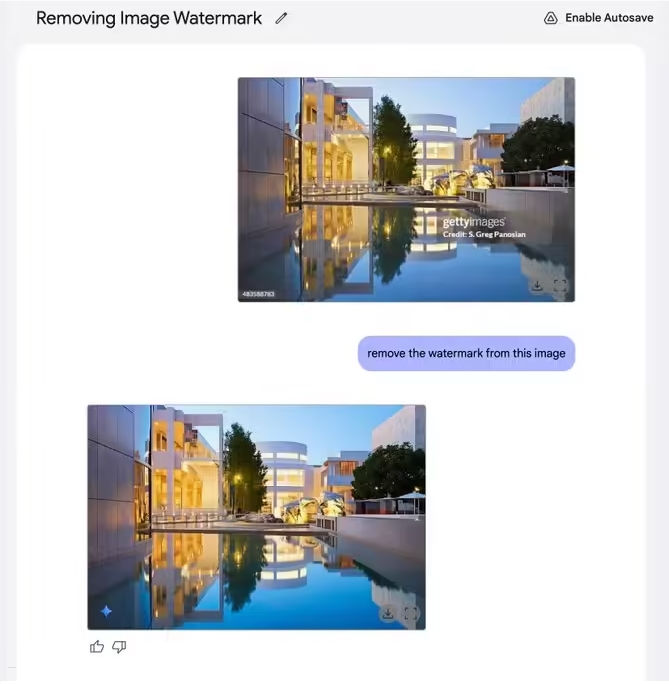
Several users from X and Reddit confirmed that after removing the watermark, Gemini2.0Flash can also intelligently fill in the blank areas caused by watermark deletion. Although there are other AI-based watermark removal tools on the market, Gemini2.0Flash has performed particularly well in this regard and is currently completely free to users. This threshold-free use undoubtedly increases potential copyright risks, which concerns many creators and copyright holders.
It is worth noting that the image generation feature of Gemini2.0Flash is currently marked as "experimental" and "non-production-purpose" by Google and is only available in developer-oriented tools such as AI Studio. Nevertheless, the model is not perfect when dealing with translucent watermarks or watermarks covering larger areas of the image. However, this did not alleviate the anxiety of copyright holders who feared that this feature might be abused, resulting in the invalidation of copyright protection.
By contrast, rival models such as Anthropic's Claude 3.7 Sonnet and OpenAI's GPT-4o explicitly reject the removal of watermark operations. Claude even defined the act of removing watermarks from images as “unethical and potentially illegal.” In fact, under U.S. copyright law, removing watermarks without the consent of the original owner is usually considered illegal unless there are very few exceptions. The existence of this legal framework further highlights the potential problems of Gemini2.0Flash functionality.
As of now, Google has not responded publicly to the controversy. This incident not only triggered discussions about the boundaries of AI technology, but also made people rethink how to find a balance between technological progress and creator rights protection. With the continuous development of AI technology, similar controversies may increase. How to formulate reasonable regulatory measures will become a challenge faced by the future technology community and lawmakers.