
Latest research from Microsoft and Carnegie Mellon University reveals the potential impact of artificial intelligence (AI) tools on people's critical thinking ability. Through a survey of 319 knowledge workers, the research team collected 936 real cases of using generative AI in multiple industries such as IT, design, administration, and finance, and deeply analyzed six dimensions of critical thinking: knowledge, understanding, application, analysis, synthesis and evaluation.
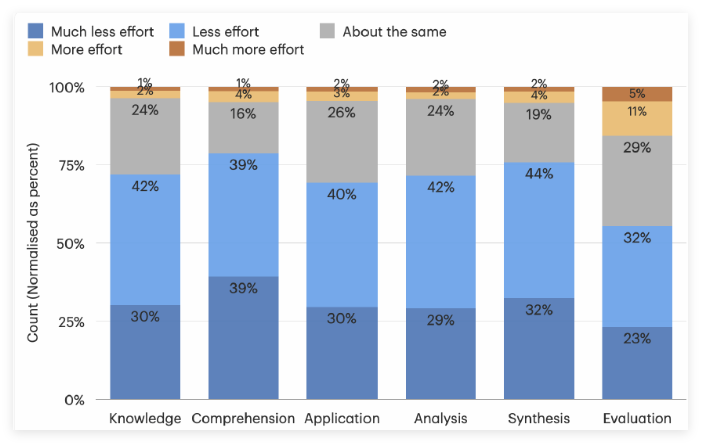
The study found that knowledge workers' mindsets changed significantly after using AI tools. First, they no longer collect information independently, but focus their main focus on verifying the results generated by AI. Secondly, they prefer to integrate the answers provided by AI rather than develop solutions independently. Finally, many people began to turn to monitoring AI systems rather than performing tasks directly. This trend is particularly evident when dealing with conventional or less important tasks, leading to people who may be overly reliant on AI without questioning, raising concerns about long-term dependence and reduced ability to solve problems independently.
The research team proposed a "automated irony" phenomenon: Although AI processes daily tasks to reduce people's work burden, it also deprives people of the opportunity to exercise their judgment and "cognitive muscles." This phenomenon of “cognitive outsourcing” may gradually weaken people’s natural abilities, especially in scenarios where independent thinking and creative problem solving are required.
Interestingly, the research also found that self-confidence may protect individuals’ critical thinking ability to a certain extent. Employees who are more confident in their abilities tend to be more skeptical about AI output. Although researchers cannot clearly determine the causal relationship of this relationship, three main factors drive people's critical thinking: the desire to improve work quality, the motivation to avoid mistakes, and the need for personal development. However, time pressures, lack of problem awareness and difficulty in improving AI responses in unfamiliar areas are obstacles to this ability.
Research suggests that companies should actively advocate critical thinking of employees and teach them how to review AI results through specialized training. At the same time, AI tools should be designed to support rather than replace critical thinking to ensure that people can maintain the ability to think independently while enjoying the convenience of technology.
Additionally, an independent study by the Swiss Business School found that young people aged 17 to 25 had the highest proportion of using AI tools, but scored the lowest on critical thinking tests. Educational level has also become an important protective factor, with people with higher education more frequently questioning the information generated by AI and maintaining stronger critical thinking while using AI tools.
Paper link: https://www.microsoft.com/en-us/research/publication/the-impact-of-generative-ai-on-critical-thinking-self-reported-reductions-in-cognitive-effort-and-confidence-effects-from-a-survey-of-knowledge-workers/
Research focus:
Research shows that excessive reliance on AI tools may lead to a decline in critical thinking ability.
Workers tend to verify AI results rather than think independently or solve problems.
Self-confidence and educational level are considered important factors in maintaining critical thinking.