Stepwise_Monotonic_Multihead_Attention
1.0.0

Pytorch Implementation of Stepwise Monotonic Multihead Attention (SMA) similar to Enhancing Monotonicity for Robust Autoregressive Transformer TTS
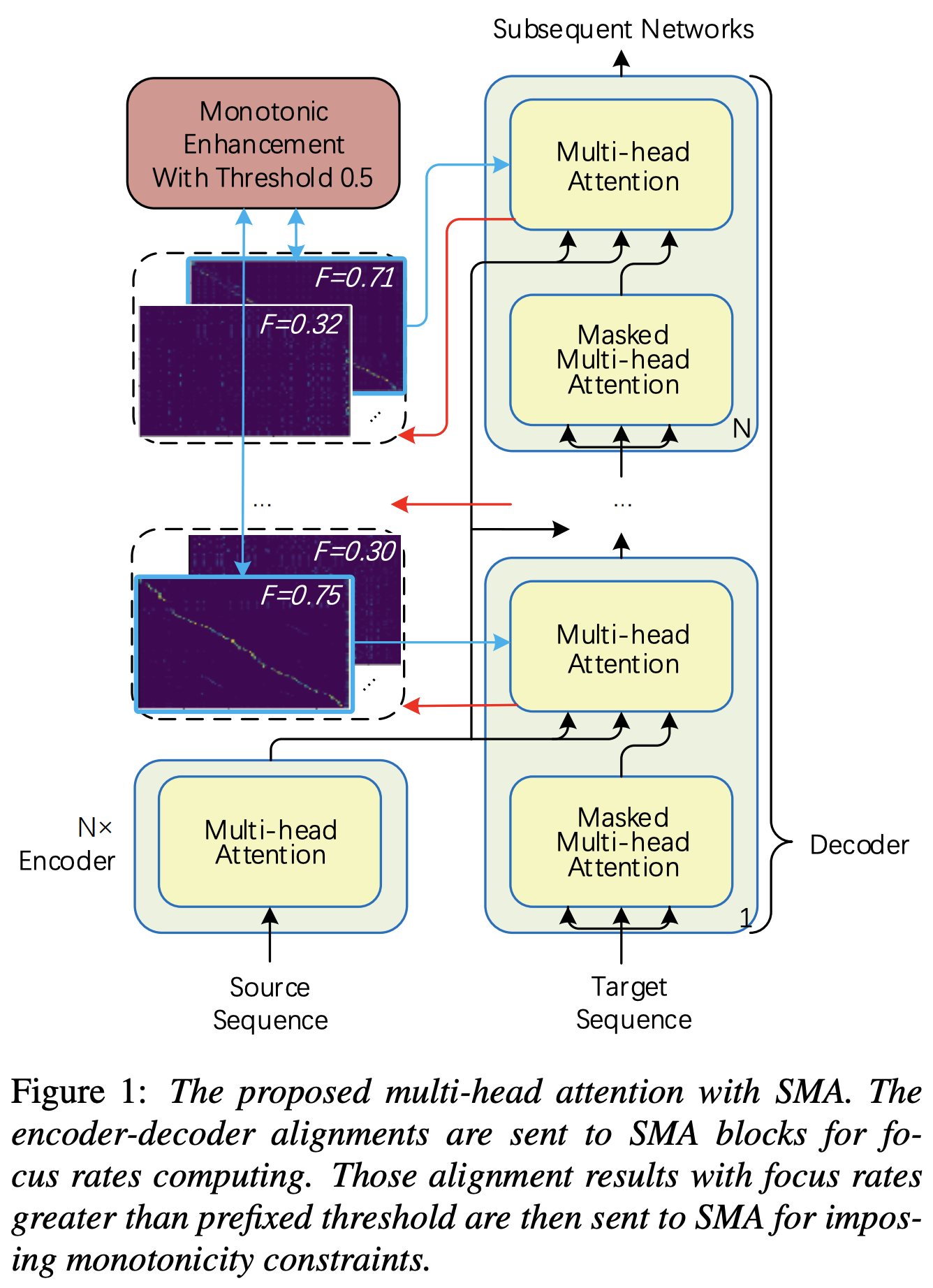
You may apply SMA to match mel-spectrogram to text in the length of sequences. Below are some results showing the effectiveness of SMA. The first figure is the alignment without sma (hp.sma_tunable=False) at 115k steps. The second figure is the one with sma tunning (hp.sma_tunable=True) at 125k steps.
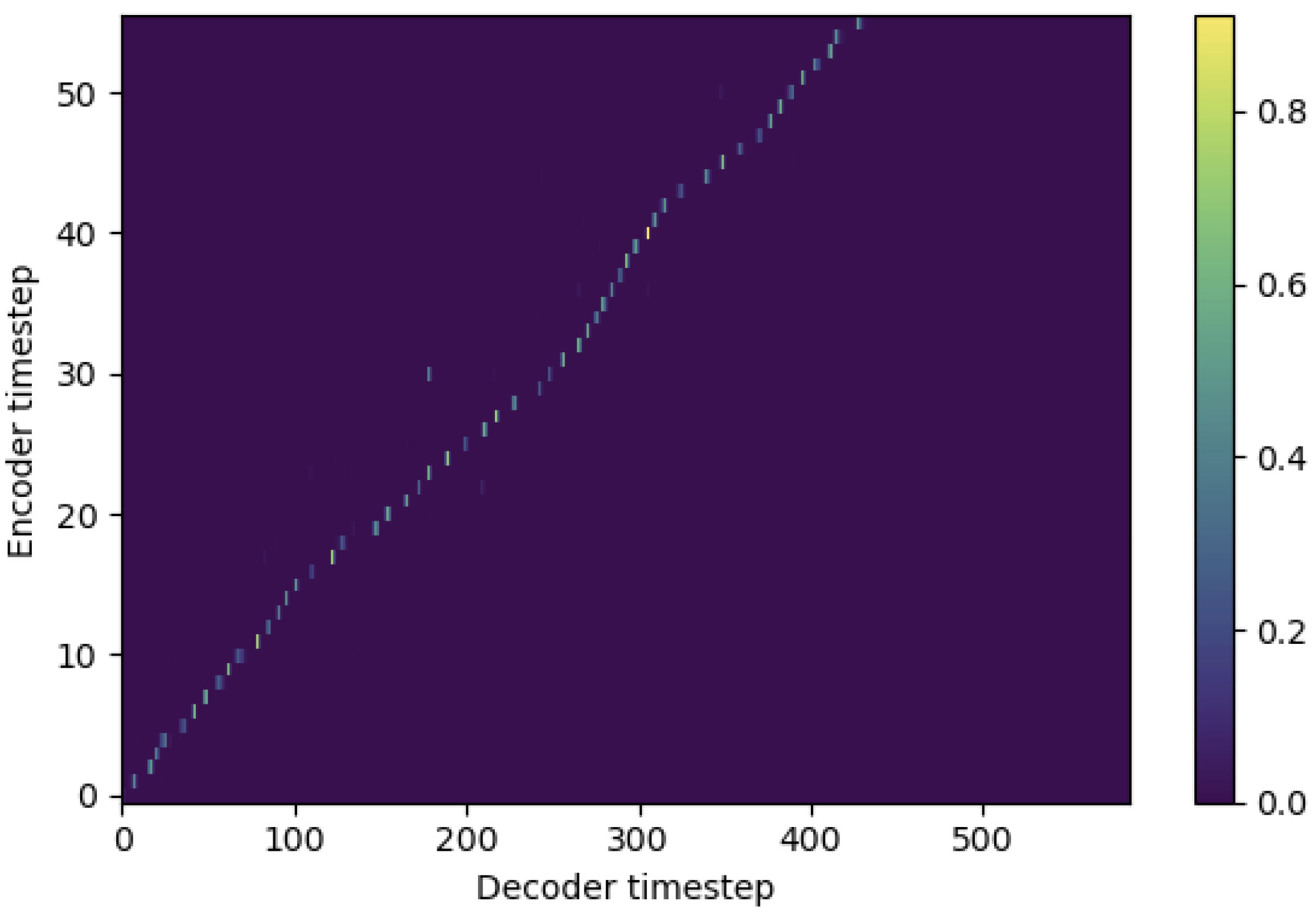
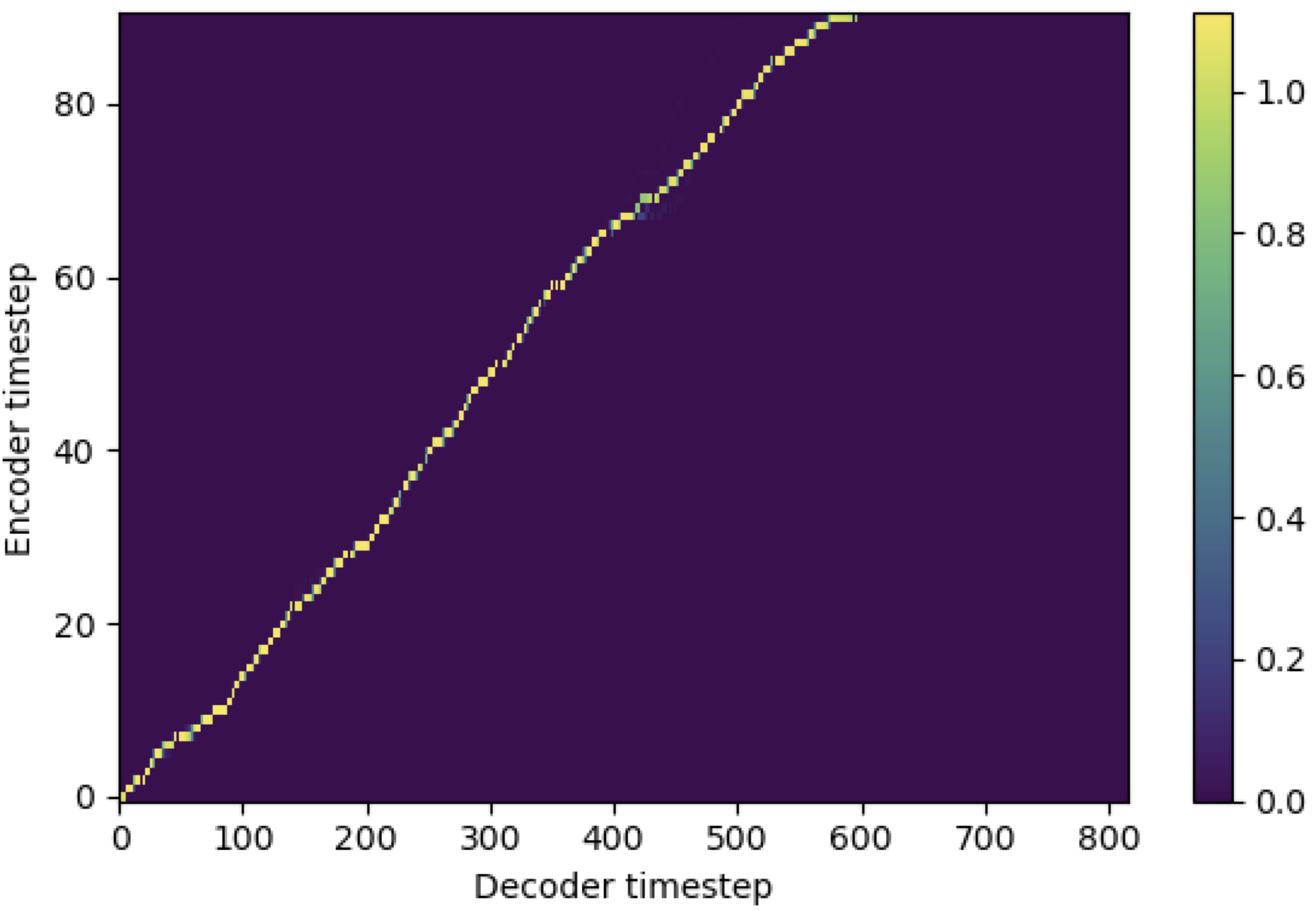
As you can see, I can confirm that the alignment is being highly stronger than normal multihead attention after applying SMA tunning.
First, define the SMA. Let's say we have 256 dimensional encoding and 4-multihead attention.
from sma import StepwiseMonotonicMultiheadAttention

ref_attention = StepwiseMonotonicMultiheadAttention(256, 256//4, 256//4)
And then, you can apply attention and get an alignment as follows. mel_len is the frame size of reference audio, and seq_len is the length of input text (which is usually a sequence of phonemes). fr_max is a maximum value of focus rate from focused_head() function. Both text_mask and attn_mask have 1. for values that will be masked out and 0. for others to be kept.
"""
enc_out --- [batch, seq_len, 256]
attn --- [batch, seq_len, mel_len]
enc_text --- [batch, seq_len, 256]
enc_audio --- [batch, mel_len, 256]
text_mask --- [batch, seq_len, 1]
attn_mask --- [batch, seq_len, mel_len]
"""

# Attention
enc_out, attn, fr_max = ref_attention(enc_text, enc_audio, enc_audio,
                                        mel_len, mask=attn_mask, query_mask=text_mask)
As you can see, SMA returns the text-audio fusion in text size (seq_len) regardless of the audio size (mel_len).
hp.sma_tunable is the hyperparameter that can toggle the tunning scheme of stepwise monotonic multihead attention. If set True, the stepwise monotonic multihead attention is activated. Else, it is a normal multihead attention, just like in Transformer. As in Enhancing Monotonicity for Robust Autoregressive Transformer TTS(we will call this paper as 'reference paper' in the following documents), for example, you may train module without SMA for certain steps to the faster training and model converge, and then activate SMA by setting sma_tunable=True to make strong monotonic alignment in few steps.expectation() is the fucntion calculating stepwise monotonic expectation score which is denoted as alpha in the reference paper.encoder in general TTS framework) and the key and value are from mel-spectrogram encoding (output of reference encoder in general mel-spectrogram encoding framework, e.g., reference encoder in GST scheme). As a result, current SMA module converts the mel-spectrogram encoding from the length of mel-spectrogram to the length of text. You MUST carefully modify the dimension (especially in the expectation function) of query, key, and value depending on the task.focused_head function will select the best diagonal (monotonically increasing) alignment among heads. It follows the 'focus rate' in FastSpeech framework as in the reference paper. Different from the reference paper, the maximum focus rated head is selected rather than by threshold. However, you can adopt it by simply adding prefixed_threshold(e.g.,0.5) to the focused_head function.@misc{lee2021sma,
author = {Lee, Keon},
title = {Stepwise_Monotonic_Multihead_Attention},
year = {2021},
publisher = {GitHub},
journal = {GitHub repository},
howpublished = {url{https://github.com/keonlee9420/Stepwise_Monotonic_Multihead_Attention}}
}







