
In 2024, the intersection of art and technology will once again attract global attention. From October 31st to November 7th, New York time, Sotheby's auction house in the UK ushered in a unique art feast - the painting "God of AI" by AI artist AI-Da was successfully exhibited and auctioned here. According to Xinhua News Agency, on November 8, Sotheby's auction house sold "The God of AI" for a whopping US$1.0848 million (approximately 7.79 million yuan).
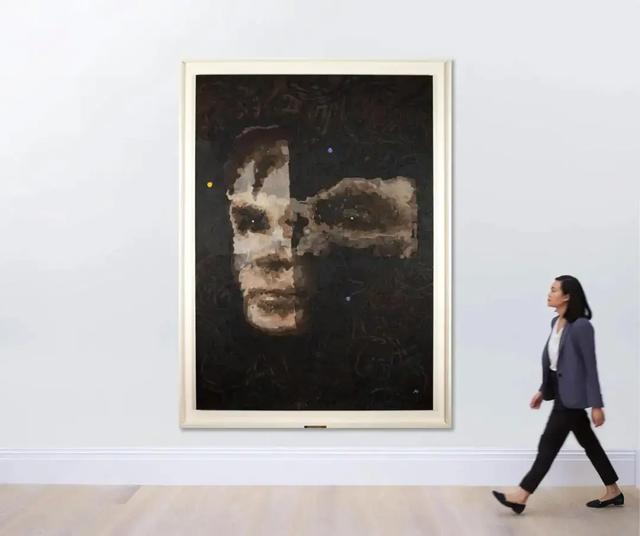
"The God of AI" Source: Sotheby's official website
A painting created by AI,
Estimated value exceeds $120,000
Will humans and artificial intelligence (AI) meet at the pinnacle of art? The painting, which is 2.2 meters high and has an estimated price of between US$120,000 and US$180,000 (equivalent to approximately RMB 850,000 to RMB 1.28 million), not only attracted bidders on the first day of the auction with a reserve price of US$120,000 (equivalent to RMB Approximately 850,000 yuan) bidding marks the first time that an AI art work has entered the halls of the top international auction houses, ushering in a new era of integration of art and technology.
This is the first time in the world that a robot "artist" has been favored by a major auction house, so it has attracted a lot of attention. "God of AI" received 27 bids after the shooting began, and was finally purchased by an unnamed buyer. Turing is a British mathematician who is mainly engaged in research in mathematical logic, pure mathematics, computer science, and theoretical biology. He is known as the "Father of Computer Science and Artificial Intelligence."
Looking back at history, this is not the first time that AI has been used in the field of artistic creation. As early as 2018, a "Portrait of Edmund de Bellamy" completed by AI was sold for a high price of US$432,500 (equivalent to RMB 3.07 million at the time). This painting was created by three young members of the French art group Obvious. What is unique is that the characters in the painting do not actually exist, but are automatically generated by AI after learning 15,000 portraits from the 14th to 20th centuries. This initiative not only demonstrates the potential of AI in artistic creation, but also lays the foundation for the birth of subsequent AI artworks.
Industry insiders believe that compared with "Portrait of Edmund de Bellamy", the birth of "God of AI" is more landmark. The artist of this painting is the humanoid robot Ai-Da, which was created by British gallerist Aidan Meller in partnership with the robotics company Engineered Arts and the University of Oxford. Ai-Da is named after 19th-century mathematician Ada Lovelace, who is not only known as the first computer programmer, but also left an indelible mark on the field of computer science. Since its launch in 2019, Ai-Da has made a name for itself in the art world with its unique image and ever-advancing AI brain. Not only has she painted a portrait of the Queen of England, but she has also delivered a speech in the British Parliament. She also held a personal exhibition at the Design Museum in London in 2021. Her works are rich and diverse, and her skills are becoming increasingly sophisticated.
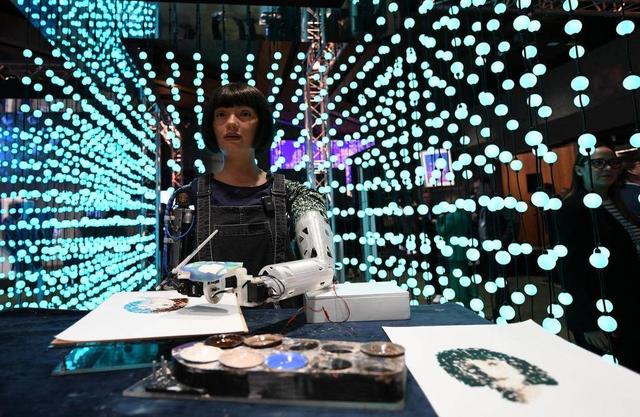
Painting artist robot Ai-Da is drawing pictures according to Xinhua News Agency
When the field of artistic creation opens the door to AI
Make the creator think deeply
The auction of "God of AI" not only demonstrated the technological progress of AI in the art field, but also triggered a new round of discussions on artistic creation, creativity and imagination around the world. Shen Linfeng, a teacher at the School of Chinese Painting at the China Academy of Art, spoke highly of Ai-Da's paintings, believing that its technique combines Impressionist "stippling" with modernist variations to present an unforgettable artistic effect. He used several "interesting" words to describe this painting, which shows his appreciation for Ai-Da's creative ability.
However, not everyone is optimistic about AI art. Shen Huaqing, deputy director of the Design Art Department of the School of Art and Archeology of Zhejiang University, put forward a different view. He believes that although Ai-Da's paintings are technically amazing, upon closer inspection, every detail is borrowed from the work of various artists. Therefore, he bluntly stated: "Ai-Da is not a human being, it has no consciousness, and there is no reference system for comparison between its works and the artist's works." In Shen Huaqing's view, the real money bought in this auction It is not the artwork itself, but its scarcity. He compared it: "Just like the second "Mona Lisa" is far less valuable than the original, the second "AI God" is no longer valuable."
The rise of AI art has triggered deep thinking among the art world and creators. Picasso once said: "Good artists copy great artists still (Imitation is the first step of an artist)." However, in the AI era, this concept seems to be being subverted. As an expert specializing in 3D vision research, Jin Yudong emphasized the term "intelligence emergence". In his view, from quantitative change to qualitative change, the development of technology is quietly changing the process of artistic creation. The AI model gradually imitates the essence by learning a large amount of data, and can even draw inferences from one example and achieve transcendence. This opens the door to AI in the field of artistic creation.
In fact, the integration between AI and art has begun to take shape. Take AIGC-loving artist Yuan Bo as an example. He admitted that he seemed to have met a co-creator. During the creative process, he no longer needs to make countless drafts, but is responsible for imagining and trying, while AI is responsible for adjustment and presentation. This cooperation model greatly broadens the freedom of creation, making the work more efficient and creative. Similarly, Gemini, an AI robot painter developed by Hong Kong artist Wong Hong-tat, is also able to create Chinese paintings on its own without human intervention. These cases further prove the potential of AI in artistic creation.
However, as AI works of art continue to emerge, copyright issues have become increasingly prominent. Many artists worry that their original works will become commonplace and devalued as training data for AI. In order to defend intellectual property rights, Penguin Random House, a world-renowned book publishing company, clearly warns on the copyright page of its books: It is prohibited to use or copy in any way any part of its books for training AI technology or systems. In addition, it is reported that on October 22, 2024, more than 15,000 visual artists, writers, musicians and other creative people signed an open letter warning AI companies not to use their creative works to train AI without permission. They noted that this posed a "significant and unfair threat to the livelihoods of the artists behind the works and must not be allowed."
In addition to copyright issues, AI art also triggers in-depth discussions about art ethics and the nature of art. Supporters believe that the existence of AI artists such as Ai-Da opens up new possibilities for art and brings robots closer to humans. They pointed out that AI art not only demonstrates the power of technology, but also inspires new thinking about artistic creation and imagination. However, art critics take a different view. They believe that machines cannot truly understand art itself, pointing out that AI is only recombining existing creative elements, lacking emotional depth and cultural authenticity. Therefore, the identity of AI artists, the originality of AI-generated works, and the ethical issues in the actual creation process all need to be resolved urgently.
While enjoying the convenience of technology,
We must also maintain awe of art and culture
It is worth noting that although AI art faces many challenges and controversies, it is still developing and growing. Taking Ai-Da as an example, she has not only made remarkable achievements in artistic creation, but also plays an active role in the field of education. She once walked into the classroom of graduate students at Zhejiang University and shared her creative experience and technical applications with students. This cross-field cooperation not only promotes the in-depth integration of art and technology, but also provides artists with new creative inspiration and ideas.
In addition, with the continuous advancement and popularization of technology, we can expect more AI works to appear in fields such as music, literature, and movies. This interdisciplinary integration will bring more innovations and surprises to mankind. For example, in the field of music creation, Suno, known as "ChatGPT in the music industry", has been able to help people quickly generate songs with connected words and tunes. This enables more and more people to break through creative bottlenecks with the help of AI and fully demonstrate their personal talents.
While enjoying the convenience brought by technology, we also need to maintain awe of art and culture. As Louis Mumford, an American scholar of humanist philosophy of technology, said: "Technology is just an element in human culture." Although AI art has strong creativity and expressive power, it still needs to be in harmony with human cultural heritage and aesthetic values. Only when combined can they truly radiate vitality. Therefore, in the process of promoting the integration of art and technology, we need to pay attention to balancing the relationship between technological progress and humanistic care to ensure that AI art can maintain respect and inheritance for art and culture while developing.