samantha_ia
1.0.0

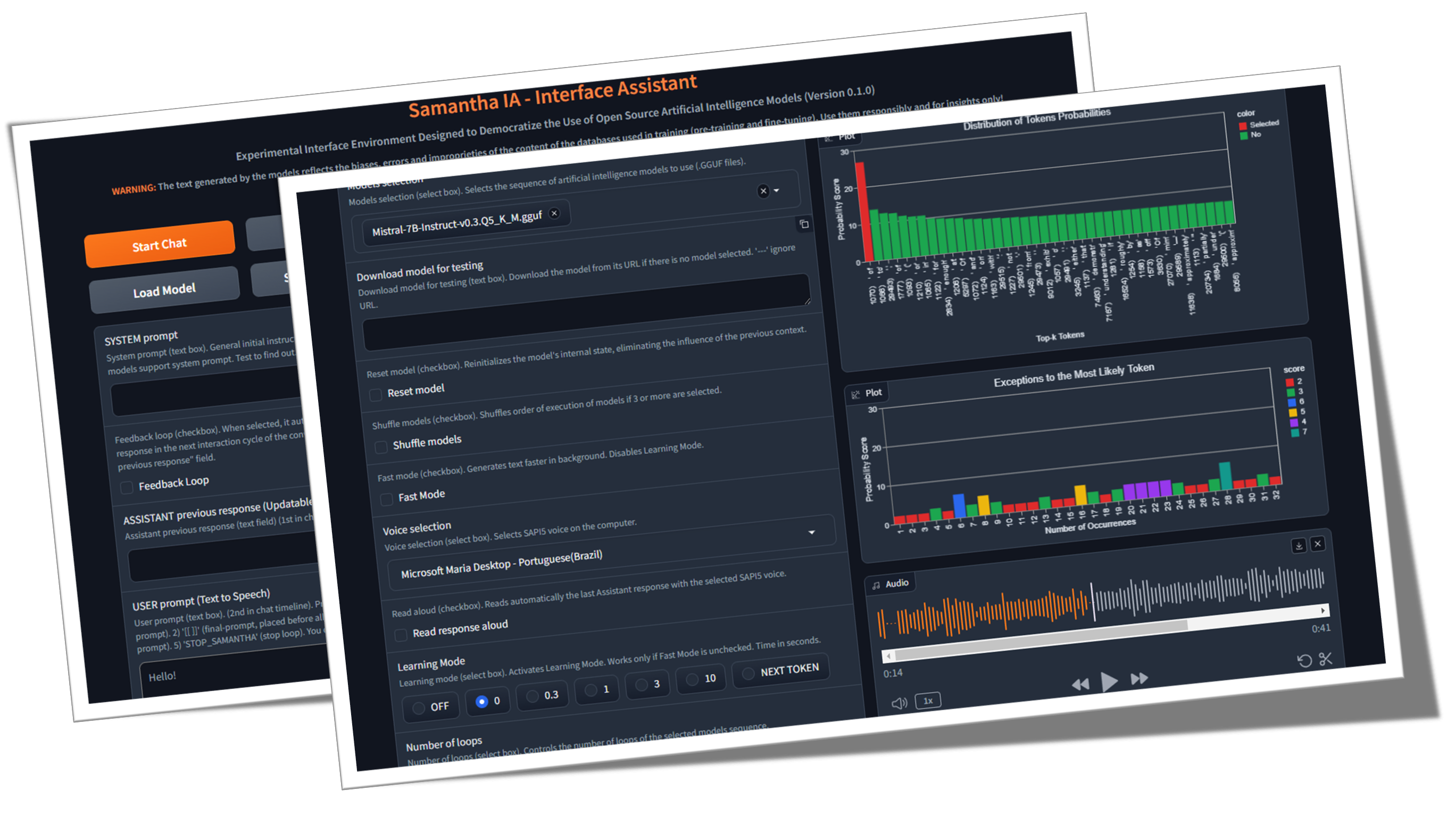
Samantha é apenas um assistente simples de interface para modelos de inteligência artificial de geração de texto de código aberto, desenvolvidos sob princípios de ciências abertas (metodologia aberta, código aberto, dados abertos, acesso aberto, revisão de pares abertos e recursos educacionais abertos) e licença MIT para uso em computadores comuns do Windows (sem GPU). O programa executa o LLM localmente, gratuito e ilimitado, sem a necessidade de uma conexão com a Internet, exceto para baixar os modelos GGUF (o GGUF significa formato unificado gerado por GPT) ou quando exigido pela execução do código criado pelos modelos (para baixar conjuntos de dados para análise de dados). Seu objetivo é democratizar o conhecimento sobre o uso da IA e demonstrar que, usando a técnica apropriada, mesmo os pequenos modelos são capazes de produzir respostas semelhantes às dos maiores. Sua missão é ajudar a explorar os limites dos modelos (realmente) de IA aberta.
O que é a IA de código aberto (OpenSource.org)
O tamanho do LLM é importante? (Gary explica)
Documentos de inteligência artificial (arxiv.org)
Samantha está sendo desenvolvida para ajudar no exercício do controle social e institucional da administração pública, considerando o cenário atual preocupante do aumento da perda da confiança dos cidadãos nas instituições de controle. Seus recursos permitem que ele seja usado por qualquer pessoa interessada em explorar modelos de inteligência artificial de código aberto, especialmente programadores Python e cientistas de dados. O projeto se originou da necessidade da equipe MPC-ES de desenvolver um sistema que permitiria a compreensão do processo de geração de tokens pelos modelos LLM.
♾️ The system allows the sequential loading of a list of prompts (prompt chaining) and models (model chaining), one model at a time to save memory, as well as the adjustment of their hyperparameters, allowing the response generated by the previous model to be feedbacked and analyzed by the subsequent model to generate the next response ( Feedback Loop feature), in an unlimited number of interaction cycles between LLMs without human intervention. Os modelos podem interagir com a resposta fornecida pelo modelo imediatamente anterior, para que cada nova resposta substitua a anterior. Você também pode usar apenas um modelo e interagir com sua resposta anterior sobre um número ilimitado de ciclos de geração de texto. Use sua imaginação para combinar modelos, avisos e recursos!
Este vídeo mostra um exemplo de interação entre modelos sem intervenção humana, encadeando modelos e avisos usando o recurso Cópia e Colar LLM de Samantha. As versões quantizadas dos modelos Microsoft Phi 3.5 e Google Gemma 2 (de Bartowski) são desafiados a responder a uma pergunta sobre a natureza humana criada pelo modelo Meta Llama 3.1 (por NouseRearch). As respostas também são avaliadas pelo meta modelo.

Desafio de Inteligência: Gemma 2 vs Phi 3.5 com llama 3.1 como juiz
? Alguns exemplos de encadeamento sem usar o recurso de loop de feedback de resposta de Samantha:
(Model_1) Responde (Prompt_1) X Número de respostas: usado para analisar o comportamento determinístico e estocástico do Model com a ajuda do recurso de modo de aprendizado , bem como para gerar várias respostas diversas com configurações estocásticas (vídeo).
(Model_1) responde (Prompt_1, Prompt_2, Prompt_N): Usado para executar instruções múltiplas de múltiplos sequenciais com o mesmo modelo (encadeamento prompt) (vídeo).
(Model_1, Model_2, Model_N) Responder (Prompt_1): Usado para comparar as respostas dos modelos para o mesmo prompt único (encadeamento de modelo). Útil para comparar diferentes modelos, bem como versões quantizadas do mesmo modelo.
(Model_1, Model_2, Model_N) Responder (Prompt_1, Prompt_2, Prompt_N): Usado para comparar as respostas dos modelos para uma lista de prompts, bem como para executar uma sequência de instruções usando modelos disctintos (modelo e encadeamento rápido). Cada modelo responde todos os avisos. Por sua vez, ao usar o recurso de resposta única por modelo , cada modelo responde a apenas um prompt específico.
? Alguns exemplos de encadeamento usando o recurso de loop de feedback de resposta de Samantha:
(Model_1) responde (Prompt_1) X Número de respostas: usado para melhorar ou complementar a resposta anterior do modelo através de uma instrução fixa do usuário usando o mesmo modelo, bem como para simular uma conversa infinita entre 2 AIS usando um único modelo (vídeo).
(Model_1) Responde (Prompt_1, Prompt_2, Prompt_N): Usado para melhorar a resposta anterior do modelo através de múltiplos instruções do usuário seqüencialmente com o mesmo modelo (encadeamento rápido). Cada prompt é usado para refinar ou concluir a resposta anterior, bem como para executar uma sequência de avisos que dependem da resposta anterior, como realizar a análise de dados exploratórios (EDA) com codificação incremental (vídeo).
(Model_1, Model_2, Model_N) Responder (Prompt_1): Usado para melhorar a resposta do modelo anterior usando modelos disctintos (encadeamento de modelos), bem como para gerar uma caixa de diálogo entre diferentes modelos.
(Model_1, Model_2, Model_N) Responder (Prompt_1, Prompt_2, Prompt_N): Usado para executar uma sequência de instruções usando modelos disctintos (modelo e encadeamento rápido) e resposta única por modelo .
Cada um desses modelos e solicitações de solicitações pode ser executado mais de uma vez através do número de loops .
Modelo de sequência de encadeamento de Samantha:
([Lista de modelos] -> Responder -> ([Lista de prompts do usuário] x número de respostas)) X Número de loops
Mas o que é um GPT? Introdução visual aos transformadores (3Blue1Brown)
Atenção nos transformadores, explicada visualmente (3Blue1Brown)
Explicação do transformador (Poloclub)
? O sequenciamento de prompts e modelos permite a geração de respostas longas, fracionando a instrução de entrada do usuário. Toda resposta parcial se encaixa no comprimento da resposta do modelo definido no processo de treinamento do modelo.
? Como uma ferramenta de código aberto para a auto-interação automática entre os modelos de IA, o Samantha Interface Assistant foi projetado para explorar a engenharia rápida reversa com um loop de feedback de auto-aperfeiçoamento ? Essa técnica ajuda os pequenos modelos de linguagem grande (LLM) a gerar respostas mais precisas, transferindo para o modelo a tarefa de criar o prompt final e a resposta correspondente com base nas instruções iniciais iniciais do usuário, adicionando camadas intermediárias ao processo de construção imediato. Samantha não possui um prompt de sistema oculto, como acontece com os modelos proprietários. Todas as instruções são controladas pelo usuário. Veja o sistema antrópico solicita.
? Graças ao comportamento emergente resultante de padrões de generalização extraídos dos textos de treinamento, com a configuração de hiperparâmetro adequada e adequada, mesmo pequenos modelos que trabalham juntos podem gerar grandes respostas!
A inteligência da espécie humana não se baseia em um único ser inteligente, mas com base em uma inteligência coletiva. Individualmente, na verdade não somos tão inteligentes ou capazes. Nossa sociedade e sistema econômico baseiam -se em ter uma vasta gama de instituições compostas por diversos indivíduos com diferentes especializações e conhecimentos. Essa vasta inteligência coletiva molda quem somos como indivíduos, e cada um de nós segue nosso próprio caminho na vida para se tornar o indivíduo único e, por sua vez, contribui para fazer parte de nossa inteligência coletiva em constante expansão como espécie. Acreditamos que o desenvolvimento da inteligência artificial seguirá um caminho coletivo semelhante. O futuro da IA não consistirá em um sistema de IA único, gigantesco e onisciente, que requer energia enorme para treinar, executar e manter, mas uma vasta coleção de pequenos sistemas de IA-cada um com seu próprio nicho e especialidade, interagindo entre si, com novos sistemas de IA desenvolvidos para preencher um nicho em particular . Evoluindo novos modelos de fundação: desencadeando o poder de automatizar o desenvolvimento de modelos - Sakana AI
? Um pequeno passo: Samantha é apenas um movimento em direção a um futuro em que a inteligência artificial não é um privilégio, mas uma ferramenta para todos em um mundo em que os indivíduos podem alavancar a IA para melhorar sua produtividade, criatividade e tomada de decisão sem barreiras, caminhando em uma jornada para democratizar a IA e torná-la uma força para o bem em nossa vida diária.
? A natureza instrumental da IA: reconhecendo o monopólio tecnológico da inteligência artificial como um possível instrumento de dominação e a expansão das desigualdades sociais representa um desafio nesse ponto de inflexão da história. Observar as falhas dos modelos menores durante o processo de geração de texto ajuda nesse entendimento, comparando -os com a perfeição reivindicada dos modelos proprietários maiores. É necessário reposicionar as coisas em seus lugares adequados e questionar a visão reducionista romântica de atribuir características humanas - como inteligência (antropomorfização causada pelo fenômeno psicológico da pareidolia) - a uma tecnologia produzida pelo intelecto humano. Por esse motivo, é essencial desmistificar a inteligência artificial por meio de uma abordagem didática de como esse novo "calculador de palavras/token" funciona. Certamente, a dopamina do charme inicial criada artificialmente pelo mercado não suportará a geração de algumas centenas de tokens (o token é o nome dado ao bloco de construção básico de textos que um LLM usa para entender e gerar texto. Um token pode ser uma palavra inteira ou parte de uma palavra).
✏️ Considerações sobre geração de texto: os usuários devem estar cientes de que as respostas geradas pela IA são derivadas do treinamento de seus grandes modelos de idiomas em um vasto corpus de dados de texto. As fontes ou processos exatos usados pela IA para gerar suas saídas não podem ser citados ou identificados com precisão. O conteúdo produzido pela IA não é uma citação ou compilação direta de fontes específicas. Em vez disso, reflete os padrões, as relações estatísticas e o conhecimento que as redes neurais da IA aprenderam e codificaram durante o processo de treinamento no amplo corpus de dados. As respostas são geradas com base nessa representação aprendida do conhecimento, em vez de serem recuperadas literalmente de qualquer material de origem específico. Embora os dados de treinamento da IA possam ter incluído fontes autorizadas, seus resultados são suas próprias expressões sintetizadas das associações e conceitos instruídos.
Objetivo: O objetivo principal de Samantha é inspirar outras pessoas a criar sistemas semelhantes - e muito melhores, para ter certeza - e educar os usuários sobre a utilização da IA. Nosso objetivo é promover uma comunidade de desenvolvedores e entusiastas que possam levar o conhecimento e as ferramentas para inovar e contribuir para o campo da IA de código aberto. Ao fazer isso, o objetivo de cultivar uma cultura de colaboração e compartilhamento, garantindo que os benefícios da IA sejam acessíveis a todos, independentemente de seus antecedentes técnicos ou recursos financeiros. Acredita -se que, ao permitir que mais pessoas construam e compreendam aplicativos de IA, podemos impulsionar coletivamente o progresso e abordar os desafios da sociedade com perspectivas informadas e diversas. Vamos trabalhar juntos para moldar um futuro em que a IA é uma força positiva e inclusiva para a humanidade .
Recomendações de inteligência artificial da UNESCO
Programa da OCDE sobre IA em trabalho, inovação, produtividade e habilidades
O custo humano da inovação: embora esse sistema tenha como objetivo capacitar os usuários e democratizar o acesso à IA, é crucial reconhecer as implicações éticas dessa tecnologia. O desenvolvimento de sistemas poderosos de IA geralmente depende da exploração do trabalho humano, particularmente nos processos de anotação e treinamento de dados. Isso pode perpetuar as desigualdades existentes e criar novas formas de divisão digital. Como usuários da IA, temos a responsabilidade de estar ciente desses problemas e defender práticas mais justas dentro do setor . Ao apoiar o desenvolvimento ético da IA e promover a transparência no fornecimento de dados, podemos contribuir para um futuro mais inclusivo e equitativo para todos.
Como Funciona O Trabalho Humano por Trás da Inteligênia Artificial
Os "escravos modernos" do mundo da tecnologia da AI
Outras fontes
Sobre os ombros dos gigantes: agradecimentos especiais a Georgi Gerganov e a toda a equipe que trabalha no lhama.cpp por tornar tudo isso possível, bem como a Andrei Bleten por seus incríveis viciado em Python para a biblioteca Gerganov C ++ (llama-cpp-python).
Foundation Fundação de código aberto: construído sobre llama.cpp / llama-cpp-python e graduio, sob licença do MIT, a Samantha é executada em computadores padrão, mesmo sem uma unidade de processamento de gráficos dedicados (GPU).
✅ Capacidade offline: Samantha opera independentemente da Internet, exigindo conectividade apenas para o download inicial de arquivos de modelo ou quando exigido pela execução do código criado pelos modelos. Isso garante privacidade e segurança para suas necessidades de processamento de dados. Seus dados confidenciais não são compartilhados pela Internet com as empresas por meio de acordos de confidencialidade.
✅ Uso ilimitado e livre: a natureza de código aberto de Samantha permite uso irrestrito sem custos ou limitações, tornando -o acessível a qualquer pessoa, em qualquer lugar, a qualquer momento.
✅ Seleção extensa de modelo: com acesso a milhares de modelos de base e código aberto de fundação e de ajuste, os usuários podem experimentar vários recursos de IA, cada um adaptado a diferentes tarefas e aplicativos, permitindo encadear a sequência de modelos que melhor atendem às suas necessidades.
✅ Copiar e paste LLMS: Para experimentar uma sequência de modelos gguf , basta copiar seus links para download de qualquer repositório de face abraçando e colar dentro de Samantha para executá -los imediatamente em sequência.
✅ Customizable Parameters: Users have control over model hyperparameters such as context window length ( n_ctx , max_tokens ), token sampling ( temperature , tfs_z , top-k , top-p , min_p , typical_p ), penalties ( presence_penalty , frequency_penalty , repeat_penalty ) and stop words ( stop ), allowing for responses that suit specific requirements, with comportamento determinístico ou estocástico.
✅ Ajustes aleatórios de hiperparâmetro: você pode testar combinações aleatórias de configurações de hiperparâmetro e observar seu impacto nas respostas geradas pelo modelo.
✅ Experiência interativa: a funcionalidade de encadeamento de Samantha permite que os usuários gerem textos infinitos encadeando instruções e modelos, facilitando interações complexas entre diferentes LLMs sem intervenção humana.
✅ Loop de feedback: esse recurso permite capturar a resposta gerada pelo modelo e alimentá -lo de volta ao próximo ciclo da conversa.
✅ Lista de prompts: você pode adicionar qualquer número de prompts (separados por $$$n ou n ) para controlar a sequência de instruções a serem executadas pelos modelos. É possível importar um arquivo TXT com uma sequência predefinida de prompts.
✅ Lista do modelo: você pode selecionar qualquer número de modelos e em qualquer ordem para controlar qual modelo responde ao próximo prompt.
✅ Resposta cumulativa: Você pode concatenar cada nova resposta adicionando -a à resposta anterior a ser considerada ao gerar a próxima resposta pelo modelo. É importante destacar que o conjunto de respostas concatenadas deve se encaixar na janela de contexto do modelo.
✅ Insights de aprendizagem: um recurso chamado Modo de Aprendizagem permite que os usuários observem o processo de tomada de decisão do modelo, fornecendo informações sobre como ele seleciona tokens de saída com base em suas pontuações de probabilidade (unidades logísticas ou apenas logits ) e configurações de hiperparâmetro. Uma lista dos tokens menos prováveis selecionados também é gerada.
✅ Interação de voz: Samantha suporta comandos de voz simples com Vosk de fala para texto offline (inglês e português) e texto para falar com vozes SAPI5, tornando-a acessível e fácil de usar.
✅ Feedback de áudio: a interface fornece alertas audíveis ao usuário, sinalizando o início e o fim da fase de geração de texto pelo modelo.
✅ Manuseio de documentos: o sistema pode carregar pequenos arquivos pdf e txt. Correção de avisos do usuário, prompt do sistema e lista de URL do modelo podem ser inseridos por meio de um arquivo TXT por conveniência.
✅ Entrada de texto versátil: Campos para inserção imediata permitem que os usuários interajam com o sistema de maneira eficaz, incluindo o prompt do sistema, a resposta anterior do modelo e o prompt do usuário para orientar a resposta do modelo.
✅ Integração de código: extração automática de bloqueios de código Python da resposta do modelo, juntamente com o ambiente de desenvolvimento integrado do JupyterLab pré-instalado (IDE) em um ambiente virtual isolado, permite que os usuários executem o código gerado rapidamente para obter resultados imediatos.
✅ Editar, copiar e executar o código Python: o sistema permite ao usuário editar o código gerado pelo modelo e executá -lo selecionando, copiando com CTRL + C e clicando no botão Executar código . Você também pode copiar um código Python de qualquer lugar (por exemplo, de uma página da web) e executá -lo apenas pressionando os botões Copy Python e ExcUr Code (desde que use as bibliotecas Python instaladas).
✅ Edição de blocos de código: os usuários podem selecionar e executar blocos de código Python gerados pelo modelo que usa as bibliotecas instaladas no ambiente virtual jupyterlab , inserindo o comentário #IDE no código de saída, selecionando e copiando com CTRL + C e, finalmente, clicando no botão Executar código ;
✅ Saída HTML: Exiba a saída do intérprete Python em uma janela pop-up HTML quando o texto impresso no terminal é diferente de '' (String vazia). Esse recurso permite que, por exemplo, execute um script ilimitado e exiba apenas o resultado quando uma determinada condição é atendida;
✅ Execução automática de código: Samantha apresenta a opção de executar automaticamente o código Python gerado pelos modelos sequencialmente. O código gerado é executado pelo intérprete Python instalado em um ambiente virtual que contém várias bibliotecas (recurso inteligente do tipo agente).
Stop Condição de parada: para Samantha se a execução automática do código Python gerado pelo modelo imprime no terminal um valor diferente de '' (string vazia) e isso não contém uma mensagem de erro. Você também pode forçar a saída de um loop em execução, criando uma função que retorna apenas a string STOP_SAMANTHA quando uma determinada condição é atendida.
Coding Codificação incremental: Usando configurações determinísticas, crie o código Python de forma incremental, certificando -se de que cada parte funcione antes de passar para a próxima.
✅ Acesso e controle completo: através do ecossistema das bibliotecas Python e dos códigos gerados pelos modelos, é possível acessar arquivos de computador, permitindo ler, criar, alterar e excluir arquivos locais, além de acessar a Internet, se disponível, para fazer upload e baixar informações e arquivos.
✅ Automação de teclado e mouse: você pode criar uma sequência de avisos para automatizar tarefas no seu computador usando a biblioteca Pyautogui (consulte Automatize as coisas chatas com Python. Você pode até converter arquivos Python ( .py ) em arquivos executáveis ( .exe ) usando o botão de siblio-pede-1 (.py) para o Botão de Usuário Auto-Py-Py, um Usuário Gráfico.
✅ Data Analysis Tools: A suite of data analysis tools like Pandas, Numpy, SciPy, Scikit-Learn, Matplotlib, Seaborn, Vega-Altair, Plotly, Bokeh, Dash, Streamlit, Ydata-Profiling, Sweetviz, D-Tale, DataPrep, NetworkX, Pyvis, Selenium, PyMuPDF, SQLAlchemy and Beautiful Soup are available within JupyterLab para análise e visualização abrangentes. A integração com o navegador de banco de dados também está disponível (consulte o botão do navegador DB).
Para obter uma lista completa de todas as bibliotecas Python intaladas no ambiente virtual jupyterlab , use um prompt como "Crie um código Python que imprime todos os módulos instalados usando a biblioteca pkgutil ". e pressione o botão Executar código após a geração de código. O resultado será exibido em um pop -up do navegador. Você também pode usar pipdeptree --packages module_name em qualquer terminal habilitado para o ambiente para ver suas dependências.
✅ Desempenho otimizado: Para garantir um desempenho suave nas CPUs, Samantha mantém um histórico limitado de bate -papo apenas para a resposta anterior, reduzindo o tamanho da janela de contexto do modelo para salvar a memória e os recursos computacionais.
Para usar Samantha, você precisará:
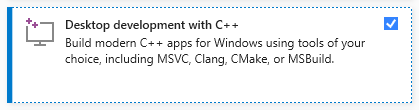
Instale o Visual Studio (versão da comunidade gratuita) no seu computador. Faça o download, execute -o e selecione apenas o desenvolvimento da área de trabalho da opção com C ++ (privilégios de administrador necessários):
Faça o download do arquivo zip do repositório de Samantha clicando aqui e descompacte -o no seu computador. Selecione a unidade onde deseja instalar o programa:

Abra o diretório samantha_ia-main e clique duas vezes em install_samantha_ia.bat Arquivo para iniciar a instalação. O Windows pode solicitar que você confirme a origem do arquivo .bat . Clique em 'mais informações' e confirme. Encoretamos para inspecionar o código de todos os arquivos (use sistemas Virustototal e IA para fazer isso):

Esta é a parte crítica da instalação. Se tudo correr bem, o processo será concluído sem exibir mensagens de erro no terminal.
O processo de instalação leva cerca de 20 minutos e deve terminar com a criação de dois ambientes virtuais: samantha , para executar apenas o modelo de IA e jupyterlab , para executar os outros programas instalados. Ele levará cerca de 5 GB do seu disco rígido.
Depois de instalado, abra Samantha clicando duas vezes no arquivo open_samantha.bat . O Windows pode pedir novamente para confirmar a fonte do arquivo .bat . Essa autorização é necessária apenas na primeira vez que você executa o programa. Clique em 'mais informações' e confirme:

Uma janela do terminal será aberta. Este é o lado do servidor do Samantha.
Depois de responder às perguntas iniciais (opções de linguagem de interface e controle de voz - o controle de voz não é adequado para o primeiro uso), a interface será aberta em uma nova guia navegador. Este é o lado do navegador de Samantha:
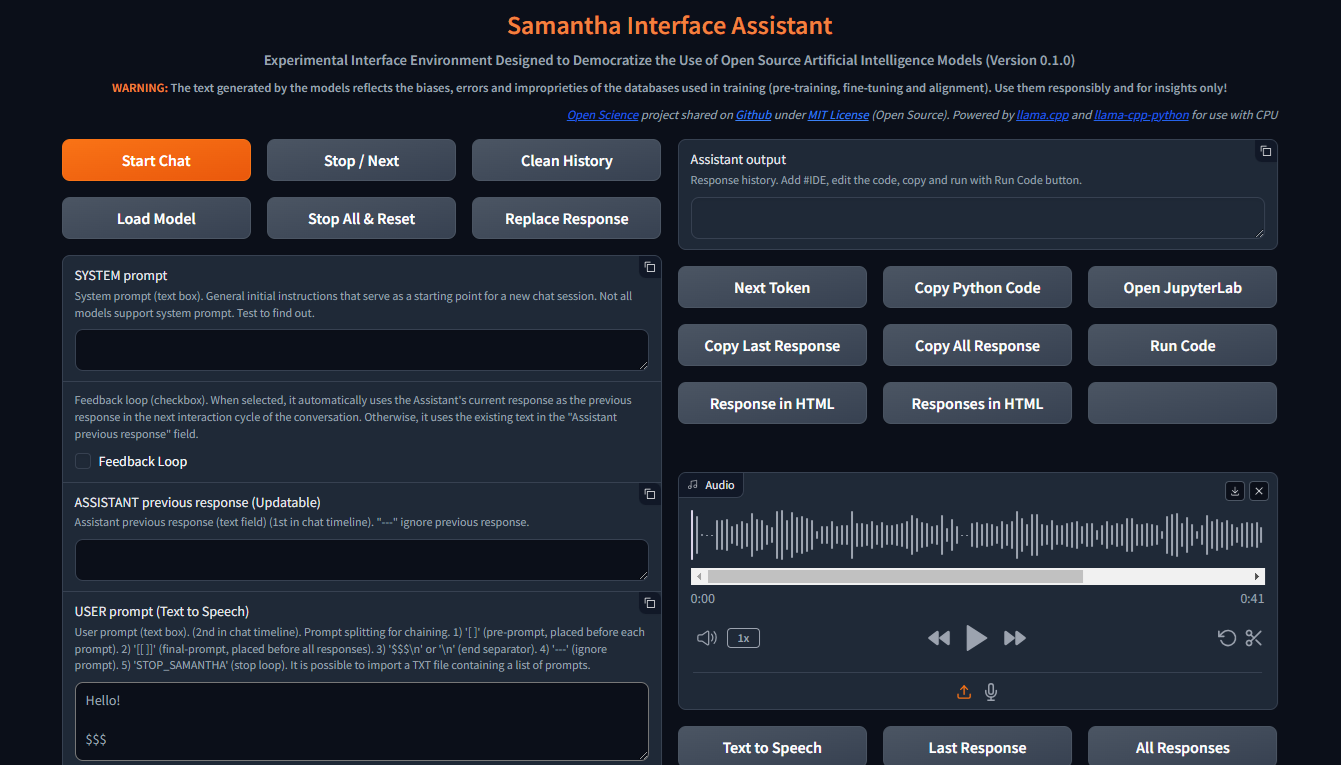
Com a janela do navegador aberta, Samantha está pronta para ir.
Confira o vídeo de instalação.
Samantha precisa de apenas um arquivo .gguf modelo para gerar texto. Siga estas etapas para executar um teste de modelo simples:
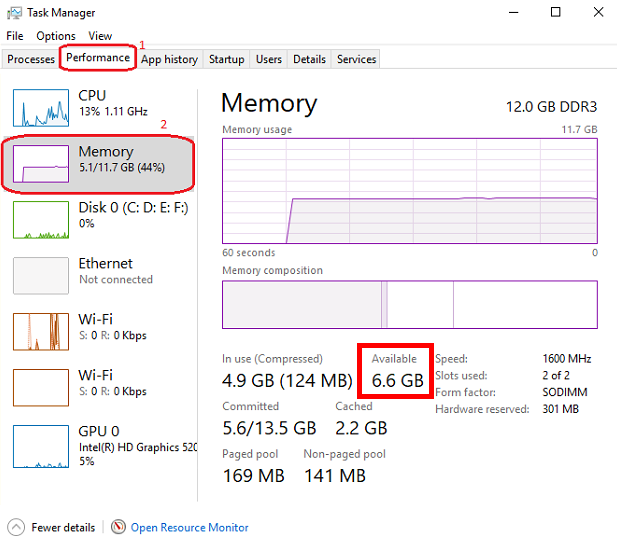
Abra o gerenciamento de tarefas do Windows pressionando CTRL + SHIFT + ESC e verifique a memória disponível. Feche alguns programas, se necessário, para a memória livre.
Visite o Hugging Face Repository e clique no cartão para abrir a página correspondente. Localize a guia Arquivos e versões e escolha um modelo de geração de texto .gguf que se encaixa na sua memória disponível.
Clique com o botão direito do mouse no ícone do link de download do modelo e copie seu URL.
Cole o URL do modelo nos modelos de download de Samantha para o campo de teste .
Insira um prompt no campo Prompt de usuário e pressione Enter . Mantenha o sinal $$$ no final do seu prompt. O modelo será baixado e a resposta será gerada usando as configurações determinísticas padrão. Você pode rastrear esse processo via gerenciamento de tarefas do Windows.
Todo novo modelo baixado através deste procedimento de cópia e colagem substituirá o anterior para salvar o espaço do disco rígido. O download do modelo é salvo como MODEL_FOR_TESTING.gguf na sua pasta de downloads .
Você também pode baixar o modelo e salvá -lo permanentemente no seu computador. Para mais datas, consulte a seção abaixo.
Os modelos abertos de geração de texto da Souce podem ser baixados do Hugging Face, usando o gguf como parâmetro de pesquisa. Você pode combinar duas palavras, como gguf code ou gguf portuguese .
Você também pode acessar um repositório específico e ver todos os modelos .gguf disponíveis para download e testes, como https://huggingface.co/bartowski ou https://huggingface.co/nousresearch.
Os modelos são exibidos em cartões como este:

Para baixar o modelo, clique no cartão para abrir a página correspondente. Localize as guias Model Card e Arquivos e Versões :

Para baixar alguns modelos, você deve concordar com os termos de uso.
Depois disso, clique na guia Arquivos e versões e faça o download de um modelo que se encaixa no seu espaço RAM disponível. Para verificar sua memória disponível, abra o Windows Task Manager pressionando CTRL + SHIFT + ESC , clique na guia Desempenho (1) e selecione Memória (2):
Sugerimos baixar o modelo com Q4_K_M (quantização de 4 bits) em seu nome de link (Coloque o mouse sobre o botão de download para ver o nome completo do arquivo no link como este: https://huggingface.co/NousResearch/Hermes-2-Pro-Llama-3-8B-GGUF/resolve/main/Hermes-2-Pro-Llama-3-8B-Q4_K_M.gguf?download=true ). Como regra, quanto maior o tamanho do modelo, maior a precisão do texto gerado.
Se o modelo baixado não se encaixar no espaço RAM disponível, seu disco rígido será usado, impactando o desempenho.
Faça o download do modelo escolhido e salve -o no seu computador ou apenas copie o link de download e cole -o no modelo de download de Samantha para o campo de teste . Assista aos tutoriais em vídeo na seção abaixo para obter mais detalhes.
Observe que cada modelo possui suas próprias características, apresentando respostas significativamente diferentes, dependendo de seu tamanho, arquitetura interna, método de treinamento, linguagem predominante do banco de dados de treinamento, prompt do usuário e ajuste de hiperparâmetro e é necessário testar seu desempenho para a tarefa desejada.
Alguns modelos não podem ser carregados devido às suas características técnicas ou incompatibilidade com a versão atual da ligação do llama.CPP Python usada por Samantha .
Onde encontrar modelos para testar: modelos de huggingface gguf
Samantha é um programa experimental, criado para testar os modelos de IA de código aberto. Portanto, é comum que ocorram erros ao tentar testar um novo modelo ou novas versões de modelos criados pelos usuários.
A qualidade das respostas geradas por um modelo pode ser avaliada usando alguns critérios, como:
Grau de entendimento das instruções explícitas e implícitas contidas nas solicitações do usuário e do sistema;
Grau de obediência a essas instruções, aspecto relacionado à linguagem predominante do banco de dados;
Grau de alucinação na geração de texto coerente, mas incorreto ou fora de contexto. A alucinação na geração de texto geralmente resulta do treinamento insuficiente do modelo ou da seleção inadequada do próximo token, que leva o modelo em uma direção semântica indesejada;
Grau de precisão no processo de tomada de decisão para preencher as lacunas no contexto do prompt do usuário e resolver ambiguidades necessárias para gerar a resposta. O que não é especificado explicitamente, o modelo tenta inferir com base em seu treinamento, o que pode levar a erros;
Grau de coerência do viés adotado pelo modelo com o viés (ou a falta dela) contido no prompt do usuário;
Grau de pertinência e relevância dos tópicos escolhidos a serem abordados;
Grau de amplitude e profundidade de abordagem dos tópicos na resposta;
Grau de precisão sintática e semântica da resposta;
Qualidade da estrutura e conteúdo da resposta em relação às expectativas do usuário (e a superação deles) para o problema enviado ao modelo, considerando a técnica usada para criar o prompt (engenharia rápida) e o ajuste dos hiperparâmetros do modelo.
Principais controles:
Inicia uma sessão de bate -papo, enviando todos os textos de entrada (prompt do sistema, resposta anterior e prompt de usuário) para o servidor, bem como as configurações ajustadas pelo usuário. Assim como todos os outros botões, um clique do mouse soará.
Este botão também limpa a resposta anterior interna.
Uma sessão de bate -papo pode conter mais de um ciclo de conversa (loop).
Inicie o bate -papo de bate -papo atalho do teclado: pressione Enter em qualquer lugar da página.
Para gerar texto, um modelo deve ser pré-selecionado na lista suspensa de seleção de modelos ou em um URL do modelo de face abraça deve ser fornecido para baixar o modelo para o campo de teste . Se ambos os campos forem preenchidos, o modelo selecionado através da lista suspensa terá precedência.
? Interrompe o processo de geração de token para o modelo ou prompt atual, iniciando a execução do próximo modelo ou prompt na sequência, se houver.
Ele também interrompe a reprodução do áudio atualmente jogando quando no modo AutoPlay ( Leia a Caixa de seleção de resposta em voz alta selecionada).
Samantha tem 3 fases:
Esse botão interrompe a geração de token somente quando a próxima fase de seleção de token é iniciada, mesmo que fosse pressionada anteriormente.
Essa interrupção não impede a execução do código gerado pelo modelo, se o código de execução automaticamente a caixa de seleção for selecionada. Você pode pressionar o botão para interromper a geração de texto e executar o código Python já gerado.
? Limpa o histórico da sessão de bate -papo atual, apagando o campo de saída do assistente, bem como todos os logs internos, resposta anterior etc.
Para que este botão funcione, você precisa esperar que o modelo termine de gerar o texto (borda laranja do campo de saída do assistente para piscar)
✅ Permite selecionar o diretório onde os modelos disponíveis para carregamento são salvos.
Padrão padrão: Windows "Downloads"
Você pode selecionar qualquer diretório que contenha modelos GGUF . Nesse caso, os modelos contidos no diretório selecionado serão listados na lista suspensa de seleção de modelos .
Quando a janela pop-up for aberta, clique na pasta que deseja selecionar.
? Interrompe a sequência de modelos em execução e redefine as configurações internas do último modelo carregado.
Após a redefinição, os modelos levam algum tempo para reiniciar a geração de texto, dependendo do tamanho do texto de entrada.
Essa interrupção evita a execução do código já Python gerado pelo modelo, se o código de execução automaticamente for selecionado.
? Substitui o texto no campo de resposta anterior do assistente pelo texto da última resposta gerada pelo modelo.
O texto substituído será usado como resposta anterior do modelo no próximo ciclo de conversação.
Este texto substituído não é visível. Ele não apaga o texto do campo de resposta do assistente anterior , que pode ser usado novamente mais tarde.
No contexto de grandes modelos de idiomas (LLMS), um prompt do sistema é um tipo especial de instrução dada ao modelo no início de uma conversa ou tarefa. É considerado em todas as interações com o modelo.
Pense nisso como preparar o cenário para a interação. Ele fornece ao LLM informações cruciais sobre seu papel, a persona desejada, o comportamento e o contexto geral da conversa.
Aqui está como funciona:
Definindo o papel: o prompt do sistema define claramente o papel do LLM na interação.
Definir o tom e a persona: o prompt do sistema também pode estabelecer o tom e a persona desejados para as respostas do LLM.
Fornecendo informações contextuais: o prompt do sistema pode oferecer informações básicas relevantes para a conversa ou tarefa.
Benefits of Using System Prompts:
Exemplo:
Let's say you want to use an LLM to write a poem in the style of Shakespeare. A suitable system prompt would be:
You are William Shakespeare, a renowned poet from Elizabethan England.
By providing this system prompt, you guide the LLM to generate a response that reflects Shakespeare's language, style, and thematic interests.
Not all models support system prompt. Test to find out: fill in "x = 2" in the System prompt field and ask the model the value of "x" in the User prompt field. If the model gets the value of "x", system prompt is available in the model.
You can simulate the effect of the system prompt by adding text in square brackets in the beginning of the User prompt field: [This text acts as a system prompt] or adding the system prompt text into the Assistant previous response field (do not use feedback loop).
To ignore the text present in this field, include --- at the beginning. To split the text in parts, put $$$ between them. To ignore each part, include --- at the beginning of each part.
↩️ When activated, it automatically considers the response generated by the model in the current conversation cycle as being the Assistant's previous response in the next cycle, allowing feedback from the system.
Any text entered by the user in the Assistant previous response field is only considered in the first cycle after activating this feature. In the following cycles, the model's response internally replaces the previous response, but without deleting the text contained in that field, which can be reused in a new chat session. You can monitor the content of the assistant previous response via terminal.
In turn, when deactivated, it always uses the text contained in the Assistant previous response field as the previous response, unless the text is preceded by --- (triple dash). Text preceded by --- is ignored by the model.
To internally clear the model's previous response, press the Clean history button.
➡️ Stores the text considered by the model as its previous response in the current conversation cycle.
Used to feed back the responses generated by the model.
To ignore the text present in this field, include --- at the beginning. To split the text in parts, put $$$ between them. To ignore each part, include --- at the beginning of each part.
✏️ The main input field of the interface. It receives the list of user prompts that will be submitted to the model sequentially.
Each item in the list must be separated from the next one by a line break ( SHIFT + ENTER or n ) or by the symbols $$$ (triple dollar signal), if the items are made up of text with line breaks.
When present in the user prompt, the $$$ separator takes precedence over the n separator. In other words, n is ignored.
You can import a TXT file containing a list of prompts.
--- before a prompt list item causes the system to ignore that item.
Text positioned within single square brackets ( [ and ] ) is added to the beginning of each prompt list item, simulating a system prompt.
Text positioned within double square brackets ( [[ and ]] ) is added as the last item in the prompt list. In this case, all responses generated by the model in the current chat session are concatenated and added to the end of this item, allowing the model to analyze them together.
If the Python code execution returns only the word STOP_SAMANTHA , it stops token generation and exits the loop.
If the Python code execution returns only '' (empty string), it does not display the HTML pop-up window.
You can add specific hyperparameters before each prompt. You must use this pattern:
{max_tokens=4000, temperature=0, tfs_z=0, top_p=0, min_p=1, typical_p=0, top_k=40, presence_penalty=0, frequency_penalty=0, repeat_penalty=1}
Exemplo:
[You are a poet that writes only in Portuguese]
Create a sentence about love
Create a sentence about life
--- Create a sentence about time (this instruction is ignored)
[[Create a paragraph in English that summarizes the ideas contained in the following sentences:]]
( previous responses are concatenated here )
Model responses sequence:
"O amor é um fogo que arde no meu peito, uma chama que me guia através da vida."
"A vida é um rio que flui sem parar, levando-nos para além do que conhecemos."
Love and life are intertwined forces that shape our existence. Love burns within us like a fire, guiding us through life's journey with passion and purpose. Meanwhile, life itself is a dynamic and ever-changing river, constantly flowing and carrying us beyond the familiar and into the unknown. Together, love and life create a powerful current that propels us forward, urging us to explore, discover, and grow.
✅ Dropdown list of models saved on the computer and available for text generation.
To view models in this field, click the Load model button and select the folder containing the models.
The default location for saving models is the Windows Downloads directory.
You can select multiples models (even repeated) to create a sequence of models to respond the user prompts.
The last model downloaded from a URL is saved as MODEL_FOR_TESTING.gguf and is also displayed in this list.
Receives a list of Hugging Face links to the models that will be downloaded and executed sequencially.
Link example:
Links preceded by --- will be ignored.
Only works if no model is selected in Model selection dropdown list.
1️⃣ Activates a single response per model.
Prompts that exceed the number of models are ignored.
Models that exceed the number of prompts are also ignored.
You can select the same model more than once.
This checkbox disables Number of loops and Number of responses checkboxes.
⏮️ Reinitializes the internal state of the model, eliminating the influence of the previous context.
How it Works:
When the reset feature is invoked:
Benefits:
Use Cases:
? Shuffles the execution order of the models if 3 or more models are selected in Model selection dropdown list.
?♀️ Generates text faster in the background without displaying the addition of each token in the Assistant output field.
Minimizing or hiding the Samantha browser window makes the token generation process even faster.
This checkbox disables Learning Mode.
Selects the language of the computer's SAPI5 voice that will read the responses generated by the model.
? Activates automatic reading mode for responses generated by the model using the language selected in the Voice selection dropdown list.
If you wish to reproduce the response generated by the model using a better quality speech synthesizer (Microsoft Edge browser), open the response in an HTML pop-up using the Response in HTML button, right-click inside the page and select the option to read the page text aloud.
To save and edit the audio generated by the speech synthesizer, we recommend record de audio using the portable version of the open source program Audacity. Adjust the recording setting to capture audio output from the speakers (not from the microphone).
?? Activates Learning Mode.
It presents a series of features that help in understanding the token selection process by the model, such as:
Only works if Fast Mode is unchecked.
Radio buttons options:
? Set the number of repetitions of the block in the following chaining sequence:
Chaining Sequence: ( [models list] -> respond -> ( [user prompt list] X number of responses) ) X number of loops
Each model in the models list responds to all prompts in the user prompt list for the selected number of responses . This block is repeated for the selected number of loops .
? Number of responses to be generated by each selected model in the following chaining sequence:
Chaining Sequence: ( [models list] -> respond -> ( [user prompt list] X number of responses ) ) X number of loops
Each model in the models list responds to all prompts in the user prompt list for the selected number of responses . This block is repeated for the selected number of loops .
? When checked, runs automatically the Python code generated by the model.
Whenever Python code returns a value other than '' (empty string), an HTML pop-up window opens to display the returned content.
? When checked, stops Samantha when the automatic execution of the Python code generated by the model prints in the terminal a value other than '' (empty string) and that does not contain error message.
Use it to stop a generation loop when a condition is met.
? When checked, concatenates each new response by adding it to the previous response to be considered when generating the next response by the model.
It is important to highlight that the set of concatenated responses must fit in the model's context window.
? Adjusts the model's hyperparameters with random values in each new conversation cycle.
Randomly chosen values vary within the following value range of each hyperparameter and are displayed at the beginning of each response generated by the model.
| Hyperparameter | Min. Valor | Máx. Valor |
|---|---|---|
| temperatura | 0.1 | 1.0 |
| tfs_z | 0.1 | 1.0 |
| top_p | 0.1 | 1.0 |
| min_p | 0.1 | 1.0 |
| typical_p | 0.1 | 1.0 |
| presence_penalty | 0.0 | 0,3 |
| frequency_penalty | 0.0 | 0,3 |
| repeat_penalty | 1.0 | 1.2 |
This resource has application in the study of the reflections of the interaction between hyperparameters.
? Feedback only the Python interpreter output as the next assistant's previous response. Do not include model's response.
This feature reduces the number of tokens to be inserted in the assistant's previous response in the next conversation cycle.
Works only with Feedback Loop activated.
Hide HTML model responses, including Python interpreter error messages.
Context Window:
n_ctx stands for number of context tokens in the context window and determines the maximum number of tokens that the model can process at once. It determines how much previous text the model can "remember" and utilize when selecting the next token from model vocabulary.
The context length directly impacts the memory usage and computational load. Longer n_ctx requires more memory and computational power.
How n_ctx works:
It sets the upper limit on the number of tokens the model can "see" at once. Tokens are usually word parts, full words, or characters, depending on the tokenization method. The model uses this context to understand and generate text. For example, if n_ctx is 2048, the model can process up to 2048 tokens (now words) at a time.
Impact on model operation:
During training and inference, the model attends to all tokens within this context window.
It allows the model to capture long-range dependencies in the text.
Larger n_ctx enables the model to handle longer sequences of text without losing earlier context.
Why increasing n_ctx increases memory usage:
Attention mechanism: LLMs uses self-attention mechanisms (like in Transformers) which compute attention scores between all pairs of tokens in the input.
Quadratic scaling: The memory required for attention computations scales quadratically with the context length. If you double n_ctx , you quadruple the memory needed for attention.
CAUTION: n_ctx MUST BE GREATER THAN ( max_tokens + number of input tokens) (system prompt + assistant previous response + user prompt).
If the prompt text contains more tokens than the context window defined with n_ctx or the memory required exceeds the total available on the computer, an error message will be displayed.
Error message displayed on Assistant output field:
 ==========================================
Error loading LongWriter-glm4-9B-Q4_K_M.gguf.
Some models may not be loaded due to their technical characteristics or incompatibility with the current version of the llama.cpp Python binding used by Samantha.
Try another model.
==========================================
Error messages displayed on terminal:
Requested tokens (22856) exceed context window of 10016

Unable to allocate 14.2 GiB for an array with shape (25000, 151936) and data type float32
When set to 0 , the system will use the maximum n_ctx possible (model's context window size).
As a rule, set n_ctx equal to max_tokens , but only to the value necessary to accommodate the text parsed by the model. Samantha's default values for n_ctx and max_tokens are 4,000 tokens.
Before adjusting n_ctx , you must to unload the model by clicking Unload model button.
Exemplo:
User prompt = 2000 tokens
n_ctx = 4000 tokens
If the text generated by the model is equals or greater than 2000 tokens (4000 - 2000), the system will raise an IndexError in the terminal, but the interface will not crash.
To check the impact of the n_ctx in memory, open Windows Task Manager ( CTRL + SHIFT + ESC ) to monitor memory usage, select memory panel and vary n_ctx values. Don't forget to unload model between changes.
?️ Controls maximum number of tokens to be generated by the model.
Select 0 for the models' maximum number of tokens (maximum memory required).
How max_tokens Works:
Sampling Process: When generating text, LLMs predict the next token based on the context provided (system prompt + previous response + user prompt + text already generated). This prediction involves calculating probabilities for each possible token in the vocabulary.
Token Limit: The max_tokens parameter sets a hard limit on how many tokens the model can generate before stopping, regardless of the predicted probabilities.
Truncation: Once the generated text reaches max_tokens , the generation process is abruptly terminated. This means the final output might be incomplete or feel cut off.
Stop Words:
? List of characters that interrupt text generation by the model, in the format ["$$$", ".", ".n"] (Python list).
Token Sampling:
Deterministic Behavior:
To check the deterministic impact of each hyperparameter on the model's behavior, set all others hyperparameters to their maximum stochastic values and execute a prompt more than once. Repeat this procedure for each token sampling hyperparameter.
| Hyperparameter | Determinístico | Estocástico | Selecionado |
|---|---|---|---|
| temperatura | 0 | > 0 | 2 (stochastic) |
| tfs_z | 0 | > 0 | 1 (stochastic) |
| top_p | 0 | > 0 | 1 (stochastic) |
| min_p | 1 | < 1 | 1 (deterministic) |
| typical_p | 0 | > 0 | 1 (stochastic) |
| top_k | 1 | > 1 | 40 (stochastic) |
In other words, the hyperparameter with deterministic adjustment prevails over all other hyperparameters with stochastic adjustments.
As the hyperparameter with deterministic tuning loses this condition, interaction between all hyperparameters with stochastic tuning occurs.
Stochastic Behavior:
To check the stochastic reflection of a hyperparameter on the model's behavior, set all other hyperparameters to their maximum stochastic values and gradually vary the selected hyperparameter based on its deterministic value. Repeat this procedure for each token sampling hyperparameter.
You can combine stochastic tuning of different hyperparameters.
| Hyperparameter | Determinístico | Estocástico | Selecionado |
|---|---|---|---|
| temperatura | 0 | > 0 | 2 (stochastic) |
| tfs_z | 0 | > 0 | 1 (stochastic) |
| top_p | 0 | > 0 | 1 (stochastic) |
| min_p | 1 | < 1 | 1 (reduce progressively) |
| typical_p | 0 | > 0 | 1 (stochastic) |
| top_k | 1 | > 1 | 40 (stochastic) |
The text generation hyperparameters in language models, such as top_k , top_p , tfs-z , typical_p , min_p , and temperature , interact in a complementary way to control the process of choosing the next token. Each affects token selection in different ways, but there is an order of prevalence in terms of influence on the final set of tokens that can be selected. Let's examine how these hyperparameters relate to each other and who "prevails" over whom.
All these hyperparameters are adjusted after the model generates the logits of each token.
Samantha displays the logits of each token in learning mode, before they are changed by the hyperparameters.
Samantha also indicates which token was selected after applying the hyperparameters.
10 vocabulary tokens most likely returned by the model to initiate the answer to the following question: Who are you? :
Vocabulary id / token / logit value:
 358)    ' I'       (15.83)
40)     'I'        (14.75)     <<<  Selected
21873)  ' Hello'   (14.68)
9703)   'Hello'    (14.41)
1634)   ' As'      (14.31)
2121)   'As'       (13.98)
20971)  ' Hi'      (13.73)
715)    ' n'      (13.03)
5050)   'My'       (13.01)
13041)  'Hi'       (12.77)
How to disable hyperparameters:
temperature : Setting it to 1.0 keeps the original odds unchanged. Note: Setting it to 0 does not "disable" it, but makes the selection deterministic.
tfs_z (Tail-Free Sampling with z-score): Setting it to a very high value effectively disables it.
top-p (nucleus sampling): Setting it to 1.0 effectively disables it.
min-p : Setting it to a very low value (close to 0) effectively disables it.
typical-p : Setting it to 1.0 effectively disables it.
top-k : Setting it to a very high value (eg vocabulary size) essentially disables it.
Order of Prevalence
1 top_k , top_p , tfs_z , typical_p , min_p : These delimit the space of possible tokens that can be selected.
top_k restricts the number of available tokens to the k most likely ones. For example, if k = 50 , the model will only consider the 50 most likely tokens for the next word. Tokens outside of these 50 most likely are completely discarded, which can help avoid unlikely or very risky choices.
top-p defines a threshold based on the sum of cumulative probabilities . If p = 0.9 , the model will include the most likely tokens until the sum of their probabilities reaches 90% . Unlike top_k , the number of tokens considered is dynamic, varying according to the probability distribution.
tfs_z aims to eliminate the "tail" of the tokens' probability distribution. It works by discarding tokens whose cumulative probability (from the tail of the distribution) is less than a certain threshold z. The idea is to keep only the most informative tokens and eliminate those with less relevance, regardless of how many tokens this leaves in the set. So, instead of simply truncating the distribution at the top (as top_k or top_p does), tfs_z makes the model get rid of the tokens at the tail of the distribution. This creates a more adaptive way of filtering the least likely tokens, promoting the most important ones without strictly limiting the number of tokens, as with top_k . tfs_z discards the "tail" of the token distribution, eliminating those with cumulative probabilities below a certain threshold z.
typical_p selects tokens based on their divergence from the mean entropy of the distribution, ie how "typical" the token is. typical-p is a more sophisticated sampling technique that aims to maintain the "naturalness" of text generation, based on the notion of entropy, ie how "surprising" or predictable is the choice of a token compared to the what the model expects. How Typical-p Works: Instead of focusing only on the absolute probabilities of tokens, as top_k or top_p do, typical_p selects tokens based on their deviation from the mean entropy of the probability distribution.
Here is the typical_p process:
a) Average Entropy: The average entropy of a token distribution reflects the average level of uncertainty or surprise associated with choosing a token. Tokens with a very high (expected) or very low (rare) probability may be less "typical" in terms of entropy.
b) Divergence Calculation: Each token has its probability compared to the average entropy of the distribution. Divergence measures how far the probability of that token is from the average. The idea is that tokens with a smaller divergence from average entropy are more "typical" or natural within the context.
c) Sampling: typical_p defines a fraction p of the accumulated entropy to consider tokens. Tokens are ordered based on their divergence and those that fall within a portion p (eg, 90% of the most "typical" distribution) are considered for selection. The model chooses tokens in a way that favors those that represent the average uncertainty well, promoting naturalness in text generation.
Prevalence: These parameters define the set of candidate tokens . They are first used to restrict the number of possible tokens before any other adjustments are applied. The way they are combined can be cumulative, where applying multiples of these filters progressively reduces the number of available tokens. The final set is the intersection set between the tokens that pass all these checks.
If you use top_k and top_p at the same time, both must be respected. For example, if top_k = 50 and top_p = 0.9 , the model first limits the choice to the 50 most likely tokens and, within these, considers those whose probability sum reaches 90%.
If you add typical_p or tfs_z to the equation, the model will apply these additional filters over the same set, further reducing the options.
2 temperature: Adjusts the randomness within the set of already filtered tokens .
After the model restricts the universe of tokens based on cutoff hyperparameters like top-k , top_p , tfs_z , etc., temperature comes into play.
temperature changes the smoothness or rigidity of the probability distribution of the remaining tokens. A temperature lower than 1 concentrates the probabilities, causing the model to prefer the most likely tokens. A temperature greater than 1 flattens the distribution, allowing less likely tokens to have a greater chance of being selected.
Prevalence: temperature does not change the set of available tokens, but adjusts the relative probability of already filtered tokens . Thus, it does not prevail over the top_k , top_p , etc. filters, but acts after them, influencing the final selection within the remaining option space.
General Hierarchy
top_k, top_p, tfs_z, typical_p, min_p : These parameters act first, restricting the number of possible tokens.
temperature : After the selection filters are applied, temperature adjusts the probabilities of the remaining tokens, controlling the randomness in the final choice.
Combination Scenario
_top_k + top_p : If top_k is less than the number of tokens selected by top_p , top_k prevails as it limits the number of tokens to k. If top_p is more restrictive (eg only considers 5 tokens with p=0.9), then it prevails over top_k .
typical_p + top_p : Both apply filters, but in different directions. typical_p selects based on entropy, while top_p selects based on cumulative probability. If used together, the end result is the intersection set of these filters.
Temperature : It is always applied last, modulating the randomness in the final selection, but without changing the limits imposed by previous filters.
Prevalence Summary
Filters ( top_k, top_p, tfs_z, typical_p, min_p ) define the set of candidate tokens.
temperature adjusts the relative probability within the filtered set.
The end result is a combination of these filters, where the set of tokens eligible for selection is defined first, and then the randomness is adjusted with temperature.
? Temperature is a hyperparameter that controls the randomness of the text generation process in LLMs. It affects the probability distribution of the model's next-token predictions.
Temperature is a hyperparameter t that we find in stochastic models to regulate the randomness in a sampling process (Ackley, Hinton, and Sejnowski 1985). The softmax function (Equation 1) applies a non-linear transformation to the output logits of the network, turning it into a probability distribution (ie they sum to 1). The temperature parameter regulates its shape, redistributing the output probability mass, flattening the distribution proportional to the chosen temperature. This means that for t > 1, high probabilities are decreased, while low probabilities are increased, and vice versa for t < 1. Higher temperatures increase entropy and perplexity, leading to more randomness and uncertainty in the generative process. Typically, values for t are in the range of [0, 2] and t = 0, in practice, means greedy sampling, ie always taking the token with the highest probability. Is Temperature the Creativity Parameter of Large Language Models?
The Effect of Sampling Temperature on Problem Solving in Large Language Models
Controlling Creativity:
Use higher temperatures when you want the model to generate more creative, unexpected, and varied responses. This is useful for creative writing, brainstorming, and exploring multiple ideas.
This flattens the probability distribution, making the model more likely to sample less probable tokens.
The generated text becomes more diverse and creative, but potentially less coherent.
❄ Use lower temperatures when you need more predictable and focused output. This is useful for tasks requiring precise and reliable information, such as summarization or answering factual questions.
This sharpens the probability distribution, making the model more likely to sample the most probable tokens.
The generated text becomes more focused and deterministic, but potentially less creative.
Como funciona:
? Mathematically, the temperature (T) is applied by dividing the logits (raw scores from the model) by T before applying the softmax function.
A lower temperature makes the distribution more "peaked," favoring high-probability options.
A higher temperature "flattens" the distribution, giving more chance to lower-probability options.
Temperature scale:
Generally ranges from 0 to 2, with 1 being the default (no modification).
T < 1: Makes the text more deterministic, focused, and "safe."
T > 1: Makes the text more random, diverse, and potentially more creative.
T = 0: Equivalent to greedy selection, always choosing the most probable option.
Avoiding Repetition:
Higher temperatures can help reduce repetitive patterns in the generated text by promoting diversity.
Very low temperatures can sometimes lead to repetitive and deterministic outputs, as the model might keep choosing the highest-probability tokens.
It's important to note that temperature is just one of several sampling hyperparameters available. Others include top-k sampling, nucleus sampling (or top-p), and the TFS-Z. Each of these methods has its own characteristics and may be more suitable for different tasks or generation styles.
Videos:
temperature shorts 1
temperature shorts 2
tfs_z stands for tail-free sampling with z-score . It's a hyperparameter used in a text generation technique designed to balance the trade-off between diversity and quality in generated text.
Context and purpose:
Tail-free sampling was introduced as an alternative to other sampling methods like top-k or nucleus ( top-p ) sampling. Its goal is to remove the arbitrary "tail" of the probability distribution while maintaining a dynamic threshold.
Technical Details of tfs_z in LLM Text Generation
Probability distribution analysis:
The method examines the probability distribution of the next token predictions. It focuses on the "tail" of this distribution - the less likely tokens.
Z-score calculation:
For each token in the sorted (descending) probability distribution, a z-score is calculated. The z-score represents how many standard deviations a token's probability is from the mean.
Cutoff determination:
The tfs_z parameter sets the z-score threshold. Tokens with a z-score below this threshold are removed from consideration.
Dynamic thresholding:
Unlike fixed methods like top-k , the number of tokens retained can vary based on the shape of the distribution. This allows for more flexibility in different contexts.
Sampling process:
After applying the tfs_z cutoff, sampling occurs from the remaining tokens. This can be done using various methods (eg, temperature-adjusted sampling).
tfs_z is a hyperparameter that controls the temperature scaling of the output logits during text generation.
Here's what it does:
Logits : When an LLM generates text, it produces a probability distribution over all possible tokens in the vocabulary. This distribution is represented as a vector of logits (unnormalized log probabilities).
Temperature scaling : To control the level of uncertainty or "temperature" of the output, you can scale the logits by multiplying them with a temperature factor ( t ). This is known as temperature scaling.
tfs_z hyperparameter : It's a hyperparameter that controls how much to scale the logits before applying temperature scaling.
When you set tfs_z > 0 , the model first normalizes the logits by subtracting their mean ( z-score normalization ) and then scales them with the temperature factor ( t ). This has two effects:
Reduced variance : By normalizing the logits, you reduce the variance of the output distribution, which can help stabilize the generation process.
Increased uncertainty : By scaling the normalized logits with a temperature factor, you increase the uncertainty of the output distribution, which can lead to more diverse and creative text generations.
Practical example:
Imagine that the model is trying to complete the sentence "The sky is..."
Without tfs_z , the model could consider:
blue (30%), cloudy (25%), clear (20%), dark (15%), green (5%), singing (3%), salty (2%)
With TFS-Z (cut by 10%):
blue (30%), cloudy (25%), light (20%), dark (15%)
This eliminates less likely and potentially meaningless options, such as "The sky is salty."
By adjusting the Z-score, we can control how "conservative" or "creative" we want the model to be. A higher Z-score will result in fewer but more "safe" options, while a lower Z-score will allow for more variety but with a greater risk of inconsistencies.
In summary, tfs_z controls how much to scale the output logits after normalizing them. A higher value of tfs_z will produce more uncertain and potentially more creative text generations.
Keep in mind that this is a relatively advanced hyperparameter, and its optimal value may depend on the specific LLM architecture, dataset, and task at hand.
⭕ Top-p (nucleus sampling) is a hyperparameter that controls the diversity and quality of text generation in LLMs. It affects the selection of tokens during the generation process by dynamically limiting the vocabulary based on cumulative probability.
Controlling Output Quality:
? Use higher top-p values (closer to 1) when you want the model to consider a wider range of possibilities, potentially leading to more diverse and creative outputs. This is useful for open-ended tasks, storytelling, or generating multiple alternatives. Higher values allow for more low-probability tokens to be included in the sampling pool.
Use lower top-p values (closer to 0) when you need more focused and high-quality output. This is beneficial for tasks requiring precise information or coherent responses, such as answering specific questions or generating formal text. Lower values restrict the sampling to only the most probable tokens.
Como funciona:
? Mathematically, top-p sampling selects the smallest possible set of words whose cumulative probability exceeds the chosen p-value. The model then samples from this reduced set of tokens. This approach adapts to the confidence of the model's predictions, unlike fixed methods like top-k sampling.
Top-p scale:
Generally ranges from 0 to 1, with common values between 0.1 (10% most likely) and 0.9 (90% most likely).
p = 1: Equivalent to unmodified sampling from the full vocabulary.
p → 0: Increasingly deterministic, focusing on the highest probability tokens.
p = 0.9: A common choice that balances quality and diversity.
Balancing Coherence and Diversity:
Top-p sampling helps maintain coherence while allowing for diversity. It adapts to the model's confidence, using a smaller set of tokens when the model is very certain and a larger set when it's less certain. This can lead to more natural-sounding text compared to fixed cutoff methods.
Comparison with Temperature:
While temperature modifies the entire probability distribution, top-p directly limits the vocabulary considered. Top-p can be more effective at preventing low-quality outputs while still allowing for creativity, as it dynamically adjusts based on the model's confidence.
It's worth noting that top-p is often used in combination with other sampling methods, such as temperature adjustment or top-k sampling. The optimal choice of hyperparameters often depends on the specific task and desired output characteristics.
The min_p hyperparameter is a relatively recent sampling technique used in text generation by large-scale language models (LLMs). It offers an alternative approach to top_k and nucleus sampling ( top_p ) to control the quality and diversity of generated text.
min_p is a sampling hyperparameter that works in a complementary way to top_p (nucleus sampling). While top_p sets an upper bound on cumulative probabilities, min_p sets a lower bound on individual probabilities.
Explicação:
As with other sampling techniques, LLM calculates a probability distribution over the entire vocabulary for the next word.
The min_p defines a minimum probability threshold, p_min.
The method selects the smallest set of words whose summed probability is greater than or equal to p_min.
The next word is then chosen from that set of words.
Detailed operation:
The model calculates P(w|c) for each word w in the vocabulary, given context c.
The words are ordered by decreasing probability: w₁, w₂, ..., w|V|.
The algorithm selects words in the order of greatest probability until the sum of the probabilities is greater than or equal to p_min :
Exemplo:
Suppose we are generating text and the model predicts the following probabilities for the next word:
 "o":        0.3
"one":      0.25
"this":     0.2
"that one": 0.15
"some":     0.1
If we use min-p with p_min = 0.7, the algorithm would work like this:
 Sum "o":                    0.3                     < 0.7
Sum "o" + "one":            0.3 + 0.25       = 0.55 < 0.7
Sum "the" + "one" + "this": 0.3 + 0.25 + 0.2 = 0.75 ≥ 0.7
Therefore, we select the first three words. Renormalizing:
 "o":    0.3  / 0.75 = 0.4
"one":  0.25 / 0.75 ≈ 0.33
"this": 0.2  / 0.75 ≈ 0.27
The next word will be chosen randomly from these three options with the new probabilities.
The typical_p hyperparameter is an entropy-based sampling technique that aims to generate more natural and less predictable text by selecting tokens that represent what is "typical" or "expected" in a probability distribution. Unlike methods like top_k or top_p , which focus on the absolute probabilities of tokens, typical_p considers how surprising or informative a token is relative to the overall probability distribution.
Technical Operation of typical_p
Entropy: The entropy of a distribution measures the expected uncertainty or surprise of an event. In the context of language models, the higher the entropy, the more uncertain the model is about which token should be generated next. Tokens that are very close to the mean entropy of the output distribution are considered "typical", while tokens that are very far away (too predictable or very unlikely) are considered "atypical".
Calculation of Surprise (Local Entropy): For each token in a given probability distribution, we can calculate its surprise (or "informativeness") by comparing its probability with the average entropy of the token distribution. This surprise is measured by the divergence in relation to the average entropy, that is, how much the probability of a token deviates from the average behavior expected by the distribution.
Selection Based on Entropy Divergence: typical_p filters tokens based on this "divergence" or difference between the token's surprise and the average entropy of the distribution. The model orders the tokens according to how "typical" they are, that is, how close they are to the average entropy.
Typical-p limit: After calculating the divergences of all tokens, the model defines a cumulative probability limit, similar to top_p (nucleus sampling). However, instead of summing the tokens' absolute probabilities, typical_p considers the cumulative sum of the divergences until a portion p of the distribution is included. That p is a value between 0 and 1 (eg 0.9), indicating that the model will include tokens that cover 90% of the most "typical" divergences.
If p = 0.9 , the model selects tokens whose divergences in relation to the average entropy represent 90% of the expected uncertainty. This helps avoid both tokens that are extremely predictable and those that are very unlikely, promoting a more natural and fluid generation.
Exemplo prático
Suppose the model is predicting the next word in a sentence, and the probability distribution of the tokens looks like this:
In the case of top_p with p = 0.9, the model would only include tokens A, B and C, as their probabilities add up to 90%. However, typical_p can include or exclude tokens based on how their probabilities compare to the average entropy of the distribution. If A is extremely predictable, it can be excluded, and tokens like B, C, and even D can be selected for their more typical representativeness in terms of entropy.
Difference from Other Methods
top_k selects the k most likely tokens directly , regardless of entropy or probability distribution.
top_p selects tokens based on the cumulative sum of absolute probabilities , without considering entropy or surprise.
typical_p , on the other hand, introduces the notion of entropy, ensuring that the selected tokens are neither too predictable nor too surprising , but ones that align with the expected behavior of the distribution.
How Typical-p Improves Text Generation
Naturalness: typical-p prevents the model from choosing very predictable tokens (as could happen with a low temperature or restrictive top-p) or very rare tokens (as could happen with a high temperature), maintaining a fluid and natural generation.
Controlled Diversity: By considering the surprise of each token, it promotes diversity without sacrificing coherence. Tokens that are close to the mean entropy of the distribution are more likely to be chosen, promoting natural variations in the text.
Avoids Extreme Outputs: By excluding overly unlikely or predictable tokens, Typical-p keeps generation within a "safe" and natural range, without veering toward extremes of certainty or uncertainty.
Interaction with Other Parameters
typical_p can be combined with other sampling methods:
When combined with temperature , typical_p further adjusts the set of selectable tokens, while temperature modulates the randomness within that set.
It can be combined with top_k or top_p to further fine-tune the process, restricting the universe of tokens based on different probability and entropy criteria.
In summary, typical_p acts in a unique way by considering the entropy of the distribution and selects tokens that are aligned with the expected behavior of this distribution, resulting in a more balanced, fluid and natural generation.
Here are some guidelines and strategies for tuning typical_p :
typical_p = 1.0: Includes all tokens available in the distribution, without restrictions based on entropy. This is equivalent to not applying any typical restrictions, allowing the model to use the full distribution of tokens.
_typical_p < 1.0: The lower the typical_p value, the narrower the set of tokens considered, keeping only those that most closely align with the average entropy. Common values include 0.9 (90% of "typical" tokens) and 0.8 (80%).
Recommendations:
typical-p = 0.9: This is a common value that typically maintains a balance between diversity and coherence. The model will have the flexibility to generate varied text, but without allowing very extreme choices.
typical_p = 0.8: This value is more restrictive and will result in more predictable choices, keeping only tokens that most accurately align with the average entropy. Useful in scenarios where fluidity and naturalness are priorities.
typical_p = 0.7 or less: The lower the value, the more predictable the text generation will be, eliminating tokens that could be considered atypical. This may result in a less diversified and more conservative output.
Fine-Tuning with temperature
typical_p controls the set of tokens based on entropy, but temperature can be used to adjust the randomness within that set . The interaction between these two parameters is important:
temperature > 1.0: Increases randomness within the set of tokens selected by typical_p , allowing even less likely tokens to have a greater chance of being chosen. This can generate more creative or unexpected responses.
temperature < 1.0: Reduces randomness, making the model more conservative by preferring the most likely tokens from the set filtered by typical_p . Using a low temperature with a high typical_p (0.9 or 1.0) can result in very predictable outputs.
Exemplo:
typical_p = 0.9 with _temperature = 1.0: Maintains the balance between naturalness and diversity, allowing the model to generate fluid and creative text, but without major deviations.
typical_p = 0.8 with temperature = 0.7: Makes generation more conservative and predictable, preferring tokens that are closer to the average uncertainty and reducing the chance of creative variations.
How It Works
In a language model, when the next word is predicted, the model generates a probability distribution for the next token (word or part of a word), where each token has an associated probability based on its previous context. The sum of all probabilities is equal to 1.
top_k works by reducing the number of options available for sampling, limiting the number of candidate tokens. It does this by selecting only the tokens with the k highest probabilities and discarding all others. Then sampling is done from these k tokens, redistributing the probabilities between them.
Exemplo:
Suppose we are generating text and the model predicts the following probabilities for the next word:
 "o":        0.3
"one":      0.25
"this":     0.2
"that one": 0.15
"some":     0.1
If we use top-k with k=3, we only keep the three most likely words:
 "o":        0.3
"one":      0.25
"this":     0.2
Then, we renormalize the probabilities:
 "o":        0.3  / (0.3 + 0.25 + 0.2) ≈ 0.4  (40%)
"one":      0.25 / (0.3 + 0.25 + 0.2) ≈ 0.33 (33%)
"this":     0.2  / (0.3 + 0.25 + 0.2) ≈ 0.27 (27%)
The next word will be chosen from these three options with the new probabilities.
Effect of Hyperparameter k
small k (eg ?=1): The model will be extremely deterministic, as it will always choose the token with the highest probability. This can lead to repetitive and predictable text.
large k (or use all tokens without truncating): The model will have more options and be more creative, but may generate less coherent text as low probability tokens may also be chosen.
Token Penalties:
? Syntactic and semantic variation arises from the penalization of tokens that are replaced by others that begin words related to different ideas, leading the response generated by the model in another direction.
Syntactic variations do not always generate semantic variations.
As text is generated, penalties become more frequent as there are more tokens to be punished.
Deterministic Behavior:
To obtain a deterministic text (same input, same output), but without repeating words (tokens), increase the values of the penalty hyperparameters.
However, if it proves necessary to allow the model to reselect already generated tokens, keep these settings at their default values.
| Hyperparameter | Default Values | Text Diversity |
|---|---|---|
| presence_penalty | 0 | > 0 |
| frequency_penalty | 0 | > 0 |
| repeat_penalty | 1 | > 1 |
Presence Penalty:
The presence penalty penalizes tokens that have already appeared in the text, regardless of their frequency. It discourages the repetition of ideas or themes.
Operação:
Efeito:
Ajustar:
Frequency Penalty:
The frequency penalty penalizes tokens based on their frequency in the text generated so far. The more times a token appeared, the greater the penalty.
Operação:
Efeito:
Ajustar:
Repeat Penalty:
The repeat penalty is similar to the frequency penalty, but generally applies to sequences of tokens (n-grams) rather than individual tokens.
Operação:
Efeito:
Ajustar:
How repeat_penalty works:
Starting from the default value (=1), as we reduce this value (<1) the text starts to present more and more repeated words (tokens), to the point where the model starts to repeat a certain passage or word indefinitely.
In turn, as we increase this value (>1), the model starts to penalize repeated words (tokens) more heavily, up to the point where the input text no longer generates penalties in the output text.
During the penalty process (>1), there is a variation in syntactic and semantic coherence.
Practical observations showed that increasing the token penalty (>1) generates syntactic and semantic diversity in the response, as well as promoting a variation in the response length until stabilization, when increasing the value no longer generates variation in the output.
The repeat_penalty hyperparameter has a deterministic nature.
Adjustment tip:
Outros:
Displays model's metadata.
Exemplo:
Model: https://huggingface.co/NousResearch/Hermes-3-Llama-3.1-8B-GGUF/resolve/main/Hermes-3-Llama-3.1-8B.Q8_0.gguf?download=true
 {'general.name': 'Hermes 3 Llama 3.1 8B'
  'general.architecture': 'llama'
  'general.type': 'model'
  'general.organization': 'NousResearch'
  'llama.context_length': '131072'
  'llama.block_count': '32'
  'general.basename': 'Hermes-3-Llama-3.1'
  'general.size_label': '8B'
  'llama.embedding_length': '4096'
  'llama.feed_forward_length': '14336'
  'llama.attention.head_count': '32'
  'tokenizer.ggml.eos_token_id': '128040'
  'general.file_type': '7'
  'llama.attention.head_count_kv': '8'
  'llama.rope.freq_base': '500000.000000'
  'llama.attention.layer_norm_rms_epsilon': '0.000010'
  'llama.vocab_size': '128256'
  'llama.rope.dimension_count': '128'
  'tokenizer.ggml.model': 'gpt2'
  'tokenizer.ggml.pre': 'llama-bpe'
  'general.quantization_version': '2'
  'tokenizer.ggml.bos_token_id': '128000'
  'tokenizer.ggml.padding_token_id': '128040'
  'tokenizer.chat_template': "{% if not add_generation_prompt is defined %}{% set add_generation_prompt = false %}{% endif %}{% for message in messages %}{{'<|im_start|>' + message['role'] + 'n' + message['content'] + '<|im_end|>' + 'n'}}{% endfor %}{% if add_generation_prompt %}{{ '<|im_start|>assistantn' }}{% endif %}"}
✅ Displays model's token vocabulary when selected.
? Displays model's vocabulary when Learning Mode and Show Model Vocabulary are selected simultaneously.
Example (from token 2000 to 2100):
Model: https://huggingface.co/Triangle104/Mistral-7B-Instruct-v0.3-Q5_K_M-GGUF/resolve/main/mistral-7b-instruct-v0.3-q5_k_m.gguf?download=true
 2000)    'ility'
2001)    ' é'
2002)    ' er'
2003)    ' does'
2004)    ' here'
2005)    'the'
2006)    'ures'
2007)    ' %'
2008)    'min'
2009)    ' null'
2010)    'rap'
2011)    '")'
2012)    'rr'
2013)    'List'
2014)    'right'
2015)    ' User'
2016)    'UL'
2017)    'ational'
2018)    ' being'
2019)    'AN'
2020)    'sk'
2021)    ' car'
2022)    'ole'
2023)    ' dist'
2024)    'plic'
2025)    'ollow'
2026)    ' pres'
2027)    ' such'
2028)    'ream'
2029)    'ince'
2030)    'gan'
2031)    ' For'
2032)    '":'
2033)    'son'
2034)    'rivate'
2035)    ' years'
2036)    ' serv'
2037)    ' made'
2038)    'def'
2039)    ';r'
2040)    ' gl'
2041)    ' bel'
2042)    ' list'
2043)    ' cor'
2044)    ' det'
2045)    'ception'
2046)    'egin'
2047)    ' б'
2048)    ' char'
2049)    'trans'
2050)    ' fam'
2051)    ' !='
2052)    'ouse'
2053)    ' dec'
2054)    'ica'
2055)    ' many'
2056)    'aking'
2057)    ' à'
2058)    ' sim'
2059)    'ages'
2060)    'uff'
2061)    'ased'
2062)    'man'
2063)    ' Sh'
2064)    'iet'
2065)    'irect'
2066)    ' Re'
2067)    ' differ'
2068)    ' find'
2069)    'ethod'
2070)    ' r'
2071)    'ines'
2072)    ' inv'
2073)    ' point'
2074)    ' They'
2075)    ' used'
2076)    'ctions'
2077)    ' still'
2078)    'ió'
2079)    'ined'
2080)    ' while'
2081)    'It'
2082)    'ember'
2083)    ' say'
2084)    ' help'
2085)    ' cre'
2086)    ' x'
2087)    ' Tr'
2088)    'ument'
2089)    ' sk'
2090)    'ought'
2091)    'ually'
2092)    'message'
2093)    ' Con'
2094)    ' mon'
2095)    'ared'
2096)    'work'
2097)    '):'
2098)    'ister'
2099)    'arn'
2100)    'ized'
?️ Manually removes the model from memory, freeing up space.
When a new model is selected and the Start chat button is pressed, the previous model is removed from memory automatically.
? Allows you to select a PDF file located on your computer, extracting the text from each page and inserting it in the User prompt field.
The text on each page is separated by $$$ to allow the model to parse it separately.
Click the button to select the PDF file.
? Allows the selection of a PDF file located on the computer, extracting its full text and inserting it in the User prompt field.
At the end, $$$ is inserted to allow the model to fully analyze the entire text.
Click the button to select the PDF file.
Fills System prompt field with a prompt saved in a TXT file.
Click the button to select the TXT file.
Fills Assistant Previous Response field with a prompt saved in a TXT file.
Click the button to select the TXT file.
Fills User prompt field with a list of prompt saved in a TXT file.
Click the button to select the TXT file.
Copy a Hugging Face download model URL (Files and versions tab) and extract all links to .gguf files.
You can paste all the copied links into the Dowonload models for testing field at once.
Fills Download model for testing field with a list of model URLs saved in a TXT file.
Click the button to select the TXT file.
Saves the User prompt in a TXT file.
Click the button to select the directory where to save the file.
Opens DB Browser if its directory is into Samantha's directory.
To install DB Browser:
Download the .zip (no installer) version.
Unpack it with its original name (it will create a directory like DB.Browser.for.SQLite-v3.13.1-win64 ).
Rename the DB Browser directory to db_browser .
Finally, move the db_browser directory to Samantha's directory: ..samantha-ia-maindb_browser
Opens D-Tale library interface in a new browser tab with a example dataset (titanic.csv).
Web Client for Visualizing Pandas Objects
D-Tale is the combination of a Flask back-end and a React front-end to bring you an easy way to view & analyze Pandas data structures. It integrates seamlessly with ipython notebooks & python/ipython terminals. Currently this tool supports such Pandas objects as DataFrame, Series, MultiIndex, DatetimeIndex & RangeIndex. D-Tale Project
Live Demo
A Windows terminal will also open.
Opens Auto-Py-To-Exe library, a graphical user interface to Pyinstaller.
Visão geral
Auto-Py-To-Exe is a user-friendly desktop application that provides a graphical interface for converting Python scripts into standalone executable files (.exe). It serves as a wrapper around PyInstaller, making the conversion process more accessible to users who prefer not to work directly with command-line interfaces.
This tool is particularly valuable for Python developers who need to distribute their applications to users who don't have Python installed or prefer standalone executables. Its combination of simplicity and power makes it an excellent choice for both beginners and experienced developers.
To run the .exe file, right-click inside the directory where the file is located and select the Open in terminal option. Then, type the file name in the terminal and press Enter . This procedure allows you to identify any file execution errors.
Uso básico
When you copy a Python scrip using CTRL + C or Copy Python Code button and run it by pressing Run Code button, the code is saved as temp.py . Select this file to create a .exe file.
You can use the this procedure with any code, even copyied from the internet.
Common Workflow
Script Selection:
Configuração:
Conversão:
Testing:
Práticas recomendadas
Desenvolvimento:
Conversão:
Distribuição:
Questões e soluções comuns
Missing Dependencies:
Path Issues:
Desempenho:
Vantagens
Limitations
Security Considerations
Closes all instances created with the Python interpreter of the jyupyterlab virtual environment.
Use this button to force close running modules that block the Python interpreter, such as servers.
Default Settings:
Samantha's initial settings is deterministic . As a rule, this means that for the same prompt, you'll get always the same answer, even when applying penalties to exclude repeated tokens (penalties does not affect the model deterministic behavior).
? Deterministic settings (default):
Deterministic settings can be used to assess training database biases.
Some models tend to loop (repeat the same text indefinitely) when using highly deterministic adjustments, selecting tokens with the highest probability score. Others may generate the first response with different content from subsequent ones. In this case, to always get the same response, activate the Reset model checkbox.
In turn, for stochastic behavior, suited for creative content, in which model selects tokens with different probability scores, adjust the hyperparameters accordingly.
? Stochastic settings (example):
You can use the Learning Mode to monitor and adjust the degree of determinism/randomness of the responses generated by the model.
Displays the history of responses generated by the model.
The text displayed in this field is editable. But changes made by the user do not affect the text actually generated by the model and stored internally in the interface, which remains accessible through the buttons.
You can use this field to type, paste, edit, copy, and run Python code, as if it were an IDE.
➕ Adds the next token to the model response when Learning Mode is activated.
Copies Python code blocks generated by the model, present in the last response (not the pasted code manually).
You can press this button during response generation to copy the already generated text.
The code must be enclosed in triple backticks:
``` python
(código)
`` `
Library installation code blocks starting with pip or !pip are ignored.
To manually run the Python code generated by the model, you must first copy it to the clipboard using this button.
This button executes any Python code copied to the clipboard that uses the libraries installed in the jupterlab virtual environment. Just select the code (even outside of Samantha), press CTRL + C and click this button.
Use it in combination with Copy Python Code button.
To run Python code, you don't need to load the model.
The pip and !pip instructions lines present in the code are ignored.
Whenever Python code returns a value other than '' (empty string), an HTML pop-up window opens to display the returned content.
Copies the text generated by the model in your last response.
You can press this button during response generation to copy the already generated text.
Copies the entire text generated by the model in the current chat session.
You can press this button during response generation to copy the already generated text.
Opens Jupyterlab integrated development environment (IDE) in a new browser tab.
Jupyterlab is installed in a separate Python virtual environment with many libraries available, such as:
For a complete list of all Python available libraries, use a prompt like "create a Python code that prints all modules installed using pkgutil library. Separate each module with <br> tag." and press Run code button. The result will be displayed in a browser popup.
Displays the model's latest response in a HTML pop-up browser window.
Also displays the output of the Python interpreter when it is other than '' (empty string).
The first time the button is pressed, the browser takes a few seconds to load (default: Microsoft Edge).
Displays the all the current chat session responses in a HTML pop-up browser window.
The first time the button is pressed, it takes a few seconds for the window to appear.
When enabled when starting Samantha, this button initiates interaction with the interface through voice.
Interface to convert texts and responses to audio without using the internet.
Reads the text in the User prompt field aloud, using the computer's SAPI5 voice selected by the Voice Selection drop-down list.
Reads the text of the model's last response aloud, using the SAPI5 computer voice selected in the Voice Selection drop-down list.
Reads all the chat session responses aloud, using the SAPI5 computer voice selected in the Voice Selection drop-down list.
List of links to the .gguf model search result on the Hugging Face website, separated by families (llama, gemma, phi, etc.)
Samantha interface operation tips.
For a complete understanding of how the interface works, see the Samantha project on Github.
A collection of user prompts.
Just click to select a prompt and send it to the User prompt field.
You can change this list of prompts by editing the user_prompts.txt file. Samantha must be restarted to display the changes.
A collection of system prompts.
Just click to select a prompt and send it to the System prompt field.
You can change this list of prompts by editing the system_prompts.txt file. Samantha must be restarted to display the changes.
Prompt engineering guides:
? Butterfly Effect: Small changes in the input text (even a single prompt or its position) can lead to substantial changes (syntatic and semantic) in the output generated by the model.
?️ Prompt Tuning: A technique through which the user tests variations of the prompt text (input tokens) in order to generate variations in the output text (scoring of the output tokens) that meet their expectations.
Whatever you don't specify, if it required to generate the response, the model will decide for you.
Simply deleting a word from the prompt or replacing it with its synonym can lead the model to produce the desired answer.
The best response generated by the model does not necessarily result from the most complete prompt text, but rather from the result of a (non-provable) mathematical operation that combines all the prompt tokens.
Using deterministic adjustment and Feedback Mode , the same sequence of prompts will always generate the same sequence of responses. The use of deterministic adjustment allows the reproducibility of the results.
It all comes down to a trial and error process that depends on:
Examples:
Settings: Deterministic, with repeat_penalty = 1.5.
Compare the models' answers in relation to syntactic (different words) and semantic (different ideas) diversities.
Prompt 1: Who are you?
 ==========================================
1) gemma-2-9b-it-Q4_K_M.gguf
==========================================
I am Gemma, an open-weights AI assistant. I'm a large language model trained by Google DeepMind on a massive dataset of text and code. My purpose is to help users by understanding their requests and providing helpful, informative responses.

Here are some key things to know about me:

* **Open-Weights:** This means my weights are publicly accessible. Anyone can see how I work!
* **Text-Based:** I communicate solely through text. I cannot generate images, sound or videos.
* **Knowledge Cut-Off:** My knowledge is based on the data I was trained on, which has a specific cut-off point. I don't have access to real-time information or Google Search.

I am still under development but learning new things every day!
---------- (161 tokens, 58.4s)
Prompt 2: Who are you (without question mark)
 ==========================================
1) gemma-2-9b-it-Q4_K_M.gguf
==========================================
I am Gemma, an open-weights AI assistant. I'm a large language model trained by Google DeepMind on a massive dataset of text and code. My purpose is to help users by understanding their requests and providing helpful, informative responses.

Here are some key things to know about me:

* **Open-Weights:** This means my weights (the parameters that control how I work) are publicly available. Anyone can access them, study them, or even build upon them.
* **Text-Based:** I communicate and generate text only. I cannot interact with the world in any physical way, nor can I process images, audio, or video.

My abilities include:

* Generating creative content (stories, poems, articles)
* Answering your questions based on my training data
* Summarizing factual topics
* Translating languages
* Writing different kinds of creative text formats

Keep in mind that while I strive to be helpful and informative, I am still under development. My knowledge is limited to the data I was trained on, which has a cutoff point. I can sometimes make mistakes or provide incomplete information.
---------- (229 tokens, 83.6s)
Prompt 3: Who are you. (replacing "?" by ".")
 ==========================================
1) gemma-2-9b-it-Q4_K_M.gguf
==========================================
I am Gemma, an open-weights AI assistant developed by the Gemma team at Google DeepMind.

Think of me as a language expert! I can understand and generate text, which means I can answer your questions, write stories, summarize information, translate languages, and much more. However, remember that I'm just a computer program – I don't have feelings or personal experiences like humans do. My knowledge comes from the massive amount of text data I was trained on.

What can I help you with today?
---------- (106 tokens, 39.0s)
User prompt:
You are the AI Judge of an INTELLIGENCE CHALLENGE between two other AIs (AI 1 and AI 2). Your task is to create a challenging question about HUMAN NATURE that tests the reasoning skills, creativity and knowledge of the two AIs. The question must be open-ended, allowing for varied and complex answers. Start by identifying yourself as "IA Judge" and informing who created you. AIs 1 and 2 will respond next.
$$$
You are "AI 1". You are being challenged in your ability to answer questions. Start by saying who you are, who created you, and answer the question asked by the AI Judge. Respond from the point of view of a non-human artificial intelligence entity. Your goal is to provide the most complete and accurate answer possible.
$$$
You are "AI 2". You are being challenged in your ability to answer questions. Start by saying who you are, who created you, and answer the question asked by the AI Judge. Respond from the point of view of a non-human artificial intelligence entity. Your goal is to provide the most complete and accurate answer possible.
$$$
You are the AI Judge. Evaluate the responses of AIs 1 and 2, also identifying them by the developer (Ex.: AI 1 - Google, AI 2 - Microsoft), and decide based on which of the two is the best.
$$$
---Você é a IA Juiz de um DESAFIO DE INTELIGÊNCIA entre duas outras IAs (IA 1 e IA 2). Sua tarefa é criar uma pergunta desafiadora sobre a NATUREZA HUMANA que teste as habilidades de raciocínio, criatividade e conhecimento das duas IAs. A pergunta deve ser aberta, permitindo respostas variadas e complexas. Inicie identificando-se como "IA Juiz" e informando quem lhe criou. As IAs 1 e 2 responderão na sequência.
$$$
---Você é a "IA 1". Você está sendo desafiada em sua capacidade de responder perguntas. Inicie dizendo quem é você, quem lhe criou, e responda a pergunta formulada pela IA Juiz. Responda sob o ponto de vista de uma entidade de entidade de inteligência artificial não humana. Seu objetivo é fornecer a resposta mais completa e precisa possível.
$$$
---Você é a "IA 2". Você está sendo desafiada em sua capacidade de responder perguntas. Inicie dizendo quem é você, quem lhe criou, e responda a pergunta formulada pela IA Juiz. Responda sob o ponto de vista de uma entidade de entidade de inteligência artificial não humana. Seu objetivo é fornecer a resposta mais completa e precisa possível.
$$$
---Você é a IA Juiz. Avalie as respostas das IAs 1 e 2, identificando-as também pelo desenvolvedor (Ex.: IA 1 - Google, IA 2 - Microsoft), e decida fundamentadamente qual das duas é a melhor.
$$$
Prompts are separated by $$$ . Prompts beginning with --- are ignored.
Model chaining sequence:
Configurações:
You can just paste the model URLs in Download model for testing field or download them and select via Model selection dropdown list.
Each prompt is answered by a single model, following the model selection order (first model answers the first prompt and so on).
Each prompt is executed automatically and the model's response is fed back cumulatively to the model to generate the next response.
The responses are concatenated to allow the next model to consider the entire context of the conversation when generating the next response.
Experiment with other models to test their behaviors. Change the initial prompt slightly to test the model's adherence.
User prompt:
 Translate to English and refine the following instruction:
"Crie um prompt para uma IA gerar um código em Python que exiba um gráfico de barras usando dados aleatórios contextualizados."
DO NOT EXECUTE THE CODE!
$$$

Refine even more the prompt in your previous response.
DO NOT EXECUTE THE CODE!
$$$

Execute the prompt in your previous response.
$$$

Correct the errors in your previous response, if any.
$$$
Modelo:
https://huggingface.co/chatpdflocal/llama3.1-8b-gguf/resolve/main/ggml-model-Q4_K_M.gguf?download=true (you can just paste the URL in Download model for testing field)
Configurações:
This prompt translate the initial instruction from Portuguese to English (instructions in English use to generate more accurate responses), transfers the task of refining the user's initial prompt to the model (models add detailed instructions), generating a more elaborate prompt.
Each prompt is executed automatically and the model's response, as well as the output of the Python interpreter (if existing), are fed back to the model to generate the next response.
To create a prompt list like this, add one prompt at a time and test it. If the code runs correctly, add the next prompt considering the output of the previous one. Since you are using deterministic settings, the model output will be the same for the same input text.
Experiment with other models to test their behaviors. Change the initial prompt slightly to test the model's adherence.
User prompt:
 Follow the instructions below step by step:
1) Create a Python function that generates a random number between 1 and 10. If the number returned is less than 4, print that number. Otherwise, print ''.
2) Execute the function.
Attention: Write only the code. Do not include comments.
$$$
Configurações:
This prompt creates and executes Python code sequentially until a condition is met (random number < 4), stopping Samantha.
You can ask the model to create any Python code and specify any condition to stop Samantha.
User prompt:
 Create a complete and detailed description of a Chain-of-Thougths (CoT) prompt engineer specialized AI system.
Example: "I am an AI specialized in Chain-of-Thougths (CoT) prompt engineering. My mission is to analyze the prompt provided by the user, identify areas that can be improved and generate an improved step by step prompt...".
Finish by asking the user for a prompt to improve.
$$$

Based on your previous response, improve the following prompt:
PROMPT: "Create a bar chart using Python."
$$$

Generate the code described in your previous response.
$$$
Configurações:
This prompt creates the persona of an AI prompt engineer, who refines the user's initial prompt and generates Python code. Finally, Samantha runs the code and displays the bar chart in a pop-up window.
You can submit any initial prompt to the model.
Using LLMs to assist in Exploratory Data Analysis (EDA) can be summarized in two actions:
decide on aspects of the analysis to be carried out.
generate the programming code to be used in the analysis.
Samantha has the functionality to execute the generated codes using a virtual environment in which several libraries for data analysis are installed.
? Incremental coding:
Each prompt in the chaining sequence creates a specific code that is saved in a python file ( temp.py ). This file is created, executed and cleaned for each prompt in the sequence. All Python variables are deleted at the end of each conversation cycle.
By activating the Feedback Loop mode, it is possible to ask the model to change the code of its previous message to add new functionalities. Simply execute the new code created and test its functioning.
This cycle must be repeated until the final code that performs the complete analysis is obtained.
? Em construção.
Keep only one interface window open at a time. Multiple open windows prevent the buttons from working properly. If there is more than one Samantha tab open, only one must be executed at a time (server side and browser side are independent).
It is not possible to interrupt the program during the model loading and thinking phases, except by closing it. Pressing the stop buttons during these phases will only take effect when the token generation phase begins.
You can select the same model more than once, in any sequence you prefer. To do so, select additional models at the bottom of the dropdown list. When deleting a model, all of the same type will be excluded from the selection.
To create a new line in a field, press SHIFT + ENTER . If only the ENTER key is pressed, anywhere in the Samantha interface, the loading/processing/generation phases will begin.
The pop-up window generated by the matplotlib module must be closed for the program to continue running.
Whenever you save a new model on your computer, you must click on the "Load Model" button and select the folder where it is located so that it appears in the model selection dropdown.
Changes made to the fields and interface settings during the model download and loading, processing and token generation will only be made the next time the Start Chat button or the ENTER key is pressed.
To follow the text generation on the screen, click inside the Assistant output field and press the Page Down key until you see the end of the text being generated by the model.
You can use Windows keyboard shortcuts inside fields: CTRL + A (select all text) , CTRL + C (copy text), CTRL + V (paste copied text) and CTRL + Z (undo) etc.
To reload the browser tab, press F5 and Clear history button. This procedure will reset all fields and settings of the interface. If there was a model loaded via URL, it will remain loaded and accessible in the Select model dropdown list as MODEL_FOR_TESTING (no need to re-download).
If you accidentally close Samantha's browser tab, open a new tab and type localhost to display the full local URL: http://localhost:7860/?__theme=dark . In this case, Samantha's server must be running.
When generating code incrementally, divide the user prompt into parts separated by $$$ that generate blocks of code that complement each other.
Samantha is being developed under the principles of Open Science (open methodology, open source, open data, open access, open peer review and open educational resources) and and MIT License. Therefore, anyone can contribute to its improvement.
Feel free to share your ideas with us!
?️ Code Versions:
Version 0.6.0 (2025-02-01):
Version 0.5.0 (2025-01-08):
Version 0.4.0 (2024-12-30):
Version 0.3.0 (2024-10-29):
.exe ) from the code generated by the model, using Auto-Py-To-Exe library.Version 0.2.0 (2024-10-14):
Version 0.1.0 (2024-09-01):
Future improvements:
Suggestions are always welcome!