Aptitude
1.0.0

Na água, a direção ao longo do riacho é chamada a jusante. E, a direção contra o fluxo é chamada upstream.
Se a velocidade de um barco em água parada for u km/h e a velocidade do fluxo é v km/h, então:
Velocidade a jusante = (u + v) km/h.
Velocidade a montante = (u - v) km/h.
Se a velocidade a jusante for um km/h e a velocidade a montante for B km/h, então:
Velocidade na água parada = 1/2*(a + b) km/h.
Taxa de fluxo = 1/2*(a - b) km/h.
Lucro, p = sp - cp; Sp> cp
Perda, l = cp - sp; Cp> sp
P% = (p/cp) x 100
L% = (L/CP) x 100
Sp = {(100 + p%)/100} x cp
Sp = {(100 - L%)/100} x cp
Cp = {100/(100 + p%)} x sp
Cp = {100/(100 - l%)} x sp
Desconto = MP - SP
Sp = mp -discou
Para peso falso , a porcentagem de lucro será p% = (peso verdadeiro - peso falso/ peso falso) x 100 .
Quando há dois lucros bem -sucedidos dizem M% e N%, o lucro percentual líquido é igual a (M+N+Mn)/100
Quando o lucro é M% e a perda é n%, o lucro ou perda líquido de% será: (Mn-Mn)/100
Se um produto for vendido com lucro M% e, em seguida, novamente vendido com lucro n%, o preço de custo real do produto será: cp = [100 x 100 x p/(100+m) (100+n)] . Em caso de perda , cp = [100 x 100 x p/(100-m) (100-n)]
Se p% e L% forem iguais, então, P = L e % Perda = P^2/100
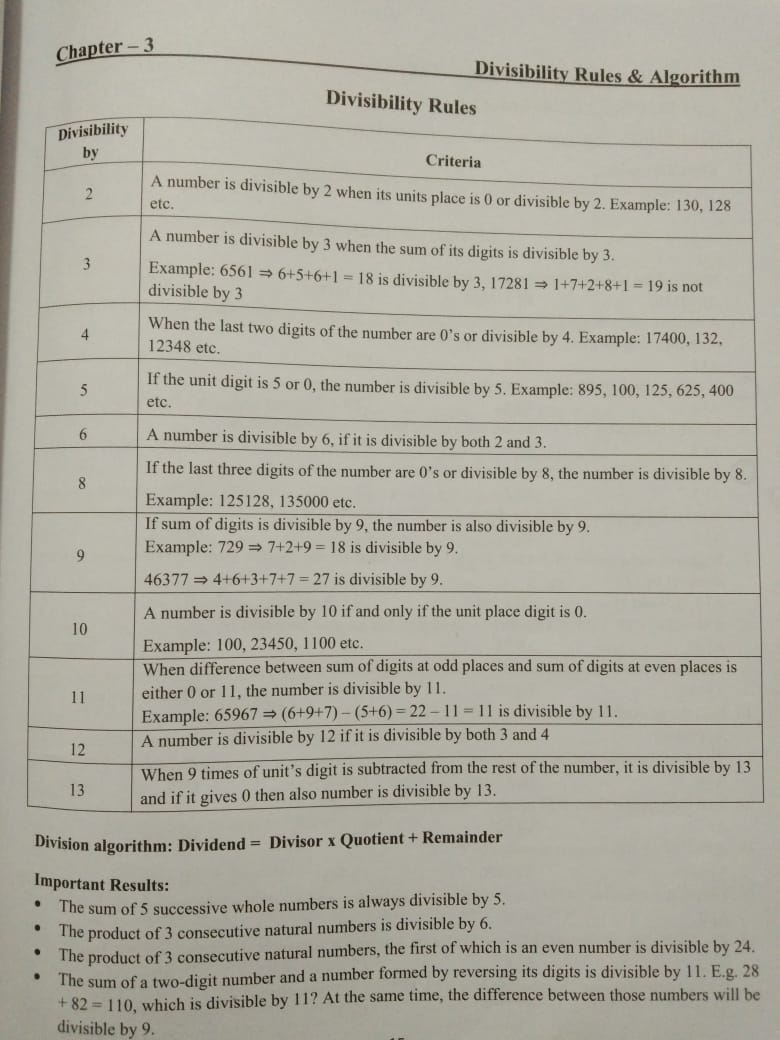
Para verificar multiplicar o número por 5 ou 2 e então esse número adicionar (se mul por 5) senão se mul por 2 (subtrair) através do número esquerdo
Por exemplo: 532 div por 7
Etapa 1- MuL 2x5 = 10 Etapa 2- Negligencie o dígito da unidade e adicione ao número 53 | 2+10 = 63
Verifique o número divisível se sim que o número original também é divisível.
Similsary multiplique por 2 e, em vez disso, adicione -o.
Multiplique o dígito da unidade por 5 e subestrate esse valor multiplicado com dígito de repouso se esse multilurente que o número for divisível por 17.
Por exemplo: 272 IV por 17
Etapa 1-
Mul 2*5 = 10 ** Etapa 2- **
27-10 = 17 17 é divisível por 17 Portanto, 272 é divisível por 17.
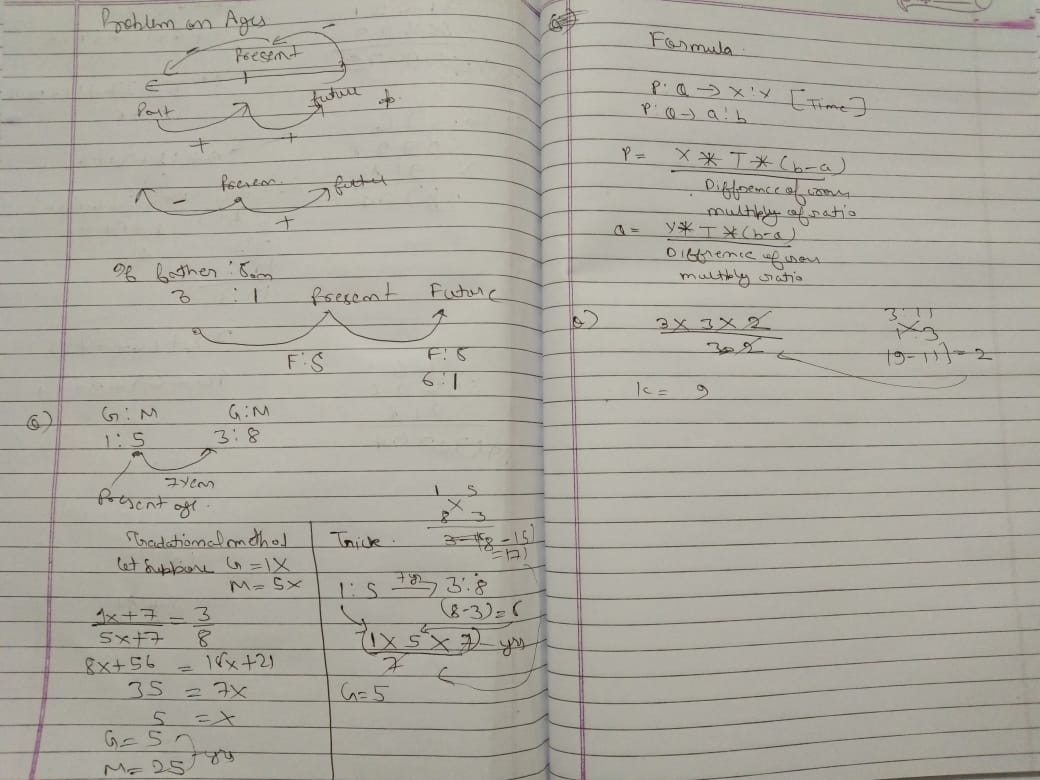
A face ou o mostrador do relógio é um círculo cuja circunferência é dividida em 60 partes iguais, denominadas espaços minuciosos.
Com a mão e um minuto, um relógio tem duas mãos. A mão menor é chamada de hora ou mão curta e a maior é chamada de mão minuciosa ou mão longa.
Em 60 minutos, a mão minuciosa ganha espaços de 55 minutos em uma hora.
(Em 60 minutos, o ponteiro moverá espaços de 5 minutos, enquanto a mão minuciosa moverá espaços de 60 minutos. Com efeito, o ganho de espaço de minuto em relação à mão de hora será de 60 - 5 = 55 minutos.)
Ambas as mãos de um relógio coincidem uma vez a cada hora.
As mãos de um relógio estão na mesma linha reta quando são coincidentes ou opostas uma à outra.
Quando as duas mãos de um relógio estão em ângulos retos , eles estão separados por 15 minutos .
Quando as mãos de um relógio estão em direções opostas, elas são de 30 minutos de separação.
Ângulo rastreado por hora em 12 horas = 360 °
Ângulo rastreado por um minuto de mão em 60 min. = 360 ° .
Teta (também conhecido como grau) = 30 x H- (11/2) XM
Ângulo de reflax = 360 - teta
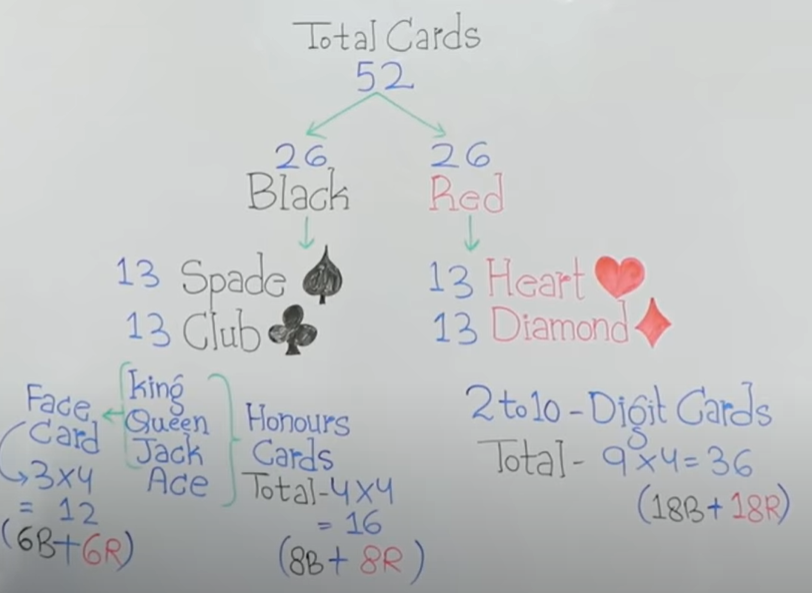
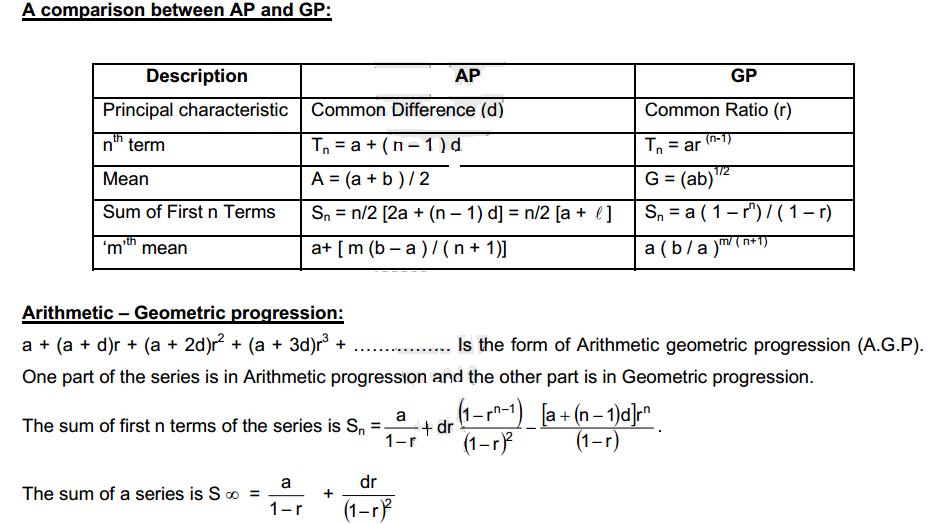

1. Números naturais (n) = 1, 2, 3 ,. . . . 2. Números inteiros (W) = 0, 1, 2, 3 ,. . . . 3. Intezers (z) = −∞. . . -2, −1, 0, 1, 2, 3 ,. . . 4. Números racionais (q) = os números do formulário p⁄q onde q ≠ 0. Por exemplo: 1⁄5, 0,46, 0,333333 Eles estão terminando, repetindo . 5. Números irracionais (i) = os números do formulário x1⁄n ≠ intestinal. Também π e E também números irracionais são não terminantes, não repetindo .
Outros tipos de números: a. Números pares: números que são exatamente divisíveis em 2. Esses números estão no formato de 2n. b. Números ímpares: números que dão o restante 1 Quando dividido por 2. Esses números estão no formato de 2n ± 1. C. Números primos: os números divisíveis por 1 e o próprio número são primos. O menor prime é 2. D. Números compostos: cujos números são divisíveis em mais de 2 números.
ímpar ± ímpar = uniforme;
mesmo ± uniforme = uniforme;
mesmo ± ímpar = ímpar
ímpar × ímpar = ímpar;
mesmo × uniforme = uniforme;
mesmo × ímpar = uniforme.
ímpar (qualquer número) = ímpar
mesmo (qualquer número) = mesmo
(a - b) 2 = (a2 + b2 - 2ab)
(a + b) 2 = (a2 + b2 + 2ab)
(a + b) (a - b) = (a2 - b2)
(a3 + b3) = (a + b) (a2 - ab + b2)
(A3 - B3) = (A - B) (A2 - AB + B2)
(a + b + c) 2 = a2 + b2 + c2 + 2 (ab + bc + ca)
(A3 + B3 + C3 - 3ABC) = (A + B + C) (AR> 2 + B2 + C2 - AB - BC - AC)
Dicas e truques rápidos
Etapa 1: Ao simplificar as expressões dadas, os primeiros colchetes devem ser removidos na ordem: '––', '()', '{}', '[]' '
Etapa2: as operações devem ser realizadas estritamente na ordem: divisão, multiplicação, adição e subtração
Bodmas é o atalho usado para lembrar o procedimento de simplificação.
B: Suporte
O: Order (ou seja, poder, raiz quadrada etc.)
D: Divisão (da esquerda para a direita)
M: Multiplicação (da esquerda para a direita)
A: adição (da esquerda para a direita)
S: Subtração (da esquerda para a direita)
Etapa 1: Ao simplificar as expressões dadas, os primeiros colchetes devem ser removidos na ordem: (), {}, []
Etapa2: as operações devem ser realizadas estritamente na ordem: divisão, multiplicação, adição e subtração
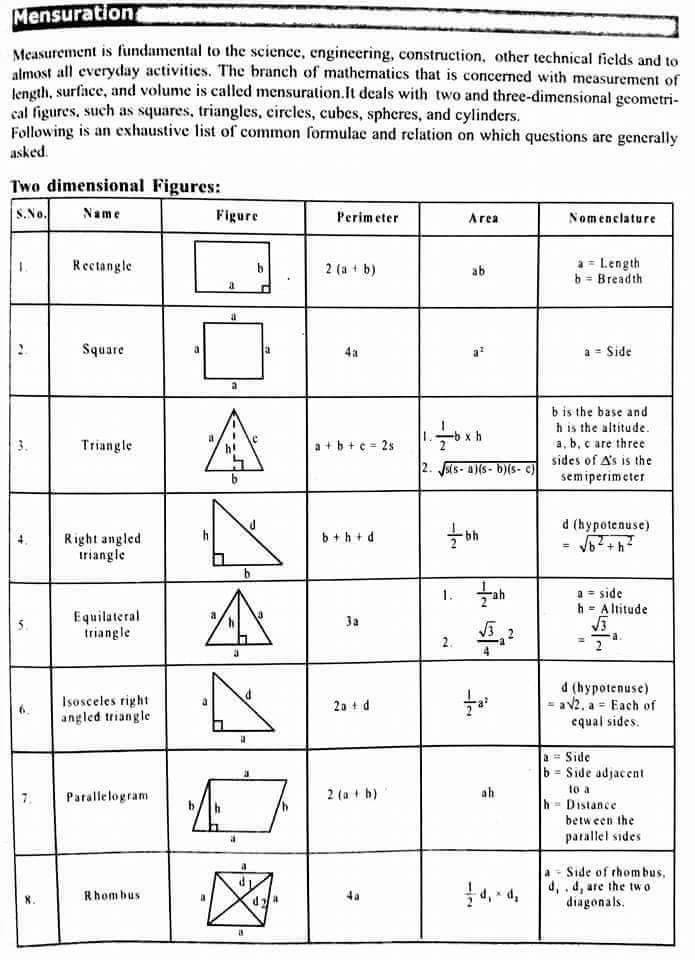
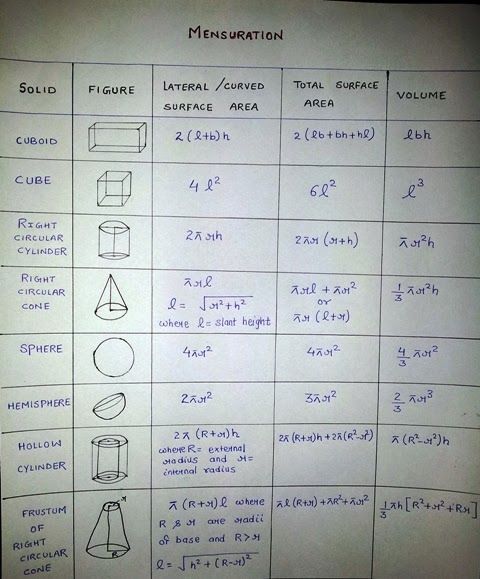
** FORMULA IMPORTANTE: **
Fórmula importante
Soma do quadrado de n número natural = n (n+1) (2n+1)/2
Soma de n número natural = n (n+1)/2
Soma em AP = nx (a+l)/2
AVG do primeiro número n ímpar = n
AVG do primeiro número n par = n+1
AVG de N Número da Naturat = (n+1)/2
AVG do número * Número total = soma
Pergunta baseada na população
Proporção e proporção
Código/decodificar
Registro
Pergunta verbal amcat
Restante negativo
Teste de elegibilidade
735/2
735/704
3/704
3/735
Solução
 Option A

Find the LCM of the numerators.

LCM (147, 30) = 1470

Step 2: Find the HCF of denominators.

HCF (64, 44) = 4

So, the LCM of 147/64 and 30/44 is (LCM of Numerators) / (HCF of Denominators) = 1470 / 4 = 735/2
A) 5 mph
B) 10 mph
C) 12 mph
D) 20 mph
Solução
 Option C

Let the speed of the river=x mph, then

Time taken row 30 miles upstream and 30 miles downstream = 30/(15-x) + 30/(15+x) = 9/2

= 10/(15-x) + 10/(15+x) = 3/2

= 2[10(15+x) + 10(15-x)] = 3(15-x)²

= 300 + 20x + 300 – 20x = 675 -3x²

x² = 25 or x=5
A) 3 dias
B) 4 dias
C) 4,5 dias
D) 5,4 dias
Solução
 option A

Working 5 hours a day, A can complete the work in 8 days = 5*8 = 40 hours

Working 6 hours a day, B can complete the work in 10 days = 6*10 = 60 hours

(A+B)’s 1 hour’s work = (1/40+1/60)

=(3+2)/120

= 1/24

Hence, A and B can complete the work in 24 hours which is equal to 3 days.
A) 6,5 litros
B) 5 litros
C) 4 litros
D) 7,5 litros
Solução
 Option B

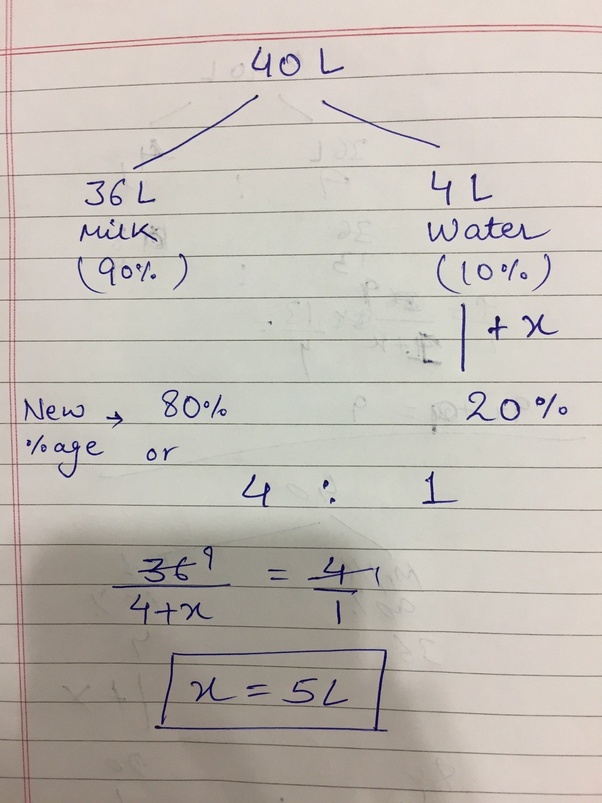
A mixture of 40 liters of milk = 36 liters of Milk and 4 liters of water = 90:10 ratio

Now the new mixture should be in the ratio of 80:20

Hence 80% is equivalent to 36 liters (no addition of milk is done)

100% is (36/80)*100 = 45 liters of milk is present in the new mixture

Thus water shall be added= (45 – 36 – 4) = 5 liters of water

**or**
A) 12 meia -noite
B) 3 da manhã
C) 6 da manhã
D) 9:00
Solução
 Option D

Four different devices beep after every 30 mins, 60 mins, 90 mins and 105 mins.

LCM of 30,60,90 and 105 is 1260.

Which means the devices beep together after every 1260 mins = 1260/60 = 21 hours

Hence 12 noon + 21 hours = 9 a.m
A) 21 m
B) 26 m
C) 28 m
D) 29 m
Solução
 Option C

When A travels 100 m, B travels 75 m. Hence A:B = 100:75

When B travels 100 m, C travels 96 m. Hence B:C = 100:96

When B Travels 75 m, C travels (96 x 75)/100 = 72 m

Hence B:C = 75:72.

Therefore, A:B:C = 100:75:72.

So, when A Travels 100 m, C travels 72 m.

Therefore, A beat C by 28 m
A) 62
B) 68
C) 66
D) 69
Solução
 Option A

70% students passed in physics = 30% failed in Physics.

65% students passed in Chemistry = 35% failed in Chemistry

Percentage of students failed in both subject = 27%.

Percentage of students failed = 35 + 30 – 27

= 38%.

Percentage of students passed = 100 – 38% = 62%
A) 40
B) 60
C) 100
D) 160
Solução
 Option D

15 oxen take 80 days so, 6 oxen take x days

x = 15*80/6 = 200 days

20 oxen also take 80 day. So, 2 cows take y days

y = 20*80/2 = 800 days

Together work will be done in 800*200/(800+200) = 160 days
A) 297/10377
B) 188/121
C) 21/34
D) 33/163
Solução
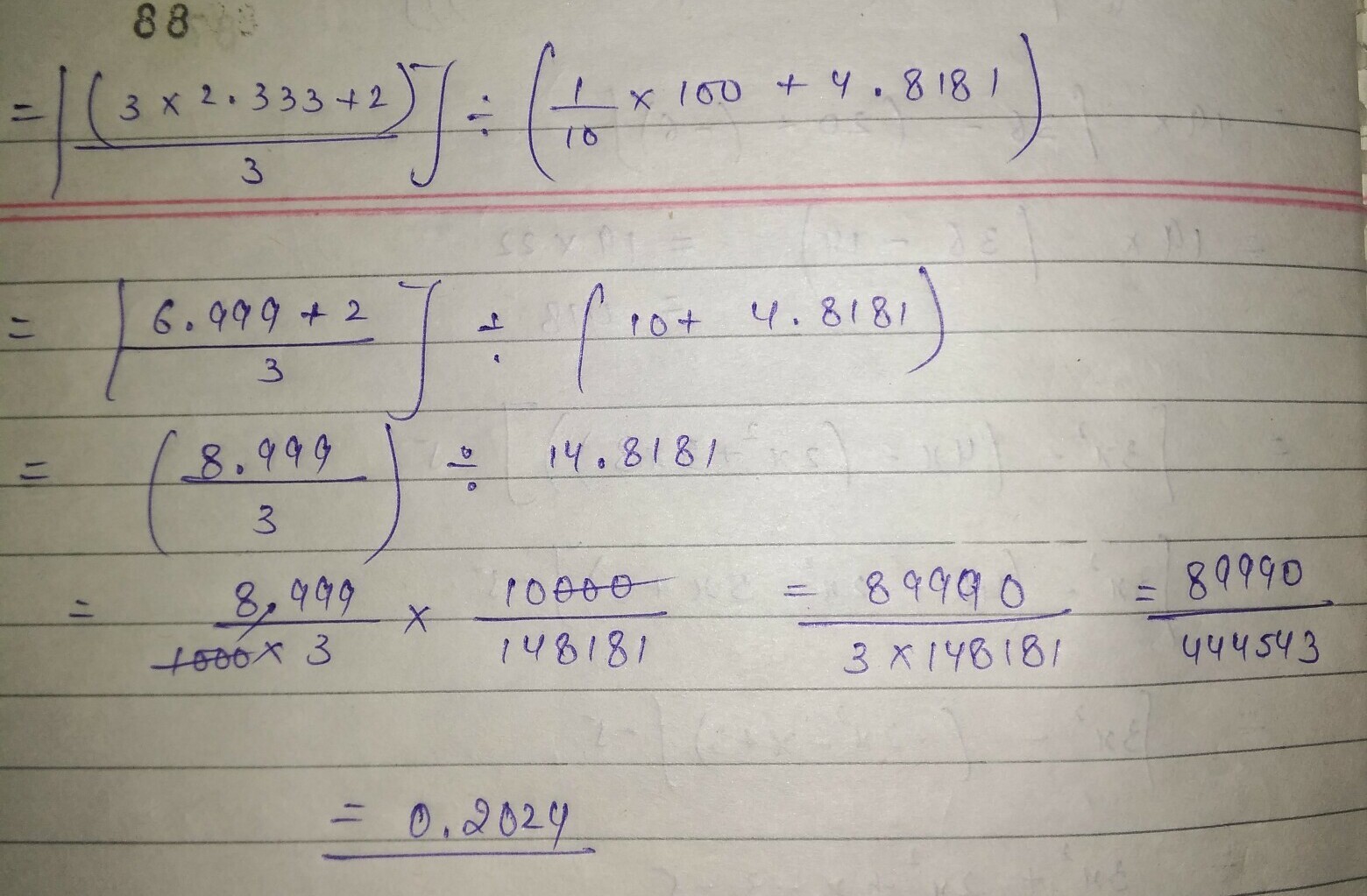
Solution: Option D
A) 6C4
B) 6p4
C) 4^6
D) 6^4
Solução
C is correct because all 4 can get 4 ticket one by one
A) 550
B) 450
C) 350
D) 150
Solução
 Option B

Going through the options,

Taking Cost Price as Rs 450.

Profit = 650 – 450 = 200

Loss = 350 – 450 = 100

Clearly profit is twice the loss incurred.

Hence, Rs 450 is the correct option.
A) 7 horas 30 minutos
B) 8 horas
C) 8 horas 15 minutos
D) 8 horas 25 minutos
Solução
 Option C

In 1hr, Ronald types = 32/6 pages and Elan types = 40/5 pages

If they work together they will type = 32/6 + 40/5 = 40/3 pages in 1 hr

Time needed  to complete the assignment is = (3 x 110)/40 = 33/4 = 8hrs 15mins

Hence, the time required is 8 hrs 15 mins.
A) diminuiu em 20%
B) aumentou 20%
C) aumentou 10%
D) diminuiu 10%
Solução
Option D

Let the initial Price = Rs.100 and initial sales = 100

So, the initial revenue = Rs. 10000

Now, the price is reduced to 25% which is equal to Rs.75 and Sales is increased by 20% which is equal to 120.

Now new revenue = 120 x 75 = Rs. 9000

Change in revenue = (10000 – 9000) = Rs.1000 decrease

% decrease = (1000/10000) x 100 = 10%

Hence, the correct option is decrease of 10%.
A) 19/21
B) 3/7
C) 2/21
D) 1/3
Solução
 Option A

Probability of getting atleast one nestle chocolate = [(10C1 x 5C1) + 10C2] / 15C2

[(10 x 5) + (10 x 9)/2] / [(15 x 14)/2] = 19/21.

Hence, the required probability is 19/21.
A) Rs 7490
B) Rs 7350
C) Rs 8250
D) Rs 8530
E) Nenhuma destes
Solução
 Option B

Solution:
Share of Anil : Share of Ruhi : Share of Teena is
2000×8 + 2600×4 : 2800×8 + 3200×4 : 4200×4
33 : 44 : 21
so share of Teena = 21/(33+44+21) × 34300 = Rs 7350
A) Rs 3200
B) Rs 4500
C) Rs 3800
D) Rs 3500
E) Rs 2800
Solução:
 Option C

Solution:
Rs 3800
Solution:
(7000-x)*8*4/100 = x [ (1 + 10/100)2 – 1] + 226
70*8*4 – 32x/100 = 21x/100 + 226
2240 – 226 = 53x/100
2014 = 53x/100
So, x = Rs 3800
A) 16
B) 18
C) 12
D) 10
E) 22
Solução:
 Option A

Solution:
20 men in 8 days so 16 men in 20 × 8/16 = 10 days and
25 women in 12 days so 10 women in 25 × 12/10 = 30 days
So in 3 days, they complete (1/10 + 1/30) × 3 = 2/5
So remaining work = 1 – 2/5 = 3/5
20 m 1 work in 8 days and x men 3/5 work in 6 days
So 20 × 8 × 3/5 = x × 6 × 1
So, x = 16 men
A) 3/5
B) 2/9
C) 1/8
D) 3/7
E) Nenhuma destes
Solução:
 Option D

Solution
Number of multiples of 3 in 140 = 140/3 = 46
Number of multiples of 7 in 140 = 140/7 = 20
Number of multiples of 3×7= 21 in 140 = 140/21 = 6
So required probability = (46+20 – 6)/140 = 60/140 = 3/7
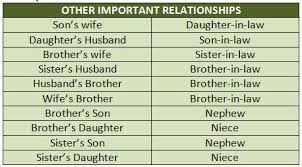
A. Mãe
B. Irmã
C. sobrinha
D. tia materna
Solução c
A) a
B) b
C) c
D) e
Solução:
 E
Solution:
D is father of A and grandfather of F. So, A is father of F.

Thus. D and A are the two fathers. C is the sister of F So. C is the daughter of A.

Since there is only one mother, it is evident that E is the wife of A and hence the mother of C and F.

So, B is brother of A There are three brothers. So. F is the brother of C.

 Clearly, A is E's Husband.
A) Mãe
B) irmã
C) tia
D) avó
Solução:
 C

Solution:
Only son of Amar's mother's father — Amar's maternal uncle.

So, the girl's maternal uncle is Arnar's maternal uncle. Thus, the girl's mother is Amar's aunt.
A) 12
B) 13
C) 14
D) 15
Solução:
 A

Solution:
A+B=B+C+12
so
A=12
Solução:
 P=(3*2*5)/1=30
Q=(4*2*5)/1=40
Solução:
 (150+x)/15=16.

=)150+x=240

=x=90
Média de suas idades = soma/número =) 90/5 = 18
A. 154 °
B. 170 °
C. 160 °
D. 180 °
Solução:
 We know that angle traced by hour hand in 12 hrs = 360°

From 8 to 2, there are 6 hours.

Angle traced by the hour hand in 6 hours =  6×360/12= 180°
A. 120 °
B. 125 °
C. 130 °
D. 135 °
Solução:
 C
Solution:
Angle traced by hour hand in 12 hrs. = 360°.

Angle traced by it in	11/3	hrs =	(360/12	x	11/3)°	= 110°.
Angle traced by minute hand in 60 min. = 360°.

Angle traced by it in 40 min. =	(360/60x40)°= 240°.
 Required angle (240 - 110)° = 130°.
A. 3.6
B. 7.2
C. 8.4
D. 10
Solução:
 B
Solution:

Speed =600/(5 x 60)= 2 m/sec.
Converting m/sec to km/hr (see important formulas section)
   =	(2 x18/5)km/hr= 7.2 km/hr.
A. 10
B. 8
C. 6
D. 4
Solução:
 C

Opposite direction
speed=60+6=66km/h
time=distance/speed=110/66=5/3 km/h
in m/s 5/3x18/5=6
A. 14,4 segundos
B. 15,5 segundos
C. 18,8 segundos
D. 20,2 segundos
Solução:
 A
Solution :
Let length of each train be x meter.

Then, speed of 1st train = x/18m/sec

Speed of 2nd train = x/12 m/sec

Now,

When both trains cross each other, time taken

=2x/(x/18+x/12)=2x/(2x+3x)/36=(2x X 36)/5x=725=14.4seconds
767 495 359 291 257?
A. 230 B. 240 C. 250 D. 280 E. 260
Soluton:
 B

Solution:

797-495=272
495-359=136
So which means it is half of previous diffrences
272/2=136
291-257=32
34/2=17
So subtract 17
257-17=240
50 67 33 84 16?
A. 101 B. 109 C. 107 D. 103 E. 201
Solução:
 A

Solution:
17 is the gap once increase and than decrease follow this order you will get the answer
192
10
38
2
3
Solução:
 3

Solution:
Logic is 2×1 + 1 = 3, 3 × 2 + 4 =10, 10 × 3 + 9 = 39, 39 × 4 + 16 = 172…. So in place of 38, it should be 39.
999980
999990
999984
Nenhum deles
Solução:
Greatest six-digit number is 999999. Divide this number by 12 and get remainder as 3. Since the remainder is 3, if you subtract 3 from the number, the remaining number will be a multiple of 12. So the greatest such number will be 999999 – 3 =999996.
5000
4950
4980
4900
Nenhum deles
Solução:
 Multiples of 3 between 100 and 200 are 102, 105, 108,… ,198.
Here, the first term = 102
last term = 198
Let the number of Multiples of 3 between 100 and 200 = n

W.K.T: Arithmetic Progression Formula:
an = a1 + (n - 1)d
Where, an = last term = 198
a1 = first term = 102
d = common difference = 105 - 102 = 3
---> 198 = 102 + (n - 1) * 3
---> 198 - 102 = (n - 1) * 3
---> 96 = (n - 1) * 3
---> (n - 1) = 96/3 = 32
---> n = 32 + 1
---> n = 33

Formula:
Sum of n terms = Sn = (n/2) * (a + l)
where n = number of elements = 33
a = first term = 102
l = last term = 198
Thus, using the above formula, Sum of all natural numbers between 100 and 200 which are multiples of 3 = (33/2) * (102 + 198)
= (33/2) * 300
= 33 * 150
= 4950
A. 5, 15, 25
B. 12, 15, 18
C. 10, 15, 20
D. -10, -15, -20
Solução:
Assuming that the numbers are (a – d), a, (a + d) and their sum is 45, we get the middle number as 15. Now, the product (a – d) (a + d) = 200. Solving, we get d = 5. Therefore, the numbers are 10, 15 and 20.
Solução:
 x/(y+1)=1/2

and

(x+1)/y=1

2x-y=1 ....eq (1)

x=y-1 ....eq (2)

by solving eq 1 and 2 we get

x=2 and y=3
A. 80
B. 75
C. 42
D. 53
Responder:
 Option D

Solution:
As the Number gives a remainder of 4 when it is divided by 7, then the number must be in form of (7x + 4)

The same gives remainder 1 when it is divided 4, so the number must be in the form of {4 × (7x + 4) + 1}

Also, the number when divided by 3 gives remainder 2, thus number must be in form of [3 × {4 × (7x + 4) + 1} + 2]

Now, On simplifying,
[3 × {4 × (7x + 4) + 1} + 2]
= 84x + 53
We get the final number 53 more than a multiple of 84 Hence, if the number is divided by 84,
The remainder will be 53
A) 55/601
B) 601/55
C) 11/120
D) 120/11
Solução:
 Then, a + b = 55 and ab = 5 x 120 = 600.
The required sum =1a+1b = a+bab= 55600=11120
Solução:
5
2, 3, 5, 8, 13, 20, 34
Solução:
 first+second=third
follow this order you get **20** as a answer
196, 169, 144, 121, 100, 80
Solução:
 80
First - Second=2
A. CMN
B. Uji
C. VIJ
D. IJT
Solução:
C
Olnnie
Onilen
Noilen
Lnoeni
Onnlie
Solução:
1
um. 9 anos
b. 10 anos
c. 13 anos
d. 15 anos
Solução:
 Correct Option: (c)

We have to find the population of cities A and B after x years.

Step 1: Population of city A = 68000, decreases at the rate of 1200/year
68000 – 1200x

Step 2: Population of city B = 42000, increases at the rate of 800/year
42000 + 800x

Step 3: Find after how many population of cities A and B are equal.

Population of city A = Population of city B
68000 – 1200x = 42000 + 800x
68000 – 42000 = 1200x + 800x
26000 = 2000x
x = 13
um. 28 dias
b. 30 dias
c. 34 dias
d. 40 dias
Solução:
 Correct Option: (b)

Step 1: Number of days worked by the worker = 60 and he remained idle for x days. Therefore, number of days worked = (60 – x)

Step 2: Each day he was getting paid Rs. 20. Therefore, the payment received for working days = (60 – x) 20

Step 3: After subtracting the amount which he forfeited, he receives Rs. 300.

Therefore,
(60 – x) 20 – 10x = 300
1200 – 20x – 10x = 300
900 = 30x
x = 30 days
um. 11
b. 15
c. 16
d. 18
Solução:
 Correct Option: (b)

Let’s the number of farmers be y.

Step 1: Find number of heads
= (50 hens + 45 goats + 8 horses + y farmers)
= (103 + y)

Step 2: Number of feet
= [(Hens 2 × 50) + (45 × 4) + (8 × 4) + (y × 2)]
= [100 + 180 + 32 + 2y]
= 312 + 2y

Step 3: Find number of farmers
(312 + 2y) – (103 + y) = 224
312 + 2y – 103 – y = 224
y = 15
A) 49500
B) 49950
C) 45000
D) 49940
Solução:
 The Correct answer is (B)

Answer with explanation:

The digit 5 has two place values in the numeral, 5 * 105 = 50,000 and 5 * 101 = 50.

∴Required difference = 50000 - 50 = 49950
A) rs. 180
B) Rs. 204
C) Rs. 210
D) Rs. 220
Solução:
 Option B
CI=P(1+r/100)^t

CI=2500*(1+4/100)^2
CI=2704
So the diffrenece is 204
A) rs. 5222.2
B) Rs. 5777.7
C) Rs. 6222.2
D) Rs. 6777.7
Solução:
 Option B
80000*12/65000*6=32/13
113/32*20000=5777.7rs
A) Quinta -feira
B) quarta -feira
C) Sexta -feira
D) Domingo
Solução:
 The correct option is (B)

Explanation:

The year 1996 is divisible by 4, so it is a leap year with 2 odd days.

As per the question, the first day of the year 1996 was Monday, so the first day of the year 1997 must be two days after Monday. So, it was Wednesday.
A) 1,5 km/h
B) 2 km/h
C) 2,5 km/h
D) 1 km/h
Solução:
 The correct answer is B

Answer with explanation:

Let the speed of stream = X km/hr

Speed of boat = 5 km/hr

Speed upstream = 3km/hr

Apply formula: Speed upstream = speed of boat - speed of stream

∴ 3 = 5 - X

X = 5 - 3 = 2 km/hr
A) 24
B) 22
C) 23
D) 21
Solução:
 The Correct answer is (B)

Explanation:

The hands of a clock coincide only once between 11 O' clock and 1 O' clock, so in every 12 hours, the hands of a clock will coincide for 11 times.

∴ In a day or 24 hours, the hands of a clock will coincide for 22 (11+11) times.
A) 10 horas
B) 12 horas
C) 14 horas
D) 16 horas
Solução:
 Option B
Water enter in 1 hr=1/6
Water empty in 1 hr=1/12
net=1/6-1/12=1/12
or 12hr
A) 8,5 km/s
B) 7,5 km/s
C) 9,5 km/s
D) 6,5 km/s
Solução:
 Option B
sec=4*60=240s
speed=500/240=25/12m/s
in km/s speed is =25/12*18/5=7.5km/s.
Solução:
 Surface area of cube=6a^2
600=6*a^2
a=10
diagonal of cube=sqrt(3)*a
ans=sqrt(3)*10
O HCF de dois números é 23 e os outros dois fatores de seu LCM são 13 e 14. O maior dos dois números é:
A. 276
B. 299
C. 322
D. 345
Solução:
 Answer: Option C

Explanation:

Clearly, the numbers are (23 x 13) and (23 x 14).

 Larger number = (23 x 14) = 322.
Seis sinos começam a tocar juntos e pedágio em intervalos de 2, 4, 6, 8 10 e 12 segundos, respectivamente. Em 30 minutos, quantas vezes eles tocam juntos?
A. 4
B. 10
C. 15
D. 16
Solução:
 Answer: Option D

Explanation:

L.C.M. of 2, 4, 6, 8, 10, 12 is 120.

So, the bells will toll together after every 120 seconds(2 minutes).

In 30 minutes, they will toll together	30	+ 1 = 16 times.
2
Seja n o maior número que dividirá 1305, 4665 e 6905, deixando o mesmo restante em cada caso. Então a soma dos dígitos em n é:
A. 4
B. 5
C. 6
D. 8
Solução:
 Answer: Option A

Explanation:

N = H.C.F. of (4665 - 1305), (6905 - 4665) and (6905 - 1305)

  = H.C.F. of 3360, 2240 and 5600 = 1120.

Sum of digits in N = ( 1 + 1 + 2 + 0 ) = 4
A. 9000
B. 9400
C. 9600
D. 9800
Solução
 Answer: Option C

Explanation:

Greatest number of 4-digits is 9999.

L.C.M. of 15, 25, 40 and 75 is 600.

On dividing 9999 by 600, the remainder is 399.

 Required number (9999 - 399) = 9600.
A) 50 dias
B) 60 dias
C) 84 dias
D) 9.333 dias
Solução:
 Answer: C

Explanation:

Let 5 men can reap a field in x days
So, put the same quantities on the same side.
Men: Days
Now, Men and Days are inversely proportional to each other. If we increase the number of men fewer days will be required to complete the work.
Inversely proportional means Apti Chain Rule
Apti Chain Rule

i.e., 5: 15 = 28: x
Or, x = (28*15)/ 5
Or, x = 84 days
Hence, 5 men can reap a field in 84 days.
A) 16
B) 13/5
C) -16/3
D) 12
Solução:
 Answer: C

Explanation:

Let log2√2 [1/256] = x

We know that loga y = x is similar to ax = y

So, we can write it as [1/256] = (2√2) x

Or, (2√2) x = [1/28]

Or, [21 * 21/2]x = 1/28

Or, 23x/2 = 2-8

Therefore, 3x/2 = -8

Hence, x = (-8 * 2)/ 3 = -16/3
Solução:
(6!)/(2!)(2!)=180
Solução:
 You can see number less than 3! are not divisible by 8 so it decide your output
(1!+2!+3!)=9
9%8=1
1 is the answer
A. 2400
B. 2000
C. 1904
D. 1906
E. Nenhuma destes
Solução:
 106 x 106 - 94 x 94	= (106)2 - (94)2
= (106 + 94)(106 - 94)    [Ref: (a2 - b2) = (a + b)(a - b)]
= (200 x 12)
= 2400.
A diferença de dois números é 1365. Ao dividir o número maior pelo menor, obtemos 6 como quociente e os 15 como restantes. Qual é o número menor?
A. 240
B. 270
C. 295
D. 360
Resposta: Opção b
Explicação:
 Let the smaller number be x. Then larger number = (x + 1365).

 x + 1365 = 6x + 15

 5x = 1350

 x = 270

Smaller number = 270
A. 1035
B. 1280
C. 2070
D. 2140
Resposta: Opção a
Explicação:
 Let Sn =(1 + 2 + 3 + ... + 45). This is an A.P. in which a =1, d =1, n = 45.

Sn =	n	[2a + (n - 1)d]	=	45	x [2 x 1 + (45 - 1) x 1]	=		45	x 46		= (45 x 23)
2	2	2
= 45 x (20 + 3)

= 45 x 20 + 45 x 3

= 900 + 135

= 1035.

Shorcut Method:

Sn =	n(n + 1)	=	45(45 + 1)	= 1035.
2	2
[A] 7 horas 30 minutos
[B] 8 horas
[C] 8 horas 15 minutos
[D] 8 horas 25 minutos
Solução)
 C)
Ronald 1 hr work = 32/6=16/3
Elan 1 hr work = 40/5=8
Show both work in an hr=8+16/3=40/3
Show for 110 pages it will take 110/(40/3) or (110 x 3)/40=33/4hr
Since: convert it into hr 4*8=32 1 left in 1 hr 60 min 60/4=15min

Show final answer is 8hr 15 mon
Solução:
link para solução
 4^x/4^x + 6^x/4^x = 9^x/4^x
Now,
1 + (3/2)^x=(3/2)^(2x)
Consider (3/2)^x=u
Then,
1 + u = u^2
Simplifying this

0 = u^2 -u -1

By solving we get
u = (1 + sqrt(5))/2

and this equal to
(1 + sqrt(5))/2 = (3/2)^x
Take log both side

and you get 1.187 approx value.
 Solution:
circumference of an wheel=πd
=22/7×98
22×14
=308cm =1 revolution
distance covered
1540×100=154000
now,154000÷308
500 rotations
A. 2%
B. 2,02%
C. 4%
D. 4,04%
E. Nenhuma destes
Resposta: Opção d
 100 cm is read as 102 cm.
∴ A1 = (100 x 100) cm2 and A2 (102 x 102) cm2
(A2 - A1) = [(102)2 - (100)2]
              = (102 + 100) x (102 - 100)
              = 404 cm2
∴ Percentage error
=(404100×100×100)%=4.04%
 Area of the square=484cm
side-22cm
perimeter=22*4=88cm
circumfrence of cirlce is 2*pi*r=88
r=14cm
area=pi*r*r=616cm^2
Solução
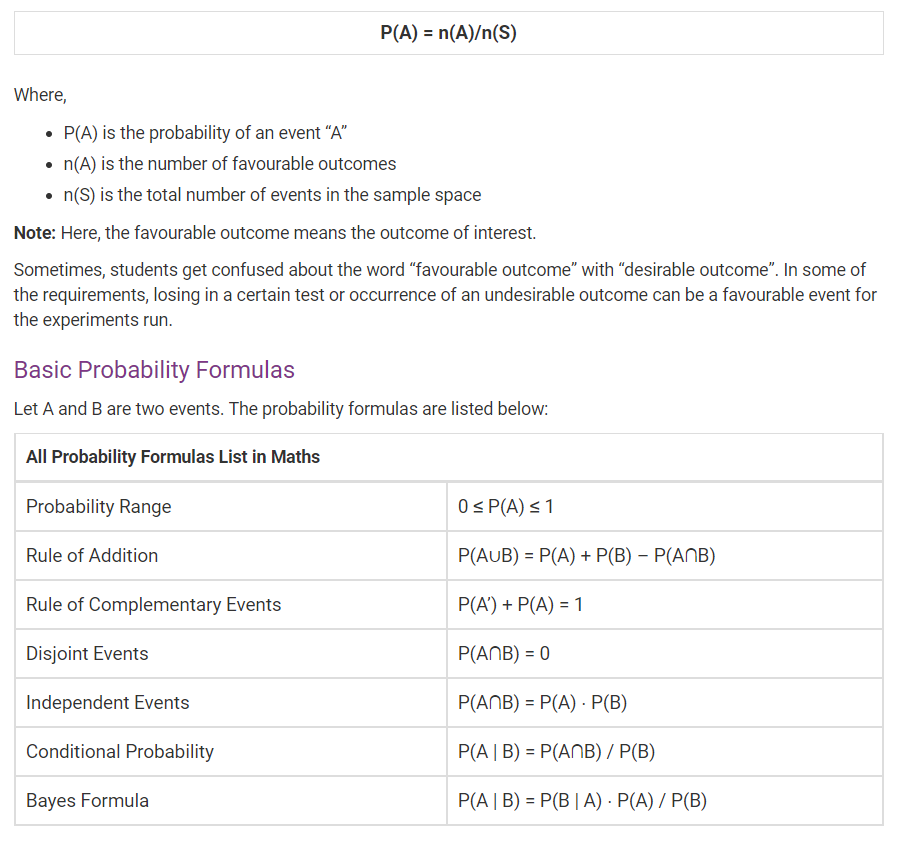
 P(A)=1/9
P(B)=1/6
P(C)=26/36=13/18
Apply GP
you get 2/5 ans





