face.evoLVe
1.0.0

| Auteur | Jian Zhao |
|---|---|
| Page d'accueil | https://zhaoj9014.github.io |
Le code de face.evolve est publié sous la licence MIT.
✅ CLOSED 02 September 2021 : Baidu Paddlepaddle a officiellement fusionné FACE.Volve pour faciliter les recherches et les applications sur l'analyse liée au visage (annonce officielle).
✅ CLOSED 03 July 2021 : Fournit un code de formation pour le cadre Paddlepaddle.
✅ CLOSED 04 July 2019 : Nous partagerons plusieurs ensembles de données accessibles au public sur la détection anti-usurre / vivacité pour faciliter la recherche et l'analyse connexes.
✅ CLOSED 07 June 2019 : Nous formons un modèle IR-152 mieux performant sur MS-celeb-1m_align_112x112, et publierons bientôt le modèle.
✅ CLOSED 23 May 2019 : Nous partageons trois ensembles de données accessibles au public pour faciliter les recherches sur la reconnaissance et l'analyse du visage hétérogènes. Veuillez vous référer à la Sec. Zoo de données pour plus de détails.
✅ CLOSED 23 Jan 2019 : Nous partageons les listes de noms et les listes de chevauchement par paire de plusieurs ensembles de données de reconnaissance faciale largement utilisés pour aider les chercheurs / ingénieurs à supprimer rapidement les pièces qui se chevauchent entre leurs propres ensembles de données privés et les ensembles de données publiques. Veuillez vous référer à la Sec. Zoo de données pour plus de détails.
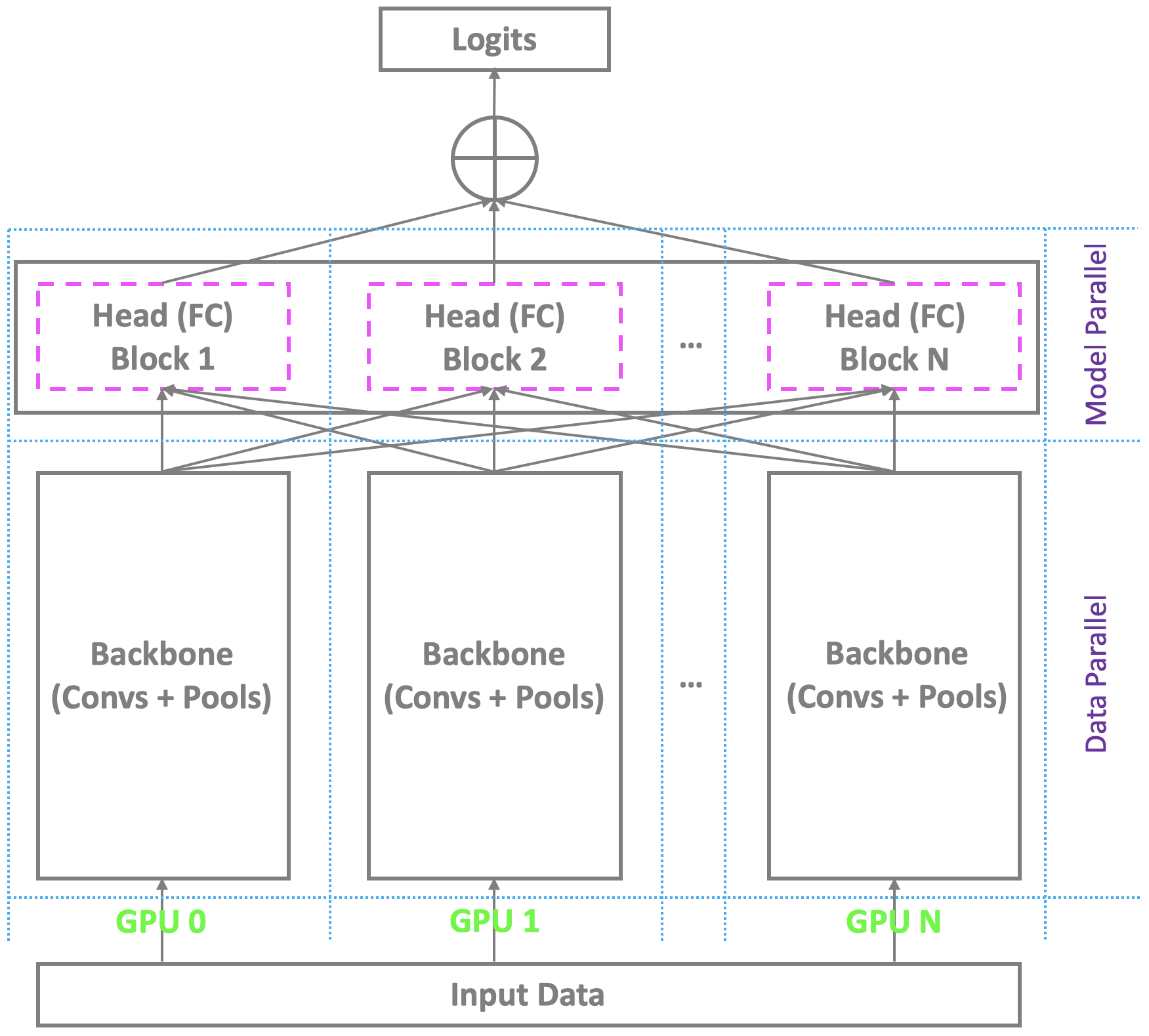
✅ CLOSED 23 Jan 2019 : Le schéma de formation distribué actuel avec multi-GPU sous Pytorch et d'autres plates-formes grand public parallèle à l'épine dorsale à travers le multi-GPU tout en s'appuyant sur un seul maître pour calculer le compteur d'étranglement final (entièrement connecté / softmax). Ce n'est pas un problème pour la reconnaissance faciale conventionnelle avec un nombre modéré d'identités. Cependant, il lutte contre la reconnaissance du visage à grande échelle, ce qui nécessite de reconnaître des millions d'identités dans le monde réel. Le maître peut difficilement contenir la couche finale surdimensionnée tandis que les esclaves ont toujours des ressources de calcul redondantes, conduisant à une formation en petit lots ou même à une formation échouée. Pour résoudre ce problème, nous développons un schéma de formation distribué hautement élégant, efficace et efficiente avec plusieurs GPU sous Pytorch, soutenant non seulement l'épine dorsale, mais aussi la tête avec la couche entièrement connectée (softmax), pour faciliter la reconnaissance du visage à grande échelle à grande échelle. Nous allons ajouter ce support à notre dépôt.
✅ CLOSED 22 Jan 2019 : Nous avons publié deux API d'extraction de fonctionnalités pour extraire les fonctionnalités de modèles pré-formés, implémentés avec des fonctions d'intégration Pytorch et OpenCV, respectivement. Veuillez vérifier ./util/extract_feature_v1.py et ./util/extract_feature_v2.py .
✅ CLOSED 22 Jan 2019 : Nous affinons notre modèle IR-50 libéré sur nos données de visage privés en Asie, qui seront publiées prochainement pour faciliter la reconnaissance du visage en Asie haute performance.
✅ CLOSED 21 Jan 2019 : Nous formons un modèle IR-50 mieux performant sur MS-Celeb-1m_align_112x112, et remplacerons bientôt le modèle actuel.
?
?
pip install torch torchvision )pip install mxnet-cu90 )pip install tensorflow-gpu )pip install tensorboardX )pip install opencv-python )pip install bcolz )Bien que non requis, pour des performances optimales, il est fortement recommandé d'exécuter le code à l'aide d'un GPU compatible CUDA. Nous avons utilisé 4-8 Nvidia Tesla P40 en parallèle.
?
git clone https://github.com/ZhaoJ9014/face.evoLVe.PyTorch.git .mkdir data checkpoint log dans le répertoire approprié pour stocker vos données de train / Val / Test, des points de contrôle et des journaux de formation. ./data/db_name/
-> id1/
-> 1.jpg
-> ...
-> id2/
-> 1.jpg
-> ...
-> ...
-> ...
-> ...
?
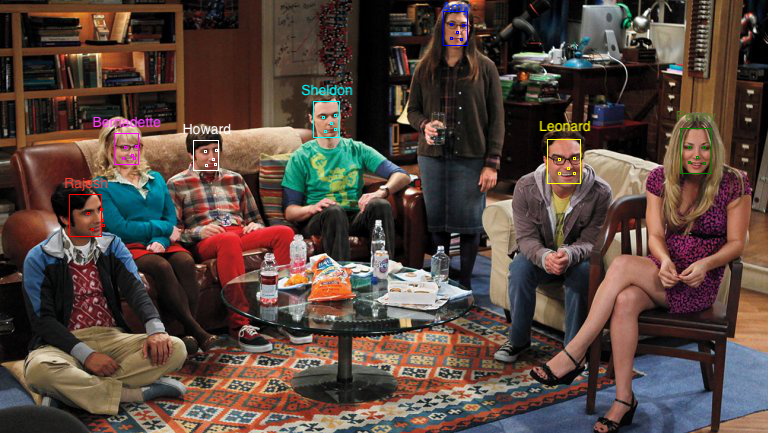

./align from PIL import Image
from detector import detect_faces
from visualization_utils import show_results
img = Image . open ( 'some_img.jpg' ) # modify the image path to yours
bounding_boxes , landmarks = detect_faces ( img ) # detect bboxes and landmarks for all faces in the image
show_results ( img , bounding_boxes , landmarks ) # visualize the resultssource_root avec la structure du répertoire, comme démontré dans l'usage de SEC, et stockez les résultats alignés sur un nouveau dossier dest_root avec la même structure de répertoire): python face_align.py -source_root [source_root] -dest_root [dest_root] -crop_size [crop_size]
# python face_align.py -source_root './data/test' -dest_root './data/test_Aligned' -crop_size 112
*.DS_Store qui peuvent ruiner vos données, car ils seront automatiquement supprimés lorsque vous exécutez les scripts.source_root , dest_root et crop_size sur vos propres valeurs lorsque vous exécutez face_align.py ; 2) Passez vos valeurs min_face_size , thresholds et nms_thresholds à la fonction detect_faces de detector.py pour faire correspondre vos exigences pratiques; 3) Si vous trouvez que la vitesse à l'aide de l'API d'alignement face est un peu lent, vous pouvez appeler API RE-SIMIENCE FACE pour tout d'abord redimensionner l'image dont la taille plus petite est plus grande qu'un seuil (spécifiez les arguments de source_root , dest_root et min_side à vos propres valeurs) avant d'appeler l'API d'alignement FACE: python face_resize.py
./balancemin_num dans la root de l'ensemble de formation avec la structure du répertoire comme démontré dans la Sec. Utilisation pour l'équilibre des données et la formation de modèle efficace): python remove_lowshot.py -root [root] -min_num [min_num]
# python remove_lowshot.py -root './data/train' -min_num 10
root et min_num à vos propres valeurs lorsque vous exécutez remove_lowshot.py .☕
Dossier: ./
API de configuration (configurer vos paramètres globaux pour la formation et la validation) config.py :
 import torch

configurations = {
    1 : dict (
        SEED = 1337 , # random seed for reproduce results

        DATA_ROOT = '/media/pc/6T/jasonjzhao/data/faces_emore' , # the parent root where your train/val/test data are stored
        MODEL_ROOT = '/media/pc/6T/jasonjzhao/buffer/model' , # the root to buffer your checkpoints
        LOG_ROOT = '/media/pc/6T/jasonjzhao/buffer/log' , # the root to log your train/val status
        BACKBONE_RESUME_ROOT = './' , # the root to resume training from a saved checkpoint
        HEAD_RESUME_ROOT = './' , # the root to resume training from a saved checkpoint

        BACKBONE_NAME = 'IR_SE_50' , # support: ['ResNet_50', 'ResNet_101', 'ResNet_152', 'IR_50', 'IR_101', 'IR_152', 'IR_SE_50', 'IR_SE_101', 'IR_SE_152']
        HEAD_NAME = 'ArcFace' , # support:  ['Softmax', 'ArcFace', 'CosFace', 'SphereFace', 'Am_softmax']
        LOSS_NAME = 'Focal' , # support: ['Focal', 'Softmax']

        INPUT_SIZE = [ 112 , 112 ], # support: [112, 112] and [224, 224]
        RGB_MEAN = [ 0.5 , 0.5 , 0.5 ], # for normalize inputs to [-1, 1]
        RGB_STD = [ 0.5 , 0.5 , 0.5 ],
        EMBEDDING_SIZE = 512 , # feature dimension
        BATCH_SIZE = 512 ,
        DROP_LAST = True , # whether drop the last batch to ensure consistent batch_norm statistics
        LR = 0.1 , # initial LR
        NUM_EPOCH = 125 , # total epoch number (use the firt 1/25 epochs to warm up)
        WEIGHT_DECAY = 5e-4 , # do not apply to batch_norm parameters
        MOMENTUM = 0.9 ,
        STAGES = [ 35 , 65 , 95 ], # epoch stages to decay learning rate

        DEVICE = torch . device ( "cuda:0" if torch . cuda . is_available () else "cpu" ),
        MULTI_GPU = True , # flag to use multiple GPUs; if you choose to train with single GPU, you should first run "export CUDA_VISILE_DEVICES=device_id" to specify the GPU card you want to use
        GPU_ID = [ 0 , 1 , 2 , 3 ], # specify your GPU ids
        PIN_MEMORY = True ,
        NUM_WORKERS = 0 ,
),
}
API Train & Validation (tous les gens sur la formation et la validation, c'est-à-dire , le package d'importation, les hyperparamètres et les chargeurs de données, le modèle et la perte et l'optimiseur, le train et la validation et l'enregistrement de contrôle) train.py . Étant donné que MS-Celeb-1m sert d'imageNet dans le fichier de reconnaissance faciale, nous pré-entraînons les modèles FACE.EVOLOVE sur MS-Celeb-1M et effectuons une validation sur LFW, CFP_FF, CFP_FP, AgedB, CALFW, CPLFW et VGGFFACE2_FP. Plongeons dans les détails étape par étape.
 import torch
import torch . nn as nn
import torch . optim as optim
import torchvision . transforms as transforms
import torchvision . datasets as datasets

from config import configurations
from backbone . model_resnet import ResNet_50 , ResNet_101 , ResNet_152
from backbone . model_irse import IR_50 , IR_101 , IR_152 , IR_SE_50 , IR_SE_101 , IR_SE_152
from head . metrics import ArcFace , CosFace , SphereFace , Am_softmax
from loss . focal import FocalLoss
from util . utils import make_weights_for_balanced_classes , get_val_data , separate_irse_bn_paras , separate_resnet_bn_paras , warm_up_lr , schedule_lr , perform_val , get_time , buffer_val , AverageMeter , accuracy

from tensorboardX import SummaryWriter
from tqdm import tqdm
import os cfg = configurations [ 1 ]
SEED = cfg [ 'SEED' ] # random seed for reproduce results
torch . manual_seed ( SEED )
DATA_ROOT = cfg [ 'DATA_ROOT' ] # the parent root where your train/val/test data are stored
MODEL_ROOT = cfg [ 'MODEL_ROOT' ] # the root to buffer your checkpoints
LOG_ROOT = cfg [ 'LOG_ROOT' ] # the root to log your train/val status
BACKBONE_RESUME_ROOT = cfg [ 'BACKBONE_RESUME_ROOT' ] # the root to resume training from a saved checkpoint
HEAD_RESUME_ROOT = cfg [ 'HEAD_RESUME_ROOT' ] # the root to resume training from a saved checkpoint
BACKBONE_NAME = cfg [ 'BACKBONE_NAME' ] # support: ['ResNet_50', 'ResNet_101', 'ResNet_152', 'IR_50', 'IR_101', 'IR_152', 'IR_SE_50', 'IR_SE_101', 'IR_SE_152']
HEAD_NAME = cfg [ 'HEAD_NAME' ] # support: ['Softmax', 'ArcFace', 'CosFace', 'SphereFace', 'Am_softmax']
LOSS_NAME = cfg [ 'LOSS_NAME' ] # support: ['Focal', 'Softmax']
INPUT_SIZE = cfg [ 'INPUT_SIZE' ]
RGB_MEAN = cfg [ 'RGB_MEAN' ] # for normalize inputs
RGB_STD = cfg [ 'RGB_STD' ]
EMBEDDING_SIZE = cfg [ 'EMBEDDING_SIZE' ] # feature dimension
BATCH_SIZE = cfg [ 'BATCH_SIZE' ]
DROP_LAST = cfg [ 'DROP_LAST' ] # whether drop the last batch to ensure consistent batch_norm statistics
LR = cfg [ 'LR' ] # initial LR
NUM_EPOCH = cfg [ 'NUM_EPOCH' ]
WEIGHT_DECAY = cfg [ 'WEIGHT_DECAY' ]
MOMENTUM = cfg [ 'MOMENTUM' ]
STAGES = cfg [ 'STAGES' ] # epoch stages to decay learning rate
DEVICE = cfg [ 'DEVICE' ]
MULTI_GPU = cfg [ 'MULTI_GPU' ] # flag to use multiple GPUs
GPU_ID = cfg [ 'GPU_ID' ] # specify your GPU ids
PIN_MEMORY = cfg [ 'PIN_MEMORY' ]
NUM_WORKERS = cfg [ 'NUM_WORKERS' ]
print ( "=" * 60 )
print ( "Overall Configurations:" )
print ( cfg )
print ( "=" * 60 )
writer = SummaryWriter ( LOG_ROOT ) # writer for buffering intermedium results train_transform = transforms . Compose ([ # refer to https://pytorch.org/docs/stable/torchvision/transforms.html for more build-in online data augmentation
transforms . Resize ([ int ( 128 * INPUT_SIZE [ 0 ] / 112 ), int ( 128 * INPUT_SIZE [ 0 ] / 112 )]), # smaller side resized
transforms . RandomCrop ([ INPUT_SIZE [ 0 ], INPUT_SIZE [ 1 ]]),
transforms . RandomHorizontalFlip (),
transforms . ToTensor (),
transforms . Normalize ( mean = RGB_MEAN ,
std = RGB_STD ),
])
dataset_train = datasets . ImageFolder ( os . path . join ( DATA_ROOT , 'imgs' ), train_transform )
# create a weighted random sampler to process imbalanced data
weights = make_weights_for_balanced_classes ( dataset_train . imgs , len ( dataset_train . classes ))
weights = torch . DoubleTensor ( weights )
sampler = torch . utils . data . sampler . WeightedRandomSampler ( weights , len ( weights ))
train_loader = torch . utils . data . DataLoader (
dataset_train , batch_size = BATCH_SIZE , sampler = sampler , pin_memory = PIN_MEMORY ,
num_workers = NUM_WORKERS , drop_last = DROP_LAST
)
NUM_CLASS = len ( train_loader . dataset . classes )
print ( "Number of Training Classes: {}" . format ( NUM_CLASS ))
lfw , cfp_ff , cfp_fp , agedb , calfw , cplfw , vgg2_fp , lfw_issame , cfp_ff_issame , cfp_fp_issame , agedb_issame , calfw_issame , cplfw_issame , vgg2_fp_issame = get_val_data ( DATA_ROOT ) BACKBONE_DICT = { 'ResNet_50' : ResNet_50 ( INPUT_SIZE ),
'ResNet_101' : ResNet_101 ( INPUT_SIZE ),
'ResNet_152' : ResNet_152 ( INPUT_SIZE ),
'IR_50' : IR_50 ( INPUT_SIZE ),
'IR_101' : IR_101 ( INPUT_SIZE ),
'IR_152' : IR_152 ( INPUT_SIZE ),
'IR_SE_50' : IR_SE_50 ( INPUT_SIZE ),
'IR_SE_101' : IR_SE_101 ( INPUT_SIZE ),
'IR_SE_152' : IR_SE_152 ( INPUT_SIZE )}
BACKBONE = BACKBONE_DICT [ BACKBONE_NAME ]
print ( "=" * 60 )
print ( BACKBONE )
print ( "{} Backbone Generated" . format ( BACKBONE_NAME ))
print ( "=" * 60 )
HEAD_DICT = { 'ArcFace' : ArcFace ( in_features = EMBEDDING_SIZE , out_features = NUM_CLASS , device_id = GPU_ID ),
'CosFace' : CosFace ( in_features = EMBEDDING_SIZE , out_features = NUM_CLASS , device_id = GPU_ID ),
'SphereFace' : SphereFace ( in_features = EMBEDDING_SIZE , out_features = NUM_CLASS , device_id = GPU_ID ),
'Am_softmax' : Am_softmax ( in_features = EMBEDDING_SIZE , out_features = NUM_CLASS , device_id = GPU_ID )}
HEAD = HEAD_DICT [ HEAD_NAME ]
print ( "=" * 60 )
print ( HEAD )
print ( "{} Head Generated" . format ( HEAD_NAME ))
print ( "=" * 60 ) LOSS_DICT = { 'Focal' : FocalLoss (),
'Softmax' : nn . CrossEntropyLoss ()}
LOSS = LOSS_DICT [ LOSS_NAME ]
print ( "=" * 60 )
print ( LOSS )
print ( "{} Loss Generated" . format ( LOSS_NAME ))
print ( "=" * 60 ) if BACKBONE_NAME . find ( "IR" ) >= 0 :
backbone_paras_only_bn , backbone_paras_wo_bn = separate_irse_bn_paras ( BACKBONE ) # separate batch_norm parameters from others; do not do weight decay for batch_norm parameters to improve the generalizability
_ , head_paras_wo_bn = separate_irse_bn_paras ( HEAD )
else :
backbone_paras_only_bn , backbone_paras_wo_bn = separate_resnet_bn_paras ( BACKBONE ) # separate batch_norm parameters from others; do not do weight decay for batch_norm parameters to improve the generalizability
_ , head_paras_wo_bn = separate_resnet_bn_paras ( HEAD )
OPTIMIZER = optim . SGD ([{ 'params' : backbone_paras_wo_bn + head_paras_wo_bn , 'weight_decay' : WEIGHT_DECAY }, { 'params' : backbone_paras_only_bn }], lr = LR , momentum = MOMENTUM )
print ( "=" * 60 )
print ( OPTIMIZER )
print ( "Optimizer Generated" )
print ( "=" * 60 ) if BACKBONE_RESUME_ROOT and HEAD_RESUME_ROOT :
print ( "=" * 60 )
if os . path . isfile ( BACKBONE_RESUME_ROOT ) and os . path . isfile ( HEAD_RESUME_ROOT ):
print ( "Loading Backbone Checkpoint '{}'" . format ( BACKBONE_RESUME_ROOT ))
BACKBONE . load_state_dict ( torch . load ( BACKBONE_RESUME_ROOT ))
print ( "Loading Head Checkpoint '{}'" . format ( HEAD_RESUME_ROOT ))
HEAD . load_state_dict ( torch . load ( HEAD_RESUME_ROOT ))
else :
print ( "No Checkpoint Found at '{}' and '{}'. Please Have a Check or Continue to Train from Scratch" . format ( BACKBONE_RESUME_ROOT , HEAD_RESUME_ROOT ))
print ( "=" * 60 ) if MULTI_GPU :
# multi-GPU setting
BACKBONE = nn . DataParallel ( BACKBONE , device_ids = GPU_ID )
BACKBONE = BACKBONE . to ( DEVICE )
else :
# single-GPU setting
BACKBONE = BACKBONE . to ( DEVICE ) DISP_FREQ = len ( train_loader ) // 100 # frequency to display training loss & acc
NUM_EPOCH_WARM_UP = NUM_EPOCH // 25 # use the first 1/25 epochs to warm up
NUM_BATCH_WARM_UP = len ( train_loader ) * NUM_EPOCH_WARM_UP # use the first 1/25 epochs to warm up
batch = 0 # batch index for epoch in range ( NUM_EPOCH ): # start training process
if epoch == STAGES [ 0 ]: # adjust LR for each training stage after warm up, you can also choose to adjust LR manually (with slight modification) once plaueau observed
schedule_lr ( OPTIMIZER )
if epoch == STAGES [ 1 ]:
schedule_lr ( OPTIMIZER )
if epoch == STAGES [ 2 ]:
schedule_lr ( OPTIMIZER )
BACKBONE . train () # set to training mode
HEAD . train ()
losses = AverageMeter ()
top1 = AverageMeter ()
top5 = AverageMeter ()
for inputs , labels in tqdm ( iter ( train_loader )):
if ( epoch + 1 <= NUM_EPOCH_WARM_UP ) and ( batch + 1 <= NUM_BATCH_WARM_UP ): # adjust LR for each training batch during warm up
warm_up_lr ( batch + 1 , NUM_BATCH_WARM_UP , LR , OPTIMIZER )
# compute output
inputs = inputs . to ( DEVICE )
labels = labels . to ( DEVICE ). long ()
features = BACKBONE ( inputs )
outputs = HEAD ( features , labels )
loss = LOSS ( outputs , labels )
# measure accuracy and record loss
prec1 , prec5 = accuracy ( outputs . data , labels , topk = ( 1 , 5 ))
losses . update ( loss . data . item (), inputs . size ( 0 ))
top1 . update ( prec1 . data . item (), inputs . size ( 0 ))
top5 . update ( prec5 . data . item (), inputs . size ( 0 ))
# compute gradient and do SGD step
OPTIMIZER . zero_grad ()
loss . backward ()
OPTIMIZER . step ()
# dispaly training loss & acc every DISP_FREQ
if (( batch + 1 ) % DISP_FREQ == 0 ) and batch != 0 :
print ( "=" * 60 )
print ( 'Epoch {}/{} Batch {}/{} t '
'Training Loss {loss.val:.4f} ({loss.avg:.4f}) t '
'Training Prec@1 {top1.val:.3f} ({top1.avg:.3f}) t '
'Training Prec@5 {top5.val:.3f} ({top5.avg:.3f})' . format (
epoch + 1 , NUM_EPOCH , batch + 1 , len ( train_loader ) * NUM_EPOCH , loss = losses , top1 = top1 , top5 = top5 ))
print ( "=" * 60 )
batch += 1 # batch index
# training statistics per epoch (buffer for visualization)
epoch_loss = losses . avg
epoch_acc = top1 . avg
writer . add_scalar ( "Training_Loss" , epoch_loss , epoch + 1 )
writer . add_scalar ( "Training_Accuracy" , epoch_acc , epoch + 1 )
print ( "=" * 60 )
print ( 'Epoch: {}/{} t '
'Training Loss {loss.val:.4f} ({loss.avg:.4f}) t '
'Training Prec@1 {top1.val:.3f} ({top1.avg:.3f}) t '
'Training Prec@5 {top5.val:.3f} ({top5.avg:.3f})' . format (
epoch + 1 , NUM_EPOCH , loss = losses , top1 = top1 , top5 = top5 ))
print ( "=" * 60 )
# perform validation & save checkpoints per epoch
# validation statistics per epoch (buffer for visualization)
print ( "=" * 60 )
print ( "Perform Evaluation on LFW, CFP_FF, CFP_FP, AgeDB, CALFW, CPLFW and VGG2_FP, and Save Checkpoints..." )
accuracy_lfw , best_threshold_lfw , roc_curve_lfw = perform_val ( MULTI_GPU , DEVICE , EMBEDDING_SIZE , BATCH_SIZE , BACKBONE , lfw , lfw_issame )
buffer_val ( writer , "LFW" , accuracy_lfw , best_threshold_lfw , roc_curve_lfw , epoch + 1 )
accuracy_cfp_ff , best_threshold_cfp_ff , roc_curve_cfp_ff = perform_val ( MULTI_GPU , DEVICE , EMBEDDING_SIZE , BATCH_SIZE , BACKBONE , cfp_ff , cfp_ff_issame )
buffer_val ( writer , "CFP_FF" , accuracy_cfp_ff , best_threshold_cfp_ff , roc_curve_cfp_ff , epoch + 1 )
accuracy_cfp_fp , best_threshold_cfp_fp , roc_curve_cfp_fp = perform_val ( MULTI_GPU , DEVICE , EMBEDDING_SIZE , BATCH_SIZE , BACKBONE , cfp_fp , cfp_fp_issame )
buffer_val ( writer , "CFP_FP" , accuracy_cfp_fp , best_threshold_cfp_fp , roc_curve_cfp_fp , epoch + 1 )
accuracy_agedb , best_threshold_agedb , roc_curve_agedb = perform_val ( MULTI_GPU , DEVICE , EMBEDDING_SIZE , BATCH_SIZE , BACKBONE , agedb , agedb_issame )
buffer_val ( writer , "AgeDB" , accuracy_agedb , best_threshold_agedb , roc_curve_agedb , epoch + 1 )
accuracy_calfw , best_threshold_calfw , roc_curve_calfw = perform_val ( MULTI_GPU , DEVICE , EMBEDDING_SIZE , BATCH_SIZE , BACKBONE , calfw , calfw_issame )
buffer_val ( writer , "CALFW" , accuracy_calfw , best_threshold_calfw , roc_curve_calfw , epoch + 1 )
accuracy_cplfw , best_threshold_cplfw , roc_curve_cplfw = perform_val ( MULTI_GPU , DEVICE , EMBEDDING_SIZE , BATCH_SIZE , BACKBONE , cplfw , cplfw_issame )
buffer_val ( writer , "CPLFW" , accuracy_cplfw , best_threshold_cplfw , roc_curve_cplfw , epoch + 1 )
accuracy_vgg2_fp , best_threshold_vgg2_fp , roc_curve_vgg2_fp = perform_val ( MULTI_GPU , DEVICE , EMBEDDING_SIZE , BATCH_SIZE , BACKBONE , vgg2_fp , vgg2_fp_issame )
buffer_val ( writer , "VGGFace2_FP" , accuracy_vgg2_fp , best_threshold_vgg2_fp , roc_curve_vgg2_fp , epoch + 1 )
print ( "Epoch {}/{}, Evaluation: LFW Acc: {}, CFP_FF Acc: {}, CFP_FP Acc: {}, AgeDB Acc: {}, CALFW Acc: {}, CPLFW Acc: {}, VGG2_FP Acc: {}" . format ( epoch + 1 , NUM_EPOCH , accuracy_lfw , accuracy_cfp_ff , accuracy_cfp_fp , accuracy_agedb , accuracy_calfw , accuracy_cplfw , accuracy_vgg2_fp ))
print ( "=" * 60 )
# save checkpoints per epoch
if MULTI_GPU :
torch . save ( BACKBONE . module . state_dict (), os . path . join ( MODEL_ROOT , "Backbone_{}_Epoch_{}_Batch_{}_Time_{}_checkpoint.pth" . format ( BACKBONE_NAME , epoch + 1 , batch , get_time ())))
torch . save ( HEAD . state_dict (), os . path . join ( MODEL_ROOT , "Head_{}_Epoch_{}_Batch_{}_Time_{}_checkpoint.pth" . format ( HEAD_NAME , epoch + 1 , batch , get_time ())))
else :
torch . save ( BACKBONE . state_dict (), os . path . join ( MODEL_ROOT , "Backbone_{}_Epoch_{}_Batch_{}_Time_{}_checkpoint.pth" . format ( BACKBONE_NAME , epoch + 1 , batch , get_time ())))
torch . save ( HEAD . state_dict (), os . path . join ( MODEL_ROOT , "Head_{}_Epoch_{}_Batch_{}_Time_{}_checkpoint.pth" . format ( HEAD_NAME , epoch + 1 , batch , get_time ()))) Maintenant, vous pouvez commencer à jouer avec face.evolve et exécuter train.py . Les informations conviviales vont surgir sur votre terminal:
Sur la configuration globale:

Sur le nombre de cours de formation:

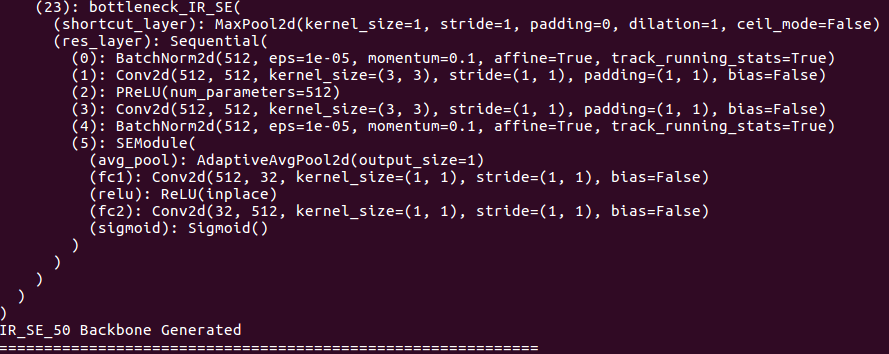
Sur les détails de l'épine dorsale:
À propos des détails de la tête:

Sur les détails de la perte:

À propos des détails de l'optimiseur:
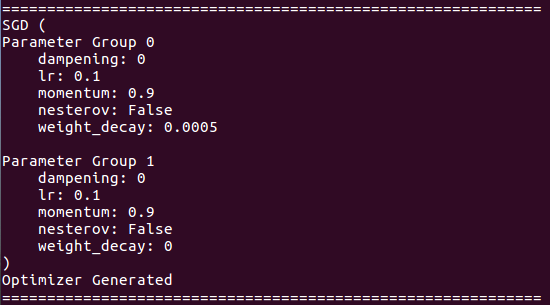
À propos de la formation de curriculum vitae:

Sur l'état de la formation et les statistiques (lorsque l'index de lots atteint DISP_FREQ ou à la fin de chaque époque):
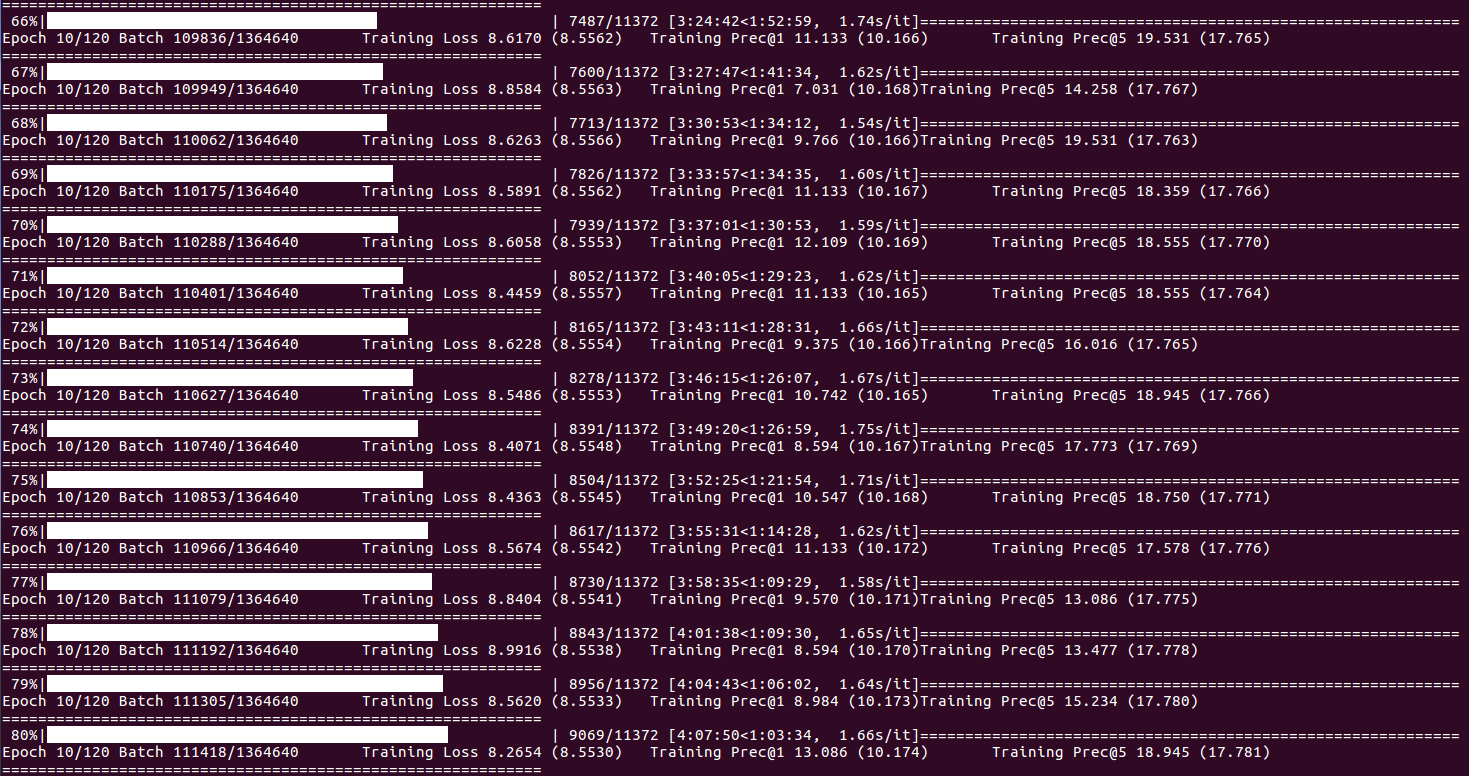
À propos des statistiques de validation et enregistrer les points de contrôle (à la fin de chaque époque):

Surveillez l'occupation du GPU à la volée avec watch -d -n 0.01 nvidia-smi .
Veuillez vous référer à la Sec. Zoo du modèle pour des poids de modèle spécifiques et des performances correspondantes.
API d'extraction de fonctionnalités (Extraire les fonctionnalités des modèles pré-entraînés) ./util/extract_feature_v1.py (implémentés avec des fonctions de construction pytorch) et ./util/extract_feature_v2.py (implémentées avec OPENCV).
Visualisez les statistiques de formation et de validation avec Tensorboardx (voir Sec. Model Zoo):
tensorboard --logdir /media/pc/6T/jasonjzhao/buffer/log
?
| Base de données | Version | #Identité | #Image | #Cadre | #Vidéo | Lien de téléchargement |
|---|---|---|---|---|---|---|
| LFW | Brut | 5 749 | 13 233 | - | - | Google Drive, Drive Baidu |
| LFW | Align_250x250 | 5 749 | 13 233 | - | - | Google Drive, Drive Baidu |
| LFW | Align_112x112 | 5 749 | 13 233 | - | - | Google Drive, Drive Baidu |
| Calfw | Brut | 4 025 | 12 174 | - | - | Google Drive, Drive Baidu |
| Calfw | Align_112x112 | 4 025 | 12 174 | - | - | Google Drive, Drive Baidu |
| Cplfw | Brut | 3 884 | 11 652 | - | - | Google Drive, Drive Baidu |
| Cplfw | Align_112x112 | 3 884 | 11 652 | - | - | Google Drive, Drive Baidu |
| Casia-webface | Raw_v1 | 10 575 | 494 414 | - | - | Baidu Drive |
| Casia-webface | RAW_V2 | 10 575 | 494 414 | - | - | Google Drive, Drive Baidu |
| Casia-webface | Faire le ménage | 10 575 | 455 594 | - | - | Google Drive, Drive Baidu |
| MS-Celeb-1m | Faire le ménage | 100 000 | 5 084 127 | - | - | Google Drive |
| MS-Celeb-1m | Align_112x112 | 85 742 | 5 822 653 | - | - | Google Drive |
| Vggface2 | Faire le ménage | 8 631 | 3 086 894 | - | - | Google Drive |
| Vggface2_fp | Align_112x112 | - | - | - | - | Google Drive, Drive Baidu |
| Vieillit | Brut | 570 | 16 488 | - | - | Google Drive, Drive Baidu |
| Vieillit | Align_112x112 | 570 | 16 488 | - | - | Google Drive, Drive Baidu |
| IJB-A | Faire le ménage | 500 | 5 396 | 20 369 | 2 085 | Google Drive, Drive Baidu |
| IJB-B | Brut | 1 845 | 21 798 | 55 026 | 7,011 | Google Drive |
| CFP | Brut | 500 | 7 000 | - | - | Google Drive, Drive Baidu |
| CFP | Align_112x112 | 500 | 7 000 | - | - | Google Drive, Drive Baidu |
| Umdfaces | Align_112x112 | 8 277 | 367 888 | - | - | Google Drive, Drive Baidu |
| Célèbre | Brut | 10 177 | 202 599 | - | - | Google Drive, Drive Baidu |
| CACD-VS | Brut | 2 000 | 163 446 | - | - | Google Drive, Drive Baidu |
| YTF | Align_344x344 | 1 595 | - | 3 425 | 621 127 | Google Drive, Drive Baidu |
| Deepglint | Align_112x112 | 180 855 | 6 753 545 | - | - | Google Drive |
| Utkface | Align_200x200 | - | 23 708 | - | - | Google Drive, Drive Baidu |
| Buaa-visnir | Align_287x287 | 150 | 5 952 | - | - | Baidu Drive, PW: XMBC |
| Casia nir-Vis 2.0 | Align_128x128 | 725 | 17 580 | - | - | Baidu Drive, PW: 883b |
| Oulu-Casia | Brut | 80 | 65 000 | - | - | Baidu Drive, PW: xxp5 |
| Nuaa-impressiondb | Brut | 15 | 12 614 | - | - | Baidu Drive, PW: IF3N |
| Casia-Surf | Brut | 1 000 | - | - | 21 000 | Baidu Drive, PW: IZB3 |
| Casia-fasd | Brut | 50 | - | - | 600 | Baidu Drive, PW: H5UN |
| Casia-MFSD | Brut | 50 | - | - | 600 | |
| Attaque de relecture | Brut | 50 | - | - | 1 200 | |
| Webface260m | Brut | 24m | 2m | - | https://www.face-benchmark.org/ |
 unzip casia-maxpy-clean.zip
cd casia-maxpy-clean
zip -F CASIA-maxpy-clean.zip --out CASIA-maxpy-clean_fix.zip
unzip CASIA-maxpy-clean_fix.zip
 import numpy as np
import bcolz
import os

def get_pair ( root , name ):
    carray = bcolz . carray ( rootdir = os . path . join ( root , name ), mode = 'r' )
    issame = np . load ( '{}/{}_list.npy' . format ( root , name ))
    return carray , issame

def get_data ( data_root ):
    agedb_30 , agedb_30_issame = get_pair ( data_root , 'agedb_30' )
    cfp_fp , cfp_fp_issame = get_pair ( data_root , 'cfp_fp' )
    lfw , lfw_issame = get_pair ( data_root , 'lfw' )
    vgg2_fp , vgg2_fp_issame = get_pair ( data_root , 'vgg2_fp' )
    return agedb_30 , cfp_fp , lfw , vgg2_fp , agedb_30_issame , cfp_fp_issame , lfw_issame , vgg2_fp_issame

agedb_30 , cfp_fp , lfw , vgg2_fp , agedb_30_issame , cfp_fp_issame , lfw_issame , vgg2_fp_issame = get_data ( DATA_ROOT )MS-Celeb-1M_Top1M_MID2Name.tsv (Google Drive, Drive Baidu), VGGface2_ID2Name.csv (Google Drive, Drive Baidu), VGGface2_FaceScrub_Overlap.txt (Google Drive, Drive Baidu, VGGface2_LFW_Overlap.txt , Baidu Drive), CASIA-WebFace_ID2Name.txt (Google Drive, Baidu Drive), CASIA-WebFace_FaceScrub_Overlap.txt (Google Drive, Drive Baidu), CASIA-WebFace_LFW_Overlap.txt FaceScrub_Name.txt Google Drive, Baidu Drive), LFW_Name.txt (Google Drive, Baidu Drive), LFW_NAM LFW_Log.txt (Google Drive, Baidu Drive) pour aider les chercheurs / ingénieurs à supprimer rapidement les pièces qui se chevauchent entre leurs propres ensembles de données privés et les ensembles de données publiques.?
Modèle
| Colonne vertébrale | Tête | Perte | Données de formation | Lien de téléchargement |
|---|---|---|---|---|
| IR-50 | Surface arc | Focal | Ms celeb-1m_align_112x112 | Google Drive, Drive Baidu |
Paramètre
INPUT_SIZE: [112, 112]; RGB_MEAN: [0.5, 0.5, 0.5]; RGB_STD: [0.5, 0.5, 0.5]; BATCH_SIZE: 512 (drop the last batch to ensure consistent batch_norm statistics); Initial LR: 0.1; NUM_EPOCH: 120; WEIGHT_DECAY: 5e-4 (do not apply to batch_norm parameters); MOMENTUM: 0.9; STAGES: [30, 60, 90]; Augmentation: Random Crop + Horizontal Flip; Imbalanced Data Processing: Weighted Random Sampling; Solver: SGD; GPUs: 4 NVIDIA Tesla P40 in Parallel
Statistiques de formation et de validation

Performance
| LFW | Cfp_ff | Cfp_fp | Vieillit | Calfw | Cplfw | Vggface2_fp |
|---|---|---|---|---|---|---|
| 99,78 | 99.69 | 98.14 | 97,53 | 95.87 | 92.45 | 95.22 |
Modèle
| Colonne vertébrale | Tête | Perte | Données de formation | Lien de téléchargement |
|---|---|---|---|---|
| IR-50 | Surface arc | Focal | Asie privée face aux données | Google Drive, Drive Baidu |
Paramètre
INPUT_SIZE: [112, 112]; RGB_MEAN: [0.5, 0.5, 0.5]; RGB_STD: [0.5, 0.5, 0.5]; BATCH_SIZE: 1024 (drop the last batch to ensure consistent batch_norm statistics); Initial LR: 0.01 (initialize weights from the above model pre-trained on MS-Celeb-1M_Align_112x112); NUM_EPOCH: 80; WEIGHT_DECAY: 5e-4 (do not apply to batch_norm parameters); MOMENTUM: 0.9; STAGES: [20, 40, 60]; Augmentation: Random Crop + Horizontal Flip; Imbalanced Data Processing: Weighted Random Sampling; Solver: SGD; GPUs: 8 NVIDIA Tesla P40 in Parallel
Performance (veuillez effectuer l'évaluation de votre propre jeu de données de référence Asie Face)
Modèle
| Colonne vertébrale | Tête | Perte | Données de formation | Lien de téléchargement |
|---|---|---|---|---|
| IR-152 | Surface arc | Focal | Ms celeb-1m_align_112x112 | Baidu Drive, PW: B197 |
Paramètre
INPUT_SIZE: [112, 112]; RGB_MEAN: [0.5, 0.5, 0.5]; RGB_STD: [0.5, 0.5, 0.5]; BATCH_SIZE: 256 (drop the last batch to ensure consistent batch_norm statistics); Initial LR: 0.01; NUM_EPOCH: 120; WEIGHT_DECAY: 5e-4 (do not apply to batch_norm parameters); MOMENTUM: 0.9; STAGES: [30, 60, 90]; Augmentation: Random Crop + Horizontal Flip; Imbalanced Data Processing: Weighted Random Sampling; Solver: SGD; GPUs: 4 NVIDIA Geforce RTX 2080 Ti in Parallel
Statistiques de formation et de validation

Performance
| LFW | Cfp_ff | Cfp_fp | Vieillit | Calfw | Cplfw | Vggface2_fp |
|---|---|---|---|---|---|---|
| 99.82 | 99.83 | 98.37 | 98.07 | 96.03 | 93.05 | 95,50 |
?
2017 No.1 sur ICCV 2017 MS-Celeb-1M à grande échelle Reconnaissance du visage Hard Set / Set Random / Low Shot Learning. WeChat News, NUS ECE News, Nus ECE Affiche, certificat de récompense pour la piste-1, certificat de récompense pour la piste-2, cérémonie de remise des prix.
2017 n ° 1 sur l'Institut national des normes et de la technologie (NIST) IARPA Janus Benchmark A (IJB-A) Défi de vérification et d'identification du visage non contraint. WeChat News.
Performance de pointe sur
?
?
Veuillez consulter et envisager de citer les documents suivants:
 @article{wu20223d,
title={3D-Guided Frontal Face Generation for Pose-Invariant Recognition},
author={Wu, Hao and Gu, Jianyang and Fan, Xiaojin and Li, He and Xie, Lidong and Zhao, Jian},
journal={T-IST},
year={2022}
}


@article{wang2021face,
title={Face.evoLVe: A High-Performance Face Recognition Library},
author={Wang, Qingzhong and Zhang, Pengfei and Xiong, Haoyi and Zhao, Jian},
journal={arXiv preprint arXiv:2107.08621},
year={2021}
}


@article{tu2021joint,
title={Joint Face Image Restoration and Frontalization for Recognition},
author={Tu, Xiaoguang and Zhao, Jian and Liu, Qiankun and Ai, Wenjie and Guo, Guodong and Li, Zhifeng and Liu, Wei and Feng, Jiashi},
journal={T-CSVT},
year={2021}
}


@article{zhao2020towards,
title={Towards age-invariant face recognition},
author={Zhao, Jian and Yan, Shuicheng and Feng, Jiashi},
journal={T-PAMI},
year={2020}
}


@article{zhao2019recognizing,
title={Recognizing Profile Faces by Imagining Frontal View},
author={Zhao, Jian and Xing, Junliang and Xiong, Lin and Yan, Shuicheng and Feng, Jiashi},
journal={IJCV},
pages={1--19},
year={2019}
}


@inproceedings{zhao2019multi,
title={Multi-Prototype Networks for Unconstrained Set-based Face Recognition},
author={Zhao, Jian and Li, Jianshu and Tu, Xiaoguang and Zhao, Fang and Xin, Yuan and Xing, Junliang and Liu, Hengzhu and Yan, Shuicheng and Feng, Jiashi},
booktitle={IJCAI},
year={2019}
}


@inproceedings{zhao2019look,
title={Look Across Elapse: Disentangled Representation Learning and Photorealistic Cross-Age Face Synthesis for Age-Invariant Face Recognition},
author={Zhao, Jian and Cheng, Yu and Cheng, Yi and Yang, Yang and Lan, Haochong and Zhao, Fang and Xiong, Lin and Xu, Yan and Li, Jianshu and Pranata, Sugiri and others},
booktitle={AAAI},
year={2019}
}


@article{zhao20183d,
title={3D-Aided Dual-Agent GANs for Unconstrained Face Recognition},
author={Zhao, Jian and Xiong, Lin and Li, Jianshu and Xing, Junliang and Yan, Shuicheng and Feng, Jiashi},
journal={T-PAMI},
year={2018}
}


@inproceedings{zhao2018towards,
title={Towards Pose Invariant Face Recognition in the Wild},
author={Zhao, Jian and Cheng, Yu and Xu, Yan and Xiong, Lin and Li, Jianshu and Zhao, Fang and Jayashree, Karlekar and Pranata,         Sugiri and Shen, Shengmei and Xing, Junliang and others},
booktitle={CVPR},
pages={2207--2216},
year={2018}
}


@inproceedings{zhao3d,
title={3D-Aided Deep Pose-Invariant Face Recognition},
author={Zhao, Jian and Xiong, Lin and Cheng, Yu and Cheng, Yi and Li, Jianshu and Zhou, Li and Xu, Yan and Karlekar, Jayashree and       Pranata, Sugiri and Shen, Shengmei and others},
booktitle={IJCAI},
pages={1184--1190},
year={2018}
}


@inproceedings{zhao2018dynamic,
title={Dynamic Conditional Networks for Few-Shot Learning},
author={Zhao, Fang and Zhao, Jian and Yan, Shuicheng and Feng, Jiashi},
booktitle={ECCV},
pages={19--35},
year={2018}
}


@inproceedings{zhao2017dual,
title={Dual-agent gans for photorealistic and identity preserving profile face synthesis},
author={Zhao, Jian and Xiong, Lin and Jayashree, Panasonic Karlekar and Li, Jianshu and Zhao, Fang and Wang, Zhecan and Pranata,           Panasonic Sugiri and Shen, Panasonic Shengmei and Yan, Shuicheng and Feng, Jiashi},
booktitle={NeurIPS},
pages={66--76},
year={2017}
}


@inproceedings{zhao122017marginalized,
title={Marginalized cnn: Learning deep invariant representations},
author={Zhao12, Jian and Li, Jianshu and Zhao, Fang and Yan13, Shuicheng and Feng, Jiashi},
booktitle={BMVC},
year={2017}
}


@inproceedings{cheng2017know,
title={Know you at one glance: A compact vector representation for low-shot learning},
author={Cheng, Yu and Zhao, Jian and Wang, Zhecan and Xu, Yan and Jayashree, Karlekar and Shen, Shengmei and Feng, Jiashi},
booktitle={ICCVW},
pages={1924--1932},
year={2017}
}


@inproceedings{wangconditional,
title={Conditional Dual-Agent GANs for Photorealistic and Annotation Preserving Image Synthesis},
author={Wang, Zhecan and Zhao, Jian and Cheng, Yu and Xiao, Shengtao and Li, Jianshu and Zhao, Fang and Feng, Jiashi and Kassim, Ashraf},
booktitle={BMVCW},
}