face.evoLVe
1.0.0

| Autor | Jian Zhao |
|---|---|
| Página principal | https://zhaoj9014.github.io |
El código de cara.
✅ CLOSED 02 September 2021 : Baidu Paddlepaddle fusionó oficialmente la cara.
✅ CLOSED 03 July 2021 : Proporciona código de entrenamiento para el marco Paddlepaddle.
✅ CLOSED 04 July 2019 : Compartiremos varios conjuntos de datos disponibles públicamente en la detección de la anti-desglose/livalidad para facilitar la investigación y el análisis relacionados.
✅ CLOSED 07 June 2019 : Estamos entrenando un modelo IR-152 de mejor rendimiento en MS-CELEB-1M_ALIGN_112X112, y lanzaremos el modelo pronto.
✅ CLOSED 23 May 2019 : Compartimos tres conjuntos de datos disponibles públicamente para facilitar la investigación sobre el reconocimiento y el análisis de la cara heterogénea. Consulte la Sec. Zoológico de datos para más detalles.
✅ CLOSED 23 Jan 2019 : Compartimos las listas de nombres y las listas superpuestas de pares de varios conjuntos de datos de reconocimiento facial ampliamente utilizado para ayudar a los investigadores/ingenieros a eliminar rápidamente las piezas superpuestas entre sus propios conjuntos de datos privados y los conjuntos de datos públicos. Consulte la Sec. Zoológico de datos para más detalles.
✅ CLOSED 23 Jan 2019 : El esquema de entrenamiento distribuido actual con múltiples GPU en Pytorch y otras plataformas convencionales es paralela a la columna vertebral a través de Multi-GPU, mientras se basa en un solo maestro para calcular la capa final de cuello de botella (totalmente conectado/softMax). Este no es un problema para el reconocimiento facial convencional con un número moderado de identidades. Sin embargo, lucha con el reconocimiento facial a gran escala, lo que requiere reconocer a millones de identidades en el mundo real. El maestro apenas puede mantener la capa final de gran tamaño, mientras que los esclavos aún tienen un recurso de cálculo redundante, lo que lleva a un entrenamiento de lotes pequeños o incluso un entrenamiento fallido. Para abordar este problema, estamos desarrollando un esquema de entrenamiento distribuido altamente elegante, efectivo y eficiente con multi-GPU bajo Pytorch, que respalda no solo la columna vertebral, sino también la cabeza con la capa totalmente conectada (Softmax), para facilitar el reconocimiento de la cara a gran escala de alta rendimiento. Agregaremos este soporte a nuestro repositorio.
✅ CLOSED 22 Jan 2019 : Hemos lanzado dos API de extracción de características para extraer características de modelos previamente capacitados, implementadas con funciones de construcción de Pytorch y OpenCV, respectivamente. Compruebe ./util/extract_feature_v1.py y ./util/extract_feature_v2.py .
✅ CLOSED 22 Jan 2019 : Estamos ajustando nuestro modelo IR-50 lanzado en nuestros datos privados de Asia Face, que se lanzarán pronto para facilitar el reconocimiento de la cara de Asia de alto rendimiento.
✅ CLOSED 21 Jan 2019 : Estamos entrenando un modelo IR-50 de mejor rendimiento en MS-CELEB-1M_ALIGN_112X112, y reemplazaremos el modelo actual pronto.
?
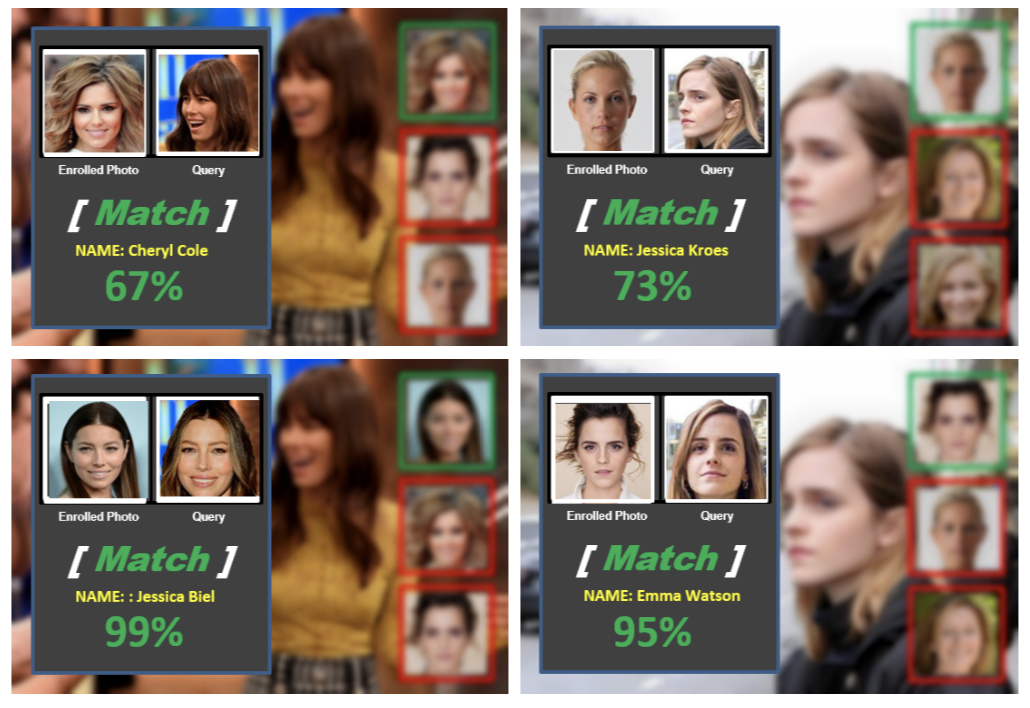
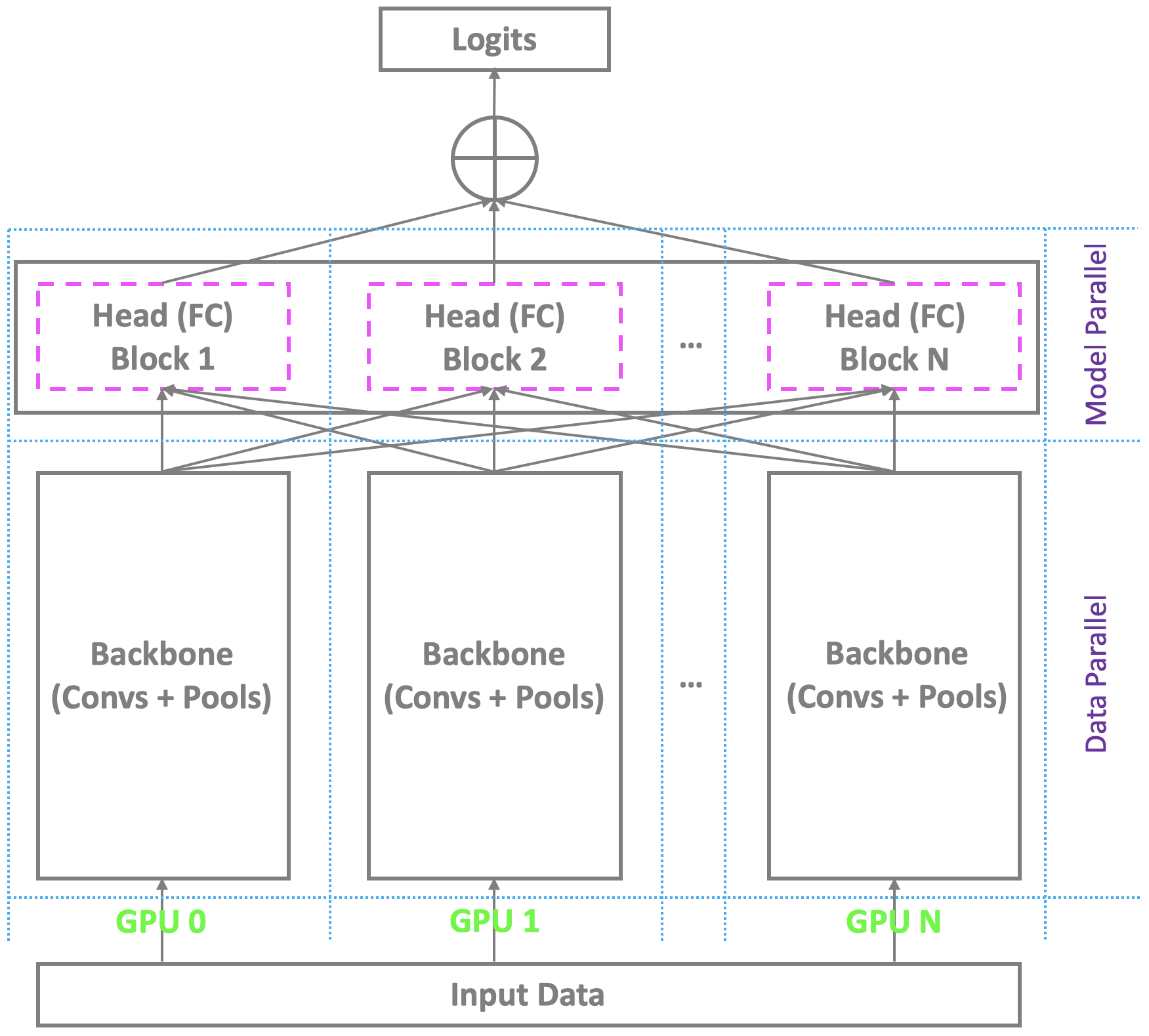
?
pip install torch torchvision )pip install mxnet-cu90 )pip install tensorflow-gpu )pip install tensorboardX )pip install opencv-python )pip install bcolz )Si bien no es necesario, para un rendimiento óptimo se recomienda ejecutar el código utilizando una GPU habilitada para CUDA. Usamos 4-8 Nvidia Tesla P40 en paralelo.
?
git clone https://github.com/ZhaoJ9014/face.evoLVe.PyTorch.git .mkdir data checkpoint log en el directorio apropiado para almacenar sus datos de tren/Val/prueba, puntos de control y registros de capacitación. ./data/db_name/
-> id1/
-> 1.jpg
-> ...
-> id2/
-> 1.jpg
-> ...
-> ...
-> ...
-> ...
?
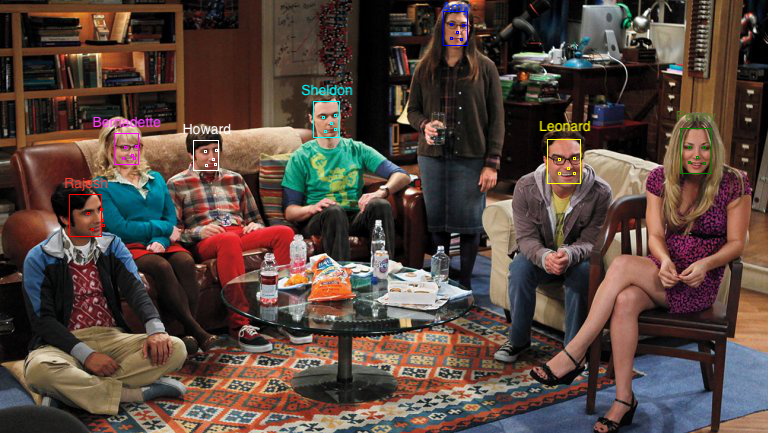

./align from PIL import Image
from detector import detect_faces
from visualization_utils import show_results
img = Image . open ( 'some_img.jpg' ) # modify the image path to yours
bounding_boxes , landmarks = detect_faces ( img ) # detect bboxes and landmarks for all faces in the image
show_results ( img , bounding_boxes , landmarks ) # visualize the resultssource_root con la estructura del directorio como se demuestra en el uso de la Sec., Y almacene los resultados alineados a una nueva carpeta dest_root con la misma estructura del directorio): python face_align.py -source_root [source_root] -dest_root [dest_root] -crop_size [crop_size]
# python face_align.py -source_root './data/test' -dest_root './data/test_Aligned' -crop_size 112
*.DS_Store que pueden arruinar sus datos, ya que se eliminarán automáticamente cuando ejecute los scripts.source_root , dest_root y crop_size a sus propios valores cuando ejecuta face_align.py ; 2) Pase su min_face_size personalizado, thresholds y valores nms_thresholds a la función detect_faces de detector.py para que coincida con sus requisitos prácticos; 3) Si encuentra la velocidad que usa la API de alineación de la cara es un poco lenta, puede llamar a la API de cambio de tamaño para cambiar el tamaño de la imagen cuyo tamaño más pequeño es más grande que un umbral (especifique los argumentos de source_root , dest_root y min_side a sus propios valores) antes de llamar a la API de alineación de la cara: python face_resize.py
./balancemin_num en la root del conjunto de entrenamiento con la estructura del directorio como se demuestra en la Sec. Uso para el equilibrio de datos y el entrenamiento de modelo efectivo): python remove_lowshot.py -root [root] -min_num [min_num]
# python remove_lowshot.py -root './data/train' -min_num 10
root y min_num a sus propios valores cuando ejecuta remove_lowshot.py .☕
Carpeta: ./
API de configuración (configure su configuración general para capacitación y validación) config.py :
 import torch

configurations = {
    1 : dict (
        SEED = 1337 , # random seed for reproduce results

        DATA_ROOT = '/media/pc/6T/jasonjzhao/data/faces_emore' , # the parent root where your train/val/test data are stored
        MODEL_ROOT = '/media/pc/6T/jasonjzhao/buffer/model' , # the root to buffer your checkpoints
        LOG_ROOT = '/media/pc/6T/jasonjzhao/buffer/log' , # the root to log your train/val status
        BACKBONE_RESUME_ROOT = './' , # the root to resume training from a saved checkpoint
        HEAD_RESUME_ROOT = './' , # the root to resume training from a saved checkpoint

        BACKBONE_NAME = 'IR_SE_50' , # support: ['ResNet_50', 'ResNet_101', 'ResNet_152', 'IR_50', 'IR_101', 'IR_152', 'IR_SE_50', 'IR_SE_101', 'IR_SE_152']
        HEAD_NAME = 'ArcFace' , # support:  ['Softmax', 'ArcFace', 'CosFace', 'SphereFace', 'Am_softmax']
        LOSS_NAME = 'Focal' , # support: ['Focal', 'Softmax']

        INPUT_SIZE = [ 112 , 112 ], # support: [112, 112] and [224, 224]
        RGB_MEAN = [ 0.5 , 0.5 , 0.5 ], # for normalize inputs to [-1, 1]
        RGB_STD = [ 0.5 , 0.5 , 0.5 ],
        EMBEDDING_SIZE = 512 , # feature dimension
        BATCH_SIZE = 512 ,
        DROP_LAST = True , # whether drop the last batch to ensure consistent batch_norm statistics
        LR = 0.1 , # initial LR
        NUM_EPOCH = 125 , # total epoch number (use the firt 1/25 epochs to warm up)
        WEIGHT_DECAY = 5e-4 , # do not apply to batch_norm parameters
        MOMENTUM = 0.9 ,
        STAGES = [ 35 , 65 , 95 ], # epoch stages to decay learning rate

        DEVICE = torch . device ( "cuda:0" if torch . cuda . is_available () else "cpu" ),
        MULTI_GPU = True , # flag to use multiple GPUs; if you choose to train with single GPU, you should first run "export CUDA_VISILE_DEVICES=device_id" to specify the GPU card you want to use
        GPU_ID = [ 0 , 1 , 2 , 3 ], # specify your GPU ids
        PIN_MEMORY = True ,
        NUM_WORKERS = 0 ,
),
}
API de trenes y validación (todas las personas sobre capacitación y validación, es decir , paquete de importación, hiperparametros y cargadores de datos, modelo y pérdida y optimizador, trenes y validación y ahorro de puntos de control) train.py . Dado que MS-CELEB-1M sirve como un Imagenet en el reconocimiento de cara archivado, pre-entretenemos los modelos de cara. Vamos a sumergirnos en detalles juntos paso a paso.
 import torch
import torch . nn as nn
import torch . optim as optim
import torchvision . transforms as transforms
import torchvision . datasets as datasets

from config import configurations
from backbone . model_resnet import ResNet_50 , ResNet_101 , ResNet_152
from backbone . model_irse import IR_50 , IR_101 , IR_152 , IR_SE_50 , IR_SE_101 , IR_SE_152
from head . metrics import ArcFace , CosFace , SphereFace , Am_softmax
from loss . focal import FocalLoss
from util . utils import make_weights_for_balanced_classes , get_val_data , separate_irse_bn_paras , separate_resnet_bn_paras , warm_up_lr , schedule_lr , perform_val , get_time , buffer_val , AverageMeter , accuracy

from tensorboardX import SummaryWriter
from tqdm import tqdm
import os cfg = configurations [ 1 ]
SEED = cfg [ 'SEED' ] # random seed for reproduce results
torch . manual_seed ( SEED )
DATA_ROOT = cfg [ 'DATA_ROOT' ] # the parent root where your train/val/test data are stored
MODEL_ROOT = cfg [ 'MODEL_ROOT' ] # the root to buffer your checkpoints
LOG_ROOT = cfg [ 'LOG_ROOT' ] # the root to log your train/val status
BACKBONE_RESUME_ROOT = cfg [ 'BACKBONE_RESUME_ROOT' ] # the root to resume training from a saved checkpoint
HEAD_RESUME_ROOT = cfg [ 'HEAD_RESUME_ROOT' ] # the root to resume training from a saved checkpoint
BACKBONE_NAME = cfg [ 'BACKBONE_NAME' ] # support: ['ResNet_50', 'ResNet_101', 'ResNet_152', 'IR_50', 'IR_101', 'IR_152', 'IR_SE_50', 'IR_SE_101', 'IR_SE_152']
HEAD_NAME = cfg [ 'HEAD_NAME' ] # support: ['Softmax', 'ArcFace', 'CosFace', 'SphereFace', 'Am_softmax']
LOSS_NAME = cfg [ 'LOSS_NAME' ] # support: ['Focal', 'Softmax']
INPUT_SIZE = cfg [ 'INPUT_SIZE' ]
RGB_MEAN = cfg [ 'RGB_MEAN' ] # for normalize inputs
RGB_STD = cfg [ 'RGB_STD' ]
EMBEDDING_SIZE = cfg [ 'EMBEDDING_SIZE' ] # feature dimension
BATCH_SIZE = cfg [ 'BATCH_SIZE' ]
DROP_LAST = cfg [ 'DROP_LAST' ] # whether drop the last batch to ensure consistent batch_norm statistics
LR = cfg [ 'LR' ] # initial LR
NUM_EPOCH = cfg [ 'NUM_EPOCH' ]
WEIGHT_DECAY = cfg [ 'WEIGHT_DECAY' ]
MOMENTUM = cfg [ 'MOMENTUM' ]
STAGES = cfg [ 'STAGES' ] # epoch stages to decay learning rate
DEVICE = cfg [ 'DEVICE' ]
MULTI_GPU = cfg [ 'MULTI_GPU' ] # flag to use multiple GPUs
GPU_ID = cfg [ 'GPU_ID' ] # specify your GPU ids
PIN_MEMORY = cfg [ 'PIN_MEMORY' ]
NUM_WORKERS = cfg [ 'NUM_WORKERS' ]
print ( "=" * 60 )
print ( "Overall Configurations:" )
print ( cfg )
print ( "=" * 60 )
writer = SummaryWriter ( LOG_ROOT ) # writer for buffering intermedium results train_transform = transforms . Compose ([ # refer to https://pytorch.org/docs/stable/torchvision/transforms.html for more build-in online data augmentation
transforms . Resize ([ int ( 128 * INPUT_SIZE [ 0 ] / 112 ), int ( 128 * INPUT_SIZE [ 0 ] / 112 )]), # smaller side resized
transforms . RandomCrop ([ INPUT_SIZE [ 0 ], INPUT_SIZE [ 1 ]]),
transforms . RandomHorizontalFlip (),
transforms . ToTensor (),
transforms . Normalize ( mean = RGB_MEAN ,
std = RGB_STD ),
])
dataset_train = datasets . ImageFolder ( os . path . join ( DATA_ROOT , 'imgs' ), train_transform )
# create a weighted random sampler to process imbalanced data
weights = make_weights_for_balanced_classes ( dataset_train . imgs , len ( dataset_train . classes ))
weights = torch . DoubleTensor ( weights )
sampler = torch . utils . data . sampler . WeightedRandomSampler ( weights , len ( weights ))
train_loader = torch . utils . data . DataLoader (
dataset_train , batch_size = BATCH_SIZE , sampler = sampler , pin_memory = PIN_MEMORY ,
num_workers = NUM_WORKERS , drop_last = DROP_LAST
)
NUM_CLASS = len ( train_loader . dataset . classes )
print ( "Number of Training Classes: {}" . format ( NUM_CLASS ))
lfw , cfp_ff , cfp_fp , agedb , calfw , cplfw , vgg2_fp , lfw_issame , cfp_ff_issame , cfp_fp_issame , agedb_issame , calfw_issame , cplfw_issame , vgg2_fp_issame = get_val_data ( DATA_ROOT ) BACKBONE_DICT = { 'ResNet_50' : ResNet_50 ( INPUT_SIZE ),
'ResNet_101' : ResNet_101 ( INPUT_SIZE ),
'ResNet_152' : ResNet_152 ( INPUT_SIZE ),
'IR_50' : IR_50 ( INPUT_SIZE ),
'IR_101' : IR_101 ( INPUT_SIZE ),
'IR_152' : IR_152 ( INPUT_SIZE ),
'IR_SE_50' : IR_SE_50 ( INPUT_SIZE ),
'IR_SE_101' : IR_SE_101 ( INPUT_SIZE ),
'IR_SE_152' : IR_SE_152 ( INPUT_SIZE )}
BACKBONE = BACKBONE_DICT [ BACKBONE_NAME ]
print ( "=" * 60 )
print ( BACKBONE )
print ( "{} Backbone Generated" . format ( BACKBONE_NAME ))
print ( "=" * 60 )
HEAD_DICT = { 'ArcFace' : ArcFace ( in_features = EMBEDDING_SIZE , out_features = NUM_CLASS , device_id = GPU_ID ),
'CosFace' : CosFace ( in_features = EMBEDDING_SIZE , out_features = NUM_CLASS , device_id = GPU_ID ),
'SphereFace' : SphereFace ( in_features = EMBEDDING_SIZE , out_features = NUM_CLASS , device_id = GPU_ID ),
'Am_softmax' : Am_softmax ( in_features = EMBEDDING_SIZE , out_features = NUM_CLASS , device_id = GPU_ID )}
HEAD = HEAD_DICT [ HEAD_NAME ]
print ( "=" * 60 )
print ( HEAD )
print ( "{} Head Generated" . format ( HEAD_NAME ))
print ( "=" * 60 ) LOSS_DICT = { 'Focal' : FocalLoss (),
'Softmax' : nn . CrossEntropyLoss ()}
LOSS = LOSS_DICT [ LOSS_NAME ]
print ( "=" * 60 )
print ( LOSS )
print ( "{} Loss Generated" . format ( LOSS_NAME ))
print ( "=" * 60 ) if BACKBONE_NAME . find ( "IR" ) >= 0 :
backbone_paras_only_bn , backbone_paras_wo_bn = separate_irse_bn_paras ( BACKBONE ) # separate batch_norm parameters from others; do not do weight decay for batch_norm parameters to improve the generalizability
_ , head_paras_wo_bn = separate_irse_bn_paras ( HEAD )
else :
backbone_paras_only_bn , backbone_paras_wo_bn = separate_resnet_bn_paras ( BACKBONE ) # separate batch_norm parameters from others; do not do weight decay for batch_norm parameters to improve the generalizability
_ , head_paras_wo_bn = separate_resnet_bn_paras ( HEAD )
OPTIMIZER = optim . SGD ([{ 'params' : backbone_paras_wo_bn + head_paras_wo_bn , 'weight_decay' : WEIGHT_DECAY }, { 'params' : backbone_paras_only_bn }], lr = LR , momentum = MOMENTUM )
print ( "=" * 60 )
print ( OPTIMIZER )
print ( "Optimizer Generated" )
print ( "=" * 60 ) if BACKBONE_RESUME_ROOT and HEAD_RESUME_ROOT :
print ( "=" * 60 )
if os . path . isfile ( BACKBONE_RESUME_ROOT ) and os . path . isfile ( HEAD_RESUME_ROOT ):
print ( "Loading Backbone Checkpoint '{}'" . format ( BACKBONE_RESUME_ROOT ))
BACKBONE . load_state_dict ( torch . load ( BACKBONE_RESUME_ROOT ))
print ( "Loading Head Checkpoint '{}'" . format ( HEAD_RESUME_ROOT ))
HEAD . load_state_dict ( torch . load ( HEAD_RESUME_ROOT ))
else :
print ( "No Checkpoint Found at '{}' and '{}'. Please Have a Check or Continue to Train from Scratch" . format ( BACKBONE_RESUME_ROOT , HEAD_RESUME_ROOT ))
print ( "=" * 60 ) if MULTI_GPU :
# multi-GPU setting
BACKBONE = nn . DataParallel ( BACKBONE , device_ids = GPU_ID )
BACKBONE = BACKBONE . to ( DEVICE )
else :
# single-GPU setting
BACKBONE = BACKBONE . to ( DEVICE ) DISP_FREQ = len ( train_loader ) // 100 # frequency to display training loss & acc
NUM_EPOCH_WARM_UP = NUM_EPOCH // 25 # use the first 1/25 epochs to warm up
NUM_BATCH_WARM_UP = len ( train_loader ) * NUM_EPOCH_WARM_UP # use the first 1/25 epochs to warm up
batch = 0 # batch index for epoch in range ( NUM_EPOCH ): # start training process
if epoch == STAGES [ 0 ]: # adjust LR for each training stage after warm up, you can also choose to adjust LR manually (with slight modification) once plaueau observed
schedule_lr ( OPTIMIZER )
if epoch == STAGES [ 1 ]:
schedule_lr ( OPTIMIZER )
if epoch == STAGES [ 2 ]:
schedule_lr ( OPTIMIZER )
BACKBONE . train () # set to training mode
HEAD . train ()
losses = AverageMeter ()
top1 = AverageMeter ()
top5 = AverageMeter ()
for inputs , labels in tqdm ( iter ( train_loader )):
if ( epoch + 1 <= NUM_EPOCH_WARM_UP ) and ( batch + 1 <= NUM_BATCH_WARM_UP ): # adjust LR for each training batch during warm up
warm_up_lr ( batch + 1 , NUM_BATCH_WARM_UP , LR , OPTIMIZER )
# compute output
inputs = inputs . to ( DEVICE )
labels = labels . to ( DEVICE ). long ()
features = BACKBONE ( inputs )
outputs = HEAD ( features , labels )
loss = LOSS ( outputs , labels )
# measure accuracy and record loss
prec1 , prec5 = accuracy ( outputs . data , labels , topk = ( 1 , 5 ))
losses . update ( loss . data . item (), inputs . size ( 0 ))
top1 . update ( prec1 . data . item (), inputs . size ( 0 ))
top5 . update ( prec5 . data . item (), inputs . size ( 0 ))
# compute gradient and do SGD step
OPTIMIZER . zero_grad ()
loss . backward ()
OPTIMIZER . step ()
# dispaly training loss & acc every DISP_FREQ
if (( batch + 1 ) % DISP_FREQ == 0 ) and batch != 0 :
print ( "=" * 60 )
print ( 'Epoch {}/{} Batch {}/{} t '
'Training Loss {loss.val:.4f} ({loss.avg:.4f}) t '
'Training Prec@1 {top1.val:.3f} ({top1.avg:.3f}) t '
'Training Prec@5 {top5.val:.3f} ({top5.avg:.3f})' . format (
epoch + 1 , NUM_EPOCH , batch + 1 , len ( train_loader ) * NUM_EPOCH , loss = losses , top1 = top1 , top5 = top5 ))
print ( "=" * 60 )
batch += 1 # batch index
# training statistics per epoch (buffer for visualization)
epoch_loss = losses . avg
epoch_acc = top1 . avg
writer . add_scalar ( "Training_Loss" , epoch_loss , epoch + 1 )
writer . add_scalar ( "Training_Accuracy" , epoch_acc , epoch + 1 )
print ( "=" * 60 )
print ( 'Epoch: {}/{} t '
'Training Loss {loss.val:.4f} ({loss.avg:.4f}) t '
'Training Prec@1 {top1.val:.3f} ({top1.avg:.3f}) t '
'Training Prec@5 {top5.val:.3f} ({top5.avg:.3f})' . format (
epoch + 1 , NUM_EPOCH , loss = losses , top1 = top1 , top5 = top5 ))
print ( "=" * 60 )
# perform validation & save checkpoints per epoch
# validation statistics per epoch (buffer for visualization)
print ( "=" * 60 )
print ( "Perform Evaluation on LFW, CFP_FF, CFP_FP, AgeDB, CALFW, CPLFW and VGG2_FP, and Save Checkpoints..." )
accuracy_lfw , best_threshold_lfw , roc_curve_lfw = perform_val ( MULTI_GPU , DEVICE , EMBEDDING_SIZE , BATCH_SIZE , BACKBONE , lfw , lfw_issame )
buffer_val ( writer , "LFW" , accuracy_lfw , best_threshold_lfw , roc_curve_lfw , epoch + 1 )
accuracy_cfp_ff , best_threshold_cfp_ff , roc_curve_cfp_ff = perform_val ( MULTI_GPU , DEVICE , EMBEDDING_SIZE , BATCH_SIZE , BACKBONE , cfp_ff , cfp_ff_issame )
buffer_val ( writer , "CFP_FF" , accuracy_cfp_ff , best_threshold_cfp_ff , roc_curve_cfp_ff , epoch + 1 )
accuracy_cfp_fp , best_threshold_cfp_fp , roc_curve_cfp_fp = perform_val ( MULTI_GPU , DEVICE , EMBEDDING_SIZE , BATCH_SIZE , BACKBONE , cfp_fp , cfp_fp_issame )
buffer_val ( writer , "CFP_FP" , accuracy_cfp_fp , best_threshold_cfp_fp , roc_curve_cfp_fp , epoch + 1 )
accuracy_agedb , best_threshold_agedb , roc_curve_agedb = perform_val ( MULTI_GPU , DEVICE , EMBEDDING_SIZE , BATCH_SIZE , BACKBONE , agedb , agedb_issame )
buffer_val ( writer , "AgeDB" , accuracy_agedb , best_threshold_agedb , roc_curve_agedb , epoch + 1 )
accuracy_calfw , best_threshold_calfw , roc_curve_calfw = perform_val ( MULTI_GPU , DEVICE , EMBEDDING_SIZE , BATCH_SIZE , BACKBONE , calfw , calfw_issame )
buffer_val ( writer , "CALFW" , accuracy_calfw , best_threshold_calfw , roc_curve_calfw , epoch + 1 )
accuracy_cplfw , best_threshold_cplfw , roc_curve_cplfw = perform_val ( MULTI_GPU , DEVICE , EMBEDDING_SIZE , BATCH_SIZE , BACKBONE , cplfw , cplfw_issame )
buffer_val ( writer , "CPLFW" , accuracy_cplfw , best_threshold_cplfw , roc_curve_cplfw , epoch + 1 )
accuracy_vgg2_fp , best_threshold_vgg2_fp , roc_curve_vgg2_fp = perform_val ( MULTI_GPU , DEVICE , EMBEDDING_SIZE , BATCH_SIZE , BACKBONE , vgg2_fp , vgg2_fp_issame )
buffer_val ( writer , "VGGFace2_FP" , accuracy_vgg2_fp , best_threshold_vgg2_fp , roc_curve_vgg2_fp , epoch + 1 )
print ( "Epoch {}/{}, Evaluation: LFW Acc: {}, CFP_FF Acc: {}, CFP_FP Acc: {}, AgeDB Acc: {}, CALFW Acc: {}, CPLFW Acc: {}, VGG2_FP Acc: {}" . format ( epoch + 1 , NUM_EPOCH , accuracy_lfw , accuracy_cfp_ff , accuracy_cfp_fp , accuracy_agedb , accuracy_calfw , accuracy_cplfw , accuracy_vgg2_fp ))
print ( "=" * 60 )
# save checkpoints per epoch
if MULTI_GPU :
torch . save ( BACKBONE . module . state_dict (), os . path . join ( MODEL_ROOT , "Backbone_{}_Epoch_{}_Batch_{}_Time_{}_checkpoint.pth" . format ( BACKBONE_NAME , epoch + 1 , batch , get_time ())))
torch . save ( HEAD . state_dict (), os . path . join ( MODEL_ROOT , "Head_{}_Epoch_{}_Batch_{}_Time_{}_checkpoint.pth" . format ( HEAD_NAME , epoch + 1 , batch , get_time ())))
else :
torch . save ( BACKBONE . state_dict (), os . path . join ( MODEL_ROOT , "Backbone_{}_Epoch_{}_Batch_{}_Time_{}_checkpoint.pth" . format ( BACKBONE_NAME , epoch + 1 , batch , get_time ())))
torch . save ( HEAD . state_dict (), os . path . join ( MODEL_ROOT , "Head_{}_Epoch_{}_Batch_{}_Time_{}_checkpoint.pth" . format ( HEAD_NAME , epoch + 1 , batch , get_time ()))) Ahora, puede comenzar a jugar con Face.evolve y corre train.py . La información fácil de usar aparecerá en su terminal:
Acerca de la configuración general:

Aproximadamente el número de clases de entrenamiento:

Sobre detalles de la troncal:
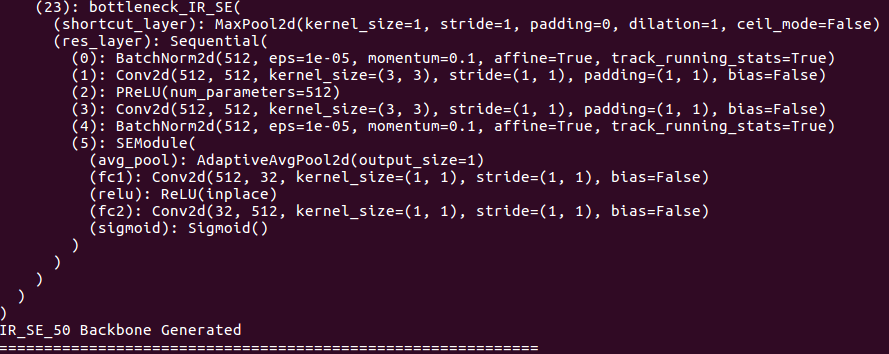
Acerca de los detalles de la cabeza:

Acerca de los detalles de la pérdida:

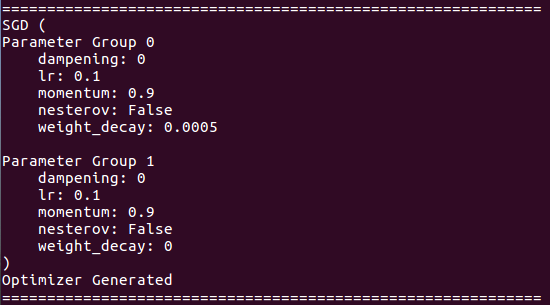
Acerca de los detalles del optimizador:
Acerca de la capacitación de currículum:

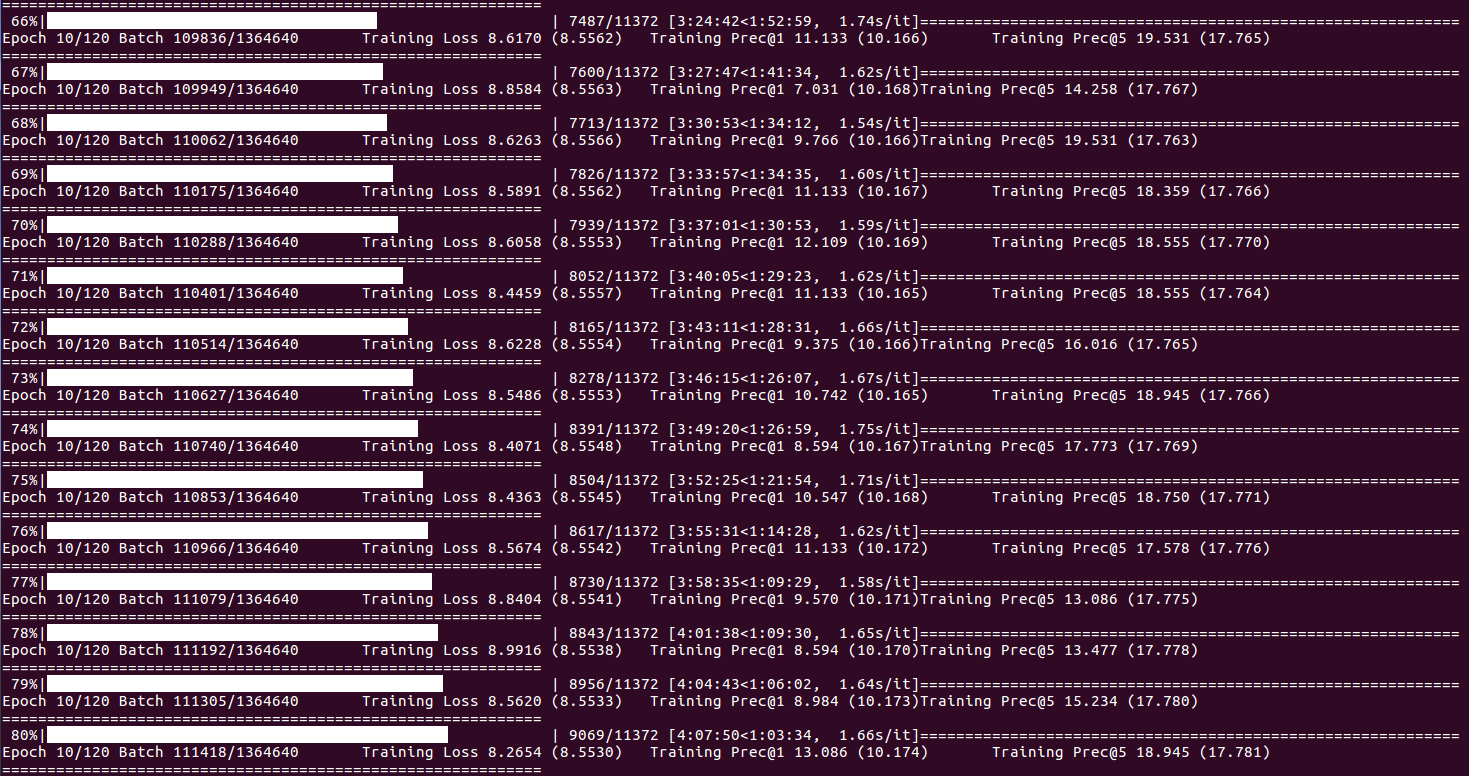
Sobre el estado de capacitación y las estadísticas (cuando el índice de lotes llega DISP_FREQ o al final de cada época):
Sobre estadísticas de validación y puntos de control de guardado (al final de cada época):

Monitoree la ocupación de GPU sobre la marcha con watch -d -n 0.01 nvidia-smi .
Consulte la Sec. Zoológico modelo para pesos de modelo específicos y rendimiento correspondiente.
API de extracción de características (extraer características de modelos pre-entrenados) ./util/extract_feature_v1.py (implementado con funciones de construcción de Pytorch) y ./util/extract_feature_v2.py (implementado con OpenCV).
Visualizar estadísticas de entrenamiento y validación con TensorBoardX (ver Sec. Modelo Model Zoo):
tensorboard --logdir /media/pc/6T/jasonjzhao/buffer/log
?
| Base de datos | Versión | #Identidad | #Imagen | #Marco | #Video | Enlace de descarga |
|---|---|---|---|---|---|---|
| LFW | Crudo | 5.749 | 13,233 | - | - | Google Drive, Baidu Drive |
| LFW | Align_250x250 | 5.749 | 13,233 | - | - | Google Drive, Baidu Drive |
| LFW | Align_112x112 | 5.749 | 13,233 | - | - | Google Drive, Baidu Drive |
| Becerro | Crudo | 4.025 | 12,174 | - | - | Google Drive, Baidu Drive |
| Becerro | Align_112x112 | 4.025 | 12,174 | - | - | Google Drive, Baidu Drive |
| CPLFW | Crudo | 3.884 | 11,652 | - | - | Google Drive, Baidu Drive |
| CPLFW | Align_112x112 | 3.884 | 11,652 | - | - | Google Drive, Baidu Drive |
| Casia-Webface | RAW_V1 | 10,575 | 494,414 | - | - | Baidu Drive |
| Casia-Webface | RAW_V2 | 10,575 | 494,414 | - | - | Google Drive, Baidu Drive |
| Casia-Webface | Limpio | 10,575 | 455,594 | - | - | Google Drive, Baidu Drive |
| MS-CELEB-1M | Limpio | 100,000 | 5.084,127 | - | - | Google Drive |
| MS-CELEB-1M | Align_112x112 | 85,742 | 5.822.653 | - | - | Google Drive |
| VGGFACE2 | Limpio | 8,631 | 3,086,894 | - | - | Google Drive |
| VGGFACE2_FP | Align_112x112 | - | - | - | - | Google Drive, Baidu Drive |
| Envejecimiento | Crudo | 570 | 16,488 | - | - | Google Drive, Baidu Drive |
| Envejecimiento | Align_112x112 | 570 | 16,488 | - | - | Google Drive, Baidu Drive |
| IJB-A | Limpio | 500 | 5.396 | 20,369 | 2.085 | Google Drive, Baidu Drive |
| IJB-B | Crudo | 1.845 | 21,798 | 55,026 | 7,011 | Google Drive |
| CFP | Crudo | 500 | 7,000 | - | - | Google Drive, Baidu Drive |
| CFP | Align_112x112 | 500 | 7,000 | - | - | Google Drive, Baidu Drive |
| Umdfaces | Align_112x112 | 8,277 | 367,888 | - | - | Google Drive, Baidu Drive |
| Ceneba | Crudo | 10,177 | 202,599 | - | - | Google Drive, Baidu Drive |
| Cacd-vs | Crudo | 2,000 | 163,446 | - | - | Google Drive, Baidu Drive |
| YTF | Align_344x344 | 1.595 | - | 3,425 | 621,127 | Google Drive, Baidu Drive |
| Profundo | Align_112x112 | 180,855 | 6,753,545 | - | - | Google Drive |
| Utkface | Aline_200x200 | - | 23,708 | - | - | Google Drive, Baidu Drive |
| Bua-visnir | Align_287x287 | 150 | 5.952 | - | - | Baidu Drive, PW: XMBC |
| Casia nir-vis 2.0 | Align_128x128 | 725 | 17,580 | - | - | Baidu Drive, PW: 883b |
| Oulu-cassia | Crudo | 80 | 65,000 | - | - | Baidu Drive, PW: xxp5 |
| Nua-impostdb | Crudo | 15 | 12,614 | - | - | Baidu Drive, PW: IF3N |
| Casia-surf | Crudo | 1,000 | - | - | 21,000 | Baidu Drive, PW: IZB3 |
| Casia-fasd | Crudo | 50 | - | - | 600 | Baidu Drive, PW: H5un |
| Casia-MFSD | Crudo | 50 | - | - | 600 | |
| Atacar de repetición | Crudo | 50 | - | - | 1.200 | |
| Webface260m | Crudo | 24m | 2m | - | https://www.face-benchmark.org/ |
 unzip casia-maxpy-clean.zip
cd casia-maxpy-clean
zip -F CASIA-maxpy-clean.zip --out CASIA-maxpy-clean_fix.zip
unzip CASIA-maxpy-clean_fix.zip
 import numpy as np
import bcolz
import os

def get_pair ( root , name ):
    carray = bcolz . carray ( rootdir = os . path . join ( root , name ), mode = 'r' )
    issame = np . load ( '{}/{}_list.npy' . format ( root , name ))
    return carray , issame

def get_data ( data_root ):
    agedb_30 , agedb_30_issame = get_pair ( data_root , 'agedb_30' )
    cfp_fp , cfp_fp_issame = get_pair ( data_root , 'cfp_fp' )
    lfw , lfw_issame = get_pair ( data_root , 'lfw' )
    vgg2_fp , vgg2_fp_issame = get_pair ( data_root , 'vgg2_fp' )
    return agedb_30 , cfp_fp , lfw , vgg2_fp , agedb_30_issame , cfp_fp_issame , lfw_issame , vgg2_fp_issame

agedb_30 , cfp_fp , lfw , vgg2_fp , agedb_30_issame , cfp_fp_issame , lfw_issame , vgg2_fp_issame = get_data ( DATA_ROOT )MS-Celeb-1M_Top1M_MID2Name.tsv (Google Drive, Baidu Drive), VGGface2_ID2Name.csv (Google Drive, Baidu Drive), VGGface2_FaceScrub_Overlap.txt (Google Drive, Baidu Drive), VGGface2_LFW_Overlap.txt (Google Drive, Baidu Drive, Drive Baidu, Drive,),), CASIA-WebFace_ID2Name.txt (Google Drive, Baidu Drive), CASIA-WebFace_FaceScrub_Overlap.txt (Google Drive, Baidu Drive), CASIA-WebFace_LFW_Overlap.txt (Google Drive, Baidu Drive), FaceScrub_Name.txt (Google, Baidu Drive), LFW_Name.txt (Google. LFW_Log.txt (Google Drive, Baidu Drive) para ayudar a los investigadores/ingenieros a eliminar rápidamente las piezas superpuestas entre sus propios conjuntos de datos privados y los conjuntos de datos públicos.?
Modelo
| Columna vertebral | Cabeza | Pérdida | Datos de capacitación | Enlace de descarga |
|---|---|---|---|---|
| IR-50 | Cara de arco | Focal | MS-Celeb-1M_Align_112x112 | Google Drive, Baidu Drive |
Configuración
INPUT_SIZE: [112, 112]; RGB_MEAN: [0.5, 0.5, 0.5]; RGB_STD: [0.5, 0.5, 0.5]; BATCH_SIZE: 512 (drop the last batch to ensure consistent batch_norm statistics); Initial LR: 0.1; NUM_EPOCH: 120; WEIGHT_DECAY: 5e-4 (do not apply to batch_norm parameters); MOMENTUM: 0.9; STAGES: [30, 60, 90]; Augmentation: Random Crop + Horizontal Flip; Imbalanced Data Processing: Weighted Random Sampling; Solver: SGD; GPUs: 4 NVIDIA Tesla P40 in Parallel
Estadísticas de capacitación y validación

Actuación
| LFW | CFP_FF | CFP_FP | Envejecimiento | Becerro | CPLFW | VGGFACE2_FP |
|---|---|---|---|---|---|---|
| 99.78 | 99.69 | 98.14 | 97.53 | 95.87 | 92.45 | 95.22 |
Modelo
| Columna vertebral | Cabeza | Pérdida | Datos de capacitación | Enlace de descarga |
|---|---|---|---|---|
| IR-50 | Cara de arco | Focal | Datos privados de Asia Face | Google Drive, Baidu Drive |
Configuración
INPUT_SIZE: [112, 112]; RGB_MEAN: [0.5, 0.5, 0.5]; RGB_STD: [0.5, 0.5, 0.5]; BATCH_SIZE: 1024 (drop the last batch to ensure consistent batch_norm statistics); Initial LR: 0.01 (initialize weights from the above model pre-trained on MS-Celeb-1M_Align_112x112); NUM_EPOCH: 80; WEIGHT_DECAY: 5e-4 (do not apply to batch_norm parameters); MOMENTUM: 0.9; STAGES: [20, 40, 60]; Augmentation: Random Crop + Horizontal Flip; Imbalanced Data Processing: Weighted Random Sampling; Solver: SGD; GPUs: 8 NVIDIA Tesla P40 in Parallel
Rendimiento (realice una evaluación en su propio conjunto de datos de referencia de Asia Face)
Modelo
| Columna vertebral | Cabeza | Pérdida | Datos de capacitación | Enlace de descarga |
|---|---|---|---|---|
| IR-152 | Cara de arco | Focal | MS-Celeb-1M_Align_112x112 | Baidu Drive, PW: B197 |
Configuración
INPUT_SIZE: [112, 112]; RGB_MEAN: [0.5, 0.5, 0.5]; RGB_STD: [0.5, 0.5, 0.5]; BATCH_SIZE: 256 (drop the last batch to ensure consistent batch_norm statistics); Initial LR: 0.01; NUM_EPOCH: 120; WEIGHT_DECAY: 5e-4 (do not apply to batch_norm parameters); MOMENTUM: 0.9; STAGES: [30, 60, 90]; Augmentation: Random Crop + Horizontal Flip; Imbalanced Data Processing: Weighted Random Sampling; Solver: SGD; GPUs: 4 NVIDIA Geforce RTX 2080 Ti in Parallel
Estadísticas de capacitación y validación

Actuación
| LFW | CFP_FF | CFP_FP | Envejecimiento | Becerro | CPLFW | VGGFACE2_FP |
|---|---|---|---|---|---|---|
| 99.82 | 99.83 | 98.37 | 98.07 | 96.03 | 93.05 | 95.50 |
?
2017 No.1 en ICCV 2017 MS-CELEB-1M A LA PARA ENCENDIDO A LA PARA ENCENDIDO HARTO/SET ALATAR/APRENDIZAJE DE APRENDIZAJE DE APARTAMIENTO DE BAJO. WeChat News, NUS ECE News, NUS ECE POSTER, Certificado de premio para la pista-1, certificado de premio para la pista-2, ceremonia de premiación.
2017 No.1 sobre el Instituto Nacional de Normas y Tecnología (NIST) IARPA Janus Benchmark A (IJB-A) Desafío de verificación y identificación de verificación sin restricciones. WeChat News.
Rendimiento de última generación en
?
?
Consulte y considere citar los siguientes documentos:
 @article{wu20223d,
title={3D-Guided Frontal Face Generation for Pose-Invariant Recognition},
author={Wu, Hao and Gu, Jianyang and Fan, Xiaojin and Li, He and Xie, Lidong and Zhao, Jian},
journal={T-IST},
year={2022}
}


@article{wang2021face,
title={Face.evoLVe: A High-Performance Face Recognition Library},
author={Wang, Qingzhong and Zhang, Pengfei and Xiong, Haoyi and Zhao, Jian},
journal={arXiv preprint arXiv:2107.08621},
year={2021}
}


@article{tu2021joint,
title={Joint Face Image Restoration and Frontalization for Recognition},
author={Tu, Xiaoguang and Zhao, Jian and Liu, Qiankun and Ai, Wenjie and Guo, Guodong and Li, Zhifeng and Liu, Wei and Feng, Jiashi},
journal={T-CSVT},
year={2021}
}


@article{zhao2020towards,
title={Towards age-invariant face recognition},
author={Zhao, Jian and Yan, Shuicheng and Feng, Jiashi},
journal={T-PAMI},
year={2020}
}


@article{zhao2019recognizing,
title={Recognizing Profile Faces by Imagining Frontal View},
author={Zhao, Jian and Xing, Junliang and Xiong, Lin and Yan, Shuicheng and Feng, Jiashi},
journal={IJCV},
pages={1--19},
year={2019}
}


@inproceedings{zhao2019multi,
title={Multi-Prototype Networks for Unconstrained Set-based Face Recognition},
author={Zhao, Jian and Li, Jianshu and Tu, Xiaoguang and Zhao, Fang and Xin, Yuan and Xing, Junliang and Liu, Hengzhu and Yan, Shuicheng and Feng, Jiashi},
booktitle={IJCAI},
year={2019}
}


@inproceedings{zhao2019look,
title={Look Across Elapse: Disentangled Representation Learning and Photorealistic Cross-Age Face Synthesis for Age-Invariant Face Recognition},
author={Zhao, Jian and Cheng, Yu and Cheng, Yi and Yang, Yang and Lan, Haochong and Zhao, Fang and Xiong, Lin and Xu, Yan and Li, Jianshu and Pranata, Sugiri and others},
booktitle={AAAI},
year={2019}
}


@article{zhao20183d,
title={3D-Aided Dual-Agent GANs for Unconstrained Face Recognition},
author={Zhao, Jian and Xiong, Lin and Li, Jianshu and Xing, Junliang and Yan, Shuicheng and Feng, Jiashi},
journal={T-PAMI},
year={2018}
}


@inproceedings{zhao2018towards,
title={Towards Pose Invariant Face Recognition in the Wild},
author={Zhao, Jian and Cheng, Yu and Xu, Yan and Xiong, Lin and Li, Jianshu and Zhao, Fang and Jayashree, Karlekar and Pranata,         Sugiri and Shen, Shengmei and Xing, Junliang and others},
booktitle={CVPR},
pages={2207--2216},
year={2018}
}


@inproceedings{zhao3d,
title={3D-Aided Deep Pose-Invariant Face Recognition},
author={Zhao, Jian and Xiong, Lin and Cheng, Yu and Cheng, Yi and Li, Jianshu and Zhou, Li and Xu, Yan and Karlekar, Jayashree and       Pranata, Sugiri and Shen, Shengmei and others},
booktitle={IJCAI},
pages={1184--1190},
year={2018}
}


@inproceedings{zhao2018dynamic,
title={Dynamic Conditional Networks for Few-Shot Learning},
author={Zhao, Fang and Zhao, Jian and Yan, Shuicheng and Feng, Jiashi},
booktitle={ECCV},
pages={19--35},
year={2018}
}


@inproceedings{zhao2017dual,
title={Dual-agent gans for photorealistic and identity preserving profile face synthesis},
author={Zhao, Jian and Xiong, Lin and Jayashree, Panasonic Karlekar and Li, Jianshu and Zhao, Fang and Wang, Zhecan and Pranata,           Panasonic Sugiri and Shen, Panasonic Shengmei and Yan, Shuicheng and Feng, Jiashi},
booktitle={NeurIPS},
pages={66--76},
year={2017}
}


@inproceedings{zhao122017marginalized,
title={Marginalized cnn: Learning deep invariant representations},
author={Zhao12, Jian and Li, Jianshu and Zhao, Fang and Yan13, Shuicheng and Feng, Jiashi},
booktitle={BMVC},
year={2017}
}


@inproceedings{cheng2017know,
title={Know you at one glance: A compact vector representation for low-shot learning},
author={Cheng, Yu and Zhao, Jian and Wang, Zhecan and Xu, Yan and Jayashree, Karlekar and Shen, Shengmei and Feng, Jiashi},
booktitle={ICCVW},
pages={1924--1932},
year={2017}
}


@inproceedings{wangconditional,
title={Conditional Dual-Agent GANs for Photorealistic and Annotation Preserving Image Synthesis},
author={Wang, Zhecan and Zhao, Jian and Cheng, Yu and Xiao, Shengtao and Li, Jianshu and Zhao, Fang and Feng, Jiashi and Kassim, Ashraf},
booktitle={BMVCW},
}