face.evoLVe
1.0.0

| Autor | Jian Zhao |
|---|---|
| Homepage | https://zhaoj9014.github.io |
Der Code von Face.evolve wird unter der MIT -Lizenz veröffentlicht.
✅ CLOSED 02 September 2021 : Baidu Paddlepaddle hat das Gesicht offiziell verschmolzen.
✅ CLOSED 03 July 2021 : Bietet Trainingscode für das Paddlepaddle -Framework.
✅ CLOSED 04 July 2019 : Wir werden mehrere öffentlich verfügbare Datensätze zur Erkennung von Anti-Spoofing/Lensive-Lebendigkeit teilen, um die damit verbundene Forschung und Analyse zu erleichtern.
✅ CLOSED 07 June 2019 : Wir trainieren ein besseres IR-152-Modell auf MS-CELEB-1M_ALIGN_112X112 und werden das Modell bald freigeben.
✅ CLOSED 23 May 2019 : Wir teilen drei öffentlich verfügbare Datensätze, um die Erforschung heterogener Gesichtserkennung und -analytik zu erleichtern. Bitte beziehen Sie sich auf Sec. Datenzoo für Details.
✅ CLOSED 23 Jan 2019 : Wir teilen die Namenslisten und die paarweise überlappenden Listen mehrerer weit verbreiteter Datensätze mit der Gesichtserkennung, mit denen Forscher/Ingenieure die überlappenden Teile zwischen ihren eigenen privaten Datensätzen und den öffentlichen Datensätzen schnell entfernen können. Bitte beziehen Sie sich auf Sec. Datenzoo für Details.
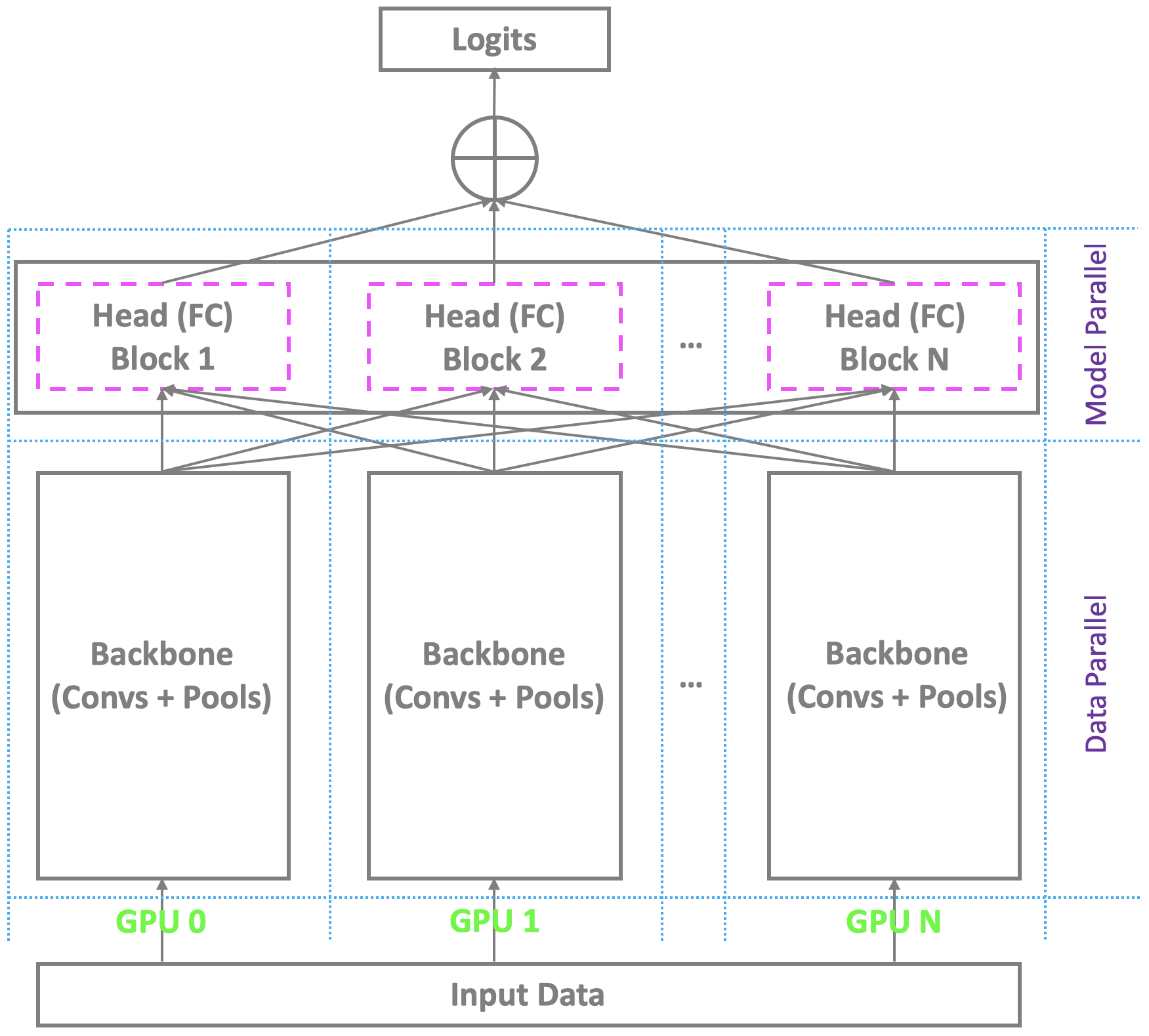
✅ CLOSED 23 Jan 2019 : Das aktuelle verteilte Trainingsschema mit Multi-GPUs unter Pytorch und anderen Mainstream-Plattformen entspricht dem Rückgrat über Multi-GPUs und stützt sich auf einen einzelnen Master, um die endgültige Engpassschicht (vollständig vernetzt/Softmax) zu berechnen. Dies ist kein Problem für die konventionelle Gesichtserkennung mit mäßiger Anzahl von Identitäten. Es kämpft jedoch mit einer groß angelegten Gesichtserkennung, die das Erkennen von Millionen von Identitäten in der realen Welt erfordert. Der Meister kann die übergroße endgültige Schicht kaum halten, während die Sklaven noch über überträgliche Berechnungsressourcen verfügen, was zu einem Small-Batch-Training oder sogar zu einem fehlgeschlagenen Training führt. Um dieses Problem anzugehen, entwickeln wir ein hoch elegantes, effektives und effizientes verteiltes Trainingsschema mit Multi-GPUs unter Pytorch, das nicht nur das Rückgrat, sondern auch den Kopf mit der vollständigen Schicht (Softmax) (Softmax) zur Erleichterung einer hohen Performance-Gesichtserkennung erleichtert. Wir werden diese Unterstützung in unser Repo aufnehmen.
✅ CLOSED 22 Jan 2019 : Wir haben zwei Feature-Extraktions-APIs zum Extrahieren von Funktionen aus vorgebliebenen Modellen veröffentlicht, die mit Pytorch-Build-In-Funktionen bzw. openCV implementiert sind. Bitte überprüfen ./util/extract_feature_v2.py ./util/extract_feature_v1.py
✅ CLOSED 22 Jan 2019 : Wir stimmen unser freigegebenes IR-50-Modell in unseren privaten Asien-Face-Daten, die bald veröffentlicht werden, um die Erkennung von Hochleistungs-Asien-Asien zu erleichtern.
✅ CLOSED 21 Jan 2019 : Wir trainieren ein besseres IR-50-Modell auf MS-CELEB-1M_ALIGN_112X112 und ersetzen das aktuelle Modell bald.
?
?
pip install torch torchvision )pip install mxnet-cu90 )pip install tensorflow-gpu )pip install tensorboardX )pip install opencv-python )pip install bcolz )Obwohl dies nicht erforderlich ist, wird für eine optimale Leistung dringend empfohlen, den Code mithilfe einer CUDA -fähigen GPU auszuführen. Wir haben parallel 4-8 Nvidia Tesla P40 verwendet.
?
git clone https://github.com/ZhaoJ9014/face.evoLVe.PyTorch.git .mkdir data checkpoint log im angemessenen Verzeichnis, um Ihre Zug-/Val/Testdaten, Checkpoints und Trainingsprotokolle zu speichern. ./data/db_name/
-> id1/
-> 1.jpg
-> ...
-> id2/
-> 1.jpg
-> ...
-> ...
-> ...
-> ...
?
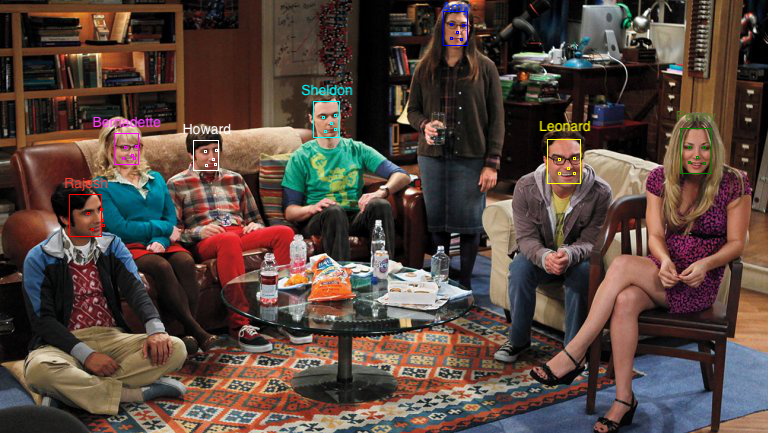

./align from PIL import Image
from detector import detect_faces
from visualization_utils import show_results
img = Image . open ( 'some_img.jpg' ) # modify the image path to yours
bounding_boxes , landmarks = detect_faces ( img ) # detect bboxes and landmarks for all faces in the image
show_results ( img , bounding_boxes , landmarks ) # visualize the resultssource_root mit der Verzeichnisstruktur, wie in Abschnitt verwendet, und speichern Sie die ausgerichteten Ergebnisse in einem neuen Ordner dest_root mit derselben Verzeichnisstruktur): python face_align.py -source_root [source_root] -dest_root [dest_root] -crop_size [crop_size]
# python face_align.py -source_root './data/test' -dest_root './data/test_Aligned' -crop_size 112
*.DS_Store -Dateien machen, die Ihre Daten ruinieren können, da sie beim Ausführen der Skripte automatisch entfernt werden.source_root , dest_root und crop_size an Ihre eigenen Werte an, wenn Sie face_align.py ausführen; 2) Übergeben Sie Ihre benutzerdefinierten min_face_size , thresholds und nms_thresholds -Werte an die Funktion von detect_faces von detector.py , um Ihren praktischen Anforderungen zu entsprechen. 3) Wenn Sie die Geschwindigkeit mithilfe der Gesichtsausrichtungs -API ein wenig langsam finden, können Sie die API der Gesichtsgröße aufrufen, um das Bild zuerst zu ändern, dessen kleinere Größe größer als ein Schwellenwert ist (Geben Sie die Argumente von source_root , dest_root und min_side an Ihre eigenen Werte an), bevor Sie die API der Gesichtsalignment aufrufen: python face_resize.py
./balancemin_num Proben im root mit der Verzeichnisstruktur, wie in Abschnitt Sec. Zeigt für Datenbilanz und effektives Modelltraining): python remove_lowshot.py -root [root] -min_num [min_num]
# python remove_lowshot.py -root './data/train' -min_num 10
root und min_num an Ihre eigenen Werte an, wenn Sie remove_lowshot.py ausführen.☕
Ordner: ./
Konfigurations -API (Konfigurieren Sie Ihre Gesamteinstellungen für Training und Validierung) config.py :
 import torch

configurations = {
    1 : dict (
        SEED = 1337 , # random seed for reproduce results

        DATA_ROOT = '/media/pc/6T/jasonjzhao/data/faces_emore' , # the parent root where your train/val/test data are stored
        MODEL_ROOT = '/media/pc/6T/jasonjzhao/buffer/model' , # the root to buffer your checkpoints
        LOG_ROOT = '/media/pc/6T/jasonjzhao/buffer/log' , # the root to log your train/val status
        BACKBONE_RESUME_ROOT = './' , # the root to resume training from a saved checkpoint
        HEAD_RESUME_ROOT = './' , # the root to resume training from a saved checkpoint

        BACKBONE_NAME = 'IR_SE_50' , # support: ['ResNet_50', 'ResNet_101', 'ResNet_152', 'IR_50', 'IR_101', 'IR_152', 'IR_SE_50', 'IR_SE_101', 'IR_SE_152']
        HEAD_NAME = 'ArcFace' , # support:  ['Softmax', 'ArcFace', 'CosFace', 'SphereFace', 'Am_softmax']
        LOSS_NAME = 'Focal' , # support: ['Focal', 'Softmax']

        INPUT_SIZE = [ 112 , 112 ], # support: [112, 112] and [224, 224]
        RGB_MEAN = [ 0.5 , 0.5 , 0.5 ], # for normalize inputs to [-1, 1]
        RGB_STD = [ 0.5 , 0.5 , 0.5 ],
        EMBEDDING_SIZE = 512 , # feature dimension
        BATCH_SIZE = 512 ,
        DROP_LAST = True , # whether drop the last batch to ensure consistent batch_norm statistics
        LR = 0.1 , # initial LR
        NUM_EPOCH = 125 , # total epoch number (use the firt 1/25 epochs to warm up)
        WEIGHT_DECAY = 5e-4 , # do not apply to batch_norm parameters
        MOMENTUM = 0.9 ,
        STAGES = [ 35 , 65 , 95 ], # epoch stages to decay learning rate

        DEVICE = torch . device ( "cuda:0" if torch . cuda . is_available () else "cpu" ),
        MULTI_GPU = True , # flag to use multiple GPUs; if you choose to train with single GPU, you should first run "export CUDA_VISILE_DEVICES=device_id" to specify the GPU card you want to use
        GPU_ID = [ 0 , 1 , 2 , 3 ], # specify your GPU ids
        PIN_MEMORY = True ,
        NUM_WORKERS = 0 ,
),
}
Zug- und Validierungs -API (alle Leute über Training und Validierung, dh , importierende Paket, Hyperparameter & Datenlader, Modell & Verlust & Optimierer, Zug & Validation & Save Checkpoint) train.py . Da MS-Celeb-1M als Bildnachteil bei der Einreichung der Gesichtserkennung dient, verarbeiten wir das Gesicht. Lassen Sie uns Schritt für Schritt gemeinsam auf Details eintauchen.
 import torch
import torch . nn as nn
import torch . optim as optim
import torchvision . transforms as transforms
import torchvision . datasets as datasets

from config import configurations
from backbone . model_resnet import ResNet_50 , ResNet_101 , ResNet_152
from backbone . model_irse import IR_50 , IR_101 , IR_152 , IR_SE_50 , IR_SE_101 , IR_SE_152
from head . metrics import ArcFace , CosFace , SphereFace , Am_softmax
from loss . focal import FocalLoss
from util . utils import make_weights_for_balanced_classes , get_val_data , separate_irse_bn_paras , separate_resnet_bn_paras , warm_up_lr , schedule_lr , perform_val , get_time , buffer_val , AverageMeter , accuracy

from tensorboardX import SummaryWriter
from tqdm import tqdm
import os cfg = configurations [ 1 ]
SEED = cfg [ 'SEED' ] # random seed for reproduce results
torch . manual_seed ( SEED )
DATA_ROOT = cfg [ 'DATA_ROOT' ] # the parent root where your train/val/test data are stored
MODEL_ROOT = cfg [ 'MODEL_ROOT' ] # the root to buffer your checkpoints
LOG_ROOT = cfg [ 'LOG_ROOT' ] # the root to log your train/val status
BACKBONE_RESUME_ROOT = cfg [ 'BACKBONE_RESUME_ROOT' ] # the root to resume training from a saved checkpoint
HEAD_RESUME_ROOT = cfg [ 'HEAD_RESUME_ROOT' ] # the root to resume training from a saved checkpoint
BACKBONE_NAME = cfg [ 'BACKBONE_NAME' ] # support: ['ResNet_50', 'ResNet_101', 'ResNet_152', 'IR_50', 'IR_101', 'IR_152', 'IR_SE_50', 'IR_SE_101', 'IR_SE_152']
HEAD_NAME = cfg [ 'HEAD_NAME' ] # support: ['Softmax', 'ArcFace', 'CosFace', 'SphereFace', 'Am_softmax']
LOSS_NAME = cfg [ 'LOSS_NAME' ] # support: ['Focal', 'Softmax']
INPUT_SIZE = cfg [ 'INPUT_SIZE' ]
RGB_MEAN = cfg [ 'RGB_MEAN' ] # for normalize inputs
RGB_STD = cfg [ 'RGB_STD' ]
EMBEDDING_SIZE = cfg [ 'EMBEDDING_SIZE' ] # feature dimension
BATCH_SIZE = cfg [ 'BATCH_SIZE' ]
DROP_LAST = cfg [ 'DROP_LAST' ] # whether drop the last batch to ensure consistent batch_norm statistics
LR = cfg [ 'LR' ] # initial LR
NUM_EPOCH = cfg [ 'NUM_EPOCH' ]
WEIGHT_DECAY = cfg [ 'WEIGHT_DECAY' ]
MOMENTUM = cfg [ 'MOMENTUM' ]
STAGES = cfg [ 'STAGES' ] # epoch stages to decay learning rate
DEVICE = cfg [ 'DEVICE' ]
MULTI_GPU = cfg [ 'MULTI_GPU' ] # flag to use multiple GPUs
GPU_ID = cfg [ 'GPU_ID' ] # specify your GPU ids
PIN_MEMORY = cfg [ 'PIN_MEMORY' ]
NUM_WORKERS = cfg [ 'NUM_WORKERS' ]
print ( "=" * 60 )
print ( "Overall Configurations:" )
print ( cfg )
print ( "=" * 60 )
writer = SummaryWriter ( LOG_ROOT ) # writer for buffering intermedium results train_transform = transforms . Compose ([ # refer to https://pytorch.org/docs/stable/torchvision/transforms.html for more build-in online data augmentation
transforms . Resize ([ int ( 128 * INPUT_SIZE [ 0 ] / 112 ), int ( 128 * INPUT_SIZE [ 0 ] / 112 )]), # smaller side resized
transforms . RandomCrop ([ INPUT_SIZE [ 0 ], INPUT_SIZE [ 1 ]]),
transforms . RandomHorizontalFlip (),
transforms . ToTensor (),
transforms . Normalize ( mean = RGB_MEAN ,
std = RGB_STD ),
])
dataset_train = datasets . ImageFolder ( os . path . join ( DATA_ROOT , 'imgs' ), train_transform )
# create a weighted random sampler to process imbalanced data
weights = make_weights_for_balanced_classes ( dataset_train . imgs , len ( dataset_train . classes ))
weights = torch . DoubleTensor ( weights )
sampler = torch . utils . data . sampler . WeightedRandomSampler ( weights , len ( weights ))
train_loader = torch . utils . data . DataLoader (
dataset_train , batch_size = BATCH_SIZE , sampler = sampler , pin_memory = PIN_MEMORY ,
num_workers = NUM_WORKERS , drop_last = DROP_LAST
)
NUM_CLASS = len ( train_loader . dataset . classes )
print ( "Number of Training Classes: {}" . format ( NUM_CLASS ))
lfw , cfp_ff , cfp_fp , agedb , calfw , cplfw , vgg2_fp , lfw_issame , cfp_ff_issame , cfp_fp_issame , agedb_issame , calfw_issame , cplfw_issame , vgg2_fp_issame = get_val_data ( DATA_ROOT ) BACKBONE_DICT = { 'ResNet_50' : ResNet_50 ( INPUT_SIZE ),
'ResNet_101' : ResNet_101 ( INPUT_SIZE ),
'ResNet_152' : ResNet_152 ( INPUT_SIZE ),
'IR_50' : IR_50 ( INPUT_SIZE ),
'IR_101' : IR_101 ( INPUT_SIZE ),
'IR_152' : IR_152 ( INPUT_SIZE ),
'IR_SE_50' : IR_SE_50 ( INPUT_SIZE ),
'IR_SE_101' : IR_SE_101 ( INPUT_SIZE ),
'IR_SE_152' : IR_SE_152 ( INPUT_SIZE )}
BACKBONE = BACKBONE_DICT [ BACKBONE_NAME ]
print ( "=" * 60 )
print ( BACKBONE )
print ( "{} Backbone Generated" . format ( BACKBONE_NAME ))
print ( "=" * 60 )
HEAD_DICT = { 'ArcFace' : ArcFace ( in_features = EMBEDDING_SIZE , out_features = NUM_CLASS , device_id = GPU_ID ),
'CosFace' : CosFace ( in_features = EMBEDDING_SIZE , out_features = NUM_CLASS , device_id = GPU_ID ),
'SphereFace' : SphereFace ( in_features = EMBEDDING_SIZE , out_features = NUM_CLASS , device_id = GPU_ID ),
'Am_softmax' : Am_softmax ( in_features = EMBEDDING_SIZE , out_features = NUM_CLASS , device_id = GPU_ID )}
HEAD = HEAD_DICT [ HEAD_NAME ]
print ( "=" * 60 )
print ( HEAD )
print ( "{} Head Generated" . format ( HEAD_NAME ))
print ( "=" * 60 ) LOSS_DICT = { 'Focal' : FocalLoss (),
'Softmax' : nn . CrossEntropyLoss ()}
LOSS = LOSS_DICT [ LOSS_NAME ]
print ( "=" * 60 )
print ( LOSS )
print ( "{} Loss Generated" . format ( LOSS_NAME ))
print ( "=" * 60 ) if BACKBONE_NAME . find ( "IR" ) >= 0 :
backbone_paras_only_bn , backbone_paras_wo_bn = separate_irse_bn_paras ( BACKBONE ) # separate batch_norm parameters from others; do not do weight decay for batch_norm parameters to improve the generalizability
_ , head_paras_wo_bn = separate_irse_bn_paras ( HEAD )
else :
backbone_paras_only_bn , backbone_paras_wo_bn = separate_resnet_bn_paras ( BACKBONE ) # separate batch_norm parameters from others; do not do weight decay for batch_norm parameters to improve the generalizability
_ , head_paras_wo_bn = separate_resnet_bn_paras ( HEAD )
OPTIMIZER = optim . SGD ([{ 'params' : backbone_paras_wo_bn + head_paras_wo_bn , 'weight_decay' : WEIGHT_DECAY }, { 'params' : backbone_paras_only_bn }], lr = LR , momentum = MOMENTUM )
print ( "=" * 60 )
print ( OPTIMIZER )
print ( "Optimizer Generated" )
print ( "=" * 60 ) if BACKBONE_RESUME_ROOT and HEAD_RESUME_ROOT :
print ( "=" * 60 )
if os . path . isfile ( BACKBONE_RESUME_ROOT ) and os . path . isfile ( HEAD_RESUME_ROOT ):
print ( "Loading Backbone Checkpoint '{}'" . format ( BACKBONE_RESUME_ROOT ))
BACKBONE . load_state_dict ( torch . load ( BACKBONE_RESUME_ROOT ))
print ( "Loading Head Checkpoint '{}'" . format ( HEAD_RESUME_ROOT ))
HEAD . load_state_dict ( torch . load ( HEAD_RESUME_ROOT ))
else :
print ( "No Checkpoint Found at '{}' and '{}'. Please Have a Check or Continue to Train from Scratch" . format ( BACKBONE_RESUME_ROOT , HEAD_RESUME_ROOT ))
print ( "=" * 60 ) if MULTI_GPU :
# multi-GPU setting
BACKBONE = nn . DataParallel ( BACKBONE , device_ids = GPU_ID )
BACKBONE = BACKBONE . to ( DEVICE )
else :
# single-GPU setting
BACKBONE = BACKBONE . to ( DEVICE ) DISP_FREQ = len ( train_loader ) // 100 # frequency to display training loss & acc
NUM_EPOCH_WARM_UP = NUM_EPOCH // 25 # use the first 1/25 epochs to warm up
NUM_BATCH_WARM_UP = len ( train_loader ) * NUM_EPOCH_WARM_UP # use the first 1/25 epochs to warm up
batch = 0 # batch index for epoch in range ( NUM_EPOCH ): # start training process
if epoch == STAGES [ 0 ]: # adjust LR for each training stage after warm up, you can also choose to adjust LR manually (with slight modification) once plaueau observed
schedule_lr ( OPTIMIZER )
if epoch == STAGES [ 1 ]:
schedule_lr ( OPTIMIZER )
if epoch == STAGES [ 2 ]:
schedule_lr ( OPTIMIZER )
BACKBONE . train () # set to training mode
HEAD . train ()
losses = AverageMeter ()
top1 = AverageMeter ()
top5 = AverageMeter ()
for inputs , labels in tqdm ( iter ( train_loader )):
if ( epoch + 1 <= NUM_EPOCH_WARM_UP ) and ( batch + 1 <= NUM_BATCH_WARM_UP ): # adjust LR for each training batch during warm up
warm_up_lr ( batch + 1 , NUM_BATCH_WARM_UP , LR , OPTIMIZER )
# compute output
inputs = inputs . to ( DEVICE )
labels = labels . to ( DEVICE ). long ()
features = BACKBONE ( inputs )
outputs = HEAD ( features , labels )
loss = LOSS ( outputs , labels )
# measure accuracy and record loss
prec1 , prec5 = accuracy ( outputs . data , labels , topk = ( 1 , 5 ))
losses . update ( loss . data . item (), inputs . size ( 0 ))
top1 . update ( prec1 . data . item (), inputs . size ( 0 ))
top5 . update ( prec5 . data . item (), inputs . size ( 0 ))
# compute gradient and do SGD step
OPTIMIZER . zero_grad ()
loss . backward ()
OPTIMIZER . step ()
# dispaly training loss & acc every DISP_FREQ
if (( batch + 1 ) % DISP_FREQ == 0 ) and batch != 0 :
print ( "=" * 60 )
print ( 'Epoch {}/{} Batch {}/{} t '
'Training Loss {loss.val:.4f} ({loss.avg:.4f}) t '
'Training Prec@1 {top1.val:.3f} ({top1.avg:.3f}) t '
'Training Prec@5 {top5.val:.3f} ({top5.avg:.3f})' . format (
epoch + 1 , NUM_EPOCH , batch + 1 , len ( train_loader ) * NUM_EPOCH , loss = losses , top1 = top1 , top5 = top5 ))
print ( "=" * 60 )
batch += 1 # batch index
# training statistics per epoch (buffer for visualization)
epoch_loss = losses . avg
epoch_acc = top1 . avg
writer . add_scalar ( "Training_Loss" , epoch_loss , epoch + 1 )
writer . add_scalar ( "Training_Accuracy" , epoch_acc , epoch + 1 )
print ( "=" * 60 )
print ( 'Epoch: {}/{} t '
'Training Loss {loss.val:.4f} ({loss.avg:.4f}) t '
'Training Prec@1 {top1.val:.3f} ({top1.avg:.3f}) t '
'Training Prec@5 {top5.val:.3f} ({top5.avg:.3f})' . format (
epoch + 1 , NUM_EPOCH , loss = losses , top1 = top1 , top5 = top5 ))
print ( "=" * 60 )
# perform validation & save checkpoints per epoch
# validation statistics per epoch (buffer for visualization)
print ( "=" * 60 )
print ( "Perform Evaluation on LFW, CFP_FF, CFP_FP, AgeDB, CALFW, CPLFW and VGG2_FP, and Save Checkpoints..." )
accuracy_lfw , best_threshold_lfw , roc_curve_lfw = perform_val ( MULTI_GPU , DEVICE , EMBEDDING_SIZE , BATCH_SIZE , BACKBONE , lfw , lfw_issame )
buffer_val ( writer , "LFW" , accuracy_lfw , best_threshold_lfw , roc_curve_lfw , epoch + 1 )
accuracy_cfp_ff , best_threshold_cfp_ff , roc_curve_cfp_ff = perform_val ( MULTI_GPU , DEVICE , EMBEDDING_SIZE , BATCH_SIZE , BACKBONE , cfp_ff , cfp_ff_issame )
buffer_val ( writer , "CFP_FF" , accuracy_cfp_ff , best_threshold_cfp_ff , roc_curve_cfp_ff , epoch + 1 )
accuracy_cfp_fp , best_threshold_cfp_fp , roc_curve_cfp_fp = perform_val ( MULTI_GPU , DEVICE , EMBEDDING_SIZE , BATCH_SIZE , BACKBONE , cfp_fp , cfp_fp_issame )
buffer_val ( writer , "CFP_FP" , accuracy_cfp_fp , best_threshold_cfp_fp , roc_curve_cfp_fp , epoch + 1 )
accuracy_agedb , best_threshold_agedb , roc_curve_agedb = perform_val ( MULTI_GPU , DEVICE , EMBEDDING_SIZE , BATCH_SIZE , BACKBONE , agedb , agedb_issame )
buffer_val ( writer , "AgeDB" , accuracy_agedb , best_threshold_agedb , roc_curve_agedb , epoch + 1 )
accuracy_calfw , best_threshold_calfw , roc_curve_calfw = perform_val ( MULTI_GPU , DEVICE , EMBEDDING_SIZE , BATCH_SIZE , BACKBONE , calfw , calfw_issame )
buffer_val ( writer , "CALFW" , accuracy_calfw , best_threshold_calfw , roc_curve_calfw , epoch + 1 )
accuracy_cplfw , best_threshold_cplfw , roc_curve_cplfw = perform_val ( MULTI_GPU , DEVICE , EMBEDDING_SIZE , BATCH_SIZE , BACKBONE , cplfw , cplfw_issame )
buffer_val ( writer , "CPLFW" , accuracy_cplfw , best_threshold_cplfw , roc_curve_cplfw , epoch + 1 )
accuracy_vgg2_fp , best_threshold_vgg2_fp , roc_curve_vgg2_fp = perform_val ( MULTI_GPU , DEVICE , EMBEDDING_SIZE , BATCH_SIZE , BACKBONE , vgg2_fp , vgg2_fp_issame )
buffer_val ( writer , "VGGFace2_FP" , accuracy_vgg2_fp , best_threshold_vgg2_fp , roc_curve_vgg2_fp , epoch + 1 )
print ( "Epoch {}/{}, Evaluation: LFW Acc: {}, CFP_FF Acc: {}, CFP_FP Acc: {}, AgeDB Acc: {}, CALFW Acc: {}, CPLFW Acc: {}, VGG2_FP Acc: {}" . format ( epoch + 1 , NUM_EPOCH , accuracy_lfw , accuracy_cfp_ff , accuracy_cfp_fp , accuracy_agedb , accuracy_calfw , accuracy_cplfw , accuracy_vgg2_fp ))
print ( "=" * 60 )
# save checkpoints per epoch
if MULTI_GPU :
torch . save ( BACKBONE . module . state_dict (), os . path . join ( MODEL_ROOT , "Backbone_{}_Epoch_{}_Batch_{}_Time_{}_checkpoint.pth" . format ( BACKBONE_NAME , epoch + 1 , batch , get_time ())))
torch . save ( HEAD . state_dict (), os . path . join ( MODEL_ROOT , "Head_{}_Epoch_{}_Batch_{}_Time_{}_checkpoint.pth" . format ( HEAD_NAME , epoch + 1 , batch , get_time ())))
else :
torch . save ( BACKBONE . state_dict (), os . path . join ( MODEL_ROOT , "Backbone_{}_Epoch_{}_Batch_{}_Time_{}_checkpoint.pth" . format ( BACKBONE_NAME , epoch + 1 , batch , get_time ())))
torch . save ( HEAD . state_dict (), os . path . join ( MODEL_ROOT , "Head_{}_Epoch_{}_Batch_{}_Time_{}_checkpoint.pth" . format ( HEAD_NAME , epoch + 1 , batch , get_time ()))) Jetzt können Sie mit Face.evolve und Run train.py spielen. Benutzerfreundliche Informationen finden Sie in Ihrem Terminal aus:
Über allgemeine Konfiguration:

Über die Anzahl der Schulungsklassen:

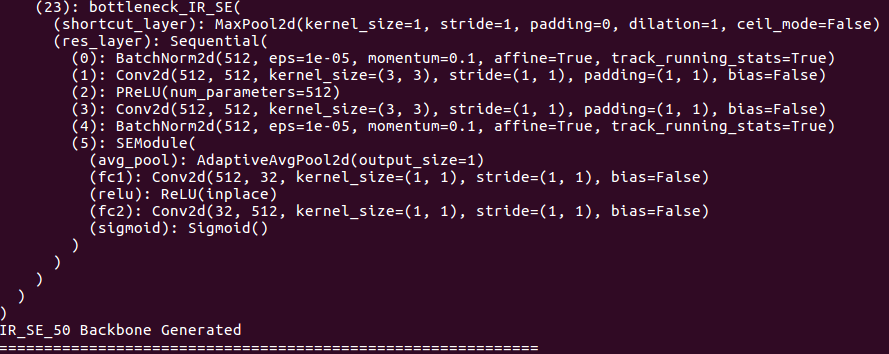
Über Backbone -Details:
Über Kopfdetails:

Über Verlustdetails:

Über Optimierer Details:
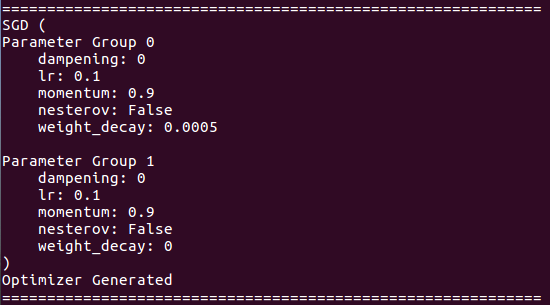
Über Lebenslauftraining:

Über Schulungsstatus und Statistiken (wenn der Batch -Index DISP_FREQ oder am Ende jeder Epoche erreicht):
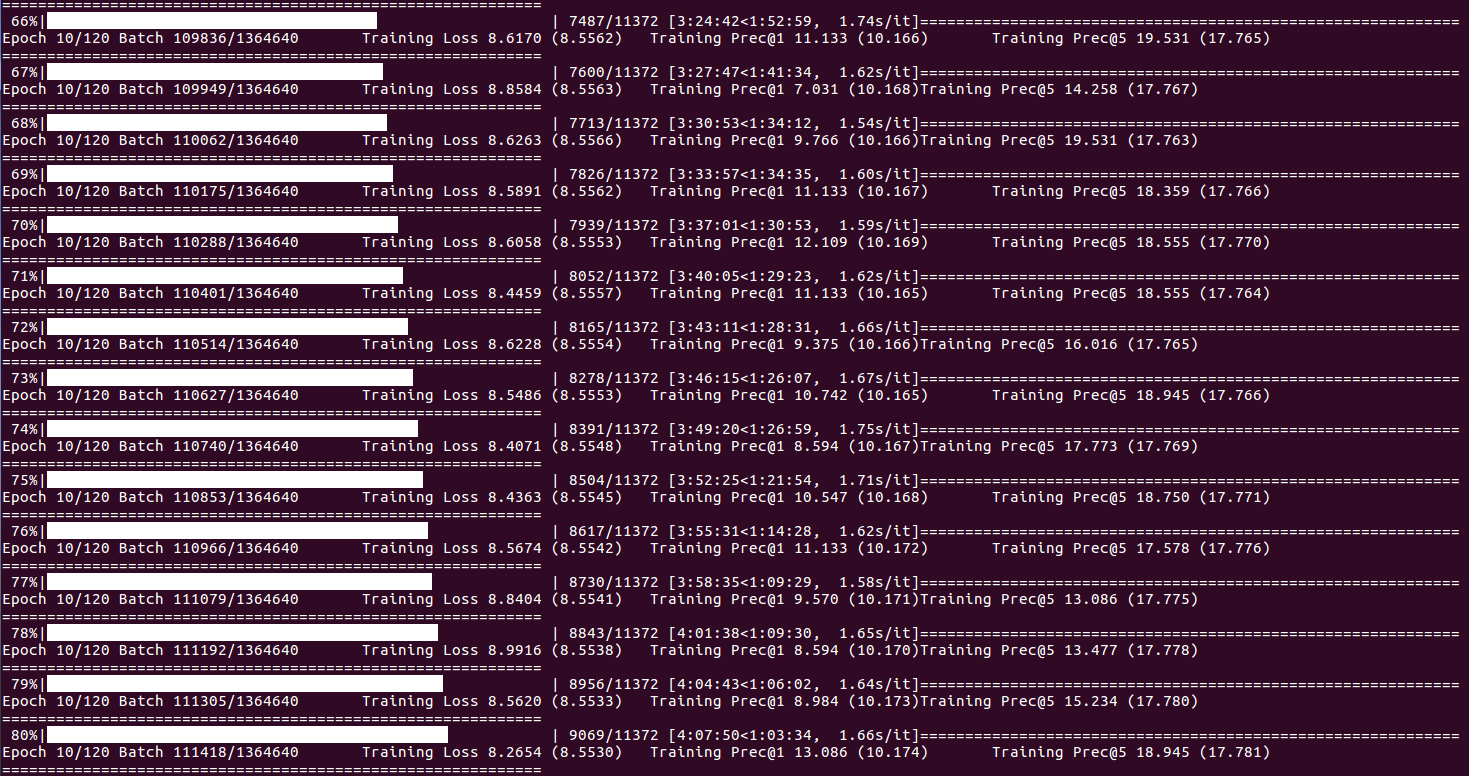
Über Validierungsstatistiken und speichern Checkpoints (am Ende jeder Epoche):

Überwachen Sie die GPU-Belegung der Fliege mit watch -d -n 0.01 nvidia-smi .
Bitte beziehen Sie sich auf Sec. Modellzoo für bestimmte Modellgewichte und entsprechende Leistung.
Featurextraktions-API (extrahieren Merkmale aus vorgeborenen Modellen) ./util/extract_feature_v1.py (implementiert mit Pytorch-Build-in-Funktionen) und ./util/extract_feature_v2.py (implementiert mit OpenCV).
Visualisieren Sie Trainings- und Validierungsstatistiken mit Tensorboardx (siehe Abschnitt Modellzoo):
tensorboard --logdir /media/pc/6T/jasonjzhao/buffer/log
?
| Datenbank | Version | #Identität | #Bild | #Rahmen | #Video | Link herunterladen |
|---|---|---|---|---|---|---|
| Lfw | Roh | 5,749 | 13.233 | - - | - - | Google Drive, Baidu Drive |
| Lfw | Align_250x250 | 5,749 | 13.233 | - - | - - | Google Drive, Baidu Drive |
| Lfw | Align_112x112 | 5,749 | 13.233 | - - | - - | Google Drive, Baidu Drive |
| Kalb | Roh | 4,025 | 12,174 | - - | - - | Google Drive, Baidu Drive |
| Kalb | Align_112x112 | 4,025 | 12,174 | - - | - - | Google Drive, Baidu Drive |
| CPLFW | Roh | 3.884 | 11.652 | - - | - - | Google Drive, Baidu Drive |
| CPLFW | Align_112x112 | 3.884 | 11.652 | - - | - - | Google Drive, Baidu Drive |
| Casia-Webface | RAW_V1 | 10.575 | 494.414 | - - | - - | Baidu Drive |
| Casia-Webface | RAW_V2 | 10.575 | 494.414 | - - | - - | Google Drive, Baidu Drive |
| Casia-Webface | Sauber | 10.575 | 455.594 | - - | - - | Google Drive, Baidu Drive |
| Ms-celeb-1m | Sauber | 100.000 | 5.084.127 | - - | - - | Google Drive |
| Ms-celeb-1m | Align_112x112 | 85.742 | 5.822.653 | - - | - - | Google Drive |
| Vggface2 | Sauber | 8.631 | 3.086.894 | - - | - - | Google Drive |
| Vggface2_fp | Align_112x112 | - - | - - | - - | - - | Google Drive, Baidu Drive |
| Gealtert | Roh | 570 | 16.488 | - - | - - | Google Drive, Baidu Drive |
| Gealtert | Align_112x112 | 570 | 16.488 | - - | - - | Google Drive, Baidu Drive |
| Ijb-a | Sauber | 500 | 5,396 | 20.369 | 2.085 | Google Drive, Baidu Drive |
| IJB-B | Roh | 1.845 | 21.798 | 55.026 | 7.011 | Google Drive |
| CFP | Roh | 500 | 7.000 | - - | - - | Google Drive, Baidu Drive |
| CFP | Align_112x112 | 500 | 7.000 | - - | - - | Google Drive, Baidu Drive |
| Umdfaces | Align_112x112 | 8,277 | 367.888 | - - | - - | Google Drive, Baidu Drive |
| Celeba | Roh | 10,177 | 202.599 | - - | - - | Google Drive, Baidu Drive |
| CACD-VS | Roh | 2.000 | 163.446 | - - | - - | Google Drive, Baidu Drive |
| Ytf | Align_344x344 | 1.595 | - - | 3.425 | 621,127 | Google Drive, Baidu Drive |
| DeepGlint | Align_112x112 | 180.855 | 6.753.545 | - - | - - | Google Drive |
| Utkface | Align_200x200 | - - | 23.708 | - - | - - | Google Drive, Baidu Drive |
| Buaa-visnir | Align_287x287 | 150 | 5,952 | - - | - - | Baidu Drive, PW: XMBC |
| Casia Nir-Vis 2.0 | Align_128x128 | 725 | 17.580 | - - | - - | Baidu Drive, PW: 883b |
| Oulu-Casia | Roh | 80 | 65.000 | - - | - - | Baidu Drive, PW: xxp5 |
| Nuaaa-Eposterdb | Roh | 15 | 12.614 | - - | - - | Baidu Drive, PW: IF3N |
| Casia-surf | Roh | 1.000 | - - | - - | 21.000 | Baidu Drive, PW: IZB3 |
| Casia-Fasd | Roh | 50 | - - | - - | 600 | Baidu Drive, PW: H5un |
| CASIA-MFSD | Roh | 50 | - - | - - | 600 | |
| Wiederholungsangriff | Roh | 50 | - - | - - | 1.200 | |
| Webface260m | Roh | 24m | 2m | - - | https://www.face-Benchmark.org/ |
 unzip casia-maxpy-clean.zip
cd casia-maxpy-clean
zip -F CASIA-maxpy-clean.zip --out CASIA-maxpy-clean_fix.zip
unzip CASIA-maxpy-clean_fix.zip
 import numpy as np
import bcolz
import os

def get_pair ( root , name ):
    carray = bcolz . carray ( rootdir = os . path . join ( root , name ), mode = 'r' )
    issame = np . load ( '{}/{}_list.npy' . format ( root , name ))
    return carray , issame

def get_data ( data_root ):
    agedb_30 , agedb_30_issame = get_pair ( data_root , 'agedb_30' )
    cfp_fp , cfp_fp_issame = get_pair ( data_root , 'cfp_fp' )
    lfw , lfw_issame = get_pair ( data_root , 'lfw' )
    vgg2_fp , vgg2_fp_issame = get_pair ( data_root , 'vgg2_fp' )
    return agedb_30 , cfp_fp , lfw , vgg2_fp , agedb_30_issame , cfp_fp_issame , lfw_issame , vgg2_fp_issame

agedb_30 , cfp_fp , lfw , vgg2_fp , agedb_30_issame , cfp_fp_issame , lfw_issame , vgg2_fp_issame = get_data ( DATA_ROOT )MS-Celeb-1M_Top1M_MID2Name.tsv (Google Drive, Baidu Drive), VGGface2_ID2Name.csv (Google Drive, Baidu Drive), VGGface2_FaceScrub_Overlap.txt (Google Drive), Baidu Drive, Baidu Drive), Baidu Drive, Baidu Drive), Baidu Drive, Baidu Drive), Baidu Drive, Baidu Drive), Baidu Drive, Baidu Drive), VGGface2_LFW_Overlap.txt Drive, Baidu Drive), Baidu Drive, Baidu Drive), Baidu Drive, Baidu Drive), Baidu Drive, Baidu Drive), Baidu Drive, Baidu Drive),, CASIA-WebFace_ID2Name.txt (Google Drive, Baidu Drive), CASIA-WebFace_FaceScrub_Overlap.txt (Google Drive, Baidu Drive), CASIA-WebFace_LFW_Overlap.txt (Google Drive, Baidu Drive), FaceScrub_Name.txt (Google Drive, Baidu Drive), LFW_Name.txt (Google Drive, Baidu Drive), LFW_Log.txt (Google Drive, Baidu Drive), um Forschern/Ingenieuren dabei zu helfen, die überlappenden Teile zwischen ihren eigenen privaten Datensätzen und den öffentlichen Datensätzen schnell zu entfernen.?
Modell
| Rückgrat | Kopf | Verlust | Trainingsdaten | Link herunterladen |
|---|---|---|---|---|
| IR-50 | Bogenface | Fokal | Ms-celeb-1m_align_112x112 | Google Drive, Baidu Drive |
Einstellung
INPUT_SIZE: [112, 112]; RGB_MEAN: [0.5, 0.5, 0.5]; RGB_STD: [0.5, 0.5, 0.5]; BATCH_SIZE: 512 (drop the last batch to ensure consistent batch_norm statistics); Initial LR: 0.1; NUM_EPOCH: 120; WEIGHT_DECAY: 5e-4 (do not apply to batch_norm parameters); MOMENTUM: 0.9; STAGES: [30, 60, 90]; Augmentation: Random Crop + Horizontal Flip; Imbalanced Data Processing: Weighted Random Sampling; Solver: SGD; GPUs: 4 NVIDIA Tesla P40 in Parallel
Trainings- und Validierungsstatistik

Leistung
| Lfw | CFP_FF | CFP_FP | Gealtert | Kalb | CPLFW | Vggface2_fp |
|---|---|---|---|---|---|---|
| 99.78 | 99.69 | 98.14 | 97.53 | 95,87 | 92.45 | 95.22 |
Modell
| Rückgrat | Kopf | Verlust | Trainingsdaten | Link herunterladen |
|---|---|---|---|---|
| IR-50 | Bogenface | Fokal | Private Asien sind mit Daten vorhanden | Google Drive, Baidu Drive |
Einstellung
INPUT_SIZE: [112, 112]; RGB_MEAN: [0.5, 0.5, 0.5]; RGB_STD: [0.5, 0.5, 0.5]; BATCH_SIZE: 1024 (drop the last batch to ensure consistent batch_norm statistics); Initial LR: 0.01 (initialize weights from the above model pre-trained on MS-Celeb-1M_Align_112x112); NUM_EPOCH: 80; WEIGHT_DECAY: 5e-4 (do not apply to batch_norm parameters); MOMENTUM: 0.9; STAGES: [20, 40, 60]; Augmentation: Random Crop + Horizontal Flip; Imbalanced Data Processing: Weighted Random Sampling; Solver: SGD; GPUs: 8 NVIDIA Tesla P40 in Parallel
Leistung (Bitte führen Sie die Bewertung in Ihrem eigenen Asien -Gesichtsbenchmark -Datensatz durch)
Modell
| Rückgrat | Kopf | Verlust | Trainingsdaten | Link herunterladen |
|---|---|---|---|---|
| IR-152 | Bogenface | Fokal | Ms-celeb-1m_align_112x112 | Baidu Drive, PW: B197 |
Einstellung
INPUT_SIZE: [112, 112]; RGB_MEAN: [0.5, 0.5, 0.5]; RGB_STD: [0.5, 0.5, 0.5]; BATCH_SIZE: 256 (drop the last batch to ensure consistent batch_norm statistics); Initial LR: 0.01; NUM_EPOCH: 120; WEIGHT_DECAY: 5e-4 (do not apply to batch_norm parameters); MOMENTUM: 0.9; STAGES: [30, 60, 90]; Augmentation: Random Crop + Horizontal Flip; Imbalanced Data Processing: Weighted Random Sampling; Solver: SGD; GPUs: 4 NVIDIA Geforce RTX 2080 Ti in Parallel
Trainings- und Validierungsstatistik

Leistung
| Lfw | CFP_FF | CFP_FP | Gealtert | Kalb | CPLFW | Vggface2_fp |
|---|---|---|---|---|---|---|
| 99,82 | 99,83 | 98.37 | 98.07 | 96.03 | 93.05 | 95,50 |
?
2017 Nr. 1 auf ICCV 2017 MS-CELEB-1M groß angelegte Gesichtserkennung hartes Set/zufälliger Set/Lern-Shot-Lernherausforderungen. Wechat News, NUS ECE News, NUS ECE-Poster, Preiszertifikat für Track-1, Preiszertifikat für Track-2, Preisverleihung.
2017 Nr. 1 zum National Institute of Standards and Technology (NIST) IARPA Janus Benchmark A (IJB-A) Unconstrained Face Converification Challenge and Identification Challenge. Wechat News.
Hochmoderne Leistung auf
?
?
Bitte wenden Sie sich an und erwägen Sie die folgenden Papiere:
 @article{wu20223d,
title={3D-Guided Frontal Face Generation for Pose-Invariant Recognition},
author={Wu, Hao and Gu, Jianyang and Fan, Xiaojin and Li, He and Xie, Lidong and Zhao, Jian},
journal={T-IST},
year={2022}
}


@article{wang2021face,
title={Face.evoLVe: A High-Performance Face Recognition Library},
author={Wang, Qingzhong and Zhang, Pengfei and Xiong, Haoyi and Zhao, Jian},
journal={arXiv preprint arXiv:2107.08621},
year={2021}
}


@article{tu2021joint,
title={Joint Face Image Restoration and Frontalization for Recognition},
author={Tu, Xiaoguang and Zhao, Jian and Liu, Qiankun and Ai, Wenjie and Guo, Guodong and Li, Zhifeng and Liu, Wei and Feng, Jiashi},
journal={T-CSVT},
year={2021}
}


@article{zhao2020towards,
title={Towards age-invariant face recognition},
author={Zhao, Jian and Yan, Shuicheng and Feng, Jiashi},
journal={T-PAMI},
year={2020}
}


@article{zhao2019recognizing,
title={Recognizing Profile Faces by Imagining Frontal View},
author={Zhao, Jian and Xing, Junliang and Xiong, Lin and Yan, Shuicheng and Feng, Jiashi},
journal={IJCV},
pages={1--19},
year={2019}
}


@inproceedings{zhao2019multi,
title={Multi-Prototype Networks for Unconstrained Set-based Face Recognition},
author={Zhao, Jian and Li, Jianshu and Tu, Xiaoguang and Zhao, Fang and Xin, Yuan and Xing, Junliang and Liu, Hengzhu and Yan, Shuicheng and Feng, Jiashi},
booktitle={IJCAI},
year={2019}
}


@inproceedings{zhao2019look,
title={Look Across Elapse: Disentangled Representation Learning and Photorealistic Cross-Age Face Synthesis for Age-Invariant Face Recognition},
author={Zhao, Jian and Cheng, Yu and Cheng, Yi and Yang, Yang and Lan, Haochong and Zhao, Fang and Xiong, Lin and Xu, Yan and Li, Jianshu and Pranata, Sugiri and others},
booktitle={AAAI},
year={2019}
}


@article{zhao20183d,
title={3D-Aided Dual-Agent GANs for Unconstrained Face Recognition},
author={Zhao, Jian and Xiong, Lin and Li, Jianshu and Xing, Junliang and Yan, Shuicheng and Feng, Jiashi},
journal={T-PAMI},
year={2018}
}


@inproceedings{zhao2018towards,
title={Towards Pose Invariant Face Recognition in the Wild},
author={Zhao, Jian and Cheng, Yu and Xu, Yan and Xiong, Lin and Li, Jianshu and Zhao, Fang and Jayashree, Karlekar and Pranata,         Sugiri and Shen, Shengmei and Xing, Junliang and others},
booktitle={CVPR},
pages={2207--2216},
year={2018}
}


@inproceedings{zhao3d,
title={3D-Aided Deep Pose-Invariant Face Recognition},
author={Zhao, Jian and Xiong, Lin and Cheng, Yu and Cheng, Yi and Li, Jianshu and Zhou, Li and Xu, Yan and Karlekar, Jayashree and       Pranata, Sugiri and Shen, Shengmei and others},
booktitle={IJCAI},
pages={1184--1190},
year={2018}
}


@inproceedings{zhao2018dynamic,
title={Dynamic Conditional Networks for Few-Shot Learning},
author={Zhao, Fang and Zhao, Jian and Yan, Shuicheng and Feng, Jiashi},
booktitle={ECCV},
pages={19--35},
year={2018}
}


@inproceedings{zhao2017dual,
title={Dual-agent gans for photorealistic and identity preserving profile face synthesis},
author={Zhao, Jian and Xiong, Lin and Jayashree, Panasonic Karlekar and Li, Jianshu and Zhao, Fang and Wang, Zhecan and Pranata,           Panasonic Sugiri and Shen, Panasonic Shengmei and Yan, Shuicheng and Feng, Jiashi},
booktitle={NeurIPS},
pages={66--76},
year={2017}
}


@inproceedings{zhao122017marginalized,
title={Marginalized cnn: Learning deep invariant representations},
author={Zhao12, Jian and Li, Jianshu and Zhao, Fang and Yan13, Shuicheng and Feng, Jiashi},
booktitle={BMVC},
year={2017}
}


@inproceedings{cheng2017know,
title={Know you at one glance: A compact vector representation for low-shot learning},
author={Cheng, Yu and Zhao, Jian and Wang, Zhecan and Xu, Yan and Jayashree, Karlekar and Shen, Shengmei and Feng, Jiashi},
booktitle={ICCVW},
pages={1924--1932},
year={2017}
}


@inproceedings{wangconditional,
title={Conditional Dual-Agent GANs for Photorealistic and Annotation Preserving Image Synthesis},
author={Wang, Zhecan and Zhao, Jian and Cheng, Yu and Xiao, Shengtao and Li, Jianshu and Zhao, Fang and Feng, Jiashi and Kassim, Ashraf},
booktitle={BMVCW},
}