holmes extractor
Holmes 4.0.0

Autor: Richard Paul Hudson, Explosion Ai
Managermanager.nlpOntologySupervisedTopicTrainingBasis (devuelto de Manager.get_supervised_topic_training_basis() ))SupervisedTopicModelTrainer (devuelto de SupervisedTopicTrainingBasis.train() )SupervisedTopicClassifier (devuelto de SupervisedTopicModelTrainer.classifier() y Manager.deserialize_supervised_topic_classifier() ))Manager.match()Manager.topic_match_documents_against()Holmes es una biblioteca de Python 3 (V3.6 - V3.10) que se ejecuta sobre Spacy (V3.1 - V3.3) que respalda una serie de casos de uso que involucran extracción de información de textos en inglés y alemán. En todos los casos de uso, la extracción de información se basa en el análisis de las relaciones semánticas expresadas por las partes componentes de cada oración:
En el caso de uso de chatbot, el sistema está configurado utilizando una o más frases de búsqueda . Holmes luego busca estructuras cuyos significados corresponden a los de estas frases de búsqueda dentro de un documento buscado, que en este caso corresponde a un fragmento individual de texto o habla ingresada por el usuario final. Dentro de una coincidencia, cada palabra con su propio significado (es decir, que no simplemente cumple una función gramatical) en la frase de búsqueda corresponde a una o más palabras de este tipo en el documento. Tanto el hecho de que una frase de búsqueda coincidiera como cualquier información estructurada que los extractos de frase de búsqueda se puedan usar para conducir el chatbot.
El caso de uso de extracción estructural utiliza exactamente la misma tecnología de coincidencia estructural que el caso de uso de chatbot, pero la búsqueda tiene lugar con respecto a un documento o documentos preexistentes que generalmente son mucho más largos que los fragmentos analizados en el caso de uso de chatbot, y el objetivo es extraer y almacenar información estructurada. Por ejemplo, se podría buscar un conjunto de artículos comerciales para encontrar todos los lugares donde se dice que una compañía planea hacerse cargo de una segunda compañía. Las identidades de las empresas en cuestión podrían almacenarse en una base de datos.
El caso de uso del tema tiene como objetivo encontrar pasajes en un documento o documentos cuyo significado esté cerca del de otro documento, que asume el papel del documento de consulta , o al de una frase de consulta ingresada por el usuario ad-hoc. Holmes extrae una serie de pequeñas componaciones de la frase de consulta o documento de consulta, coincide con los documentos que se buscan en cada fraseal y combina los resultados para encontrar los pasajes más relevantes dentro de los documentos. Debido a que no existe un requisito estricto de que cada palabra con su propio significado en el documento de consulta coincida con una palabra o palabras específicas en los documentos buscados, se encuentran más coincidencias que en el caso de uso de extracción estructural, pero las coincidencias no contienen información estructurada que se puede utilizar en el procesamiento posterior. El caso de uso del tema es demostrado por un sitio web que permite búsquedas dentro de las seis novelas de Charles Dickens (para inglés) y alrededor de 350 historias tradicionales (para alemán).
El caso de uso de clasificación de documentos supervisado utiliza datos de capacitación para aprender un clasificador que asigna una o más etiquetas de clasificación a nuevos documentos basados en lo que se trata. Clasifica un nuevo documento al igualarlo contra Phraselets que se extrajeron de los documentos de capacitación de la misma manera que las selecciones de Phraselets se extraen del documento de consulta en el caso de uso que coincide con el tema. La técnica está inspirada en algoritmos de clasificación basados en la bolsa de palabras que usan n-grams, pero tiene como objetivo derivar n gramas cuyas palabras componentes están relacionadas semánticamente en lugar de eso es vecinos en la representación superficial de un idioma.
En los cuatro casos de uso, las palabras individuales coinciden utilizando una serie de estrategias. Para determinar si dos estructuras gramaticales que contienen palabras de juego individuales corresponden lógicamente y constituyen una coincidencia, Holmes transforma la información de análisis sintáctico proporcionada por la biblioteca de Spacy en estructuras semánticas que permiten que los textos se comparan con la lógica de predicado. Como usuario de Holmes, no necesita comprender las complejidades de cómo funciona esto, aunque hay algunos consejos importantes sobre escribir frases de búsqueda efectivas para los casos de uso de chatbot y extracción estructural que debe intentar en bordo.
Holmes tiene como objetivo ofrecer soluciones generalistas que se puedan usar más o menos fuera de la caja con relativamente poco ajuste, ajuste o entrenamiento y que sean rápidamente aplicables a una amplia gama de casos de uso. En su núcleo, se encuentra un sistema lógico, programado y basado en reglas que describe cómo las representaciones sintácticas en cada lenguaje expresan relaciones semánticas. Although the supervised document classification use case does incorporate a neural network and although the spaCy library upon which Holmes builds has itself been pre-trained using machine learning, the essentially rule-based nature of Holmes means that the chatbot, structural extraction and topic matching use cases can be put to use out of the box without any training and that the supervised document classification use case typically requires relatively little training data, which is a great advantage because pre-labelled training data is not available for many Problemas del mundo real.
Holmes tiene una historia larga y compleja y ahora podemos publicarla bajo la licencia del MIT gracias a la buena voluntad y la apertura de varias compañías. Yo, Richard Hudson, escribí las versiones hasta 3.0.0 mientras trabajaba en MSG Systems, una gran consultoría internacional de software con sede cerca de Munich. A finales de 2021, cambié de empleadores y ahora trabajé para la explosión, los creadores de Spacy and Prodigy. Los elementos de la Biblioteca Holmes están cubiertos por una patente estadounidense que yo mismo escribí a principios de la década de 2000 mientras trabajaba en una startup llamada Definiens que desde entonces ha sido adquirida por AstraZeneca. Con el amable permiso de los sistemas de AstraZeneca y MSG, ahora estoy manteniendo a Holmes en Explosion y puedo ofrecerlo por primera vez bajo una licencia permisiva: cualquiera ahora puede usar Holmes bajo los términos de la licencia MIT sin tener que preocuparse por la patente.
La biblioteca se desarrolló originalmente en MSG Systems, pero ahora se mantiene en Explosion AI. Dirija cualquier problema o discusión nuevos al repositorio de explosión.
Si aún no tiene Python 3 y PIP en su máquina, deberá instalarlos antes de instalar Holmes.
Instale Holmes usando los siguientes comandos:
Linux:
pip3 install holmes-extractor
Windows:
pip install holmes-extractor
Para actualizar desde una versión anterior de Holmes, emita los siguientes comandos y luego vuelva a emitir los comandos para descargar los modelos Spacy y CoreFeree para asegurarse de tener las versiones correctas de ellos:
Linux:
pip3 install --upgrade holmes-extractor
Windows:
pip install --upgrade holmes-extractor
Si desea usar los ejemplos y las pruebas, clone el código fuente usando
git clone https://github.com/explosion/holmes-extractor
Si desea experimentar con el cambio del código fuente, puede anular el código instalado iniciando Python (escriba python3 (Linux) o python (Windows)) en el directorio principal del directorio donde está su código de módulo holmes_extractor alterado. Si ha marcado a Holmes fuera de GIT, este será el directorio holmes-extractor .
Si desea desinstalar Holmes nuevamente, esto se logra eliminando los archivos instalados directamente del sistema de archivos. Estos se pueden encontrar emitiendo lo siguiente desde el símbolo del sistema Python iniciado desde cualquier directorio que no sea el directorio principal de holmes_extractor :
 import holmes_extractor
print(holmes_extractor.__file__)
Las bibliotecas Spacy y CoreFeree sobre las que Holmes se basa requieren modelos específicos del lenguaje que deben descargarse por separado antes de que se pueda usar Holmes:
Linux/inglés:
 python3 -m spacy download en_core_web_trf
python3 -m spacy download en_core_web_lg
python3 -m coreferee install en
Linux/alemán:
 pip3 install spacy-lookups-data # (from spaCy 3.3 onwards)
python3 -m spacy download de_core_news_lg
python3 -m coreferee install de
Windows/Inglés:
 python -m spacy download en_core_web_trf
python -m spacy download en_core_web_lg
python -m coreferee install en
Windows/Alemán:
 pip install spacy-lookups-data # (from spaCy 3.3 onwards)
python -m spacy download de_core_news_lg
python -m coreferee install de
Y si planeas ejecutar las pruebas de regresión:
Linux:
python3 -m spacy download en_core_web_sm
Windows:
python -m spacy download en_core_web_sm
Usted especifica un modelo de Spacy para que Holmes lo use cuando instanciona la clase de fachada del administrador. en_core_web_trf y de_core_web_lg SON LOS MODELOS QUE HA HABIDO PRODENCIDO LOS MEJORES MEJORES PARA EL INGLÉS y ALEMÁN. Debido a que en_core_web_trf no tiene sus propios vectores de palabras, pero Holmes requiere vectores de palabras para la combinación basada en la incrustación, el modelo en_core_web_lg se carga como una fuente vectorial cada vez que en_core_web_trf se especifica a la clase Manager como el modelo principal.
El modelo en_core_web_trf requiere suficientes recursos que los otros modelos; En una siutación donde los recursos son escasos, puede ser un compromiso sensato usar en_core_web_lg como modelo principal.
La mejor manera de integrar a Holmes en un entorno que no sea Python es envolverlo como un servicio HTTP relajante e implementarlo como un microservicio. Vea aquí para un ejemplo.
Debido a que Holmes realiza un análisis complejo e inteligente, es inevitable que requiera más recursos de hardware que los marcos de búsqueda más tradicionales. Los casos de uso que implican la carga de documentos (extracción estructural y coincidencia de temas) son más aplicables de inmediato a corpus grandes pero no masivos (por ejemplo, todos los documentos que pertenecen a una determinada organización, todas las patentes sobre un tema determinado, todos los libros de cierto autor). Por razones de costos, ¡Holmes no sería una herramienta apropiada para analizar el contenido de todo Internet!
Dicho esto, Holmes es escalable vertical como horizontalmente. Con suficiente hardware, ambos casos de uso se pueden aplicar a un número esencialmente ilimitado de documentos ejecutando Holmes en múltiples máquinas, procesando un conjunto diferente de documentos en cada uno y combinando los resultados. Tenga en cuenta que esta estrategia ya está empleada para distribuir la coincidencia entre múltiples núcleos en una sola máquina: la clase del gerente inicia varios procesos de trabajadores y distribuye documentos registrados entre ellos.
Holmes posee documentos cargados en la memoria, que se relacionan con su uso previsto con corpus grandes pero no masivos. El rendimiento de la carga de documentos, la extracción estructural y la coincidencia de temas se degradan en gran medida si el sistema operativo tiene que intercambiar páginas de memoria al almacenamiento secundario, porque Holmes puede requerir memoria de una variedad de páginas para abordar al procesar una sola oración. Esto significa que es importante suministrar suficiente RAM en cada máquina para contener todos los documentos cargados.
Tenga en cuenta los comentarios anteriores sobre los requisitos de recursos relativos de los diferentes modelos.
El caso de uso más fácil para obtener una idea básica rápida de cómo funciona Holmes es el caso de uso de chatbot .
Aquí una o más frases de búsqueda se definen de antemano a Holmes, y los documentos buscados son oraciones cortas o párrafos tipificados interactivamente por un usuario final. En un entorno de la vida real, la información extraída se utilizaría para determinar el flujo de interacción con el usuario final. Para fines de prueba y demostración, hay una consola que muestra sus hallazgos coincidentes de manera interactiva. Se puede iniciar fácil y rápidamente desde la línea de comandos de Python (que se inicia desde el indicador del sistema operativo escribiendo python3 (Linux) o python (Windows)) o desde un cuaderno de Jupyter.
El siguiente fragmento de código se puede ingresar a la línea en la línea de comando Python, en un cuaderno Jupyter o en un IDE. Registra el hecho de que está interesado en oraciones sobre perros grandes persiguiendo a los gatos y comienza una consola de chatbot de demostración:
Inglés:
 import holmes_extractor as holmes
holmes_manager = holmes.Manager(model='en_core_web_lg', number_of_workers=1)
holmes_manager.register_search_phrase('A big dog chases a cat')
holmes_manager.start_chatbot_mode_console()
Alemán:
 import holmes_extractor as holmes
holmes_manager = holmes.Manager(model='de_core_news_lg', number_of_workers=1)
holmes_manager.register_search_phrase('Ein großer Hund jagt eine Katze')
holmes_manager.start_chatbot_mode_console()
Si ahora ingresa una oración que corresponde a la frase de búsqueda, la consola mostrará una coincidencia:
Inglés:
 Ready for input

A big dog chased a cat


Matched search phrase with text 'A big dog chases a cat':
'big'->'big' (Matches BIG directly); 'A big dog'->'dog' (Matches DOG directly); 'chased'->'chase' (Matches CHASE directly); 'a cat'->'cat' (Matches CAT directly)
Alemán:
 Ready for input

Ein großer Hund jagte eine Katze


Matched search phrase 'Ein großer Hund jagt eine Katze':
'großer'->'groß' (Matches GROSS directly); 'Ein großer Hund'->'hund' (Matches HUND directly); 'jagte'->'jagen' (Matches JAGEN directly); 'eine Katze'->'katze' (Matches KATZE directly)
Esto podría haberse logrado fácilmente con un algoritmo de correspondencia simple, por lo que escriba algunas oraciones más complejas para convencerse de que Holmes realmente las está agarrando y que los partidos aún se devuelven:
Inglés:
 The big dog would not stop chasing the cat
The big dog who was tired chased the cat
The cat was chased by the big dog
The cat always used to be chased by the big dog
The big dog was going to chase the cat
The big dog decided to chase the cat
The cat was afraid of being chased by the big dog
I saw a cat-chasing big dog
The cat the big dog chased was scared
The big dog chasing the cat was a problem
There was a big dog that was chasing a cat
The cat chase by the big dog
There was a big dog and it was chasing a cat.
I saw a big dog. My cat was afraid of being chased by the dog.
There was a big dog. His name was Fido. He was chasing my cat.
A dog appeared. It was chasing a cat. It was very big.
The cat sneaked back into our lounge because a big dog had been chasing her.
Our big dog was excited because he had been chasing a cat.
Alemán:
 Der große Hund hat die Katze ständig gejagt
Der große Hund, der müde war, jagte die Katze
Die Katze wurde vom großen Hund gejagt
Die Katze wurde immer wieder durch den großen Hund gejagt
Der große Hund wollte die Katze jagen
Der große Hund entschied sich, die Katze zu jagen
Die Katze, die der große Hund gejagt hatte, hatte Angst
Dass der große Hund die Katze jagte, war ein Problem
Es gab einen großen Hund, der eine Katze jagte
Die Katzenjagd durch den großen Hund
Es gab einmal einen großen Hund, und er jagte eine Katze
Es gab einen großen Hund. Er hieß Fido. Er jagte meine Katze
Es erschien ein Hund. Er jagte eine Katze. Er war sehr groß.
Die Katze schlich sich in unser Wohnzimmer zurück, weil ein großer Hund sie draußen gejagt hatte
Unser großer Hund war aufgeregt, weil er eine Katze gejagt hatte
La demostración no está completa sin probar otras oraciones que contienen las mismas palabras, pero no expresan la misma idea y observan que no coinciden:
Inglés:
 The dog chased a big cat
The big dog and the cat chased about
The big dog chased a mouse but the cat was tired
The big dog always used to be chased by the cat
The big dog the cat chased was scared
Our big dog was upset because he had been chased by a cat.
The dog chase of the big cat
Alemán:
 Der Hund jagte eine große Katze
Die Katze jagte den großen Hund
Der große Hund und die Katze jagten
Der große Hund jagte eine Maus aber die Katze war müde
Der große Hund wurde ständig von der Katze gejagt
Der große Hund entschloss sich, von der Katze gejagt zu werden
Die Hundejagd durch den große Katze
En los ejemplos anteriores, Holmes ha igualado una variedad de diferentes estructuras de nivel de oración que comparten el mismo significado, pero las formas base de las tres palabras en los documentos coincidentes siempre han sido las mismas que las tres palabras en la frase de búsqueda. Holmes proporciona varias estrategias adicionales para coincidir en el nivel de palabras individuales. En combinación con la capacidad de Holmes para igualar diferentes estructuras de oraciones, estos pueden permitir que una frase de búsqueda coincida con una oración de documento que comparta su significado incluso cuando los dos no comparten palabras y son gramaticalmente completamente diferentes.
Una de estas estrategias adicionales de coincidencia de palabras se denomina coincidencia de entidad: se pueden incluir palabras especiales en frases de búsqueda que coinciden con clases enteras de nombres como personas o lugares. Salga de la consola escribiendo exit , luego registre una segunda frase de búsqueda y reinicie la consola:
Inglés:
 holmes_manager.register_search_phrase('An ENTITYPERSON goes into town')
holmes_manager.start_chatbot_mode_console()
Alemán:
 holmes_manager.register_search_phrase('Ein ENTITYPER geht in die Stadt')
holmes_manager.start_chatbot_mode_console()
Ahora ha registrado su interés en las personas que van a la ciudad y puede ingresar las oraciones apropiadas en la consola:
Inglés:
 Ready for input

I met Richard Hudson and John Doe last week. They didn't want to go into town.


Matched search phrase with text 'An ENTITYPERSON goes into town'; negated; uncertain; involves coreference:
'Richard Hudson'->'ENTITYPERSON' (Has an entity label matching ENTITYPERSON); 'go'->'go' (Matches GO directly); 'into'->'into' (Matches INTO directly); 'town'->'town' (Matches TOWN directly)

Matched search phrase with text 'An ENTITYPERSON goes into town'; negated; uncertain; involves coreference:
'John Doe'->'ENTITYPERSON' (Has an entity label matching ENTITYPERSON); 'go'->'go' (Matches GO directly); 'into'->'into' (Matches INTO directly); 'town'->'town' (Matches TOWN directly)
Alemán:
 Ready for input

Letzte Woche sah ich Richard Hudson und Max Mustermann. Sie wollten nicht mehr in die Stadt gehen.


Matched search phrase with text 'Ein ENTITYPER geht in die Stadt'; negated; uncertain; involves coreference:
'Richard Hudson'->'ENTITYPER' (Has an entity label matching ENTITYPER); 'gehen'->'gehen' (Matches GEHEN directly); 'in'->'in' (Matches IN directly); 'die Stadt'->'stadt' (Matches STADT directly)

Matched search phrase with text 'Ein ENTITYPER geht in die Stadt'; negated; uncertain; involves coreference:
'Max Mustermann'->'ENTITYPER' (Has an entity label matching ENTITYPER); 'gehen'->'gehen' (Matches GEHEN directly); 'in'->'in' (Matches IN directly); 'die Stadt'->'stadt' (Matches STADT directly)
En cada uno de los dos idiomas, este último ejemplo demuestra varias características adicionales de Holmes:
Para más ejemplos, consulte la Sección 5.
Las siguientes estrategias se implementan con un módulo Python por estrategia. Aunque la biblioteca estándar no admite agregar estrategias a medida a través de la clase de administrador, sería relativamente fácil para cualquier persona con habilidades de programación de Python cambiar el código para habilitar esto.
word_match.type=='direct' )La coincidencia directa entre palabras de frase de búsqueda y palabras de documento siempre está activa. La estrategia se basa principalmente en las formas de palabras STEM, por ejemplo, compra en inglés y un niño comprado e hijos , Steigen alemán y amables con Stieg y Kinder . Sin embargo, para aumentar la posibilidad de que la coincidencia directa funcione cuando el analizador ofrece una forma STEM incorrecta para una palabra, las formas de texto sin procesar de las palabras de búsqueda de frase y documento también se tienen en cuenta durante la coincidencia directa.
word_match.type=='derivation' ) La correspondencia basada en la derivación implica palabras distintas pero relacionadas que generalmente pertenecen a diferentes clases de palabras, por ejemplo, Evaluación y evaluación de inglés, Jagen y Jagd alemán. Está activo de forma predeterminada, pero se puede apagar utilizando el parámetro analyze_derivational_morphology , que se establece al instanciar la clase del administrador.
word_match.type=='entity' )La coincidencia de la entidad nombrada se activa insertando un identificador especial de entidad con nombre en el punto deseado en una frase de búsqueda en lugar de un sustantivo, por ejemplo,
Un entidad va a la ciudad (inglés)
Ein EntityPer Geht en Die Stadt (alemán).
Los identificadores de entidad nominados admitidos dependen directamente de la información de entidad nominada suministrada por los modelos Spacy para cada idioma (descripciones copiadas de una versión anterior de la documentación de Spacy):
Inglés:
| Identificador | Significado |
|---|---|
| Entidad | Cualquier frase nominal. |
| Entidad | Gente, incluida la ficción. |
| Entidadnorp | Nacionalidades o grupos religiosos o políticos. |
| EntityFAC | Edificios, aeropuertos, carreteras, puentes, etc. |
| Entidadorg | Empresas, agencias, instituciones, etc. |
| Entitygpe | Países, ciudades, estados. |
| Entidad | Ubicaciones que no son GPE, cadenas montañosas, cuerpos de agua. |
| Producto de la entidad | Objetos, vehículos, alimentos, etc. (no servicios). |
| Entidad | Nombrado huracanes, batallas, guerras, eventos deportivos, etc. |
| Entitywork_of_art | Títulos de libros, canciones, etc. |
| Entidad | Documentos nombrados realizados en leyes. |
| Entidad | Cualquier idioma nombrado. |
| Entidad | Fechas o períodos absolutos o relativos. |
| Entidad | Veces más pequeño que un día. |
| Entidad | Porcentaje, incluido "%". |
| Entidad | Valores monetarios, incluida la unidad. |
| Entidad | Medidas, como de peso o distancia. |
| Entidadordinal | "Primero", "segundo", etc. |
| Entidad | Números que no caen bajo otro tipo. |
Alemán:
| Identificador | Significado |
|---|---|
| Entidad | Cualquier frase nominal. |
| Entidad | Persona nombrada o familia. |
| Entidad | Nombre de la ubicación política o geográficamente definida (ciudades, provincias, países, regiones internacionales, cuerpos de agua, montañas). |
| Entidadorg | Nombrado corporativo, gubernamental u otra entidad organizativa. |
| Entidad | Entidades diversas, EG Events, nacionalidades, productos o obras de arte. |
Hemos agregado ENTITYNOUN a los identificadores genuinos de entidad nombrados. Como coincide con cualquier frase nominal, se comporta de manera similar a los pronombres genéricos. Las diferencias son que ENTITYNOUN tiene que coincidir con una frase nominal específica dentro de un documento y que esta frase nominal específica se extrae y está disponible para su posterior procesamiento. ENTITYNOUN no es compatible con el caso de uso de coincidencia del tema.
word_match.type=='ontology' )Una ontología permite al usuario definir relaciones entre las palabras que luego se tienen en cuenta al hacer coincidir los documentos con frases de búsqueda. Los tres tipos de relaciones relevantes son los hiponomas (algo es un subtipo de algo), sinónimos (algo significa lo mismo que algo) y los individuos nombrados (algo es una instancia específica de algo). Los tres tipos de relación se ejemplifican en la Figura 1:
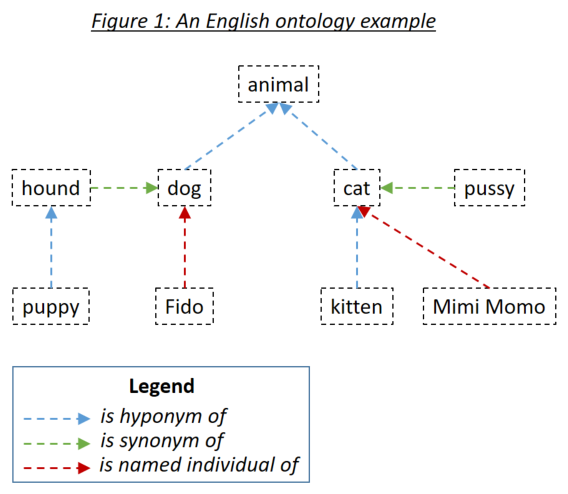
Las ontologías se definen a Holmes utilizando el estándar de ontología OWL serializado usando RDF/XML. Dichas ontologías se pueden generar con una variedad de herramientas. Para los ejemplos y pruebas de Holmes, se utilizó el protegido de la herramienta libre. Se recomienda que use protegido tanto para definir sus propias ontologías como para explorar las ontologías que se envían con los ejemplos y las pruebas. Al guardar una ontología bajo protegido, seleccione RDF/XML como formato. Protege asigna etiquetas estándar para el hipónimo, el sinónimo y el nombre individual de las relaciones que Holmes entiende como los valores predeterminados, pero que también se pueden anular.
Las entradas de ontología se definen utilizando un identificador de recursos internacionalizado (IRI), por ejemplo, http://www.semanticweb.org/hudsonr/ontologies/2019/0/animals#dog . Holmes solo usa el fragmento final para la coincidencia, lo que permite definir los homónimos (palabras con la misma forma pero múltiples significados) en múltiples puntos en el árbol de ontología.
La coincidencia basada en la ontología ofrece los mejores resultados con Holmes cuando se utilizan pequeñas ontologías que se han construido para dominios y casos de uso específicos de sujetos. Por ejemplo, si está implementando un chatbot para un caso de uso de seguro de construcción, debe crear una pequeña ontología que capture los términos y relaciones dentro de ese dominio específico. Por otro lado, no se recomienda utilizar grandes ontologías construidas para todos los dominios dentro de un idioma completo, como WordNet. Esto se debe a que los muchos homónimos y relaciones que solo se aplican en dominios de sujetos estrechos tenderán a conducir a una gran cantidad de coincidencias incorrectas. Para los casos de uso general, la coincidencia basada en la incrustación tenderá a producir mejores resultados.
Cada palabra en una ontología puede considerarse como encabezando un subárbol que consiste en sus hipónimos, sinónimos e individuos nombrados, esas palabras 'hipónimos, sinónimos e individuos nombrados, etc. Con una ontología configurada en la manera estándar que es apropiada para los casos de uso de chatbot y extracción estructural, una palabra en una frase de búsqueda de Holmes coincide con una palabra en un documento si la palabra del documento está dentro del subárbol de la palabra frase de búsqueda. Si la ontología en la Figura 1 definiera a Holmes, además de la estrategia de coincidencia directa, que coincidiría con cada palabra con sí misma, las siguientes combinaciones coincidirían:
Los verbos frasales en inglés como comer y verbos separables alemanes como Aufessen deben definirse como elementos individuales dentro de las ontologías. Cuando Holmes analiza un texto y se encuentra con dicho verbo, el verbo principal y la partícula se combinan en una sola palabra lógica que luego puede coincidir a través de una ontología. Esto significa que comer dentro de un texto coincidiría con el subárbol de comer dentro de la ontología, pero no el subárbol de comer dentro de la ontología.
Si la coincidencia basada en derivación está activa, se tiene en cuenta en ambos lados de una posible coincidencia basada en ontología. Por ejemplo, si Alter y Enmend se definen como sinónimos en una ontología, la alteración y la enmienda también coincidirían entre sí.
En situaciones en las que encontrar oraciones relevantes es más importante que garantizar la correspondencia lógica de las coincidencias de documentos con las frases de búsqueda, puede tener sentido especificar la coincidencia simétrica al definir la ontología. Se recomienda la coincidencia simétrica para el caso de uso de la coincidencia del tema, pero es poco probable que sea apropiado para los casos de uso de chatbot o de extracción estructural. Significa que se tiene en cuenta la relación HypernyM (hipónimo inverso), así como las relaciones hipónimo y de sinónimos cuando coinciden, lo que lleva a una relación más simétrica entre documentos y frases de búsqueda. Una regla importante aplicada al coincidir a través de una ontología simétrica es que una ruta de coincidencia puede no contener relaciones hipernimales y hipónimos, es decir, no puedes volver a ti mismo. Si se definiera la ontología anterior como simétrica, las siguientes combinaciones coincidirían:
En el caso de uso de clasificación de documentos supervisado, se pueden usar dos ontologías separadas:
La ontología de correspondencia estructural se utiliza para analizar el contenido de los documentos de capacitación y prueba. Cada palabra de un documento que se encuentra en la ontología es reemplazada por su ancestro más general Hypernym. Es importante darse cuenta de que una ontología solo es probable que funcione con una coincidencia estructural para la clasificación de documentos supervisados si se construyó específicamente para el propósito: dicha ontología debería consistir en una serie de árboles separados que representan las principales clases de objeto en los documentos a clasificar. En el ejemplo de la ontología que se muestra arriba, todas las palabras en la ontología serían reemplazadas por animal ; En un caso extremo con una ontología estilo WordNet, todos los sustantivos terminarían siendo reemplazados por las cosas , ¡lo cual claramente no es un resultado deseable!
La ontología de clasificación se utiliza para capturar relaciones entre las etiquetas de clasificación: que un documento tiene una determinada clasificación implica que también tiene clasificaciones a cuyo subárbol pertenece esa clasificación. Los sinónimos deben usarse con moderación, si es que las ontologías de clasificación porque se suman a la complejidad de la red neuronal sin agregar ningún valor; Y aunque técnicamente es posible establecer una ontología de clasificación para usar la coincidencia simétrica, no hay una razón sensata para hacerlo. Tenga en cuenta que una etiqueta dentro de la ontología de clasificación que no se define directamente como la etiqueta de cualquier documento de capacitación debe registrarse específicamente utilizando el método SupervisedTopicTrainingBasis.register_additional_classification_label() si se debe tener en cuenta al capacitar el clasificador.
word_match.type=='embedding' )Spacy ofrece incrustaciones de palabras : representaciones numéricas vectoriales generadas por el aprendizaje automático de palabras que capturan los contextos en los que cada palabra tiende a ocurrir. Dos palabras con un significado similar tienden a surgir con incrustaciones de palabras que están cerca entre sí, y Spacy puede medir la similitud cosena entre las dos palabras de dos palabras expresadas como un decimal entre 0.0 (sin similitud) y 1.0 (la misma palabra). Debido a que el perro y el gato tienden a aparecer en contextos similares, tienen una similitud de 0.80; El perro y el caballo tienen menos en común y tienen una similitud de 0.62; y el perro y el hierro tienen una similitud de solo 0.25. La coincidencia basada en la incrustación solo se activa para sustantivos, adjetivos y adverbios porque se ha encontrado que los resultados no son satisfactorios con otras clases de palabras.
Es importante comprender que el hecho de que dos palabras tienen incrustaciones similares no implican el mismo tipo de relación lógica entre los dos que cuando se usa la coincidencia basada en la ontología: por ejemplo, el hecho de que el perro y el gato tengan incrustaciones similares no significa que ni un perro sea un tipo de gato ni que un gato sea un tipo de perro. Si la coincidencia basada en la incrustación es o no, una opción apropiada depende del caso de uso funcional.
Para el chatbot, la extracción estructural y los casos de uso de clasificación de documentos supervisados, Holmes utiliza similitudes basadas en la incrustación de palabras utilizando un parámetro overall_similarity_threshold definido a nivel mundial en la clase del administrador. Se detecta una coincidencia entre una frase de búsqueda y una estructura dentro de un documento cada vez que la media geométrica de las similitudes entre los pares de palabras correspondientes individuales es mayor que este umbral. La intuición detrás de esta técnica es que una frase de búsqueda con EG seis palabras léxicas ha coincidido con una estructura de documentos donde cinco de estas palabras coinciden exactamente y solo una corresponde a través de una incrustación, la similitud que debería requerirse para que coincida con esta sexta palabra es menor que cuando solo tres de las palabras coinciden exactamente y dos de las otras palabras también se corresponden a través de las incrustaciones.
Hacer coincidir una frase de búsqueda con un documento comienza buscando palabras en el documento que coincidan con la palabra en la raíz (cabeza sintáctica) de la frase de búsqueda. Holmes luego investiga la estructura alrededor de cada una de estas palabras de documento coincidentes para verificar si la estructura del documento coincide con la estructura de frase de búsqueda en su entiridad. Las palabras del documento que coinciden con la palabra raíz de frase de búsqueda normalmente se encuentran usando un índice. Sin embargo, si se deben tener en cuenta los incrustaciones al encontrar palabras de documento que coincidan con una palabra raíz de frase de búsqueda, cada palabra en cada documento con una clase de palabra válida debe compararse para similitud con esa palabra raíz de frase de búsqueda. Esto tiene un rendimiento muy notable que hace que todos los casos de uso, excepto el caso de uso de chatbot, esencialmente inutilizable.
Para evitar el éxito de rendimiento típicamente innecesario que resulta de la coincidencia basada en las palabras de la raíz de la frase de búsqueda, se controla por separado de la coincidencia basada en la incrustación en general utilizando el parámetro embedding_based_matching_on_root_words , que se establece al instancias de la clase del administrador. Se recomienda mantener esta configuración apagada (valor False ) para la mayoría de los casos de uso.
Ni el parámetro overall_similarity_threshold ni el parámetro embedding_based_matching_on_root_words tiene ningún efecto en el caso de uso de coincidencia del tema. Aquí se establecen los umbrales de similitud de incrustación a nivel de palabras utilizando los parámetros word_embedding_match_threshold e initial_question_word_embedding_match_threshold al llamar a la función topic_match_documents_against en la clase Administrador.
word_match.type=='entity_embedding' ) Una coincidencia basada en la entrada de la entidad nombrada se obtiene entre una palabra de documento buscado que tiene una determinada etiqueta de entidad y una frase de búsqueda o palabra de documento de consulta cuya incrustación es suficientemente similar al significado subyacente de esa etiqueta de entidad, por ejemplo, la palabra individual en una frase de búsqueda tiene una palabra similar que incorpora el significado subyacente de la etiqueta de la entidad de la persona . Tenga en cuenta que la coincidencia basada en la incrustación de entidad nombrada nunca está activa en palabras raíz, independientemente de la configuración de embedding_based_matching_on_root_words .
word_match.type=='question' )La coincidencia de palabras iniciales de la pregunta solo está activa durante la coincidencia del tema. Las palabras de la pregunta inicial en las frases de consulta coinciden con las entidades en los documentos buscados que representan respuestas potenciales a la pregunta, por ejemplo, al comparar la frase de consulta, ¿cuándo Peter desayunó con la frase del documento buscado que Peter desayunó a las 8 am , la palabra de la pregunta cuándo coincidiría con la frase adverbial temporal a las 8 am ?
La coincidencia de palabras de cuestión inicial se enciende y apaga utilizando el parámetro initial_question_word_behaviour al llamar a la función topic_match_documents_against en la clase de administrador. It is only likely to be useful when topic matching is being performed in an interactive setting where the user enters short query phrases, as opposed to when it is being used to find documents on a similar topic to an pre-existing query document: initial question words are only processed at the beginning of the first sentence of the query phrase or query document.
Linguistically speaking, if a query phrase consists of a complex question with several elements dependent on the main verb, a finding in a searched document is only an 'answer' if contains matches to all these elements. Because recall is typically more important than precision when performing topic matching with interactive query phrases, however, Holmes will match an initial question word to a searched-document phrase wherever they correspond semantically (eg wherever when corresponds to a temporal adverbial phrase) and each depend on verbs that themselves match at the word level. One possible strategy to filter out 'incomplete answers' would be to calculate the maximum possible score for a query phrase and reject topic matches that score below a threshold scaled to this maximum.
Before Holmes analyses a searched document or query document, coreference resolution is performed using the Coreferee library running on top of spaCy. This means that situations are recognised where pronouns and nouns that are located near one another within a text refer to the same entities. The information from one mention can then be applied to the analysis of further mentions:
I saw a big dog . It was chasing a cat.
I saw a big dog . The dog was chasing a cat.
Coreferee also detects situations where a noun refers back to a named entity:
We discussed AstraZeneca . The company had given us permission to publish this library under the MIT license.
If this example were to match the search phrase A company gives permission to publish something , the coreference information that the company under discussion is AstraZeneca is clearly relevant and worth extracting in addition to the word(s) directly matched to the search phrase. Such information is captured in the word_match.extracted_word field.
The concept of search phrases has already been introduced and is relevant to the chatbot use case, the structural extraction use case and to preselection within the supervised document classification use case.
It is crucial to understand that the tips and limitations set out in Section 4 do not apply in any way to query phrases in topic matching. If you are using Holmes for topic matching only, you can completely ignore this section!
Structural matching between search phrases and documents is not symmetric: there are many situations in which sentence X as a search phrase would match sentence Y within a document but where the converse would not be true. Although Holmes does its best to understand any search phrases, the results are better when the user writing them follows certain patterns and tendencies, and getting to grips with these patterns and tendencies is the key to using the relevant features of Holmes successfully.
Holmes distinguishes between: lexical words like dog , chase and cat (English) or Hund , jagen and Katze (German) in the initial example above; and grammatical words like a (English) or ein and eine (German) in the initial example above. Only lexical words match words in documents, but grammatical words still play a crucial role within a search phrase: they enable Holmes to understand it.
Dog chase cat (English)
Hund jagen Katze (German)
contain the same lexical words as the search phrases in the initial example above, but as they are not grammatical sentences Holmes is liable to misunderstand them if they are used as search phrases. This is a major difference between Holmes search phrases and the search phrases you use instinctively with standard search engines like Google, and it can take some getting used to.
A search phrase need not contain a verb:
ENTITYPERSON (English)
A big dog (English)
Interest in fishing (English)
ENTITYPER (German)
Ein großer Hund (German)
Interesse am Angeln (German)
are all perfectly valid and potentially useful search phrases.
Where a verb is present, however, Holmes delivers the best results when the verb is in the present active , as chases and jagt are in the initial example above. This gives Holmes the best chance of understanding the relationship correctly and of matching the widest range of document structures that share the target meaning.
Sometimes you may only wish to extract the object of a verb. For example, you might want to find sentences that are discussing a cat being chased regardless of who is doing the chasing. In order to avoid a search phrase containing a passive expression like
A cat is chased (English)
Eine Katze wird gejagt (German)
you can use a generic pronoun . This is a word that Holmes treats like a grammatical word in that it is not matched to documents; its sole purpose is to help the user form a grammatically optimal search phrase in the present active. Recognised generic pronouns are English something , somebody and someone and German jemand (and inflected forms of jemand ) and etwas : Holmes treats them all as equivalent. Using generic pronouns, the passive search phrases above could be re-expressed as
Somebody chases a cat (English)
Jemand jagt eine Katze (German).
Experience shows that different prepositions are often used with the same meaning in equivalent phrases and that this can prevent search phrases from matching where one would intuitively expect it. For example, the search phrases
Somebody is at the market (English)
Jemand ist auf dem Marktplatz (German)
would fail to match the document phrases
Richard was in the market (English)
Richard war am Marktplatz (German)
The best way of solving this problem is to define the prepositions in question as synonyms in an ontology.
The following types of structures are prohibited in search phrases and result in Python user-defined errors:
A dog chases a cat. A cat chases a dog (English)
Ein Hund jagt eine Katze. Eine Katze jagt einen Hund (German)
Each clause must be separated out into its own search phrase and registered individually.
A dog does not chase a cat. (Inglés)
Ein Hund jagt keine Katze. (Alemán)
Negative expressions are recognised as such in documents and the generated matches marked as negative; allowing search phrases themselves to be negative would overcomplicate the library without offering any benefits.
A dog and a lion chase a cat. (Inglés)
Ein Hund und ein Löwe jagen eine Katze. (Alemán)
Wherever conjunction occurs in documents, Holmes distributes the information among multiple matches as explained above. In the unlikely event that there should be a requirement to capture conjunction explicitly when matching, this could be achieved by using the Manager.match() function and looking for situations where the document token objects are shared by multiple match objects.
The (English)
Der (German)
A search phrase cannot be processed if it does not contain any words that can be matched to documents.
A dog chases a cat and he chases a mouse (English)
Ein Hund jagt eine Katze und er jagt eine Maus (German)
Pronouns that corefer with nouns elsewhere in the search phrase are not permitted as this would overcomplicate the library without offering any benefits.
The following types of structures are strongly discouraged in search phrases:
Dog chase cat (English)
Hund jagen Katze (German)
Although these will sometimes work, the results will be better if search phrases are expressed grammatically.
A cat is chased by a dog (English)
A dog will have chased a cat (English)
Eine Katze wird durch einen Hund gejagt (German)
Ein Hund wird eine Katze gejagt haben (German)
Although these will sometimes work, the results will be better if verbs in search phrases are expressed in the present active.
Who chases the cat? (Inglés)
Wer jagt die Katze? (Alemán)
Although questions are supported as query phrases in the topic matching use case, they are not appropriate as search phrases. Questions should be re-phrased as statements, in this case
Something chases the cat (English)
Etwas jagt die Katze (German).
Informationsextraktion (German)
Ein Stadtmittetreffen (German)
The internal structure of German compound words is analysed within searched documents as well as within query phrases in the topic matching use case, but not within search phrases. In search phrases, compound words should be reexpressed as genitive constructions even in cases where this does not strictly capture their meaning:
Extraktion der Information (German)
Ein Treffen der Stadtmitte (German)
The following types of structures should be used with caution in search phrases:
A fierce dog chases a scared cat on the way to the theatre (English)
Ein kämpferischer Hund jagt eine verängstigte Katze auf dem Weg ins Theater (German)
Holmes can handle any level of complexity within search phrases, but the more complex a structure, the less likely it becomes that a document sentence will match it. If it is really necessary to match such complex relationships with search phrases rather than with topic matching, they are typically better extracted by splitting the search phrase up, eg
A fierce dog (English)
A scared cat (English)
A dog chases a cat (English)
Something chases something on the way to the theatre (English)
Ein kämpferischer Hund (German)
Eine verängstigte Katze (German)
Ein Hund jagt eine Katze (German)
Etwas jagt etwas auf dem Weg ins Theater (German)
Correlations between the resulting matches can then be established by matching via the Manager.match() function and looking for situations where the document token objects are shared across multiple match objects.
One possible exception to this piece of advice is when embedding-based matching is active. Because whether or not each word in a search phrase matches then depends on whether or not other words in the same search phrase have been matched, large, complex search phrases can sometimes yield results that a combination of smaller, simpler search phrases would not.
The chasing of a cat (English)
Die Jagd einer Katze (German)
These will often work, but it is generally better practice to use verbal search phrases like
Something chases a cat (English)
Etwas jagt eine Katze (German)
and to allow the corresponding nominal phrases to be matched via derivation-based matching.
The chatbot use case has already been introduced: a predefined set of search phrases is used to extract information from phrases entered interactively by an end user, which in this use case act as the documents.
The Holmes source code ships with two examples demonstrating the chatbot use case, one for each language, with predefined ontologies. Having cloned the source code and installed the Holmes library, navigate to the /examples directory and type the following (Linux):
Inglés:
python3 example_chatbot_EN_insurance.py
Alemán:
python3 example_chatbot_DE_insurance.py
or click on the files in Windows Explorer (Windows).
Holmes matches syntactically distinct structures that are semantically equivalent, ie that share the same meaning. In a real chatbot use case, users will typically enter equivalent information with phrases that are semantically distinct as well, ie that have different meanings. Because the effort involved in registering a search phrase is barely greater than the time it takes to type it in, it makes sense to register a large number of search phrases for each relationship you are trying to extract: essentially all ways people have been observed to express the information you are interested in or all ways you can imagine somebody might express the information you are interested in . To assist this, search phrases can be registered with labels that do not need to be unique: a label can then be used to express the relationship an entire group of search phrases is designed to extract. Note that when many search phrases have been defined to extract the same relationship, a single user entry is likely to be sometimes matched by multiple search phrases. This must be handled appropriately by the calling application.
One obvious weakness of Holmes in the chatbot setting is its sensitivity to correct spelling and, to a lesser extent, to correct grammar. Strategies for mitigating this weakness include:
The structural extraction use case uses structural matching in the same way as the chatbot use case, and many of the same comments and tips apply to it. The principal differences are that pre-existing and often lengthy documents are scanned rather than text snippets entered ad-hoc by the user, and that the returned match objects are not used to drive a dialog flow; they are examined solely to extract and store structured information.
Code for performing structural extraction would typically perform the following tasks:
Manager.register_search_phrase() several times to define a number of search phrases specifying the information to be extracted.Manager.parse_and_register_document() several times to load a number of documents within which to search.Manager.match() to perform the matching.The topic matching use case matches a query document , or alternatively a query phrase entered ad-hoc by the user, against a set of documents pre-loaded into memory. The aim is to find the passages in the documents whose topic most closely corresponds to the topic of the query document; the output is a ordered list of passages scored according to topic similarity. Additionally, if a query phrase contains an initial question word, the output will contain potential answers to the question.
Topic matching queries may contain generic pronouns and named-entity identifiers just like search phrases, although the ENTITYNOUN token is not supported. However, an important difference from search phrases is that the topic matching use case places no restrictions on the grammatical structures permissible within the query document.
In addition to the Holmes demonstration website, the Holmes source code ships with three examples demonstrating the topic matching use case with an English literature corpus, a German literature corpus and a German legal corpus respectively. Users are encouraged to run these to get a feel for how they work.
Topic matching uses a variety of strategies to find text passages that are relevant to the query. These include resource-hungry procedures like investigating semantic relationships and comparing embeddings. Because applying these across the board would prevent topic matching from scaling, Holmes only attempts them for specific areas of the text that less resource-intensive strategies have already marked as looking promising. This and the other interior workings of topic matching are explained here.
In the supervised document classification use case, a classifier is trained with a number of documents that are each pre-labelled with a classification. The trained classifier then assigns one or more labels to new documents according to what each new document is about. As explained here, ontologies can be used both to enrichen the comparison of the content of the various documents and to capture implication relationships between classification labels.
A classifier makes use of a neural network (a multilayer perceptron) whose topology can either be determined automatically by Holmes or specified explicitly by the user. With a large number of training documents, the automatically determined topology can easily exhaust the memory available on a typical machine; if there is no opportunity to scale up the memory, this problem can be remedied by specifying a smaller number of hidden layers or a smaller number of nodes in one or more of the layers.
A trained document classification model retains no references to its training data. This is an advantage from a data protection viewpoint, although it cannot presently be guaranteed that models will not contain individual personal or company names.
A typical problem with the execution of many document classification use cases is that a new classification label is added when the system is already live but that there are initially no examples of this new classification with which to train a new model. The best course of action in such a situation is to define search phrases which preselect the more obvious documents with the new classification using structural matching. Those documents that are not preselected as having the new classification label are then passed to the existing, previously trained classifier in the normal way. When enough documents exemplifying the new classification have accumulated in the system, the model can be retrained and the preselection search phrases removed.
Holmes ships with an example script demonstrating supervised document classification for English with the BBC Documents dataset. The script downloads the documents (for this operation and for this operation alone, you will need to be online) and places them in a working directory. When training is complete, the script saves the model to the working directory. If the model file is found in the working directory on subsequent invocations of the script, the training phase is skipped and the script goes straight to the testing phase. This means that if it is wished to repeat the training phase, either the model has to be deleted from the working directory or a new working directory has to be specified to the script.
Having cloned the source code and installed the Holmes library, navigate to the /examples directory. Specify a working directory at the top of the example_supervised_topic_model_EN.py file, then type python3 example_supervised_topic_model_EN (Linux) or click on the script in Windows Explorer (Windows).
It is important to realise that Holmes learns to classify documents according to the words or semantic relationships they contain, taking any structural matching ontology into account in the process. For many classification tasks, this is exactly what is required; but there are tasks (eg author attribution according to the frequency of grammatical constructions typical for each author) where it is not. For the right task, Holmes achieves impressive results. For the BBC Documents benchmark processed by the example script, Holmes performs slightly better than benchmarks available online (see eg here) although the difference is probably too slight to be significant, especially given that the different training/test splits were used in each case: Holmes has been observed to learn models that predict the correct result between 96.9% and 98.7% of the time. The range is explained by the fact that the behaviour of the neural network is not fully deterministic.
The interior workings of supervised document classification are explained here.
Manager holmes_extractor.Manager(self, model, *, overall_similarity_threshold=1.0,
embedding_based_matching_on_root_words=False, ontology=None,
analyze_derivational_morphology=True, perform_coreference_resolution=None,
number_of_workers=None, verbose=False)
The facade class for the Holmes library.
Parameters:
model -- the name of the spaCy model, e.g. *en_core_web_trf*
overall_similarity_threshold -- the overall similarity threshold for embedding-based
matching. Defaults to *1.0*, which deactivates embedding-based matching. Note that this
parameter is not relevant for topic matching, where the thresholds for embedding-based
matching are set on the call to *topic_match_documents_against*.
embedding_based_matching_on_root_words -- determines whether or not embedding-based
matching should be attempted on search-phrase root tokens, which has a considerable
performance hit. Defaults to *False*. Note that this parameter is not relevant for topic
matching.
ontology -- an *Ontology* object. Defaults to *None* (no ontology).
analyze_derivational_morphology -- *True* if matching should be attempted between different
words from the same word family. Defaults to *True*.
perform_coreference_resolution -- *True* if coreference resolution should be taken into account
when matching. Defaults to *True*.
use_reverse_dependency_matching -- *True* if appropriate dependencies in documents can be
matched to dependencies in search phrases where the two dependencies point in opposite
directions. Defaults to *True*.
number_of_workers -- the number of worker processes to use, or *None* if the number of worker
processes should depend on the number of available cores. Defaults to *None*
verbose -- a boolean value specifying whether multiprocessing messages should be outputted to
the console. Defaults to *False*
 Manager.register_serialized_document(self, serialized_document:bytes, label:str="") -> None

Parameters:

document -- a preparsed Holmes document.
label -- a label for the document which must be unique. Defaults to the empty string,
    which is intended for use cases involving single documents (typically user entries).
 Manager.register_serialized_documents(self, document_dictionary:dict[str, bytes]) -> None

Note that this function is the most efficient way of loading documents.

Parameters:

document_dictionary -- a dictionary from labels to serialized documents.
 Manager.parse_and_register_document(self, document_text:str, label:str='') -> None

Parameters:

document_text -- the raw document text.
label -- a label for the document which must be unique. Defaults to the empty string,
    which is intended for use cases involving single documents (typically user entries).
Manager.remove_document(self, label:str) -> None
 Manager.remove_all_documents(self, labels_starting:str=None) -> None

Parameters:

labels_starting -- a string starting the labels of documents to be removed,
    or 'None' if all documents are to be removed.
 Manager.list_document_labels(self) -> List[str]

Returns a list of the labels of the currently registered documents.
 Manager.serialize_document(self, label:str) -> Optional[bytes]

Returns a serialized representation of a Holmes document that can be
  persisted to a file. If 'label' is not the label of a registered document,
  'None' is returned instead.

Parameters:

label -- the label of the document to be serialized.
 Manager.get_document(self, label:str='') -> Optional[Doc]

Returns a Holmes document. If *label* is not the label of a registered document, *None*
  is returned instead.

Parameters:

label -- the label of the document to be serialized.
 Manager.debug_document(self, label:str='') -> None

Outputs a debug representation for a loaded document.

Parameters:

label -- the label of the document to be serialized.
 Manager.register_search_phrase(self, search_phrase_text:str, label:str=None) -> SearchPhrase

Registers and returns a new search phrase.

Parameters:

search_phrase_text -- the raw search phrase text.
label -- a label for the search phrase, which need not be unique.
  If label==None, the assigned label defaults to the raw search phrase text.
Manager.remove_all_search_phrases_with_label(self, label:str) -> None
Manager.remove_all_search_phrases(self) -> None
Manager.list_search_phrase_labels(self) -> List[str]
 Manager.match(self, search_phrase_text:str=None, document_text:str=None) -> List[Dict]

Matches search phrases to documents and returns the result as match dictionaries.

Parameters:

search_phrase_text -- a text from which to generate a search phrase, or 'None' if the
    preloaded search phrases should be used for matching.
document_text -- a text from which to generate a document, or 'None' if the preloaded
    documents should be used for matching.
 topic_match_documents_against(self, text_to_match:str, *,
    use_frequency_factor:bool=True,
    maximum_activation_distance:int=75,
    word_embedding_match_threshold:float=0.8,
    initial_question_word_embedding_match_threshold:float=0.7,
    relation_score:int=300,
    reverse_only_relation_score:int=200,
    single_word_score:int=50,
    single_word_any_tag_score:int=20,
    initial_question_word_answer_score:int=600,
    initial_question_word_behaviour:str='process',
    different_match_cutoff_score:int=15,
    overlapping_relation_multiplier:float=1.5,
    embedding_penalty:float=0.6,
    ontology_penalty:float=0.9,
    relation_matching_frequency_threshold:float=0.25,
    embedding_matching_frequency_threshold:float=0.5,
    sideways_match_extent:int=100,
    only_one_result_per_document:bool=False,
    number_of_results:int=10,
    document_label_filter:str=None,
    tied_result_quotient:float=0.9) -> List[Dict]:

Returns a list of dictionaries representing the results of a topic match between an entered text
and the loaded documents.

Properties:

text_to_match -- the text to match against the loaded documents.
use_frequency_factor -- *True* if scores should be multiplied by a factor between 0 and 1
  expressing how rare the words matching each phraselet are in the corpus. Note that,
  even if this parameter is set to *False*, the factors are still calculated as they are
  required for determining which relation and embedding matches should be attempted.
maximum_activation_distance -- the number of words it takes for a previous phraselet
  activation to reduce to zero when the library is reading through a document.
word_embedding_match_threshold -- the cosine similarity above which two words match where
  the search phrase word does not govern an interrogative pronoun.
initial_question_word_embedding_match_threshold -- the cosine similarity above which two
  words match where the search phrase word governs an interrogative pronoun.
relation_score -- the activation score added when a normal two-word relation is matched.
reverse_only_relation_score -- the activation score added when a two-word relation
  is matched using a search phrase that can only be reverse-matched.
single_word_score -- the activation score added when a single noun is matched.
single_word_any_tag_score -- the activation score added when a single word is matched
  that is not a noun.
initial_question_word_answer_score -- the activation score added when a question word is
  matched to an potential answer phrase.
initial_question_word_behaviour -- 'process' if a question word in the sentence
  constituent at the beginning of *text_to_match* is to be matched to document phrases
  that answer it and to matching question words; 'exclusive' if only topic matches that
  answer questions are to be permitted; 'ignore' if question words are to be ignored.
different_match_cutoff_score -- the activation threshold under which topic matches are
  separated from one another. Note that the default value will probably be too low if
  *use_frequency_factor* is set to *False*.
overlapping_relation_multiplier -- the value by which the activation score is multiplied
  when two relations were matched and the matches involved a common document word.
embedding_penalty -- a value between 0 and 1 with which scores are multiplied when the
  match involved an embedding. The result is additionally multiplied by the overall
  similarity measure of the match.
ontology_penalty -- a value between 0 and 1 with which scores are multiplied for each
  word match within a match that involved the ontology. For each such word match,
  the score is multiplied by the value (abs(depth) + 1) times, so that the penalty is
  higher for hyponyms and hypernyms than for synonyms and increases with the
  depth distance.
relation_matching_frequency_threshold -- the frequency threshold above which single
  word matches are used as the basis for attempting relation matches.
embedding_matching_frequency_threshold -- the frequency threshold above which single
  word matches are used as the basis for attempting relation matches with
  embedding-based matching on the second word.
sideways_match_extent -- the maximum number of words that may be incorporated into a
  topic match either side of the word where the activation peaked.
only_one_result_per_document -- if 'True', prevents multiple results from being returned
  for the same document.
number_of_results -- the number of topic match objects to return.
document_label_filter -- optionally, a string with which document labels must start to
  be considered for inclusion in the results.
tied_result_quotient -- the quotient between a result and following results above which
  the results are interpreted as tied.
 Manager.get_supervised_topic_training_basis(self, *, classification_ontology:Ontology=None,
  overlap_memory_size:int=10, oneshot:bool=True, match_all_words:bool=False,
  verbose:bool=True) -> SupervisedTopicTrainingBasis:

Returns an object that is used to train and generate a model for the
supervised document classification use case.

Parameters:

classification_ontology -- an Ontology object incorporating relationships between
    classification labels, or 'None' if no such ontology is to be used.
overlap_memory_size -- how many non-word phraselet matches to the left should be
    checked for words in common with a current match.
oneshot -- whether the same word or relationship matched multiple times within a
    single document should be counted once only (value 'True') or multiple times
    (value 'False')
match_all_words -- whether all single words should be taken into account
          (value 'True') or only single words with noun tags (value 'False')
verbose -- if 'True', information about training progress is outputted to the console.
 Manager.deserialize_supervised_topic_classifier(self,
  serialized_model:bytes, verbose:bool=False) -> SupervisedTopicClassifier:

Returns a classifier for the supervised document classification use case
that will use a supplied pre-trained model.

Parameters:

serialized_model -- the pre-trained model as returned from `SupervisedTopicClassifier.serialize_model()`.
verbose -- if 'True', information about matching is outputted to the console.
 Manager.start_chatbot_mode_console(self)

Starts a chatbot mode console enabling the matching of pre-registered
  search phrases to documents (chatbot entries) entered ad-hoc by the
  user.
 Manager.start_structural_search_mode_console(self)

Starts a structural extraction mode console enabling the matching of pre-registered
  documents to search phrases entered ad-hoc by the user.
 Manager.start_topic_matching_search_mode_console(self,
  only_one_result_per_document:bool=False, word_embedding_match_threshold:float=0.8,
  initial_question_word_embedding_match_threshold:float=0.7):

Starts a topic matching search mode console enabling the matching of pre-registered
  documents to query phrases entered ad-hoc by the user.

Parameters:

only_one_result_per_document -- if 'True', prevents multiple topic match
  results from being returned for the same document.
word_embedding_match_threshold -- the cosine similarity above which two words match where the
  search phrase word does not govern an interrogative pronoun.
initial_question_word_embedding_match_threshold -- the cosine similarity above which two
  words match where the search phrase word governs an interrogative pronoun.
 Manager.close(self) -> None

Terminates the worker processes.
manager.nlp manager.nlp is the underlying spaCy Language object on which both Coreferee and Holmes have been registered as custom pipeline components. The most efficient way of parsing documents for use with Holmes is to call manager.nlp.pipe() . This yields an iterable of documents that can then be loaded into Holmes via manager.register_serialized_documents() .
The pipe() method has an argument n_process that specifies the number of processors to use. With _lg , _md and _sm spaCy models, there are some situations where it can make sense to specify a value other than 1 (the default). Note however that with transformer spaCy models ( _trf ) values other than 1 are not supported.
Ontology holmes_extractor.Ontology(self, ontology_path,
owl_class_type='http://www.w3.org/2002/07/owl#Class',
owl_individual_type='http://www.w3.org/2002/07/owl#NamedIndividual',
owl_type_link='http://www.w3.org/1999/02/22-rdf-syntax-ns#type',
owl_synonym_type='http://www.w3.org/2002/07/owl#equivalentClass',
owl_hyponym_type='http://www.w3.org/2000/01/rdf-schema#subClassOf',
symmetric_matching=False)
Loads information from an existing ontology and manages ontology
matching.
The ontology must follow the W3C OWL 2 standard. Search phrase words are
matched to hyponyms, synonyms and instances from within documents being
searched.
This class is designed for small ontologies that have been constructed
by hand for specific use cases. Where the aim is to model a large number
of semantic relationships, word embeddings are likely to offer
better results.
Holmes is not designed to support changes to a loaded ontology via direct
calls to the methods of this class. It is also not permitted to share a single instance
of this class between multiple Manager instances: instead, a separate Ontology instance
pointing to the same path should be created for each Manager.
Matching is case-insensitive.
Parameters:
ontology_path -- the path from where the ontology is to be loaded,
or a list of several such paths. See https://github.com/RDFLib/rdflib/.
owl_class_type -- optionally overrides the OWL 2 URL for types.
owl_individual_type -- optionally overrides the OWL 2 URL for individuals.
owl_type_link -- optionally overrides the RDF URL for types.
owl_synonym_type -- optionally overrides the OWL 2 URL for synonyms.
owl_hyponym_type -- optionally overrides the RDF URL for hyponyms.
symmetric_matching -- if 'True', means hypernym relationships are also taken into account.
SupervisedTopicTrainingBasis (returned from Manager.get_supervised_topic_training_basis() )Holder object for training documents and their classifications from which one or more SupervisedTopicModelTrainer objects can be derived. This class is NOT threadsafe.
 SupervisedTopicTrainingBasis.parse_and_register_training_document(self, text:str, classification:str,
  label:Optional[str]=None) -> None

Parses and registers a document to use for training.

Parameters:

text -- the document text
classification -- the classification label
label -- a label with which to identify the document in verbose training output,
  or 'None' if a random label should be assigned.
 SupervisedTopicTrainingBasis.register_training_document(self, doc:Doc, classification:str,
  label:Optional[str]=None) -> None

Registers a pre-parsed document to use for training.

Parameters:

doc -- the document
classification -- the classification label
label -- a label with which to identify the document in verbose training output,
  or 'None' if a random label should be assigned.
 SupervisedTopicTrainingBasis.register_additional_classification_label(self, label:str) -> None

Register an additional classification label which no training document possesses explicitly
  but that should be assigned to documents whose explicit labels are related to the
  additional classification label via the classification ontology.
 SupervisedTopicTrainingBasis.prepare(self) -> None

Matches the phraselets derived from the training documents against the training
  documents to generate frequencies that also include combined labels, and examines the
  explicit classification labels, the additional classification labels and the
  classification ontology to derive classification implications.

  Once this method has been called, the instance no longer accepts new training documents
  or additional classification labels.
 SupervisedTopicTrainingBasis.train(
        self,
        *,
        minimum_occurrences: int = 4,
        cv_threshold: float = 1.0,
        learning_rate: float = 0.001,
        batch_size: int = 5,
        max_epochs: int = 200,
        convergence_threshold: float = 0.0001,
        hidden_layer_sizes: Optional[List[int]] = None,
        shuffle: bool = True,
        normalize: bool = True
    ) -> SupervisedTopicModelTrainer:

Trains a model based on the prepared state.

Parameters:

minimum_occurrences -- the minimum number of times a word or relationship has to
  occur in the context of the same classification for the phraselet
  to be accepted into the final model.
cv_threshold -- the minimum coefficient of variation with which a word or relationship has
  to occur across the explicit classification labels for the phraselet to be
  accepted into the final model.
learning_rate -- the learning rate for the Adam optimizer.
batch_size -- the number of documents in each training batch.
max_epochs -- the maximum number of training epochs.
convergence_threshold -- the threshold below which loss measurements after consecutive
  epochs are regarded as equivalent. Training stops before 'max_epochs' is reached
  if equivalent results are achieved after four consecutive epochs.
hidden_layer_sizes -- a list containing the number of neurons in each hidden layer, or
  'None' if the topology should be determined automatically.
shuffle -- 'True' if documents should be shuffled during batching.
normalize -- 'True' if normalization should be applied to the loss function.
SupervisedTopicModelTrainer (returned from SupervisedTopicTrainingBasis.train() ) Worker object used to train and generate models. This object could be removed from the public interface ( SupervisedTopicTrainingBasis.train() could return a SupervisedTopicClassifier directly) but has been retained to facilitate testability.
This class is NOT threadsafe.
 SupervisedTopicModelTrainer.classifier(self)

Returns a supervised topic classifier which contains no explicit references to the training data and that
can be serialized.
SupervisedTopicClassifier (returned from SupervisedTopicModelTrainer.classifier() and Manager.deserialize_supervised_topic_classifier() ))
 SupervisedTopicClassifier.def parse_and_classify(self, text: str) -> Optional[OrderedDict]:

Returns a dictionary from classification labels to probabilities
  ordered starting with the most probable, or *None* if the text did
  not contain any words recognised by the model.

Parameters:

text -- the text to parse and classify.
 SupervisedTopicClassifier.classify(self, doc: Doc) -> Optional[OrderedDict]:

Returns a dictionary from classification labels to probabilities
  ordered starting with the most probable, or *None* if the text did
  not contain any words recognised by the model.


Parameters:

doc -- the pre-parsed document to classify.
 SupervisedTopicClassifier.serialize_model(self) -> str

Returns a serialized model that can be reloaded using
  *Manager.deserialize_supervised_topic_classifier()*
Manager.match() A text-only representation of a match between a search phrase and a
document. The indexes refer to tokens.
Properties:
search_phrase_label -- the label of the search phrase.
search_phrase_text -- the text of the search phrase.
document -- the label of the document.
index_within_document -- the index of the match within the document.
sentences_within_document -- the raw text of the sentences within the document that matched.
negated -- 'True' if this match is negated.
uncertain -- 'True' if this match is uncertain.
involves_coreference -- 'True' if this match was found using coreference resolution.
overall_similarity_measure -- the overall similarity of the match, or
'1.0' if embedding-based matching was not involved in the match.
word_matches -- an array of dictionaries with the properties:
search_phrase_token_index -- the index of the token that matched from the search phrase.
search_phrase_word -- the string that matched from the search phrase.
document_token_index -- the index of the token that matched within the document.
first_document_token_index -- the index of the first token that matched within the document.
Identical to 'document_token_index' except where the match involves a multiword phrase.
last_document_token_index -- the index of the last token that matched within the document
(NOT one more than that index). Identical to 'document_token_index' except where the match
involves a multiword phrase.
structurally_matched_document_token_index -- the index of the token within the document that
structurally matched the search phrase token. Is either the same as 'document_token_index' or
is linked to 'document_token_index' within a coreference chain.
document_subword_index -- the index of the token subword that matched within the document, or
'None' if matching was not with a subword but with an entire token.
document_subword_containing_token_index -- the index of the document token that contained the
subword that matched, which may be different from 'document_token_index' in situations where a
word containing multiple subwords is split by hyphenation and a subword whose sense
contributes to a word is not overtly realised within that word.
document_word -- the string that matched from the document.
document_phrase -- the phrase headed by the word that matched from the document.
match_type -- 'direct', 'derivation', 'entity', 'embedding', 'ontology', 'entity_embedding'
or 'question'.
negated -- 'True' if this word match is negated.
uncertain -- 'True' if this word match is uncertain.
similarity_measure -- for types 'embedding' and 'entity_embedding', the similarity between the
two tokens, otherwise '1.0'.
involves_coreference -- 'True' if the word was matched using coreference resolution.
extracted_word -- within the coreference chain, the most specific term that corresponded to
the document_word.
depth -- the number of hyponym relationships linking 'search_phrase_word' and
'extracted_word', or '0' if ontology-based matching is not active. Can be negative
if symmetric matching is active.
explanation -- creates a human-readable explanation of the word match from the perspective of the
document word (e.g. to be used as a tooltip over it).
Manager.topic_match_documents_against() A text-only representation of a topic match between a search text and a document.
Properties:
document_label -- the label of the document.
text -- the document text that was matched.
text_to_match -- the search text.
rank -- a string representation of the scoring rank which can have the form e.g. '2=' in case of a tie.
index_within_document -- the index of the document token where the activation peaked.
subword_index -- the index of the subword within the document token where the activation peaked, or
'None' if the activation did not peak at a specific subword.
start_index -- the index of the first document token in the topic match.
end_index -- the index of the last document token in the topic match (NOT one more than that index).
sentences_start_index -- the token start index within the document of the sentence that contains
'start_index'
sentences_end_index -- the token end index within the document of the sentence that contains
'end_index' (NOT one more than that index).
sentences_character_start_index_in_document -- the character index of the first character of 'text'
within the document.
sentences_character_end_index_in_document -- one more than the character index of the last
character of 'text' within the document.
score -- the score
word_infos -- an array of arrays with the semantics:
[0] -- 'relative_start_index' -- the index of the first character in the word relative to
'sentences_character_start_index_in_document'.
[1] -- 'relative_end_index' -- one more than the index of the last character in the word
relative to 'sentences_character_start_index_in_document'.
[2] -- 'type' -- 'single' for a single-word match, 'relation' if within a relation match
involving two words, 'overlapping_relation' if within a relation match involving three
or more words.
[3] -- 'is_highest_activation' -- 'True' if this was the word at which the highest activation
score reported in 'score' was achieved, otherwise 'False'.
[4] -- 'explanation' -- a human-readable explanation of the word match from the perspective of
the document word (e.g. to be used as a tooltip over it).
answers -- an array of arrays with the semantics:
[0] -- the index of the first character of a potential answer to an initial question word.
[1] -- one more than the index of the last character of a potential answer to an initial question
word.
Earlier versions of Holmes could only be published under a restrictive license because of patent issues. As explained in the introduction, this is no longer the case thanks to the generosity of AstraZeneca: versions from 4.0.0 onwards are licensed under the MIT license.
The word-level matching and the high-level operation of structural matching between search-phrase and document subgraphs both work more or less as one would expect. What is perhaps more in need of further comment is the semantic analysis code subsumed in the parsing.py script as well as in the language_specific_rules.py script for each language.
SemanticAnalyzer is an abstract class that is subclassed for each language: at present by EnglishSemanticAnalyzer and GermanSemanticAnalyzer . These classes contain most of the semantic analysis code. SemanticMatchingHelper is a second abstract class, again with an concrete implementation for each language, that contains semantic analysis code that is required at matching time. Moving this out to a separate class family was necessary because, on operating systems that spawn processes rather than forking processes (eg Windows), SemanticMatchingHelper instances have to be serialized when the worker processes are created: this would not be possible for SemanticAnalyzer instances because not all spaCy models are serializable, and would also unnecessarily consume large amounts of memory.
At present, all functionality that is common to the two languages is realised in the two abstract parent classes. Especially because English and German are closely related languages, it is probable that functionality will need to be moved from the abstract parent classes to specific implementing children classes if and when new semantic analyzers are added for new languages.
The HolmesDictionary class is defined as a spaCy extension attribute that is accessed using the syntax token._.holmes . The most important information in the dictionary is a list of SemanticDependency objects. These are derived from the dependency relationships in the spaCy output ( token.dep_ ) but go through a considerable amount of processing to make them 'less syntactic' and 'more semantic'. To give but a few examples:
Some new semantic dependency labels that do not occur in spaCy outputs as values of token.dep_ are added for Holmes semantic dependencies. It is important to understand that Holmes semantic dependencies are used exclusively for matching and are therefore neither intended nor required to form a coherent set of linguistic theoretical entities or relationships; whatever works best for matching is assigned on an ad-hoc basis.
For each language, the match_implication_dict dictionary maps search-phrase semantic dependencies to matching document semantic dependencies and is responsible for the asymmetry of matching between search phrases and documents.
Topic matching involves the following steps:
SemanticMatchingHelper.topic_matching_phraselet_stop_lemmas ), which are consistently ignored throughout the whole process.SemanticMatchingHelper.phraselet_templates .SemanticMatchingHelper.topic_matching_reverse_only_parent_lemmas ) or when the frequency factor for the parent word is below the threshold for relation matching ( relation_matching_frequency_threshold , default: 0.25). These measures are necessary because matching on eg a parent preposition would lead to a large number of potential matches that would take a lot of resources to investigate: it is better to start investigation from the less frequent word within a given relation.relation_matching_frequency_threshold , default: 0.25).embedding_matching_frequency_threshold , default: 0.5), matching at all of those words where the relation template has not already been matched is retried using embeddings at the other word within the relation. A pair of words is then regarded as matching when their mutual cosine similarity is above initial_question_word_embedding_match_threshold (default: 0.7) in situations where the document word has an initial question word in its phrase or word_embedding_match_threshold (default: 0.8) in all other situations.use_frequency_factor is set to True (the default), each score is scaled by the frequency factor of its phraselet, meaning that words that occur less frequently in the corpus give rise to higher scores.maximum_activation_distance ; default: 75) of its value is subtracted from it as each new word is read.single_word_score ; default: 50), a non-noun single-word phraselet or a noun phraselet that matched a subword ( single_word_any_tag_score ; default: 20), a relation phraselet produced by a reverse-only template ( reverse_only_relation_score ; default: 200), any other (normally matched) relation phraselet ( relation_score ; default: 300), or a relation phraselet involving an initial question word ( initial_question_word_answer_score ; default: 600).embedding_penalty ; default: 0.6).ontology_penalty ; default: 0.9) once more often than the difference in depth between the two ontology entries, ie once for a synonym, twice for a child, three times for a grandchild and so on.overlapping_relation_multiplier ; default: 1.5).sideways_match_extent ; default: 100 words) within which the activation score is higher than the different_match_cutoff_score (default: 15) are regarded as belonging to a contiguous passage around the peak that is then returned as a TopicMatch object. (Note that this default will almost certainly turn out to be too low if use_frequency_factor is set to False .) A word whose activation equals the threshold exactly is included at the beginning of the area as long as the next word where activation increases has a score above the threshold. If the topic match peak is below the threshold, the topic match will only consist of the peak word.initial_question_word_behaviour is set to process (the default) or to exclusive , where a document word has matched an initial question word from the query phrase, the subtree of the matched document word is identified as a potential answer to the question and added to the dictionary to be returned. If initial_question_word_behaviour is set to exclusive , any topic matches that do not contain answers to initial question words are discarded.only_one_result_per_document = True prevents more than one result from being returned from the same document; only the result from each document with the highest score will then be returned.tied_result_quotient (default: 0.9) are labelled as tied. The supervised document classification use case relies on the same phraselets as the topic matching use case, although reverse-only templates are ignored and a different set of stop words is used ( SemanticMatchingHelper.supervised_document_classification_phraselet_stop_lemmas ). Classifiers are built and trained as follows:
oneshot ; whether single-word phraselets are generated for all words with their own meaning or only for those such words whose part-of-speech tags match the single-word phraselet template specification (essentially: noun phraselets) depends on the value of match_all_words . Wherever two phraselet matches overlap, a combined match is recorded. Combined matches are treated in the same way as other phraselet matches in further processing. This means that effectively the algorithm picks up one-word, two-word and three-word semantic combinations. See here for a discussion of the performance of this step.minimum_occurrences ; default: 4) or where the coefficient of variation (the standard deviation divided by the arithmetic mean) of the occurrences across the categories is below a threshold ( cv_threshold ; default: 1.0).oneshot==True vs. oneshot==False respectively). The outputs are the category labels, including any additional labels determined via a classification ontology. By default, the multilayer perceptron has three hidden layers where the first hidden layer has the same number of neurons as the input layer and the second and third layers have sizes in between the input and the output layer with an equally sized step between each size; the user is however free to specify any other topology.Holmes code is formatted with black.
The complexity of what Holmes does makes development impossible without a robust set of over 1400 regression tests. These can be executed individually with unittest or all at once by running the pytest utility from the Holmes source code root directory. (Note that the Python 3 command on Linux is pytest-3 .)
The pytest variant will only work on machines with sufficient memory resources. To reduce this problem, the tests are distributed across three subdirectories, so that pytest can be run three times, once from each subdirectory:
New languages can be added to Holmes by subclassing the SemanticAnalyzer and SemanticMatchingHelper classes as explained here.
The sets of matching semantic dependencies captured in the _matching_dep_dict dictionary for each language have been obtained on the basis of a mixture of linguistic-theoretical expectations and trial and error. The results would probably be improved if the _matching_dep_dict dictionaries could be derived using machine learning instead; as yet this has not been attempted because of the lack of appropriate training data.
An attempt should be made to remove personal data from supervised document classification models to make them more compliant with data protection laws.
In cases where embedding-based matching is not active, the second step of the supervised document classification procedure repeats a considerable amount of processing from the first step. Retaining the relevant information from the first step of the procedure would greatly improve training performance. This has not been attempted up to now because a large number of tests would be required to prove that such performance improvements did not have any inadvertent impacts on functionality.
The topic matching and supervised document classification use cases are both configured with a number of hyperparameters that are presently set to best-guess values derived on a purely theoretical basis. Results could be further improved by testing the use cases with a variety of hyperparameters to learn the optimal values.
The initial open-source version.
pobjp linking parents of prepositions directly with their children.MultiprocessingManager object as its facade.Manager and MultiprocessingManager classes into a single Manager class, with a redesigned public interface, that uses worker threads for everything except supervised document classification.




