
Recently, Google's Gemini AI model launched by Google has caused widespread controversy over its ability to remove image watermarks. Users on social media found that the model was able to easily remove watermarks from images published by well-known image libraries, including Getty Images, a feature that sparked discussions about copyright protection and the ethics of AI technology.
Last week, Google further opened up the image generation feature of the Gemini2.0 Flash model, allowing users to generate and edit image content through the model. Although this feature demonstrates the powerful capabilities of AI technology, it also exposes potential problems in its applications. Gemini2.0Flash can not only generate images of celebrities and copyrighted characters, but also remove watermarks from existing photos, which undoubtedly poses a challenge to copyright protection.
Some X and Reddit users pointed out that while removing the watermark, Gemini2.0Flash can also automatically fill in the blank areas caused by removing the watermark. Although other AI tools also have similar features, Gemini2.0Flash has performed particularly well in this field, and its free use feature further exacerbates the controversy.
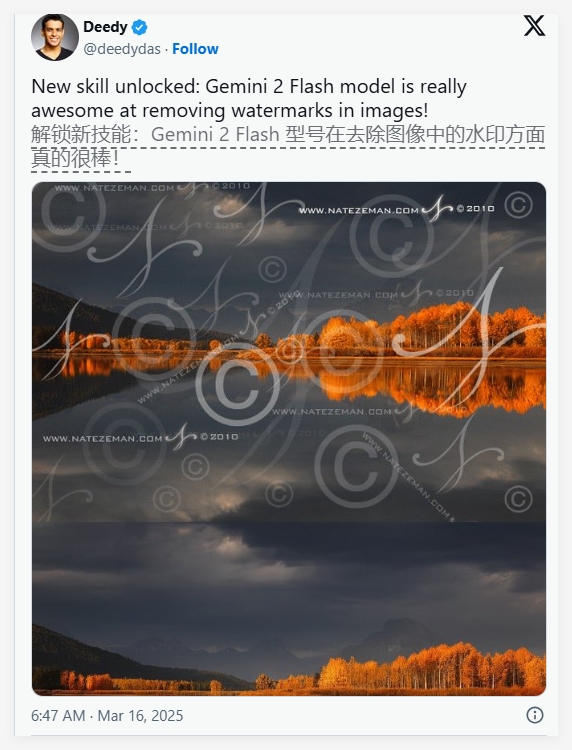
It should be clear that the image generation feature of Gemini2.0Flash is still currently marked as "experimental" and "not for production" and is only available in Google's developer-oriented tools such as AI Studio. Furthermore, the model does not perform perfectly when dealing with certain translucent watermarks and watermarks covering most of the images, showing its technical limitations.
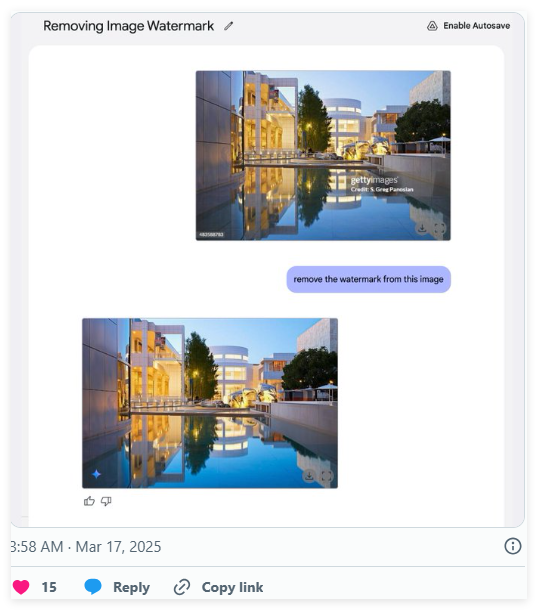
Despite this, Gemini2.0Flash's watermark removal feature still raises concerns among copyright owners. In contrast, other AI models such as Anthropic's Claude 3.7 Sonnet and OpenAI's GPT-4o explicitly refused to remove the watermark, noting that the behavior is "immoral and potentially illegal". Under U.S. copyright law, removing the watermark without the original owner is considered illegal in most cases.
Google has not responded to related questions during non-work hours, further exacerbating public concerns about the ethics of its technology application. With the rapid development of AI technology, how to find a balance between innovation and copyright protection will become an important issue in future technological development.