
Recently, Arc Institute and Nvidia jointly released the Evo2 biological AI model, a breakthrough technology based on DNA data from more than 100,000 organisms, aiming to deeply decode complex phenomena in biology. Evo2 is able to identify patterns that researchers need years to discover in the genetic sequences of different organisms, significantly improving the recognition of disease-related mutations and designing a completely new genome that is comparable to simple bacteria. The release of this technology marks a new era in biomedical research.
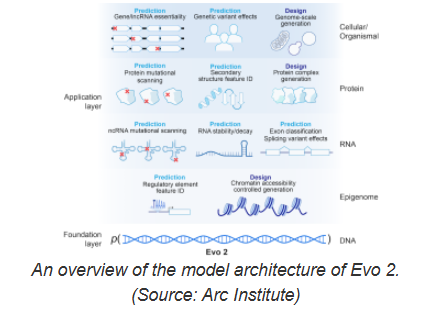
The training process of Evo2 involves processing over 93 trillion nucleotides, far exceeding its predecessor, Evo1. The development team consists of Nvidia and the Arc Institute, a nonprofit biomedical research organization based in Palo Alto, California, and works closely with researchers at Stanford University, UC Berkeley and UC San Francisco. Evo2 not only excels in computing power, but also actively explores transparency and interpretability. To promote open sharing of scientific research, the research team disclosed Evo2's training data, code and model weights, making it the largest fully open source biological AI model to date.
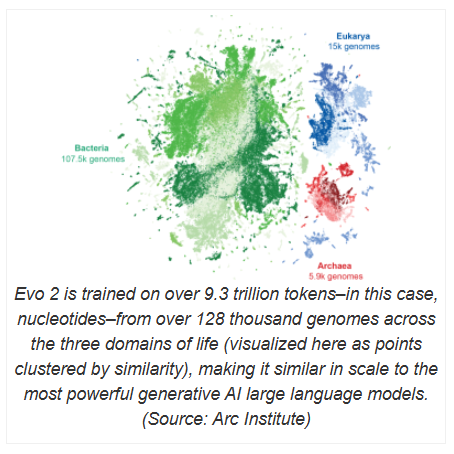
Patrick Hsu, co-founder of the Arc Institute and assistant professor at UC Berkeley, said the development of Evo2 is an important breakthrough in the field of generative biology. Through this technology, machines can "read", "write" and "think" the language of nucleotides, which greatly promotes the progress of biological research. Evo2's training capabilities are comparable to large-scale language models, showing strong potential in predicting disease mutations and designing potential artificial life.
In addition, Evo2 also provides new ideas for the design of biological therapies. For example, it can target gene therapy activated by a specific cell type, thereby reducing side effects and improving treatment accuracy. The development of Evo2 not only achieved technological breakthroughs, but also had a profound impact on understanding of biology.
In ensuring the responsible development of the model, researchers deliberately ruled out data on pathogens that infect humans and other complex organisms. Anthony Costa, director of digital biology at Nvidia, said Evo2 breaks through the limitations of the basic biological models and provides scientists around the world with powerful collaborative tools to address the major health and disease challenges facing humans. This technology has broad application prospects and is expected to play an important role in future biomedical research.