
Apple recently released 20 new Core ML models and 4 data sets on the Hugging Face platform, marking significant progress in its on-device AI technology. This move not only demonstrates Apple's commitment to the development of AI technology, but also highlights its emphasis on user privacy and data security. These models cover multiple fields such as image classification, depth estimation, and semantic segmentation, and are optimized to run offline on user devices, improving application performance while ensuring data security.
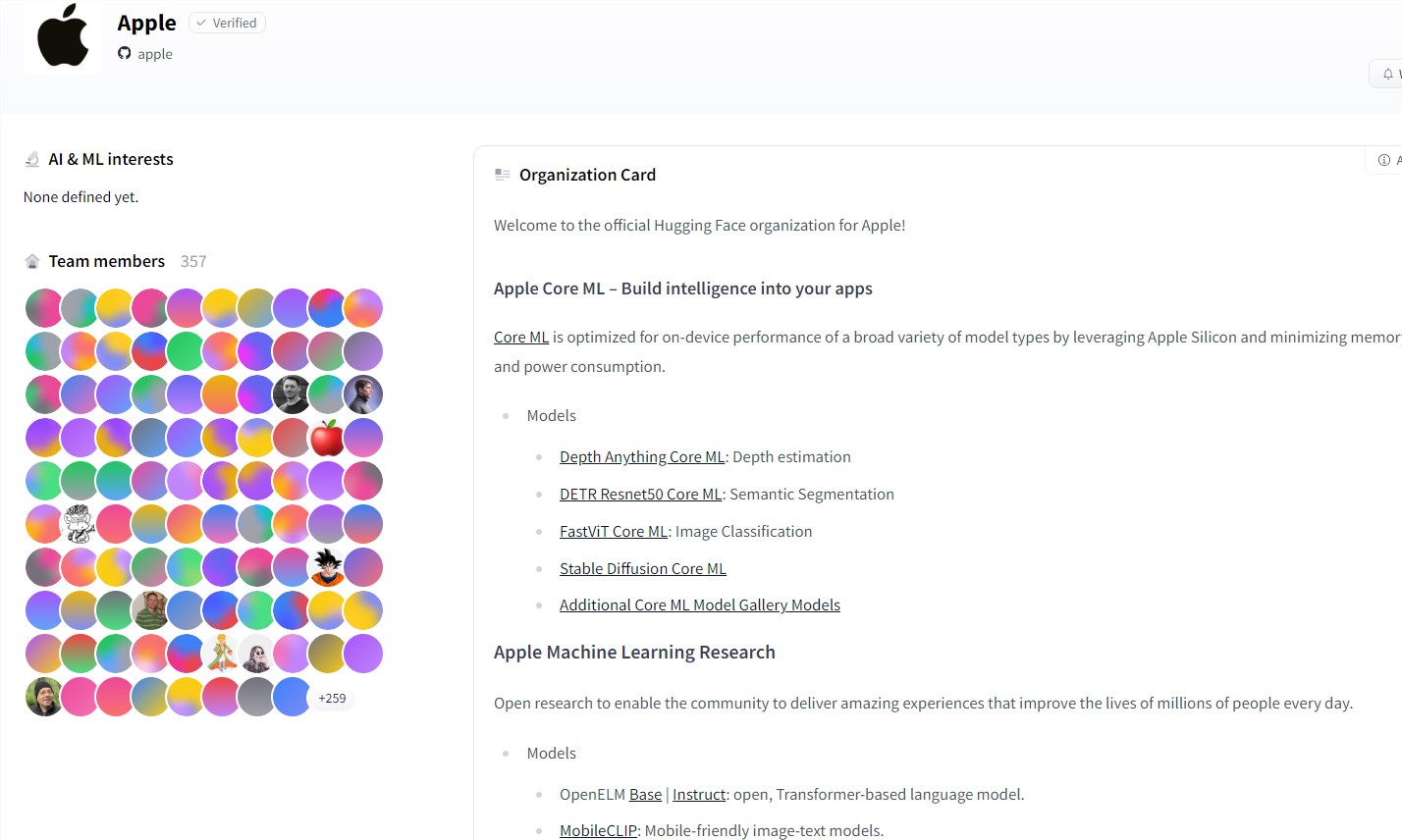
Website: https://huggingface.co/apple
Clement De Lange, co-founder and CEO of Hugging Face, emphasized the importance of this update. "Apple has made a major update by uploading many models to their Hugging Face repository and combining them with their Core ML framework," De Lange said. "This update includes a number of exciting new models that focus on text and images. Like image classification or deep segmentation. Imagine an app that can easily remove unwanted background from a photo or instantly recognize an object in front of you and provide a name in a foreign language.”
The newly released Core ML models cover a wide range of applications, including FastViT for image classification, DepthAnything for monocular depth estimation, and DETR for semantic segmentation. These models are optimized to run exclusively on the user's device, without the need for an internet connection. This approach not only improves application performance but also ensures the security and privacy of user data.
DeLange emphasized the importance of on-device AI, saying: "Core ML models run strictly on the user's device, without the need for a network connection. This makes your application extremely fast while ensuring user data remains private."
The release of these models and datasets on the Hugging Face platform demonstrates Apple’s growing partnership with this artificial intelligence community platform. Apple has been actively working with Hugging Face in recent months to support various initiatives such as the MLX community and integrating open source AI into Apple Intelligence capabilities.
Industry experts believe Apple's focus on on-device AI is consistent with a broader trend of moving computing power from the cloud to edge devices. By leveraging the power of Apple Silicon to minimize memory footprint and power consumption, Core ML enables developers to create smart applications that provide a seamless user experience without compromising privacy or performance.
Apple's move not only promotes the development of device-side AI technology, but also provides developers with more powerful tools and resources. In the future, it is expected to see the emergence of more innovative applications to further enrich the user experience. This will undoubtedly accelerate the application of AI on mobile devices and promote innovation throughout the industry.