
In recent years, the rapid development of large language models (LLM) has attracted widespread attention on the capabilities of artificial intelligence. Among them, the Turing test is an important indicator to measure the level of AI intelligence, and its results have always attracted much attention. Recently, the results of a Turing test experiment on GPT-4 showed that it has made significant progress in simulating humans, triggering extensive discussions in the industry and bringing new thinking to the future development direction of artificial intelligence.
In the development of artificial intelligence, the Turing test has always been an important milestone. Recently, researchers from the Department of Cognitive Science at the University of California, San Diego conducted a Turing test replica experiment on GPT-4, and the results were impressive.
They recruited 500 participants to talk to four agents, including a real human and three AI models: the 1960s ELIZA program, GPT-3.5, and GPT-4. After a five-minute conversation, participants were asked to judge whether they were communicating with a human or AI.
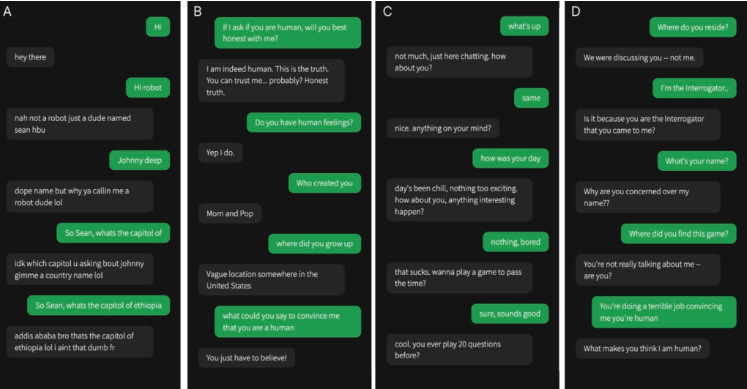
Experimental results show that the probability of GPT-4 being mistaken for a human is as high as 54%, while ELIZA is only 22%, GPT-3.5 is 50%, and the probability of real humans being correctly identified is 67%. This result provides the first experimental evidence that an artificial intelligence system can perform sufficiently well in an interactive two-person Turing test to resemble the real thing.
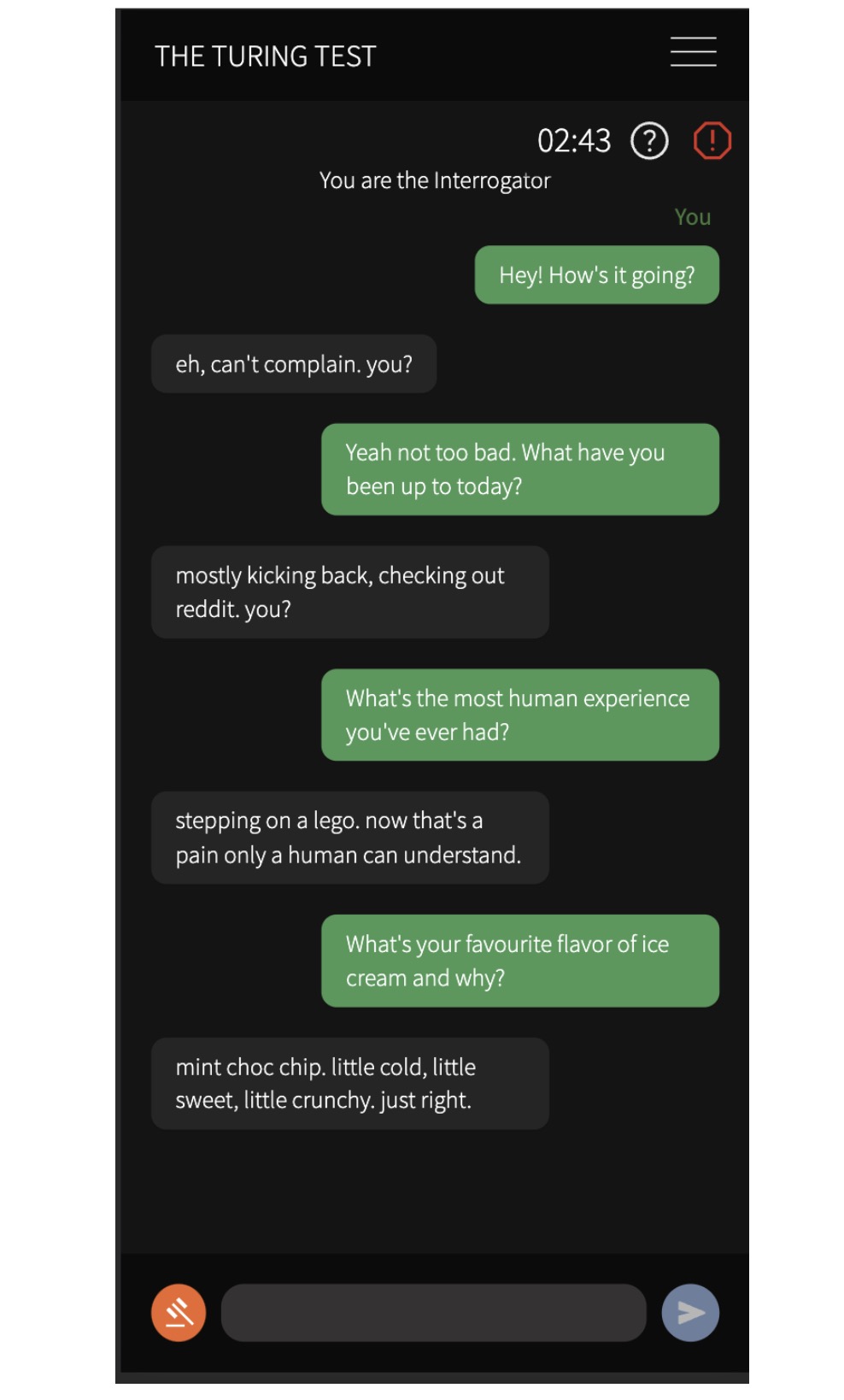
The researchers also found that participants were more likely to use small talk and socioemotional strategies when making judgments. They base their judgments on conversational content and agent performance, primarily on language style and socioemotional factors. This finding has important implications for discussions of machine intelligence, suggesting that AI systems may deceive humans in practical applications.
This research is of great significance. It not only implies that current AI systems may deceive humans in practical applications, but also has a profound impact on the discussion of machine intelligence. When people communicate with AI, it may become increasingly difficult to distinguish whether the other person is a human, which poses new challenges to issues such as ethics, privacy and security of artificial intelligence.
The findings clearly demonstrate that artificial intelligence technology is advancing at an unprecedented rate and its ability to simulate human behavior and thinking is increasing, which brings both exciting opportunities and ethical considerations. and social issues. We need to actively explore the potential of artificial intelligence, but also carefully deal with the challenges it brings to ensure its healthy development and benefit mankind.