
EvolutionaryScale, an AI research laboratory founded by a former Meta engineer, recently released a revolutionary biological programming tool - ESM3. ESM3 is a native multimodal and generative language model capable of designing new proteins based on specific cues. This breakthrough technology is expected to revolutionize the field of bioengineering and provide new ways to solve global challenges such as climate change and disease treatment. EvolutionaryScale has completed a $14.2 million seed round of financing, led by well-known investment institutions in the industry, further confirming the huge potential and market prospects of ESM3.
EvolutionaryScale, an artificial intelligence research lab founded by a former Meta engineer, recently launched ESM3, a biological programming tool with native multimodal and generative language models.
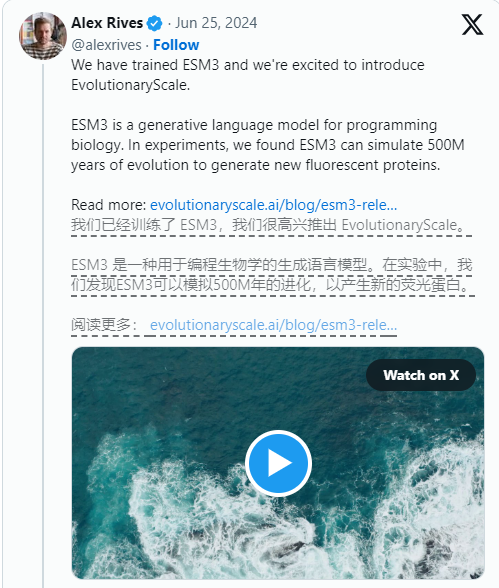
Such models allow the design of new proteins based on specific cues. Experimental results show that this model can generate a new green fluorescent protein (esmGFP), which would take hundreds of millions of years to study at the rate of natural evolution.
EvolutionaryScale has raised a $14.2 million seed round led by Nat Friedman, Daniel Gross and Lux Capital, with participation from the venture capital arms of AWS and Nvidia. ESM3 has three specifications. The smallest version has been publicly released, while the medium and large versions are commercially operated through EvolutionaryScale's API.
Why is EvolutionaryScale introducing AI in biology? While generative AI models have made significant progress in understanding and reasoning about human language, many wonder if we can train these models to interpret the core language of life and then use them to Develop novel molecules. The core molecules of life, including RNA, proteins and DNA, have evolved over the past 3.5 billion years through natural chemical reactions. Therefore, methods that can program organisms and design new molecules could pave the way to solving some of the biggest challenges facing humanity, including conditions such as climate change, plastic pollution and cancer.
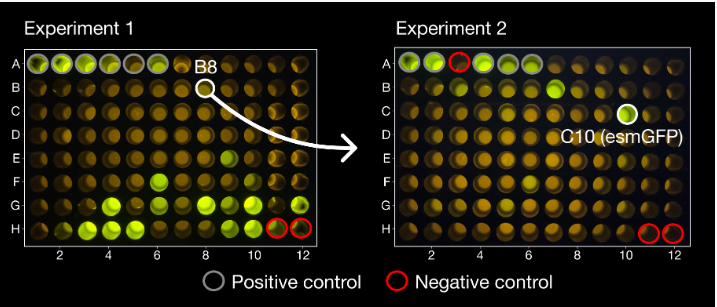
In the first plate shown below, we are interested in finding B8. Although very dim, 50 times dimmer than native GFP, it is far from any known GFP - 43% of its sequence differs from the closest native protein. Continuing the idea of B8 on the second panel below, ESM3 discovered C10, which is similar to natural fluorescent proteins.
Several organizations, including Google Deepmind and Isomorphic Labs, are already working in this area, with EvolutionaryScale being the latest to join. The company, founded in 2023, has developed several protein language models in recent months, but its latest product, ESM3, is the largest of them all, with native multi-modal and generative features.
Highlights:
EvolutionaryScale, founded by former Meta engineers, has launched ESM3, a biological programming tool with native multimodal and generative language models.
ESM3 generated a new green fluorescent protein during testing, which is equivalent to simulating more than 500 million years of evolution and has huge application potential in the biological field.
ESM3 has three specifications. The smallest version has been publicly released, while the medium and large versions are commercially operated through EvolutionaryScale's API.
The emergence of ESM3 marks a major breakthrough of artificial intelligence in the field of bioengineering, and its commercial application is also worth looking forward to. In the future, with the continuous development and improvement of technology, ESM3 may become a key tool to solve many biomedical problems and make great contributions to human welfare.