packj github action
1.0.0

เพิ่ม PackJ ลงในเวิร์กโฟลว์ของคุณเพื่อตรวจสอบคำขอดึงของคุณสำหรับการพึ่งพา NPM/PYPI/Ruby ที่เป็นอันตราย/เสี่ยง
ขับเคลื่อนด้วยเครื่องมือโอเพนซอร์ซของเรา
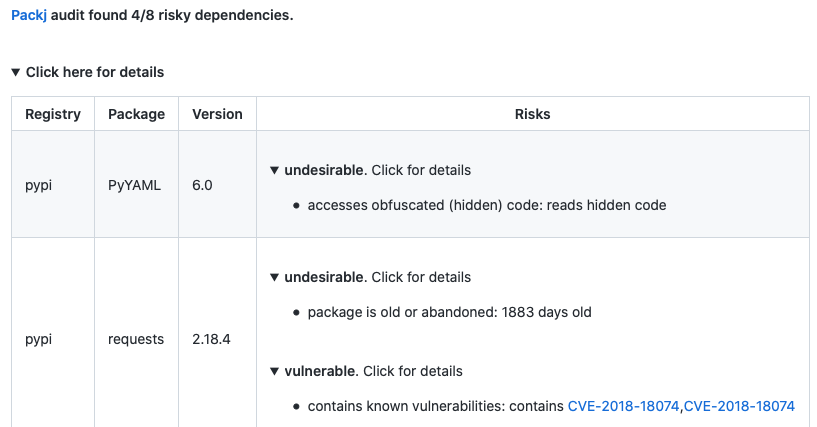
PackJ จะแสดงความคิดเห็นเกี่ยวกับการประชาสัมพันธ์หากพบการพึ่งพาที่มีความเสี่ยง ดูตัวอย่างการตรวจสอบคำขอดึง
เพียงเพิ่มสิ่งต่อไปนี้ในเวิร์กโฟลว์ของคุณ:
- name : Packj Security Audit
  uses : ossillate-inc/[email protected]
    with :
      # TODO: replace with your dependency files in the repo
      DEPENDENCY_FILES : pypi:requirements.txt,npm:package.json,rubygems:Gemfile
REPO_TOKEN : ${{ secrets.GITHUB_TOKEN } # This is a basic workflow to help you get started with Actions
name : Packj security audit
# Controls when the workflow will run
on :
pull_request :
branches :
- main
# A workflow run is made up of one or more jobs that can run sequentially or in parallel
jobs :
# This workflow contains a single job called "packj-audit"
packj-security-audit :
# The type of runner that the job will run on
runs-on : ubuntu-latest
# Steps represent a sequence of tasks that will be executed as part of the job
steps :
# Audit
- name : Audit dependencies
uses : ossillate-inc/[email protected]
with :
# TODO: replace with your dependency files in the repo
DEPENDENCY_FILES : pypi:requirements.txt,npm:package.json,rubygems:Gemfile
REPO_TOKEN : ${{ secrets.GITHUB_TOKEN }}secrets.GITHUB_TOKEN ถูกใช้โดยค่าเริ่มต้น (GitHub Action Runner)falsePackJ สามารถตรวจสอบแพ็คเกจ PYPI, NPM และ RubyGems มันดำเนินการ:
connect , exec )open() , fork() )แพ็คเกจที่มีโดเมนอีเมลที่หมดอายุช่องว่างเวลาวางจำหน่ายขนาดใหญ่ API ที่ละเอียดอ่อน ฯลฯ จะถูกตั้งค่าสถานะเป็นความเสี่ยงด้วยเหตุผลด้านความปลอดภัย
การออกแบบ PackJ นั้นได้รับคำแนะนำจากการศึกษาตัวอย่างมัลแวร์ 651 ตัวอย่างของการโจมตีซัพพลายเชนซอฟต์แวร์โอเพนซอร์ซที่บันทึกไว้ มันสแกนสำหรับรหัสที่มีความเสี่ยง 40+ และคุณลักษณะข้อมูลเมตาที่ทำให้แพคเกจมีความเสี่ยงต่อการโจมตีห่วงโซ่อุปทาน
| เสี่ยง | เหตุผล |
|---|---|
| แพ็คเกจการแอบอ้างแพ็คเกจยอดนิยม | นักแสดงที่ไม่ดีดำเนินการโจมตีที่พิมพ์ผิดพลาดโดยแพ็คเกจที่เป็นอันตรายที่เผยแพร่แพ็คเกจยอดนิยม (เช่น Lodash vs Loadash) |
| แพ็คเกจเก่าหรือ abandonded | แพ็คเกจเก่าหรือไม่ได้รับการแก้ไขไม่ได้รับการแก้ไขความปลอดภัย |
| แพ็คเกจโดยใช้ APIs ที่ละเอียดอ่อนเช่น Exec และ Eval | มัลแวร์ใช้ APIs จากระบบปฏิบัติการหรือรันไทม์ภาษาเพื่อดำเนินการที่ละเอียดอ่อน (เช่นอ่านคีย์ SSH) |
| แพ็คเกจที่มีที่อยู่อีเมลไม่ถูกต้องหรือไม่มี | ที่อยู่อีเมลไม่ถูกต้องหรือขาดหาย |
| แพ็คเกจที่มีการซื้อคืนที่ไม่ถูกต้องหรือไม่มีแหล่งสาธารณะ | การไม่มีการซื้อคืนสาธารณะหมายถึงวิธีการตรวจสอบหรือตรวจสอบรหัสแหล่งที่มาสาธารณะอย่างง่ายดาย |
| แพ็คเกจที่มีช่องโหว่ที่รู้จัก | ช่องโหว่ด้านความปลอดภัยที่รู้จักกันดี (CVES) ในรหัสแพ็คเกจอาจถูกนำไปใช้โดยนักแสดงที่ไม่ดี |
PackJ สามารถปรับแต่งเพื่อส่งการแจ้งเตือนที่ใช้กับรูปแบบการคุกคามของคุณเท่านั้น เพียงเพิ่มไฟล์ .packj.yaml ใน repo ของคุณตามเทมเพลตของเรา (ด้านล่าง) และเปิด/ปิดการแจ้งเตือนที่สำคัญสำหรับคุณ
#
# Audit policies
#
audit:

  #
  # Risk alerts (enable or disable according to your threat model)
  #
  alerts:

    #
    # category: malicious packages (publicly known and unknown)
    #
    malicious:
      contains known malware:
        - reason: package is known to contain a dangerous malware
        - enabled: true
      typo-squatting or repo-jacking package:
        - reason: package impersonates another popular package to propagate malware
        - enabled: true

    #
    # alert category: packages vulnerable to code exploits
    #
    vulnerable:
      contains known vulnerabilities:
        - reason: known vulnerabilities (CVEs) in package code could be exploited
        - enabled: true

    #
    # packages with undesirable or "risky" attributes
    #
    undesirable:
      package is old or abandoned:
        - reason: old or abandoned packages receive no security updates and are risky
        - enabled: true

      invalid or no author email:
        - reason: a package with lack of or invalid author email suggests 2FA not enabled
        - enabled: true

      invalid or no homepage:
        - reason: a package with no or invalid homepage may not be preferable
        - enabled: false

      no source repo:
        - reason: lack of public source repo may suggest malicious intention
        - enabled: true

      fewer downloads:
        - reason: a package with few downloads may not be preferable
        - enabled: true

      no or insufficient readme:
        - reason: a package with lack of documentation may not be preferable
        - enabled: false

      fewer versions or releases:
        - reason: few versions suggest unstable or inactive project
        - enabled: true

      too many dependencies:
        - reason: too many dependencies increase attack surface
        - enabled: false

      version release after a long gap:
        - reason: a release after a long time may indicate account hijacking
        - enabled: false

      contains custom installation hooks:
        - reason: custom installation hooks may download or execute malicious code
        - enabled: false # WIP

      #
      # type: repo stats
      #
      few source repo stars:
        - reason: a package with few repo stars may not be preferable
        - enabled: false

      few source repo forks:
        - reason: a package with few repo forks may not be preferable
        - enabled: false

      forked source repo:
        - reason: a forked copy of a popular package may contain malicious code
        - enabled: true

      #
      # type: APIs and permissions
      #
      generates new code:
        - reason: package generates new code at runtime, which could be malicious
        - enabled: false
      forks or exits OS processes:
        - reason: package spawns new operating system processes, which could be malicious
        - enabled: false
      accesses obfuscated (hidden) code:
        - enabled: true
      accesses environment variables:
        - enabled: false
      changes system/environment variables:
        - enabled: false
      accesses files and dirs:
        - enabled: false
      communicates with external network:
        - enabled: false
      reads user input:
        - enabled: false

sandbox:
  rules:
    #
    # File system (allow or block accesses to file/dirs)
    #
    #   ~/ represents home dir
    #   . represents cwd dir
    #
    # NOTE: only ONE 'allow' and 'block' lines are allowed
    #
    fs:
      # TODO: customize as per your threat model

      # block access to home dir and all other locations (except the ones below)
      block: ~/, /
      allow: ., ~/.cache, ~/.npm, ~/.local, ~/.ruby, /tmp, /proc, /etc, /var, /bin, /usr/include, /usr/local, /usr/bin, /usr/lib, /usr/share, /lib

    #
    # Network (allow or block domains/ports)
    #
    # NOTE: only ONE 'allow' and 'block' lines are allowed
    #
    network:

      # TODO: customize as per your threat model

      # block all external network communication (except the ones below)
      block: 0.0.0.0

      # For installing PyPI, Rubygems, and NPM packages
      allow: pythonhosted.org:443, pypi.org:443, rubygems.org:443, npmjs.org:0, npmjs.com:0