packj github action
1.0.0

ワークフローにPackJを追加して、悪意のある/リスクのあるNPM/PYPI/RUBY依存関係のプルリクエストを監査します。
オープンソースツールPackjを搭載しています。
PackJは、危険な依存関係が見つかった場合、PRについてコメントします。プルリクエスト監査の例を参照してください。
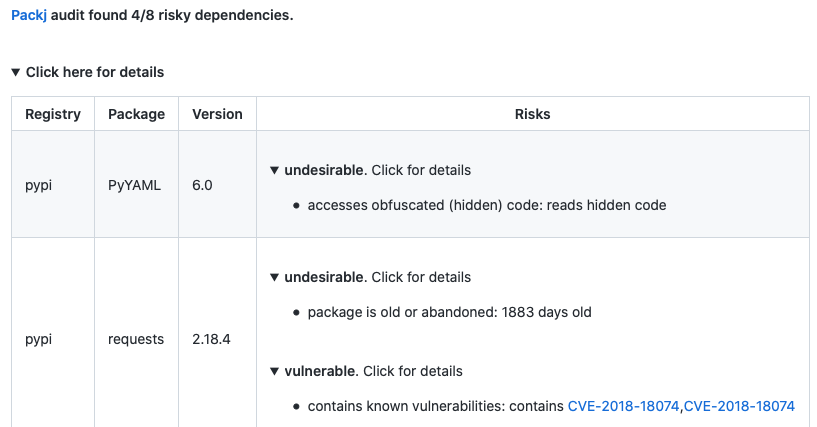
次のワークフローに追加するだけです。
- name : Packj Security Audit
  uses : ossillate-inc/[email protected]
    with :
      # TODO: replace with your dependency files in the repo
      DEPENDENCY_FILES : pypi:requirements.txt,npm:package.json,rubygems:Gemfile
REPO_TOKEN : ${{ secrets.GITHUB_TOKEN } # This is a basic workflow to help you get started with Actions
name : Packj security audit
# Controls when the workflow will run
on :
pull_request :
branches :
- main
# A workflow run is made up of one or more jobs that can run sequentially or in parallel
jobs :
# This workflow contains a single job called "packj-audit"
packj-security-audit :
# The type of runner that the job will run on
runs-on : ubuntu-latest
# Steps represent a sequence of tasks that will be executed as part of the job
steps :
# Audit
- name : Audit dependencies
uses : ossillate-inc/[email protected]
with :
# TODO: replace with your dependency files in the repo
DEPENDENCY_FILES : pypi:requirements.txt,npm:package.json,rubygems:Gemfile
REPO_TOKEN : ${{ secrets.GITHUB_TOKEN }}secrets.GITHUB_TOKENはデフォルトで使用されます(githubアクションランナー)falseに設定します。PackJは、PYPI、NPM、およびRubyGemsパッケージを監査できます。実行する:
connect 、 exec )の使用についてパッケージコード全体を確認してください。open() 、 fork() )のトレースを分析します。期限切れの電子メールドメイン、大きなリリースの時刻ギャップ、敏感なAPIなどを備えたパッケージは、セキュリティ上の理由で危険であるとフラグが付けられています。
PackJの設計は、文書化されたオープンソースソフトウェアサプライチェーン攻撃の651のマルウェアサンプルの調査によって導かれます。サプライチェーン攻撃に対してパッケージを脆弱にする40以上のリスクの高いコードとメタデータ属性をスキャンします。
| リスク | 理由 |
|---|---|
| 人気のあるパッケージになりすましているパッケージ | 悪い俳優は、人気のあるパッケージになりすましている悪意のあるパッケージ(例えば、Lodash vs loadash)でタイプミス式の攻撃を実行します |
| 古いパッケージまたは廃止されたパッケージ | 古いパッケージまたは維持されていないパッケージでは、セキュリティの修正が届きません |
| execや評価などの敏感なAPIを使用したパッケージ | マルウェアは、オペレーティングシステムまたは言語ランタイムのAPIを使用して機密操作を実行します(例:SSHキーを読む) |
| 貢献者の電子メールアドレスが無効または電子メールアドレスなしのパッケージ | 電子メールアドレスが不正確または不足していることは、アカウントに2FAの欠如を示唆しているため、悪いアクターがパッケージの所有権をハイジャックしやすくなります |
| パブリックソースリポジトリの無効またはなしのパッケージ | パブリックリポジトリがないということは、ソースコードを公に監査または確認する簡単な方法がないことを意味します |
| 既知の脆弱性を含むパッケージ | パッケージコードの既知のセキュリティの脆弱性(CVE)は、悪い俳優によって悪用される可能性があります |
PackJは、脅威モデルに適用されるアラートのみを送信するようにカスタマイズできます。テンプレート(下)に基づいてリポジトリに.packj.yamlファイルを追加し、重要なアラートを有効/無効にするだけです。
#
# Audit policies
#
audit:

  #
  # Risk alerts (enable or disable according to your threat model)
  #
  alerts:

    #
    # category: malicious packages (publicly known and unknown)
    #
    malicious:
      contains known malware:
        - reason: package is known to contain a dangerous malware
        - enabled: true
      typo-squatting or repo-jacking package:
        - reason: package impersonates another popular package to propagate malware
        - enabled: true

    #
    # alert category: packages vulnerable to code exploits
    #
    vulnerable:
      contains known vulnerabilities:
        - reason: known vulnerabilities (CVEs) in package code could be exploited
        - enabled: true

    #
    # packages with undesirable or "risky" attributes
    #
    undesirable:
      package is old or abandoned:
        - reason: old or abandoned packages receive no security updates and are risky
        - enabled: true

      invalid or no author email:
        - reason: a package with lack of or invalid author email suggests 2FA not enabled
        - enabled: true

      invalid or no homepage:
        - reason: a package with no or invalid homepage may not be preferable
        - enabled: false

      no source repo:
        - reason: lack of public source repo may suggest malicious intention
        - enabled: true

      fewer downloads:
        - reason: a package with few downloads may not be preferable
        - enabled: true

      no or insufficient readme:
        - reason: a package with lack of documentation may not be preferable
        - enabled: false

      fewer versions or releases:
        - reason: few versions suggest unstable or inactive project
        - enabled: true

      too many dependencies:
        - reason: too many dependencies increase attack surface
        - enabled: false

      version release after a long gap:
        - reason: a release after a long time may indicate account hijacking
        - enabled: false

      contains custom installation hooks:
        - reason: custom installation hooks may download or execute malicious code
        - enabled: false # WIP

      #
      # type: repo stats
      #
      few source repo stars:
        - reason: a package with few repo stars may not be preferable
        - enabled: false

      few source repo forks:
        - reason: a package with few repo forks may not be preferable
        - enabled: false

      forked source repo:
        - reason: a forked copy of a popular package may contain malicious code
        - enabled: true

      #
      # type: APIs and permissions
      #
      generates new code:
        - reason: package generates new code at runtime, which could be malicious
        - enabled: false
      forks or exits OS processes:
        - reason: package spawns new operating system processes, which could be malicious
        - enabled: false
      accesses obfuscated (hidden) code:
        - enabled: true
      accesses environment variables:
        - enabled: false
      changes system/environment variables:
        - enabled: false
      accesses files and dirs:
        - enabled: false
      communicates with external network:
        - enabled: false
      reads user input:
        - enabled: false

sandbox:
  rules:
    #
    # File system (allow or block accesses to file/dirs)
    #
    #   ~/ represents home dir
    #   . represents cwd dir
    #
    # NOTE: only ONE 'allow' and 'block' lines are allowed
    #
    fs:
      # TODO: customize as per your threat model

      # block access to home dir and all other locations (except the ones below)
      block: ~/, /
      allow: ., ~/.cache, ~/.npm, ~/.local, ~/.ruby, /tmp, /proc, /etc, /var, /bin, /usr/include, /usr/local, /usr/bin, /usr/lib, /usr/share, /lib

    #
    # Network (allow or block domains/ports)
    #
    # NOTE: only ONE 'allow' and 'block' lines are allowed
    #
    network:

      # TODO: customize as per your threat model

      # block all external network communication (except the ones below)
      block: 0.0.0.0

      # For installing PyPI, Rubygems, and NPM packages
      allow: pythonhosted.org:443, pypi.org:443, rubygems.org:443, npmjs.org:0, npmjs.com:0