packj github action
1.0.0

Fügen Sie Packj zu Ihrem Workflow hinzu, um Ihre Pull -Anfragen für böswillige/riskante NPM/PYPI/Ruby -Abhängigkeiten zu prüfen.
Angetrieben von unserem Open-Source-Toolpackj.
Packj kommentiert die PR, wenn riskante Abhängigkeiten gefunden werden. Siehe Beispiele für Pull Request Audit.
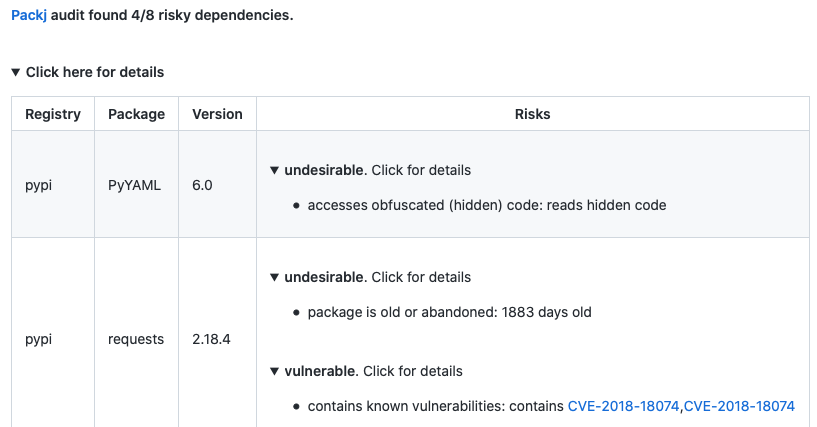
Fügen Sie Ihren Workflow einfach Folgendes hinzu:
- name : Packj Security Audit
  uses : ossillate-inc/[email protected]
    with :
      # TODO: replace with your dependency files in the repo
      DEPENDENCY_FILES : pypi:requirements.txt,npm:package.json,rubygems:Gemfile
REPO_TOKEN : ${{ secrets.GITHUB_TOKEN } # This is a basic workflow to help you get started with Actions
name : Packj security audit
# Controls when the workflow will run
on :
pull_request :
branches :
- main
# A workflow run is made up of one or more jobs that can run sequentially or in parallel
jobs :
# This workflow contains a single job called "packj-audit"
packj-security-audit :
# The type of runner that the job will run on
runs-on : ubuntu-latest
# Steps represent a sequence of tasks that will be executed as part of the job
steps :
# Audit
- name : Audit dependencies
uses : ossillate-inc/[email protected]
with :
# TODO: replace with your dependency files in the repo
DEPENDENCY_FILES : pypi:requirements.txt,npm:package.json,rubygems:Gemfile
REPO_TOKEN : ${{ secrets.GITHUB_TOKEN }}secrets.GITHUB_TOKEN wird standardmäßig verwendet (GitHub -Aktionsläufer)false .Packj kann PYPI-, NPM- und RubyGems -Pakete prüfen. Es wird ausgeführt:
connect , exec ).open() , fork() ) analysieren.Pakete mit abgelaufenen E -Mail -Domänen, Zeitlücke mit großer Freigabe, sensible APIs usw. werden aus Sicherheitsgründen als riskant gekennzeichnet.
Das Design von Packj wird durch unsere Untersuchung von 651 Malware-Muster dokumentierter Open-Source-Software-Supply-Chain-Angriffe geleitet. Es scannt nach mehr als 40 riskanten Code- und Metadatenattributen, die ein Paket für Lieferkettenangriffe anfällig machen.
| Risiko | Grund |
|---|---|
| Verpackungen, die sich als beliebte Pakete ausgeben | Schlechte Schauspieler führen Angriffe von Tippfehler von bösartigen Paketen durch, die sich als beliebte Pakete ausgeben (z. B. Lodash vs Loadash). |
| Alte oder aufgehobene Pakete | Alte oder nicht gehörte Pakete erhalten keine Sicherheitskorrekturen |
| Paket mithilfe sensibler APIs wie Exec und Eval | Malware verwendet APIs aus dem Betriebssystem oder der Sprachlaufzeit, um sensible Vorgänge auszuführen (z. B. SSH -Tasten lesen). |
| Pakete mit ungültig oder ohne E -Mail -Adressen der Mitwirkenden | Falsche oder fehlende E -Mail -Adressen deuten auf einen Mangel an 2FA auf dem Konto hin, was es schlechten Schauspielern erleichtert, das Besitz von Paket zu entführen |
| Pakete mit ungültigem oder keinem öffentlichen Quell -Repo | Das Fehlen eines öffentlichen Repo bedeutet keine einfache Möglichkeit, den Quellcode öffentlich zu prüfen oder zu überprüfen |
| Pakete mit bekannten Schwachstellen | Bekannte Sicherheitslücken (CVEs) im Paketcode könnten von schlechten Schauspielern ausgenutzt werden |
Packj kann so angepasst werden, dass nur Warnungen für Ihr Bedrohungsmodell gelten. Fügen Sie einfach eine .packj.yaml -Datei in Ihr Repo basierend auf unserer Vorlage (unten) hinzu und aktivieren/deaktivieren Sie Warnungen, die für Sie von Bedeutung sind.
#
# Audit policies
#
audit:

  #
  # Risk alerts (enable or disable according to your threat model)
  #
  alerts:

    #
    # category: malicious packages (publicly known and unknown)
    #
    malicious:
      contains known malware:
        - reason: package is known to contain a dangerous malware
        - enabled: true
      typo-squatting or repo-jacking package:
        - reason: package impersonates another popular package to propagate malware
        - enabled: true

    #
    # alert category: packages vulnerable to code exploits
    #
    vulnerable:
      contains known vulnerabilities:
        - reason: known vulnerabilities (CVEs) in package code could be exploited
        - enabled: true

    #
    # packages with undesirable or "risky" attributes
    #
    undesirable:
      package is old or abandoned:
        - reason: old or abandoned packages receive no security updates and are risky
        - enabled: true

      invalid or no author email:
        - reason: a package with lack of or invalid author email suggests 2FA not enabled
        - enabled: true

      invalid or no homepage:
        - reason: a package with no or invalid homepage may not be preferable
        - enabled: false

      no source repo:
        - reason: lack of public source repo may suggest malicious intention
        - enabled: true

      fewer downloads:
        - reason: a package with few downloads may not be preferable
        - enabled: true

      no or insufficient readme:
        - reason: a package with lack of documentation may not be preferable
        - enabled: false

      fewer versions or releases:
        - reason: few versions suggest unstable or inactive project
        - enabled: true

      too many dependencies:
        - reason: too many dependencies increase attack surface
        - enabled: false

      version release after a long gap:
        - reason: a release after a long time may indicate account hijacking
        - enabled: false

      contains custom installation hooks:
        - reason: custom installation hooks may download or execute malicious code
        - enabled: false # WIP

      #
      # type: repo stats
      #
      few source repo stars:
        - reason: a package with few repo stars may not be preferable
        - enabled: false

      few source repo forks:
        - reason: a package with few repo forks may not be preferable
        - enabled: false

      forked source repo:
        - reason: a forked copy of a popular package may contain malicious code
        - enabled: true

      #
      # type: APIs and permissions
      #
      generates new code:
        - reason: package generates new code at runtime, which could be malicious
        - enabled: false
      forks or exits OS processes:
        - reason: package spawns new operating system processes, which could be malicious
        - enabled: false
      accesses obfuscated (hidden) code:
        - enabled: true
      accesses environment variables:
        - enabled: false
      changes system/environment variables:
        - enabled: false
      accesses files and dirs:
        - enabled: false
      communicates with external network:
        - enabled: false
      reads user input:
        - enabled: false

sandbox:
  rules:
    #
    # File system (allow or block accesses to file/dirs)
    #
    #   ~/ represents home dir
    #   . represents cwd dir
    #
    # NOTE: only ONE 'allow' and 'block' lines are allowed
    #
    fs:
      # TODO: customize as per your threat model

      # block access to home dir and all other locations (except the ones below)
      block: ~/, /
      allow: ., ~/.cache, ~/.npm, ~/.local, ~/.ruby, /tmp, /proc, /etc, /var, /bin, /usr/include, /usr/local, /usr/bin, /usr/lib, /usr/share, /lib

    #
    # Network (allow or block domains/ports)
    #
    # NOTE: only ONE 'allow' and 'block' lines are allowed
    #
    network:

      # TODO: customize as per your threat model

      # block all external network communication (except the ones below)
      block: 0.0.0.0

      # For installing PyPI, Rubygems, and NPM packages
      allow: pythonhosted.org:443, pypi.org:443, rubygems.org:443, npmjs.org:0, npmjs.com:0