KOSmk4
1.0.0

モノリシック/モジュラーX86オペレーティングシステム +ユーザースペースは、他の主流OS(主にLinux)の再環境と拡張に重点を置いており、API/ABI互換性があります。
KOSMK4(KOSオペレーティングシステムシリーズの4回目の演出)は、自家製のモノリシックですが、 I386およびX86_64 (32ビット互換モードを含む)マシンのモジュラーカーネルであり、C ++で記述されています(ただし、機能過負荷と例外を使用するだけです)。
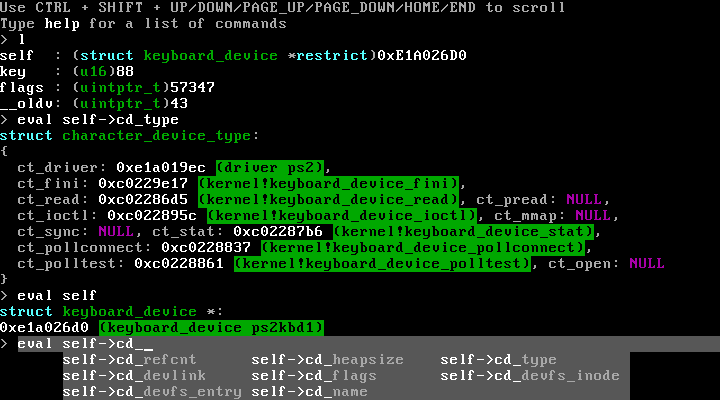
それは、デバッグ中に支援するために多くのトリックを整えて設計されています。たとえば、完全にインタラクティブなビルトインデバッガーで、何か問題が発生したときにシステム状態をインタラクティブに分析することができます。
一般に、KOSはホイールを再発明するように設計されていません(ここには正方形のホイールはありません)が、可能な限り比phor的なホイールの外観とロールを行おうとします。これが意味することは、
通知:KOSはGitサブモジュール(KOSの構築に必要な)を使用しているため、ダウンロードZIP関数を使用しても、KOSの構築に至るすべてのものになることはありません。したがって、KOS全体をクローンするには、次のことを介してこのgitをクローンする必要があります。
git clone --recursive https://github.com/GrieferAtWork/KOSmk4deemon magic.dee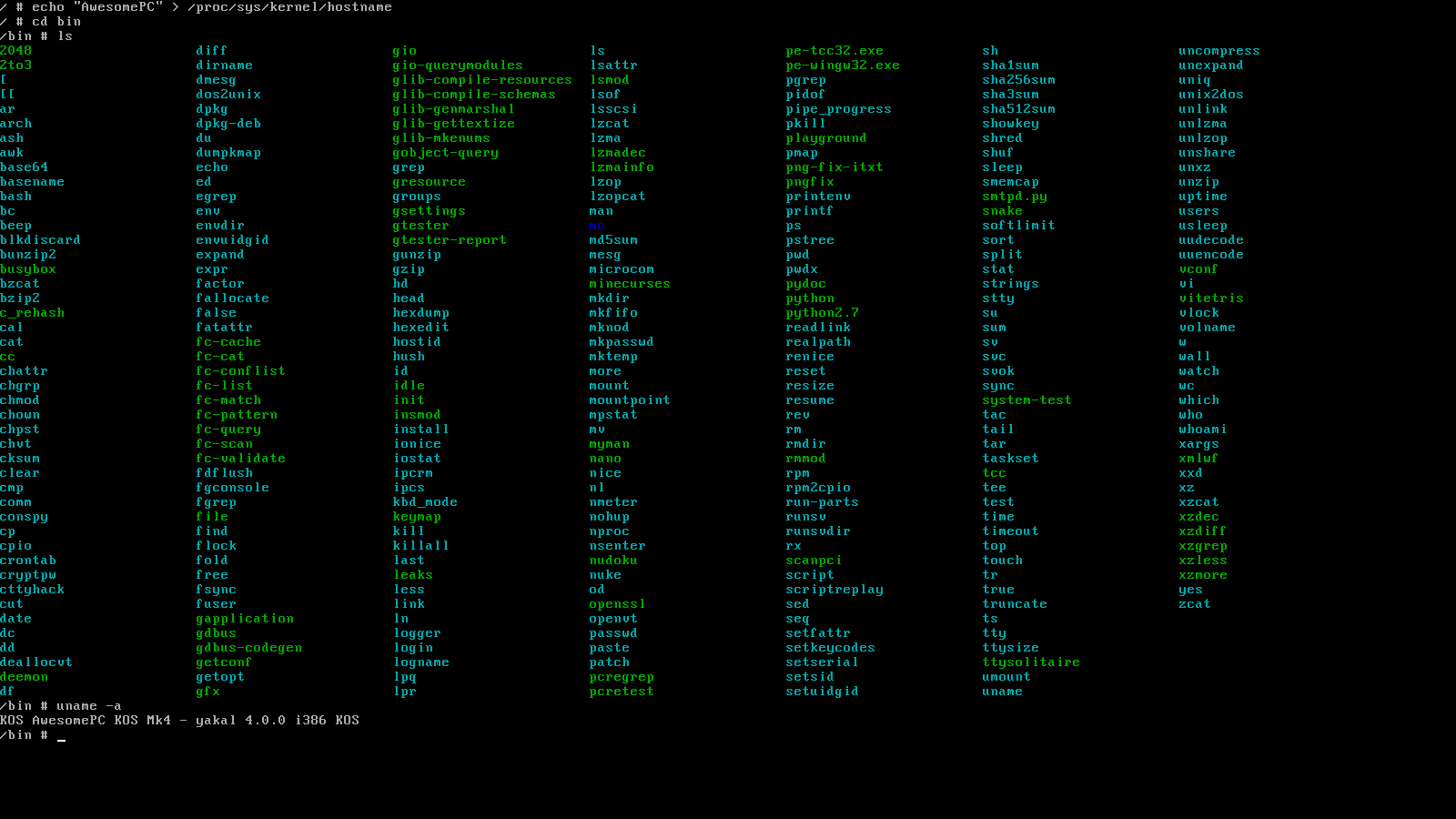
すべての移植されたアプリケーションはbash $PROJPATH/kos/misc/make_utility.sh i386 <UTILITY_NAME>を使用して、KOSディスクイメージにインストールできます(シェルの取得も参照)
catch (...)で捕まえることができます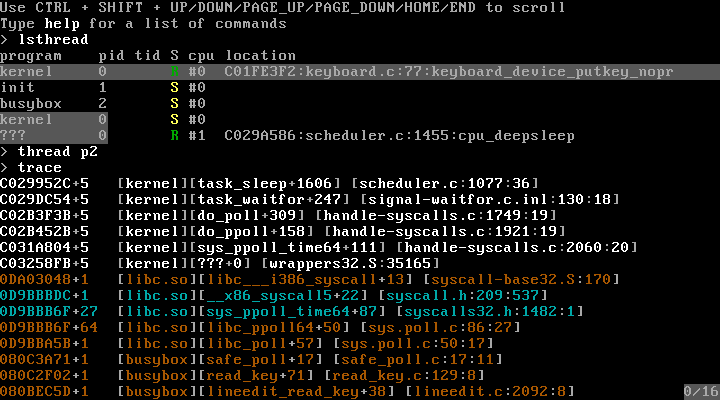
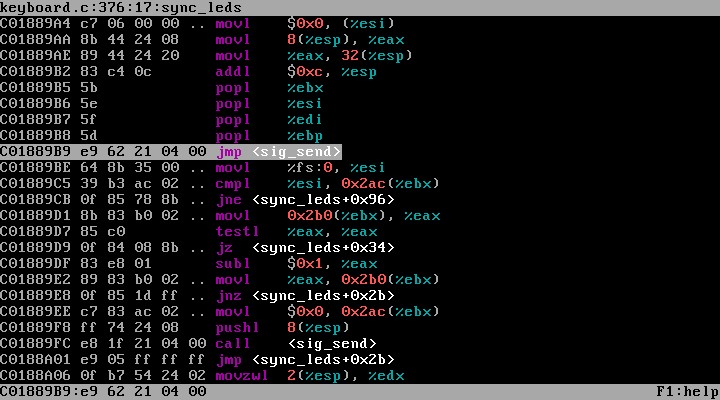
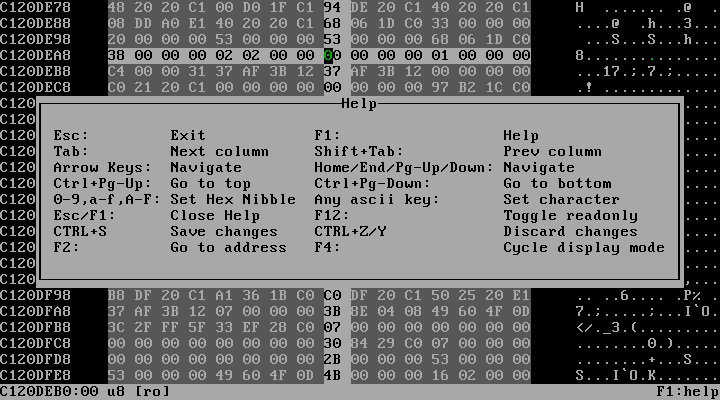
./binutils/deemon/deemon magic.dee --emulator=qemu --gdb=emulatorを介して使用できます。./binutils/deemon/deemon magic.dee --emulator=bochs --gdb=emulatorを介して使用できます。./binutils/deemon/deemon magic.dee --emulator=vbox --gdb=emulatorを介して使用できます。/kos/src/kernel/modgdbserver )を提供しますboot=/dev/hda1/にマウントされます)init=/bin/initrdfsbase 、 rdgsbase 、 wrfsbase 、 wrgsbase%fs / %gsベースアドレスを簡単かつ直感的に読み込む方法として、32ビットユーザースペースにも提供されます。cmpxchg 、 cmpxchg8b 、 xaddcmovcc 、 cpuid 、 nop (マルチバイト)sfence 、 lfence 、 mfencemovbe 、 sarx 、 shlx 、 shrx 、 rorxpopcnt 、 tzcnt 、 lzcnt 、 pext 、 pdep 、 bzhi 、 andnxbegin 、 xend 、 xabort 、 xtest (以下のsa rtm)modrtm )が含まれます。modrtmドライバーは、小さなサンドボックスでユーザー空間コードを一時的にエミュレートし、そこからユーザー空間プログラムによってメモリに行われたすべての変更を収集し、一度にすべてを原子的に適用します(同じメモリ領域を変更しようとする他のRTM操作に関して)/kos/include/kos/rtm.h include/kos/rtm.hのパブリックインターフェイスも提供します#UDのみを見ることができる場合、KOSは障害の指示を分析しますlibvm86経由のVM86サポートにより、リアルモードのようなBIOS呼び出しは、制御された64ビット環境からまだ作成されます(自家製のX86エミュレータlibemu86を介して派遣されたソフトウェアベースの命令エミュレーションを使用しています)bash $PROJPATH/kos/misc/make_toolchain.sh x86_64-kos )に置き換えるだけであることに注意してください。fxsave / fxrstorinvlpg (TLB-ShootDowns)hltベースのアイドリング(何も起こっていないときにCPUサイクルがないことを意味します)struct sigから派生していますfutex()ベースの同期プリミティブのユーザースペースサポートvoid pit_interrupt() { ++time; yield(); } )に基づいており、代わりにハードウェアTSC(Timestampcounter)に基づいていますrdtsc 、APICタイマーのみ、またはピットを介して実装できますtsc_deadline()を実装し、その後割り込みを起動する必要があります。rdtscについては、 IA32_TSC_DEADLINE msrに書き込むだけですif (NOW >= CURRENT_DEADLINE) DO_INTR(); else tsc_deadline(CURRENT_DEADLINE); 、したがって、実際の締め切りが終了するまでAPIC/PITリロード値を継続的に更新します(NOW - TIME_WHEN_THREAD_STARTED_WAITING) / NUM_RUNNING_THREADSに等しい量子長を割り当てられます。tsc_deadline()はNOW + (NOW - TIME_WHEN_THREAD_STARTED_WAITING) / NUM_RUNNING_THREADSに設定されていますram=[{ "type": "ram", "start": 0x1234, "size": 0x4567 }] commandlineオプションによって提供libjson )iopl()およびioperm()のユーザースペースサポート( 65536ポートすべてをスレッドごとに制御できるようにします)ioperm()はLinuxのように実装されていないことに注意してください。これは、スレッドが先制されるたびにmemcpy()を行います。代わりに、KOSはLazy Page Directoryマッピングを使用して、異なるスレッド間を切り替えるときにTSS.IOBMメモリ領域を再マップし、IOインストラクションの1つが#PFを引き起こすとマッピングを復元します。ioperm()を使用するオーバーヘッドは両方とも最小限であり、より多くの数のIoportsが使用されている場合は増加しないことを意味します(これもまた、Linuxの場合になります)。invpcid ( cpuidを使用して選択)invlpg ( cpuidを使用して選択)PGEグローバルページ( cpuidを使用して選択)P32 (正常)およびPAEページング( cpuidを使用して選択)PAE.2MiBおよびP32.4MiB大きなページ( cpuidを使用して選択され、メモリマッピングが許可されている場合は自動的に使用されます)PAE.XD (execute-disable)( cpuidを使用して選択)P64 (4レベル)ページングP64.2MiBおよびP64.1GiB大きなページ(後者はcpuidを使用して選択されます)P64.NX (no-execute)( cpuidを使用して選択)mmap()怠initializatializedおよびWride-Backファイルマッピングをサポートしていますlibemu86 )jmp SOME_ADDRESSとしてmovl $SOME_ADDRESS, OFFSETOF_REGISTER_MAP_EIPを実行できます。mmap("/dev/urandom")ができます。結果は、作成されていない場所に関係なく、すべての読み取りが行われるたびにランダムな値を返すメモリマッピングです。heap_alloc() :生のヒープアロケーター(メモリを解放するときにサイズを指定する必要があります)kmalloc()実装するために使用されますmman_map_kram() ( mmap() )に相当するカーネルに相当するカーネルを使用してページ全体を割り当てるslab_kmalloc() :スラブアロケーターサポートkmalloc()実装するために使用されますrealloc()ではないという欠点があります(したがって、 krealloc()スラブの場合はmalloc()+memcpy()+free()としてエミュレートする必要があります)kmalloc() :ユーザースペースmalloc()とほぼ同じですが、その動作を説明するフラグのセットを撮影しますkmalloc()割り当てが失敗したときに例外( E_BADALLOC )をスローしますkmalloc_nx()何かがうまくいかなかったときにNULL返します( NoExceptのためにnxが立っています)O_DOSPATHとAT_DOSPATH提供して、特定のパスをDOSセマンティクスを使用して解釈する必要があることを指定しますDOSPATH -Modeを強制/無効にすることができるシステムコールfsmode(2)が存在しますS_ISBLK() )と文字( S_ISCHR() )devicesの両方)/dev )/tmp )/proc/[pid]/... )/proc/self/proc/[pid]/exe/proc/[pid]/fd/[fdno]int 80hlcall $7, $0 (sysvで要求)%eaxを使用する代わりに、 lcall $7, $<sysno>を使用することもできます。sysentersyscallint 80hと同じABI/kos/include/kos/ukern.h:userkern_syscall() )/kos/src/kernel/modsctraceおよび/kos/src/libsctracecall __i386_syscallとx86_64でsyscall呼び出しです.freeセクションの概念があります(例:カーネルの初期ブートローダーエントリポイント、またはデバイス初期化コード)if 、すべての場合、すべての場合、カーネルソースファイル内でのlikely / unlikelyの可能性がすべてあります。likely / unlikely注釈を見つけることができますdd起動することができます(またはエミュレータの場合:その平らなバイナリを生で起動可能なディスクイメージとしてマウント)/kos/src/kernel/core/arch/i386/boot/_boot0.S/dev/mem 、 /dev/kmem 、 /dev/port/dev/null 、 /dev/zero 、 /dev/full/dev/random 、 /dev/urandom/dev/kmsg/dev/tty )off_t 、 pos_t )time_tsignal() 、 raise()pipe()fork() 、 exec()open() 、 openat()[p]read() 、 [p]write() 、 lseek()[f]realpath[at]()/kos/includeを見てください))SIGTTINとSIGTTOU )dup2(1, 0x7fff1234)が許可されていることを意味しますe[0m )を実装する$PROJPATH/kos/misc/make_utility.sh i386 ncurses )でlibcursesをホストし、 nanoを実行できます。pipe()および端子キヤノンバッファの実装に使用されるライン/リング/パケットバッファー、およびソケットreadelf -rW /lib/i386-linux-gnu/libc.so.6をやったことがありますか?libc.soで同じことをして、私は14の移転をカウントしています(ただし、私のものはまだすべて同じ機能を備えており、ほぼ100%のAPI互換性、少なくとも95%のABI互換性を備えています)。そして、それはKOSのLIBCに見られるすべての拡張機能についてさえ言及していませんが、Glibcから欠落しています。strend()検出し、インライン関数でサポートされていないものをあらゆるものにしようとします。memcpy()および友人のための高速実装専用のアセンブリ<stdio.h> 、 <stdlib.h> 、 <malloc.h> 、 <string.h> 、 <uchar.h> 、...<format-printer.h> 、 <unicode.h> 、 <kos/futex.h> 、...'および"脱出)をサポートします).debug_info 、 .debug_line 、 .debug_... to ...にある解析情報__thread )メモリのサポートR_386_JMP_SLOT )dlopen() 、 dlsym() 、 dlclose()RTLD_NEXTのサポートdlgethandle() )dlmodulename() )dlmodulefd() )fdlopen() )dllocksection() )dlmalloc()関数の周りの薄いラッパーライブラリram=[{ ... }, ...]オプション)structオブジェクトに簡単に変換するためのコーデックベースのシステムを提供します<kos/keyboard.h> from < KEY_*の1つ)と、プレスキーに対応するUnicode文字へのキー修飾子<libkeymap/keymap.h>/kos/src/misc/keymaps/*で見つかった自己探求のconfly likeファイルからKMPファイルを作成するためのコンパイラが提供されています<regex.h>ヘッダーを実装するために使用されますsys_open(filename: "/lib64/libc.so", oflags: O_RDONLY|O_CLOEXEC)struct termiosのすべての異なる変換フラグをサポートする.eh_frameベースのスタックの巻き戻しを提供します/kos/misc/libgen/cfi/compiler.dee:compileExpression()を使用できることに注意してください。vio.cおよびhw_illegal_instruction.cまだ十分ではありませんでした)E_SEGFAULTを投げることができ、マップされていないアドレスのアクセスと同じ方法で例外を処理できます。make_utilityを介してインストールできます)を使用して、PCIベンダー/デバイス名を表示することもできます。/kos/include/*によって公開されたlibc関数は、 __CRT_HAVE_{name}が定義されているかどうかを確認する必要がありますdlopen(3)フォルダー<libmylibrary/...>に配置する必要があり、一般的な呼び出し条約を定義するファイル<libmylibrary/api.h>を常にLIBMYLIBRARY_WANT_PROTOTYPES必要があります。 typedef int ( LIBMYLIBRARY_CC * PNAME_OF_EXPORTED_FUNCTION )( int x , int y );
#ifdef LIBMYLIBRARY_WANT_PROTOTYPES
LIBMYLIBRARY_DECL int LIBMYLIBRARY_CC name_of_exported_function ( int x , int y );
#endif /* LIBMYLIBRARY_WANT_PROTOTYPES *//kos/include/* /kos/misc/magicgenerator/generate_headers.deeを使用して自動的に生成する必要があります/kos/include/hybrid/*および/kos/include/compiler/*以外のファイルに相互依存性/kos/include/__std(cxx|inc).h持たないはずです/kos/.clang-formatファイルは完全ではありません:/kos/include/hybrid/*を介して利用可能なはるかに多くのポータブル関数を使用します。それ以外の場合は、事前に__has_builtin()でビルトインが存在するかどうかを常に確認してください(GCCが__has_builtin()を提供していないことを心配しないでください。KOSヘッダーはGCCのマクロをエミュレートできます)__builtin_va_list 、 __builtin_va(start|end|copy|arg)(...)__builtin_prefetch(addr)__builtin_choose_expr(cond, tt, ff)__NO_builtin_choose_exprが定義されている場合cond ? tt : ffとしてエミュレートされる場合があります)__builtin_offsetof(struct, field)__builtin_expect(expr, expected)__builtin_unreachable()__builtin_assume(expr)expr常に真実であると仮定するようにコンパイラに指示するために使用できます(主に速いコードを取得したい場合のexpr assert()の代替品として有用であり、慎重に使用しないでください。__NO_builtin_assumeが付属しています。__builtin_constant_p(expr) (常にfalseと評価するようにエミュレートされる場合があります)__NO_builtin_constant_pが付属しています__restrictrestrictを定義するようになりましたが、多くのコンパイラは、 restrict理解しているものよりも__restrictネイティブに理解しているポイントまでまだサポートしていません__restrictを書いて、ヘッダーがそのキーワードを提供する方法を心配させます__builtin_types_compatible_p(T1, T2) (常に戻るにはスタブアウトします0 )__NO_builtin_types_compatible_pが付属しています<__stdinc.h>を含むか、無条件にそれを含む別のヘッダーを含むことを常に確認する必要があります(このヘッダーは、利用可能な機能の共通のクロスコンパイラ基礎を作成するすべての作業を行うために使用されます)#ifdef __CC__ block ( CC standing C/C++-Compiler)/kos/include/[__]OFFSET_MYSTRUCT_MYFIELD and [__]SIZEOF_MYSTRUCT macros describing the absolute offsets of certain fields$PROJPATH/kos/src/_verify/[arch/(i386|...)/]assert_types.ctcc from inside of KOS after also having installed KOS system headers.MYOBJ_IOC_COMMAND ioctls from files in /kos/include/kos/ioctl/ 要件:
$PATH , this will automatically be downloaded + configured + build by: bash $PROJPATH/kos/misc/make_toolchain.sh i386-kos Don't worry: the install location will still be contained within the KOS source tree. More specifically, the deemon executable will end up as $PROJPATH/binutils/deemon/deemon[.exe]$PROJPATH/binutils/i386-kos/bin/i686-kos-*[.exe]bash $PROJPATH/kos/misc/make_toolchain.sh i386-kos$PATH . otherwise, add the location to the enumerateQEmuInstallationLocations() function in $PROJPATH/kos/misc/magicemulator/qemu.dee )make (obviously...)wget (to download 3rd party packages, including binutils and gcc)mpfr , gmp , mpclib (needed for building gcc)patch (for patching 3rd party packages to better understand KOS)gdb (if you wish to debug KOS)mpfr / gmp / mpclib (as needed for building gcc), I had to do: apt-get install libmpc-devBuilding KOS (from $PROJPATH):
./binutils/deemon/deemon magic.dee --build-only --target=i386 --config=ODRunning KOS (from $PROJPATH):
./binutils/deemon/deemon magic.dee --run-only --target=i386 --config=ODBuilding+Running KOS (from $PROJPATH):
./binutils/deemon/deemon magic.dee --target=i386 --config=OD Be careful if you're using an outdated version of deemon . I (GrieferAtWork) am the BDFL for it, as well as KOS, and it already happened more than once that I fixed/added something in/to deemon because I needed it for use with the KOS toolchain. So if something's not working, try to re-build deemon for the $DEEMON_VERSION declared in kos/misc/make_toolchain.sh , and if that also isn't working, try using the most recent version of deemon. One or the other should be working, and if not, create an issue for it and I'll see if I can help.
Just like its predecessors, KOS mk4 uses busybox to provide you with the full user-space bash-like shell experience (Personally, I'm really only interested in the whole kernel-space side of hobby OS programming, alongside the design and implementation of user-space libraries). When it comes to front-ends (and yes: I'm calling a commandline a front-end; deal with it puts-on-sunglasses ), I loose all interest.
However, I made it as simple as ever for you to get going with an installation of busybox onto your KOS disk image:
 # Make sure that you've already set up the KOS toolchain
bash $PROJPATH /kos/misc/make_toolchain.sh i386-kos

# Make sure that you've built the entirety of KOS at least once (here: in no-optimize-debug mode)
deemon $PROJPATH /magic.dee --target=i386 --config=nOD --build-only

# Do the actual work of downloading, configuring & building busybox
bash $PROJPATH /kos/misc/make_utility.sh i386 busybox
それでおしまい。 That last command will download, build & install busybox into every i386 KOS disk image that it can find under $PROJPATH/bin/... , also meaning that if you choose to clear out $PROJPATH/bin (or have just build KOS for a specific configuration for the first time), you will have to ensure that magic.dee was run at least once for your intended configuration, followed by re-executing the make_utility.sh command.
The plan is to add more software to make_utility.sh in the future, so that you'll be able to install select third-party software with this easy-to-use method of building them.
If you have any suggestions for software (or even better: code snippets for use in make_utility.sh alongside any required patch files), feel free to send them to me and I might add them so that everyone can use them.
Like already mentioned in Ported Applications, building 3rd party programs/libraries for use with KOS is done by invoking the $PROJPATH/kos/misc/make_utility.sh script.
I'd also like to recommend that you dont run make_utility.sh as root. While I'm doing my best to get utilities to behave and not try to copy files into host system paths, given that these aren't my projects, I can't guaranty that some of them might still try to do this in certain situations. As such, by running make_utility.sh as a normal user, 3rd party configure+make scripts won't be able to modify/write files in host system paths.
However, building 3rd party programs sometimes requires additional utilities to be installed. In most cases, these utilities can be read from error messages, however here's a list of some that you'll be needing for quite a few of them:
autoconf + automake + libtool (for projects that don't come with a ready-made ./configure script, but instead the raw configure.ac )cmake (for cmake-based projects)gperf (currently only needed by fontconfig )perl (currently only needed by openssl ) I neither have the time nor will to make sure that any kind of build environment works.
So with that in mind, I can only recommend you'd use the same one I'm using:
If that's not to your liking, you can also try to mirror the environment used in .github/workflows/build-i386-kos-nOD.yml , which essentially just uses linux.
The magic.dee file found in $PROJROOT is the primary controller for doing anything with KOS (you can just think of it as my version of make )
If the file extension (and the use of deemon for starting) wasn't enough, it's a deemon script.
To help you understand how this script works to do what it does, here is a documentation about its options:
-1-v , --verbose-E , -S-E preprocessor output files-S assembler input files--run-only--build-only-fRebuild kernel in Visual Studio--format-error-messagesfile:line[:column]:... into what is accepted by Visual Studio's file(line[,column]) : ... format (allowing you to click such lines within build output)--install-sh$DESTDIR (see also Installing KOS)--deemon magic.dee -- init=/bin/system-test will run system-test after boot instead of /bin/init-n=N (Defaults to -n=<number-of-cores-on-your-machine> )N--emulator=NAME (Defaults to --emulator=qemu )NAME must be one of qemu , bochs or vbox--changed=FILENAMEFILENAME has changedFILE is interpreted relative to the PWD set when magic.dee got invoked--gdb=MODE (Defaults to not-given)MODE must be one ofserver : Use the builtin GDB server driveremulator : Use the emulators's builtin GDB stub (not supported by all emulators)tcp:localhost:1234 on your machine--emulator-started-pattern=TEXTTEXT to stdout when the emulator is started (needed for syncing with Visual Studio)--target=TARGET (Defaults to automatic detection; see below)TARGET (which must be one of i386 , x86_64 , ...)--config=CONFIG (Defaults to automatic detection; see below)OD and nOD , so there is a high chance that the other two configurations won't even build...--gen=FILEFILE instead of executing everythinglibc.so and libm.so as part of make_toolchain.shFILE is interpreted relative to the PWD set when magic.dee got invoked--gengroup=NAMENAME , as well as steps for dependencies of a group NAMEdeemon magic.dee --gengroup=libs.libc )--gengroup-of=FILE--gengroup=... , but instead of specifying the name of some group, only a source file is givenFILE , then forming a set of all of the groups of those files, before finally running all steps and dependencies of those groupsFILE is interpreted relative to the PWD set when magic.dee got invokedFILE should be passed as the file that is currently opened, allowing you to quickly build (only) the part of the system that you currently have opened.$PROJPATH/kos/misc/build/vsautoconfig.dee--regen=PATTERN--gen=... , but select files using a regular expression patternPATTERN doesn't get formatted according to the PWD set when magic.dee got invoked--driver=NAME[:NAME] , --driver=NAME,CMDLINENAME into the kernel during boot, where NAME is either the driver's filename within $PROJPATH/bin/$TARGET-kos-$CONFIG/os/drivers/ , or a filename within the host filesystem if it contains any slashesCMDLINE may be given, which is then passed to the driver during initializationdeemon magic.dee --driver=usb-storage:usb , deemon magic.dee --driver=usb:usb-storageusb is a dependency of usb-storage , and the initialization order is always:usbusb-storagedeemon magic.dee --driver=usb-storageusb driver is missing $PROJPATH/bin/$TARGET-kos expands to $TARGET-kos-$CONFIG .$PROJPATH/bin/$TARGET-kos/lib is set up as part of the library path used by things such as -lc flags.--target=$TARGET and --config=$CONFIG$PROJPATH/bin/$TARGET-kos/...$PROJPATH/bin/$TARGET-kos-$CONFIG/...$PROJPATH/kos/include/$TARGET_XARCH-kos/...$PROJPATH/kos/src/[...]/$TARGET_XARCH/...TARGET_XARCH = $TARGET == "x86_64" ? "i386" : $TARGET --target=... and --config=... options$PROJPATH/kos/.vs/ProjectSettings.json (which is automatically created and updated by Visual Studio to always reflect the currently selected build configuration) Many KOS system features can be configured before you start building KOS for real. For this purpose, you can create custom configurations (or use the one of the 4 default configurations). Configurations are created by you writing a new header file /kos/include/kos/config/configurations/myconfig.h . For more information on the contents of this file, see the associated README.md.
Files in this folder are interpreted as configurations, which can then be used with magic.dee to build KOS using your custom configuration.
deemon magic.dee --target=i386 --config=myconfig Additionally, custom configurations also appear in VS/VSC project files (though only once you re-generate them). For this, you can simply re-run make_toolchain.sh for any configuration, or directly execute the relevant script ( deemon kos/misc/config/files.dee ).
Build files, binary output, as well as disk images all exist on a per-configuration basis, meaning that after creating a new configuration, you will have to re-install 3rd party library into the new disk images, as well as allow KOS to be re-build from scratch (this is automatically done by magic.dee ).
As such, when executed, your custom config will produce files under the following paths:
/build/i386-kos-myconfig (temporary build files)/bin/i386-kos-myconfig (generated binaries, including your disk image)The following configurations are provided by default:
| 名前 | Pretty name | Extra GCC commandline options |
|---|---|---|
nOD | DEBUG | -fstack-protector-strong |
nOnD | NDEBUG | -DNDEBUG |
OD | Optimize, DEBUG | -O2 -fstack-protector-strong |
OnD | Optimize, NDEBUG | -O3 -DNDEBUG |
To install (and eventually run) KOS on real hardware, the easiest way is to get a USB thumbdrive, format it as FAT32 (caution: make sure it doesn't get formatted as VFAT), and install GRUB or some other multiboot- or multiboot2-compliant bootloader onto it.
With that done, you can use the KOS build system to build everything you're going to need, as well as have it generate+execute some shell-scripts which can then be used to copy everything onto your USB thumbdrive:
 export TARGET= " i386 "
export CONFIG= " nOD "
export DESTDIR= " /path/to/kos/install "
make install-system
make install-busybox
If you don't want to use make , but execute the commands yourself, here is how installing works:
deemon magic.dee --install-sh --target=i386 --config=nOD > install.sh
bash kos/misc/make_utility.sh --install-sh i386 busybox >> install.sh
This process can later be repeated for any 3rd party utility you wish to install. At this point, install.sh should look like this:
 [...]
mkdir -p "$DESTDIR/os/drivers"
KOS_ROOT="${KOS_ROOT:-/cygdrive/e/c/kls/kos}"
cp "$KOS_ROOT/bin/i386-kos-nOD/os/drivers/tar" "$DESTDIR/os/drivers/tar"
mkdir -p "$DESTDIR/lib"
cp "$KOS_ROOT/bin/i386-kos-nOD/lib/libbios86.so" "$DESTDIR/lib/libbios86.so"
cp "$KOS_ROOT/bin/i386-kos-nOD/os/drivers/pe" "$DESTDIR/os/drivers/pe"
mkdir -p "$DESTDIR/bin"
cp "$KOS_ROOT/bin/i386-kos-nOD/bin/init" "$DESTDIR/bin/init"
cp "$KOS_ROOT/bin/i386-kos-nOD/os/drivers/procfs" "$DESTDIR/os/drivers/procfs"
[...]
ln -s "busybox" "$DESTDIR/bin/script"
ln -s "busybox" "$DESTDIR/bin/scriptreplay"
ln -s "busybox" "$DESTDIR/bin/setpriv"
ln -s "busybox" "$DESTDIR/bin/setsid"
ln -s "../bin/busybox" "$DESTDIR/sbin/swapon"
ln -s "../bin/busybox" "$DESTDIR/sbin/swapoff"
ln -s "../bin/busybox" "$DESTDIR/sbin/switch_root"
ln -s "busybox" "$DESTDIR/bin/taskset"
ln -s "busybox" "$DESTDIR/bin/umount"
ln -s "busybox" "$DESTDIR/bin/unshare"
ln -s "busybox" "$DESTDIR/bin/wall"
mkdir -p "$DESTDIR/etc"
ln -s "/proc/mounts" "$DESTDIR/etc/mtab"
Finally, you can execute this script like so (but make sure to replace /path/to/kos/install with where you mounted the USB thumbdrive on your host computer):
cat " install.sh " | DESTDIR= " /path/to/kos/install " bash Once this has been done, you should be able to boot KOS from within grub by loading it from /os/kernel.bin , whilst supplying it the necessary USB drivers as multiboot modules, so that it's able to detect the thumbdrive and mount it during booting.
Note that it's also possible to directly stream these build scripts into bash like so:
deemon magic.dee --install-sh --target=i386 --config=nOD | DESTDIR= " /path/to/kos/install " bash
bash kos/misc/make_utility.sh --recursive --install-sh i386 busybox | DESTDIR= " /path/to/kos/install " bash
bash kos/misc/make_utility.sh --recursive --install-sh i386 vitetris | DESTDIR= " /path/to/kos/install " bash
bash kos/misc/make_utility.sh --recursive --install-sh i386 nano | DESTDIR= " /path/to/kos/install " bash
...
That way, you only need a single commandline to install each component.
You will need to install the C/C++ extension (just search for C++ under extensions)
Afterwards, make sure that make_toolchain.sh has already been executed at least once, as it will generate required configuration files for VS code.
Finally, use the Open Folder function to open the /kos sub-folder.
Make sure that make_toolchain.sh has already been executed at least once, as it will generate required configuration files for Visual Studio. Once this has been done, you can use the Open Folder function under the file-tab ( CTRL+SHIFT+ALT+O ) to open the /kos sub-folder. - DONT OPEN THE ACTUAL ROOT FOLDER (see notes below).
Alternatively (because Open Folder tends to be extremely laggy), you can also run make vs-proj , and open the /.vs/kos.sln file it generated. While this method fixes all of the slow-downs that appear when using Open Folder , take note of the following caveats:
make vs-proj , any changes you made will be overwrittenmake vs-proj (After doing this, VS will detect this and ask you to re-load its project files. When prompted to, confirm this reload)F5 ), you will not actually be debugging KOS, but will be debugging deemon as it is executing /magic.dee (though while it does so, deemon will still launch qemu and KOS as expected). To properly debug KOS, you have to do the following:CTRL+ALT+A to open the "Command Window"alias d Debug.MIDebugLaunch /Executable:foo /OptionsFile:MIOptions.xmld , followed by ENTERCTRL+SHIFT+B ) before running d from the "Command Window". If you fail to do so and run d immediately, you will actually launch whatever configuration you had selected previously. I personally use Visual Studio 2017 Community Edition for this, as it actually has a fairly unknown feature Open Folder which allows for a hacky way to get full support for GDB debugging without having to pay an insane sum of up to $340 for VisualGDB (I'm doing this as a hobby; I don't have that kind of money; Jeez: I could barely scrape together $10 if that was the asking price)
I mean seriously: Even when you scoure the osdev wiki you'll come across references to VisualGDB and VisualKernel, so I really don't understand who wrote that recommendation. - I don't think any of us bare-metal, kernel-development enthusiats (especially newcomers who could use a real, and simple to use integrated debugging experience the most) would be willing to pay that much...
とにかく。 - Even though practically no documentation on this feature of Visual Studio (of which you can get the Community Edition for free by the way) exists, I managed to get it working through trial and error.
And if you don't like Visual Studio (or aren't using Windows) I do know for a fact that Visual Studio Code also includes functionality for connecting to a GDB server/stub when you start diving into extensions
So here are your options:
tcp:localhost:1234 , and have qemu wait until something connects to it):deemon magic.dee --run-only --gdb=server --target=i386 --config=OD This one uses my own personal gdb server that gets loaded into the kernel as a driver. It offers out-of-the-box support for enumerating libraries, drivers, and running threads/processes (offering both multiprocess+ and QNonStop:1 functionality)deemon magic.dee --run-only --gdb=emulator --target=i386 --config=OD This one uses qemu's built-in gdb stub, which offers less functionality since it won't know how to enumerate threads created by the KOS scheduler, or list all of the libraries/drivers loaded into the kernel, meaning that tracebacks will only include source locations from the kernel core. This option is mainly meant for debugging things that happen before the GDB driver is loaded, or things that break the GDB stub driver itself (It's home-made and hacked together based on knowledge leared from observation, qemu's implementation, gdbserver, and bits and pieces of documentation from across the internet)$PROJPATH/kos folder and have all of this happen in 1 step when you press the debug buttongdb built for a generic i386 target and type target remote localhost:1234注:
$PROJPATH , but open $PROJPATH/kos instead. - Opening the former will not work properly and Visual Studio may even crash after a while since (at least for me) it seems unable to coax with the thousands of source files apart of binutils and gcc. And despite all of the methods that (supposedly) exist to have Visual Studio ignore certain paths within your source tree, all of them only function to hide folders from the Solution Explorer (despite their documentation claiming to also hide them from the source code scanners). So my solution was to move everything that's actually interesting to me into the $PROJPATH/kos sub-folder and always open that one when programming.make_toolchain.sh at least once to ensure that it was able to generate the file $PROJPATH/kos/.vs/launch.vs.json (this has to be done dynamically since it must contain some absolute paths depending on where your $PROJPATH is located at) (for this purpose, it's likely to work even if make_toolchain.sh fails, since the creation of this file is one of the first things it does) The KOS build system is quite complex, as KOS system headers depend on CRT feature definition files which it will automatically generate/update as features are added to, or removed from the kernel or libc.
Some parts of the system headers and libraries are automatically generated. This normally happens as part of invoking deemon magic.dee , which will check if changes happened to the sources of such files. (You can easily tell that a file is auto-generated by checking if it starts with /* HASH CRC-32:... */ )
Note however that you should not attempt to manually modify automatically generated pieces of code. - Doing so will cause the build system to refuse to overwrite your changes so-as to never accidentally delete them without you realizing what happened.
The most notable feature of the KOS build system is the way that it generates libc headers, as well as sources, inline-substitutions, and a few other files.
For this, the KOS system header folder contains crt feature files. These files are literally huge headers with thousands of #define s for every publicly exported symbol (they can be found in /kos/include/i386-kos/crt-features/crt-kos[-kernel].h ).
Using this system, KOS system headers will automatically determine the features provided by the linked libc, and fill in the gaps, thus offering a much more complete API experience, regardless of what the underlying libraries actually offer.
Now assuming that some functionality is missing from linked libraries, this manifests itself by the automatic function substitution system kicking in and providing local definitions (aka. static/inline functions) for pretty much everything found in system headers (eg memcpy is immediately implemented as an inline/static function in /kos/include/libc/local/string/memcpy.h ).
With these substitutions in place, libraries and the kernel can still be built, however will result in below-optimal code being generated, simple due to the rediculous amount of redundancies.
For more information about the header substitution system, and how it makes it possible to use KOS's headers for toolchains other than KOS itself (requiring only minor, to no modifications at all), take a look at the section on Automatic System Headers.
KOS supports emulated execution via one of the following emulators:
deemon magic.deedeemon magic.dee --emulator=qemuenumerateQEmuInstallationLocations() in $PROJPATH/kos/misc/magicemulator/qemu.dee (by default this list contains $PATH )deemon magic.dee --emulator=bochsenumerateBochsInstallationLocations() in $PROJPATH/kos/misc/magicemulator/bochs.dee (by default this list contains $PATH )deemon magic.dee --emulator=vboxenumerateVirtualBoxInstallLocations() in $PROJPATH/kos/misc/magicemulator/vbox.dee (by default this list contains $PATH ) KOS uses various interpreter/intermediate compilers for centralizing the definition, substitution, aliasing, binding, and documentation of most system headers containing definitions of functions exported from libc. (A similar system also exists for defining and updating system calls)
This system is tightly interwoven with the CRT feature files described in the section Notes on building KOS, and will automatically provide and substitute definitions for not only C-standard headers, but also a variety of others.
This is done via a custom function definition protocol implemented by a deemon program found in $PROJPATH/kos/misc/magicgenerator/generate_headers.dee , which when run, will parse and link the definition files from $PROJPATH/kos/src/libc/magic/*.c to gain knowledge of what goes where, how everything looks like, what annotations may be applied to functions, how functions are implemented, and so on...
As the end result, KOS is able to provide definitions for many header functions while simultaniously exporting them from both libc (and sometimes the kernel) in such a way that the possibility of mistakes happening due to redundancy falls away (eg all function prototypes of memcpy() are annotated with ATTR_NONNULL((1, 2)) , and despite this specific annotation existing in possibly more than 20 places, any changes to it would only require a single modification of the tags in /kos/src/libc/magic/string.c ).
Additionally, when using KOS headers with a CRT other than KOS, this makes it possible to substitute KOS-specific extensions such as strend() by automatically providing a local implementation of the function though /kos/include/local/string/strend.h , where this variant of the function is implemented identically to the variant exported by KOS's libc, meaning that in the event of changes having to be made to its implementation, all that's required is another single alteration in /kos/src/libc/magic/string.c .
In the end, thanks to the feature definition files (which basically just needs to contain a list of all the symbols exported from the CRT against which the hosted binary is to-be linked), 90% of the usual work of having KOS headers be hosted by some new libc will only require the addition of a new crt-features file, as well as making use of it in /kos/include/__crt.h , making the KOS toolchain extremely configurable, as well as versatile and portable. (That is: once you understand how everything fits together)
Another useful feature of this lies in the fact that it allows any source file to force the use of local definitions of certain functions, preventing that source file from becoming dependent on being linked against libc (being able to do this is required to build a dynamic linker, which couldn't very well do its job of linking if it had to link itself first...).
For example, an application could force the headers to provide a local implementation of sprintf() :
 /* Load CRT features so we can modify them to our liking */
#include <__crt.h>

/* Delete sprintf() support from libc (`sprintf()' will now be
 * defined with a local implementation that invokes `vsprintf()') */
#undef __CRT_HAVE_sprintf

/* Delete vsprintf() support from libc (`vsprintf()' will now be
 * defined with a local implementation that invokes `format_vprintf()') */
#undef __CRT_HAVE_vsprintf

/* Delete format_vprintf() support from libc (`format_vprintf()' will
 * now be implemented entirely within this compilation unit, and no
 * longer be loaded from libc) */
#undef __CRT_HAVE_format_vprintf

/* The same procedure could now be repeated for all of the functions
 * which may be called by `format_vprintf()', until eventually there
 * won't be any trace left of the dependencies normally related to
 * `sprintf()' */

#include <stdio.h>

/* This application does not have a dependency on libc:`sprintf' */
int main () {
	char buf [ 64 ];
	sprintf ( buf , "foo = %d" , 42 );
	printf ( "%sn" , buf );
	return 0 ;
}
Note however, that some functions can't easily be substituted (eg open(2) ). As such, if a function appears in a header, but isn't provided by libc, nor has a local implementation, the function will simply not be defined (giving you a compile-time error, rather than having to wait for link-time).
Lastly, if there ever ends up being some gaping flaw in how KOS defines functions in headers, the fix will always be as simple as making a limited number of changes to the code generator scripts, instead of requiring millions of code locations to be updated, only to forget a hand full of them and have them lingering as dormant bugs to re-surface years in the future.
WARNING: NOTHING IN THE FOLLOWING SECTION IS LEGAL ADVICE, OR MAY BE CONSIDERED AS LEGALLY BINDING IN ANY SORT OF COURT! IT'S ONLY PURPOSE IS TO HELP CLARIFY HOW TO DEAL WITH CODE THAT IS LICENSED DIFFERENTLY!
Certain components of KOS, its (system-)headers, libraries, or some other component found as part of its source tree, as one is presented with in whatever form of distribution you may encouter it (KOS's source tree) in, may contain few parts that are not necessarily licensed under the ZLib license (the ZLib license being the primary license under which all of the new (as in: specifically written for the purpose of use with KOS) code falls)
One example for this would be the implementation of the libc function qsort() , as exported from the header <stdlib.h> , who's implementation has been lifted from Glibc (which is not licensed under ZLib, and as such requires derived code's direct (as in: static inclusion during linking, or automatic inline substitution during compilation, as opposed to dynamic linking at runtime) use in any derived software to also comply with its (Glibc's) license agreement)
For this purpose, note that the ZLib license is compatible with GPL (which is the license that applies to the aformentioned , meaning that use of KOS in its entirety in any product requires that product to comply with the requirements of both GPL, as well as ZLib.qsort() function)
For the purpose of using only parts of KOS (such as copy-pasting a piece of KOS-specific ( new ) code), it is usually sufficient to include a copy of the copyright notice that should be located at the top of the original source file, or can also be found in $PROJPATH/LICENSE , as well as include a reference (eg a link) to the original source (and git revision/commit id), and document the fact if changes have been made. However, once any code is included that is not part of the aformentioned KOS-specific ( new ) code (such code is plainly marked as such), you once again will have to comply to its specific copyright requirements as well.
Note that for this purpose, GPL was only mentioned as an example, but not as the rule, as other pieces of code may exist that use different licenses yet.
In practice this means that the KOS source tree, and its repository are required to remain open-source forever, thus complying with GPL, however other projects are allowed to lift KOS-specific code (and KOS-specific code only), and only have to comply with requirements stated by the ZLib license. (eg You could steal my pageframe allocator system and use it in a commercial kernel, so-long as you neither claim to have written it yourself, and as an extension: don't claim to have written everything in your project yourself, as well as take the blame when it does end up breaking for some reason at some point)
Another important distinction applies to GPL code that has been modified for the purpose of being made functional with KOS. Such code will always be marked as such and must be handled as falling under both the GPL, and the ZLib license (the original base code being GPL, and the changed made (ie an imaginary *.patch file) being ZLib), meaning that it (the end-product of the imaginary *.patch file), too, has to remain open-source, may not end up being used in commercial products, and any further changes made to it in the context of other projects will also have to be marked as such (in this case it sufficies to include all pre-exting copyright notices, before adding your own (GPL- and ZLib-compatible) license alongside a comment stating something something along the lines of Originally lifted from https://github.com/GrieferAtWork/KOSmk4/..., before changes were made to the original source material ) The exact changes are not required to be marked on a per-line basis, since the inclusion of a reference to the original source (alongside a git revision/commit id) would allow one to perform a diff between the two versions to determine changes made.





