BYOSC Build Your Own Scalable Chatbots
1.0.0

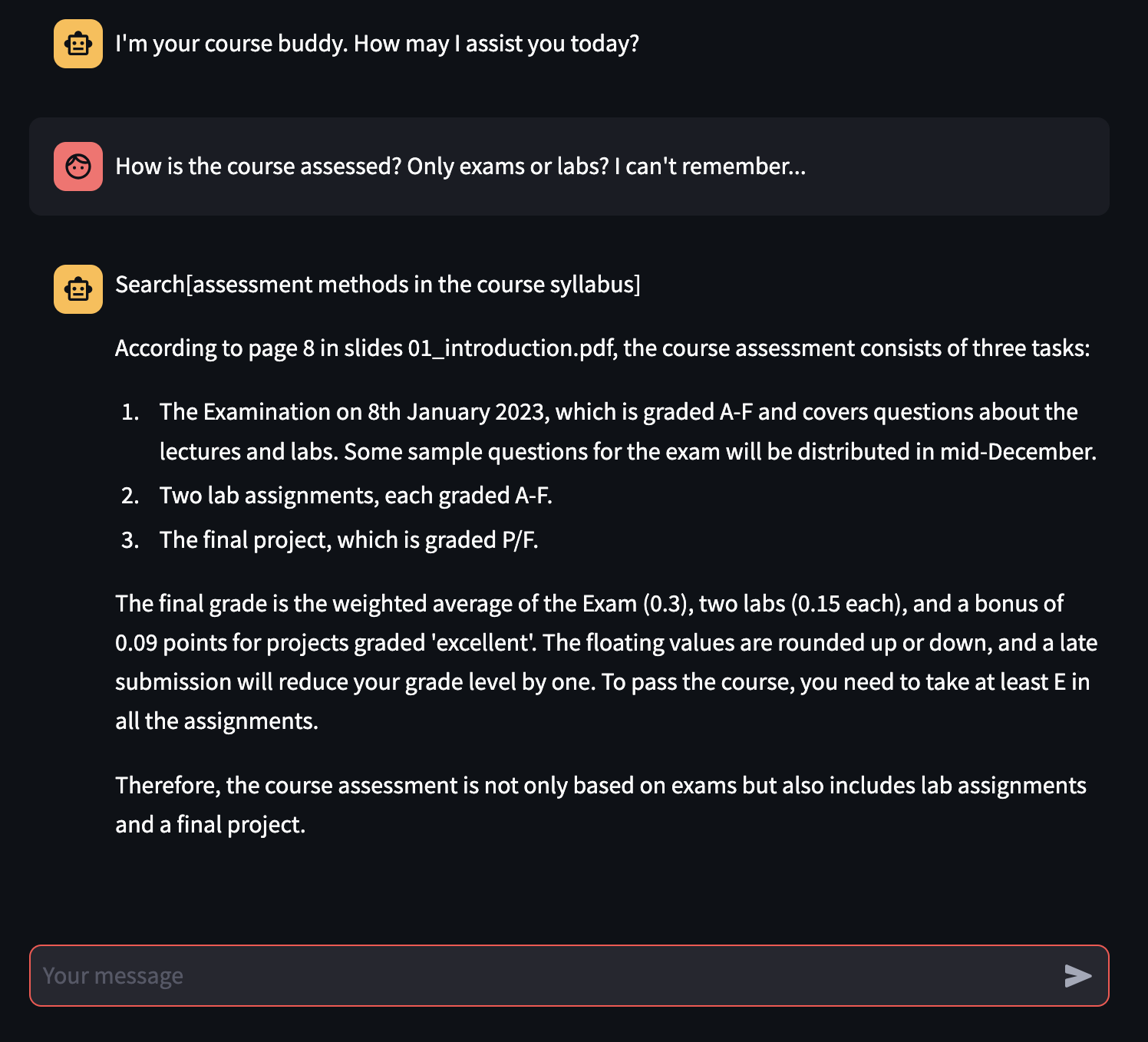
When preparing for university exams, having a partner has been proven to be essential to discover knowledge gaps and clarifying specific doubts on the topic treated during classes. While chatbots based on LLMs such as ChatGPT, Phind and Clod are providing help to students already, they cannot provide a lecture/material-specific help on the students’ university courses. We propose to create a system to fine-tune chatbots on specific material of specific courses. Thanks to this, we will create study buddies for the courses of a typical university student, able to answer doubts, generate questions and more!
It's possible to test the chatbot at this link.
The implicit scope of the project (and of the entire course) is to build a scalable infrastructure that can host our MLops. For this reason, the traditional monolithic ML pipeline is split into three different processes: Feature Pipeline, Training Pipeline, Inference Pipeline.
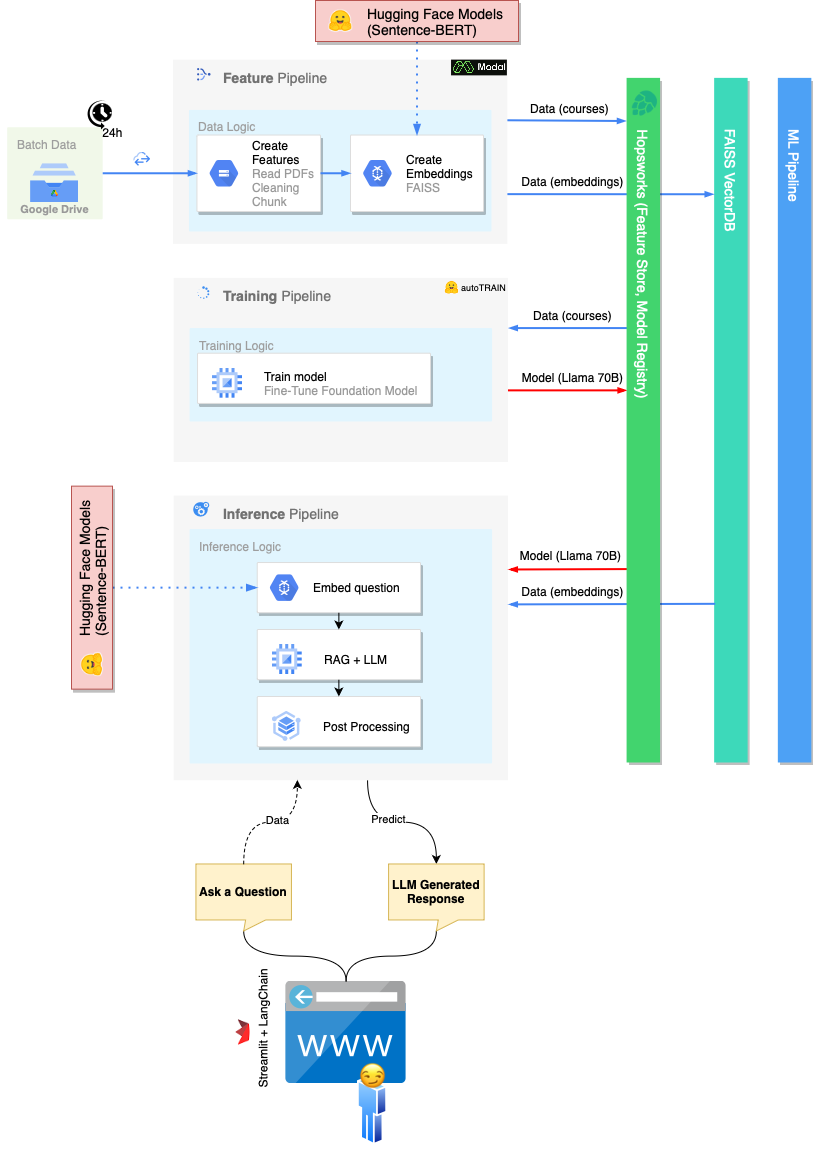
The Feature Pipeline is in charge of:
There are several option to run the Feature Pipeline:
FeaturePipeline/Reading.ipynb notebookFeaturePipeline/FeaturePipeline.py using python3 FeaturePipeline/FeaturePipeline.pyA copy of the latter is slightly modified in the file FeaturePipeline/FeaturePipeline_modal.py to make it runnable on the modal hosting service using modal [run|deploy] FeaturePipeline/FeaturePipeline.py
The Training Pipeline is in charge of:
To execute the Training Pipeline, run the notebook TrainingPipeline/FineTuning.ipynb
The Inference Pipeline is in charge of:
To execute the Inference Pipeline, run streamlit run chatbot_app.py
While experimentally the fine-tuning process is not enough to make the foundational model consistently better than a non-fine-tuned one, the RAG-enabled chatbot is able not only to answer user's questions correctly following the original material, but it is also able to give (mostly) correct references of where the answer is taken from, essential feature for a student studying for an University exam!
Fine tuning doesn't work as well as intended due to the lack of material used and computational resources. As future work, we want to improve the knowledge-extraction process and use more computational power to address the problems shown in the report.