Space Simulation
1.0.0

View Demo · Report Bug · Request Feature
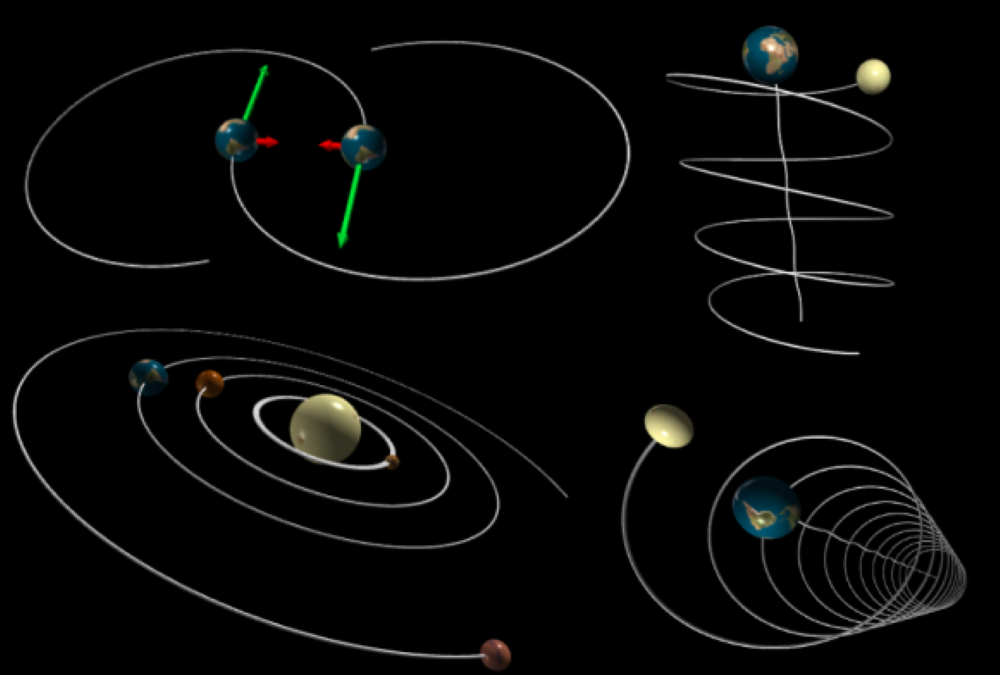
This is a Python program to simulate planets interactions
It means that you can enter the planets masses and initial positions and velocities and our program will show you how would they interact with eachothers in a nice simulation
our program will show you an expected scenario but It may not be 100% accurate.
There are many ready-made demos may impress you !
A few of the things you can do with our app:
Make sure you have installed all of the following prerequisites on your development machine:
pip --version
first open cmd in the place you want to download the project in then write this commands :
Clone the repository to your local machine:
git clone https://github.com/suliman-99/Space-Simulation.git
Navigate to the project directory:
cd Space-Simulation
then to install pipenv module by pip just write this command on your cmd
pip install pipenv
Install the required dependencies using pipenv:
pipenv install
Run the project:
Windows:
python main.py
Linux or Mac:
python3 main.py
The first step is to run the program by following the previous section Installation.
An app will open with tow buttons:
click Create new Simulation to make a new one
or choose Simulation From File button to open a ready-made demo or to open your saved demos or states
then Click Run Simulation to start the simulation
your default browser will open with the simulation page
you can save the current state by clicking on Save State Button and it will be saved in the demos/saved_state.txt file, and you can use it again from there
If you want to try a new demo I am sorry to say that you need to close the program and open it again
Newton's law of universal gravitation
F = (G * m1 * m2) / r^2
G: the gravitational constant
m1, m2: the masses of these two objects
r: the distance between the centers of the masses
F: the gravitational force acting between them
we use this Formula to calculate the force berween each pair of planets
We update the total force for planeets by this method:
 def apply_gravity(planet1: Planet, planet2: Planet) -> None:
     u = planet2.pos - planet1.pos
     grav = g * planet1.mass * planet2.mass / (u.length() ** 2)
     planet1.add_force(u.scale_to(grav))
     planet2.add_force(u.scale_to(-grav))
Newton's Second Law of Motion
F = m * a => a = F / m
m: mass of the object
F : Total Force applied on it
a: the acceleration of it
We Use this Fomula to calculate the acceleration of each planet depending on the total force applied on it
after that we can calculate the new velocity (speed vector) depending on the current velocity and the acceleration
after that we can calculate the new position (x, y, z) depending on the current position and the velocity
then we can re-render the object in the new place
we can do that a lot of time in the same seconde (more that 10 time) and we will have a good visualization
We update the palnet data by this method:
 def update(self, dt: float) -> None:
     self.pos += (self.velocity * dt) + (self.acceleration * ((dt ** 2) / 2))
     self.velocity += self.acceleration * dt
     self.acceleration = self.force / self.mass
Another Topic Collision
Project Name
│   main.py
└───core
│   │   camera.py
│   │   environment.py
│   │   file.py
│   │   physics.py
│   │   planet.py
│   │   vector.py
│
└───gui
    │   screens
    │   app.py
    │   controls.py
assets here are our imagesdemos here are our demos and states are saved as filesresources here some stubid global variablestesting this is our testing folderIf you have suggestions for how Space-Simulation could be improved, or want to report a bug, open an issue! We'd love all and any contributions.
For more, check out the Contributing Guide.
Suliman Awad - [email protected] - Linkedin
Project Link: https://github.com/suliman-99/Space-Simulation
MIT License
Copyright (c) 2023 Suliman Awad
For more, check out the License File.





