fxserver
1.0.0

Setup cloud as a VFX server.
Quick tutorial to setup a Cloud Server for multiple machines access, and VFX Pipeline on Windows, macOS and Linux. This repository is based on Google Drive VFX Server, with loads of improvements.
First, you'll need to mount your Cloud server on your system, using any software you like (rclone, Google Drive File Stream, etc.)
We can then start moving files around. The setup only relies on environment variables:
SERVER_ROOT: The root of the mounted Cloud server. This is the only value that needs to be changed depending on your setupCONFIG_ROOT: The .config folderENVIRONMENT_ROOT: the .config/environment folderPIPELINE_ROOT: the .config/pipeline folderYou can now download the code from this repository and extract its content to your SERVER_ROOT. Using Z:/My Drive as the mounted Cloud server path, it should look like this:
.
└──  Z:/My Drive/
    └──  .config/
        ├──  environment
        └──  pipeline
Which equals to:
.
└──  $SERVER_ROOT/
    └──  $CONFIG_ROOT/
        ├──  $ENVIRONMENT_ROOT
        └──  $PIPELINE_ROOT
You will need to modify SERVER_ROOT in .zshrc (Unix) and/or dcc.bat (Windows) by your mounted Cloud server path:
export SERVER_ROOT="Path/to/drive/linux" (Line 12, 17, 21)setx SERVER_ROOT "Pathtodrivewindows" (Line 9)Once the folder structure is created and the SERVER_ROOT value has been modified, you can now assign the environment variables:
Windows supports shell scripting after some manipulations but it's way easier to "hard" write the environment variables by running dcc.bat.
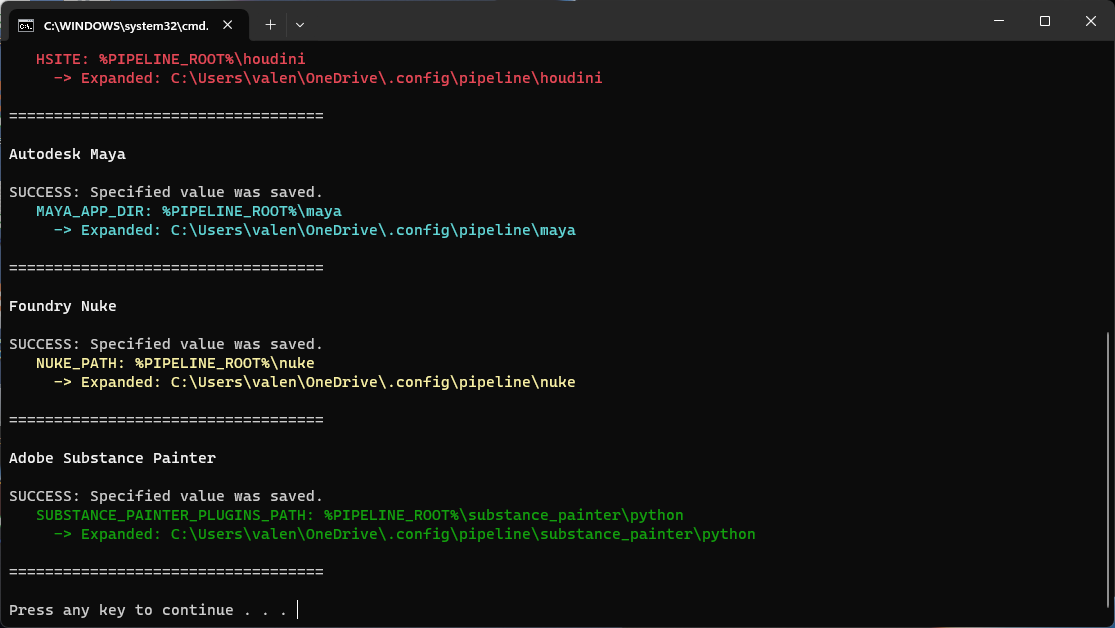
To check that everything is working:
About
Device Specifications and press Advanced System Settings
System Properties dialogue box, hit Environmental Variables
User
SERVER_ROOT has been defined with the right pathmacOS and Linux are both Unix based OS.
The simplest way is to migrate your shell to Zsh using chsh -s $(which zsh) in your terminal.
You can then symlink .zshrc in your $HOME folder.
To check that everything is working, restart your terminal and type echo $SERVER_ROOT: it should output your mounted Cloud server path.
Warning
.zshrc needs to be called exactly that way in $HOME to be picked up by the terminal: remove any alias or symlink added in the name.
Warning
The Make Alias command in macOS Finder won't work properly. You should use this service instead to create proper Symlinks: Symbolic Linker
This setup automatically links the following DCCs, using this folder structure:
.
└──  $SERVER_ROOT/
    └──  .config/
        ├──  environment
        └──  pipeline/
            ├──  houdini               ──> Using $HSITE
            ├──  maya                  ──> Using $MAYA_APP_DIR
            ├──  nuke                  ──> Using $NUKE_PATH
            ├──  other
            └──  substance_painter
                └──  python            ──> Using $SUBSTANCE_PAINTER_PLUGINS_PATH
The DDCs can be launched normally on Windows if the dcc.bat file has been used to define the environment variables.
For macOS and Linux, you should start them from a terminal, in order to inherit the environment variables defined by .zshrc.
You can find an example script for Houdini just here: houdini.sh.
To access it quickly, we also defined an alias for houdini pointing to that script in aliases.sh. It will allow you to simply type this command to launch Houdini.
WIP
Note
See Maya file path variables
.
└──  $SERVER_ROOT/
    └──  .config/
        ├──  environment
        └──  pipeline/
            └──  maya/
                └──  2023/
                    ├──  Maya.env
                    ├──  prefs
                    ├──  presets
└── scriptsWIP
Note
See Substance Painter environment variables
.
└──  $SERVER_ROOT/
    └──  .config/
        ├──  environment
        └──  pipeline/
            └──  substance_painter/
                └──  python/
                    └──  plugin.py
Houdini will automatically scan the folder defined by $HSITE for any folder being named houdini<houdini version>/<recognized folder> such as otls or packages and load the content of those folders at Houdini startup.
Note
See Configuring Houdini
You can find two package file examples:
Both taking advantage of the environment variables posteriorly defined.
.
└──  $SERVER_ROOT/
    └──  .config/
        ├──  environment
        └──  pipeline/
            └──  houdini/
                └──  houdini19.5/
                    ├──  desktop
                    ├──  otls/
                    │   └──  digital_asset.hda
                    └──  packages/
                        └──  package.json
Nuke will scan the content of the folder defined by NUKE_PATH, searching for init.py and menu.py.
Note
See What are the init.py and menu.py files
You can find an init.py file example, showing how to load plugins on Nuke startup.
.
└──  $SERVER_ROOT/
    └──  .config/
        ├──  environment
        └──  pipeline/
            └──  nuke/
                ├──  init.py
└── menu.pyProject Link: Cloud VFX Server





