postgresql exercises
1.0.0

这是关于Alisdair Owen的PostgreSQL练习的所有问题和答案的汇编。请记住,实际解决这些问题将使您不仅要浏览本指南,因此请确保支付后Ql练习的访问。
进行练习非常简单:您要做的就是打开练习,看看问题,然后尝试回答它们!
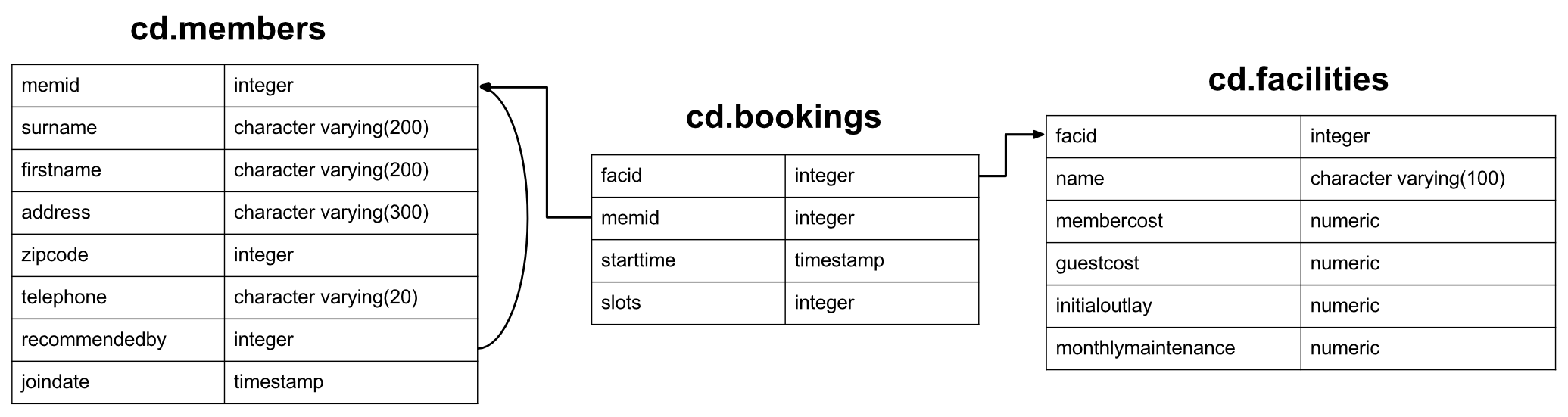
这些练习的数据集用于新创建的乡村俱乐部,其中包括一套成员,网球场等设施以及为这些设施的预订历史。除其他外,俱乐部想了解他们如何使用信息来分析设施的使用/需求。请注意:此数据集纯粹是为了支持有趣的练习阵列,并且数据库模式在几个方面存在缺陷 - 请不要以它为良好设计的示例。我们将从查看会员表开始:
 CREATE TABLE cd .members
(
    memid integer NOT NULL ,
    surname character varying ( 200 ) NOT NULL ,
    firstname character varying ( 200 ) NOT NULL ,
    address character varying ( 300 ) NOT NULL ,
    zipcode integer NOT NULL ,
    telephone character varying ( 20 ) NOT NULL ,
    recommendedby integer ,
    joindate timestamp not null ,
    CONSTRAINT members_pk PRIMARY KEY (memid),
    CONSTRAINT fk_members_recommendedby FOREIGN KEY (recommendedby)
        REFERENCES cd . members (memid) ON DELETE SET NULL
);
每个成员都有一个ID(不能保证是顺序的),基本地址信息,对推荐它们的成员的引用(如果有)以及它们加入时的时间戳。数据集中的地址是完全(不切实际)的。
 CREATE TABLE cd .facilities
(
    facid integer NOT NULL ,
    name character varying ( 100 ) NOT NULL ,
    membercost numeric NOT NULL ,
    guestcost numeric NOT NULL ,
    initialoutlay numeric NOT NULL ,
    monthlymaintenance numeric NOT NULL ,
    CONSTRAINT facilities_pk PRIMARY KEY (facid)
);
设施表列出了乡村俱乐部拥有的所有可预订设施。俱乐部存储ID/名称信息,预订会员和客人的费用,建造设施的初始成本以及估计的每月维护费用。他们希望使用这些信息来跟踪每个设施的财务价值。
 CREATE TABLE cd .bookings
(
    bookid integer NOT NULL ,
    facid integer NOT NULL ,
    memid integer NOT NULL ,
    starttime timestamp NOT NULL ,
    slots integer NOT NULL ,
    CONSTRAINT bookings_pk PRIMARY KEY (bookid),
    CONSTRAINT fk_bookings_facid FOREIGN KEY (facid) REFERENCES cd . facilities (facid),
    CONSTRAINT fk_bookings_memid FOREIGN KEY (memid) REFERENCES cd . members (memid)
);
最后,有一个桌子跟踪设施的预订。这存储了设施ID,进行预订的成员,预订的开始以及预订的半小时“老虎机”。这种特殊的设计将使某些查询更加困难,但应该为您提供一些有趣的挑战 - 并为使用一些现实世界数据库的恐怖做好准备:-)。
好的,那应该是您需要的所有信息。您可以从上面的菜单中选择一个类别的查询,也可以从一开始就开始。
没问题!起床并运行并不难。首先,您需要安装PostgreSQL,您可以从这里获得。启动后,下载SQL。
最后,运行psql -U <username> -f clubdata.sql -d postgres -x -q创建“练习”数据库,Postgres'PGEXERCERS'PGEXERCESS'用户,表格,并加载数据。请注意,请注意,您可能会发现,您可能会在网站上使用perge的范围,因为该端口与网站相差不同,因为该pers可能会在网站上设置:这是一个不同C语言环境)
当您运行查询时,您可能会发现PSQL有点笨拙。如果是这样,我建议尝试使用PGADMIN或Eclipse数据库开发工具。
此类别涉及SQL的基础知识。它涵盖了选择,案例表达式,工会以及其他一些赔率和终点。如果您已经在SQL中受过教育,则可能会发现这些练习相当容易。如果没有,您应该发现它们是开始学习未来更困难的类别的好点!
如果您在这些问题上挣扎,我强烈建议Alan Beaulieu撰写的SQL,作为一本关于该主题的简洁而精心编写的书。如果您对数据库系统的基础知识感兴趣(而不是如何使用它们),则还应通过CJ日期调查数据库系统的简介。
如何从CD.FICICITIONS表中检索所有信息?
预期结果:
| FACID | 姓名 | 成员代表 | 来宾代表 | 初始OUTOUTLAY | 每月保养 |
|---|---|---|---|---|---|
| 0 | 网球场1 | 5 | 25 | 10000 | 200 |
| 1 | 网球场2 | 5 | 25 | 8000 | 200 |
| 2 | 羽毛球法院 | 0 | 15.5 | 4000 | 50 |
| 3 | 乒乓球 | 0 | 5 | 320 | 10 |
| 4 | 按摩室1 | 35 | 80 | 4000 | 3000 |
| 5 | 按摩室2 | 35 | 80 | 4000 | 3000 |
| 6 | 壁球场 | 3.5 | 17.5 | 5000 | 80 |
| 7 | Snooker表 | 0 | 5 | 450 | 15 |
| 8 | 泳池表 | 0 | 5 | 400 | 15 |
回答:
select * from cd . facilities ; SELECT语句是查询的基本起始块,这些查询是从数据库中读取信息的。最小的选择语句通常select [some set of columns] from [some table or group of tables]组成。
在这种情况下,我们希望从设施表中的所有信息。从节很容易 - 我们只需要指定cd.facilities表即可。 “ CD”是表格的架构 - 用于数据库中相关信息的逻辑分组的术语。
接下来,我们需要指定所有列。方便地,有一个“所有列”的速记 - *。我们可以使用它,而不是费力地指定所有列名。
您想打印出所有设施及其成本的清单。您如何检索仅设施名称和成本的列表?
预期结果:
| 姓名 | 成员代表 |
|---|---|
| 网球场1 | 5 |
| 网球场2 | 5 |
| 羽毛球法院 | 0 |
| 乒乓球 | 0 |
| 按摩室1 | 35 |
| 按摩室2 | 35 |
| 壁球场 | 3.5 |
| Snooker表 | 0 |
| 泳池表 | 0 |
回答:
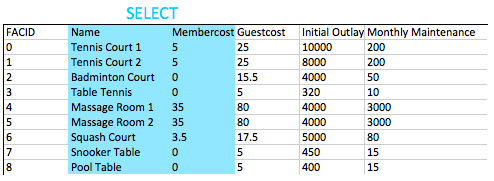
select name, membercost from cd . facilities ; 对于这个问题,我们需要指定所需的列。我们可以使用指定为选择语句的简单逗号列表的简单逗号列表来做到这一点。所有数据库所做的就是查看从子句中可用的列,然后返回我们要求的列,如下所示
一般而言,对于非throwaway查询,可以认为可以在查询中指定所需的列的名称而不是使用 *。这是因为如果将更多列添加到表中,您的应用程序可能无法应对。
您如何制定向会员收取费用的设施清单?
预期结果:
| FACID | 姓名 | 成员代表 | 来宾代表 | 初始OUTOUTLAY | 每月保养 |
|---|---|---|---|---|---|
| 0 | 网球场1 | 5 | 25 | 10000 | 200 |
| 1 | 网球场2 | 5 | 25 | 8000 | 200 |
| 4 | 按摩室1 | 35 | 80 | 4000 | 3000 |
| 5 | 按摩室2 | 35 | 80 | 4000 | 3000 |
| 6 | 壁球场 | 3.5 | 17.5 | 5000 | 80 |
回答:
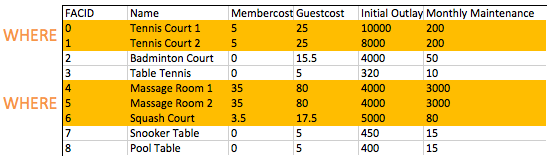
select * from cd . facilities where membercost > 0 ; FROM子句用于建立一组候选行以读取结果。到目前为止,在我们的示例中,这组排只是表的内容。将来我们将探索加入,这使我们能够创建更多有趣的候选人。
一旦我们建立了一组候选行, WHERE子句允许我们过滤我们感兴趣的行 - 在这种情况下,成员代表的成员超过零。正如您将在以后的练习中看到的那样, WHERE条款可以具有多个组件与布尔逻辑相结合 - 例如,可以搜索其成本大于0且小于10的设施。设施上的WHERE子句的过滤操作如下:
您如何制定向会员收取费用的设施清单,而该费用少于每月维护成本的1/50?返回相关设施的FACID,设施名称,会员成本和每月维护。
预期结果:
| FACID | 姓名 | 成员代表 | 每月保养 |
|---|---|---|---|
| 4 | 按摩室1 | 35 | 3000 |
| 5 | 按摩室2 | 35 | 3000 |
回答:
 select facid, name, membercost, monthlymaintenance
	from cd . facilities
	where
		membercost > 0 and
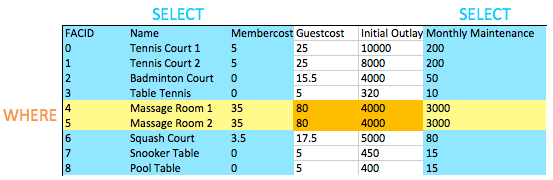
(membercost < monthlymaintenance / 50 . 0 ); WHERE条款允许我们过滤我们感兴趣的行 - 在这种情况下,成员成员的成员超过零,少于每月维护成本的1/50少于1/50。如您所见,由于人员配备成本,按摩室运行非常昂贵!
当我们要测试两个或多个条件时,我们会使用AND结合它们。如您所期望的那样,我们可以使用OR测试一对条件中的任何一个是正确的。
您可能已经注意到,这是我们的第一个查询,将WHERE子句与选择特定的列相结合。您可以在下面的图像中看到以下效果:所选列和所选行的相交为我们提供了返回的数据。现在似乎不太有趣,但是正如我们添加了更复杂的操作,例如加入后来,您会看到这种行为的简单优雅。
您如何以其名称以“网球”一词的形式制作所有设施的列表?
预期结果:
| FACID | 姓名 | 成员代表 | 来宾代表 | 初始OUTOUTLAY | 每月保养 |
|---|---|---|---|---|---|
| 0 | 网球场1 | 5 | 25 | 10000 | 200 |
| 1 | 网球场2 | 5 | 25 | 8000 | 200 |
| 3 | 乒乓球 | 0 | 5 | 320 | 10 |
回答:
 select *
	from cd . facilities
	where
name like ' %Tennis% ' ; SQL的LIKE运营商在字符串上提供了简单的模式匹配。它几乎是普遍实现的,并且既易于使用又易于使用 - 它只需带一个符合任何字符串字符的字符串,_匹配任何单个字符。在这种情况下,我们正在寻找包含“网球”一词的名称,因此在任何一边都贴上一个%的账单。
还有其他方法可以完成此任务:例如,Postgres支持与操作员的正则表达式。使用让您感到舒适的任何东西,但请注意, LIKE操作员在系统之间更便携。
您如何使用ID 1和5检索设施的详细信息?尝试在不使用或操作员的情况下执行此操作。
预期结果:
| FACID | 姓名 | 成员代表 | 来宾代表 | 初始OUTOUTLAY | 每月保养 |
|---|---|---|---|---|---|
| 1 | 网球场2 | 5 | 25 | 8000 | 200 |
| 5 | 按摩室2 | 35 | 80 | 4000 | 3000 |
回答:
 select *
	from cd . facilities
	where
facid in ( 1 , 5 ); 这个问题的明显答案是使用WHERE看起来像where facid = 1 or facid = 5子句。在IN符中,有大量可能的匹配项更容易。在运算IN获取可能的值列表,并将它们与(在这种情况下)facid匹配。如果其中一个值匹配,则该行的where子句为true,然后返回行。
IN符是关系模型优雅的良好早期演示者。它采取的参数不仅是值列表 - 它实际上是一个带有单列的表。由于查询也返回表,因此如果您创建一个返回单列的查询,则可以将这些结果馈送到IN员中。举一个玩具例子:
 select *
	from cd . facilities
	where
		facid in (
			select facid from cd . facilities
);该示例在功能上等同于仅选择所有设施,但向您展示了如何将一个查询的结果馈送到另一个查询的结果。内部查询称为子查询。
您如何制作设施列表,每个设施都标记为“便宜”或“昂贵”,具体取决于其每月维护成本是否超过100美元?返回有关设施的名称和每月维护。
预期结果:
| 姓名 | 成本 |
|---|---|
| 网球场1 | 昂贵的 |
| 网球场2 | 昂贵的 |
| 羽毛球法院 | 便宜的 |
| 乒乓球 | 便宜的 |
| 按摩室1 | 昂贵的 |
| 按摩室2 | 昂贵的 |
| 壁球场 | 便宜的 |
| Snooker表 | 便宜的 |
| 泳池表 | 便宜的 |
回答:
 select name,
	case when (monthlymaintenance > 100 ) then
		' expensive '
	else
		' cheap '
	end as cost
from cd . facilities ; 本练习包含一些新概念。首先是我们在SELECT和FROM的查询区域进行计算。以前,我们仅将其用于选择要返回的列,但是您可以将任何内容都放在每个返回行(包括子查询)中会产生单个结果。
第二个新概念是CASE陈述本身。 CASE实际上就像其他语言中的/开关语句一样,其形式如查询所示。要添加“中间”选项,我们只需when...then插入另一个选项。
最后,有AS操作员。这仅用于标记列或表达式,以使其显示更精美,或者在用作子查询的一部分时使其更易于参考。
您如何制定2012年9月开始后加入的成员名单?返回有关成员的MEMID,姓氏,名称和加入。
预期结果:
| 梅德 | 姓 | 名 | 加入 |
|---|---|---|---|
| 24 | 萨尔文 | 拉姆纳雷什 | 2012-09-01 08:44:42 |
| 26 | 琼斯 | 道格拉斯 | 2012-09-02 18:43:05 |
| 27 | 拉姆尼 | 亨利埃塔 | 2012-09-05 08:42:35 |
| 28 | 法雷尔 | 大卫 | 2012-09-15 08:22:05 |
| 29 | Worthington-Smyth | 亨利 | 2012-09-17 12:27:15 |
| 30 | 范围 | 米里森 | 2012-09-18 19:04:01 |
| 33 | 特百惠 | 风信子 | 2012-09-18 19:32:05 |
| 35 | 打猎 | 约翰 | 2012-09-19 11:32:45 |
| 36 | 碎屑 | 埃里卡 | 2012-09-22 08:36:38 |
| 37 | 史密斯 | 达伦 | 2012-09-26 18:08:45 |
回答:
 select memid, surname, firstname, joindate
	from cd . members
	where joindate >= ' 2012-09-01 ' ;
这是我们对SQL时间戳的首次浏览。它们以降序的数量级格式: YYYY-MM-DD HH:MM:SS.nnnnnn 。我们可以像Unix Timestamp一样比较它们,尽管在日期之间获得差异的参与度更高(而且强大!)。在这种情况下,我们刚刚指定了时间戳的日期部分。这将被Postgres自动投入到整个时间戳2012-09-01 00:00:00 。
如何在成员表中产生前10个姓氏的有序列表?该列表不得包含重复项。
预期结果:
| 姓 |
|---|
| 坏人 |
| 贝克 |
| 展位 |
| 黄油 |
| 科普林 |
| 碎屑 |
| 敢 |
| 法雷尔 |
| 客人 |
| 云顶 |
回答:
 select distinct surname
	from cd . members
order by surname
limit 10 ;
这里有三个新概念,但是它们都很简单。
SELECT后指定DISTINCT之后的不同之后,将从结果集中删除重复行。请注意,这适用于行:如果行A具有多个列,则仅在所有列中的值相同时,行B仅等于它。一般而言,不要以威利·尼利(Willy-nilly)的方式使用DISTINCT方式 - 从大查询结果集中删除重复项并不是免费的,因此请尽一切努力。ORDER BY (在查询末尾的从FROM和WHERE之后)指定顺序,允许通过列或一组列(逗号分隔)订购结果。LIMIT关键字允许您限制检索到的结果数。这对于一次获得结果很有用,并且可以与OFFSET关键字结合使用以获取以下页面。这与MySQL使用的方法相同,并且非常方便 - 不幸的是,您可能会发现此过程在其他DB中更为复杂。由于某种原因,您想要所有姓氏和所有设施名称的列表。是的,这是一个人为的例子:-)。生产该清单!
预期结果:
| 姓 |
|---|
| 网球场2 |
| Worthington-Smyth |
| 羽毛球法院 |
| 平克 |
| 敢 |
| 坏人 |
| 麦肯齐 |
| 碎屑 |
| 按摩室1 |
| 壁球场 |
回答:
 select surname
	from cd . members
union
select name
from cd . facilities ; UNION操作员会做您可能期望的事情:将两个SQL查询的结果结合到一个表中。需要注意的是,这两个查询的两个结果都必须具有相同数量的列和兼容数据类型。
UNION删除了重复的行,而UNION ALL没有。默认情况下,请使用UNION ALL使用,除非您关心重复的结果。
您想获得最后会员的注册日期。您如何检索此信息?
预期结果:
| 最新的 |
|---|
| 2012-09-26 18:08:45 |
回答:
 select max (joindate) as latest
	from cd . members ;
这是我们第一次涉足SQL的汇总功能。它们用于提取有关整个行的信息,并让我们轻松提出类似的问题:
这里的最大聚合函数非常简单:它接收加入的所有可能值,并输出最大的值。汇总功能还有更多的功能,您将在以后的练习中遇到。
您想获得注册的最后一个成员的名字和姓氏,而不仅仅是日期。你怎么做?
预期结果:
| 名 | 姓 | 加入 |
|---|---|---|
| 达伦 | 史密斯 | 2012-09-26 18:08:45 |
回答:
 select firstname, surname, joindate
	from cd . members
	where joindate =
		( select max (joindate)
from cd . members ); 在上面建议的方法中,您使用子查询来找出最近的结合。此子查询返回标量表 - 即,一个带有单列和一行的表。由于我们只有一个值,因此我们可以在可能放置一个恒定值的任何地方替换子查询。在这种情况下,我们使用它来完成查询的WHERE子句以找到给定的成员。
您可能希望您能够做以下类似的事情:
 select firstname, surname, max (joindate)
        from cd . members
不幸的是,这无效。 MAX函数不会像WHERE所做的那样限制行 - 它只是占用一大堆值并返回最大的值。然后留下数据库,想知道如何将一长串名称列表与最大功能出现的单个加入日期配对,并且失败。取而代之的是,您不得不说“找到我的行,该行的加入日期与最大联盟日期相同”。
如提示所述,还有其他方法可以完成这项工作 - 下面是一个示例。在这种方法中,我们只需明确地找出最后一个加入日期是什么,而是只需以降序的加入日期订购我们的会员表,然后挑选第一个。请注意,这种方法并不能涵盖两个人同时加入的极端情况:-)。
 select firstname, surname, joindate
	from cd . members
order by joindate desc
limit 1 ;此类别主要涉及关系数据库系统中的基础概念:加入。加入使您可以组合来自多个表的相关信息来回答问题。这不仅有利于查询:缺乏联接功能会鼓励数据划定数据,这增加了保持数据内部一致的复杂性。
该主题涵盖了内部,外部和自我连接,并花了一点时间在子查询上(查询中的查询)。如果您在这些问题上挣扎,我强烈建议Alan Beaulieu撰写的SQL,作为一本关于该主题的简洁而精心编写的书。
您如何制定名为“ David Farrell”的成员预订的开始列表?
预期结果:
| 开始时间 |
|---|
| 2012-09-18 09:00:00 |
| 2012-09-18 17:30:00 |
| 2012-09-18 13:30:00 |
| 2012-09-18 20:00:00 |
| 2012-09-19 09:30:00 |
| 2012-09-19 15:00:00 |
| 2012-09-19 12:00:00 |
| 2012-09-20 15:30:00 |
| 2012-09-20 11:30:00 |
| 2012-09-20 14:00:00 |
回答:
 select bks . starttime
	from
		cd . bookings bks
		inner join cd . members mems
			on mems . memid = bks . memid
	where
		mems . firstname = ' David '
and mems . surname = ' Farrell ' ; 最常用的类型的联接是INNER JOIN 。这样做的方法是根据联接表达式组合两个表 - 在这种情况下,对于成员表中的每个成员ID,我们正在寻找预订表中的匹配值。在我们找到匹配的地方,返回了一个组合每个表的值的行。请注意,我们为每个表提供了一个别名(BKS和MEMS)。这是有两个原因的:首先,它很方便,其次,我们可能会多次加入同一表,要求我们将列与每个不同时间连接的不同时间区分。
让我们忽略我们的选择和现在的条款,而要关注FROM语句的产生的内容。在我们以前的所有示例中, FROM只是一个简单的表。现在是什么?另一个桌子!这次,它是作为预订和成员组成的。您可以看到下面的加入的输出的子集:

对于成员表中的每个成员,JOIN在预订表中找到了所有匹配的成员ID。对于每场比赛,然后制作了一排从成员表组合行,以及预订表中的行。
显然,这本身就是太多的信息,任何有用的问题都希望将其过滤。在我们的查询中,我们使用SELECT子句的开始来选择列,以及选择行的WHERE子句,如下所示:

这就是我们需要找到大卫预订的全部!通常,我鼓励您记住,从FROM的输出本质上是一张大表格,然后您将信息过滤掉。这听起来可能效率低下 - 但不用担心,在封面下,数据库的行为会更加聪明:-)。
最后一个注意:内在连接有两个不同的语法。我向您展示了我喜欢的那个,发现与其他联接类型更一致。您通常会看到不同的语法,如下所示:
 select bks . starttime
        from
                cd . bookings bks,
                cd . members mems
        where
                mems . firstname = ' David '
                and mems . surname = ' Farrell '
                and mems . memid = bks . memid ;
这在功能上与批准的答案完全相同。如果您对此语法更舒适,请随时使用它!
您如何在“ 2012-09-21”日期为网球场预订的开始时间列表?返回按时间订购的开始时间和设施配对的列表。
预期结果:
| 开始 | 姓名 |
|---|---|
| 2012-09-21 08:00:00 | 网球场1 |
| 2012-09-21 08:00:00 | 网球场2 |
| 2012-09-21 09:30:00 | 网球场1 |
| 2012-09-21 10:00:00 | 网球场2 |
| 2012-09-21 11:30:00 | 网球场2 |
| 2012-09-21 12:00:00 | 网球场1 |
| 2012-09-21 13:30:00 | 网球场1 |
| 2012-09-21 14:00:00 | 网球场2 |
| 2012-09-21 15:30:00 | 网球场1 |
| 2012-09-21 16:00:00 | 网球场2 |
| 2012-09-21 17:00:00 | 网球场1 |
| 2012-09-21 18:00:00 | 网球场2 |
回答:
 select bks . starttime as start, facs . name as name
	from
		cd . facilities facs
		inner join cd . bookings bks
			on facs . facid = bks . facid
	where
		facs . facid in ( 0 , 1 ) and
		bks . starttime >= ' 2012-09-21 ' and
		bks . starttime < ' 2012-09-22 '
order by bks . starttime ; 这是另一个INNER JOIN查询,尽管它的复杂性更加复杂!查询的FROM很容易 - 我们只是将设施和预订表加在一起。这会产生一张表格,对于预订中的每一行,我们都附加了有关预订设施的详细信息。
到查询的WHERE组件。对开始时间的检查是相当自我解释的 - 我们确保所有预订都在指定的日期之间开始。由于我们只对网球场感兴趣,因此我们还使用IN运营商告诉数据库系统,仅向我们提供回式设施IDS 0或1-法院的IDS。还有其他方法可以表达出来:我们可以where facs.facid = 0 or facs.facid = 1使用,甚至where facs.name like 'Tennis%' 。
其余的非常简单:我们SELECT我们感兴趣的列,然后在开始时间ORDER BY 。
您如何输出所有推荐其他成员的成员的列表?确保列表中没有重复项,并且结果由(姓氏,firstName)订购。
预期结果:
| 名 | 姓 |
|---|---|
| 佛罗伦萨 | 坏人 |
| 蒂莫西 | 贝克 |
| 杰拉尔德 | 黄油 |
| 杰米玛 | 法雷尔 |
| 马修 | 云顶 |
| 大卫 | 琼斯 |
| 珍妮丝 | 乔普特 |
| 米里森 | 范围 |
| 蒂姆 | 罗恩南 |
| 达伦 | 史密斯 |
| 特雷西 | 史密斯 |
| 思考 | Stibbons |
| 伯顿 | 特雷西 |
回答:
 select distinct recs . firstname as firstname, recs . surname as surname
	from
		cd . members mems
		inner join cd . members recs
			on recs . memid = mems . recommendedby
order by surname, firstname;
这是一些人感到困惑的概念:您可以加入桌子!如果您在同一表中具有参考数据的列,就像我们在cd.members中使用的推荐一样,这真的很有用。
如果您难以实现此目标,请记住,这与任何其他内部联接一样。我们的加入将每行都带入具有推荐值的成员中,并再次查找具有匹配成员ID的行。然后,它生成一个组合两个成员条目的输出行。这看起来像以下图:

请注意,尽管我们可能在输出集中有两个“姓氏”列,但它们可以通过其表格别名区分。一旦选择了所需的列,我们就简单地使用DISTINCT来确保没有重复。
您如何输出所有成员的列表,包括推荐他们的个人(如果有)?确保结果由(姓氏,名称)订购。
预期结果:
| memfname | memsname | recFname | recsname |
|---|---|---|---|
| 佛罗伦萨 | 坏人 | 思考 | Stibbons |
| 安妮 | 贝克 | 思考 | Stibbons |
| 蒂莫西 | 贝克 | 杰米玛 | 法雷尔 |
| 蒂姆 | 展位 | 蒂姆 | 罗恩南 |
| 杰拉尔德 | 黄油 | 达伦 | 史密斯 |
| 琼 | 科普林 | 蒂莫西 | 贝克 |
| 埃里卡 | 碎屑 | 特雷西 | 史密斯 |
| 南希 | 敢 | 珍妮丝 | 乔普特 |
| 大卫 | 法雷尔 | ||
| 杰米玛 | 法雷尔 | ||
| 客人 | 客人 | ||
| 马修 | 云顶 | 杰拉尔德 | 黄油 |
| 约翰 | 打猎 | 米里森 | 范围 |
| 大卫 | 琼斯 | 珍妮丝 | 乔普特 |
| 道格拉斯 | 琼斯 | 大卫 | 琼斯 |
| 珍妮丝 | 乔普特 | 达伦 | 史密斯 |
| 安娜 | 麦肯齐 | 达伦 | 史密斯 |
| 查尔斯 | 欧文 | 达伦 | 史密斯 |
| 大卫 | 平克 | 杰米玛 | 法雷尔 |
| 米里森 | 范围 | 特雷西 | 史密斯 |
| 蒂姆 | 罗恩南 | ||
| 亨利埃塔 | 拉姆尼 | 马修 | 云顶 |
| 拉姆纳雷什 | 萨尔文 | 佛罗伦萨 | 坏人 |
| 达伦 | 史密斯 | ||
| 达伦 | 史密斯 | ||
| 杰克 | 史密斯 | 达伦 | 史密斯 |
| 特雷西 | 史密斯 | ||
| 思考 | Stibbons | 伯顿 | 特雷西 |
| 伯顿 | 特雷西 | ||
| 风信子 | 特百惠 | ||
| 亨利 | Worthington-Smyth | 特雷西 | 史密斯 |
回答:
 select mems . firstname as memfname, mems . surname as memsname, recs . firstname as recfname, recs . surname as recsname
	from
		cd . members mems
		left outer join cd . members recs
			on recs . memid = mems . recommendedby
order by memsname, memfname;
让我们介绍另一个新概念: LEFT OUTER JOIN 。最好通过它们与内在的连接不同的方式来解释这些。内部连接左右桌子,并根据联接条件( ON )寻找匹配行。满足条件后,会产生一个连接的行。 LEFT OUTER JOIN运行方式类似,只是,如果左侧表上的一个给定行与任何内容都不匹配,则仍然会产生输出行。该输出行由左手表行组成,并代替右手表行的一堆NULLS 。
在这样的情况下,这很有用,我们想在其中产生带有可选数据的输出。我们想要所有成员的名字,以及如果该人的存在的名称。您无法通过内在联接正确表达这一点。
您可能已经猜到了,还有其他外部连接。 RIGHT OUTER JOIN非常类似于LEFT OUTER JOIN ,只是表达式的左侧是包含可选数据的表达式。很少使用的FULL OUTER JOIN将表达式的两侧视为可选的。
您如何找到使用网球场的所有成员的清单?在您的输出中包括法院的名称,以及以单列格式的成员名称。确保没有重复的数据,并按成员名称订购。
预期结果:
| 成员 | 设施 |
|---|---|
| 安妮·贝克 | 网球场2 |
| 安妮·贝克 | 网球场1 |
| 伯顿·特雷西 | 网球场2 |
| 伯顿·特雷西 | 网球场1 |
| 查尔斯·欧文 | 网球场2 |
| 查尔斯·欧文 | 网球场1 |
| 达伦·史密斯(Darren Smith) | 网球场2 |
| 大卫·法雷尔(David Farrell) | 网球场2 |
| 大卫·法雷尔(David Farrell) | 网球场1 |
| 大卫·琼斯 | 网球场1 |
| 大卫·琼斯 | 网球场2 |
| 大卫·平克(David Pinker) | 网球场1 |
| 道格拉斯·琼斯(Douglas Jones) | 网球场1 |
| Erica Crumpet | 网球场1 |
| 佛罗伦萨·巴德 | 网球场1 |
| 佛罗伦萨·巴德 | 网球场2 |
| 来宾 | 网球场2 |
| 来宾 | 网球场1 |
| 杰拉尔德·巴特斯(Gerald Butters) | 网球场1 |
| 杰拉尔德·巴特斯(Gerald Butters) | 网球场2 |
| Henrietta Rumney | 网球场2 |
| 杰克·史密斯 | 网球场1 |
| 杰克·史密斯 | 网球场2 |
| 珍妮丝·乔普莱特(Janice Joplette) | 网球场1 |
| 珍妮丝·乔普莱特(Janice Joplette) | 网球场2 |
| 杰米玛·法雷尔(Jemima Farrell) | 网球场2 |
| 杰米玛·法雷尔(Jemima Farrell) | 网球场1 |
| 琼·科普林 | 网球场1 |
| 约翰·亨特 | 网球场1 |
| 约翰·亨特 | 网球场2 |
| 马修·云顶 | 网球场1 |
| Millicent Purview | 网球场2 |
| 南希·敢 | 网球场2 |
| 南希·敢 | 网球场1 |
| 思考史蒂布斯 | 网球场2 |
| 思考史蒂布斯 | 网球场1 |
| Ramnaresh Sarwin | 网球场2 |
| Ramnaresh Sarwin | 网球场1 |
| 蒂姆·布特 | 网球场1 |
| 蒂姆·布特 | 网球场2 |
| 蒂姆·罗恩纳姆(Tim Rownam) | 网球场1 |
| 蒂姆·罗恩纳姆(Tim Rownam) | 网球场2 |
| 蒂莫西·贝克(Timothy Baker) | 网球场2 |
| 蒂莫西·贝克(Timothy Baker) | 网球场1 |
| 特雷西·史密斯 | 网球场2 |
| 特雷西·史密斯 | 网球场1 |
回答:
 select distinct mems . firstname || ' ' || mems . surname as member, facs . name as facility
	from
		cd . members mems
		inner join cd . bookings bks
			on mems . memid = bks . memid
		inner join cd . facilities facs
			on bks . facid = facs . facid
	where
		bks . facid in ( 0 , 1 )
order by member
这项练习在很大程度上是您在先前问题中学到的知识的更为复杂的应用。这也是我们第一次使用多个加入,这可能有些混乱。在阅读加入表达式时,请记住,一个连接是一个有效的函数,该函数占两个表,一个标记为左表,另一个标记为右表。只需在查询中加入一个即可可视化这很容易可视化,但与两个相关。
我们在此查询中的第二个INNER JOIN具有CD.FICISITIONS的右侧。这很容易掌握。但是,左侧是通过将CD.会员加入CD.Bookings返回的桌子。强调这一点很重要:关系模型与表有关。任何加入的输出是另一个表。查询的输出是一个表。单列列表是表。一旦掌握了这一点,就可以掌握模型的基本美。
最后,我们确实在这里介绍了一件新事物: ||操作员用于连接字符串。
您如何在2012-09-14当天制定预订列表,这将使会员(或来宾)损失超过30美元?请记住,客人对成员的费用不同(列出的成本为每半小时的“插槽”),并且来宾用户始终是ID 0。在您的输出中包括设施的名称,成员名称为单一列,以及成本。通过下降成本订购,不要使用任何子征服。
预期结果:
| 成员 | 设施 | 成本 |
|---|---|---|
| 来宾 | 按摩室2 | 320 |
| 来宾 | 按摩室1 | 160 |
| 来宾 | 按摩室1 | 160 |
| 来宾 | 按摩室1 | 160 |
| 来宾 | 网球场2 | 150 |
| 杰米玛·法雷尔(Jemima Farrell) | 按摩室1 | 140 |
| 来宾 | 网球场1 | 75 |
| 来宾 | 网球场2 | 75 |
| 来宾 | 网球场1 | 75 |
| 马修·云顶 | 按摩室1 | 70 |
| 佛罗伦萨·巴德 | 按摩室2 | 70 |
| 来宾 | 壁球场 | 70.0 |
| 杰米玛·法雷尔(Jemima Farrell) | 按摩室1 | 70 |
| 思考史蒂布斯 | 按摩室1 | 70 |
| 伯顿·特雷西 | 按摩室1 | 70 |
| 杰克·史密斯 | 按摩室1 | 70 |
| 来宾 | 壁球场 | 35.0 |
| 来宾 | 壁球场 | 35.0 |
回答:
 select mems . firstname || ' ' || mems . surname as member,
	facs . name as facility,
	case
		when mems . memid = 0 then
			bks . slots * facs . guestcost
		else
			bks . slots * facs . membercost
	end as cost
        from
                cd . members mems
                inner join cd . bookings bks
                        on mems . memid = bks . memid
                inner join cd . facilities facs
                        on bks . facid = facs . facid
        where
		bks . starttime >= ' 2012-09-14 ' and
		bks . starttime < ' 2012-09-15 ' and (
			( mems . memid = 0 and bks . slots * facs . guestcost > 30 ) or
			( mems . memid != 0 and bks . slots * facs . membercost > 30 )
		)
order by cost desc ;
这有点复杂!虽然它比我们以前使用的要复杂的逻辑还要复杂,但并没有很多值得注意的话题。 WHERE子句将我们的产出限制为在2012 - 09-14的足够昂贵的行,记得区分客人和其他人。然后,我们在“选择”列中使用CASE语句为会员或来宾输出正确的成本。
您如何在不使用任何加入的情况下输出所有成员的列表,包括推荐他们的个人(如果有的话)?确保列表中没有重复项,并且每个firstName +姓氏配对都格式化为列并订购。
预期结果:
| 成员 | 推荐人 |
|---|---|
| 安娜·麦肯齐(Anna Mackenzie) | 达伦·史密斯(Darren Smith) |
| 安妮·贝克 | 思考史蒂布斯 |
| 伯顿·特雷西 | |
| 查尔斯·欧文 | 达伦·史密斯(Darren Smith) |
| 达伦·史密斯(Darren Smith) | |
| 大卫·法雷尔(David Farrell) | |
| 大卫·琼斯 | 珍妮丝·乔普莱特(Janice Joplette) |
| 大卫·平克(David Pinker) | 杰米玛·法雷尔(Jemima Farrell) |
| 道格拉斯·琼斯(Douglas Jones) | 大卫·琼斯 |
| Erica Crumpet | 特雷西·史密斯 |
| 佛罗伦萨·巴德 | 思考史蒂布斯 |
| 来宾 | |
| 杰拉尔德·巴特斯(Gerald Butters) | 达伦·史密斯(Darren Smith) |
| Henrietta Rumney | 马修·云顶 |
| 亨利·沃辛顿 - 史密斯 | 特雷西·史密斯 |
| 风信子特百惠 | |
| 杰克·史密斯 | 达伦·史密斯(Darren Smith) |
| 珍妮丝·乔普莱特(Janice Joplette) | 达伦·史密斯(Darren Smith) |
| 杰米玛·法雷尔(Jemima Farrell) | |
| 琼·科普林 | 蒂莫西·贝克(Timothy Baker) |
| 约翰·亨特 | Millicent Purview |
| 马修·云顶 | 杰拉尔德·巴特斯(Gerald Butters) |
| Millicent Purview | 特雷西·史密斯 |
| 南希·敢 | 珍妮丝·乔普莱特(Janice Joplette) |
| 思考史蒂布斯 | 伯顿·特雷西 |
| Ramnaresh Sarwin | 佛罗伦萨·巴德 |
| 蒂姆·布特 | 蒂姆·罗恩纳姆(Tim Rownam) |
| 蒂姆·罗恩纳姆(Tim Rownam) | |
| 蒂莫西·贝克(Timothy Baker) | 杰米玛·法雷尔(Jemima Farrell) |
| 特雷西·史密斯 |
回答:
 select distinct mems . firstname || ' ' ||  mems . surname as member,
	( select recs . firstname || ' ' || recs . surname as recommender
		from cd . members recs
		where recs . memid = mems . recommendedby
	)
	from
		cd . members mems
order by member;
此练习标志着次级的引入。顾名思义,在查询中查询。它们通常与聚集体一起使用,以回答诸如“让我在网球场1中度过最多时间的成员的所有细节”之类的问题。
在这种情况下,我们只是使用子查询模仿外部连接。对于成员的每个值,都会运行一次子查询以找到推荐它们的个人名称(如果有)。 A subquery that uses information from the outer query in this way (and thus has to be run for each row in the result set) is known as a correlated subquery .
The Produce a list of costly bookings exercise contained some messy logic: we had to calculate the booking cost in both the WHERE clause and the CASE statement. Try to simplify this calculation using subqueries. For reference, the question was:
How can you produce a list of bookings on the day of 2012-09-14 which will cost the member (or guest) more than $30? Remember that guests have different costs to members (the listed costs are per half-hour 'slot'), and the guest user is always ID 0. Include in your output the name of the facility, the name of the member formatted as a single column, and the cost. Order by descending cost.
预期结果:
| 成员 | 设施 | 成本 |
|---|---|---|
| GUEST GUEST | Massage Room 2 | 320 |
| GUEST GUEST | Massage Room 1 | 160 |
| GUEST GUEST | Massage Room 1 | 160 |
| GUEST GUEST | Massage Room 1 | 160 |
| GUEST GUEST | Tennis Court 2 | 150 |
| Jemima Farrell | Massage Room 1 | 140 |
| GUEST GUEST | Tennis Court 1 | 75 |
| GUEST GUEST | Tennis Court 2 | 75 |
| GUEST GUEST | Tennis Court 1 | 75 |
| Matthew Genting | Massage Room 1 | 70 |
| Florence Bader | Massage Room 2 | 70 |
| GUEST GUEST | Squash Court | 70.0 |
| Jemima Farrell | Massage Room 1 | 70 |
| Ponder Stibbons | Massage Room 1 | 70 |
| Burton Tracy | Massage Room 1 | 70 |
| 杰克·史密斯 | Massage Room 1 | 70 |
| GUEST GUEST | Squash Court | 35.0 |
| GUEST GUEST | Squash Court | 35.0 |
回答:
 select member, facility, cost from (
	select
		mems . firstname || ' ' || mems . surname as member,
		facs . name as facility,
		case
			when mems . memid = 0 then
				bks . slots * facs . guestcost
			else
				bks . slots * facs . membercost
		end as cost
		from
			cd . members mems
			inner join cd . bookings bks
				on mems . memid = bks . memid
			inner join cd . facilities facs
				on bks . facid = facs . facid
		where
			bks . starttime >= ' 2012-09-14 ' and
			bks . starttime < ' 2012-09-15 '
	) as bookings
	where cost > 30
order by cost desc ;
This answer provides a mild simplification to the previous iteration: in the no-subquery version, we had to calculate the member or guest's cost in both the WHERE clause and the CASE statement. In our new version, we produce an inline query that calculates the total booking cost for us, allowing the outer query to simply select the bookings it's looking for. For reference, you may also see subqueries in the FROM clause referred to as inline views .
Querying data is all well and good, but at some point you're probably going to want to put data into your database! This section deals with inserting, updating, and deleting information. Operations that alter your data like this are collectively known as Data Manipulation Language, or DML.
In previous sections, we returned to you the results of the query you've performed. Since modifications like the ones we're making in this section don't return any query results, we instead show you the updated content of the table you're supposed to be working on. You can compare this with the table shown in 'Expected Results' to see how you've done.
If you struggle with these questions, I strongly recommend Learning SQL, by Alan Beaulieu.
The club is adding a new facility - a spa. We need to add it into the facilities table. Use the following values:
预期结果:
| facid | 姓名 | membercost | guestcost | initialoutlay | monthlymaintenance |
|---|---|---|---|---|---|
| 0 | Tennis Court 1 | 5 | 25 | 10000 | 200 |
| 1 | Tennis Court 2 | 5 | 25 | 8000 | 200 |
| 2 | Badminton Court | 0 | 15.5 | 4000 | 50 |
| 3 | 乒乓球 | 0 | 5 | 320 | 10 |
| 4 | Massage Room 1 | 35 | 80 | 4000 | 3000 |
| 5 | Massage Room 2 | 35 | 80 | 4000 | 3000 |
| 6 | Squash Court | 3.5 | 17.5 | 5000 | 80 |
| 7 | Snooker Table | 0 | 5 | 450 | 15 |
| 8 | Pool Table | 0 | 5 | 400 | 15 |
| 9 | 温泉 | 20 | 30 | 100000 | 800 |
回答:
 insert into cd . facilities
    (facid, name, membercost, guestcost, initialoutlay, monthlymaintenance)
    values ( 9 , ' Spa ' , 20 , 30 , 100000 , 800 );
INSERT INTO ... VALUES is the simplest way to insert data into a table. There's not a whole lot to discuss here: VALUES is used to construct a row of data, which the INSERT statement inserts into the table. It's a simple as that.
You can see that there's two sections in parentheses. The first is part of the INSERT statement, and specifies the columns that we're providing data for. The second is part of VALUES , and specifies the actual data we want to insert into each column.
If we're inserting data into every column of the table, as in this example, explicitly specifying the column names is optional. As long as you fill in data for all columns of the table, in the order they were defined when you created the table, you can do something like the following:
insert into cd . facilities values ( 9 , ' Spa ' , 20 , 30 , 100000 , 800 );Generally speaking, for SQL that's going to be reused I tend to prefer being explicit and specifying the column names.
In the previous exercise, you learned how to add a facility. Now you're going to add multiple facilities in one command. Use the following values:
预期结果:
| facid | 姓名 | membercost | guestcost | initialoutlay | monthlymaintenance |
|---|---|---|---|---|---|
| 0 | Tennis Court 1 | 5 | 25 | 10000 | 200 |
| 1 | Tennis Court 2 | 5 | 25 | 8000 | 200 |
| 2 | Badminton Court | 0 | 15.5 | 4000 | 50 |
| 3 | 乒乓球 | 0 | 5 | 320 | 10 |
| 4 | Massage Room 1 | 35 | 80 | 4000 | 3000 |
| 5 | Massage Room 2 | 35 | 80 | 4000 | 3000 |
| 6 | Squash Court | 3.5 | 17.5 | 5000 | 80 |
| 7 | Snooker Table | 0 | 5 | 450 | 15 |
| 8 | Pool Table | 0 | 5 | 400 | 15 |
| 9 | 温泉 | 20 | 30 | 100000 | 800 |
| 10 | Squash Court 2 | 3.5 | 17.5 | 5000 | 80 |
回答:
 insert into cd . facilities
    (facid, name, membercost, guestcost, initialoutlay, monthlymaintenance)
    values
        ( 9 , ' Spa ' , 20 , 30 , 100000 , 800 ),
        ( 10 , ' Squash Court 2 ' , 3 . 5 , 17 . 5 , 5000 , 80 );
VALUES can be used to generate more than one row to insert into a table, as seen in this example. Hopefully it's clear what's going on here: the output of VALUES is a table, and that table is copied into cd.facilities, the table specified in the INSERT command.
While you'll most commonly see VALUES when inserting data, Postgres allows you to use VALUES wherever you might use a SELECT . This makes sense: the output of both commands is a table, it's just that VALUES is a bit more ergonomic when working with constant data.
Similarly, it's possible to use SELECT wherever you see a VALUES . This means that you can INSERT the results of a SELECT .例如:
 insert into cd . facilities
    (facid, name, membercost, guestcost, initialoutlay, monthlymaintenance)
    SELECT 9 , ' Spa ' , 20 , 30 , 100000 , 800
    UNION ALL
        SELECT 10 , ' Squash Court 2 ' , 3 . 5 , 17 . 5 , 5000 , 80 ;
In later exercises you'll see us using INSERT ... SELECT to generate data to insert based on the information already in the database.
Let's try adding the spa to the facilities table again. This time, though, we want to automatically generate the value for the next facid, rather than specifying it as a constant. Use the following values for everything else:
预期结果:
| facid | 姓名 | membercost | guestcost | initialoutlay | monthlymaintenance |
|---|---|---|---|---|---|
| 0 | Tennis Court 1 | 5 | 25 | 10000 | 200 |
| 1 | Tennis Court 2 | 5 | 25 | 8000 | 200 |
| 2 | Badminton Court | 0 | 15.5 | 4000 | 50 |
| 3 | 乒乓球 | 0 | 5 | 320 | 10 |
| 4 | Massage Room 1 | 35 | 80 | 4000 | 3000 |
| 5 | Massage Room 2 | 35 | 80 | 4000 | 3000 |
| 6 | Squash Court | 3.5 | 17.5 | 5000 | 80 |
| 7 | Snooker Table | 0 | 5 | 450 | 15 |
| 8 | Pool Table | 0 | 5 | 400 | 15 |
| 9 | 温泉 | 20 | 30 | 100000 | 800 |
回答:
 insert into cd . facilities
    (facid, name, membercost, guestcost, initialoutlay, monthlymaintenance)
    select ( select max (facid) from cd . facilities ) + 1 , ' Spa ' , 20 , 30 , 100000 , 800 ;
In the previous exercises we used VALUES to insert constant data into the facilities table. Here, though, we have a new requirement: a dynamically generated ID. This gives us a real quality of life improvement, as we don't have to manually work out what the current largest ID is: the SQL command does it for us.
Since the VALUES clause is only used to supply constant data, we need to replace it with a query instead. The SELECT statement is fairly simple: there's an inner subquery that works out the next facid based on the largest current id, and the rest is just constant data. The output of the statement is a row that we insert into the facilities table.
While this works fine in our simple example, it's not how you would generally implement an incrementing ID in the real world. Postgres provides SERIAL types that are auto-filled with the next ID when you insert a row. As well as saving us effort, these types are also safer: unlike the answer given in this exercise, there's no need to worry about concurrent operations generating the same ID.
We made a mistake when entering the data for the second tennis court. The initial outlay was 10000 rather than 8000: you need to alter the data to fix the error.
预期结果:
| facid | 姓名 | membercost | guestcost | initialoutlay | monthlymaintenance |
|---|---|---|---|---|---|
| 0 | Tennis Court 1 | 5 | 25 | 10000 | 200 |
| 1 | Tennis Court 2 | 5 | 25 | 10000 | 200 |
| 2 | Badminton Court | 0 | 15.5 | 4000 | 50 |
| 3 | 乒乓球 | 0 | 5 | 320 | 10 |
| 4 | Massage Room 1 | 35 | 80 | 4000 | 3000 |
| 5 | Massage Room 2 | 35 | 80 | 4000 | 3000 |
| 6 | Squash Court | 3.5 | 17.5 | 5000 | 80 |
| 7 | Snooker Table | 0 | 5 | 450 | 15 |
| 8 | Pool Table | 0 | 5 | 400 | 15 |
回答:
 update cd . facilities
    set initialoutlay = 10000
    where facid = 1 ;
The UPDATE statement is used to alter existing data. If you're familiar with SELECT queries, it's pretty easy to read: the WHERE clause works in exactly the same fashion, allowing us to filter the set of rows we want to work with. These rows are then modified according to the specifications of the SET clause: in this case, setting the initial outlay.
The WHERE clause is extremely important. It's easy to get it wrong or even omit it, with disastrous results. Consider the following command:
 update cd . facilities
    set initialoutlay = 10000 ;
There's no WHERE clause to filter for the rows we're interested in. The result of this is that the update runs on every row in the table! This is rarely what we want to happen.
We want to increase the price of the tennis courts for both members and guests. Update the costs to be 6 for members, and 30 for guests.
| facid | 姓名 | membercost | guestcost | initialoutlay | monthlymaintenance |
|---|---|---|---|---|---|
| 0 | Tennis Court 1 | 6 | 30 | 10000 | 200 |
| 1 | Tennis Court 2 | 6 | 30 | 8000 | 200 |
| 2 | Badminton Court | 0 | 15.5 | 4000 | 50 |
| 3 | 乒乓球 | 0 | 5 | 320 | 10 |
| 4 | Massage Room 1 | 35 | 80 | 4000 | 3000 |
| 5 | Massage Room 2 | 35 | 80 | 4000 | 3000 |
| 6 | Squash Court | 3.5 | 17.5 | 5000 | 80 |
| 7 | Snooker Table | 0 | 5 | 450 | 15 |
| 8 | Pool Table | 0 | 5 | 400 | 15 |
回答:
 update cd . facilities
    set
        membercost = 6 ,
        guestcost = 30
    where facid in ( 0 , 1 );
The SET clause accepts a comma separated list of values that you want to update.
We want to alter the price of the second tennis court so that it costs 10% more than the first one. Try to do this without using constant values for the prices, so that we can reuse the statement if we want to.
预期结果:
| facid | 姓名 | membercost | guestcost | initialoutlay | monthlymaintenance |
|---|---|---|---|---|---|
| 0 | Tennis Court 1 | 5 | 25 | 10000 | 200 |
| 1 | Tennis Court 2 | 5.5 | 27.5 | 8000 | 200 |
| 2 | Badminton Court | 0 | 15.5 | 4000 | 50 |
| 3 | 乒乓球 | 0 | 5 | 320 | 10 |
| 4 | Massage Room 1 | 35 | 80 | 4000 | 3000 |
| 5 | Massage Room 2 | 35 | 80 | 4000 | 3000 |
| 6 | Squash Court | 3.5 | 17.5 | 5000 | 80 |
| 7 | Snooker Table | 0 | 5 | 450 | 15 |
| 8 | Pool Table | 0 | 5 | 400 | 15 |
回答:
 update cd . facilities facs
    set
        membercost = ( select membercost * 1 . 1 from cd . facilities where facid = 0 ),
        guestcost = ( select guestcost * 1 . 1 from cd . facilities where facid = 0 )
    where facs . facid = 1 ;
Updating columns based on calculated data is not too intrinsically difficult: we can do so pretty easily using subqueries. You can see this approach in our selected answer.
As the number of columns we want to update increases, standard SQL can start to get pretty awkward: you don't want to be specifying a separate subquery for each of 15 different column updates. Postgres provides a nonstandard extension to SQL called UPDATE...FROM that addresses this: it allows you to supply a FROM clause to generate values for use in the SET clause. Example below:
 update cd . facilities facs
    set
        membercost = facs2 . membercost * 1 . 1 ,
        guestcost = facs2 . guestcost * 1 . 1
    from ( select * from cd . facilities where facid = 0 ) facs2
where facs . facid = 1 ;As part of a clearout of our database, we want to delete all bookings from the cd.bookings table. How can we accomplish this?
预期结果:
| bookid | facid | memid | starttime | 老虎机 |
|---|---|---|---|---|
回答:
delete from cd . bookings ; The DELETE statement does what it says on the tin: deletes rows from the table. Here, we show the command in its simplest form, with no qualifiers. In this case, it deletes everything from the table. Obviously, you should be careful with your deletes and make sure they're always limited - we'll see how to do that in the next exercise.
An alternative to unqualified DELETE s is the following:
truncate cd . bookings ; TRUNCATE also deletes everything in the table, but does so using a quicker underlying mechanism. It's not perfectly safe in all circumstances, though, so use judiciously. When in doubt, use DELETE .
We want to remove member 37, who has never made a booking, from our database. How can we achieve that?
预期结果:
| memid | 姓 | 名 | 地址 | 邮政编码 | 电话 | recommendedby | joindate |
|---|---|---|---|---|---|---|---|
| 0 | 客人 | 客人 | 客人 | 0 | (000)000-0000 | 2012-07-01 00:00:00 | |
| 1 | 史密斯 | 达伦 | 8 Bloomsbury Close, Boston | 4321 | 555-555-5555 | 2012-07-02 12:02:05 | |
| 2 | 史密斯 | 特雷西 | 8 Bloomsbury Close, New York | 4321 | 555-555-5555 | 2012-07-02 12:08:23 | |
| 3 | Rownam | 蒂姆 | 23 Highway Way, Boston | 23423 | (844) 693-0723 | 2012-07-03 09:32:15 | |
| 4 | Joplette | 珍妮丝 | 20 Crossing Road, New York | 234 | (833) 942-4710 | 1 | 2012-07-03 10:25:05 |
| 5 | Butters | 杰拉尔德 | 1065 Huntingdon Avenue, Boston | 56754 | (844) 078-4130 | 1 | 2012-07-09 10:44:09 |
| 6 | 特雷西 | 伯顿 | 3 Tunisia Drive, Boston | 45678 | (822) 354-9973 | 2012-07-15 08:52:55 | |
| 7 | 敢 | 南希 | 6 Hunting Lodge Way, Boston | 10383 | (833) 776-4001 | 4 | 2012-07-25 08:59:12 |
| 8 | Boothe | 蒂姆 | 3 Bloomsbury Close, Reading, 00234 | 234 | (811) 433-2547 | 3 | 2012-07-25 16:02:35 |
| 9 | Stibbons | 思考 | 5 Dragons Way, Winchester | 87630 | (833) 160-3900 | 6 | 2012-07-25 17:09:05 |
| 10 | 欧文 | 查尔斯 | 52 Cheshire Grove, Winchester, 28563 | 28563 | (855) 542-5251 | 1 | 2012-08-03 19:42:37 |
| 11 | 琼斯 | 大卫 | 976 Gnats Close, Reading | 33862 | (844) 536-8036 | 4 | 2012-08-06 16:32:55 |
| 12 | 贝克 | 安妮 | 55 Powdery Street, Boston | 80743 | 844-076-5141 | 9 | 2012-08-10 14:23:22 |
| 13 | Farrell | Jemima | 103 Firth Avenue, North Reading | 57392 | (855) 016-0163 | 2012-08-10 14:28:01 | |
| 14 | 史密斯 | 杰克 | 252 Binkington Way, Boston | 69302 | (822) 163-3254 | 1 | 2012-08-10 16:22:05 |
| 15 | 坏人 | 佛罗伦萨 | 264 Ursula Drive, Westford | 84923 | (833) 499-3527 | 9 | 2012-08-10 17:52:03 |
| 16 | 贝克 | 蒂莫西 | 329 James Street, Reading | 58393 | 833-941-0824 | 13 | 2012-08-15 10:34:25 |
| 17 | Pinker | 大卫 | 5 Impreza Road, Boston | 65332 | 811 409-6734 | 13 | 2012-08-16 11:32:47 |
| 20 | Genting | 马修 | 4 Nunnington Place, Wingfield, Boston | 52365 | (811) 972-1377 | 5 | 2012-08-19 14:55:55 |
| 21 | 麦肯齐 | 安娜 | 64 Perkington Lane, Reading | 64577 | (822) 661-2898 | 1 | 2012-08-26 09:32:05 |
| 22 | Coplin | 琼 | 85 Bard Street, Bloomington, Boston | 43533 | (822) 499-2232 | 16 | 2012-08-29 08:32:41 |
| 24 | Sarwin | Ramnaresh | 12 Bullington Lane, Boston | 65464 | (822) 413-1470 | 15 | 2012-09-01 08:44:42 |
| 26 | 琼斯 | 道格拉斯 | 976 Gnats Close, Reading | 11986 | 844 536-8036 | 11 | 2012-09-02 18:43:05 |
| 27 | Rumney | 亨利埃塔 | 3 Burkington Plaza, Boston | 78533 | (822) 989-8876 | 20 | 2012-09-05 08:42:35 |
| 28 | Farrell | 大卫 | 437 Granite Farm Road, Westford | 43532 | (855) 755-9876 | 2012-09-15 08:22:05 | |
| 29 | Worthington-Smyth | 亨利 | 55 Jagbi Way, North Reading | 97676 | (855) 894-3758 | 2 | 2012-09-17 12:27:15 |
| 30 | 范围 | Millicent | 641 Drudgery Close, Burnington, Boston | 34232 | (855) 941-9786 | 2 | 2012-09-18 19:04:01 |
| 33 | 特百惠 | 风信子 | 33 Cheerful Plaza, Drake Road, Westford | 68666 | (822) 665-5327 | 2012-09-18 19:32:05 | |
| 35 | 打猎 | 约翰 | 5 Bullington Lane, Boston | 54333 | (899) 720-6978 | 30 | 2012-09-19 11:32:45 |
| 36 | Crumpet | 埃里卡 | Crimson Road, North Reading | 75655 | (811) 732-4816 | 2 | 2012-09-22 08:36:38 |
回答:
delete from cd . members where memid = 37 ; This exercise is a small increment on our previous one. Instead of deleting all bookings, this time we want to be a bit more targeted, and delete a single member that has never made a booking. To do this, we simply have to add a WHERE clause to our command, specifying the member we want to delete. You can see the parallels with SELECT and UPDATE statements here.
There's one interesting wrinkle here. Try this command out, but substituting in member id 0 instead. This member has made many bookings, and you'll find that the delete fails with an error about a foreign key constraint violation. This is an important concept in relational databases, so let's explore a little further.
Foreign keys are a mechanism for defining relationships between columns of different tables. In our case we use them to specify that the memid column of the bookings table is related to the memid column of the members table. The relationship (or 'constraint') specifies that for a given booking, the member specified in the booking must exist in the members table. It's useful to have this guarantee enforced by the database: it means that code using the database can rely on the presence of the member. It's hard (even impossible) to enforce this at higher levels: concurrent operations can interfere and leave your database in a broken state.
PostgreSQL supports various different kinds of constraints that allow you to enforce structure upon your data. For more information on constraints, check out the PostgreSQL documentation on foreign keys
In our previous exercises, we deleted a specific member who had never made a booking. How can we make that more general, to delete all members who have never made a booking?
预期结果:
| memid | 姓 | 名 | 地址 | 邮政编码 | 电话 | recommendedby | joindate |
|---|---|---|---|---|---|---|---|
| 0 | 客人 | 客人 | 客人 | 0 | (000)000-0000 | 2012-07-01 00:00:00 | |
| 1 | 史密斯 | 达伦 | 8 Bloomsbury Close, Boston | 4321 | 555-555-5555 | 2012-07-02 12:02:05 | |
| 2 | 史密斯 | 特雷西 | 8 Bloomsbury Close, New York | 4321 | 555-555-5555 | 2012-07-02 12:08:23 | |
| 3 | Rownam | 蒂姆 | 23 Highway Way, Boston | 23423 | (844) 693-0723 | 2012-07-03 09:32:15 | |
| 4 | Joplette | 珍妮丝 | 20 Crossing Road, New York | 234 | (833) 942-4710 | 1 | 2012-07-03 10:25:05 |
| 5 | Butters | 杰拉尔德 | 1065 Huntingdon Avenue, Boston | 56754 | (844) 078-4130 | 1 | 2012-07-09 10:44:09 |
| 6 | 特雷西 | 伯顿 | 3 Tunisia Drive, Boston | 45678 | (822) 354-9973 | 2012-07-15 08:52:55 | |
| 7 | 敢 | 南希 | 6 Hunting Lodge Way, Boston | 10383 | (833) 776-4001 | 4 | 2012-07-25 08:59:12 |
| 8 | Boothe | 蒂姆 | 3 Bloomsbury Close, Reading, 00234 | 234 | (811) 433-2547 | 3 | 2012-07-25 16:02:35 |
| 9 | Stibbons | 思考 | 5 Dragons Way, Winchester | 87630 | (833) 160-3900 | 6 | 2012-07-25 17:09:05 |
| 10 | 欧文 | 查尔斯 | 52 Cheshire Grove, Winchester, 28563 | 28563 | (855) 542-5251 | 1 | 2012-08-03 19:42:37 |
| 11 | 琼斯 | 大卫 | 976 Gnats Close, Reading | 33862 | (844) 536-8036 | 4 | 2012-08-06 16:32:55 |
| 12 | 贝克 | 安妮 | 55 Powdery Street, Boston | 80743 | 844-076-5141 | 9 | 2012-08-10 14:23:22 |
| 13 | Farrell | Jemima | 103 Firth Avenue, North Reading | 57392 | (855) 016-0163 | 2012-08-10 14:28:01 | |
| 14 | 史密斯 | 杰克 | 252 Binkington Way, Boston | 69302 | (822) 163-3254 | 1 | 2012-08-10 16:22:05 |
| 15 | 坏人 | 佛罗伦萨 | 264 Ursula Drive, Westford | 84923 | (833) 499-3527 | 9 | 2012-08-10 17:52:03 |
| 16 | 贝克 | 蒂莫西 | 329 James Street, Reading | 58393 | 833-941-0824 | 13 | 2012-08-15 10:34:25 |
| 17 | Pinker | 大卫 | 5 Impreza Road, Boston | 65332 | 811 409-6734 | 13 | 2012-08-16 11:32:47 |
| 20 | Genting | 马修 | 4 Nunnington Place, Wingfield, Boston | 52365 | (811) 972-1377 | 5 | 2012-08-19 14:55:55 |
| 21 | 麦肯齐 | 安娜 | 64 Perkington Lane, Reading | 64577 | (822) 661-2898 | 1 | 2012-08-26 09:32:05 |
| 22 | Coplin | 琼 | 85 Bard Street, Bloomington, Boston | 43533 | (822) 499-2232 | 16 | 2012-08-29 08:32:41 |
| 24 | Sarwin | Ramnaresh | 12 Bullington Lane, Boston | 65464 | (822) 413-1470 | 15 | 2012-09-01 08:44:42 |
| 26 | 琼斯 | 道格拉斯 | 976 Gnats Close, Reading | 11986 | 844 536-8036 | 11 | 2012-09-02 18:43:05 |
| 27 | Rumney | 亨利埃塔 | 3 Burkington Plaza, Boston | 78533 | (822) 989-8876 | 20 | 2012-09-05 08:42:35 |
| 28 | Farrell | 大卫 | 437 Granite Farm Road, Westford | 43532 | (855) 755-9876 | 2012-09-15 08:22:05 | |
| 29 | Worthington-Smyth | 亨利 | 55 Jagbi Way, North Reading | 97676 | (855) 894-3758 | 2 | 2012-09-17 12:27:15 |
| 30 | 范围 | Millicent | 641 Drudgery Close, Burnington, Boston | 34232 | (855) 941-9786 | 2 | 2012-09-18 19:04:01 |
| 33 | 特百惠 | 风信子 | 33 Cheerful Plaza, Drake Road, Westford | 68666 | (822) 665-5327 | 2012-09-18 19:32:05 | |
| 35 | 打猎 | 约翰 | 5 Bullington Lane, Boston | 54333 | (899) 720-6978 | 30 | 2012-09-19 11:32:45 |
| 36 | Crumpet | 埃里卡 | Crimson Road, North Reading | 75655 | (811) 732-4816 | 2 | 2012-09-22 08:36:38 |
回答:
delete from cd . members where memid not in ( select memid from cd . bookings ); We can use subqueries to determine whether a row should be deleted or not. There's a couple of standard ways to do this. In our featured answer, the subquery produces a list of all the different member ids in the cd.bookings table. If a row in the table isn't in the list generated by the subquery, it gets deleted.
An alternative is to use a correlated subquery . Where our previous example runs a large subquery once, the correlated approach instead specifies a smaller subqueryto run against every row.
delete from cd . members mems where not exists ( select 1 from cd . bookings where memid = mems . memid );The two different forms can have different performance characteristics. Under the hood, your database engine is free to transform your query to execute it in a correlated or uncorrelated fashion, though, so things can be a little hard to predict.
Aggregation is one of those capabilities that really make you appreciate the power of relational database systems. It allows you to move beyond merely persisting your data, into the realm of asking truly interesting questions that can be used to inform decision making. This category covers aggregation at length, making use of standard grouping as well as more recent window functions.
If you struggle with these questions, I strongly recommend Learning SQL, by Alan Beaulieu and SQL Cookbook by Anthony Molinaro. In fact, get the latter anyway - it'll take you beyond anything you find on this site, and on multiple different database systems to boot.
For our first foray into aggregates, we're going to stick to something simple. We want to know how many facilities exist - simply produce a total count.
预期结果:
| 数数 |
|---|
| 9 |
回答:
select count ( * ) from cd . facilities ; Aggregation starts out pretty simply! The SQL above selects everything from our facilities table, and then counts the number of rows in the result set. The count function has a variety of uses:
COUNT(*) simply returns the number of rowsCOUNT(address) counts the number of non-null addresses in the result set.COUNT(DISTINCT address) counts the number of different addresses in the facilities table. The basic idea of an aggregate function is that it takes in a column of data, performs some function upon it, and outputs a scalar (single) value. There are a bunch more aggregation functions, including MAX , MIN , SUM , and AVG . These all do pretty much what you'd expect from their names :-).
One aspect of aggregate functions that people often find confusing is in queries like the below:
select facid, count ( * ) from cd . facilitiesTry it out, and you'll find that it doesn't work. This is because count(*) wants to collapse the facilities table into a single value - unfortunately, it can't do that, because there's a lot of different facids in cd.facilities - Postgres doesn't know which facid to pair the count with.
Instead, if you wanted a query that returns all the facids along with a count on each row, you can break the aggregation out into a subquery as below:
 select facid,
	( select count ( * ) from cd . facilities )
	from cd . facilities
When we have a subquery that returns a scalar value like this, Postgres knows to simply repeat the value for every row in cd.facilities.
Produce a count of the number of facilities that have a cost to guests of 10 or more.
| 数数 |
|---|
| 6 |
回答:
select count ( * ) from cd . facilities where guestcost >= 10 ; This one is only a simple modification to the previous question: we need to weed out the inexpensive facilities. This is easy to do using a WHERE clause. Our aggregation can now only see the expensive facilities.
Produce a count of the number of recommendations each member has made. Order by member ID.
预期结果:
| recommendedby | 数数 |
|---|---|
| 1 | 5 |
| 2 | 3 |
| 3 | 1 |
| 4 | 2 |
| 5 | 1 |
| 6 | 1 |
| 9 | 2 |
| 11 | 1 |
| 13 | 2 |
| 15 | 1 |
| 16 | 1 |
| 20 | 1 |
| 30 | 1 |
回答:
 select recommendedby, count ( * )
	from cd . members
	where recommendedby is not null
	group by recommendedby
order by recommendedby;
Previously, we've seen that aggregation functions are applied to a column of values, and convert them into an aggregated scalar value. This is useful, but we often find that we don't want just a single aggregated result: for example, instead of knowing the total amount of money the club has made this month, I might want to know how much money each different facility has made, or which times of day were most lucrative.
In order to support this kind of behaviour, SQL has the GROUP BY construct. What this does is batch the data together into groups, and run the aggregation function separately for each group. When you specify a GROUP BY , the database produces an aggregated value for each distinct value in the supplied columns. In this case, we're saying 'for each distinct value of recommendedby, get me the number of times that value appears'.
Produce a list of the total number of slots booked per facility. For now, just produce an output table consisting of facility id and slots, sorted by facility id.
预期结果:
| facid | Total Slots |
|---|---|
| 0 | 1320 |
| 1 | 1278 |
| 2 | 1209 |
| 3 | 830 |
| 4 | 1404 |
| 5 | 228 |
| 6 | 1104 |
| 7 | 908 |
| 8 | 911 |
回答:
 select facid, sum (slots) as " Total Slots "
	from cd . bookings
	group by facid
order by facid;
Other than the fact that we've introduced the SUM aggregate function, there's not a great deal to say about this exercise. For each distinct facility id, the SUM function adds together everything in the slots column.
Produce a list of the total number of slots booked per facility in the month of September 2012. Produce an output table consisting of facility id and slots, sorted by the number of slots.
预期结果:
| facid | Total Slots |
|---|---|
| 5 | 122 |
| 3 | 422 |
| 7 | 426 |
| 8 | 471 |
| 6 | 540 |
| 2 | 570 |
| 1 | 588 |
| 0 | 591 |
| 4 | 648 |
回答:
 select facid, sum (slots) as " Total Slots "
	from cd . bookings
	where
		starttime >= ' 2012-09-01 '
		and starttime < ' 2012-10-01 '
	group by facid
order by sum (slots);
This is only a minor alteration of our previous example. Remember that aggregation happens after the WHERE clause is evaluated: we thus use the WHERE to restrict the data we aggregate over, and our aggregation only sees data from a single month.
Produce a list of the total number of slots booked per facility per month in the year of 2012. Produce an output table consisting of facility id and slots, sorted by the id and month.
预期结果:
| facid | 月 | Total Slots |
|---|---|---|
| 0 | 7 | 270 |
| 0 | 8 | 459 |
| 0 | 9 | 591 |
| 1 | 7 | 207 |
| 1 | 8 | 483 |
| 1 | 9 | 588 |
| 2 | 7 | 180 |
| 2 | 8 | 459 |
| 2 | 9 | 570 |
| 3 | 7 | 104 |
| 3 | 8 | 304 |
| 3 | 9 | 422 |
| 4 | 7 | 264 |
| 4 | 8 | 492 |
| 4 | 9 | 648 |
| 5 | 7 | 24 |
| 5 | 8 | 82 |
| 5 | 9 | 122 |
| 6 | 7 | 164 |
| 6 | 8 | 400 |
| 6 | 9 | 540 |
| 7 | 7 | 156 |
| 7 | 8 | 326 |
| 7 | 9 | 426 |
| 8 | 7 | 117 |
| 8 | 8 | 322 |
| 8 | 9 | 471 |
回答:
 select facid, extract(month from starttime) as month, sum (slots) as " Total Slots "
	from cd . bookings
	where
		starttime >= ' 2012-01-01 '
		and starttime < ' 2013-01-01 '
	group by facid, month
order by facid, month;
The main piece of new functionality in this question is the EXTRACT function. EXTRACT allows you to get individual components of a timestamp, like day, month, year, etc. We group by the output of this function to provide per-month values. An alternative, if we needed to distinguish between the same month in different years, is to make use of the DATE_TRUNC function, which truncates a date to a given granularity.
It's also worth noting that this is the first time we've truly made use of the ability to group by more than one column.
Find the total number of members who have made at least one booking.
预期结果:
| 数数 |
|---|
| 30 |
回答:
select count (distinct memid) from cd . bookings Your first instinct may be to go for a subquery here. Something like the below:
 select count ( * ) from
	( select distinct memid from cd . bookings ) as mems
This does work perfectly well, but we can simplify a touch with the help of a little extra knowledge in the form of COUNT DISTINCT . This does what you might expect, counting the distinct values in the passed column.
Produce a list of facilities with more than 1000 slots booked. Produce an output table consisting of facility id and hours, sorted by facility id.
预期结果:
| facid | Total Slots |
|---|---|
| 0 | 1320 |
| 1 | 1278 |
| 2 | 1209 |
| 4 | 1404 |
| 6 | 1104 |
回答:
 select facid, sum (slots) as " Total Slots "
        from cd . bookings
        group by facid
        having sum (slots) > 1000
        order by facid
It turns out that there's actually an SQL keyword designed to help with the filtering of output from aggregate functions. This keyword is HAVING .
The behaviour of HAVING is easily confused with that of WHERE . The best way to think about it is that in the context of a query with an aggregate function, WHERE is used to filter what data gets input into the aggregate function, while HAVING is used to filter the data once it is output from the function. Try experimenting to explore this difference!
Produce a list of facilities along with their total revenue. The output table should consist of facility name and revenue, sorted by revenue. Remember that there's a different cost for guests and members!
预期结果:
| 姓名 | 收入 |
|---|---|
| 乒乓球 | 180 |
| Snooker Table | 240 |
| Pool Table | 270 |
| Badminton Court | 1906.5 |
| Squash Court | 13468.0 |
| Tennis Court 1 | 13860 |
| Tennis Court 2 | 14310 |
| Massage Room 2 | 15810 |
| Massage Room 1 | 72540 |
回答:
 select facs . name , sum (slots * case
			when memid = 0 then facs . guestcost
			else facs . membercost
		end) as revenue
	from cd . bookings bks
	inner join cd . facilities facs
		on bks . facid = facs . facid
	group by facs . name
order by revenue;
The only real complexity in this query is that guests (member ID 0) have a different cost to everyone else. We use a case statement to produce the cost for each session, and then sum each of those sessions, grouped by facility.
Produce a list of facilities with a total revenue less than 1000. Produce an output table consisting of facility name and revenue, sorted by revenue. Remember that there's a different cost for guests and members!
预期结果:
| 姓名 | 收入 |
|---|---|
| 乒乓球 | 180 |
| Snooker Table | 240 |
| Pool Table | 270 |
回答:
 select name, revenue from (
	select facs . name , sum (case
				when memid = 0 then slots * facs . guestcost
				else slots * membercost
			end) as revenue
		from cd . bookings bks
		inner join cd . facilities facs
			on bks . facid = facs . facid
		group by facs . name
	) as agg where revenue < 1000
order by revenue;
You may well have tried to use the HAVING keyword we introduced in an earlier exercise, producing something like below:
 select facs . name , sum (case
		when memid = 0 then slots * facs . guestcost
		else slots * membercost
	end) as revenue
	from cd . bookings bks
	inner join cd . facilities facs
		on bks . facid = facs . facid
	group by facs . name
	having revenue < 1000
order by revenue;
Unfortunately, this doesn't work! You'll get an error along the lines of ERROR: column "revenue" does not exist . Postgres, unlike some other RDBMSs like SQL Server and MySQL, doesn't support putting column names in the HAVING clause. This means that for this query to work, you'd have to produce something like below:
 select facs . name , sum (case
		when memid = 0 then slots * facs . guestcost
		else slots * membercost
	end) as revenue
	from cd . bookings bks
	inner join cd . facilities facs
		on bks . facid = facs . facid
	group by facs . name
	having sum (case
		when memid = 0 then slots * facs . guestcost
		else slots * membercost
	end) < 1000
order by revenue;
Having to repeat significant calculation code like this is messy, so our anointed solution instead just wraps the main query body as a subquery, and selects from it using a WHERE clause. In general, I recommend using HAVING for simple queries, as it increases clarity. Otherwise, this subquery approach is often easier to use.
Output the facility id that has the highest number of slots booked. For bonus points, try a version without a LIMIT clause. This version will probably look messy!
预期结果:
| facid | Total Slots |
|---|---|
| 4 | 1404 |
回答:
 select facid, sum (slots) as " Total Slots "
	from cd . bookings
	group by facid
order by sum (slots) desc
LIMIT 1 ;
Let's start off with what's arguably the simplest way to do this: produce a list of facility IDs and the total number of slots used, order by the total number of slots used, and pick only the top result.
It's worth realising, though, that this method has a significant weakness. In the event of a tie, we will still only get one result! To get all the relevant results, we might try using the MAX aggregate function, something like below:
 select facid, max (totalslots) from (
	select facid, sum (slots) as totalslots
		from cd . bookings
		group by facid
	) as sub group by facid
The intent of this query is to get the highest totalslots value and its associated facid(s). Unfortunately, this just won't work! In the event of multiple facids having the same number of slots booked, it would be ambiguous which facid should be paired up with the single (or scalar ) value coming out of the MAX function. This means that Postgres will tell you that facid ought to be in a GROUP BY section, which won't produce the results we're looking for.
Let's take a first stab at a working query:
 select facid, sum (slots) as totalslots
	from cd . bookings
	group by facid
	having sum (slots) = ( select max ( sum2 . totalslots ) from
		( select sum (slots) as totalslots
		from cd . bookings
		group by facid
		) as sum2);
The query produces a list of facility IDs and number of slots used, and then uses a HAVING clause that works out the maximum totalslots value. We're essentially saying: 'produce a list of facids and their number of slots booked, and filter out all the ones that doen't have a number of slots booked equal to the maximum.'
Useful as HAVING is, however, our query is pretty ugly. To improve on that, let's introduce another new concept: Common Table Expressions (CTEs). CTEs can be thought of as allowing you to define a database view inline in your query. It's really helpful in situations like this, where you're having to repeat yourself a lot.
CTEs are declared in the form WITH CTEName as (SQL-Expression) . You can see our query redefined to use a CTE below:
with sum as ( select facid, sum (slots) as totalslots
	from cd . bookings
	group by facid
)
select facid, totalslots
	from sum
	where totalslots = ( select max (totalslots) from sum);
You can see that we've factored out our repeated selections from cd.bookings into a single CTE, and made the query a lot simpler to read in the process!
BUT WAIT.还有更多。 It's also possible to complete this problem using Window Functions. We'll leave these until later, but even better solutions to problems like these are available.
That's a lot of information for a single exercise. Don't worry too much if you don't get it all right now - we'll reuse these concepts in later exercises.
Produce a list of the total number of slots booked per facility per month in the year of 2012. In this version, include output rows containing totals for all months per facility, and a total for all months for all facilities. The output table should consist of facility id, month and slots, sorted by the id and month. When calculating the aggregated values for all months and all facids, return null values in the month and facid columns.
预期结果:
| facid | 月 | 老虎机 |
|---|---|---|
| 0 | 7 | 270 |
| 0 | 8 | 459 |
| 0 | 9 | 591 |
| 0 | 1320 | |
| 1 | 7 | 207 |
| 1 | 8 | 483 |
| 1 | 9 | 588 |
| 1 | 1278 | |
| 2 | 7 | 180 |
| 2 | 8 | 459 |
| 2 | 9 | 570 |
| 2 | 1209 | |
| 3 | 7 | 104 |
| 3 | 8 | 304 |
| 3 | 9 | 422 |
| 3 | 830 | |
| 4 | 7 | 264 |
| 4 | 8 | 492 |
| 4 | 9 | 648 |
| 4 | 1404 | |
| 5 | 7 | 24 |
| 5 | 8 | 82 |
| 5 | 9 | 122 |
| 5 | 228 | |
| 6 | 7 | 164 |
| 6 | 8 | 400 |
| 6 | 9 | 540 |
| 6 | 1104 | |
| 7 | 7 | 156 |
| 7 | 8 | 326 |
| 7 | 9 | 426 |
| 7 | 908 | |
| 8 | 7 | 117 |
| 8 | 8 | 322 |
| 8 | 9 | 471 |
| 8 | 910 | |
| 9191 |
回答:
 select facid, extract(month from starttime) as month, sum (slots) as slots
	from cd . bookings
	where
		starttime >= ' 2012-01-01 '
		and starttime < ' 2013-01-01 '
	group by rollup(facid, month)
order by facid, month;
When we are doing data analysis, we sometimes want to perform multiple levels of aggregation to allow ourselves to 'zoom' in and out to different depths. In this case, we might be looking at each facility's overall usage, but then want to dive in to see how they've performed on a per-month basis. Using the SQL we know so far, it's quite cumbersome to produce a single query that does what we want - we effectively have to resort to concatenating multiple queries using UNION ALL :
 select facid, extract(month from starttime) as month, sum (slots) as slots
    from cd . bookings
    where
        starttime >= ' 2012-01-01 '
        and starttime < ' 2013-01-01 '
    group by facid, month
union all
select facid, null , sum (slots) as slots
    from cd . bookings
    where
        starttime >= ' 2012-01-01 '
        and starttime < ' 2013-01-01 '
    group by facid
union all
select null , null , sum (slots) as slots
    from cd . bookings
    where
        starttime >= ' 2012-01-01 '
        and starttime < ' 2013-01-01 '
order by facid, month;
As you can see, each subquery performs a different level of aggregation, and we just combine the results. We can clean this up a lot by factoring out commonalities using a CTE:
with bookings as (
	select facid, extract(month from starttime) as month, slots
	from cd . bookings
	where
		starttime >= ' 2012-01-01 '
		and starttime < ' 2013-01-01 '
)
select facid, month, sum (slots) from bookings group by facid, month
union all
select facid, null , sum (slots) from bookings group by facid
union all
select null , null , sum (slots) from bookings
order by facid, month;
This version is not excessively hard on the eyes, but it becomes cumbersome as the number of aggregation columns increases. Fortunately, PostgreSQL 9.5 introduced support for the ROLLUP operator, which we've used to simplify our accepted answer.
ROLLUP produces a hierarchy of aggregations in the order passed into it: for example, ROLLUP(facid, month) outputs aggregations on (facid, month), (facid), and (). If we wanted an aggregation of all facilities for a month (instead of all months for a facility) we'd have to reverse the order, using ROLLUP(month, facid) . Alternatively, if we instead want all possible permutations of the columns we pass in, we can use CUBE rather than ROLLUP . This will produce (facid, month), (month), (facid), and ().
ROLLUP and CUBE are special cases of GROUPING SETS . GROUPING SETS allow you to specify the exact aggregation permutations you want: you could, for example, ask for just (facid, month) and (facid), skipping the top-level aggregation.
Produce a list of the total number of hours booked per facility, remembering that a slot lasts half an hour. The output table should consist of the facility id, name, and hours booked, sorted by facility id. Try formatting the hours to two decimal places.
预期结果:
| facid | 姓名 | Total Hours |
|---|---|---|
| 0 | Tennis Court 1 | 660.00 |
| 1 | Tennis Court 2 | 639.00 |
| 2 | Badminton Court | 604.50 |
| 3 | 乒乓球 | 415.00 |
| 4 | Massage Room 1 | 702.00 |
| 5 | Massage Room 2 | 114.00 |
| 6 | Squash Court | 552.00 |
| 7 | Snooker Table | 454.00 |
| 8 | Pool Table | 455.50 |
回答:
 select facs . facid , facs . name ,
	trim (to_char( sum ( bks . slots ) / 2 . 0 , ' 9999999999999999D99 ' )) as " Total Hours "

	from cd . bookings bks
	inner join cd . facilities facs
		on facs . facid = bks . facid
	group by facs . facid , facs . name
order by facs . facid ;
There's a few little pieces of interest in this question. Firstly, you can see that our aggregation works just fine when we join to another table on a 1:1 basis. Also note that we group by both facs.facid and facs.name . This is might seem odd: after all, since facid is the primary key of the facilities table, each facid has exactly one name, and grouping by both fields is the same as grouping by facid alone. In fact, you'll find that if you remove facs.name from the GROUP BY clause, the query works just fine: Postgres works out that this 1:1 mapping exists, and doesn't insist that we group by both columns.
Unfortunately, depending on which database system we use, validation might not be so smart, and may not realise that the mapping is strictly 1:1. That being the case, if there were multiple names for each facid and we hadn't grouped by name , the DBMS would have to choose between multiple (equally valid) choices for the name . Since this is invalid, the database system will insist that we group by both fields. In general, I recommend grouping by all columns you don't have an aggregate function on: this will ensure better cross-platform compatibility.
Next up is the division. Those of you familiar with MySQL may be aware that integer divisions are automatically cast to floats. Postgres is a little more traditional in this respect, and expects you to tell it if you want a floating point division. You can do that easily in this case by dividing by 2.0 rather than 2.
Finally, let's take a look at formatting. The TO_CHAR function converts values to character strings. It takes a formatting string, which we specify as (up to) lots of numbers before the decimal place, decimal place, and two numbers after the decimal place. The output of this function can be prepended with a space, which is why we include the outer TRIM function.
Produce a list of each member name, id, and their first booking after September 1st 2012. Order by member ID.
预期结果:
| 姓 | 名 | memid | starttime |
|---|---|---|---|
| 客人 | 客人 | 0 | 2012-09-01 08:00:00 |
| 史密斯 | 达伦 | 1 | 2012-09-01 09:00:00 |
| 史密斯 | 特雷西 | 2 | 2012-09-01 11:30:00 |
| Rownam | 蒂姆 | 3 | 2012-09-01 16:00:00 |
| Joplette | 珍妮丝 | 4 | 2012-09-01 15:00:00 |
| Butters | 杰拉尔德 | 5 | 2012-09-02 12:30:00 |
| 特雷西 | 伯顿 | 6 | 2012-09-01 15:00:00 |
| 敢 | 南希 | 7 | 2012-09-01 12:30:00 |
| Boothe | 蒂姆 | 8 | 2012-09-01 08:30:00 |
| Stibbons | 思考 | 9 | 2012-09-01 11:00:00 |
| 欧文 | 查尔斯 | 10 | 2012-09-01 11:00:00 |
| 琼斯 | 大卫 | 11 | 2012-09-01 09:30:00 |
| 贝克 | 安妮 | 12 | 2012-09-01 14:30:00 |
| Farrell | Jemima | 13 | 2012-09-01 09:30:00 |
| 史密斯 | 杰克 | 14 | 2012-09-01 11:00:00 |
| 坏人 | 佛罗伦萨 | 15 | 2012-09-01 10:30:00 |
| 贝克 | 蒂莫西 | 16 | 2012-09-01 15:00:00 |
| Pinker | 大卫 | 17 | 2012-09-01 08:30:00 |
| Genting | 马修 | 20 | 2012-09-01 18:00:00 |
| 麦肯齐 | 安娜 | 21 | 2012-09-01 08:30:00 |
| Coplin | 琼 | 22 | 2012-09-02 11:30:00 |
| Sarwin | Ramnaresh | 24 | 2012-09-04 11:00:00 |
| 琼斯 | 道格拉斯 | 26 | 2012-09-08 13:00:00 |
| Rumney | 亨利埃塔 | 27 | 2012-09-16 13:30:00 |
| Farrell | 大卫 | 28 | 2012-09-18 09:00:00 |
| Worthington-Smyth | 亨利 | 29 | 2012-09-19 09:30:00 |
| 范围 | Millicent | 30 | 2012-09-19 11:30:00 |
| 特百惠 | 风信子 | 33 | 2012-09-20 08:00:00 |
| 打猎 | 约翰 | 35 | 2012-09-23 14:00:00 |
| Crumpet | 埃里卡 | 36 | 2012-09-27 11:30:00 |
回答:
 select mems . surname , mems . firstname , mems . memid , min ( bks . starttime ) as starttime
	from cd . bookings bks
	inner join cd . members mems on
		mems . memid = bks . memid
	where starttime >= ' 2012-09-01 '
	group by mems . surname , mems . firstname , mems . memid
order by mems . memid ;
This answer demonstrates the use of aggregate functions on dates. MIN works exactly as you'd expect, pulling out the lowest possible date in the result set. To make this work, we need to ensure that the result set only contains dates from September onwards. We do this using the WHERE clause.
You might typically use a query like this to find a customer's next booking. You can use this by replacing the date '2012-09-01' with the function now()
Produce a list of member names, with each row containing the total member count. Order by join date.
预期结果:
| 数数 | 名 | 姓 |
|---|---|---|
| 31 | 客人 | 客人 |
| 31 | 达伦 | 史密斯 |
| 31 | 特雷西 | 史密斯 |
| 31 | 蒂姆 | Rownam |
| 31 | 珍妮丝 | Joplette |
| 31 | 杰拉尔德 | Butters |
| 31 | 伯顿 | 特雷西 |
| 31 | 南希 | 敢 |
| 31 | 蒂姆 | Boothe |
| 31 | 思考 | Stibbons |
| 31 | 查尔斯 | 欧文 |
| 31 | 大卫 | 琼斯 |
| 31 | 安妮 | 贝克 |
| 31 | Jemima | Farrell |
| 31 | 杰克 | 史密斯 |
| 31 | 佛罗伦萨 | 坏人 |
| 31 | 蒂莫西 | 贝克 |
| 31 | 大卫 | Pinker |
| 31 | 马修 | Genting |
| 31 | 安娜 | 麦肯齐 |
| 31 | 琼 | Coplin |
| 31 | Ramnaresh | Sarwin |
| 31 | 道格拉斯 | 琼斯 |
| 31 | 亨利埃塔 | Rumney |
| 31 | 大卫 | Farrell |
| 31 | 亨利 | Worthington-Smyth |
| 31 | Millicent | 范围 |
| 31 | 风信子 | 特百惠 |
| 31 | 约翰 | 打猎 |
| 31 | 埃里卡 | Crumpet |
| 31 | 达伦 | 史密斯 |
回答:
 select count ( * ) over(), firstname, surname
	from cd . members
order by joindate
Using the knowledge we've built up so far, the most obvious answer to this is below. We use a subquery because otherwise SQL will require us to group by firstname and surname, producing a different result to what we're looking for.
 select ( select count ( * ) from cd . members ) as count, firstname, surname
	from cd . members
order by joindate
There's nothing at all wrong with this answer, but we've chosen a different approach to introduce a new concept called window functions. Window functions provide enormously powerful capabilities, in a form often more convenient than the standard aggregation functions. While this exercise is only a toy, we'll be working on more complicated examples in the near future.
Window functions operate on the result set of your (sub-)query, after the WHERE clause and all standard aggregation. They operate on a window of data. By default this is unrestricted: the entire result set, but it can be restricted to provide more useful results. For example, suppose instead of wanting the count of all members, we want the count of all members who joined in the same month as that member:
 select count ( * ) over(partition by date_trunc( ' month ' ,joindate)),
	firstname, surname
	from cd . members
order by joindate
In this example, we partition the data by month. For each row the window function operates over, the window is any rows that have a joindate in the same month. The window function thus produces a count of the number of members who joined in that month.
You can go further. Imagine if, instead of the total number of members who joined that month, you want to know what number joinee they were that month. You can do this by adding in an ORDER BY to the window function:
 select count ( * ) over(partition by date_trunc( ' month ' ,joindate) order by joindate),
	firstname, surname
	from cd . members
order by joindate
The ORDER BY changes the window again. Instead of the window for each row being the entire partition, the window goes from the start of the partition to the current row, and not beyond. Thus, for the first member who joins in a given month, the count is 1. For the second, the count is 2, and so on.
One final thing that's worth mentioning about window functions: you can have multiple unrelated ones in the same query. Try out the query below for an example - you'll see the numbers for the members going in opposite directions! This flexibility can lead to more concise, readable, and maintainable queries.
 select count ( * ) over(partition by date_trunc( ' month ' ,joindate) order by joindate asc ),
	count ( * ) over(partition by date_trunc( ' month ' ,joindate) order by joindate desc ),
	firstname, surname
	from cd . members
order by joindate
Window functions are extraordinarily powerful, and they will change the way you write and think about SQL. Make good use of them!
Produce a monotonically increasing numbered list of members, ordered by their date of joining. Remember that member IDs are not guaranteed to be sequential.
预期结果:
| row_number | 名 | 姓 |
|---|---|---|
| 1 | 客人 | 客人 |
| 2 | 达伦 | 史密斯 |
| 3 | 特雷西 | 史密斯 |
| 4 | 蒂姆 | Rownam |
| 5 | 珍妮丝 | Joplette |
| 6 | 杰拉尔德 | Butters |
| 7 | 伯顿 | 特雷西 |
| 8 | 南希 | 敢 |
| 9 | 蒂姆 | Boothe |
| 10 | 思考 | Stibbons |
| 11 | 查尔斯 | 欧文 |
| 12 | 大卫 | 琼斯 |
| 13 | 安妮 | 贝克 |
| 14 | Jemima | Farrell |
| 15 | 杰克 | 史密斯 |
| 16 | 佛罗伦萨 | 坏人 |
| 17 | 蒂莫西 | 贝克 |
| 18 | 大卫 | Pinker |
| 19 | 马修 | Genting |
| 20 | 安娜 | 麦肯齐 |
| 21 | 琼 | Coplin |
| 22 | Ramnaresh | Sarwin |
| 23 | 道格拉斯 | 琼斯 |
| 24 | 亨利埃塔 | Rumney |
| 25 | 大卫 | Farrell |
| 26 | 亨利 | Worthington-Smyth |
| 27 | Millicent | 范围 |
| 28 | 风信子 | 特百惠 |
| 29 | 约翰 | 打猎 |
| 30 | 埃里卡 | Crumpet |
| 31 | 达伦 | 史密斯 |
回答:
 select row_number() over( order by joindate), firstname, surname
	from cd . members
order by joindate
This exercise is a simple bit of window function practise! You could just as easily use count(*) over(order by joindate) here, so don't worry if you used that instead.
In this query, we don't define a partition, meaning that the partition is the entire dataset. Since we define an order for the window function, for any given row the window is: start of the dataset -> current row.
Output the facility id that has the highest number of slots booked. Ensure that in the event of a tie, all tieing results get output.
预期结果:
| facid | 全部的 |
|---|---|
| 4 | 1404 |
回答:
 select facid, total from (
	select facid, sum (slots) total, rank() over ( order by sum (slots) desc ) rank
        	from cd . bookings
		group by facid
	) as ranked
	where rank = 1
You may recall that this is a problem we've already solved in an earlier exercise. We came up with an answer something like below, which we then cut down using CTEs:
 select facid, sum (slots) as totalslots
	from cd . bookings
	group by facid
	having sum (slots) = ( select max ( sum2 . totalslots ) from
		( select sum (slots) as totalslots
		from cd . bookings
		group by facid
		) as sum2);
Once we've cleaned it up, this solution is perfectly adequate. Explaining how the query works makes it seem a little odd, though - 'find the number of slots booked by the best facility. Calculate the total slots booked for each facility, and return only the rows where the slots booked are the same as for the best'. Wouldn't it be nicer to be able to say 'calculate the number of slots booked for each facility, rank them, and pick out any at rank 1'?
Fortunately, window functions allow us to do this - although it's fair to say that doing so is not trivial to the untrained eye. The first key piece of information is the existence of the éfunction. This ranks values based on the ORDER BY that is passed to it. If there's a tie for (say) second place), the next gets ranked at position 4. So, what we need to do is get the number of slots for each facility, rank them, and pick off the ones at the top rank. A first pass at this might look something like the below:
 select facid, total from (
	select facid, total, rank() over ( order by total desc ) rank from (
		select facid, sum (slots) total
			from cd . bookings
			group by facid
		) as sumslots
	) as ranked
where rank = 1
The inner query calculates the total slots booked, the middle one ranks them, and the outer one creams off the top ranked. We can actually tidy this up a little: recall that window function get applied pretty late in the select function, after aggregation. That being the case, we can move the aggregation into the ORDER BY part of the function, as shown in the approved answer.
While the window function approach isn't massively simpler in terms of lines of code, it arguably makes more semantic sense.
Produce a list of members, along with the number of hours they've booked in facilities, rounded to the nearest ten hours. Rank them by this rounded figure, producing output of first name, surname, rounded hours, rank. Sort by rank, surname, and first name.
预期结果:
| 名 | 姓 | 小时 | 秩 |
|---|---|---|---|
| 客人 | 客人 | 1200 | 1 |
| 达伦 | 史密斯 | 340 | 2 |
| 蒂姆 | Rownam | 330 | 3 |
| 蒂姆 | Boothe | 220 | 4 |
| 特雷西 | 史密斯 | 220 | 4 |
| 杰拉尔德 | Butters | 210 | 6 |
| 伯顿 | 特雷西 | 180 | 7 |
| 查尔斯 | 欧文 | 170 | 8 |
| 珍妮丝 | Joplette | 160 | 9 |
| 安妮 | 贝克 | 150 | 10 |
| 蒂莫西 | 贝克 | 150 | 10 |
| 大卫 | 琼斯 | 150 | 10 |
| 南希 | 敢 | 130 | 13 |
| 佛罗伦萨 | 坏人 | 120 | 14 |
| 安娜 | 麦肯齐 | 120 | 14 |
| 思考 | Stibbons | 120 | 14 |
| 杰克 | 史密斯 | 110 | 17 |
| Jemima | Farrell | 90 | 18 |
| 大卫 | Pinker | 80 | 19 |
| Ramnaresh | Sarwin | 80 | 19 |
| 马修 | Genting | 70 | 21 |
| 琼 | Coplin | 50 | 22 |
| 大卫 | Farrell | 30 | 23 |
| 亨利 | Worthington-Smyth | 30 | 23 |
| 约翰 | 打猎 | 20 | 25 |
| 道格拉斯 | 琼斯 | 20 | 25 |
| Millicent | 范围 | 20 | 25 |
| 亨利埃塔 | Rumney | 20 | 25 |
| 埃里卡 | Crumpet | 10 | 29 |
| 风信子 | 特百惠 | 10 | 29 |
回答:
 select firstname, surname,
	(( sum ( bks . slots ) + 10 ) / 20 ) * 10 as hours,
	rank() over ( order by (( sum ( bks . slots ) + 10 ) / 20 ) * 10 desc ) as rank

	from cd . bookings bks
	inner join cd . members mems
		on bks . memid = mems . memid
	group by mems . memid
order by rank, surname, firstname;
This answer isn't a great stretch over our previous exercise, although it does illustrate the function of RANK better. You can see that some of the clubgoers have an equal rounded number of hours booked in, and their rank is the same. If position 2 is shared between two members, the next one along gets position 4. There's a different function, DENSE_RANK , that would assign that member position 3 instead.
It's worth noting the technique we use to do rounding here. Adding 5, dividing by 10, and multiplying by 10 has the effect (thanks to integer arithmetic cutting off fractions) of rounding a number to the nearest 10. In our case, because slots are half an hour, we need to add 10, divide by 20, and multiply by 10. One could certainly make the argument that we should do the slots -> hours conversion independently of the rounding, which would increase clarity.
Talking of clarity, this rounding malarky is starting to introduce a noticeable amount of code repetition. At this point it's a judgement call, but you may wish to factor it out using a subquery as below:
 select firstname, surname, hours, rank() over ( order by hours desc ) from
	( select firstname, surname,
		(( sum ( bks . slots ) + 10 ) / 20 ) * 10 as hours

		from cd . bookings bks
		inner join cd . members mems
			on bks . memid = mems . memid
		group by mems . memid
	) as subq
order by rank, surname, firstname;Produce a list of the top three revenue generating facilities (including ties). Output facility name and rank, sorted by rank and facility name.
预期结果:
| 姓名 | 秩 |
|---|---|
| Massage Room 1 | 1 |
| Massage Room 2 | 2 |
| Tennis Court 2 | 3 |
回答:
 select name, rank from (
	select facs . name as name, rank() over ( order by sum (case
				when memid = 0 then slots * facs . guestcost
				else slots * membercost
			end) desc ) as rank
		from cd . bookings bks
		inner join cd . facilities facs
			on bks . facid = facs . facid
		group by facs . name
	) as subq
	where rank <= 3
order by rank;
This question doesn't introduce any new concepts, and is just intended to give you the opportunity to practise what you already know. We use the CASE statement to calculate the revenue for each slot, and aggregate that on a per-facility basis using SUM . We then use the RANK window function to produce a ranking, wrap it all up in a subquery, and extract everything with a rank less than or equal to 3.
Classify facilities into equally sized groups of high, average, and low based on their revenue. Order by classification and facility name.
预期结果:
| 姓名 | 收入 |
|---|---|
| Massage Room 1 | 高的 |
| Massage Room 2 | 高的 |
| Tennis Court 2 | 高的 |
| Badminton Court | 平均的 |
| Squash Court | 平均的 |
| Tennis Court 1 | 平均的 |
| Pool Table | 低的 |
| Snooker Table | 低的 |
| 乒乓球 | 低的 |
回答:
 select name, case when class = 1 then ' high '
		when class = 2 then ' average '
		else ' low '
		end revenue
	from (
		select facs . name as name, ntile( 3 ) over ( order by sum (case
				when memid = 0 then slots * facs . guestcost
				else slots * membercost
			end) desc ) as class
		from cd . bookings bks
		inner join cd . facilities facs
			on bks . facid = facs . facid
		group by facs . name
	) as subq
order by class, name;
This exercise should mostly use familiar concepts, although we do introduce the NTILE window function. NTILE groups values into a passed-in number of groups, as evenly as possible. It outputs a number from 1->number of groups. We then use a CASE statement to turn that number into a label!
Based on the 3 complete months of data so far, calculate the amount of time each facility will take to repay its cost of ownership. Remember to take into account ongoing monthly maintenance. Output facility name and payback time in months, order by facility name. Don't worry about differences in month lengths, we're only looking for a rough value here!
预期结果:
| 姓名 | 月份 |
|---|---|
| Badminton Court | 6.8317677198975235 |
| Massage Room 1 | 0.18885741265344664778 |
| Massage Room 2 | 1.7621145374449339 |
| Pool Table | 5.3333333333333333 |
| Snooker Table | 6.9230769230769231 |
| Squash Court | 1.1339582703356516 |
| 乒乓球 | 6.4000000000000000 |
| Tennis Court 1 | 2.2624434389140271 |
| Tennis Court 2 | 1.7505470459518600 |
回答:
 select 	facs . name as name,
	facs . initialoutlay / (( sum (case
			when memid = 0 then slots * facs . guestcost
			else slots * membercost
		end) / 3 ) - facs . monthlymaintenance ) as months
	from cd . bookings bks
	inner join cd . facilities facs
		on bks . facid = facs . facid
	group by facs . facid
order by name;
In contrast to all our recent exercises, there's no need to use window functions to solve this problem: it's just a bit of maths involving monthly revenue, initial outlay, and monthly maintenance. Again, for production code you might want to clarify what's going on a little here using a subquery (although since we've hard-coded the number of months, putting this into production is unlikely!). A tidied-up version might look like:
 select 	name,
	initialoutlay / (monthlyrevenue - monthlymaintenance) as repaytime
	from
		( select facs . name as name,
			facs . initialoutlay as initialoutlay,
			facs . monthlymaintenance as monthlymaintenance,
			sum (case
				when memid = 0 then slots * facs . guestcost
				else slots * membercost
			end) / 3 as monthlyrevenue
		from cd . bookings bks
		inner join cd . facilities facs
			on bks . facid = facs . facid
		group by facs . facid
	) as subq
order by name;
But, I hear you ask, what would an automatic version of this look like? One that didn't need to have a hard-coded number of months in it? That's a little more complicated, and involves some date arithmetic. I've factored that out into a CTE to make it a little more clear.
with monthdata as (
	select 	mincompletemonth,
		maxcompletemonth,
		(extract(year from maxcompletemonth) * 12 ) +
			extract(month from maxcompletemonth) -
			(extract(year from mincompletemonth) * 12 ) -
			extract(month from mincompletemonth) as nummonths
	from (
		select 	date_trunc( ' month ' ,
				( select max (starttime) from cd . bookings )) as maxcompletemonth,
			date_trunc( ' month ' ,
				( select min (starttime) from cd . bookings )) as mincompletemonth
	) as subq
)
select 	name,
	initialoutlay / (monthlyrevenue - monthlymaintenance) as repaytime

	from
		( select facs . name as name,
			facs . initialoutlay as initialoutlay,
			facs . monthlymaintenance as monthlymaintenance,
			sum (case
				when memid = 0 then slots * facs . guestcost
				else slots * membercost
			end) / ( select nummonths from monthdata) as monthlyrevenue

			from cd . bookings bks
			inner join cd . facilities facs
				on bks . facid = facs . facid
			where bks . starttime < ( select maxcompletemonth from monthdata)
			group by facs . facid
		) as subq
order by name;
This code restricts the data that goes in to complete months. It does this by selecting the maximum date, rounding down to the month, and stripping out all dates larger than that. Even this code is not completely-complete. It doesn't handle the case of a facility making a loss. Fixing that is not too hard, and is left as (another) exercise for the reader!
For each day in August 2012, calculate a rolling average of total revenue over the previous 15 days. Output should contain date and revenue columns, sorted by the date. Remember to account for the possibility of a day having zero revenue. This one's a bit tough, so don't be afraid to check out the hint!
预期结果:
| 日期 | 收入 |
|---|---|
| 2012-08-01 | 1126.8333333333333333 |
| 2012-08-02 | 1153.0000000000000000 |
| 2012-08-03 | 1162.9000000000000000 |
| 2012-08-04 | 1177.3666666666666667 |
| 2012-08-05 | 1160.9333333333333333 |
| 2012-08-06 | 1185.4000000000000000 |
| 2012-08-07 | 1182.8666666666666667 |
| 2012-08-08 | 1172.6000000000000000 |
| 2012-08-09 | 1152.4666666666666667 |
| 2012-08-10 | 1175.0333333333333333 |
| 2012-08-11 | 1176.6333333333333333 |
| 2012-08-12 | 1195.6666666666666667 |
| 2012-08-13 | 1218.0000000000000000 |
| 2012-08-14 | 1247.4666666666666667 |
| 2012-08-15 | 1274.1000000000000000 |
| 2012-08-16 | 1281.2333333333333333 |
| 2012-08-17 | 1324.4666666666666667 |
| 2012-08-18 | 1373.7333333333333333 |
| 2012-08-19 | 1406.0666666666666667 |
| 2012-08-20 | 1427.0666666666666667 |
| 2012-08-21 | 1450.3333333333333333 |
| 2012-08-22 | 1539.7000000000000000 |
| 2012-08-23 | 1567.3000000000000000 |
| 2012-08-24 | 1592.3333333333333333 |
| 2012-08-25 | 1615.0333333333333333 |
| 2012-08-26 | 1631.2000000000000000 |
| 2012-08-27 | 1659.4333333333333333 |
| 2012-08-28 | 1687.0000000000000000 |
| 2012-08-29 | 1684.6333333333333333 |
| 2012-08-30 | 1657.9333333333333333 |
| 2012-08-31 | 1703.4000000000000000 |
回答:
 select 	dategen . date ,
	(
		-- correlated subquery that, for each day fed into it,
		-- finds the average revenue for the last 15 days
		select sum (case
			when memid = 0 then slots * facs . guestcost
			else slots * membercost
		end) as rev

		from cd . bookings bks
		inner join cd . facilities facs
			on bks . facid = facs . facid
		where bks . starttime > dategen . date - interval ' 14 days '
			and bks . starttime < dategen . date + interval ' 1 day '
	) / 15 as revenue
	from
	(
		-- generates a list of days in august
		select 	cast(generate_series( timestamp ' 2012-08-01 ' ,
			' 2012-08-31 ' , ' 1 day ' ) as date ) as date
	)  as dategen
order by dategen . date ;
There's at least two equally good solutions to this question. I've put the simplest to write as the answer, but there's also a more flexible solution that uses window functions.
Let's look at the selected answer first. When I read SQL queries, I tend to read the SELECT part of the statement last - the FROM and WHERE parts tend to be more interesting. So, what do we have in our FROM ? A call to the GENERATE_SERIES function. This does pretty much what it says on the tin - generates a series of values. You can specify a start value, a stop value, and an increment. It works for integer types and dates - although, as you can see, we need to be explicit about what types are going into and out of the function. Try removing the casts, and seeing the result!
So, we've generated a timestamp for each day in August. Now, for each day, we need to generate our average. We can do this using a correlated subquery . If you remember, a correlated subquery is a subquery that uses values from the outer query. This means that it gets executed once for each result row in the outer query. This is in contrast to an uncorrelated subquery, which only has to be executed once.
If we look at our correlated subquery, we can see that it's correlated on the dategen.date field. It produces a sum of revenue for this day and the 14 days prior to it, and then divides that sum by 15. This produces the output we're looking for!
I mentioned that there's a window function-based solution for this problem as well - you can see it below. The approach we use for this is generating a list of revenue for each day, and then using window function aggregation over that list. The nice thing about this method is that once you have the per-day revenue, you can produce a wide range of results quite easily - you might, for example, want rolling averages for the previous month, 15 days, and 5 days. This is easy to do using this method, and rather harder using conventional aggregation.
 select date , avgrev from (
	-- AVG over this row and the 14 rows before it.
	select 	dategen . date as date ,
		avg ( revdata . rev ) over( order by dategen . date rows 14 preceding) as avgrev
	from
		-- generate a list of days.  This ensures that a row gets generated
		-- even if the day has 0 revenue.  Note that we generate days before
		-- the start of october - this is because our window function needs
		-- to know the revenue for those days for its calculations.
		( select
			cast(generate_series( timestamp ' 2012-07-10 ' , ' 2012-08-31 ' , ' 1 day ' ) as date ) as date
		)  as dategen
		left outer join
			-- left join to a table of per-day revenue
			( select cast( bks . starttime as date ) as date ,
				sum (case
					when memid = 0 then slots * facs . guestcost
					else slots * membercost
				end) as rev

				from cd . bookings bks
				inner join cd . facilities facs
					on bks . facid = facs . facid
				group by cast( bks . starttime as date )
			) as revdata
			on dategen . date = revdata . date
	) as subq
	where date >= ' 2012-08-01 '
order by date ;
You'll note that we've been wanting to work out daily revenue quite frequently. Rather than inserting that calculation into all our queries, which is rather messy (and will cause us a big headache if we ever change our schema), we probably want to store that information somewhere. Your first thought might be to calculate information and store it somewhere for later use. This is a common tactic for large data warehouses, but it can cause us some problems - if we ever go back and edit our data, we need to remember to recalculate. For non-enormous-scale data like we're looking at here, we can just create a view instead. A view is essentially a stored query that looks exactly like a table. Under the covers, the DBMS just subsititutes in the relevant portion of the view definition when you select data from it. They're very easy to create, as you can see below:
 create or replace view cd .dailyrevenue as
	select 	cast( bks . starttime as date ) as date ,
		sum (case
			when memid = 0 then slots * facs . guestcost
			else slots * membercost
		end) as rev

		from cd . bookings bks
		inner join cd . facilities facs
			on bks . facid = facs . facid
		group by cast( bks . starttime as date );
You can see that this makes our query an awful lot simpler!
 select date , avgrev from (
	select  dategen . date as date ,
		avg ( revdata . rev ) over( order by dategen . date rows 14 preceding) as avgrev
	from
		( select
			cast(generate_series( timestamp ' 2012-07-10 ' , ' 2012-08-31 ' , ' 1 day ' ) as date ) as date
		)  as dategen
		left outer join
			cd . dailyrevenue as revdata on dategen . date = revdata . date
		) as subq
	where date >= ' 2012-08-01 '
order by date ;
As well as storing frequently-used query fragments, views can be used for a variety of purposes, including restricting access to certain columns of a table.
Dates/Times in SQL are a complex topic, deserving of a category of their own. They're also fantastically powerful, making it easier to work with variable-length concepts like 'months' than many programming languages.
Before getting started on this category, it's probably worth taking a look over the PostgreSQL docs page on date/time functions. You might also want to complete the aggregate functions category, since we'll use some of those capabilities in this section.
Produce a timestamp for 1 am on the 31st of August 2012.
预期结果:
| 时间戳 |
|---|
| 2012-08-31 01:00:00 |
回答:
select timestamp ' 2012-08-31 01:00:00 ' ; Here's a pretty easy question to start off with! SQL has a bunch of different date and time types, which you can peruse at your leisure over at the excellent Postgres documentation. These basically allow you to store dates, times, or timestamps (date+time).
The approved answer is the best way to create a timestamp under normal circumstances. You can also use casts to change a correctly formatted string into a timestamp, for example:
 select ' 2012-08-31 01:00:00 ' :: timestamp ;
select cast( ' 2012-08-31 01:00:00 ' as timestamp );
The former approach is a Postgres extension, while the latter is SQL-standard. You'll note that in many of our earlier questions, we've used bare strings without specifying a data type. This works because when Postgres is working with a value coming out of a timestamp column of a table (say), it knows to cast our strings to timestamps.
Timestamps can be stored with or without time zone information. We've chosen not to here, but if you like you could format the timestamp like "2012-08-31 01:00:00 +00:00", assuming UTC. Note that timestamp with time zone is a different type to timestamp - when you're declaring it, you should use TIMESTAMP WITH TIME ZONE 2012-08-31 01:00:00 +00:00.
Finally, have a bit of a play around with some of the different date/time serialisations described in the Postgres docs. You'll find that Postgres is extremely flexible with the formats it accepts, although my recommendation to you would be to use the standard serialisation we've used here - you'll find it unambiguous and easy to port to other DBs.
Find the result of subtracting the timestamp '2012-07-30 01:00:00' from the timestamp '2012-08-31 01:00:00'
预期结果:
| 间隔 |
|---|
| 32天 |
回答:
select timestamp ' 2012-08-31 01:00:00 ' - timestamp ' 2012-07-30 01:00:00 ' as interval; Subtracting timestamps produces an INTERVAL data type. INTERVAL s are a special data type for representing the difference between two TIMESTAMP types. When subtracting timestamps, Postgres will typically give an interval in terms of days, hours, minutes, seconds, without venturing into months. This generally makes life easier, since months are of variable lengths.
One of the useful things about intervals, though, is the fact that they can encode months. Let's imagine that I want to schedule something to occur in exactly one month's time, regardless of the length of my month. To do this, I could use [timestamp] + interval '1 month' .
Intervals stand in contrast to SQL's treatment of DATE types. Dates don't use intervals - instead, subtracting two dates will return an integer representing the number of days between the two dates. You can also add integer values to dates. This is sometimes more convenient, depending on how much intelligence you require in the handling of your dates!
Produce a list of all the dates in October 2012. They can be output as a timestamp (with time set to midnight) or a date.
预期结果:
| TS |
|---|
| 2012-10-01 00:00:00 |
| 2012-10-02 00:00:00 |
| 2012-10-03 00:00:00 |
| 2012-10-04 00:00:00 |
| 2012-10-05 00:00:00 |
| 2012-10-06 00:00:00 |
| 2012-10-07 00:00:00 |
| 2012-10-08 00:00:00 |
| 2012-10-09 00:00:00 |
| 2012-10-10 00:00:00 |
| 2012-10-11 00:00:00 |
| 2012-10-12 00:00:00 |
| 2012-10-13 00:00:00 |
| 2012-10-14 00:00:00 |
| 2012-10-15 00:00:00 |
| 2012-10-16 00:00:00 |
| 2012-10-17 00:00:00 |
| 2012-10-18 00:00:00 |
| 2012-10-19 00:00:00 |
| 2012-10-20 00:00:00 |
| 2012-10-21 00:00:00 |
| 2012-10-22 00:00:00 |
| 2012-10-23 00:00:00 |
| 2012-10-24 00:00:00 |
| 2012-10-25 00:00:00 |
| 2012-10-26 00:00:00 |
| 2012-10-27 00:00:00 |
| 2012-10-28 00:00:00 |
| 2012-10-29 00:00:00 |
| 2012-10-30 00:00:00 |
| 2012-10-31 00:00:00 |
回答:
select generate_series( timestamp ' 2012-10-01 ' , timestamp ' 2012-10-31 ' , interval ' 1 day ' ) as ts; One of the best features of Postgres over other DBs is a simple function called GENERATE_SERIES . This function allows you to generate a list of dates or numbers, specifying a start, an end, and an increment value. It's extremely useful for situations where you want to output, say, sales per day over the course of a month. A typical way to do that on a table containing a list of sales might be to use a SUM aggregation, grouping by the date and product type. Unfortunately, this approach has a flaw: if there are no sales for a given day, it won't show up! To make it work properly, you need to left join from a sequential list of timestamps to the aggregated data to fill in the blank spaces.
On other database systems, it's not uncommon to keep a 'calendar table' full of dates, with which you can perform these joins. Alternatively, on some systems you can write an analogue to generate_series using recursive CTEs. Fortunately for us, Postgres makes our lives a lot easier!
Get the day of the month from the timestamp '2012-08-31' as an integer.
预期结果:
| date_part |
|---|
| 31 |
回答:
select extract(day from timestamp ' 2012-08-31 ' ); The EXTRACT function is used for getting sections of a timestamp or interval. You can get the value of any field in the timestamp as an integer.
Work out the number of seconds between the timestamps '2012-08-31 01:00:00' and '2012-09-02 00:00:00'
预期结果:
| date_part |
|---|
| 169200 |
回答:
select extract(epoch from ( timestamp ' 2012-09-02 00:00:00 ' - ' 2012-08-31 01:00:00 ' )); The above answer is a Postgres-specific trick. Extracting the epoch converts an interval or timestamp into a number of seconds, or the number of seconds since epoch (January 1st, 1970) respectively. If you want the number of minutes, hours, etc you can just divide the number of seconds appropriately.
If you want to write more portable code, you will unfortunately find that you cannot use extract epoch . Instead you will need to use something like:
 select 	extract(day from ts . int ) * 60 * 60 * 24 +
	extract(hour from ts . int ) * 60 * 60 +
	extract(minute from ts . int ) * 60 +
	extract(second from ts . int )
	from
		( select timestamp ' 2012-09-02 00:00:00 ' - ' 2012-08-31 01:00:00 ' as int ) ts
回答:
This is, as you can observe, rather awful. If you're planning to write cross platform SQL, I would consider having a library of common user defined functions for each DBMS, allowing you to normalise any common requirements like this. This keeps your main codebase a lot cleaner.
For each month of the year in 2012, output the number of days in that month. Format the output as an integer column containing the month of the year, and a second column containing an interval data type.
预期结果:
| 月 | 长度 |
|---|---|
| 1 | 31天 |
| 2 | 29 days |
| 3 | 31天 |
| 4 | 30天 |
| 5 | 31天 |
| 6 | 30天 |
| 7 | 31天 |
| 8 | 31天 |
| 9 | 30天 |
| 10 | 31天 |
| 11 | 30天 |
| 12 | 31天 |
回答:
 select 	extract(month from cal . month ) as month,
	( cal . month + interval ' 1 month ' ) - cal . month as length
	from
	(
		select generate_series( timestamp ' 2012-01-01 ' , timestamp ' 2012-12-01 ' , interval ' 1 month ' ) as month
	) cal
order by month;
This answer shows several of the concepts we've learned. We use the GENERATE_SERIES function to produce a year's worth of timestamps, incrementing a month at a time. We then use the EXTRACT function to get the month number. Finally, we subtract each timestamp + 1 month from itself.
It's worth noting that subtracting two timestamps will always produce an interval in terms of days (or portions of a day). You won't just get an answer in terms of months or years, because the length of those time periods is variable.
For any given timestamp, work out the number of days remaining in the month. The current day should count as a whole day, regardless of the time. Use '2012-02-11 01:00:00' as an example timestamp for the purposes of making the answer. Format the output as a single interval value.
预期结果:
| 其余的 |
|---|
| 19天 |
回答:
 select (date_trunc( ' month ' , ts . testts ) + interval ' 1 month ' )
		- date_trunc( ' day ' , ts . testts ) as remaining
	from ( select timestamp ' 2012-02-11 01:00:00 ' as testts) ts
The star of this particular show is the DATE_TRUNC function. It does pretty much what you'd expect - truncates a date to a given minute, hour, day, month, and so on. The way we've solved this problem is to truncate our timestamp to find the month we're in, add a month to that, and subtract our timestamp. To ensure partial days get treated as whole days, the timestamp we subtract is truncated to the nearest day.
Note the way we've put the timestamp into a subquery. This isn't required, but it does mean you can give the timestamp a name, rather than having to list the literal repeatedly.
Return a list of the start and end time of the last 10 bookings (ordered by the time at which they end, followed by the time at which they start) in the system.
预期结果:
| starttime | 末日 |
|---|---|
| 2013-01-01 15:30:00 | 2013-01-01 16:00:00 |
| 2012-09-30 19:30:00 | 2012-09-30 20:30:00 |
| 2012-09-30 19:00:00 | 2012-09-30 20:30:00 |
| 2012-09-30 19:30:00 | 2012-09-30 20:00:00 |
| 2012-09-30 19:00:00 | 2012-09-30 20:00:00 |
| 2012-09-30 19:00:00 | 2012-09-30 20:00:00 |
| 2012-09-30 18:30:00 | 2012-09-30 20:00:00 |
| 2012-09-30 18:30:00 | 2012-09-30 20:00:00 |
| 2012-09-30 19:00:00 | 2012-09-30 19:30:00 |
| 2012-09-30 18:30:00 | 2012-09-30 19:30:00 |
回答:
 select starttime, starttime + slots * (interval ' 30 minutes ' ) endtime
	from cd . bookings
	order by endtime desc , starttime desc
	limit 10
This question simply returns the start time for a booking, and a calculated end time which is equal to start time + (30 minutes * slots) . Note that it's perfectly okay to multiply intervals.
The other thing you'll notice is the use of order by and limit to get the last ten bookings. All this does is order the bookings by the (descending) time at which they end, and pick off the top ten.
Return a count of bookings for each month, sorted by month
预期结果:
| 月 | 数数 |
|---|---|
| 2012-07-01 00:00:00 | 658 |
| 2012-08-01 00:00:00 | 1472 |
| 2012-09-01 00:00:00 | 1913年 |
| 2013-01-01 00:00:00 | 1 |
回答:
 select date_trunc( ' month ' , starttime) as month, count ( * )
	from cd . bookings
	group by month
	order by month
This one is a fairly simple reuse of concepts we've seen before. We simply count the number of bookings, and aggregate by the booking's start time, truncated to the month.
Work out the utilisation percentage for each facility by month, sorted by name and month, rounded to 1 decimal place. Opening time is 8am, closing time is 8.30pm. You can treat every month as a full month, regardless of if there were some dates the club was not open.
预期结果:
| 姓名 | 月 | 利用率 |
|---|---|---|
| Badminton Court | 2012-07-01 00:00:00 | 23.2 |
| Badminton Court | 2012-08-01 00:00:00 | 59.2 |
| Badminton Court | 2012-09-01 00:00:00 | 76.0 |
| Massage Room 1 | 2012-07-01 00:00:00 | 34.1 |
| Massage Room 1 | 2012-08-01 00:00:00 | 63.5 |
| Massage Room 1 | 2012-09-01 00:00:00 | 86.4 |
| Massage Room 2 | 2012-07-01 00:00:00 | 3.1 |
| Massage Room 2 | 2012-08-01 00:00:00 | 10.6 |
| Massage Room 2 | 2012-09-01 00:00:00 | 16.3 |
| Pool Table | 2012-07-01 00:00:00 | 15.1 |
| Pool Table | 2012-08-01 00:00:00 | 41.5 |
| Pool Table | 2012-09-01 00:00:00 | 62.8 |
| Pool Table | 2013-01-01 00:00:00 | 0.1 |
| Snooker Table | 2012-07-01 00:00:00 | 20.1 |
| Snooker Table | 2012-08-01 00:00:00 | 42.1 |
| Snooker Table | 2012-09-01 00:00:00 | 56.8 |
| Squash Court | 2012-07-01 00:00:00 | 21.2 |
| Squash Court | 2012-08-01 00:00:00 | 51.6 |
| Squash Court | 2012-09-01 00:00:00 | 72.0 |
| 乒乓球 | 2012-07-01 00:00:00 | 13.4 |
| 乒乓球 | 2012-08-01 00:00:00 | 39.2 |
| 乒乓球 | 2012-09-01 00:00:00 | 56.3 |
| Tennis Court 1 | 2012-07-01 00:00:00 | 34.8 |
| Tennis Court 1 | 2012-08-01 00:00:00 | 59.2 |
| Tennis Court 1 | 2012-09-01 00:00:00 | 78.8 |
| Tennis Court 2 | 2012-07-01 00:00:00 | 26.7 |
| Tennis Court 2 | 2012-08-01 00:00:00 | 62.3 |
| Tennis Court 2 | 2012-09-01 00:00:00 | 78.4 |
回答:
 select name, month,
	round(( 100 * slots) /
		cast(
			25 * (cast((month + interval ' 1 month ' ) as date )
			- cast (month as date )) as numeric ), 1 ) as utilisation
	from  (
		select facs . name as name, date_trunc( ' month ' , starttime) as month, sum (slots) as slots
			from cd . bookings bks
			inner join cd . facilities facs
				on bks . facid = facs . facid
			group by facs . facid , month
	) as inn
order by name, month
The meat of this query (the inner subquery) is really quite simple: an aggregation to work out the total number of slots used per facility per month. If you've covered the rest of this section and the category on aggregates, you likely didn't find this bit too challenging.
This query does, unfortunately, have some other complexity in it: working out the number of days in each month. We can calculate the number of days between two months by subtracting two timestamps with a month between them. This, unfortunately, gives us back on interval datatype, which we can't use to do mathematics. In this case we've worked around that limitation by converting our timestamps into dates before subtracting. Subtracting date types gives us an integer number of days.
A alternative to this workaround is to convert the interval into an epoch value: that is, a number of seconds. To do this use EXTRACT(EPOCH FROM month)/(24*60*60) . This is arguably a much nicer way to do things, but is much less portable to other database systems.
String operations in most RDBMSs are, arguably, needlessly painful. Fortunately, Postgres is better than most in this regard, providing strong regular expression support. This section covers basic string manipulation, use of the LIKE operator, and use of regular expressions. I also make an effort to show you some alternative approaches that work reliably in most RDBMSs. Be sure to check out Postgres' string function docs page if you're not confident about these exercises.
Anthony Molinaro's SQL Cookbook provides some excellent documentation of (difficult) cross-DBMS compliant SQL string manipulation. I'd strongly recommend his book, particularly as it's published by O'Reilly, whose ethical policy of DRM-free ebook distribution deserves rich rewards.
Output the names of all members, formatted as 'Surname, Firstname'
预期结果:
| 姓名 |
|---|
| GUEST, GUEST |
| Smith, Darren |
| Smith, Tracy |
| Rownam, Tim |
| Joplette, Janice |
| Butters, Gerald |
| Tracy, Burton |
| Dare, Nancy |
| Boothe, Tim |
| Stibbons, Ponder |
| Owen, Charles |
| Jones, David |
| Baker, Anne |
| Farrell, Jemima |
| Smith, Jack |
| Bader, Florence |
| Baker, Timothy |
| Pinker, David |
| Genting, Matthew |
| Mackenzie, Anna |
| Coplin, Joan |
| Sarwin, Ramnaresh |
| Jones, Douglas |
| Rumney, Henrietta |
| Farrell, David |
| Worthington-Smyth, Henry |
| Purview, Millicent |
| Tupperware, Hyacinth |
| Hunt, John |
| Crumpet, Erica |
| Smith, Darren |
回答:
select surname || ' , ' || firstname as name from cd . members Building strings in sql is similar to other languages, with the exception of the concatenation operator: ||. Some systems (like SQL Server) use +, but || is the SQL standard.
Find all facilities whose name begins with 'Tennis'. Retrieve all columns.
预期结果:
| facid | 姓名 | membercost | guestcost | initialoutlay | monthlymaintenance |
|---|---|---|---|---|---|
| 0 | Tennis Court 1 | 5 | 25 | 10000 | 200 |
| 1 | Tennis Court 2 | 5 | 25 | 8000 | 200 |
回答:
select * from cd . facilities where name like ' Tennis% ' ; The SQL LIKE operator is a highly standard way of searching for a string using basic matching. The % character matches any string, while _ matches any single character.
One point that's worth considering when you use LIKE is how it uses indexes. If you're using the 'C' locale, any LIKE string with a fixed beginning (as in our example here) can use an index. If you're using any other locale, LIKE will not use any index by default. See here for details on how to change that.
Perform a case-insensitive search to find all facilities whose name begins with 'tennis'. Retrieve all columns.
预期结果:
| facid | 姓名 | membercost | guestcost | initialoutlay | monthlymaintenance |
|---|---|---|---|---|---|
| 0 | Tennis Court 1 | 5 | 25 | 10000 | 200 |
| 1 | Tennis Court 2 | 5 | 25 | 8000 | 200 |
回答:
select * from cd . facilities where upper (name) like ' TENNIS% ' ; There's no direct operator for case-insensitive comparison in standard SQL. Fortunately, we can take a page from many other language's books, and simply force all values into upper case when we do our comparison. This renders case irrelevant, and gives us our result.
Alternatively, Postgres does provide the ILIKE operator, which performs case insensitive searches. This isn't standard SQL, but it's arguably more clear.
You should realise that running a function like UPPER over a column value prevents Postgres from making use of any indexes on the column (the same is true for ILIKE ). Fortunately, Postgres has got your back: rather than simply creating indexes over columns, you can also create indexes over expressions. If you created an index over UPPER(name) , this query could use it quite happily.
You've noticed that the club's member table has telephone numbers with very inconsistent formatting. You'd like to find all the telephone numbers that contain parentheses, returning the member ID and telephone number sorted by member ID.
预期结果:
| memid | 电话 |
|---|---|
| 0 | (000)000-0000 |
| 3 | (844) 693-0723 |
| 4 | (833) 942-4710 |
| 5 | (844) 078-4130 |
| 6 | (822) 354-9973 |
| 7 | (833) 776-4001 |
| 8 | (811) 433-2547 |
| 9 | (833) 160-3900 |
| 10 | (855) 542-5251 |
| 11 | (844) 536-8036 |
| 13 | (855) 016-0163 |
| 14 | (822) 163-3254 |
| 15 | (833) 499-3527 |
| 20 | (811) 972-1377 |
| 21 | (822) 661-2898 |
| 22 | (822) 499-2232 |
| 24 | (822) 413-1470 |
| 27 | (822) 989-8876 |
| 28 | (855) 755-9876 |
| 29 | (855) 894-3758 |
| 30 | (855) 941-9786 |
| 33 | (822) 665-5327 |
| 35 | (899) 720-6978 |
| 36 | (811) 732-4816 |
| 37 | (822) 577-3541 |
回答:
select memid, telephone from cd . members where telephone ~ ' [()] ' ; We've chosen to answer this using regular expressions, although Postgres does provide other string functions like POSITION that would do the job at least as well. Postgres implements POSIX regular expression matching via the ~ operator. If you've used regular expressions before, the functionality of the operator will be very familiar to you.
As an alternative, you can use the SQL standard SIMILAR TO operator. The regular expressions for this have similarities to the POSIX standard, but a lot of differences as well. Some of the most notable differences are:
LIKE operator, SIMILAR TO uses the '_' character to mean 'any character', and the '%' character to mean 'any string'.SIMILAR TO expression must match the whole string, not just a substring as in posix regular expressions. This means that you'll typically end up bracketing an expression in '%' characters.SIMILAR TO regexes: it's just a plain character. The SIMILAR TO equivalent of the given answer is shown below:
select memid, telephone from cd . members where telephone similar to ' %[()]% ' ;Finally, it's worth noting that regular expressions usually don't use indexes. Generally you don't want your regex to be responsible for doing heavy lifting in your query, because it will be slow. If you need fuzzy matching that works fast, consider working out if your needs can be met by full text search.
The zip codes in our example dataset have had leading zeroes removed from them by virtue of being stored as a numeric type. Retrieve all zip codes from the members table, padding any zip codes less than 5 characters long with leading zeroes. Order by the new zip code.
预期结果:
| 拉链 |
|---|
| 00000 |
| 00234 |
| 00234 |
| 04321 |
| 04321 |
| 10383 |
| 11986 |
| 23423 |
| 28563 |
| 33862 |
| 34232 |
| 43532 |
| 43533 |
| 45678 |
| 52365 |
| 54333 |
| 56754 |
| 57392 |
| 58393 |
| 64577 |
| 65332 |
| 65464 |
| 66796 |
| 68666 |
| 69302 |
| 75655 |
| 78533 |
| 80743 |
| 84923 |
| 87630 |
| 97676 |
回答:
select lpad(cast(zipcode as char ( 5 )), 5 , ' 0 ' ) zip from cd . members order by zip Postgres' LPAD function is the star of this particular show. It does basically what you'd expect: allow us to produce a padded string. We need to remember to cast the zipcode to a string for it to be accepted by the LPAD function.
When inheriting an old database, It's not that unusual to find wonky decisions having been made over data types. You may wish to fix mistakes like these, but have a lot of code that would break if you changed datatypes. In that case, one option (depending on performance requirements) is to create a view over your table which presents the data in a fixed-up manner, and gradually migrate.
You'd like to produce a count of how many members you have whose surname starts with each letter of the alphabet. Sort by the letter, and don't worry about printing out a letter if the count is 0.
预期结果:
| 信 | 数数 |
|---|---|
| b | 5 |
| c | 2 |
| d | 1 |
| f | 2 |
| g | 2 |
| h | 1 |
| j | 3 |
| m | 1 |
| o | 1 |
| p | 2 |
| r | 2 |
| s | 6 |
| t | 2 |
| w | 1 |
回答:
 select substr ( mems . surname , 1 , 1 ) as letter, count ( * ) as count
    from cd . members mems
    group by letter
    order by letter
This exercise is fairly straightforward. You simply need to retrieve the first letter of the member's surname, and do some basic aggregation to achieve a count. We use the SUBSTR function here, but there's a variety of other ways you can achieve the same thing. The LEFT function, for example, returns you the first n characters from the left of the string. Alternatively, you could use the SUBSTRING function, which allows you to use regular expressions to extract a portion of the string.
One point worth noting: as you can see, string functions in SQL are based on 1-indexing, not the 0-indexing that you're probably used to. This will likely trip you up once or twice before you get used to it :-)
The telephone numbers in the database are very inconsistently formatted. You'd like to print a list of member ids and numbers that have had '-','(',')', and ' ' characters removed. Order by member id.
预期结果:
| memid | 电话 |
|---|---|
| 0 | 0000000000 |
| 1 | 555555555 |
| 2 | 555555555 |
| 3 | 8446930723 |
| 4 | 8339424710 |
| 5 | 8440784130 |
| 6 | 8223549973 |
| 7 | 8337764001 |
| 8 | 8114332547 |
| 9 | 8331603900 |
| 10 | 8555425251 |
| 11 | 8445368036 |
| 12 | 8440765141 |
| 13 | 8550160163 |
| 14 | 8221633254 |
| 15 | 8334993527 |
| 16 | 8339410824 |
| 17 | 8114096734 |
| 20 | 8119721377 |
| 21 | 8226612898 |
| 22 | 8224992232 |
| 24 | 8224131470 |
| 26 | 8445368036 |
| 27 | 8229898876 |
| 28 | 8557559876 |
| 29 | 8558943758 |
| 30 | 8559419786 |
| 33 | 8226655327 |
| 35 | 8997206978 |
| 36 | 8117324816 |
| 37 | 8225773541 |
回答:
 select memid, translate (telephone, ' -() ' , ' ' ) as telephone
    from cd . members
    order by memid;
The most direct solution is probably the TRANSLATE function, which can be used to replace characters in a string. You pass it three strings: the value you want altered, the characters to replace, and the characters you want them replaced with. In our case, we want all the characters deleted, so our third parameter is an empty string.
As is often the way with strings, we can also use regular expressions to solve our problem. The REGEXP_REPLACE function provides what we're looking for: we simply pass a regex that matches all non-digit characters, and replace them with nothing, as shown below. The 'g' flag tells the function to replace as many instances of the pattern as it can find. This solution is perhaps more robust, as it cleans out more bad formatting.
 select memid, regexp_replace(telephone, ' [^0-9] ' , ' ' , ' g ' ) as telephone
    from cd . members
    order by memid;
Making automated use of free-formatted text data can be a chore. Ideally you want to avoid having to constantly write code to clean up the data before using it, so you should consider having your database enforce correct formatting for you. You can do this using a CHECK constraint on your column, which allow you to reject any poorly-formatted entry. It's tempting to perform this kind of validation in the application layer, and this is certainly a valid approach. As a general rule, if your database is getting used by multiple applications, favour pushing more of your checks down into the database to ensure consistent behaviour between the apps.
Occasionally, adding a constraint isn't feasible. You may, for example, have two different legacy applications asserting differently formatted information. If you're unable to alter the applications, you have a couple of options to consider. Firstly, you can define a trigger on your table. This allows you to intercept data before (or after) it gets asserted to your table, and normalise it into a single format. Alternatively, you could build a view over your table that cleans up information on the fly, as it's read out. Newer applications can read from the view and benefit from more reliably formatted information.
Common Table Expressions allow us to, effectively, create our own temporary tables for the duration of a query - they're largely a convenience to help us make more readable SQL. Using the WITH RECURSIVE modifier, however, it's possible for us to create recursive queries. This is enormously advantageous for working with tree and graph-structured data - imagine retrieving all of the relations of a graph node to a given depth, for example.
This category shows you some basic recursive queries that are possible using our dataset.
Find the upward recommendation chain for member ID 27: that is, the member who recommended them, and the member who recommended that member, and so on. Return member ID, first name, and surname. Order by descending member id.
预期结果:
| recommender | 名 | 姓 |
|---|---|---|
| 20 | 马修 | Genting |
| 5 | 杰拉尔德 | Butters |
| 1 | 达伦 | 史密斯 |
回答:
with recursive recommenders(recommender) as (
	select recommendedby from cd . members where memid = 27
	union all
	select mems . recommendedby
		from recommenders recs
		inner join cd . members mems
			on mems . memid = recs . recommender
)
select recs . recommender , mems . firstname , mems . surname
	from recommenders recs
	inner join cd . members mems
		on recs . recommender = mems . memid
order by memid desc
WITH RECURSIVE is a fantastically useful piece of functionality that many developers are unaware of. It allows you to perform queries over hierarchies of data, which is very difficult by other means in SQL. Such scenarios often leave developers resorting to multiple round trips to the database system.
You've seen WITH before. The Common Table Expressions (CTEs) defined by WITH give you the ability to produce inline views over your data. This is normally just a syntactic convenience, but the RECURSIVE modifier adds the ability to join against results already produced to produce even more. A recursive WITH takes the basic form of:
WITH RECURSIVE NAME(columns) as (
	< initial statement >
	UNION ALL
	< recursive statement >
)
The initial statement populates the initial data, and then the recursive statement runs repeatedly to produce more. Each step of the recursion can access the CTE, but it sees within it only the data produced by the previous iteration. It repeats until an iteration produces no additional data.
The most simple example of a recursive WITH might look something like this:
with recursive increment(num) as (
	select 1
	union all
	select increment . num + 1 from increment where increment . num < 5
)
select * from increment;
The initial statement produces '1'. The first iteration of the recursive statement sees this as the content of increment , and produces '2'. The next iteration sees the content of increment as '2', and so on. Execution terminates when the recursive statement produces no additional data.
With the basics out of the way, it's fairly easy to explain our answer here. The initial statement gets the ID of the person who recommended the member we're interested in. The recursive statement takes the results of the initial statement, and finds the ID of the person who recommended them. This value gets forwarded on to the next iteration, and so on.
Now that we've constructed the recommenders CTE, all our main SELECT statement has to do is get the member IDs from recommenders, and join to them members table to find out their names.
Find the downward recommendation chain for member ID 1: that is, the members they recommended, the members those members recommended, and so on. Return member ID and name, and order by ascending member id.
预期结果:
| memid | 名 | 姓 |
|---|---|---|
| 4 | 珍妮丝 | Joplette |
| 5 | 杰拉尔德 | Butters |
| 7 | 南希 | 敢 |
| 10 | 查尔斯 | 欧文 |
| 11 | 大卫 | 琼斯 |
| 14 | 杰克 | 史密斯 |
| 20 | 马修 | Genting |
| 21 | 安娜 | 麦肯齐 |
| 26 | 道格拉斯 | 琼斯 |
| 27 | 亨利埃塔 | Rumney |
回答:
with recursive recommendeds(memid) as (
	select memid from cd . members where recommendedby = 1
	union all
	select mems . memid
		from recommendeds recs
		inner join cd . members mems
			on mems . recommendedby = recs . memid
)
select recs . memid , mems . firstname , mems . surname
	from recommendeds recs
	inner join cd . members mems
		on recs . memid = mems . memid
order by memid
This is a pretty minor variation on the previous question. The essential difference is that we're now heading in the opposite direction. One interesting point to note is that unlike the previous example, this CTE produces multiple rows per iteration, by virtue of the fact that we're heading down the recommendation tree (following all branches) rather than up it.
Produce a CTE that can return the upward recommendation chain for any member. You should be able to select recommender from recommenders where member=x. Demonstrate it by getting the chains for members 12 and 22. Results table should have member and recommender, ordered by member ascending, recommender descending.
预期结果:
| 成员 | recommender | 名 | 姓 |
|---|---|---|---|
| 12 | 9 | 思考 | Stibbons |
| 12 | 6 | 伯顿 | 特雷西 |
| 22 | 16 | 蒂莫西 | 贝克 |
| 22 | 13 | Jemima | Farrell |
回答:
with recursive recommenders(recommender, member) as (
	select recommendedby, memid
		from cd . members
	union all
	select mems . recommendedby , recs . member
		from recommenders recs
		inner join cd . members mems
			on mems . memid = recs . recommender
)
select recs . member member, recs . recommender , mems . firstname , mems . surname
	from recommenders recs
	inner join cd . members mems
		on recs . recommender = mems . memid
	where recs . member = 22 or recs . member = 12
order by recs . member asc , recs . recommender desc
This question requires us to produce a CTE that can calculate the upward recommendation chain for any user. Most of the complexity of working out the answer is in realising that we now need our CTE to produce two columns: one to contain the member we're asking about, and another to contain the members in their recommendation tree. Essentially what we're doing is producing a table that flattens out the recommendation hierarchy.
Since we're looking to produce the chain for every user, our initial statement needs to select data for each user: their ID and who recommended them. Subsequently, we want to pass the member field through each iteration without changing it, while getting the next recommender. You can see that the recursive part of our statement hasn't really changed, except to pass through the 'member' field.





