
Zhang Kuo, president of Alibaba International Wholesale Market, recently revealed in an interview with the South China Morning Post that Alibaba is accelerating the application of artificial intelligence (AI) technology and has set a goal of achieving 100% use of AI tools by 2025. Currently, more than half of merchants use Alibaba's AI applications every week, a figure that reaches most of the 200,000 merchants.
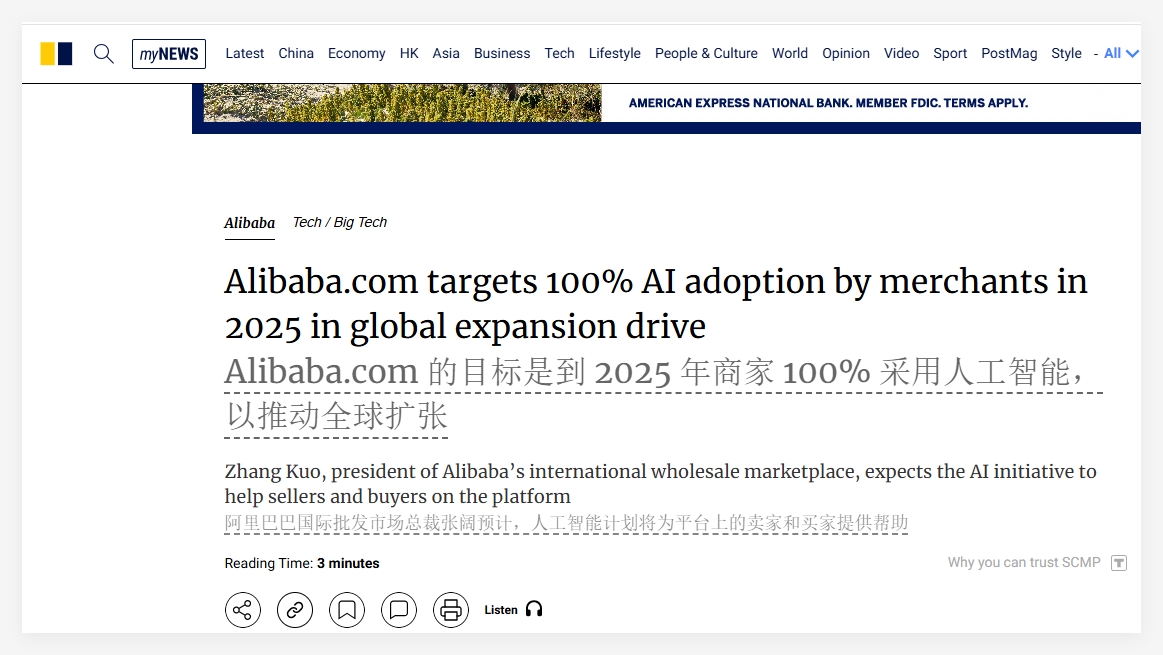
Since its launch in early 2024, these AI tools have helped merchants improve efficiency in multiple aspects, including marketing, product management, customer interaction and risk control. These measures are an important part of Alibaba's expansion of its cross-border e-commerce strategy. Zhang Kuo said that by the end of this year, all merchants will fully adopt these AI technologies. He further noted: "When merchants find that these parts are easier to manage and that AI agents can provide better performance, all relevant work will be handled by AI."
Zhang Kuo's statement reflects Alibaba's centralized layout in the fields of cloud computing and artificial intelligence. The company promises to invest at least 380 billion yuan (about 52 billion US dollars) over the next three years to improve infrastructure construction related to these technologies. The investment will become the largest computing project in the history of Chinese private enterprises, marking Alibaba's ambitions for technological innovation.
With the popularity of AI technology, merchants will be able to manage their business more effectively and improve operational efficiency. This will not only help merchants, but will also improve consumers' shopping experience. Alibaba hopes to help more merchants and consumers achieve win-win results on the platform through AI technology, further consolidating its leading position in the global e-commerce field.
Key points:
More than 50% of Alibaba merchants already use AI tools every week.
Alibaba plans to invest 380 billion yuan in the next three years to improve AI and cloud computing infrastructure.
The goal is to achieve 100% adoption of AI applications by 2025 to improve operational efficiency.