
The editor of Downcodes brings you an in-depth analysis report on the current status of AI application in American enterprises. This report is based on Menlo Ventures' survey of 600 IT decision-makers from September to October 2024, revealing the latest trends in AI investment, application scenarios, technology choices and challenges faced by U.S. companies. Data shows that AI investment will experience explosive growth in 2024, but at the same time, many companies are still exploring the best practices of AI strategy, which brings opportunities and challenges to the future development of companies in the AI field.
A growing number of U.S. businesses are moving from testing artificial intelligence (AI) to full implementation, according to a new survey. The survey of 600 IT decision-makers, conducted between September and October 2024 by U.S. venture capital firm Menlo Ventures, shows that U.S. AI investment will total $2.3 billion in 2023, while in 2024 this number will surge to US$13.8 billion, a six-fold increase.
The survey respondents were all from companies with at least 50 employees, and the results show that AI is gradually becoming a core technology for enterprises, rather than just an experimental tool. Approximately 72% of IT decision-makers expect AI tools to become more prevalent in their operations. However, despite the significant increase in investment, many companies are still figuring out their AI strategies, with more than a third of IT leaders saying they still lack a clear plan for how to use AI effectively in their organizations, indicating that many businesses are still in the technology Early stages of adoption.
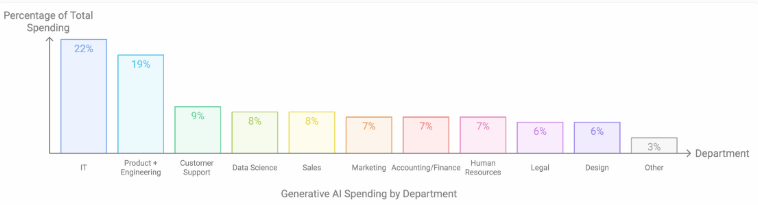
In terms of funding sources, funding channels for AI projects are changing. Currently, 60% of AI spending still comes from innovation budgets, but 40% of spending has shifted to regular operating budgets, indicating that AI is gradually becoming a standard business tool. IT departments account for the largest share of AI spending at 22%, followed by product and engineering teams at 19%. Customer support, sales, and marketing departments have also begun to use more AI tools, but spend relatively less, and the legal department only accounts for 3% of AI spending.
Currently, the most extensive application of AI by enterprises is code generation, accounting for 51%. Support chatbots and enterprise search tools follow closely at 31% and 28% respectively, and about 24% of enterprises use AI to generate meeting summaries. Most organizations now use multiple AI models rather than relying on a single vendor. OpenAI's share of the enterprise market dropped from 50% to 34%, while Anthropic gained a significant portion of the market share.
When choosing an AI system, only 1% of decision-makers consider cost as a main concern. They are more concerned about measurable returns (30%) and the adaptability of the tool to a specific industry or company (26%) . However, many organizations underestimate technology integration and support needs, which often leads to the failure of AI projects. Key reasons include unexpected implementation costs (26%), data privacy issues (21%) and disappointing results (18%). .
According to the survey, the use of search-augmented generation (RAG) technology in enterprise environments has grown significantly, rising from 31% last year to 51% in 2024. At the same time, enterprises have also changed in their choice of databases, with AI-specific vector databases gradually replacing traditional systems.
Highlight:
AI investment surges to $13.8 billion in 2024, with companies quickly shifting to full implementation.
More than one-third of companies still lack a clear plan for using AI, and many are still in the exploratory stage.
? Code generation is the main area of AI application, and enterprises choose multiple AI models instead of a single supplier.
All in all, investment and application of AI by U.S. companies is accelerating, but challenges remain. Enterprises need to formulate a clear AI strategy, focus on measurable returns, and properly handle issues such as technology integration and data privacy to succeed in the AI era. We hope this report can provide useful reference for enterprises.