How science and AI integrate and develop, this organization releases ten cutting-edge directions
Author:Eve Cole
Update Time:2025-03-06 14:16:02
With the 2024 Nobel Prize in Physics and Chemistry awarded to artificial intelligence-related research, scientific intelligence (deep integration of science and AI) and its research directions have attracted widespread attention from scientists to the public. What will be the next research focus? At the "2024 Scientific Intelligence Innovation Forum" held on the afternoon of November 11, the Shanghai Institute of Scientific Intelligence (hereinafter referred to as "Shanghai Institute"), together with Fudan University, Jizhi Scientific Research Center and Alibaba Cloud, jointly released the Scientific Intelligence Frontier Observation According to the report, the top ten cutting-edge directions cover three dimensions: AI for Science, Science for AI, and scientific intelligent infrastructure. Among them, the cutting-edge directions of AI for Science include large scientific models in vertical fields, AI models incorporating prior knowledge, scientific research based on LLM models, AI scientists from proposing hypotheses to automatic verification, and multi-agent modeling of complex worlds; The cutting-edge direction of Science for AI covers the first principles of the physical world and new explainable AI architecture inspired by science; the cutting-edge direction of scientific intelligent infrastructure includes synthetic data and new intelligent computing. Looking forward to the future, the scientific world model for credible and explainable research and the above nine directions together constitute the ten frontiers of scientific intelligence.
Qi Yuan, Dean of
the Top Ten Frontier Sophia Institutes and Haoqing Professor of Fudan University, said at the meeting that the deep integration of AI and basic science will open up a new paradigm of scientific research driven by the resonance of the "double helix engine" of AI and science. AI for Science and Science for AI are similar to the double helix structure of DNA and RNA. On the one hand, AI will become the forefront of scientific research and exploration; on the other hand, scientifically inspired AI will also become an important support for the realization of AGI. In the future, it is expected that more scientific intelligence research results will win the Nobel Prize. "The release of the scientific intelligence frontier observation report is to promote and support more scientists in the field of AI and basic research, to deeply integrate and seamlessly cooperate, to jointly explore the new future of scientific intelligence, and to create an 'AI AI' that can independently discover the unknown laws of the complex world. Stan'. " Why is it called the Double Helix Engine? Scientific intelligence (AI scientific research (AI for Science); second, use domain subject knowledge to understand and improve AI algorithms and architecture (Science for AI). With the rapid accumulation of large amounts of data and the explosive growth of literature, the information processing capabilities of human scientists have reached their limits and even become a bottleneck for research breakthroughs. And more and more scientific research fields are difficult to use traditional mathematical and physical methods when facing the challenges of complex problems. How to apply AI to research in vertical scientific fields, accelerate scientific discovery, and expand the boundaries of scientific research is the core theme of AI for Science. AlphaFold2, awarded this year's Nobel Prize in Chemistry, is a research example of AI algorithms used to solve important problems in the scientific field. Other successful research cases of AI for Science include AI controllable nuclear fusion, weather models, etc. However, despite major breakthroughs, AI still faces major challenges such as data scarcity, excessive energy consumption, and poor interpretability. Human scientists have accumulated vast amounts of knowledge in various subject areas. The ability to transform scientists' experience and knowledge, and even intuition and heuristic ideas, into AI systems constitutes the focus of Science for AI research. In an interview with China Business News, Qi Yuan said that this year's Nobel Prize is a very good representative of scientific intelligence. With the two-way rush of basic research scientists and artificial intelligence researchers, we will see more scientific intelligence achievements in the future. This It will also affect the scientific research paradigm itself. Regarding the future research direction of scientific intelligence, he mentioned that it is still necessary to choose fields with great scientific value. In addition, it is also necessary to find a balance between social and industrial value to make key breakthroughs.
Qiyuan released multiple large models . In addition to scientific intelligence frontier observation reports, the conference also released the "PI-AGENT large language model in the climate field", "Nuwa: Large model of life fluids" & "Nuwa: large model of genetic navigation", "Nuwa: A large model of biological structure." According to Shangzhiyuan, the "Nuwa: Large Biological Structure Model" released this time is similar to the 2024 Nobel Prize results AlphaFold and RoseTTAFold. It generates biological structures, including RNA, molecules, proteins, etc., through generative large models, and is mainly used in pharmaceuticals. industry, because biological structure directly determines the function of drugs. Zhu Siyu, leader of the "Nuwa: Large Biological Structure Model" team and researcher at the Institute of Artificial Intelligence Innovation and Industry at Fudan University, told China Business News that from the perspective of industrial application, they have currently cooperated with some pharmaceutical CRO companies to carry out drug structure synthesis. preclinical validation. At the same time, they are also exploring providing APIs through the official website for researchers and enterprises to apply for services of calling the Nuwa-biological structure large model. “In terms of biological data, we will cooperate with the National Protein Center (Shanghai facility) to accumulate dynamic protein data through molecular dynamics simulations to provide support for model generation.” Cheng Yuan, leader of the "Nuwa: Gene Navigation Large Model" team, deputy dean and researcher of the Institute of Artificial Intelligence Innovation and Industry at Fudan University, explained that the reason why it was named "Gene Navigation Large Model" is that it hopes to analyze these "dark matter" Provide a "navigation map" for the mechanism of life, and ultimately build a map of the relationships between genes, between genes and the environment, and between genes and external stimuli, just like what we have in a dark environment. Just like a navigation map. "We hope to open this 'navigation system' to academia and industry to contribute to future life science research. In the initial stage, we will first open up the gene regulation relationship map and prediction interface, and then gradually improve the functions." Compared with the previous work of Shangzhi Institute What is the difference between the "Fuxi" large model released and the large language model in the climate field released on the 11th? Wu Libo, leader of the "Large Language Model in the Climate Field" team, assistant to the president of Fudan University and deputy dean of Shanghai Chuangzhi Institute, explained that the model is China's first independently developed climate science large language model. The model integrates massive domain expertise and uses intelligent Volume modeling improves the model's ability to recognize and summarize scientific facts, as well as its ability to grasp data and information. It provides comprehensive intelligent AI scientist services for researchers and practitioners in the climate field and accelerates the progress of climate change research.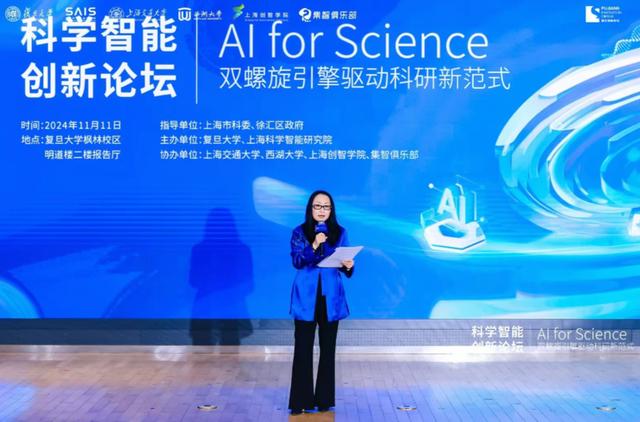
Yang Yanqing, chief strategy officer of Shangzhi Academy and part-time professor at Fudan University
