Parrot Security Guide
1.0.0


ПРИМЕЧАНИЕ. Вы можете легко преобразовать этот файл разметки в PDF в VSCODE, используя эту Handy Extension Markdown PDF.

Начиная
Получение программного обеспечения
Игры
Разработка игры
Настройка рабочей области macOS
Настройка рабочей области Windows 10
Использование приложений Android и Android на Linux
Профессиональное аудио/редактирование видео
Kubernetes
Машинное обучение
Робототехника
Безопасность с открытым исходным кодом
Дифференциальная конфиденциальность
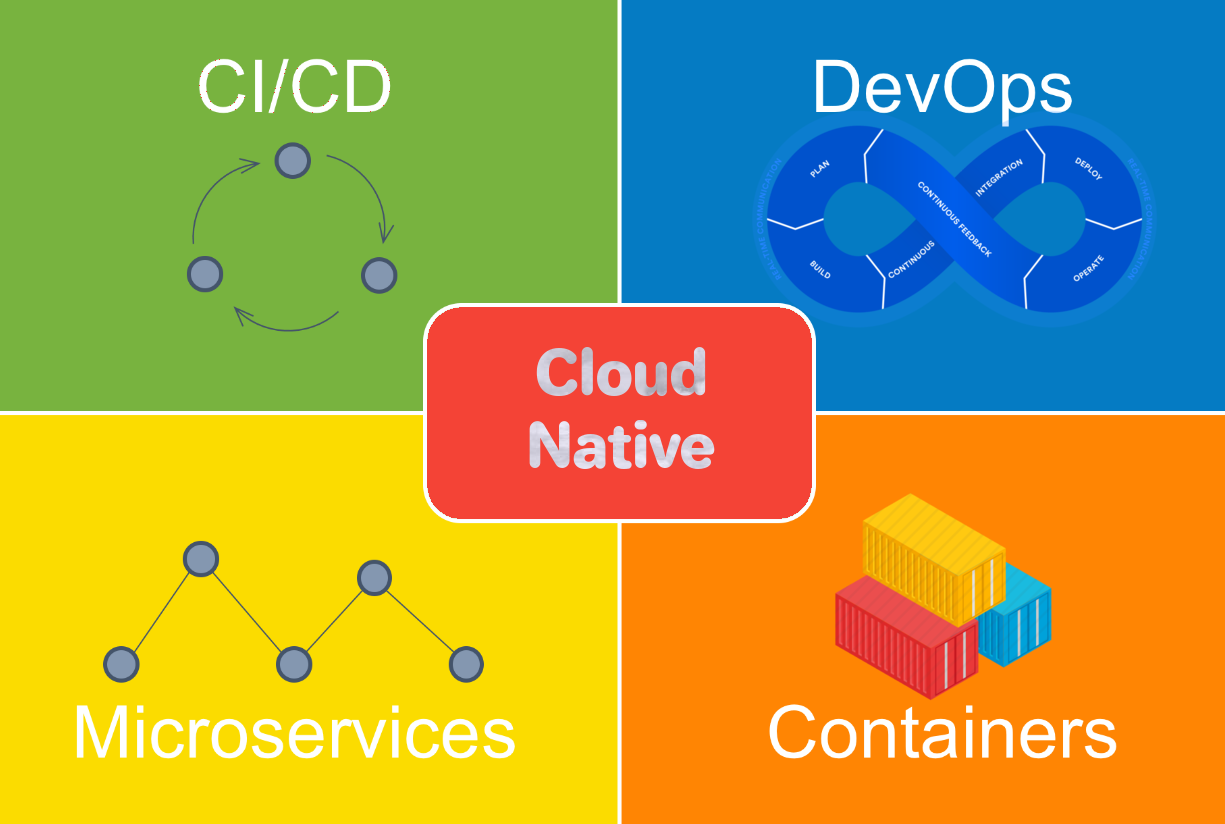
Облачная нативная разработка
DevOps Development
Сеть
Базы данных
ОС Parrot Security-это распределение Linux на базе с открытым исходным кодом, предназначенное для различных задач информационной безопасности, таких как тестирование на проникновение, исследования безопасности, компьютерная криминалистика, обратная инженерия и криптография. Он поставляется с Mate в качестве среды настольных компьютеров по умолчанию и разработан Team Frozenbox.
Edition Parrot Security Edition - это операционная система специального назначения, предназначенная для тестов на проникновение и операции Red Team. Он содержит полный арсенал готовых к использованию инструментов Pentest.
Home Edition Parrot - это операционная система общего назначения с типичным видом и ощущением попугая. Это издание предназначено для ежедневного использования, конфиденциальности и разработки программного обеспечения. Инструменты попугаев могут быть установлены вручную для сборки пользовательской и легкой среды пентуля.
IoT Parrot и облачные приборы являются специальными изданиями безопасности попугая, созданных для встроенных устройств, облачных сред, виртуальных машин и других специальных развертываний.
Документация по безопасности попугая
Попугательная безопасность GitHub
Сообщество Форум
Группа безопасности попугая
Пожертвовать в проект безопасности попугая
ETCHER-это кроссплатформенное программное обеспечение с открытым исходным кодом, которое позволяет легко вспыхивать изображения операционной системы на карту MicroSD или USB-устройство.
Rufus - это небольшое приложение, которое создает загрузочные USB -диски, которые затем можно использовать для установки или запуска Microsoft Windows, Linux или DOS.
Вернуться на вершину
ПРИМЕЧАНИЕ 1: Все это программное обеспечение также доступно в других популярных распределениях Linux, таких как Debian, Linux Mint, Elementary OS, Pop! _Os, Fedora, Manjaro Linux, Endeavouros и Arch Linux.
ПРИМЕЧАНИЕ 2: Для новых пользователей не удобно использовать командную линию. Оформление в разделе «Основные приложения» для начала. Кроме того, если вы прокрутите дальше, вы увидите другие простые способы получить программные приложения через Flathub, Snap Store и Appimages.
Google Chrome Browser
Microsoft Edge Browser
Visual Studio Code или Vscodium
Microsoft Teams
Microsoft 365 с офисными приложениями (ранее Office Online)
Google Workspace (ранее G Suite)
Зум
Как установить iCloud на Ubuntu
Pcloud - это безопасное облачное хранилище (например, Googledrive), где вы можете хранить, делиться и работать над всеми вашими файлами. Вы можете получить доступ к ним на любом устройстве, куда угодно.
Jitsi Meet - это полностью зашифрованное, 100% видеоконференц -конференция с открытым исходным кодом.
Веб -приложение Cisco Webex - это веб -версия решения для видеоконференций Cisco Webex.
Пролечить
Trello Web App
Скайп
Раздор
TeamViewer
Spotify
Apple Music (Web) - это версия Apple Music, которая работает в Safari, Google Chrome и Mozilla Firefox.
Matlab Online позволяет пользователям использовать Matlab и Simulink через веб -браузер, такой как Google Chrome.
Adobe Lighroom Online Photo Editor - это веб -версия Adobe Photoshop Lightroom. Adobe Account, необходимая для входа в приложение.
Adobe Spark (Web) - это приложения, позволяющие создавать классную социальную графику, короткие видео и веб -страницы. Adobe Account, необходимая для входа в приложение.
Photopea - это расширенный онлайн -редактор изображений, поддерживающий форматы PSD, XCF, Sketch, XD и CDR. (Adobe Photoshop, Gimp, Sketch App, Adobe XD, Coreldraw).
Master PDF-редактор является простым, простым в использовании приложения для работы с PDF-документами, оснащенными мощными многоцелевыми функциональными возможностями. С помощью Master PDF -редактора вы можете легко просматривать, создавать и изменять документы PDF.
Crossover Linux® - это слой совместимости Microsoft Windows (на основе вина (вино не эмулятор)). Уровень совместимости кроссовера позволяет тысячам приложений на основе Windows работать на Linux, MacOS или Chrome OS.
WinApps для Linux - это программа, которая запускает приложения Windows, такие как Microsoft Office & Adobe в Linux (Ubuntu/Fedora) и Gnome/KDE, как если бы они были частью нативной ОС, включая интеграцию Nautilus для правой щелчки на файлы определенных типов MIME, чтобы открыть их.
Video Editor Davinci Resolve - это полное решение для редактирования видео, которое сочетает в себе профессиональное редактирование 8K, коррекцию цвета, визуальные эффекты и аудио -пост -производство, все в одном программном инструменте.
Audio Editor Reaper - это полное приложение для производства цифрового аудио для компьютеров, предлагающее полную многотрудную аудио и Mid
FlameShot - это мощное, но простое в использовании программного обеспечения для скриншотов.
TimeShift for Linux - это приложение, которое предоставляет функциональность, аналогичную функции восстановления системы в Windows, и инструмент Time Stice в Mac OS. TINESHIFT защищает вашу систему, принимая инкрементные снимки файловой системы через регулярные промежутки времени. Эти снимки могут быть восстановлены позже, чтобы отменить все изменения в системе.
Stacer - это системный оптимизатор с открытым исходным кодом и монитор приложений, который помогает пользователям управлять всей своей системой. Также доступен в качестве аппетита.
NativeFier-это инструмент командной строки, чтобы легко создать настольное приложение для любого веб-сайта с минимальной конфигурацией. Приложения обернуты электроном (который использует Chromium под капотом) в исполняемом ОС (.app, .exe и т. Д.) Для использования в Windows, MacOS и Linux.
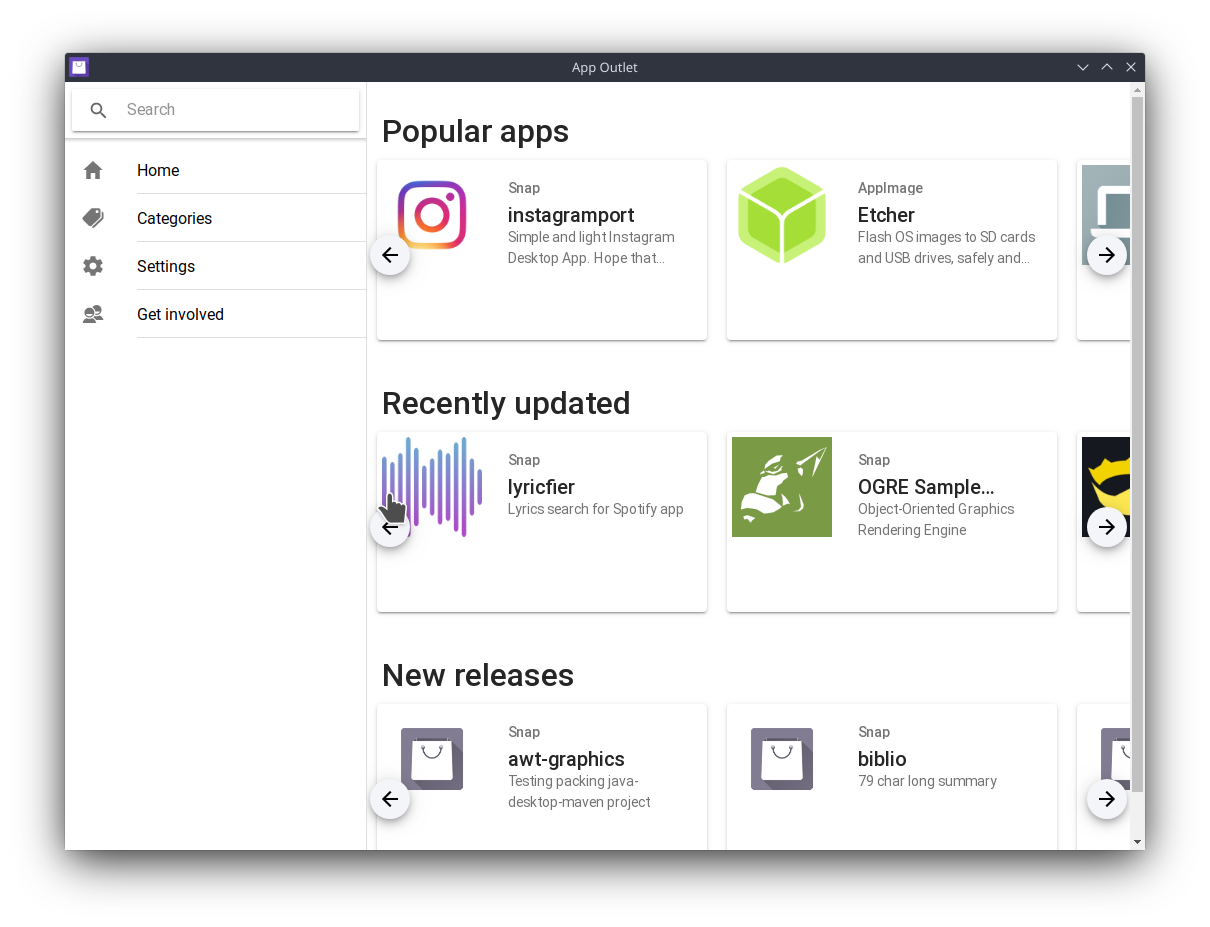
App Outlet - это универсальный магазин приложений (Flatpaks, Snaps и Appimages), вдохновленный онлайн -сервисом Linux App Store.
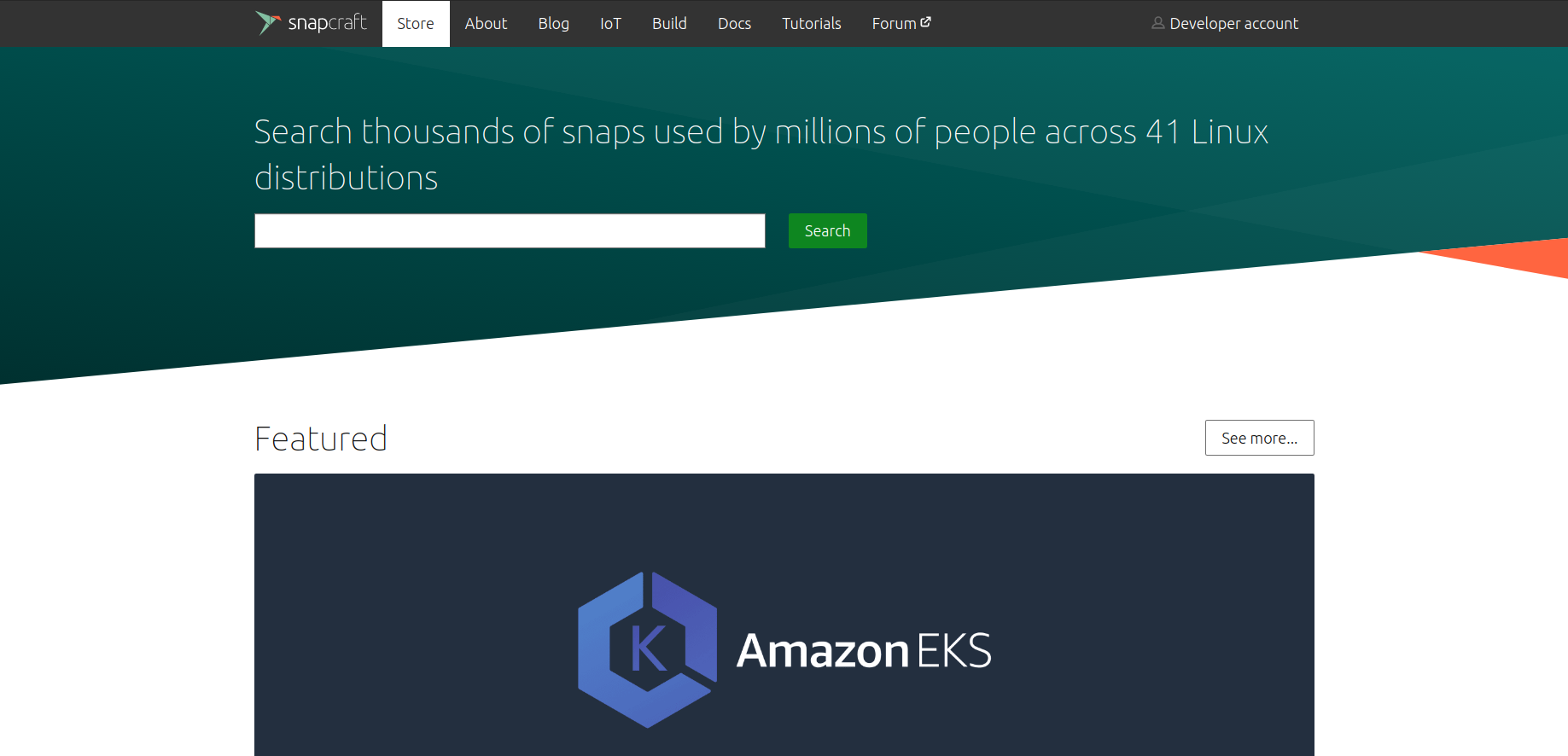
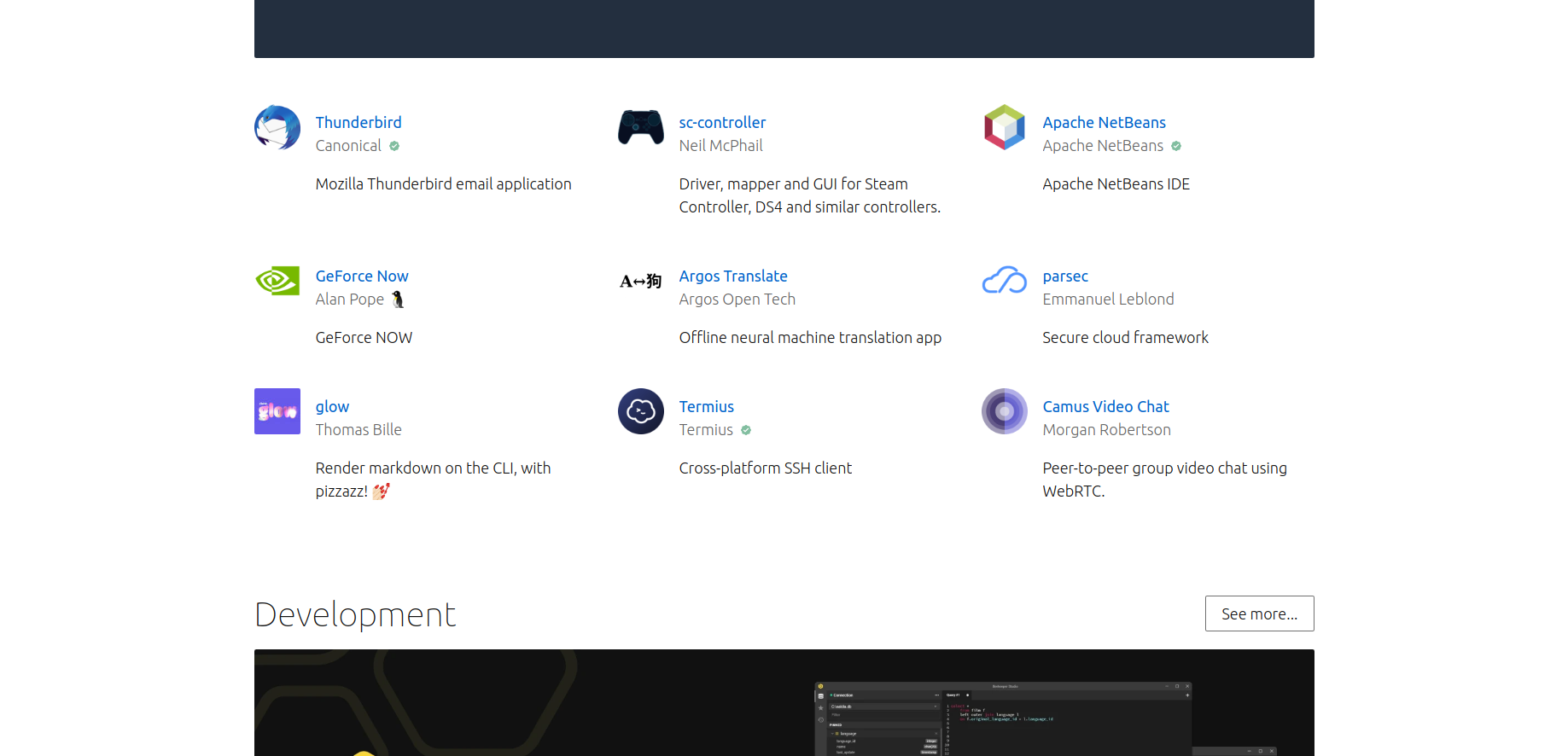
Snap Store - это служба сборки и распространения для приложений SNAP.
Snapcraft Forum
Flathub - это служба сборки и распространения для приложений Flatpak.
Форум Flathub
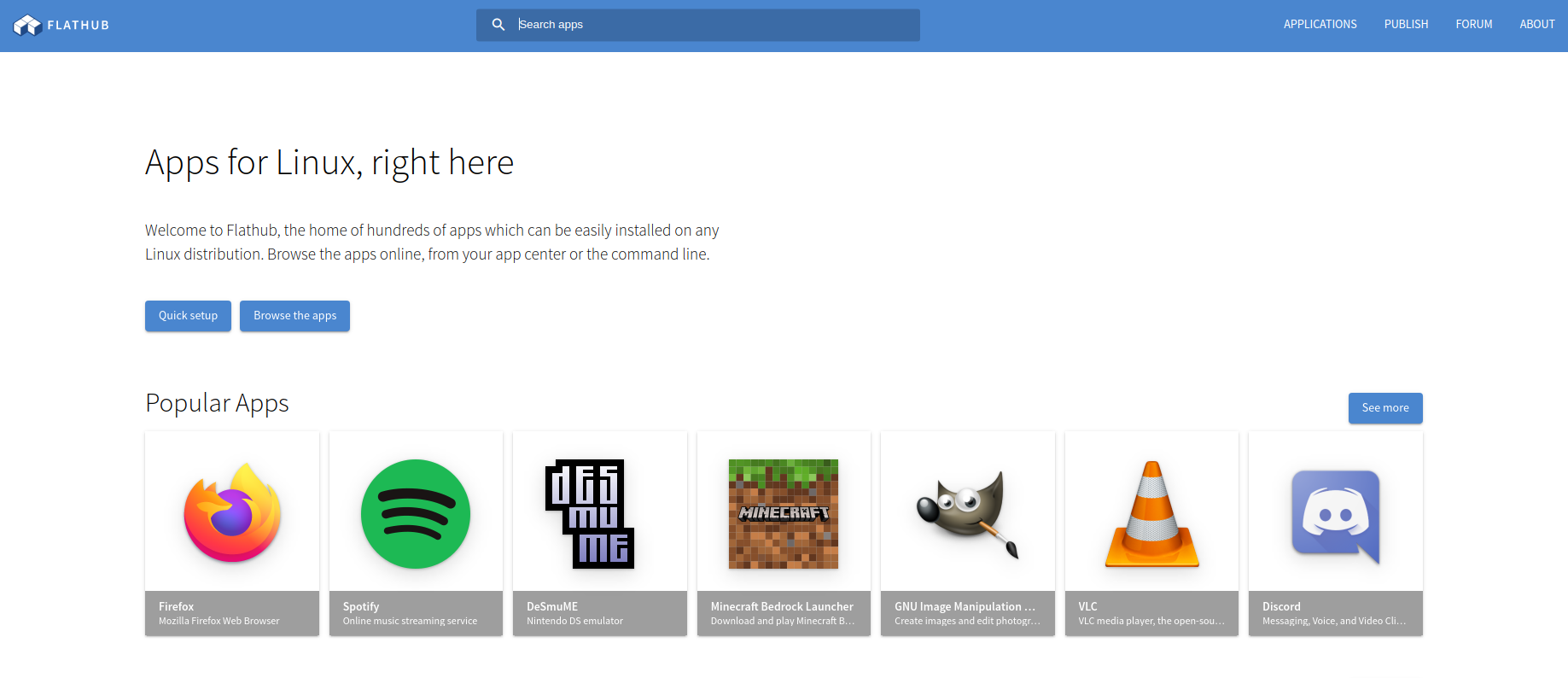
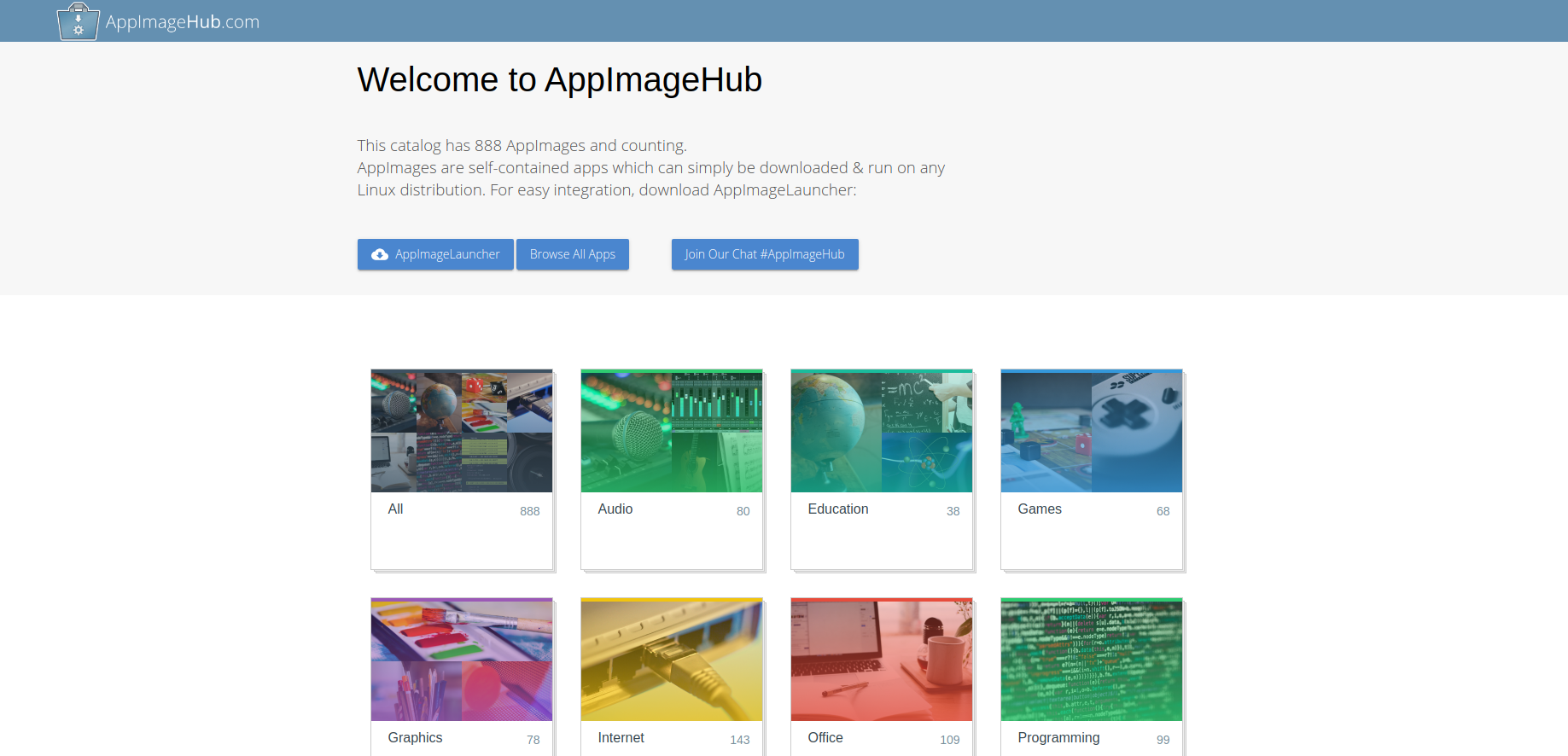
AppimageHub - это служба сборки и распространения для приложений Appimage.
Appimage Manager - это менеджер пакетов для аппетитов.
Форум Апдаж
Вернуться на вершину
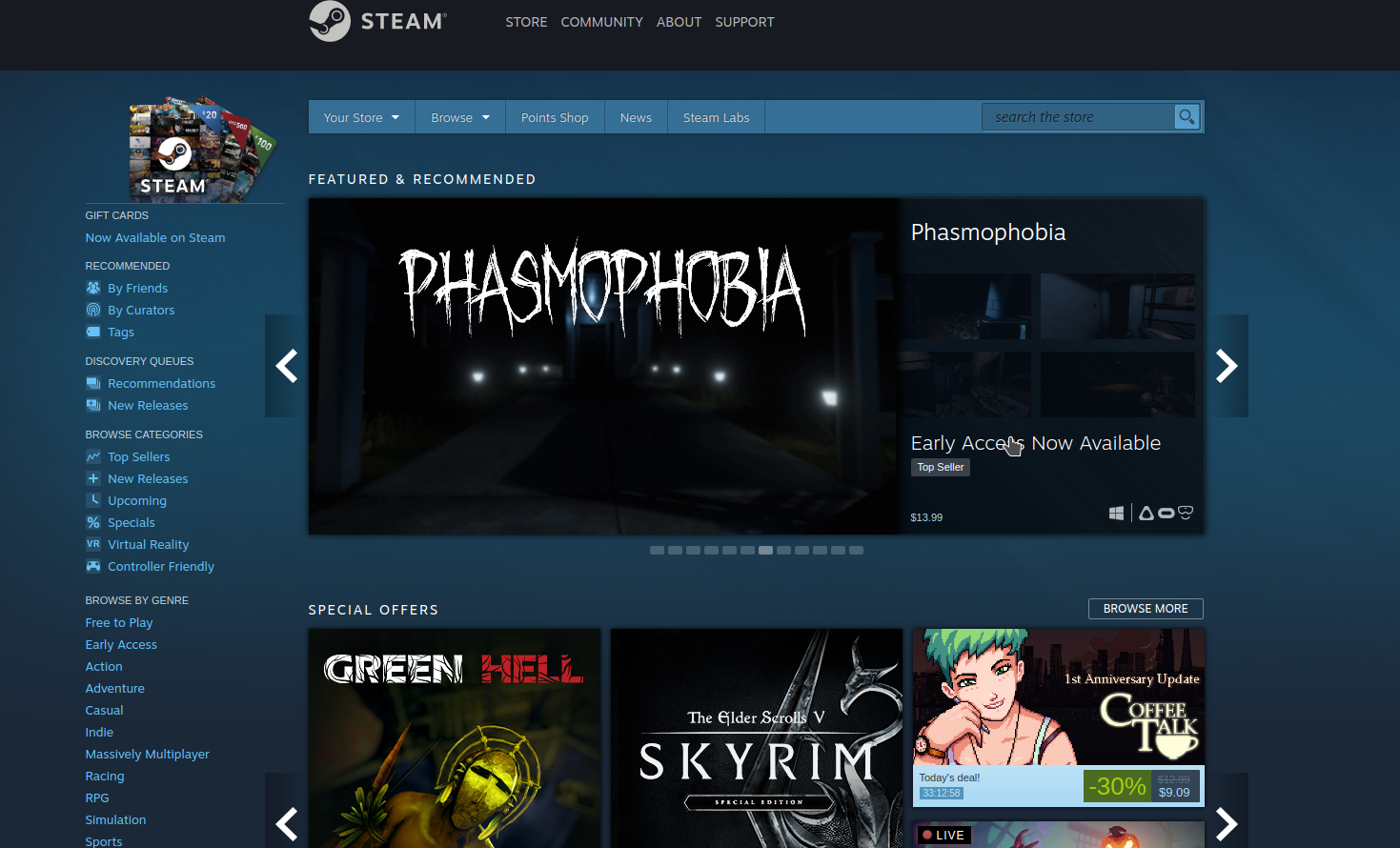
Получите пар
Или
wget https://steamcdn-a.akamaihd.net/client/installer/steam.debProton - это инструмент для использования с клиентом Steam, который позволяет игре, которые являются эксклюзивными для Windows для работы в операционной системе Linux. Он использует вино, чтобы облегчить это.
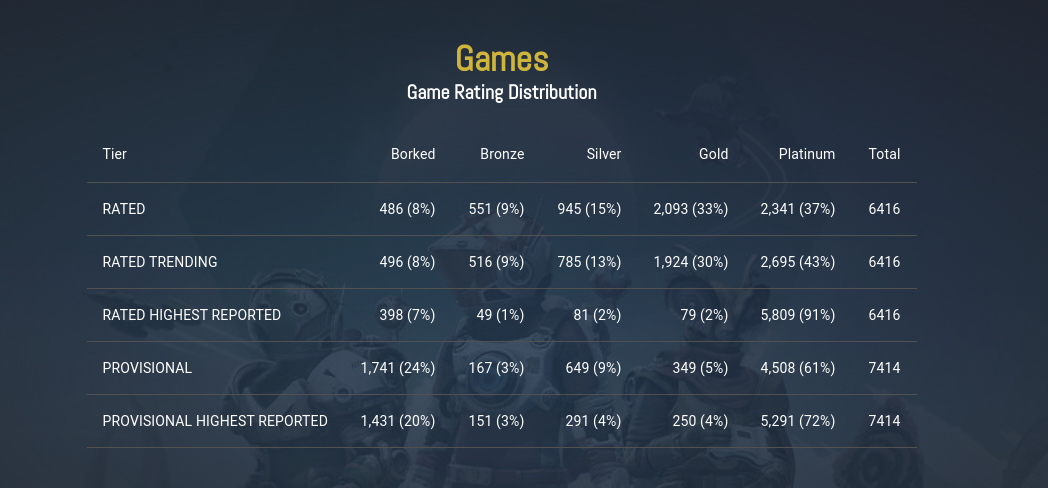
ProtondB - это коллекция из более чем 100 000 игровых отчетов от других геймеров, когда они тестируют игры с Proton на Linux и предоставляют совокупные оценки того, как хорошо работают игры. Растущий пул предложений обеспечивает настройки, которые вы можете попытаться получить игры, в то время как Proton продолжает разработку. В дополнение к этому вы можете исследовать каталог Steam Game на этом сайте, чтобы просмотреть и обнаружить широкий спектр названий, которые ранее были недоступны для использования на Linux.
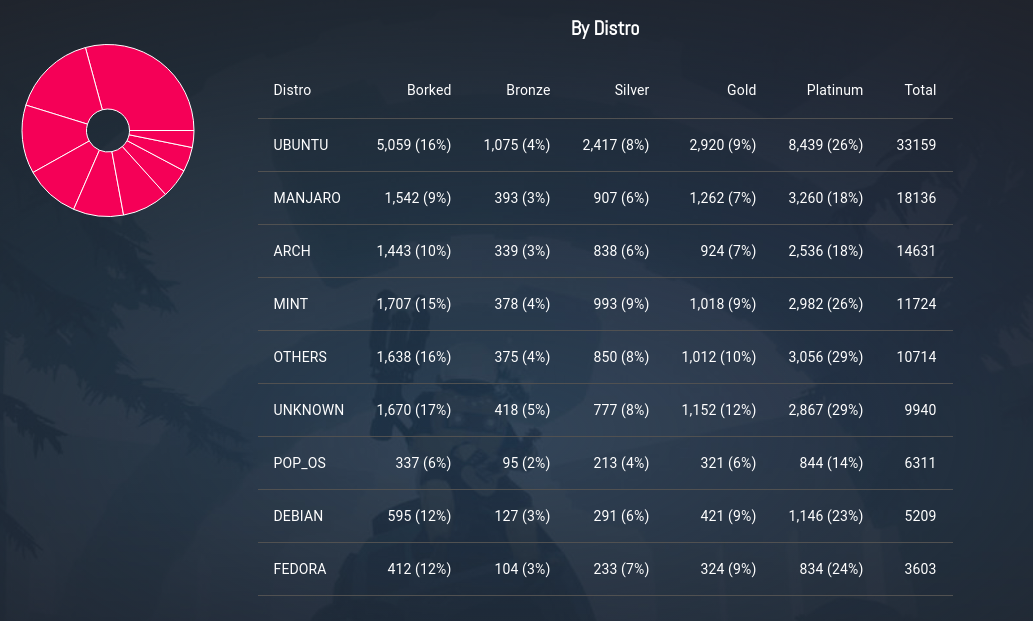
Lutris является игровым клиентом для Linux. Это дает вам доступ ко всем вашим видеоиграм, за исключением текущего поколения консоли. Кроме того, хорошо интегрируется с другими магазинами, такими как Gog, Steam, Battle.net, Origin, Uplay и многими другими источниками, которые позволяют вам импортировать существующую игровую библиотеку и сообщество, поддерживаемые установленными сценариями, дают вам полностью автоматизированную настройку.
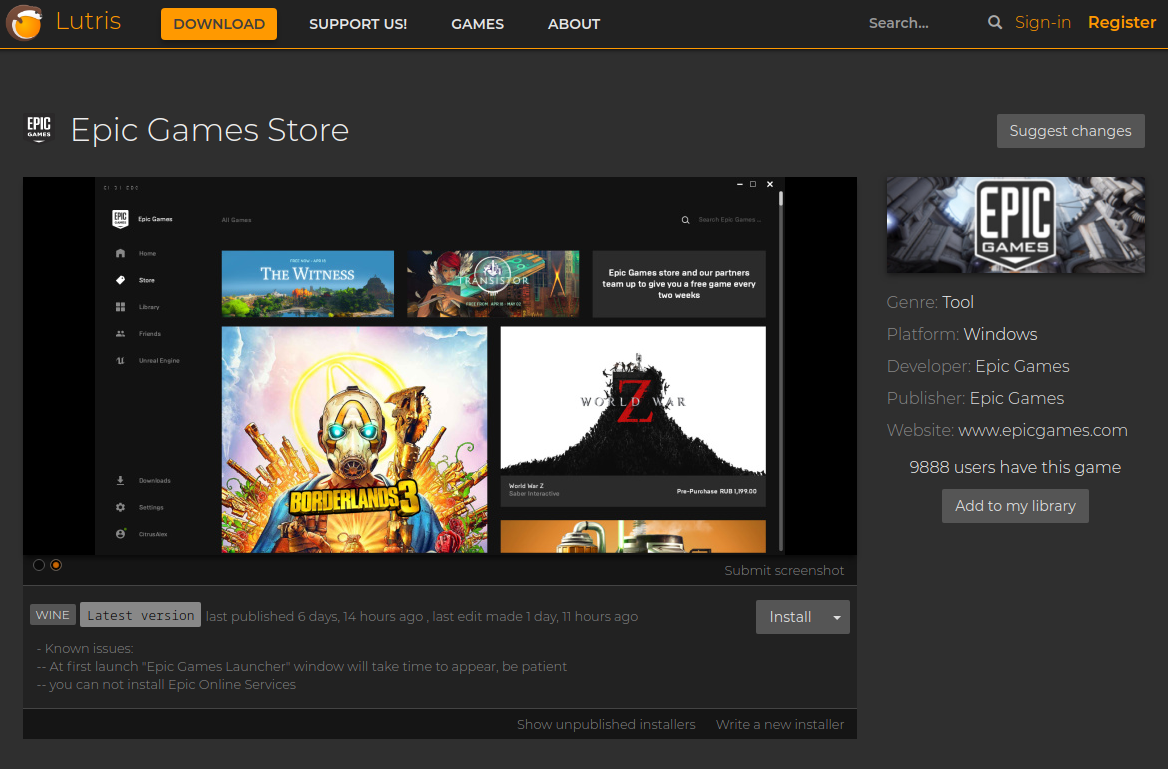
Добавить магазин Epic Games
GameHub - это единая библиотека для всех ваших игр. Это позволяет вам хранить ваши игры с разных платформ в одну программу, чтобы вам было легче управлять своими играми.
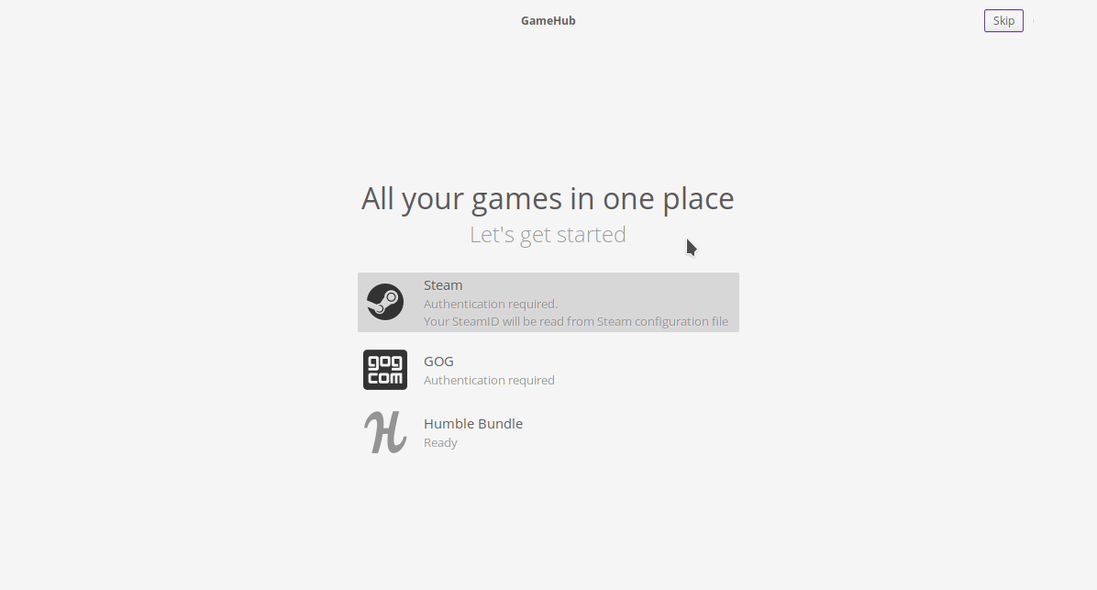
GameHub поддерживает:
Нативные игры для Linux
Несколько слоев совместимости:
Несколько игровых платформ:
Теперь GeForce использует версию Chromebook , чтобы воспроизводить все ваши игры в Google Chrome или в любом веб-браузере на основе хрома, такого как Brave, Vivaldi и Microsoft Edge. Кроме того, доступно в качестве электронного настольного приложения в Snap Store Geforce Now.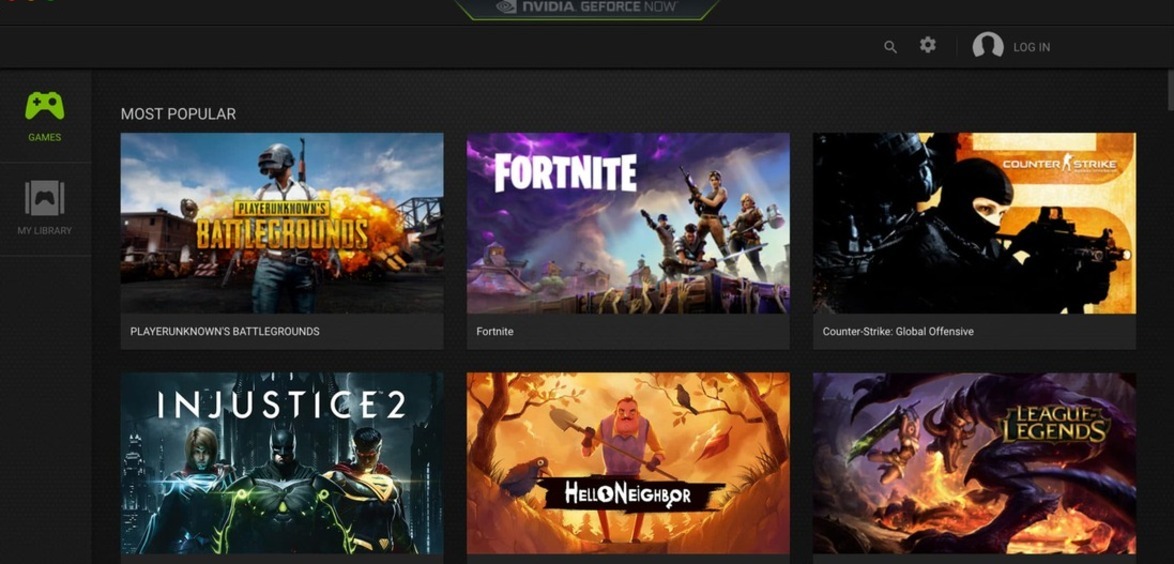
Потоковая игра Moonlight Game - это программа, которая позволяет вам транслировать из ваших компьютерных игр через Интернет без необходимости конфигурации. Поток практически с любого устройства, будь то в другой комнате или в нескольких милях от своей игровой установки.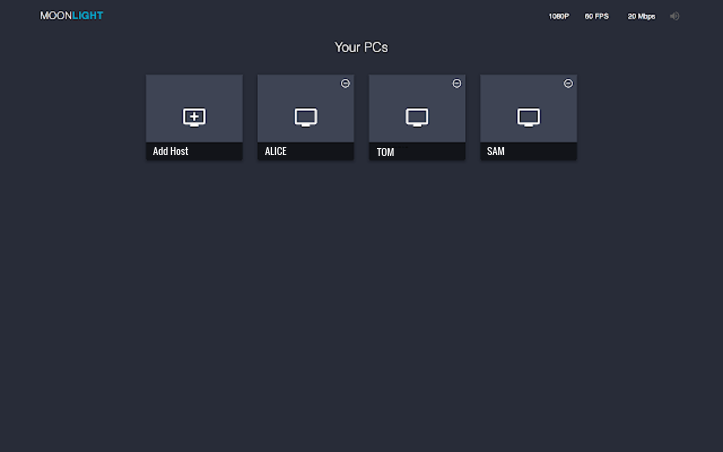
Chiaki - это бесплатный клиент программного обеспечения с открытым исходным кодом для PlayStation 4 и PlayStation 5 Remote Play для Linux, FreeBSD, OpenBSD, Android, MacOS, Windows, Nintendo Switch и, возможно, еще большего количества платформ.
Xbox Project XCLOUD-это облачная технология Microsoft Cloud Game Game Game (в настоящее время в бета-версии) . Играйте в такие игры, как Forza Horizon 4, Halo 5: Guardians, Gears of War 4, Sea of Thieves, Cuphead, Red Dead Redemption 2 и 100+ других игр на вашем мобильном устройстве или Chrome Web Browser . Microsoft Xcox Project XCloud требует Ultimate Pass Pass Pass.

Retroarch является фронтом для эмуляторов, игровых двигателей и медиа -игроков. Это позволяет вам запускать классические игры на широком спектре компьютеров и консолей через его гладкий графический интерфейс. Настройки также объединены, поэтому конфигурация выполняется раз и навсегда.
Dolphin является эмулятором двух недавних консолей видеоигр Nintendo: GameCube и Wii. Это позволяет геймерам для ПК наслаждаться играми для этих двух консолей в Full HD (1080p) с несколькими усовершенствованиями: совместимость со всеми контроллерами ПК, турбо скоростью, сетевым многопользовательским средством и даже большим.
Citra является эмулятором с открытым исходным кодом для Nintendo 3DS, способной сыграть во многие из ваших любимых игр.
Yuzu-экспериментальный эмулятор с открытым исходным кодом для Nintendo Switch от создателей Citra.
Dosbox-это эмулятор DOS с открытым исходным кодом, который в первую очередь фокусируется на запуске игр DOS.
Маме - эмулятор аркадного машины.
Xemu - оригинальный эмулятор Xbox.
Greenwithenvy (GWE) - это утилита системы GTK, разработанную Роберто Лейнарди для предоставления информации, управления поклонниками и разгонять видеокарту NVIDIA для лучшей производительности. Доступно в поп -магазине как Flatpak.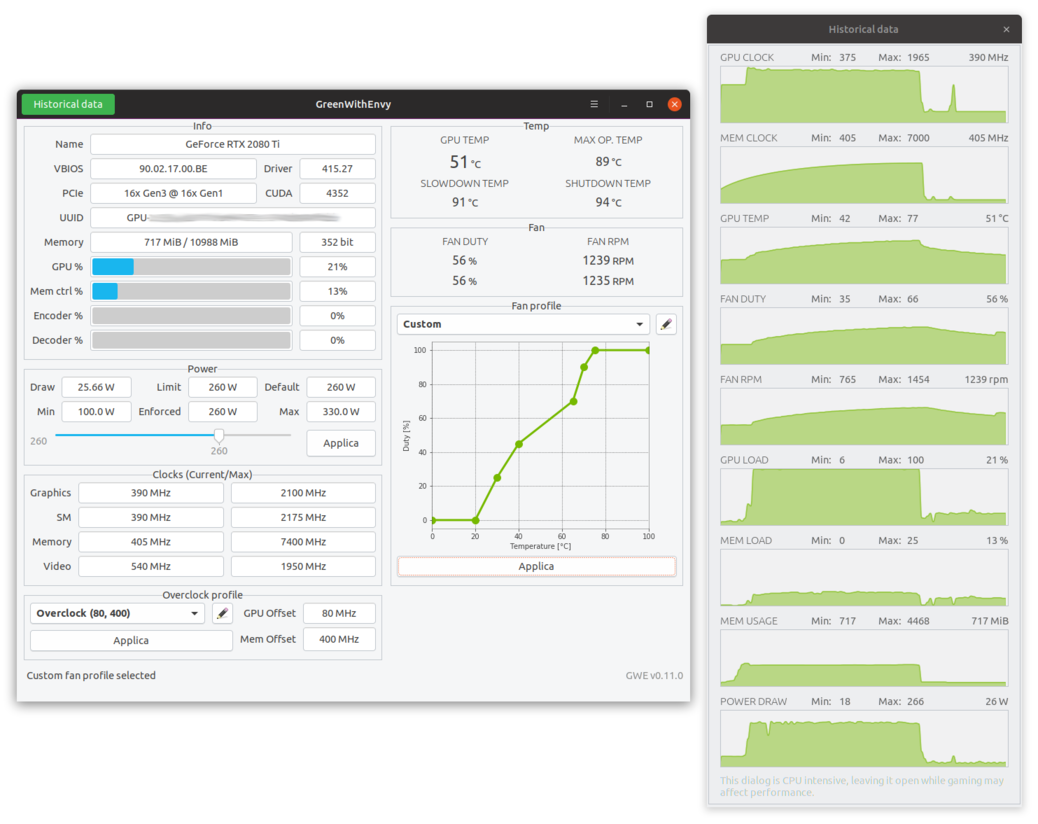
Corectrl - это бесплатное приложение Linux с открытым исходным кодом, которое позволяет вам легко управлять компьютерным оборудованием с использованием профилей приложений для приложений и Windows, имеет базовые элементы управления процессором и управление графическими процессорами AMD (как для старых, так и для новых моделей).
sudo add-apt-repository ppa:ernstp/mesarc
sudo apt install corectrl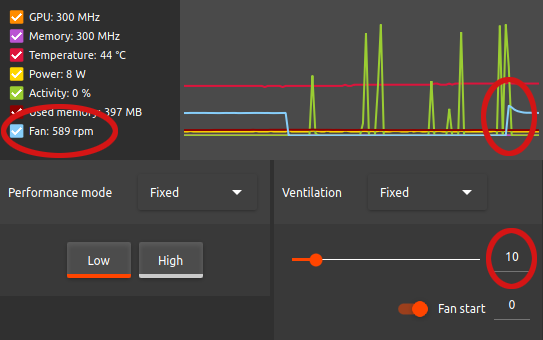
Geekbench 5-это кроссплатформенный эталон, который измеряет производительность вашей системы с нажатием кнопки.
Phoronix Test Suite
Unigine Superposition - это экстремальный тест на производительность и стабильность для ПК оборудования: видеокарта, источник питания, система охлаждения.

Wine (Wine не является эмулятором)-это слой совместимости, способный запускать приложения Windows в нескольких операционных системах, соответствующих POSIX, таких как Linux, MacOS и BSD. Вместо того, чтобы моделировать внутреннюю логику Windows, такую как виртуальная машина или эмулятор, Wine переводит вызовы Windows API в вызовы POSIX на лету, устраняя производительность и штрафы за память других методов и позволяя вам чистой интеграции приложений Windows в свой рабочий стол.
Winetricks - это простой способ обойти проблемы в вине.
Это необходимо, чтобы избежать ошибки Adobeair
sudo sed -i ' s|echo "${arg%%=*}"=\""${arg### *=}"\"|echo ${arg%%=*}=\"${arg### *=}\"|g ' /usr/local/bin/winetricks
sudo apt install cabextract libncurses5:armhfВернуться на вершину
Unity-это кроссплатформенная платформа для разработки игр. Используйте Unity, чтобы создать высококачественные 3D и 2D-игры, развернуть их по мобильным, настольным компьютеру, VR/AR, консолям или в Интернете, а также подключитесь к лояльным и восторженным игрокам и клиентам.
Unity Hub

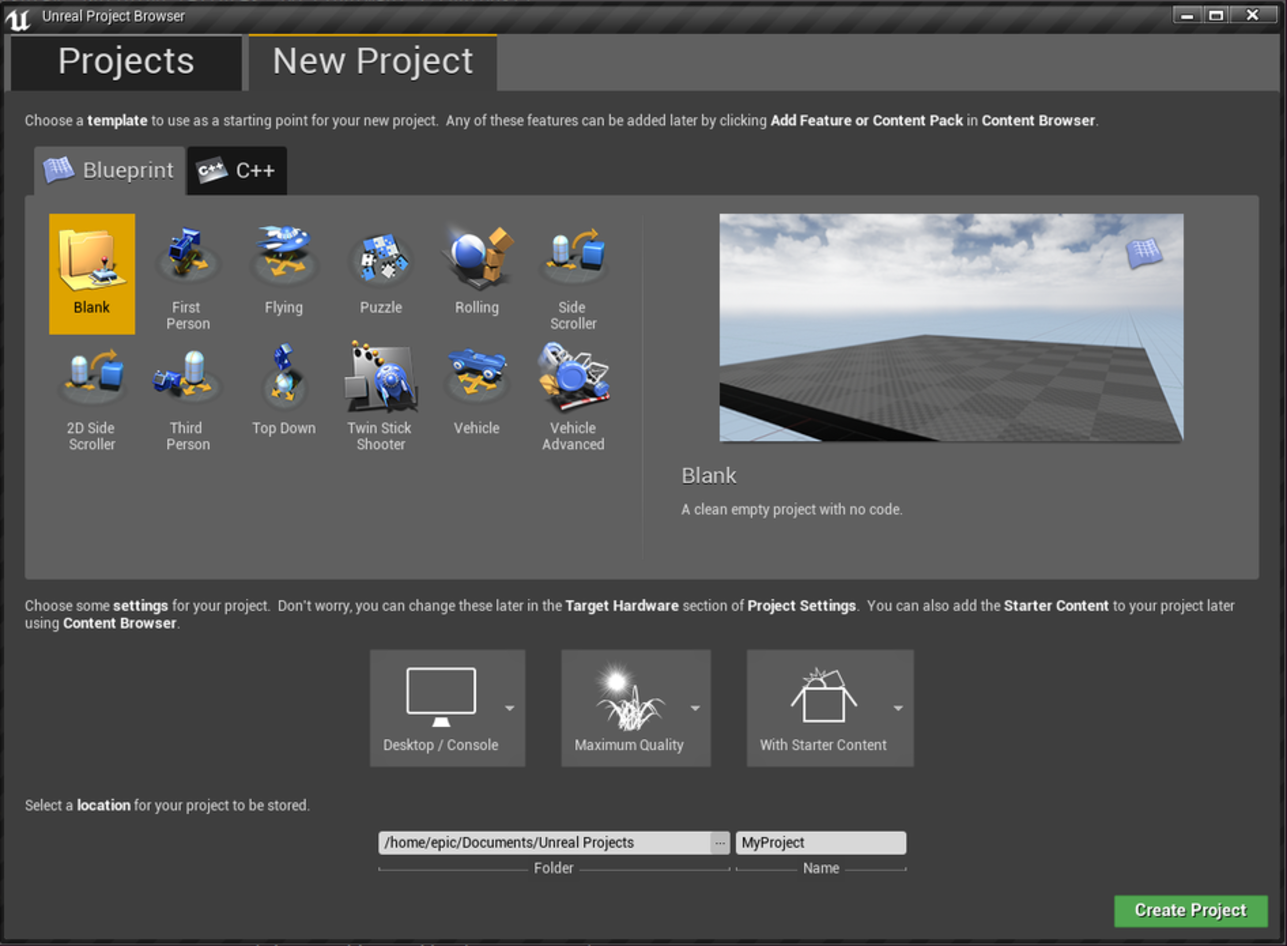
Unreal Engine 4-это игровой двигатель, разработанный Epic Games с самым открытым и передовым инструментом 3D-инструмента в реальном времени в реальном времени. Непрерывно развиваясь, чтобы служить не только своей первоначальной цели в качестве современного игрового двигателя, сегодня он дает создателям в промышленности свободу и контроль для обеспечения передового контента, интерактивного опыта и захватывающих виртуальных миров.
Разработка игры Linux на Unreal Engine 4
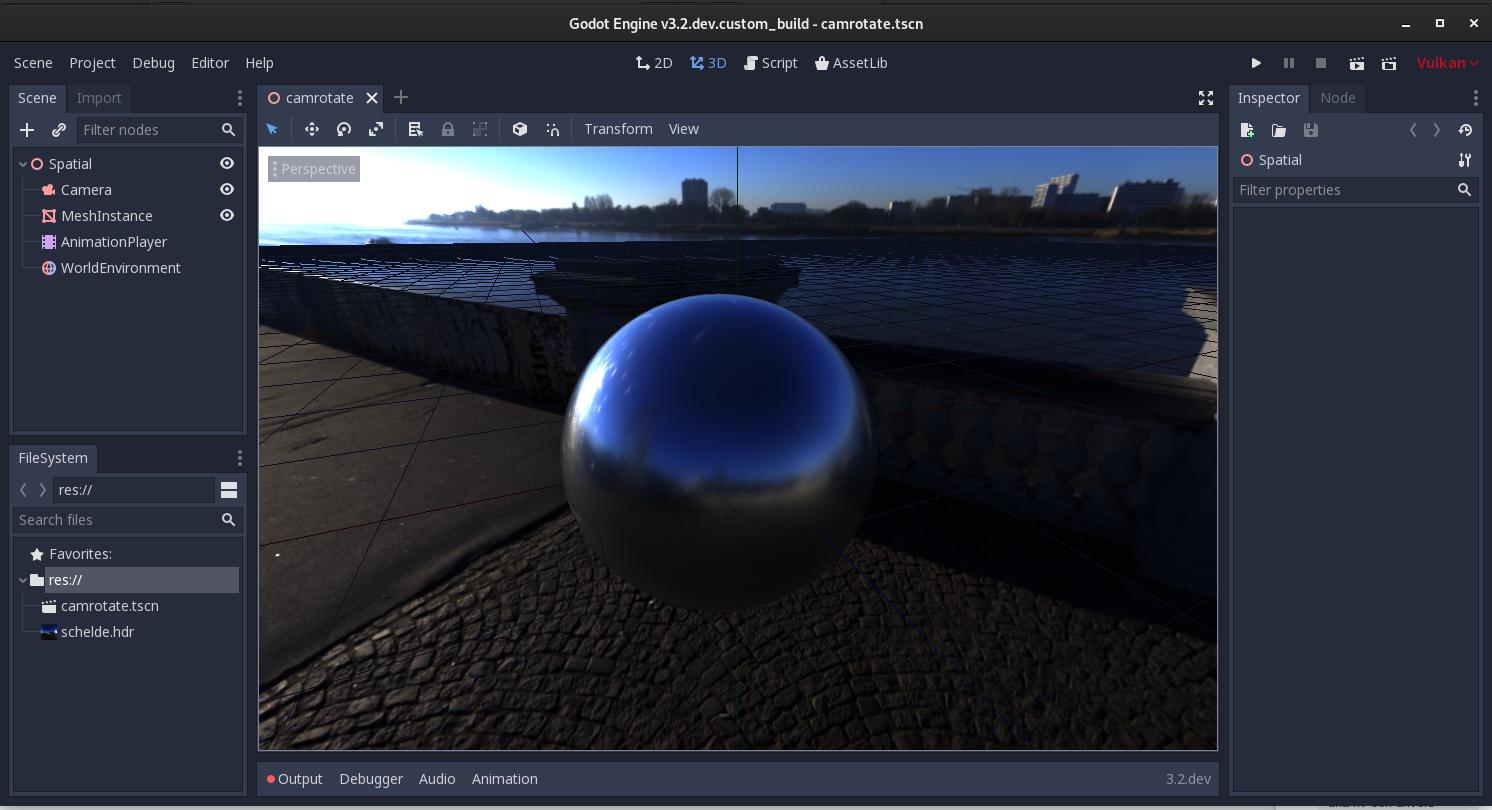
Godot Engine-это насыщенный функциональным кроссплатформенным игровым двигателем для создания 2D и 3D-игр из унифицированного интерфейса. Он предоставляет полный набор общих инструментов, чтобы пользователи могли сосредоточиться на создании игр без необходимости переосмысления колеса. Игры могут быть экспортированы за один щелчок в несколько платформ, включая основные настольные платформы (Linux, Mac OSX, Windows), а также мобильные (Android, iOS) и веб-платформы (HTML5).
Если вы хотите пожертвовать проекту Годота
Blender - это бесплатный и открытый 3D -набор для создания. Он поддерживает весь трехмерный трубопровод - моделирование, оснастка, анимация, моделирование, рендеринг, композитирование и отслеживание движения, редактирование видео и 2D -анимационную конвейера.
Если вы хотите пожертвовать в Blender Project

Unigine-это кроссплатформенный игровой двигатель, разработанный для команд разработчиков (C ++/C# программисты, 3D-артисты), работающие над интерактивными 3D-приложениями.

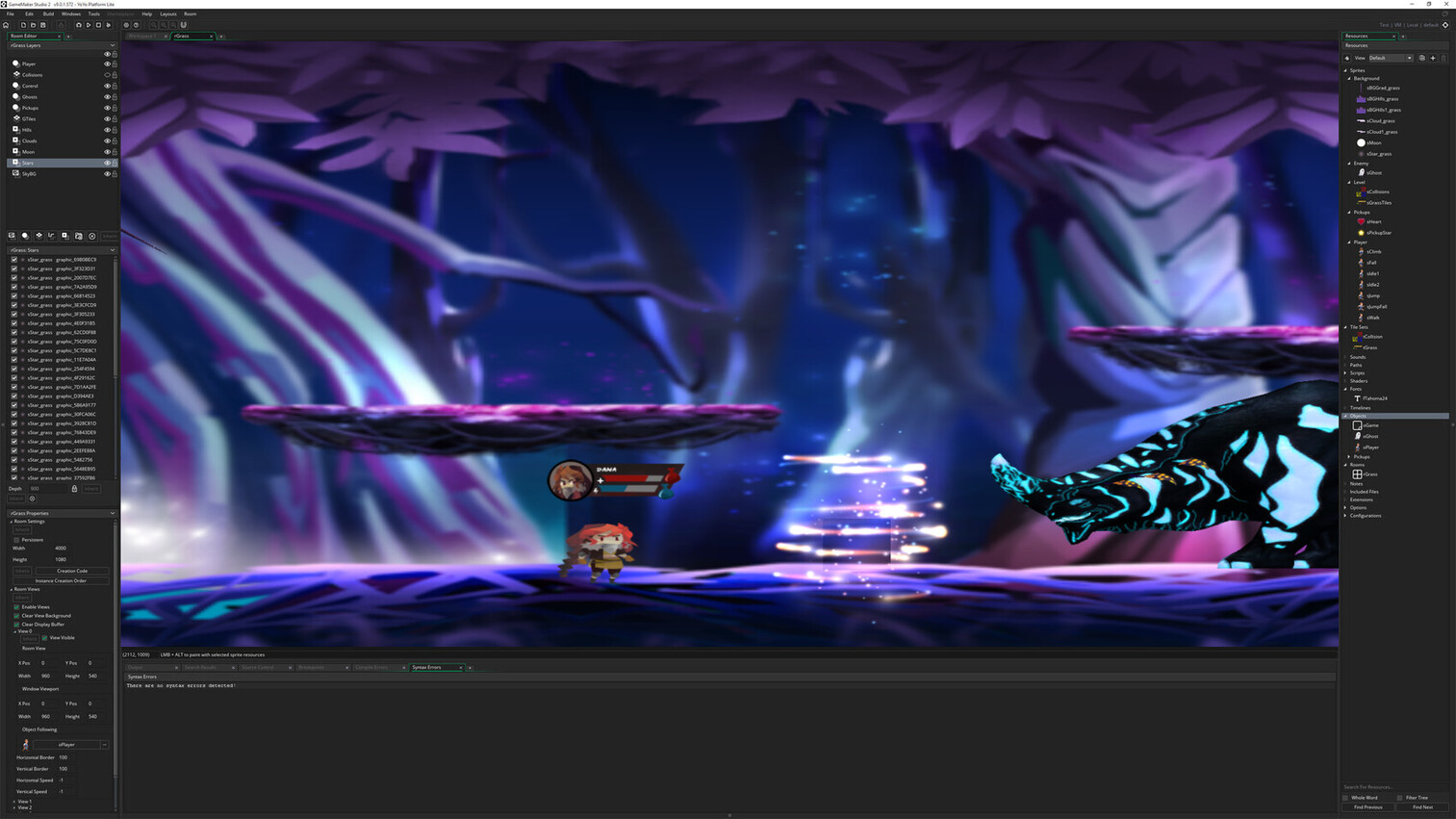
Gamemaker Studio 2 - последнее и величайшее воплощение игрока. У него есть все, что вам нужно, чтобы перенести вашу идею от концепции до готовой игры. Без препятствий для входа и мощной функциональности Gamemaker Studio 2 является конечной средой 2D Development.
Настройка Gamemaker Studio для Ubuntu
Panda3D - это игровой двигатель, рамка для 3D -рендеринга и разработки игр для программ Python и C ++, разработанных Disney и CMU. PANDA3D является открытым исходным кодом и бесплатно для любых целей, включая коммерческие предприятия.
Источник 2 - это 3D -двигатель видеоигр в разработке от Valve в качестве преемника для источника. Он используется в DOTA 2, Artifact, Bondlords DOTA, частях лаборатории, дома SteamVR и полураспадах: Alyx.
Открытая графическая библиотека (OpenGL)-это API, используемый через языки и платформы программирования Mulitple для рендеринга 2D/3D-векторной графики, разработанной в настоящее время группой Khronos.
Open Computing Language (OpenCL) является открытым стандартом для параллельного программирования гетерогенных платформ, состоящих из процессоров, графических процессоров и других аппаратных ускорителей, найденных в суперкомпьютерах, облачных серверах, персональных компьютерах, мобильных устройствах и встроенных платформах.
Language OpenGL Shading (GLSL)-это язык затенения высокого уровня, основанный на языке C-стиле, поэтому он охватывает большинство функций, которые пользователь ожидает с таким языком. Такие, как контрольные структуры (для петлей, операторов IF-ELSE и т. Д.) Существуют в GLSL, включая оператор переключателя.
Язык затенения высокого уровня (HLSL) является языком затенения высокого уровня для DirectX. Используя HLSL, пользователь может создавать C-подобные программируемые шейдеры для трубопровода Direct3D. HLSL был впервые создан с DirectX 9 для настройки программируемого 3D -конвейера.
Vulkan-это современная кроссплатформенная графика и вычислительный API, который обеспечивает высокоэффективный, кроссплатформенный доступ к современным графическим процессорам, используемым в широком спектре устройств от ПК и консолей до мобильных телефонов и встроенных платформ. Вулькан в настоящее время находится в разработке консорциумом Хронос.
Moltenvk - это реализация Vulkan, работающего на iOS и MacOS, используя структуру Apple Metal Graphics.
Moltengl - это реализация API OpenGL ES 2.0, которая работает на структуре Apple Metal Graphics.
Nvidia Omniverse-это мощная платформа моделирования и совместной работы в режиме реального времени для 3D-производственных трубопроводов, основанной на описании универсальной сцены Pixar и Nvidia RTX.
HGIG - это волонтерская группа компаний из игровой и телевизионной промышленности, которые встречаются для указания и предоставления доступных для общественных руководящих принципов для улучшения опыта потребительских игр в HDR.
Thir.js-это интерфейс библиотеки JavaScript JavaScript, используемый для создания и отображения анимированной 3D-компьютерной графики в веб-браузере с использованием WebGL.
SuperPowers-это загружаемое приложение HTML5 для совместных проектов в реальном времени. Вы можете использовать его в одиночку, как обычный автономный производитель игры, или настроить пароль и позволить друзьям присоединиться к вашему проекту через свой веб -браузер.
SteamVR для Linux - это окончательный инструмент для переживания контента VR на аппаратном обеспечении по вашему выбору. SteamVR поддерживает индекс клапана, HTC Vive, Oculus Rift, гарнитуры смешанной реальности Windows и другие.

Steamvr Home
OpenVR - это API и время выполнения, которая позволяет доступ к оборудованию VR (Steam Index, HTC Vive и Oculus Rift) от нескольких поставщиков, не требуя, чтобы приложения имели особые знания оборудования, на которое они нацелены.
OpenVR Benchmark на Steam - это первый эталонный инструмент для воспроизводимого тестирования вашей реальной производительности виртуальной реальности, рендеринг внутри гарнитуры VR.
OpenHMD-это API и драйверы с открытым исходным кодом, который поддерживает широкий спектр устройств HMD (HEAD-DISPLE), таких как Oculus Rift, HTC Vive, Sony PSVR и другие.
OpenXR-это бесплатный открытый стандарт, который обеспечивает высокопроизводительный доступ к дополненной реальности (AR) и виртуальной реальности (VR), совместно известной как XR-платформы и устройства.
Monado - это первое время выполнения OpenXR ™ для GNU/Linux. Монадо стремится начать разработку экосистемы XR с открытым исходным кодом и предоставить фундаментальные строительные блоки для поставщиков устройств для нацеливания на платформу GNU/Linux.
LibSurvive - это набор инструментов и библиотек, которые позволяют 6 DOF отслеживание на маяках и системах на основе Vive, которые являются полностью открытым исходным кодом и могут работать на любом устройстве. В настоящее время он поддерживает генерацию устройств SteamVR 1.0 и SteamVR 2.0 и должен поддерживать любой отслеживаемый объект, коммерчески доступный.
Simula является менеджером по окна VR для Linux, который работает на вершине Годо. Для установки требуется менее 1 минуты. Simula официально совместим с гарнитурами SteamVR, оснащенными драйверами Linux (например, HTC Vive, HTC Vive Pro, & Valve Index). Мы также добавили экспериментальную поддержку в гарнитуры OpenXR, в которых есть водители Monado (например, North Star, OSVR HDK и PSVR). Некоторые люди получили Oculus Rift S, чтобы запустить Simula через OpenHMD (см. Здесь).
Unreal Online Learning-это бесплатная платформа обучения, которая предлагает практические видео-курсы и управляемые пути обучения.
Программа обучения Unreal Engine
Нереальный двигатель для образования
Нереальное обучение и моделирование двигателя
Сертификаты единства
Начало работы с Vulkan
Дизайн игры онлайн курсы от Udemy
Дизайн игры онлайн курсы от SkillShare
Изучите игровой дизайн с онлайн -курсами и занятиями от EDX
Курсы игрового дизайна от Coursera
Курс специализации по дизайну и развитию игры от Coursera
Вернуться на вершину
ТРЕБОВАНИЯ
Open the terminal and run:
sudo apt install qemu uml-utilities virt-manager dmg2img git wget libguestfs-tools p7zip
Sosumi - это приложение, которое позволяет загружать и устанавливать MacOS в виртуальной машине.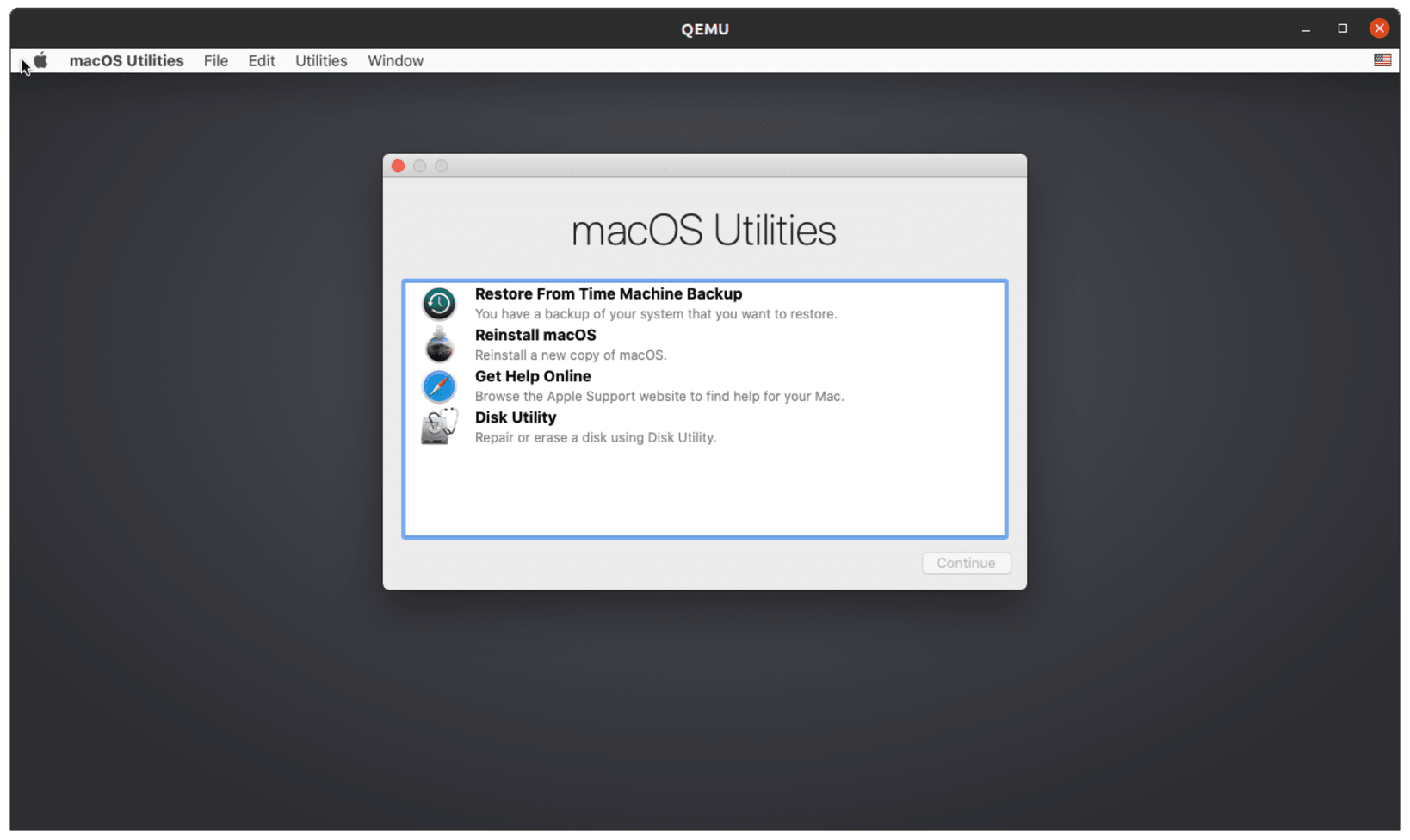
OpenCore для macOS
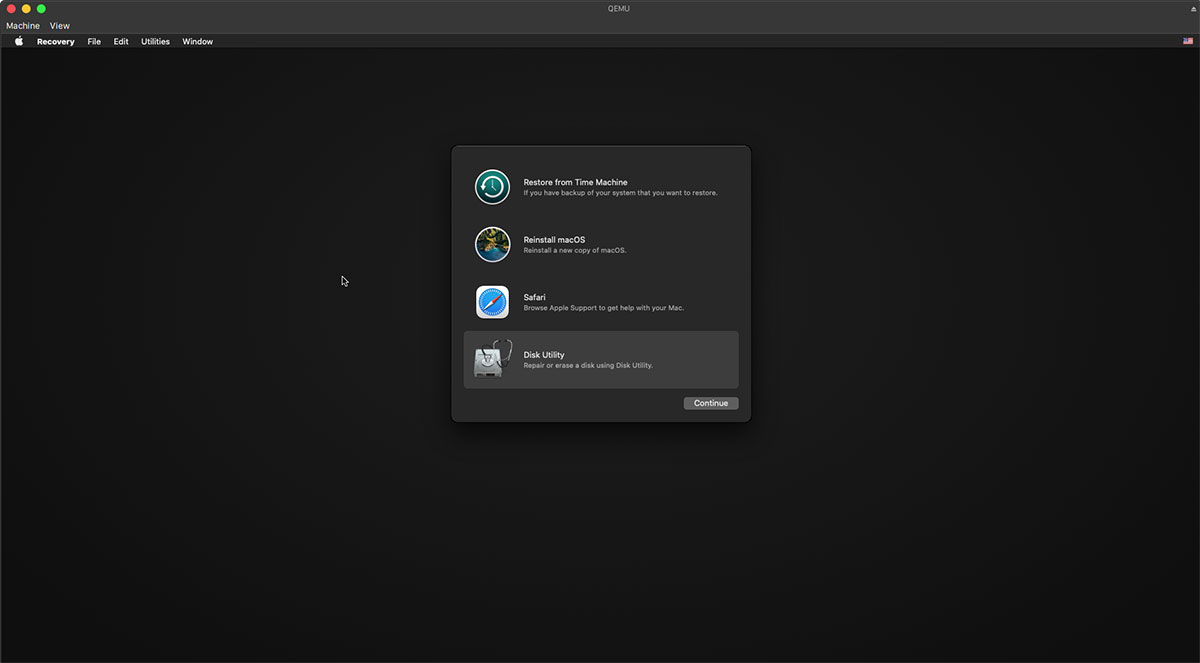
Вернуться на вершину
ТРЕБОВАНИЯ
Open the terminal and run:
sudo apt install qemu uml-utilities virt-manager gnome-boxes
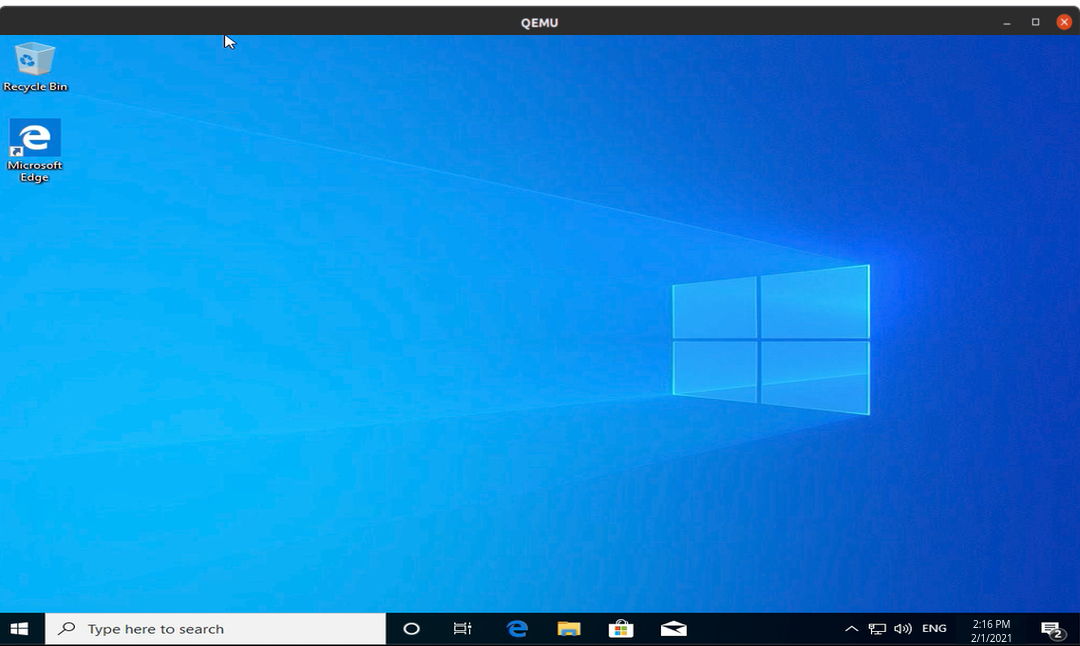
Boxes Gnome - это приложение, которое дает вам доступ к виртуальным машинам, работающим локально или удаленно. Это также позволяет подключаться к отображению удаленного компьютера.
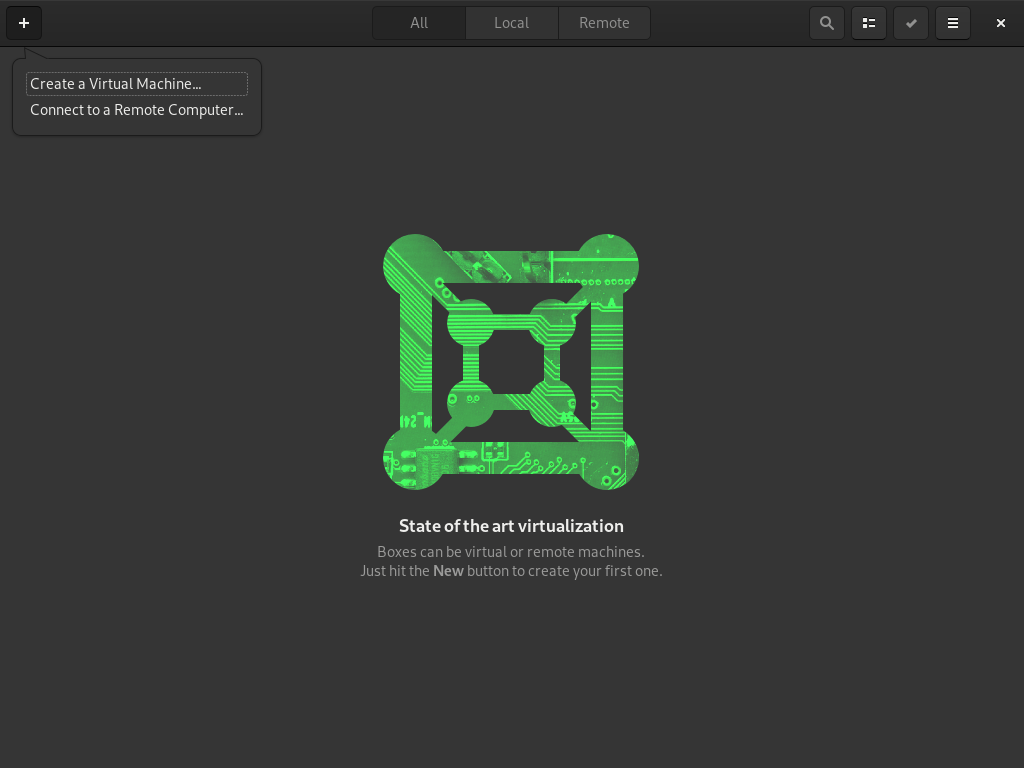
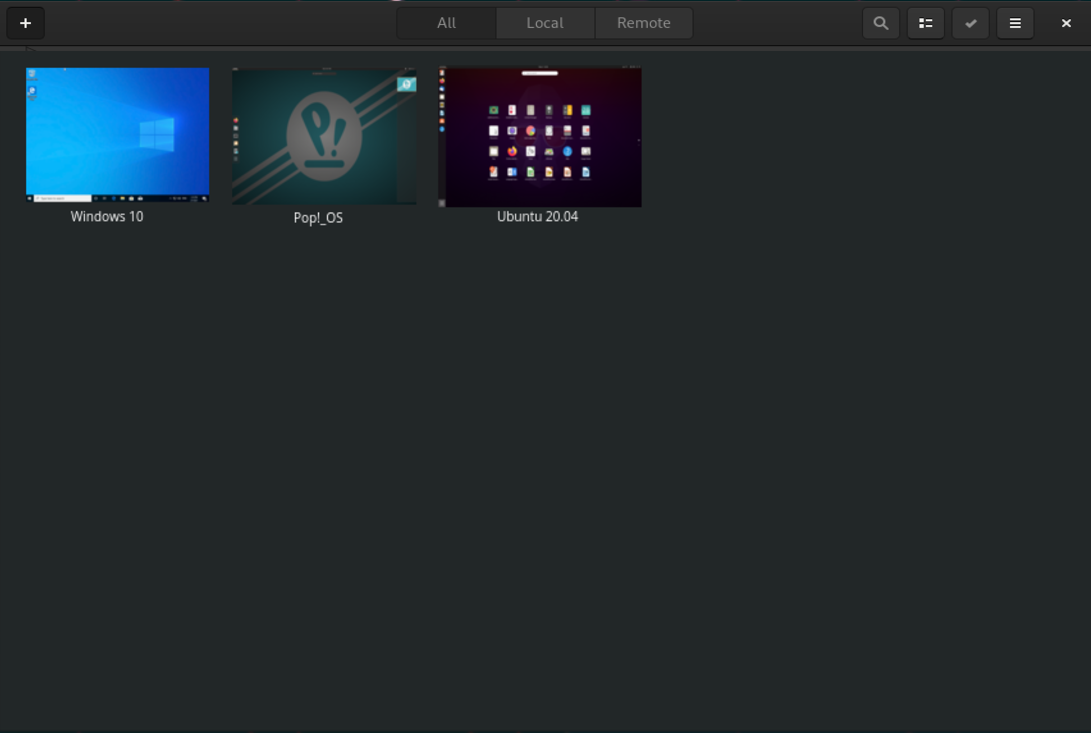
OpenCore для Windows 10
Вернуться на вершину
Android Studio - это набор разработок для операционной системы Android Google (ОС). Он построен на программном обеспечении JetBrains IntelliJ Idea и разработан специально для разработки Android. Он доступен для загрузки в Windows, MacOS и Linux.
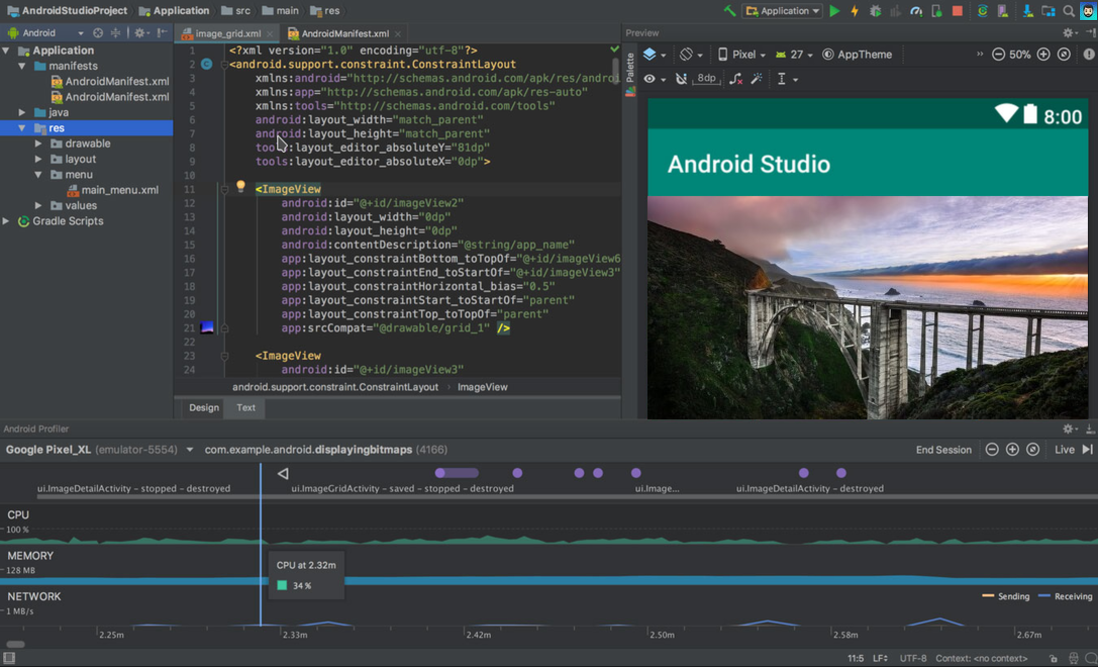
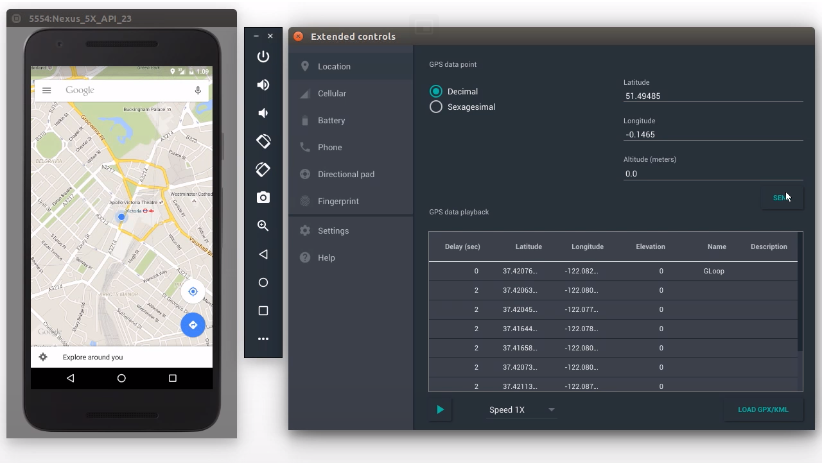
Виртуальное устройство Android (AVD) - это конфигурация в Android Studio, которая определяет характеристики телефона Android, планшет, ОС, Android TV или устройства для автомобильной ОС, которое вы хотите моделировать в эмуляторе Android. Эмулятор Android моделирует устройства Android на вашем компьютере, чтобы вы могли проверить свое приложение на различных устройствах и уровнях API Android без необходимости иметь каждое физическое устройство.
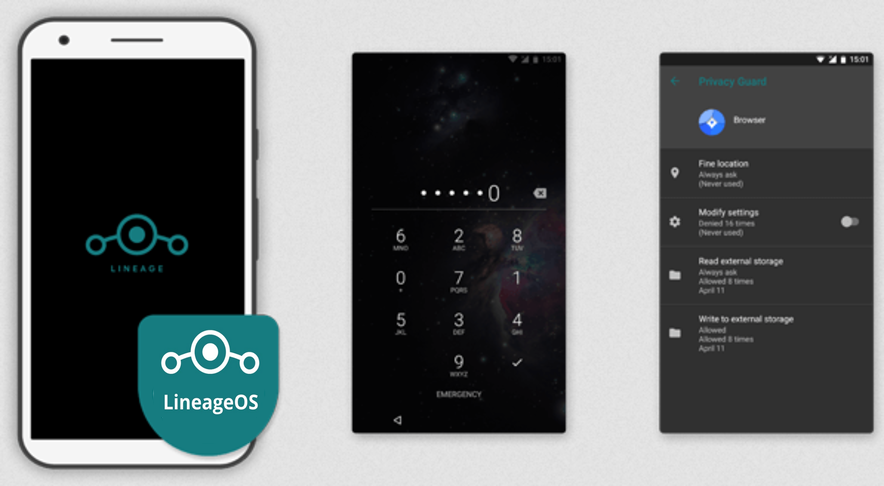
Lineageos-это бесплатная операционная система с открытым исходным кодом для различных устройств, основанная на мобильной платформе Android.
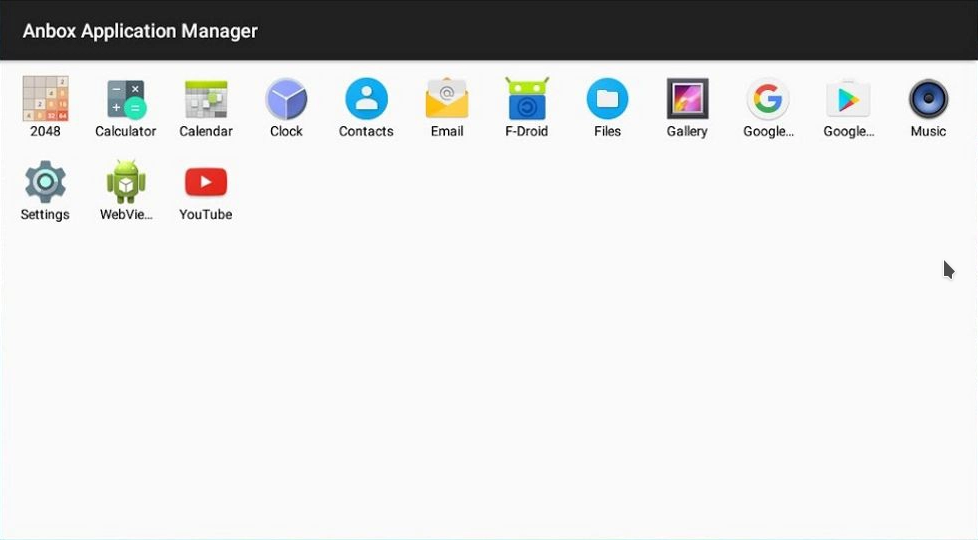
Anbox-это приложение, которое предоставляет контейнерный подход для загрузки полной системы Android в обычной системе GNU/Linux, такой как Ubuntu, Debian Fedora и OpenSuse.
Anbox Cloud - это платформа мобильных облачных вычислений, поставляемая Canonical. Запустите Android в облаке, в высокой масштабе и на любом типе оборудования.
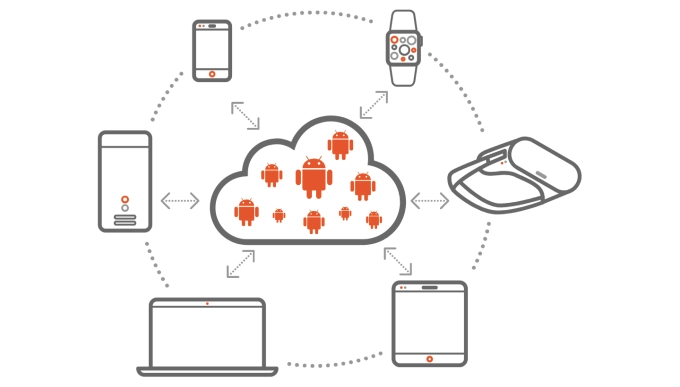
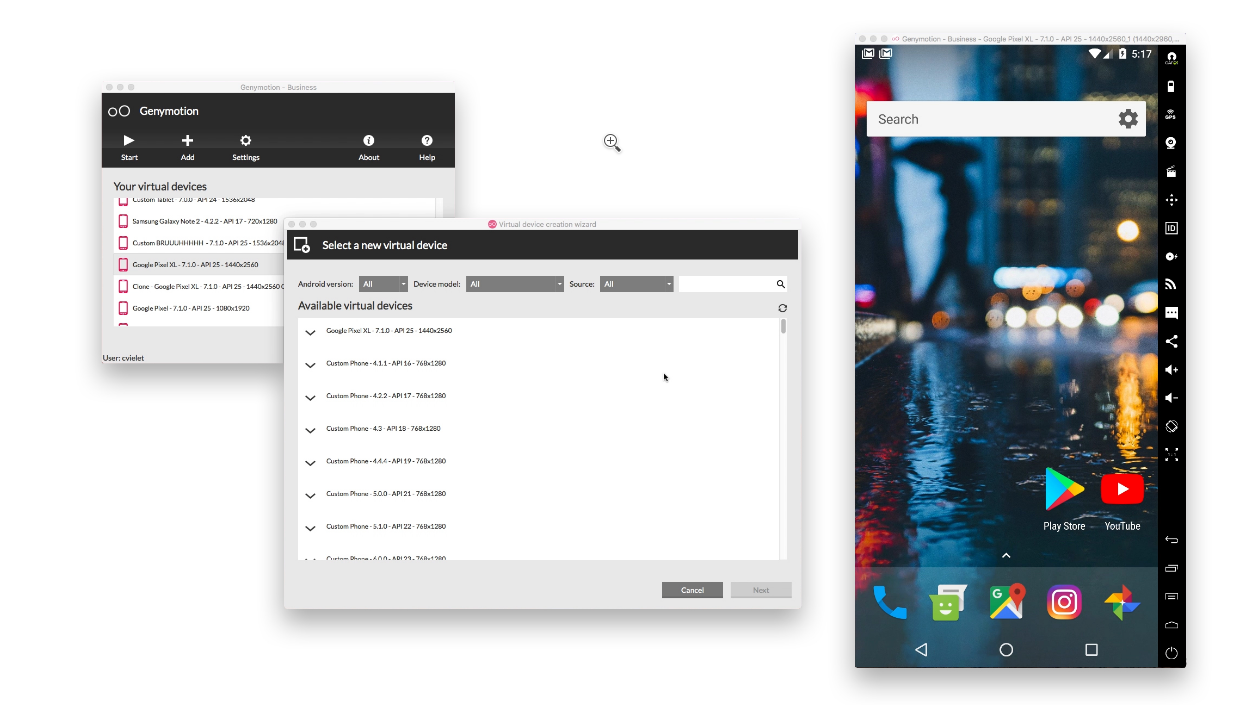
Genymotion - очень быстрый эмулятор Android. Сама программа основана на VirtualBox и известна своей эффективной быстрой скоростью и является полезностью для запуска приложений Android на рабочем столе Windows, Mac и Linux.
Настольный компьютер
Локальные виртуальные устройства с высокими характеристиками.
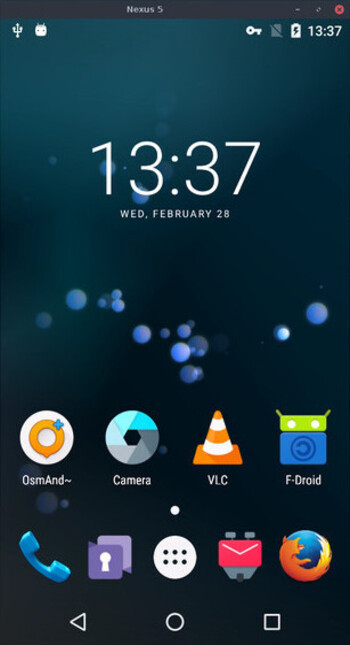
SCRCPY - это приложение по Genymotion, которое обеспечивает отображение и управление устройствами Android, подключенными на USB (или над TCP/IP). Он не требует какого -либо корневого доступа и работает на GNU/Linux, Windows и MacOS. Устройство Android требует как минимум API 21 (Android 5.0).
Вернуться на вершину
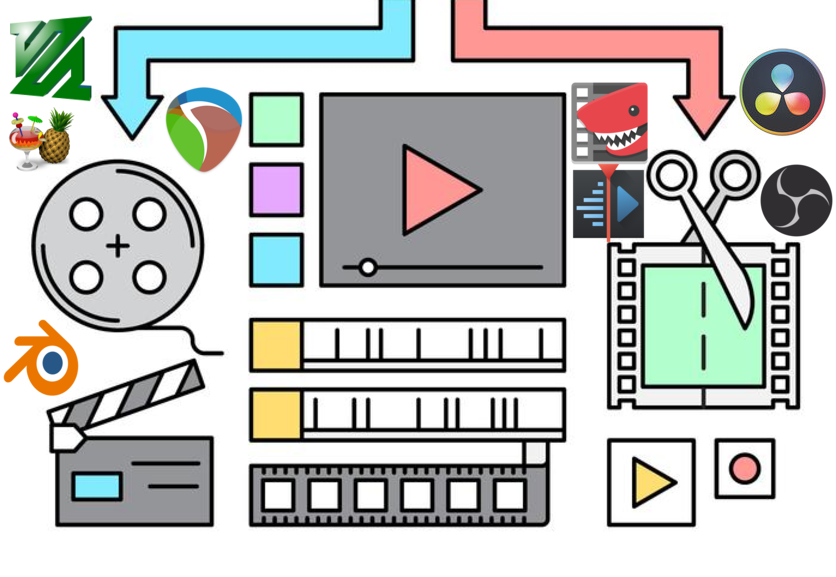
H.264 (AVC)-это стандарт сжатия видео, основанный на блоко-ориентированном и компенсированном движении кодирования целочисленного DCT, который определяет несколько профилей (инструменты) и уровни (максимальные битрейты и разрешения) с поддержкой до 8K.
H.265 (HEVC) - это стандарт сжатия видео, который является преемником H.264 (AVC). Он предлагает более от 25% до 50% лучшее сжатие данных на том же уровне качества видео или улучшенное качество видео при той же скорости.
FFMPEG - это ведущая мультимедийная структура, которая может декодировать, кодировать, транскод, mux, demux, поток, фильтр и играть практически все, что создали люди и машины. Он поддерживает самые неясные древние форматы до передовых на нескольких платформах, таких как Windows, MacOS и Linux.
Ручной тормоз - это инструмент для транскодирования видео практически из любого формата с выбором широко поддерживаемых кодеков. Он поддерживается на окне, macOS и Linux.
Динамическая адаптивная потоковая передача по HTTP (DASH) - это адаптивный протокол потоковой передачи, который позволяет видеопотоку переключаться между скоростями битов на основе производительности сети, чтобы сохранить видео.
OpenMax ™-это кроссплатформенный API, который обеспечивает комплексный потоковой медиа-кодек и портативность приложения, позволяя разрабатывать, интегрировать и запрограммировать ускоренные мультимедийные компоненты.
Davinci Resolve - единственное в мире решение, которое сочетает в себе профессиональное редактирование 8K, коррекцию цвета, визуальные эффекты и аудио -пост -производство в одном программном инструменте! Вы можете мгновенно перемещаться между редактированием, цветом, эффектами и аудио с одним щелчком. Davinci Resolve Studio также является единственным решением, предназначенным для многопользовательского сотрудничества, поэтому редакторы, помощники, колористы, художники VFX и звуковые дизайнеры могут одновременно работать в одном и том же проекте.
Blender поставляется со встроенным редактором последовательности видео позволяет вам выполнять основные действия, такие как вырезание видео и сплайсинг, а также более сложные задачи, такие как маскировка видео или оценка цвета. Видео редактор включает в себя: Live Preview, Luma Waveform, Chrama Vectorscope и гистограмму. Смешивание аудио, синхронизация, очистка и визуализация формы волны.
Kdenlive - это инструмент редактирования видео с открытым исходным кодом, который поддерживает неограниченные мультимедийные файлы. Он основан на структуре MLT, KDE и QT. Люди, которые ищут очень универсальный инструмент для редактирования видео, который оснащен функциями. Последний выпуск 20.08 вышел с изящными функциями, такими как макеты интерфейса, многочисленная поддержка аудиотока, управление кэшированными данными и зоомбары на панели монитора клипа и эффектов, но можно утверждать, что основными моментами этого выпуска являются стабильность и улучшения интерфейса.
OpenShot-это инструмент редактирования видео с открытым исходным кодом, который предназначен для новых пользователей в среде редактирования. Он имеет простые функции, такие как простая функция перетаскивания, он обеспечивает простой в использовании и быстро занятый пользовательский интерфейс. Мощный видео редактор предлагает множество эффективных способов обрезать и обрезать ваши видео. Вы можете свободно использовать неограниченные треки, двигатель видео эффектов, редактор заголовка, 3D -анимацию, замедленное движение и эффекты времени. Он поддерживает широко используемые видеокодеки, которые поддерживаются FFMPEG, такие как WebM (VP9), AVCHD (LIBX264), HEVC (LIBX265) и аудиокодеки, такие как MP3 (LIBMP3LAME) и AAC (LIBFAAC). Программа может отображать видео MPEG4, OGV, Blu-ray и DVD, а также видео Full HD для загрузки на веб-сайты интернет-видео, такие как YouTube.
Lightworks-это нелинейное применение видеоретификации для редактирования и освоения цифрового видео, используемого киноиндустрией. Его профессиональное издание использовалось для кассовых хитов, таких как остров затвора, фантастика и миссия невозможна. Запугивающий пользовательский интерфейс. Как и профессиональные редакторы видео, такие как Adobe Premiere Pro, Lightworks довольно сложный для использования для новых пользователей.
Shotcut-многоплатформенный видео редактор с открытым исходным кодом. Вы можете выполнять различные действия, такие как редактирование видео (включая качество видео 4K, добавление эффектов, создание новых фильмов, импортировать большинство форматов файлов изображений, экспорт практически в любой формат файлов и многое другое.
Olive-это бесплатный нелинейный видео редактор, направленный на предоставление полнофункциональной альтернативы высококлассному программному обеспечению для редактирования профессионального видео.
Natron - мощный цифровой композитор, который может удовлетворить все ваши потребности 2D/2,5D. Его надежные форматы файлов OIIO и архитектура OpenFX - это то, что делает Natron самым гибким композитором с открытым исходным кодом для сообщества визуальных эффектов. Его интерфейс и функционально одинаковы на всех платформах, таких как MacOS, Linux и Windows.
Obs (Open Broadcaster Software) является бесплатным программным обеспечением для записи видео и потоковой передачи видео. Поток до Twitch, YouTube и многих других поставщиков или записывает свои собственные видео с высококачественным кодированием H264 / AAC.
Reaper - это полное приложение для производства цифрового аудио для компьютеров, предлагающее полную мультитрукную аудио и MIDI -запись, редактирование, обработку, микширование и мастерство.
Jack Audio Connection Kit Aka Jack-это профессиональный демон-сервер звукового сервера, который обеспечивает подключения с низкой задержкой в режиме реального времени для данных Audio и MIDI между приложениями, которые реализуют его API. Джек может быть настроен на отправку аудиоданных по сети на «мастер» машину, которая затем выводит звук на физическое устройство. Это может быть полезно для смешивания аудио с ряда «подчиненных» компьютеров, не требуя дополнительных кабелей или аппаратных миксеров, а также поддерживать цифровой аудиоси по цифровому пути как можно дольше.
Bitwig Studio-это цифровая аудио рабочая станция, которая имеет линейные и нелинейные рабочие процессы для звукового дизайна, записи, живого исполнения и многого другого. Наряду с 90+ инструментами, эффектами и другими творческими инструментами. Это поддерживается Windows, MacOS и Linux.
Pipewire-это API Server и пользовательский пространство для борьбы с мультимедийными трубопроводами. Он предоставляет двигатель обработки на основе графиков с низкой задержкой на графике, а также аудио и видеоустройства, который можно использовать для поддержки вариантов использования, в настоящее время обрабатываемых как Pulseaudio, так и с Джеком. Pipewire была разработана с мощной моделью безопасности, которая упрощает взаимодействие с аудио и видеоустройствами из контейнерных приложений. Узлы на графике могут быть реализованы в виде отдельных процессов, общение с сокетами и обмену мультимедийным содержанием с использованием прохождения FD.
Yabridge - это современный и прозрачный способ использования плагинов Windows VST2 и VST3 на Linux. Yabridge плавно поддерживает использование 32-разрядных и 64-битных плагинов Windows VST2 и VST3 на 64-разрядном VST-хосте, как если бы они были собственными плагинами VST2 и VST3, с необязательной поддержкой групп плагинов, чтобы включить связь между плагинами для VST2 и быстрое время запуска.
Sonobus-это простое в использовании приложение для потокового высококачественного, низко-затравшего однорангового звука между устройствами через Интернет или локальной сети.
Avid Pro Tools-это программное обеспечение для аудиопроизводства в отрасли для авторов песен, музыкантов, продюсеров и инженеров.
LMMS - это прикладная программа для цифровой аудио с открытым исходным кодом. Когда LMMS сочетается с подходящим компьютерным оборудованием, это позволяет создавать музыку, распоряжая образцы, синтезируя звуки, воспроизводившись на клавиатуре MIDI и объединяя функции трекеров и секвенсоров. Эта программа, разработанная Полом Гиблоком и Тобиасом Джунгансом, означает «Multimedia Studio» Linux и поддерживает удобные плагины, которые позволяют ей работать в различных операционных системах.
Ardor является открытым исходным кодом, совместными усилиями мировой команды, включая музыкантов, программистов и профессиональных инженеров -записи. Развитие прозрачна - любой может наблюдать за нашей работой, как это происходит. Как хороший кусок винтажного оборудования, вы можете открыть коробку и заглянуть внутрь.
Audacity-это простой в использовании многоцелевой аудио редактор и рекордер для Windows, Mac OS X, GNU/Linux и других операционных систем. Разработано группой добровольцев в качестве открытого исходного кода и предлагается бесплатно. Удивительное сообщество поддержки.
Glimpse-это кроссплатформенный растровый графический редактор, основанный на программе манипулирования изображениями GNU, доступной для Linux, MacOS и Windows. Отличный инструмент для создания миниатюр видео на YouTube.
Вернуться на вершину

Kubernetes (K8S)-это система с открытым исходным кодом для автоматизации развертывания, масштабирования и управления контейнерными приложениями.
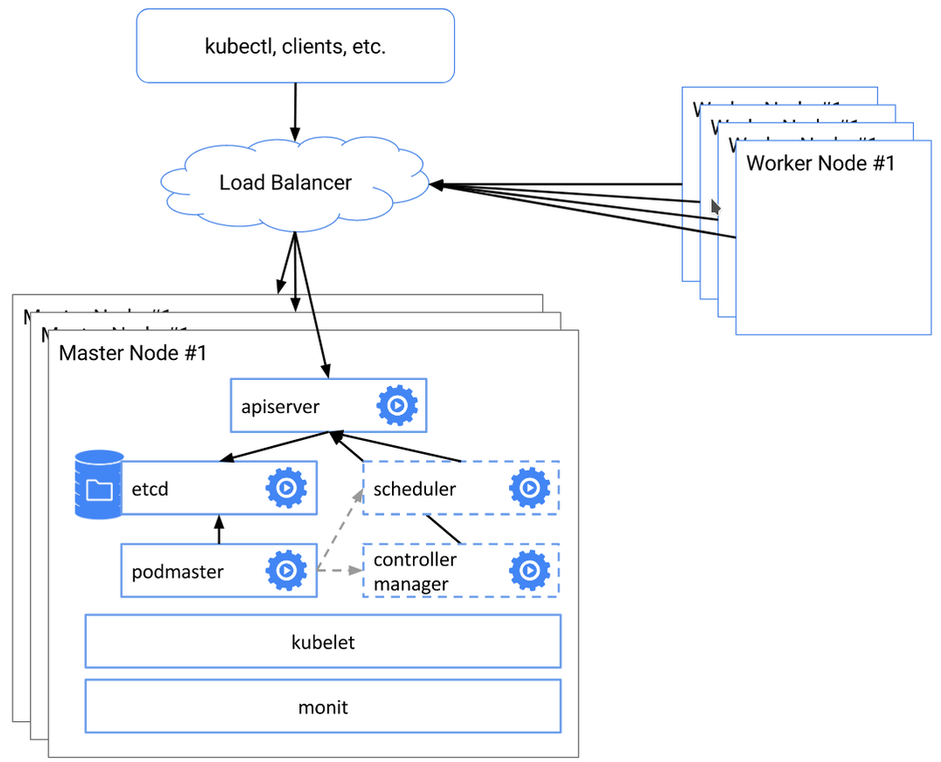
Строительство кластеров с высокой доступностью (HA) с kubeadm. Источник: kubernetes.io, 2020
Google Kubernetes Engine (GKE)-это управляемая, готовая к производству среду для запуска контейнерных приложений.
Azure Kubernetes Service (AKS) является без сервера Kubernetes, с интегрированной непрерывной интеграцией и непрерывной доставкой (CI/CD), а также безопасности и управлением корпоративным уровнем. Совместите свои команды по разработке и операциям на одной платформе, чтобы с уверенностью быстро построить, предоставлять и масштабировать приложения.
Amazon EKS - это инструмент, который запускает экземпляры плоскости управления Kubernetes по нескольким зонам доступности, чтобы обеспечить высокую доступность.
Контроллеры AWS для Kubernetes (ACK) - это новый инструмент, который позволяет вам напрямую управлять службами AWS от Kubernetes. ACK позволяет легко создавать масштабируемые и высокодоступные приложения Kubernetes, которые используют услуги AWS.
Контейнерный двигатель для kubernetes (OKE)-это операционная служба контейнерных управлений Oracle, которая может снизить время и затраты на создание современных облачных приложений. В отличие от большинства других поставщиков, Oracle Cloud Infrastructure предоставляет контейнерный двигатель для Kubernetes в качестве бесплатной услуги, которая работает на более низких и более дешевых вычислительных выборах.
Anthos-это современная платформа управления приложениями, которая обеспечивает постоянный опыт разработки и операций для облачных и локальных сред.
Red Hat OpenShift-это полностью управляемая платформа Kubernetes, которая обеспечивает основу для локальных, гибридных и мультиковых развертываний.
OKD-это сообщество, которое Kubernetes, оптимизированное для непрерывной разработки приложений и мультитенантного развертывания. OKD adds developer and operations-centric tools on top of Kubernetes to enable rapid application development, easy deployment and scaling, and long-term lifecycle maintenance for small and large teams.
Odo is a fast, iterative, and straightforward CLI tool for developers who write, build, and deploy applications on Kubernetes and OpenShift.
Kata Operator is an operator to perform lifecycle management (install/upgrade/uninstall) of Kata Runtime on Openshift as well as Kubernetes cluster.
Thanos is a set of components that can be composed into a highly available metric system with unlimited storage capacity, which can be added seamlessly on top of existing Prometheus deployments.
OpenShift Hive is an operator which runs as a service on top of Kubernetes/OpenShift. The Hive service can be used to provision and perform initial configuration of OpenShift 4 clusters.
Rook is a tool that turns distributed storage systems into self-managing, self-scaling, self-healing storage services. It automates the tasks of a storage administrator: deployment, bootstrapping, configuration, provisioning, scaling, upgrading, migration, disaster recovery, monitoring, and resource management.
VMware Tanzu is a centralized management platform for consistently operating and securing your Kubernetes infrastructure and modern applications across multiple teams and private/public clouds.
Kubespray is a tool that combines Kubernetes and Ansible to easily install Kubernetes clusters that can be deployed on AWS, GCE, Azure, OpenStack, vSphere, Packet (bare metal), Oracle Cloud Infrastructure (Experimental), or Baremetal.
KubeInit provides Ansible playbooks and roles for the deployment and configuration of multiple Kubernetes distributions.
Rancher is a complete software stack for teams adopting containers. It addresses the operational and security challenges of managing multiple Kubernetes clusters, while providing DevOps teams with integrated tools for running containerized workloads.
K3s is a highly available, certified Kubernetes distribution designed for production workloads in unattended, resource-constrained, remote locations or inside IoT appliances.
Helm is a Kubernetes Package Manager tool that makes it easier to install and manage Kubernetes applications.
Knative is a Kubernetes-based platform to build, deploy, and manage modern serverless workloads. Knative takes care of the operational overhead details of networking, autoscaling (even to zero), and revision tracking.
KubeFlow is a tool dedicated to making deployments of machine learning (ML) workflows on Kubernetes simple, portable and scalable.
Etcd is a distributed key-value store that provides a reliable way to store data that needs to be accessed by a distributed system or cluster of machines. Etcd is used as the backend for service discovery and stores cluster state and configuration for Kubernetes.
OpenEBS is a Kubernetes-based tool to create stateful applications using Container Attached Storage.
Container Storage Interface (CSI) is an API that lets container orchestration platforms like Kubernetes seamlessly communicate with stored data via a plug-in.
MicroK8s is a tool that delivers the full Kubernetes experience. In a Fully containerized deployment with compressed over-the-air updates for ultra-reliable operations. It is supported on Linux, Windows, and MacOS.
Charmed Kubernetes is a well integrated, turn-key, conformant Kubernetes platform, optimized for your multi-cloud environments developed by Canonical.
Grafana Kubernetes App is a toll that allows you to monitor your Kubernetes cluster's performance. It includes 4 dashboards, Cluster, Node, Pod/Container and Deployment. It allows for the automatic deployment of the required Prometheus exporters and a default scrape config to use with your in cluster Prometheus deployment.
KubeEdge is an open source system for extending native containerized application orchestration capabilities to hosts at Edge.It is built upon kubernetes and provides fundamental infrastructure support for network, app. deployment and metadata synchronization between cloud and edge.
Lens is the most powerful IDE for people who need to deal with Kubernetes clusters on a daily basis. It has support for MacOS, Windows and Linux operating systems.
kind is a tool for running local Kubernetes clusters using Docker container “nodes”. It was primarily designed for testing Kubernetes itself, but may be used for local development or CI.
Flux CD is a tool that automatically ensures that the state of your Kubernetes cluster matches the configuration you've supplied in Git. It uses an operator in the cluster to trigger deployments inside Kubernetes, which means that you don't need a separate continuous delivery tool.
Getting Kubernetes Certifications
Getting started with Kubernetes on AWS
Kubernetes on Microsoft Azure
Intro to Azure Kubernetes Service
Getting started with Google Cloud
Getting started with Kubernetes on Red Hat
Getting started with Kubernetes on IBM
YAML basics in Kubernetes
Elastic Cloud on Kubernetes
Docker and Kubernetes
Deploy a model to an Azure Kubernetes Service cluster
Simplify Machine Learning Inference on Kubernetes with Amazon SageMaker Operators
Running Apache Spark on Kubernetes
Kubernetes Across VMware vRealize Automation
VMware Tanzu Kubernetes Grid
All the Ways VMware Tanzu Works with AWS
VMware Tanzu Education
Using Ansible in a Cloud-Native Kubernetes Environment
Managing Kubernetes (K8s) objects with Ansible
Setting up a Kubernetes cluster using Vagrant and Ansible
Running MongoDB with Kubernetes
Kubernetes Fluentd
Understanding the new GitLab Kubernetes Agent
Kubernetes Contributors
KubeAcademy from VMware
Вернуться на вершину
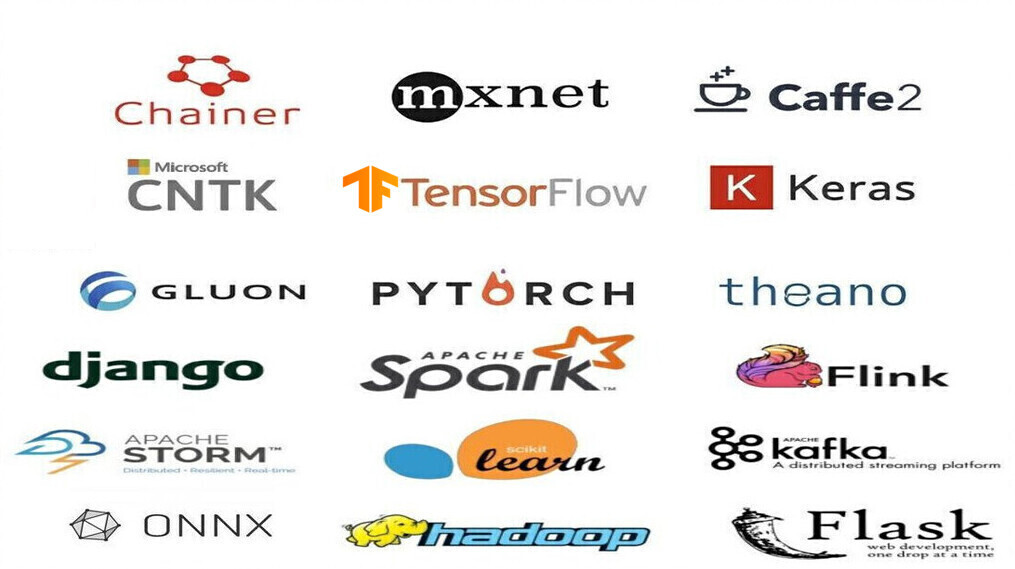
TensorFlow is an end-to-end open source platform for machine learning. It has a comprehensive, flexible ecosystem of tools, libraries and community resources that lets researchers push the state-of-the-art in ML and developers easily build and deploy ML powered applications.
Tensorman is a utility for easy management of Tensorflow containers by developed by System76.Tensorman allows Tensorflow to operate in an isolated environment that is contained from the rest of the system. This virtual environment can operate independent of the base system, allowing you to use any version of Tensorflow on any version of a Linux distribution that supports the Docker runtime.
Keras is a high-level neural networks API, written in Python and capable of running on top of TensorFlow, CNTK, or Theano.It was developed with a focus on enabling fast experimentation. It is capable of running on top of TensorFlow, Microsoft Cognitive Toolkit, R, Theano, or PlaidML.
PyTorch is a library for deep learning on irregular input data such as graphs, point clouds, and manifolds. Primarily developed by Facebook's AI Research lab.
Amazon SageMaker is a fully managed service that provides every developer and data scientist with the ability to build, train, and deploy machine learning (ML) models quickly. SageMaker removes the heavy lifting from each step of the machine learning process to make it easier to develop high quality models.
Azure Databricks is a fast and collaborative Apache Spark-based big data analytics service designed for data science and data engineering. Azure Databricks, sets up your Apache Spark environment in minutes, autoscale, and collaborate on shared projects in an interactive workspace. Azure Databricks supports Python, Scala, R, Java, and SQL, as well as data science frameworks and libraries including TensorFlow, PyTorch, and scikit-learn.
Microsoft Cognitive Toolkit (CNTK) is an open-source toolkit for commercial-grade distributed deep learning. It describes neural networks as a series of computational steps via a directed graph. CNTK allows the user to easily realize and combine popular model types such as feed-forward DNNs, convolutional neural networks (CNNs) and recurrent neural networks (RNNs/LSTMs). CNTK implements stochastic gradient descent (SGD, error backpropagation) learning with automatic differentiation and parallelization across multiple GPUs and servers.
Apache Airflow is an open-source workflow management platform created by the community to programmatically author, schedule and monitor workflows. Установить. Principles. Scalable. Airflow has a modular architecture and uses a message queue to orchestrate an arbitrary number of workers. Airflow is ready to scale to infinity.
Open Neural Network Exchange(ONNX) is an open ecosystem that empowers AI developers to choose the right tools as their project evolves. ONNX provides an open source format for AI models, both deep learning and traditional ML. It defines an extensible computation graph model, as well as definitions of built-in operators and standard data types.
Apache MXNet is a deep learning framework designed for both efficiency and flexibility. It allows you to mix symbolic and imperative programming to maximize efficiency and productivity. At its core, MXNet contains a dynamic dependency scheduler that automatically parallelizes both symbolic and imperative operations on the fly. A graph optimization layer on top of that makes symbolic execution fast and memory efficient. MXNet is portable and lightweight, scaling effectively to multiple GPUs and multiple machines. Support for Python, R, Julia, Scala, Go, Javascript and more.
AutoGluon is toolkit for Deep learning that automates machine learning tasks enabling you to easily achieve strong predictive performance in your applications. With just a few lines of code, you can train and deploy high-accuracy deep learning models on tabular, image, and text data.
Anaconda is a very popular Data Science platform for machine learning and deep learning that enables users to develop models, train them, and deploy them.
PlaidML is an advanced and portable tensor compiler for enabling deep learning on laptops, embedded devices, or other devices where the available computing hardware is not well supported or the available software stack contains unpalatable license restrictions.
OpenCV is a highly optimized library with focus on real-time computer vision applications. The C++, Python, and Java interfaces support Linux, MacOS, Windows, iOS, and Android.
Scikit-Learn is a Python module for machine learning built on top of SciPy, NumPy, and matplotlib, making it easier to apply robust and simple implementations of many popular machine learning algorithms.
Weka is an open source machine learning software that can be accessed through a graphical user interface, standard terminal applications, or a Java API. It is widely used for teaching, research, and industrial applications, contains a plethora of built-in tools for standard machine learning tasks, and additionally gives transparent access to well-known toolboxes such as scikit-learn, R, and Deeplearning4j.
Caffe is a deep learning framework made with expression, speed, and modularity in mind. It is developed by Berkeley AI Research (BAIR)/The Berkeley Vision and Learning Center (BVLC) and community contributors.
Theano is a Python library that allows you to define, optimize, and evaluate mathematical expressions involving multi-dimensional arrays efficiently including tight integration with NumPy.
nGraph is an open source C++ library, compiler and runtime for Deep Learning. The nGraph Compiler aims to accelerate developing AI workloads using any deep learning framework and deploying to a variety of hardware targets.It provides the freedom, performance, and ease-of-use to AI developers.
NVIDIA cuDNN is a GPU-accelerated library of primitives for deep neural networks. cuDNN provides highly tuned implementations for standard routines such as forward and backward convolution, pooling, normalization, and activation layers. cuDNN accelerates widely used deep learning frameworks, including Caffe2, Chainer, Keras, MATLAB, MxNet, PyTorch, and TensorFlow.
Jupyter Notebook is an open-source web application that allows you to create and share documents that contain live code, equations, visualizations and narrative text. Jupyter is used widely in industries that do data cleaning and transformation, numerical simulation, statistical modeling, data visualization, data science, and machine learning.
Apache Spark is a unified analytics engine for large-scale data processing. It provides high-level APIs in Scala, Java, Python, and R, and an optimized engine that supports general computation graphs for data analysis. It also supports a rich set of higher-level tools including Spark SQL for SQL and DataFrames, MLlib for machine learning, GraphX for graph processing, and Structured Streaming for stream processing.
Apache Spark Connector for SQL Server and Azure SQL is a high-performance connector that enables you to use transactional data in big data analytics and persists results for ad-hoc queries or reporting. The connector allows you to use any SQL database, on-premises or in the cloud, as an input data source or output data sink for Spark jobs.
Apache PredictionIO is an open source machine learning framework for developers, data scientists, and end users. It supports event collection, deployment of algorithms, evaluation, querying predictive results via REST APIs. It is based on scalable open source services like Hadoop, HBase (and other DBs), Elasticsearch, Spark and implements what is called a Lambda Architecture.
Cluster Manager for Apache Kafka(CMAK) is a tool for managing Apache Kafka clusters.
BigDL is a distributed deep learning library for Apache Spark. With BigDL, users can write their deep learning applications as standard Spark programs, which can directly run on top of existing Spark or Hadoop clusters.
Koalas is project makes data scientists more productive when interacting with big data, by implementing the pandas DataFrame API on top of Apache Spark.
Apache Spark™ MLflow is an open source platform to manage the ML lifecycle, including experimentation, reproducibility, deployment, and a central model registry. MLflow currently offers four components:
MLflow Tracking : Record and query experiments: code, data, config, and results.
MLflow Projects : Package data science code in a format to reproduce runs on any platform.
MLflow Models : Deploy machine learning models in diverse serving environments.
Model Registry : Store, annotate, discover, and manage models in a central repository.
Eclipse Deeplearning4J (DL4J) is a set of projects intended to support all the needs of a JVM-based(Scala, Kotlin, Clojure, and Groovy) deep learning application. This means starting with the raw data, loading and preprocessing it from wherever and whatever format it is in to building and tuning a wide variety of simple and complex deep learning networks.
Numba is an open source, NumPy-aware optimizing compiler for Python sponsored by Anaconda, Inc. It uses the LLVM compiler project to generate machine code from Python syntax. Numba can compile a large subset of numerically-focused Python, including many NumPy functions. Additionally, Numba has support for automatic parallelization of loops, generation of GPU-accelerated code, and creation of ufuncs and C callbacks.
Chainer is a Python-based deep learning framework aiming at flexibility. It provides automatic differentiation APIs based on the define-by-run approach (dynamic computational graphs) as well as object-oriented high-level APIs to build and train neural networks. It also supports CUDA/cuDNN using CuPy for high performance training and inference.
cuML is a suite of libraries that implement machine learning algorithms and mathematical primitives functions that share compatible APIs with other RAPIDS projects. cuML enables data scientists, researchers, and software engineers to run traditional tabular ML tasks on GPUs without going into the details of CUDA programming. In most cases, cuML's Python API matches the API from scikit-learn.
Machine Learning by Stanford University from Coursera
Machine Learning Courses Online from Coursera
Machine Learning Courses Online from Udemy
Learn Machine Learning with Online Courses and Classes from edX
Вернуться на вершину

ROS is robotics middleware. Although ROS is not an operating system, it provides services designed for a heterogeneous computer cluster such as hardware abstraction, low-level device control, implementation of commonly used functionality, message-passing between processes, and package management.
ROS2 is a set of software libraries and tools that help you build robot applications. From drivers to state-of-the-art algorithms, and with powerful developer tools, ROS has what you need for your next robotics project. And it's all open source.
Robot Framework is a generic open source automation framework. It can be used for test automation and robotic process automation. It has easy syntax, utilizing human-readable keywords. Its capabilities can be extended by libraries implemented with Python or Java.
The Robotics Library (RL) is a self-contained C++ library for robot kinematics, motion planning and control. It covers mathematics, kinematics and dynamics, hardware abstraction, motion planning, collision detection, and visualization.RL runs on many different systems, including Linux, macOS, and Windows. It uses CMake as a build system and can be compiled with Clang, GCC, and Visual Studio.
MoveIt is the most widely used software for manipulation and has been used on over 100 robots. It provides an easy-to-use robotics platform for developing advanced applications, evaluating new designs and building integrated products for industrial, commercial, R&D, and other domains.
AutoGluon is toolkit for Deep learning that automates machine learning tasks enabling you to easily achieve strong predictive performance in your applications. With just a few lines of code, you can train and deploy high-accuracy deep learning models on tabular, image, and text data.
Gazebo accurately and efficiently simulates indoor and outdoor robots. You get a robust physics engine, high-quality graphics, and programmatic and graphical interfaces.
Robotics System Toolbox provides tools and algorithms for designing, simulating, and testing manipulators, mobile robots, and humanoid robots. For manipulators and humanoid robots, the toolbox includes algorithms for collision checking, trajectory generation, forward and inverse kinematics, and dynamics using a rigid body tree representation. For mobile robots, it includes algorithms for mapping, localization, path planning, path following, and motion control. The toolbox provides reference examples of common industrial robot applications. It also includes a library of commercially available industrial robot models that you can import, visualize, and simulate.
Intel Robot DevKit is the tool to generate Robotics Software Development Kit (RDK) designed for autonomous devices, including the ROS2 core and capacibilities packages like perception, planning, control driver etc. It provides flexible build/runtime configurations to meet different autonomous requirement on top of diversity hardware choices, for example use different hareware engine CPU/GPU/VPU to accelerate AI related features.
Arduino is an open-source platform used for building electronics projects. Arduino consists of both a physical programmable circuit board (often referred to as a microcontroller) and a piece of software, or IDE (Integrated Development Environment) that runs on your computer, used to write and upload computer code to the physical board.
ArduPilot enables the creation and use of trusted, autonomous, unmanned vehicle systems for the peaceful benefit of all. ArduPilot provides a comprehensive suite of tools suitable for almost any vehicle and application.
AirSim is a simulator for drones, cars and more, built on Unreal Engine (we now also have an experimental Unity release). It is open-source, cross platform, and supports hardware-in-loop with popular flight controllers such as PX4 for physically and visually realistic simulations.
F´ (F Prime) is a component-driven framework that enables rapid development and deployment of spaceflight and other embedded software applications. Originally developed at the Jet Propulsion Laboratory, F´ has been successfully deployed on several space applications.
The JPL Open Source Rover is an open source, build it yourself, scaled down version of the 6 wheel rover design that JPL uses to explore the surface of Mars. The Open Source Rover is designed almost entirely out of consumer off the shelf (COTS) parts. This project is intended to be a teaching and learning experience for those who want to get involved in mechanical engineering, software, electronics, or robotics.
Light Detection and Ranging(LiDAR) is a remote sensing method that uses light in the form of a pulsed laser at an object, and uses the time and wavelength of the reflected beam of light to estimate the distance and in some applications (Laser Imaging), to create a 3D representation of the object and its surface characteristics. This technology is commonly used in aircraft and self-driving vehicles.
AliceVision is a Photogrammetric Computer Vision Framework which provides a 3D Reconstruction and Camera Tracking algorithms. AliceVision aims to provide strong software basis with state-of-the-art computer vision algorithms that can be tested, analyzed and reused. The project is a result of collaboration between academia and industry to provide cutting-edge algorithms with the robustness and the quality required for production usage.
CARLA is an open-source simulator for autonomous driving research. CARLA has been developed from the ground up to support development, training, and validation of autonomous driving systems. In addition to open-source code and protocols, CARLA provides open digital assets (urban layouts, buildings, vehicles) that were created for this purpose and can be used freely. The simulation platform supports flexible specification of sensor suites and environmental conditions.
ROS bridge is a package to bridge ROS for CARLA Simulator.
ROS-Industrial is an open source project that extends the advanced capabilities of ROS software to manufacturing.
AWS RoboMaker is the most complete cloud solution for robotic developers to simulate, test and securely deploy robotic applications at scale. RoboMaker provides a fully-managed, scalable infrastructure for simulation that customers use for multi-robot simulation and CI/CD integration with regression testing in simulation.
Microsoft Robotics Developer Studio is a free .NET-based programming environment for building robotics applications.
Visual Studio Code Extension for ROS is an extension provides support for Robot Operating System (ROS) development.
Azure Kinect ROS Driver is a node which publishes sensor data from the Azure Kinect Developer Kit to the Robot Operating System (ROS). Developers working with ROS can use this node to connect an Azure Kinect Developer Kit to an existing ROS installation.
Azure IoT Hub for ROS is a ROS package works with the Microsoft Azure IoT Hub service to relay telemetry messages from the Robot to Azure IoT Hub or reflect properties from the Digital Twin to the robot using dynamic reconfigure.
ROS 2 with ONNX Runtime is a program that uses ROS 2 to run on different hardware platforms using their respective AI acceleration libraries for optimized execution of the ONNX model.
Azure Cognitive Services LUIS ROS Node is a ROS node that bridges between ROS and the Azure Language Understanding Service. it can be configured to process audio directly from a microphone, or can subscribe to a ROS audio topic, then processes speech and generates "intent" ROS messages which can be processed by another ROS node to generate ROS commands.
Robotics courses from Coursera
Learn Robotics with Online Courses and Classes from edX
Top Robotics Courses Online from Udemy
Free Online AI & Robotics Courses
REC Foundation Robotics Industry Certification
Carnegie Mellon Robotics Academy
RIA Robotic Integrator Certification Program
AWS RoboMaker – Develop, Test, Deploy, and Manage Intelligent Robotics Apps
Microsoft AI School
Language Understanding (LUIS) for Azure Cognitive Services
Azure VM templates to bootstrap ROS and ROS 2 environments
Google Robotics Research
Вернуться на вершину

Open Source Security Foundation (OpenSSF) is a cross-industry collaboration that brings together leaders to improve the security of open source software by building a broader community, targeted initiatives, and best practices. The OpenSSF brings together open source security initiatives under one foundation to accelerate work through cross-industry support. Along with the Core Infrastructure Initiative and the Open Source Security Coalition, and will include new working groups that address vulnerability disclosures, security tooling and more.
STIGs Benchmarks - Security Technical Implementation Guides
CIS Benchmarks - CIS Center for Internet Security
NIST - Current FIPS
ISO Standards Catalogue
Common Criteria for Information Technology Security Evaluation (CC) is an international standard (ISO / IEC 15408) for computer security. It allows an objective evaluation to validate that a particular product satisfies a defined set of security requirements.
ISO 22301 is the international standard that provides a best-practice framework for implementing an optimised BCMS (business continuity management system).
ISO27001 is the international standard that describes the requirements for an ISMS (information security management system). The framework is designed to help organizations manage their security practices in one place, consistently and cost-effectively.
ISO 27701 specifies the requirements for a PIMS (privacy information management system) based on the requirements of ISO 27001. It is extended by a set of privacy-specific requirements, control objectives and controls. Companies that have implemented ISO 27001 will be able to use ISO 27701 to extend their security efforts to cover privacy management.
EU GDPR (General Data Protection Regulation) is a privacy and data protection law that supersedes existing national data protection laws across the EU, bringing uniformity by introducing just one main data protection law for companies/organizations to comply with.
CCPA (California Consumer Privacy Act) is a data privacy law that took effect on January 1, 2020 in the State of California. It applies to businesses that collect California residents' personal information, and its privacy requirements are similar to those of the EU's GDPR (General Data Protection Regulation).
Payment Card Industry (PCI) Data Security Standards (DSS) is a global information security standard designed to prevent fraud through increased control of credit card data.
SOC 2 is an auditing procedure that ensures your service providers securely manage your data to protect the interests of your comapny/organization and the privacy of their clients.
NIST CSF is a voluntary framework primarily intended for critical infrastructure organizations to manage and mitigate cybersecurity risk based on existing best practice.
AppArmor is an effective and easy-to-use Linux application security system. AppArmor proactively protects the operating system and applications from external or internal threats, even zero-day attacks, by enforcing good behavior and preventing both known and unknown application flaws from being exploited. AppArmor supplements the traditional Unix discretionary access control (DAC) model by providing mandatory access control (MAC). It has been included in the mainline Linux kernel since version 2.6.36 and its development has been supported by Canonical since 2009.
SELinux is a security enhancement to Linux which allows users and administrators more control over access control. Access can be constrained on such variables as which users and applications can access which resources. These resources may take the form of files. Standard Linux access controls, such as file modes (-rwxr-xr-x) are modifiable by the user and the applications which the user runs. Conversely, SELinux access controls are determined by a policy loaded on the system which may not be changed by careless users or misbehaving applications.
Control Groups(Cgroups) is a Linux kernel feature that allows you to allocate resources such as CPU time, system memory, network bandwidth, or any combination of these resources for user-defined groups of tasks (processes) running on a system.
EarlyOOM is a daemon for Linux that enables users to more quickly recover and regain control over their system in low-memory situations with heavy swap usage.
Libgcrypt is a general purpose cryptographic library originally based on code from GnuPG.
Kali Linux is an open source project that is maintained and funded by Offensive Security, a provider of world-class information security training and penetration testing services.
Pi-hole is a DNS sinkhole that protects your devices from unwanted content, without installing any client-side software, intended for use on a private network. It is designed for use on embedded devices with network capability, such as the Raspberry Pi, but it can be used on other machines running Linux and cloud implementations.
Aircrack-ng is a network software suite consisting of a detector, packet sniffer, WEP and WPA/WPA2-PSK cracker and analysis tool for 802.11 wireless LANs. It works with any wireless network interface controller whose driver supports raw monitoring mode and can sniff 802.11a, 802.11b and 802.11g traffic.
Burp Suite is a leading range of cybersecurity tools.
KernelCI is a community-based open source distributed test automation system focused on upstream kernel development. The primary goal of KernelCI is to use an open testing philosophy to ensure the quality, stability and long-term maintenance of the Linux kernel.
Continuous Kernel Integration project helps find bugs in kernel patches before they are commited to an upstram kernel tree. We are team of kernel developers, kernel testers, and automation engineers.
eBPF is a revolutionary technology that can run sandboxed programs in the Linux kernel without changing kernel source code or loading kernel modules. By making the Linux kernel programmable, infrastructure software can leverage existing layers, making them more intelligent and feature-rich without continuing to add additional layers of complexity to the system.
Cilium uses eBPF to accelerate getting data in and out of L7 proxies such as Envoy, enabling efficient visibility into API protocols like HTTP, gRPC, and Kafka.
Hubble is a Network, Service & Security Observability for Kubernetes using eBPF.
Istio is an open platform to connect, manage, and secure microservices. Istio's control plane provides an abstraction layer over the underlying cluster management platform, such as Kubernetes and Mesos.
Certgen is a convenience tool to generate and store certificates for Hubble Relay mTLS.
Scapy is a python-based interactive packet manipulation program & library.
syzkaller is an unsupervised, coverage-guided kernel fuzzer.
SchedViz is a tool for gathering and visualizing kernel scheduling traces on Linux machines.
oss-fuzz aims to make common open source software more secure and stable by combining modern fuzzing techniques with scalable, distributed execution.
OSSEC is a free, open-source host-based intrusion detection system. It performs log analysis, integrity checking, Windows registry monitoring, rootkit detection, time-based alerting, and active response.
Metasploit Project is a computer security project that provides information about security vulnerabilities and aids in penetration testing and IDS signature development.
Wfuzz was created to facilitate the task in web applications assessments and it is based on a simple concept: it replaces any reference to the FUZZ keyword by the value of a given payload.
Nmap is a security scanner used to discover hosts and services on a computer network, thus building a "map" of the network.
Patchwork is a web-based patch tracking system designed to facilitate the contribution and management of contributions to an open-source project.
pfSense is a free and open source firewall and router that also features unified threat management, load balancing, multi WAN, and more.
Snowpatch is a continuous integration tool for projects using a patch-based, mailing-list-centric git workflow. This workflow is used by a number of well-known open source projects such as the Linux kernel.
Snort is an open-source, free and lightweight network intrusion detection system (NIDS) software for Linux and Windows to detect emerging threats.
Wireshark is a free and open-source packet analyzer. It is used for network troubleshooting, analysis, software and communications protocol development, and education.
OpenSCAP is US standard maintained by National Institute of Standards and Technology (NIST). It provides multiple tools to assist administrators and auditors with assessment, measurement, and enforcement of security baselines. OpenSCAP maintains great flexibility and interoperability by reducing the costs of performing security audits. Whether you want to evaluate DISA STIGs, NIST's USGCB, or Red Hat's Security Response Team's content, all are supported by OpenSCAP.
Tink is a multi-language, cross-platform, open source library that provides cryptographic APIs that are secure, easy to use correctly, and harder to misuse.
OWASP is an online community, produces freely-available articles, methodologies, documentation, tools, and technologies in the field of web application security.
Open Vulnerability and Assessment Language is a community effort to standardize how to assess and report upon the machine state of computer systems. OVAL includes a language to encode system details, and community repositories of content. Tools and services that use OVAL provide enterprises with accurate, consistent, and actionable information to improve their security.
ClamAV is an open source antivirus engine for detecting trojans, viruses, malware & other malicious threats.
Microsoft Open Source Software Security
Cloudflare Open Source Security
The Seven Properties of Highly Secure Devices
How Layer 7 of the Internet Works
The 7 Kinds of Security
The Libgcrypt Reference Manual
The Open Web Application Security Project(OWASP) Foundation Top 10
Best Practices for Using Open Source Code from The Linux Foundation
AWS Certified Security - Specialty Certification
Microsoft Certified: Azure Security Engineer Associate
Google Cloud Certified Professional Cloud Security Engineer
Cisco Security Certifications
The Red Hat Certified Specialist in Security: Linux
Linux Professional Institute LPIC-3 Enterprise Security Certification
Cybersecurity Training and Courses from IBM Skills
Cybersecurity Courses and Certifications by Offensive Security
RSA Certification Program
Check Point Certified Security Expert(CCSE) Certification
Check Point Certified Security Administrator(CCSA) Certification
Check Point Certified Security Master (CCSM) Certification
Certified Cloud Security Professional(CCSP) Certification
Certified Information Systems Security Professional (CISSP) Certification
CCNP Routing and Switching
Certified Information Security Manager(CISM)
Wireshark Certified Network Analyst (WCNA)
Juniper Networks Certification Program Enterprise (JNCP)
Security Training Certifications and Courses from Udemy
Security Training Certifications and Courses from Coursera
Security Certifications Training from Pluarlsight
Вернуться на вершину

Differential Privacy is a system that simultaneously enables researchers and analysts to extract useful insights from datasets containing personal information and offers stronger privacy protections. This is achieved by introducing "statistical noise".
Statistical Noise is a process that small aletrations to masked datasets. The statistical noise hides identifiable characteristics of individuals, ensuring that the privacy of personal information is protected, but it's small enough to not materially impact the accuracy of the answers extracted by analysts and researchers.
Laplacian Noise is a mechanism that adds Laplacian-distributed noise to a function.
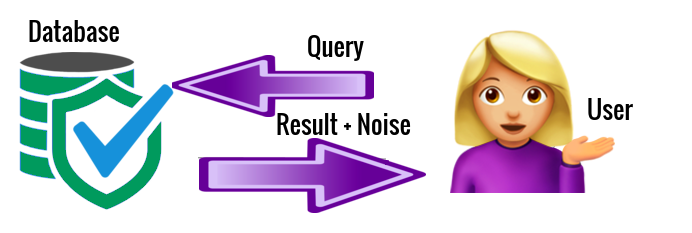
Above is a simple diagram of how Differential Privacy-Preserving Data Sharing and Data Mining protects a User's Data
PySyft is a Python library for secure and private Deep Learning. PySyft decouples private data from model training, using Federated Learning, Differential Privacy, and Encrypted Computation (like Multi-Party Computation (MPC) and Homomorphic Encryption (HE) within the main Deep Learning frameworks like PyTorch and TensorFlow.
TensorFlow Privacy is a Python library that includes implementations of TensorFlow optimizers for training machine learning models with differential privacy. The library comes with tutorials and analysis tools for computing the privacy guarantees provided.
TensorFlow Federated (TFF) is an open-source framework for machine learning and other computations on decentralized data. TFF has been developed to facilitate open research and experimentation with Federated Learning (FL), an approach to machine learning where a shared global model is trained across many participating clients that keep their training data locally.
Privacy on Beam is an end-to-end differential privacy solution built on Apache Beam. It is intended to be usable by all developers, regardless of their differential privacy expertise.
PyDP is a Python wrapper for Google's Differential Privacy project.
PennyLane is a cross-platform Python library for differentiable programming of quantum computers. By training a quantum computer the same way as a neural network.
BoTorch is a library for Bayesian Optimization built on PyTorch.
PyTorch Geometric (PyG) is a geometric deep learning extension library for PyTorch.
Skorch is a scikit-learn compatible neural network library that wraps PyTorch.
Diffprivlib is the IBM Differential Privacy Library for experimenting with, investigating and developing applications in, differential privacy.
Opacus is a library that enables training PyTorch models with differential privacy. It supports training with minimal code changes required on the client, has little impact on training performance and allows the client to online track the privacy budget expended at any given moment.
Smart Noise is a toolkit that uses state-of-the-art differential privacy (DP) techniques to inject noise into data, to prevent disclosure of sensitive information and manage exposure risk.
Differential Privacy Blog Series by the National Institute of Standards and Technology(NIST)
Apple's Differential Privacy Overview
Learning with Privacy at Scale with Apple Machine Learning
Microsoft Research Differential Privacy Overview
Responsible Machine Learning with Microsoft Azure
Responsible AI Resources with Microsoft AI
Preserve data privacy by using differential privacy and the SmartNoise package
Open Differential Privacy(OpenDP) Initiative by Microsoft and Harvard
Google's Differential Privacy Library
Computing Private Statistics with Privacy on Beam from Google Codelabs
Introducing TensorFlow Privacy: Learning with Differential Privacy for Training Data
TensorFlow Federated: Machine Learning on Decentralized Data
Federated Analytics: Collaborative Data Science without Data Collection
Differentially-Private Stochastic Gradient Descent(DP-SGD)
Learning Differential Privacy from Harvard University Privacy Tools Project
Harvard University Privacy Tools Project Courses & Educational Materials
The Weaknesses of Differential Privacy course on Coursera
The Differential Privacy of Bayesian Inference
Simultaneous private learning of multiple concepts
The Complexity of Computing the Optimal Composition of Differential Privacy
Order revealing encryption and the hardness of private learning
SAP HANA data anonymization using SAP Software Solutions
SAP HANA Security using their In-Memory Database
DEFCON Differential Privacy Training Launch
Secure and Private AI course on Udacity
Differential Privacy - Security and Privacy for Big Data - Part 1 course on Coursera
Differential Privacy - Security and Privacy for Big Data - Part 2 course on Coursera
Certified Ethical Emerging Technologist Professional Certificate course on Coursera
Вернуться на вершину
CNCF Cloud Native Interactive Landscape
Build Cloud-Native applications in Microsoft Azure
Cloud-Native application development for Google Cloud
Cloud-Native development for Amazon Web Services
Cloud Native Applications with VMware Tanzu
Cloud Native Computing Foundation Training and Certification Program
Cloud Foundry Developer Training and Certification Program
Cloud-Native Architecture Course on Pluralsight
AWS Fundamentals: Going Cloud-Native on Coursera
Developing Cloud-Native Apps w/ Microservices Architectures course on Udemy
How load balancing works for cloud native applications with Azure Application Gateway on Linkedin Learning
Developing Cloud Native Applications course on edX
Cloud Native courses from IBM
Application Framework
Spring Boot is an open-source micro framework maintained by Pivotal, which was acquired by VMware in 2019. It provides Java developers with a platform to get started with an auto configurable production-grade Spring application.
Apache Mesos is a cluster manager that provides efficient resource isolation and sharing across distributed applications, or frameworks. It can run Hadoop, Jenkins, Spark, Aurora, and other frameworks on a dynamically shared pool of nodes.
Apache Spark is a unified analytics engine for big data processing, with built-in modules for streaming, SQL, machine learning and graph processing.
Apache Hadoop is a framework that allows for the distributed processing of large data sets across clusters of computers using simple programming models. It is designed to scale up from single servers to thousands of machines, each offering local computation and storage. Rather than rely on hardware to deliver high-availability, the library itself is designed to detect and handle failures at the application layer, so delivering a highly-available service on top of a cluster of computers, each of which may be prone to failures.
Runtime Platform
BOSH is a tool that prepares your infrastructure for what needs to be managed. BOSH espouses software engineering best practices, such as continuous delivery, by making it easy to create software releases that automatically update complex distributed systems with simple commands.Due to the flexibility and power of BOSH, Google and VMware made it the heart of the Kubo project, now called the Cloud Foundry Container Runtime, based on Kubernetes.
Infrastructure Automatation
Maven is a build automation tool used primarily for Java projects. Maven can also be used to build and manage projects written in C#, Ruby, Scala, and other languages. The Maven project is hosted by the Apache Software Foundation.
Gradle is an open-source build-automation system that builds upon the concepts of Apache Ant and Apache Maven and introduces a Groovy-based domain-specific language instead of the XML form used by Apache Maven for declaring the project configuration.
Chef is an effortless Infrastructure Suite offers visibility into security and compliance status across all infrastructure and makes it easy to detect and correct issues long before they reach production.
Puppet is an open source tool that makes continuous integration and delivery of your software on traditional or containerized infrastructure easy by pulling together all your existing tools and giving you flexibility to deploy your way.
Ansible is an open-source software provisioning, configuration management, and application-deployment tool. It runs on many Unix-like systems, and can configure both Unix-like systems as well as Microsoft Windows.
Salt is Python-based, open-source software for event-driven IT automation, remote task execution, and configuration management. Supporting the "Infrastructure as Code" approach to data center system and network deployment and management, configuration automation, SecOps orchestration, vulnerability remediation, and hybrid cloud control.
Terraform is an open-source infrastructure as code software tool created by HashiCorp.It enables users to define and provision a datacenter infrastructure using a high-level configuration language known as Hashicorp Configuration Language (HCL), or optionally JSON.
Cloud Infrastructure
Amazon web service(AWS) is a platform that offers flexible, reliable, scalable, easy-to-use and cost-effective cloud computing solutions. The AWS platform is developed with a combination of infrastructure as a service (IaaS), platform as a service (PaaS) and packaged software as a service (SaaS) offerings.
Microsoft Azure is a cloud computing service created by Microsoft for building, testing, deploying, and managing applications and services through Microsoft-managed data centers.
Azure DevOps is a set of services for teams to share code, track work, and ship software; CLIs Build, deploy, diagnose, and manage multi-platform, scalable apps and services; Azure Pipelines Continuously build, test, and deploy to any platform and cloud; Azure Lab Services Set up labs for classrooms, trials, development and testing, and other scenarios.
Azure Draft is a tool for developers to create cloud-native applications on Kubernetes.
Google Cloud Platform integrates industry-leading tools(data management, hybrid & multi-cloud, and AI & ML) with Cloud Storage for enhanced support with everything from security and data transfer, to data backup and archive. Expand all . Backup, archival, and disaster recovery. Along with File systems and gateways.
OpenStack is a free and open-source software platform for cloud computing, mostly deployed as infrastructure-as-a-service that controls large pools of compute, storage, and networking resources throughout a datacenter, managed through a dashboard or via the OpenStack API. OpenStack works with popular enterprise and open source technologies making it ideal for heterogeneous infrastructure.
Cloud Foundry is an open source, multi cloud application platform as a service that makes it faster and easier to build, test, deploy and scale applications, providing a choice of clouds, developer frameworks, and application services. It is an open source project and is available through a variety of private cloud distributions and public cloud instances.
Bamboo is a continuous integration (CI) server that can be used to automate the release management for a software application, creating a continuous delivery pipeline.
Drone is a Continuous Delivery system built on container technology. Drone uses a simple YAML configuration file, a superset of docker-compose, to define and execute Pipelines inside Docker containers.
Travis CI is a hosted continuous integration service used to build and test software projects hosted at GitHub.
Circle CI is a continuous integration and continuous delivery platform that helps software teams work smarter, faster.
Team City is a build management and continuous integration server from JetBrains.
Shippable simplifies DevOps and makes it systematic with an Assembly Line platform that is heterogeneous, flexible, and provides complete visibility across your DevOps workflows.
Spinnaker is an open source, multi-cloud continuous delivery platform for releasing software changes with high velocity and confidence.
Prow is a Kubernetes based CI/CD system. Jobs can be triggered by various types of events and report their status to many different services. In addition to job execution, Prow provides GitHub automation in the form of policy enforcement, chat-ops via /foo style commands, and automatic PR merging. Prow has a microservice architecture implemented as a collection of container images that run as Kubernetes deployments.
AWS ECS is a highly scalable, high-performance container orchestration service that supports Docker containers and allows you to easily run and scale containerized applications on AWS. Amazon ECS eliminates the need for you to install and operate your own container orchestration software, manage and scale a cluster of virtual machines, or schedule containers on those virtual machines.
AWS CodeBuild is a fully managed continuous integration service that compiles source code, runs tests, and produces software packages that are ready to deploy. With CodeBuild, you don't need to provision, manage, and scale your own build servers.
CFEngine is an open-source configuration management system, written by Mark Burgess.Its primary function is to provide automated configuration and maintenance of large-scale computer systems, including the unified management of servers, desktops, consumer and industrial devices, embedded networked devices, mobile smartphones, and tablet computers.
Octpus Deploy is the deployment automation server for your entire team, designed to make it easy to orchestrate releases and deploy applications, whether on-premises or in the cloud.
AWS CodeDeploy is a fully managed deployment service that automates software deployments to a variety of compute services such as Amazon EC2, AWS Fargate, AWS Lambda, and your on-premises servers. AWS CodeDeploy makes it easier for you to rapidly release new features, helps you avoid downtime during application deployment, and handles the complexity of updating your applications.
AWS Lambda is an event-driven, serverless computing platform provided by Amazon as a part of the Amazon Web Services. It is a computing service that runs code in response to events and automatically manages the computing resources required by that code.
Traefik is an open-source Edge Router that makes publishing your services a fun and easy experience. It receives requests on behalf of your system and finds out which components are responsible for handling them. What sets Traefik apart, besides its many features, is that it automatically discovers the right configuration for your services.
Kubernetes is an open-source container-orchestration system for automating application deployment, scaling, and management. It was originally designed by Google, and is now maintained by the Cloud Native Computing Foundation.
Google Kubernetes Engine (GKE) is a managed, production-ready environment for deploying containerized applications.
OpenShift is focused on security at every level of the container stack and throughout the application lifecycle. It includes long-term, enterprise support from one of the leading Kubernetes contributors and open source software companies.
Rancher is a complete software stack for teams adopting containers. It addresses the operational and security challenges of managing multiple Kubernetes clusters, while providing DevOps teams with integrated tools for running containerized workloads.
Docker is a set of platform as a service products that use OS-level virtualization to deliver software in packages called containers. Containers are isolated from one another and bundle their own software, libraries and configuration files; they can communicate with each other through well-defined channels. All containers are run by a single operating-system kernel and are thus more lightweight than virtual machines.
Rook is an open source cloud-native storage orchestrator for Kubernetes that turns distributed storage systems into self-managing, self-scaling, self-healing storage services. It automates the tasks of a storage administrator: deployment, bootstrapping, configuration, provisioning, scaling, upgrading, migration, disaster recovery, monitoring, and resource management.
Podman(the POD MANager) is a tool for managing OCI containers and pods.
Rkt is a pod-native container engine for Linux. It is composable, secure, and built on standards.
Вернуться на вершину
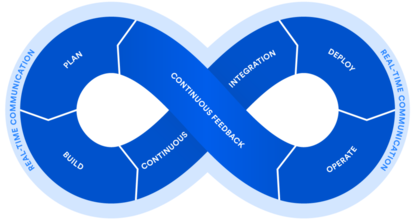
GitHub provides hosting for software development version control using Git. It offers all of the distributed version control and source code management functionality of Git as well as adding its own features. It provides access control and several collaboration features such as bug tracking, feature requests, task management, and wikis for every project.
GitHub Codespaces is an integrated development environment(IDE) on GitHub. That allows developers to develop entirely in the cloud using Visual Studio and Visual Studio Code.
GitHub Actions will automate, customize, and execute your software development workflows right in your repository with GitHub Actions. You can discover, create, and share actions to perform any job you'd like, including CI/CD, and combine actions in a completely customized workflow.GitHub Actions for Azure you can create workflows that you can set up in your repository to build, test, package, release and deploy to Azure.Learn more about all other integrations with Azure.
GitLab is a web-based DevOps lifecycle tool that provides a Git-repository manager providing wiki, issue-tracking and CI/CD pipeline features, using an open-source license, developed by GitLab Inc.
Jenkins is a free and open source automation server. Jenkins helps to automate the non-human part of the software development process, with continuous integration and facilitating technical aspects of continuous delivery.
Bitbucket is a web-based version control repository hosting service owned by Atlassian, for source code and development projects that use either Mercurial or Git revision control systems. Bitbucket offers both commercial plans and free accounts. It offers free accounts with an unlimited number of private repositories. Bitbucket integrates with other Atlassian software like Jira, HipChat, Confluence and Bamboo.
Bamboo is a continuous integration (CI) server that can be used to automate the release management for a software application, creating a continuous delivery pipeline.
Codecov is the leading, dedicated code coverage solution. It provides highly integrated tools to group, merge, archive and compare coverage reports. Whether your team is comparing changes in a pull request or reviewing a single commit, Codecov will improve the code review workflow and quality.
Drone is a Continuous Delivery system built on container technology. Drone uses a simple YAML configuration file, a superset of docker-compose, to define and execute Pipelines inside Docker containers.
Travis CI is a hosted continuous integration service used to build and test software projects hosted at GitHub.
Circle CI is a continuous integration and continuous delivery platform that helps software teams work smarter, faster.
Zuul-CI is a program that drives continuous integration, delivery, and deployment systems with a focus on project gating and interrelated projects. Using the same Ansible playbooks to deploy your system and run your tests.
Artifactory is a Universal Artifact Repository Manager developed by JFrog. It supports all major packages, enterprise ready security, clustered, HA, Docker registry, multi-site replication and scalable.
Azure DevOps is a set of services for teams to share code, track work, and ship software; CLIs Build, deploy, diagnose, and manage multi-platform, scalable apps and services; Azure Pipelines Continuously build, test, and deploy to any platform and cloud; Azure Lab Services Set up labs for classrooms, trials, development and testing, and other scenarios.
Team City is a build management and continuous integration server from JetBrains.
Shippable simplifies DevOps and makes it systematic with an Assembly Line platform that is heterogeneous, flexible, and provides complete visibility across your DevOps workflows.
Spinnaker is an open source, multi-cloud continuous delivery platform for releasing software changes with high velocity and confidence.
AWS CodeBuild is a fully managed continuous integration service that compiles source code, runs tests, and produces software packages that are ready to deploy. With CodeBuild, you don't need to provision, manage, and scale your own build servers.
Selenium is a free (open source) automated testing suite for web applications across different browsers and platforms.
Cucumber is a tool based on Behavior Driven Development (BDD) framework which is used to write acceptance tests for the web application. It allows automation of functional validation in easily readable and understandable format (like plain English) to Business Analysts, Developers, and Testers.
JUnit is a unit testing framework for the Java programming language.
Mocha is a JavaScript test framework for Node.js programs, featuring browser support, asynchronous testing, test coverage reports, and use of any assertion library.
Karma is a simple tool that allows you to execute JavaScript code in multiple real browsers.
Jasmine is an open source testing framework for JavaScript. It aims to run on any JavaScript-enabled platform, to not intrude on the application nor the IDE, and to have easy-to-read syntax.
Maven is a build automation tool used primarily for Java projects. Maven can also be used to build and manage projects written in C#, Ruby, Scala, and other languages. The Maven project is hosted by the Apache Software Foundation.
Gradle is an open-source build-automation system that builds upon the concepts of Apache Ant and Apache Maven and introduces a Groovy-based domain-specific language instead of the XML form used by Apache Maven for declaring the project configuration.
Chef is an effortless Infrastructure Suite offers visibility into security and compliance status across all infrastructure and makes it easy to detect and correct issues long before they reach production.
Puppet is an open source tool that makes continuous integration and delivery of your software on traditional or containerized infrastructure easy by pulling together all your existing tools and giving you flexibility to deploy your way.
Ansible is an open-source software provisioning, configuration management, and application-deployment tool. It runs on many Unix-like systems, and can configure both Unix-like systems as well as Microsoft Windows.
KubeInit provides Ansible playbooks and roles for the deployment and configuration of multiple Kubernetes distributions.
Salt is Python-based, open-source software for event-driven IT automation, remote task execution, and configuration management. Supporting the "Infrastructure as Code" approach to data center system and network deployment and management, configuration automation, SecOps orchestration, vulnerability remediation, and hybrid cloud control.
Terraform is an open-source infrastructure as code software tool created by HashiCorp.It enables users to define and provision a datacenter infrastructure using a high-level configuration language known as Hashicorp Configuration Language (HCL), or optionally JSON.
Consul is a service networking solution to connect and secure services across any runtime platform and public or private cloud.
Packer is lightweight, runs on every major operating system, and is highly performant, creating machine images for multiple platforms in parallel. Packer does not replace configuration management like Chef or Puppet. In fact, when building images, Packer is able to use tools like Chef or Puppet to install software onto the image.
Nomad is a highly available, distributed, data-center aware cluster and application scheduler designed to support the modern datacenter with support for long-running services, batch jobs, and much more.
Vagrant is a tool for building and managing virtual machine environments in a single workflow. With an easy-to-use workflow and focus on automation, Vagrant lowers development environment setup time and increases production parity.
Vault is a tool for securely accessing secrets. A secret is anything that you want to tightly control access to, such as API keys, passwords, certificates, and more. Vault provides a unified interface to any secret, while providing tight access control and recording a detailed audit log.
CFEngine is an open-source configuration management system, written by Mark Burgess.Its primary function is to provide automated configuration and maintenance of large-scale computer systems, including the unified management of servers, desktops, consumer and industrial devices, embedded networked devices, mobile smartphones, and tablet computers.
Octpus Deploy is the deployment automation server for your entire team, designed to make it easy to orchestrate releases and deploy applications, whether on-premises or in the cloud.
AWS CodeDeploy is a fully managed deployment service that automates software deployments to a variety of compute services such as Amazon EC2, AWS Fargate, AWS Lambda, and your on-premises servers. AWS CodeDeploy makes it easier for you to rapidly release new features, helps you avoid downtime during application deployment, and handles the complexity of updating your applications.
Kubernetes is an open-source container-orchestration system for automating application deployment, scaling, and management. It was originally designed by Google, and is now maintained by the Cloud Native Computing Foundation.
Docker is a set of platform as a service products that use OS-level virtualization to deliver software in packages called containers. Containers are isolated from one another and bundle their own software, libraries and configuration files; they can communicate with each other through well-defined channels. All containers are run by a single operating-system kernel and are thus more lightweight than virtual machines.
PowerShell/PowerShell Core is a cross-platform (Windows, Linux, and macOS) automation and configuration tool/framework that works well with your existing tools and is optimized for dealing with structured data (eg JSON, CSV, XML, etc.), REST APIs, and object models. It includes a command-line shell, an associated scripting language and a framework for processing cmdlets.
Hyper-V creates virtual machines on Windows 10. Hyper-V can be enabled in many ways including using the Windows 10 control panel, PowerShell or using the Deployment Imaging Servicing and Management tool (DISM).
Cloud Hypervisor is an open source Virtual Machine Monitor (VMM) that runs on top of KVM. The project focuses on exclusively running modern, cloud workloads, on top of a limited set of hardware architectures and platforms. Cloud workloads refers to those that are usually run by customers inside a cloud provider. Cloud Hypervisor is implemented in Rust and is based on the rust-vmm crates.
VMware vSphere Hypervisor is a bare-metal hypervisor that virtualizes servers; allowing you to consolidate your applications while saving time and money managing your IT infrastructure.
VMware vSphere is the industry-leading compute virtualization platform, and your first step to application modernization. It has been rearchitected with native Kubernetes to allow customers to modernize the 70 million+ workloads now running on vSphere.
VMware Tanzu is a centralized management platform for consistently operating and securing your Kubernetes infrastructure and modern applications across multiple teams and private/public clouds.
Rancher is a complete software stack for teams adopting containers. It addresses the operational and security challenges of managing multiple Kubernetes clusters, while providing DevOps teams with integrated tools for running containerized workloads.
K3s is a highly available, certified Kubernetes distribution designed for production workloads in unattended, resource-constrained, remote locations or inside IoT appliances.
Rook is an open source cloud-native storage orchestrator for Kubernetes that turns distributed storage systems into self-managing, self-scaling, self-healing storage services. It automates the tasks of a storage administrator: deployment, bootstrapping, configuration, provisioning, scaling, upgrading, migration, disaster recovery, monitoring, and resource management.
Google Kubernetes Engine (GKE) is a managed, production-ready environment for deploying containerized applications.
Anthos is a modern application management platform that provides a consistent development and operations experience for cloud and on-premises environments.
AWS ECS is a highly scalable, high-performance container orchestration service that supports Docker containers and allows you to easily run and scale containerized applications on AWS. Amazon ECS eliminates the need for you to install and operate your own container orchestration software, manage and scale a cluster of virtual machines, or schedule containers on those virtual machines.
Apache Mesos is a cluster manager that provides efficient resource isolation and sharing across distributed applications, or frameworks. It can run Hadoop, Jenkins, Spark, Aurora, and other frameworks on a dynamically shared pool of nodes.
Apache Spark is a unified analytics engine for big data processing, with built-in modules for streaming, SQL, machine learning and graph processing.
Apache Hadoop is a framework that allows for the distributed processing of large data sets across clusters of computers using simple programming models. It is designed to scale up from single servers to thousands of machines, each offering local computation and storage. Rather than rely on hardware to deliver high-availability, the library itself is designed to detect and handle failures at the application layer, so delivering a highly-available service on top of a cluster of computers, each of which may be prone to failures.
Microsoft Azure is a cloud computing service created by Microsoft for building, testing, deploying, and managing applications and services through Microsoft-managed data centers.
Azure Functions is a solution for easily running small pieces of code, or "functions," in the cloud. You can write just the code you need for the problem at hand, without worrying about a whole application or the infrastructure to run it.
Rkt is a pod-native container engine for Linux. It is composable, secure, and built on standards.
AWS Lambda is an event-driven, serverless computing platform provided by Amazon as a part of the Amazon Web Services. It is a computing service that runs code in response to events and automatically manages the computing resources required by that code.
Helm is the Kubernetes Package Manager.
Kubespray is a tool that combines Kubernetes and Ansible to easily install Kubernetes clusters that can be deployed on AWS, GCE, Azure, OpenStack, vSphere, Packet (bare metal), Oracle Cloud Infrastructure (Experimental), or Baremetal
Red Hat OpenShift is focused on security at every level of the container stack and throughout the application lifecycle. It includes long-term, enterprise support from one of the leading Kubernetes contributors and open source software companies.
OpenShift Hive is an operator which runs as a service on top of Kubernetes/OpenShift. The Hive service can be used to provision and perform initial configuration of OpenShift 4 clusters.
OKD is a community distribution of Kubernetes optimized for continuous application development and multi-tenant deployment. OKD adds developer and operations-centric tools on top of Kubernetes to enable rapid application development, easy deployment and scaling, and long-term lifecycle maintenance for small and large teams.
Odo is a fast, iterative, and straightforward CLI tool for developers who write, build, and deploy applications on Kubernetes and OpenShift.
Kata Operator is an operator to perform lifecycle management (install/upgrade/uninstall) of Kata Runtime on Openshift as well as Kubernetes cluster.
Knative is a Kubernetes-based platform to build, deploy, and manage modern serverless workloads. Knative takes care of the operational overhead details of networking, autoscaling (even to zero), and revision tracking.
Etcd is a distributed key-value store that provides a reliable way to store data that needs to be accessed by a distributed system or cluster of machines. Etcd is used as the backend for service discovery and stores cluster state and configuration for Kubernetes.
OpenStack is a free and open-source software platform for cloud computing, mostly deployed as infrastructure-as-a-service that controls large pools of compute, storage, and networking resources throughout a datacenter, managed through a dashboard or via the OpenStack API. OpenStack works with popular enterprise and open source technologies making it ideal for heterogeneous infrastructure.
Cloud Foundry is an open source, multi cloud application platform as a service that makes it faster and easier to build, test, deploy and scale applications, providing a choice of clouds, developer frameworks, and application services. It is an open source project and is available through a variety of private cloud distributions and public cloud instances.
Splunk software is used for searching, monitoring, and analyzing machine-generated big data, via a Web-style interface.
Prometheus is a free software application used for event monitoring and alerting. It records real-time metrics in a time series database (allowing for high dimensionality) built using a HTTP pull model, with flexible queries and real-time alerting.
Loki is a horizontally-scalable, highly-available, multi-tenant log aggregation system inspired by Prometheus. It is designed to be very cost effective and easy to operate. It does not index the contents of the logs, but rather a set of labels for each log stream.
Thanos is a set of components that can be composed into a highly available metric system with unlimited storage capacity, which can be added seamlessly on top of existing Prometheus deployments.
Container Storage Interface (CSI) is an API that lets container orchestration platforms like Kubernetes seamlessly communicate with stored data via a plug-in.
OpenEBS is a Kubernetes-based tool to create stateful applications using Container Attached Storage.
ElasticSearch is a search engine based on the Lucene library. It provides a distributed, multitenant-capable full-text search engine with an HTTP web interface and schema-free JSON documents. Elasticsearch is developed in Java.
Logstash is a tool for managing events and logs. When used generically, the term encompasses a larger system of log collection, processing, storage and searching activities.
Kibana is an open source data visualization plugin for Elasticsearch. It provides visualization capabilities on top of the content indexed on an Elasticsearch cluster. Users can create bar, line and scatter plots, or pie charts and maps on top of large volumes of data.
New Relic is a SaaS-based monitoring tool that fully supports the way DevOps teams work in the modern enterprise by streamlining your workflows with today's collaboration software and orchestration tools like Puppet, Chef, and Ansible.
Nagios is a free and open source computer-software application that monitors systems, networks and infrastructure. Nagios offers monitoring and alerting services for servers, switches, applications and services. It alerts users when things go wrong and alerts them a second time when the problem has been resolved.
SonarQube is an open-source platform developed by SonarSource for continuous inspection of code quality to perform automatic reviews with static analysis of code to detect bugs, code smells, and security vulnerabilities on 20+ programming languages.
Genie is a federated job orchestration engine developed by Netflix. Genie provides REST APIs to run a variety of big data jobs like Hadoop, Pig, Hive, Spark, Presto, Sqoop and more. It also provides APIs for managing the metadata of many distributed processing clusters and the commands and applications which run on them.
Inviso is a lightweight tool that provides the ability to search for Hadoop jobs, visualize the performance, and view cluster utilization.
Fenzo is a scheduler Java library for Apache Mesos frameworks that supports plugins for scheduling optimizations and facilitates cluster autoscaling.
Dynomite is a thin, distributed dynamo layer for different storage engines and protocols, which includes Redis and Memcached. Dynomite supports multi-datacenter replication and is designed for High Availability(HA).
Dyno is a tool that is used to scale a Java client application utilizing Dynomite.
Raigad is a process/tool that runs alongside Elasticsearch to automate backup/recovery, Deployments and Centralized Configuration management.
Priam is a process/tool that runs alongside Apache Cassandra to automate backup/recovery, Deployments and Centralized Configuration management.
Chaos Monkey is a resiliency tool used to randomly terminates virtual machine instances and containers that run inside of your production environment. Chaos Monkey should work with any backend that Spinnaker supports (AWS, Google Compute Engine, Microsoft Azure, Kubernetes, and Cloud Foundry).
Falcor is a JavaScript library for efficient data fetching. Falcor lets you represent all your remote data sources as a single domain model via a virtual JSON graph, whether in memory on the client or over the network on the server.
Restify is a framework, utilizing connect style middleware for building REST APIs.
Traefik is an open source Edge Router that makes publishing your services a fun and easy experience. It receives requests on behalf of your system and finds out which components are responsible for handling them. What sets Traefik apart, besides its many features, is that it automatically discovers the right configuration for your services.
Jira is a proprietary issue tracking product developed by Atlassian that allows bug tracking and agile project management.
Pivotal Tracker is the agile project management tool of choice for developers around the world for real-time collaboration around a shared, prioritized backlog.
Trello is a web-based Kanban-style list-making application that gives you perspective over all your projects, at work and at home.
Microsoft Teams is the hub for team collaboration in Office 365 that integrates the people, content, and tools your team needs to be more engaged and effective.
Slack is a cloud-based proprietary instant messaging platform developed by Slack Technologies.
OpsGenie is a cloud-based service for dev & ops teams, providing reliable alerts, on-call schedule management and escalations. OpsGenie integrates with monitoring tools & services, ensures the right people are notified.
Pagerduty automates processes built on best practices, allowing you to focus on higher value parts of incident response. Granular and scalable permissions enable teams to administer and operate independently while controlling visibility.
Veracode is a leading provider of enterprise-class application security, seamlessly integrating agile security solutions for organizations around the globe. In addition to application security services and secure devops services, Veracode provides a full security assessment to ensure your website and applications are secure, and ensures full enterprise data protection.
DevOps Engineering on AWS from AWS Training
AWS Certified DevOps Engineer - Professional from A Cloud Guru
Microsoft Certified: DevOps Engineer Expert Cert.
Introduction to Azure DevOps from A Cloud Guru
Architecting with Google Compute Engine
Architecting with Google Kubernetes Engine in Google Cloud
VMware Training and Certification Program
Cloudera Certification Program
Salesforce Certification Program
Salesforce Superbadges
Red Hat Training and Certification Program
Linux Foundation Training and Certification Program
Linux Professional Institute(LPI) Training and Certification
Learn DevOps with Online Courses and Lessons from edX
Top DevOps Courses Online from Udemy
Devops Courses from Coursera
Вернуться на вершину
AWS Certified Security - Specialty Certification
Microsoft Certified: Azure Security Engineer Associate
Google Cloud Certified Professional Cloud Security Engineer
Cisco Security Certifications
The Red Hat Certified Specialist in Security: Linux
Linux Professional Institute LPIC-3 Enterprise Security Certification
Cybersecurity Training and Courses from IBM Skills
Cybersecurity Courses and Certifications by Offensive Security
Citrix Certified Associate – Networking(CCA-N)
Citrix Certified Professional – Virtualization(CCP-V)
CCNP Routing and Switching
Certified Information Security Manager(CISM)
Wireshark Certified Network Analyst (WCNA)
Juniper Networks Certification Program Enterprise (JNCP)
Networking courses and specializations from Coursera
Network & Security Courses from Udemy
Network & Security Courses from edX
 • Connection: In networking, a connection refers to pieces of related information that are transferred through a network. This generally infers that a connection is built before the data transfer (by following the procedures laid out in a protocol) and then is deconstructed at the at the end of the data transfer.

• Packet: A packet is, generally speaking, the most basic unit that is transferred over a network. When communicating over a network, packets are the envelopes that carry your data (in pieces) from one end point to the other.
Packets have a header portion that contains information about the packet including the source and destination, timestamps, network hops. The main portion of a packet contains the actual data being transferred. It is sometimes called the body or the payload.
• Network Interface: A network interface can refer to any kind of software interface to networking hardware. For instance, if you have two network cards in your computer, you can control and configure each network interface associated with them individually.
A network interface may be associated with a physical device, or it may be a representation of a virtual interface. The "loop-back" device, which is a virtual interface to the local machine, is an example of this.
 • LAN: LAN stands for "local area network". It refers to a network or a portion of a network that is not publicly accessible to the greater internet. A home or office network is an example of a LAN.

• WAN: WAN stands for "wide area network". It means a network that is much more extensive than a LAN. While WAN is the relevant term to use to describe large, dispersed networks in general, it is usually meant to mean the internet, as a whole.
If an interface is connected to the WAN, it is generally assumed that it is reachable through the internet.
• Protocol: A protocol is a set of rules and standards that basically define a language that devices can use to communicate. There are a great number of protocols in use extensively in networking, and they are often implemented in different layers.
Some low level protocols are TCP, UDP, IP, and ICMP. Some familiar examples of application layer protocols, built on these lower protocols, are HTTP (for accessing web content), SSH, TLS/SSL, and FTP.
 • Port: A port is an address on a single machine that can be tied to a specific piece of software. It is not a physical interface or location, but it allows your server to be able to communicate using more than one application.

• Firewall: A firewall is a program that decides whether traffic coming into a server or going out should be allowed. A firewall usually works by creating rules for which type of traffic is acceptable on which ports. Generally, firewalls block ports that are not used by a specific application on a server.

• NAT: Network address translation is a way to translate requests that are incoming into a routing server to the relevant devices or servers that it knows about in the LAN. This is usually implemented in physical LANs as a way to route requests through one IP address to the necessary backend servers.

• VPN: Virtual private network is a means of connecting separate LANs through the internet, while maintaining privacy. This is used as a means of connecting remote systems as if they were on a local network, often for security reasons.
 While networking is often discussed in terms of topology in a horizontal way, between hosts, its implementation is layered in a vertical fashion throughout a computer or network. This means is that there are multiple technologies and protocols that are built on top of each other in order for communication to function more easily. Each successive, higher layer abstracts the raw data a little bit more, and makes it simpler to use for applications and users. It also allows you to leverage lower layers in new ways without having to invest the time and energy to develop the protocols and applications that handle those types of traffic.

As data is sent out of one machine, it begins at the top of the stack and filters downwards. At the lowest level, actual transmission to another machine takes place. At this point, the data travels back up through the layers of the other computer. Each layer has the ability to add its own "wrapper" around the data that it receives from the adjacent layer, which will help the layers that come after decide what to do with the data when it is passed off.

One method of talking about the different layers of network communication is the OSI model. OSI stands for Open Systems Interconnect.This model defines seven separate layers. The layers in this model are:

• Application: The application layer is the layer that the users and user-applications most often interact with. Network communication is discussed in terms of availability of resources, partners to communicate with, and data synchronization.

• Presentation: The presentation layer is responsible for mapping resources and creating context. It is used to translate lower level networking data into data that applications expect to see.

• Session: The session layer is a connection handler. It creates, maintains, and destroys connections between nodes in a persistent way.

• Transport: The transport layer is responsible for handing the layers above it a reliable connection. In this context, reliable refers to the ability to verify that a piece of data was received intact at the other end of the connection. This layer can resend information that has been dropped or corrupted and can acknowledge the receipt of data to remote computers.

• Network: The network layer is used to route data between different nodes on the network. It uses addresses to be able to tell which computer to send information to. This layer can also break apart larger messages into smaller chunks to be reassembled on the opposite end.

• Data Link: This layer is implemented as a method of establishing and maintaining reliable links between different nodes or devices on a network using existing physical connections.

• Physical: The physical layer is responsible for handling the actual physical devices that are used to make a connection. This layer involves the bare software that manages physical connections as well as the hardware itself (like Ethernet).
The TCP/IP model, more commonly known as the Internet protocol suite, is another layering model that is simpler and has been widely adopted.It defines the four separate layers, some of which overlap with the OSI model:
• Application: In this model, the application layer is responsible for creating and transmitting user data between applications. The applications can be on remote systems, and should appear to operate as if locally to the end user.
The communication takes place between peers network.
 • Transport: The transport layer is responsible for communication between processes. This level of networking utilizes ports to address different services. It can build up unreliable or reliable connections depending on the type of protocol used.

• Internet: The internet layer is used to transport data from node to node in a network. This layer is aware of the endpoints of the connections, but does not worry about the actual connection needed to get from one place to another. IP addresses are defined in this layer as a way of reaching remote systems in an addressable manner.

• Link: The link layer implements the actual topology of the local network that allows the internet layer to present an addressable interface. It establishes connections between neighboring nodes to send data.
Interfaces are networking communication points for your computer. Each interface is associated with a physical or virtual networking device. Typically, your server will have one configurable network interface for each Ethernet or wireless internet card you have. In addition, it will define a virtual network interface called the "loopback" or localhost interface. This is used as an interface to connect applications and processes on a single computer to other applications and processes. You can see this referenced as the "lo" interface in many tools.
Networking works by piggybacks on a number of different protocols on top of each other. In this way, one piece of data can be transmitted using multiple protocols encapsulated within one another.
Media access control is a communications protocol that is used to distinguish specific devices. Each device is supposed to get a unique MAC address during the manufacturing process that differentiates it from every other device on the internet. Addressing hardware by the MAC address allows you to reference a device by a unique value even when the software on top may change the name for that specific device during operation. Media access control is one of the only protocols from the link layer that you are likely to interact with on a regular basis.
The IP protocol is one of the fundamental protocols that allow the internet to work. IP addresses are unique on each network and they allow machines to address each other across a network. It is implemented on the internet layer in the IP/TCP model. Networks can be linked together, but traffic must be routed when crossing network boundaries. This protocol assumes an unreliable network and multiple paths to the same destination that it can dynamically change between. There are a number of different implementations of the protocol. The most common implementation today is IPv4, although IPv6 is growing in popularity as an alternative due to the scarcity of IPv4 addresses available and improvements in the protocols capabilities.
ICMP: internet control message protocol is used to send messages between devices to indicate the availability or error conditions. These packets are used in a variety of network diagnostic tools, such as ping and traceroute. Usually ICMP packets are transmitted when a packet of a different kind meets some kind of a problem. Basically, they are used as a feedback mechanism for network communications.
TCP: Transmission control protocol is implemented in the transport layer of the IP/TCP model and is used to establish reliable connections. TCP is one of the protocols that encapsulates data into packets. It then transfers these to the remote end of the connection using the methods available on the lower layers. On the other end, it can check for errors, request certain pieces to be resent, and reassemble the information into one logical piece to send to the application layer. The protocol builds up a connection prior to data transfer using a system called a three-way handshake. This is a way for the two ends of the communication to acknowledge the request and agree upon a method of ensuring data reliability. After the data has been sent, the connection is torn down using a similar four-way handshake. TCP is the protocol of choice for many of the most popular uses for the internet, including WWW, FTP, SSH, and email. It is safe to say that the internet we know today would not be here without TCP.
UDP: User datagram protocol is a popular companion protocol to TCP and is also implemented in the transport layer. The fundamental difference between UDP and TCP is that UDP offers unreliable data transfer. It does not verify that data has been received on the other end of the connection. This might sound like a bad thing, and for many purposes, it is. However, it is also extremely important for some functions. It's not required to wait for confirmation that the data was received and forced to resend data, UDP is much faster than TCP. It does not establish a connection with the remote host, it simply fires off the data to that host and doesn't care if it is accepted or not. Since UDP is a simple transaction, it is useful for simple communications like querying for network resources. It also doesn't maintain a state, which makes it great for transmitting data from one machine to many real-time clients. This makes it ideal for VOIP, games, and other applications that cannot afford delays.
HTTP: Hypertext transfer protocol is a protocol defined in the application layer that forms the basis for communication on the web. HTTP defines a number of functions that tell the remote system what you are requesting. For instance, GET, POST, and DELETE all interact with the requested data in a different way.
JSON Web Token (JWT) is a compact URL-safe means of representing claims to be transferred between two parties. The claims in a JWT are encoded as a JSON object that is digitally signed using JSON Web Signature (JWS).
OAuth 2.0 is an open source authorization framework that enables applications to obtain limited access to user accounts on an HTTP service, such as Amazon, Google, Facebook, Microsoft, Twitter GitHub, and DigitalOcean. It works by delegating user authentication to the service that hosts the user account, and authorizing third-party applications to access the user account.
FTP: File transfer protocol is in the application layer and provides a way of transferring complete files from one host to another. It is inherently insecure, so it is not recommended for any externally facing network unless it is implemented as a public, download-only resource.
DNS: Domain name system is an application layer protocol used to provide a human-friendly naming mechanism for internet resources. It is what ties a domain name to an IP address and allows you to access sites by name in your browser.
SSH: Secure shell is an encrypted protocol implemented in the application layer that can be used to communicate with a remote server in a secure way. Many additional technologies are built around this protocol because of its end-to-end encryption and ubiquity. There are many other protocols that we haven't covered that are equally important. However, this should give you a good overview of some of the fundamental technologies that make the internet and networking possible.
KVM (for Kernel-based Virtual Machine) is a full virtualization solution for Linux on x86 hardware containing virtualization extensions (Intel VT or AMD-V). It consists of a loadable kernel module, kvm.ko, that provides the core virtualization infrastructure and a processor specific module, kvm-intel.ko or kvm-amd.ko.
QEMU is a fast processor emulator using a portable dynamic translator. QEMU emulates a full system, including a processor and various peripherals. It can be used to launch a different Operating System without rebooting the PC or to debug system code.
Hyper-V enables running virtualized computer systems on top of a physical host. These virtualized systems can be used and managed just as if they were physical computer systems, however they exist in virtualized and isolated environment. Special software called a hypervisor manages access between the virtual systems and the physical hardware resources. Virtualization enables quick deployment of computer systems, a way to quickly restore systems to a previously known good state, and the ability to migrate systems between physical hosts.
VirtManager is a graphical tool for managing virtual machines via libvirt. Most usage is with QEMU/KVM virtual machines, but Xen and libvirt LXC containers are well supported. Common operations for any libvirt driver should work.
oVirt is an open-source distributed virtualization solution, designed to manage your entire enterprise infrastructure. oVirt uses the trusted KVM hypervisor and is built upon several other community projects, including libvirt, Gluster, PatternFly, and Ansible.Founded by Red Hat as a community project on which Red Hat Enterprise Virtualization is based allowing for centralized management of virtual machines, compute, storage and networking resources, from an easy-to-use web-based front-end with platform independent access.
Xen is focused on advancing virtualization in a number of different commercial and open source applications, including server virtualization, Infrastructure as a Services (IaaS), desktop virtualization, security applications, embedded and hardware appliances, and automotive/aviation.
Ganeti is a virtual machine cluster management tool built on top of existing virtualization technologies such as Xen or KVM and other open source software. Once installed, the tool assumes management of the virtual instances (Xen DomU).
Packer is an open source tool for creating identical machine images for multiple platforms from a single source configuration. Packer is lightweight, runs on every major operating system, and is highly performant, creating machine images for multiple platforms in parallel. Packer does not replace configuration management like Chef or Puppet. In fact, when building images, Packer is able to use tools like Chef or Puppet to install software onto the image.
Vagrant is a tool for building and managing virtual machine environments in a single workflow. With an easy-to-use workflow and focus on automation, Vagrant lowers development environment setup time, increases production parity, and makes the "works on my machine" excuse a relic of the past. It provides easy to configure, reproducible, and portable work environments built on top of industry-standard technology and controlled by a single consistent workflow to help maximize the productivity and flexibility of you and your team.
VMware Workstation is a hosted hypervisor that runs on x64 versions of Windows and Linux operating systems; it enables users to set up virtual machines on a single physical machine, and use them simultaneously along with the actual machine.
VirtualBox is a powerful x86 and AMD64/Intel64 virtualization product for enterprise as well as home use. Not only is VirtualBox an extremely feature rich, high performance product for enterprise customers.
Вернуться на вершину
SQL is a standard language for storing, manipulating and retrieving data in relational databases.
SQL Tutorial by W3Schools
Learn SQL Skills Online from Coursera
SQL Courses Online from Udemy
SQL Online Training Courses from LinkedIn Learning
Learn SQL For Free from Codecademy
GitLab's SQL Style Guide
OracleDB SQL Style Guide Basics
Tableau CRM: BI Software and Tools
Databases on AWS
Best Practices and Recommendations for SQL Server Clustering in AWS EC2.
Connecting from Google Kubernetes Engine to a Cloud SQL instance.
Educational Microsoft Azure SQL resources
MySQL Certifications
SQL vs. NoSQL Databases: What's the Difference?
What is NoSQL?
Azure Data Studio is an open source data management tool that enables working with SQL Server, Azure SQL DB and SQL DW from Windows, macOS and Linux.
Azure SQL Database is the intelligent, scalable, relational database service built for the cloud. It's evergreen and always up to date, with AI-powered and automated features that optimize performance and durability for you. Serverless compute and Hyperscale storage options automatically scale resources on demand, so you can focus on building new applications without worrying about storage size or resource management.
Azure SQL Managed Instance is a fully managed SQL Server Database engine instance that's hosted in Azure and placed in your network. This deployment model makes it easy to lift and shift your on-premises applications to the cloud with very few application and database changes. Managed instance has split compute and storage components.
Azure Synapse Analytics is a limitless analytics service that brings together enterprise data warehousing and Big Data analytics. It gives you the freedom to query data on your terms, using either serverless or provisioned resources at scale. It brings together the best of the SQL technologies used in enterprise data warehousing, Spark technologies used in big data analytics, and Pipelines for data integration and ETL/ELT.
MSSQL for Visual Studio Code is an extension for developing Microsoft SQL Server, Azure SQL Database and SQL Data Warehouse everywhere with a rich set of functionalities.
SQL Server Data Tools (SSDT) is a development tool for building SQL Server relational databases, Azure SQL Databases, Analysis Services (AS) data models, Integration Services (IS) packages, and Reporting Services (RS) reports. With SSDT, a developer can design and deploy any SQL Server content type with the same ease as they would develop an application in Visual Studio or Visual Studio Code.
Bulk Copy Program is a command-line tool that comes with Microsoft SQL Server. BCP, allows you to import and export large amounts of data in and out of SQL Server databases quickly snd efficeiently.
SQL Server Migration Assistant is a tool from Microsoft that simplifies database migration process from Oracle to SQL Server, Azure SQL Database, Azure SQL Database Managed Instance and Azure SQL Data Warehouse.
SQL Server Integration Services is a development platform for building enterprise-level data integration and data transformations solutions. Use Integration Services to solve complex business problems by copying or downloading files, loading data warehouses, cleansing and mining data, and managing SQL Server objects and data.
SQL Server Business Intelligence(BI) is a collection of tools in Microsoft's SQL Server for transforming raw data into information businesses can use to make decisions.
Tableau is a Data Visualization software used in relational databases, cloud databases, and spreadsheets. Tableau was acquired by Salesforce in August 2019.
DataGrip is a professional DataBase IDE developed by Jet Brains that provides context-sensitive code completion, helping you to write SQL code faster. Completion is aware of the tables structure, foreign keys, and even database objects created in code you're editing.
RStudio is an integrated development environment for R and Python, with a console, syntax-highlighting editor that supports direct code execution, and tools for plotting, history, debugging and workspace management.
MySQL is a fully managed database service to deploy cloud-native applications using the world's most popular open source database.
PostgreSQL is a powerful, open source object-relational database system with over 30 years of active development that has earned it a strong reputation for reliability, feature robustness, and performance.
Amazon DynamoDB is a key-value and document database that delivers single-digit millisecond performance at any scale. It is a fully managed, multiregion, multimaster, durable database with built-in security, backup and restore, and in-memory caching for internet-scale applications.
FoundationDB is an open source distributed database designed to handle large volumes of structured data across clusters of commodity servers. It organizes data as an ordered key-value store and employs ACID transactions for all operations. It is especially well-suited for read/write workloads but also has excellent performance for write-intensive workloads. FoundationDB was acquired by Apple in 2015.
CouchbaseDB is an open source distributed multi-model NoSQL document-oriented database. It creates a key-value store with managed cache for sub-millisecond data operations, with purpose-built indexers for efficient queries and a powerful query engine for executing SQL queries.
IBM DB2 is a collection of hybrid data management products offering a complete suite of AI-empowered capabilities designed to help you manage both structured and unstructured data on premises as well as in private and public cloud environments. Db2 is built on an intelligent common SQL engine designed for scalability and flexibility.
MongoDB is a document database meaning it stores data in JSON-like documents.
OracleDB is a powerful fully managed database helps developers manage business-critical data with the highest availability, reliability, and security.
MariaDB is an enterprise open source database solution for modern, mission-critical applications.
SQLite is a C-language library that implements a small, fast, self-contained, high-reliability, full-featured, SQL database engine.SQLite is the most used database engine in the world. SQLite is built into all mobile phones and most computers and comes bundled inside countless other applications that people use every day.
SQLite Database Browser is an open source SQL tool that allows users to create, design and edits SQLite database files. It lets users show a log of all the SQL commands that have been issued by them and by the application itself.
dbWatch is a complete database monitoring/management solution for SQL Server, Oracle, PostgreSQL, Sybase, MySQL and Azure. Designed for proactive management and automation of routine maintenance in large scale on-premise, hybrid/cloud database environments.
Cosmos DB Profiler is a real-time visual debugger allowing a development team to gain valuable insight and perspective into their usage of Cosmos DB database. It identifies over a dozen suspicious behaviors from your application's interaction with Cosmos DB.
Adminer is an SQL management client tool for managing databases, tables, relations, indexes, users. Adminer has support for all the popular database management systems such as MySQL, MariaDB, PostgreSQL, SQLite, MS SQL, Oracle, Firebird, SimpleDB, Elasticsearch and MongoDB.
DBeaver is an open source database tool for developers and database administrators. It offers supports for JDBC compliant databases such as MySQL, Oracle, IBM DB2, SQL Server, Firebird, SQLite, Sybase, Teradata, Firebird, Apache Hive, Phoenix, and Presto.
DbVisualizer is a SQL management tool that allows users to manage a wide range of databases such as Oracle, Sybase, SQL Server, MySQL, H3, and SQLite.
AppDynamics Database is a management product for Microsoft SQL Server. With AppDynamics you can monitor and trend key performance metrics such as resource consumption, database objects, schema statistics and more, allowing you to proactively tune and fix issues in a High-Volume Production Environment.
Toad is a SQL Server DBMS toolset developed by Quest. It increases productivity by using extensive automation, intuitive workflows, and built-in expertise. This SQL management tool resolve issues, manage change and promote the highest levels of code quality for both relational and non-relational databases.
Lepide SQL Server is an open source storage manager utility to analyse the performance of SQL Servers. It provides a complete overview of all configuration and permission changes being made to your SQL Server environment through an easy-to-use, graphical user interface.
Sequel Pro is a fast MacOS database management tool for working with MySQL. This SQL management tool helpful for interacting with your database by easily to adding new databases, new tables, and new rows.
Вернуться на вершину
Распространено по Attribution Creative Commons 4.0 International (CC By 4.0).





