open genie
1.0.0

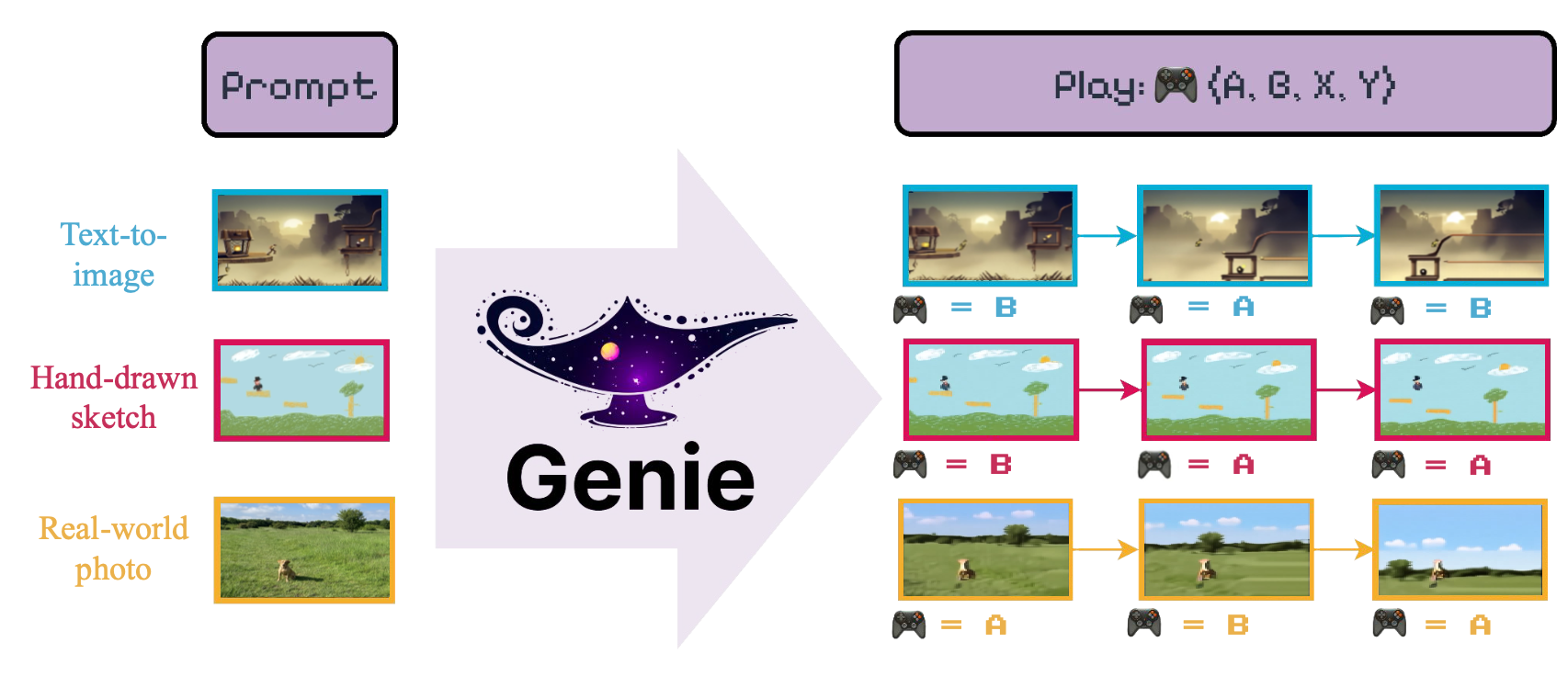
이 repo는 Genie 의 비공식적 구현을 포함합니다 : 생성 대화 형 환경 Bruce et al. (2024) Google Deepmind에 의해 소개 된대로.
이 모델의 목표는 "[...] 표지되지 않은 인터넷 비디오에서 감독되지 않은 방식으로 훈련 된 최초의 생성 대화 형 환경"을 소개하는 것입니다.
Genie 모델의 여러 구성 요소를 쉽게 훈련시키기 위해 LightningCLI 인터페이스를 제공합니다. 특히 VideoTokenizer 훈련하려면 다음을 실행해야합니다.
python tokenizer.py train -config < path_to_conf_file > LatentAction 및 Dynamics 모델을 모두 훈련시키기 위해 (사용으로 사용하여 완전 훈련 된 VideoTokenizer 를 활용할 수 있음) 단순히 실행할 수 있습니다.
python genie.py train -config < path_to_conf_file > config 폴더에 예제 구성 파일을 제공합니다.
다음 섹션에서는 전체 Genie 모듈을 형성하는 핵심 빌딩 블록에 대한 예제 코드를 제공합니다.
Genie는 입력 비디오를 소화하고 encode 을 통해 quantize 능력을 통해 이산 토큰으로 변환하는 VideoTokenizer 에 의존합니다. 이 토큰은 Dynamics 모듈이 잠재 비디오 공간을 조작하기 위해 사용하는 것입니다. VideoTokenizer 모듈은 광범위한 사용자 정의를위한 몇 가지 매개 변수를 수용합니다. 다음은 일반적인 사용을위한 예제 코드입니다.
 from genie import VideoTokenizer

# Pre-assembled description of MagViT2
# encoder & decoder architecture
from genie import MAGVIT2_ENC_DESC
from genie import MAGVIT2_DEC_DESC

tokenizer = VideoTokenizer (
  # We can pass an arbitrary description of the
  # encoder architecture, see genie.tokenizer.get_module
  # to see which module are supported
  enc_desc = (
    'causal' , { # A CausalConv3d layer
        'in_channels' : 3 ,
        'out_channels' : 64 ,
        'kernel_size' : 3 ,
    }),
    ( 'residual' , { # Residual Block
        'in_channels' : 64 ,
        'kernel_size' : 3 ,
        'downsample' : ( 1 , 2 ), # Optional down-scaling (time, space)
        'use_causal' : True , # Using causal padding
        'use_blur' : True , # Using blur-pooling
    }),
    ( 'residual' , {
        'in_channels' : 64 ,
        'out_channels' : 128 , # Output channels can be different
    }),
    ( 'residual' , {
        'n_rep' : 2 , # We can repeat this block N-times
        'in_channels' : 128 ,
    }),
    ( 'residual' , {
        'in_channels' : 128 ,
        'out_channels' : 256 , # We can mix different output channels...
        'kernel_size' : 3 ,
        'downsample' : 2 , # ...with down-sampling (here time=space=2)
        'use_causal' : True ,
    }),
    ( 'proj_out' , { # Output project to quantization module
        'in_channels' : 256 ,
        'out_channels' : 18 ,
        'num_groups' : 8 ,
        'kernel_size' : 3 ,
    }),
  # Save time, use a pre-made configuration!
  dec_desc = MAGVIT2_DEC_DESC ,

  # Description of GAN discriminator
  disc_kwargs = dict (
      # Discriminator parameters
      inp_size = ( 64 , 64 ), # Size of input frames
      model_dim = 64 ,
      dim_mults = ( 1 , 2 , 4 ),    # Channel multipliers
      down_step = ( None , 2 , 2 ), # Down-sampling steps
      inp_channels = 3 ,
      kernel_size = 3 ,
      num_groups = 8 ,
      act_fn = 'leaky' , # Use LeakyReLU as activation function
      use_blur = True ,  # Use BlurPooling for down-sampling
      use_attn = True ,  # Discriminator can have spatial attention
      num_heads = 4 ,    # Number of (spatial) attention heads
      dim_head = 32 ,    # Dimension of each spatial attention heads
  ),

  # Keyword for the LFQ module
  d_codebook = 18 , # Codebook dimension, should match encoder output channels
  n_codebook = 1 , # Support for multiple codebooks
  lfq_bias = True ,
  lfq_frac_sample = 1. ,
  lfq_commit_weight = 0.25 ,
  lfq_entropy_weight = 0.1 ,
  lfq_diversity_weight = 1. ,
  # Keyword for the different loss
  perceptual_model = 'vgg16' , # We pick VGG-16 for perceptual loss
  # Which layer should we record perceptual features from
  perc_feat_layers = ( 'features.6' , 'features.13' , 'features.18' , 'features.25' ),
  gan_discriminate = 'frames' , # GAN discriminator looks at individual frames
  gan_frames_per_batch = 4 ,  # How many frames to extract from each video to use for GAN
  gan_loss_weight = 1. ,
  perc_loss_weight = 1. ,
  quant_loss_weight = 1. ,
)

batch_size = 4
num_channels = 3
num_frames = 16
img_h , img_w = 64 , 64

# Example video tensor
mock_video = torch . randn (
  batch_size ,
  num_channels ,
  num_frames ,
  img_h ,
  img_w
)

# Tokenize input video
tokens , idxs = tokenizer . tokenize ( mock_video )

# Tokenized video has shape:
# (batch_size, d_codebook, num_frames // down_time, H // down_space, W // down_space)

# To decode the video from tokens use:
rec_video = tokenizer . decode ( tokens )

# To train the tokenizer (do many! times)
loss , aux_losses = tokenizer ( mock_video )
loss . backward () Genie는 잠재적 인 행동의 (개별) 코드북을 공식화하는 유일한 작업 인 LatentAction 모델을 구현합니다. 이 코드북은 해석 가능한 동작 (예 : MOVE_RIGHT )을 장려하기 위해 설계별로 작습니다. 이러한 코드북을 훈련시키기 위해 LatentAction 모델은 VQ-VAE 모델로 빌드되며, 여기서 인코더가 비디오 (픽셀) 프레임을 섭취하고 잠재적으로 (양자화 된) 동작을 생성합니다. 그런 다음 디코더는 이전 프레임 기록과 다음 프레임을 예측하기위한 현재 동작을 섭취합니다. 사용자가 조치를 제공 할 때 인코더와 디코더는 추론 시간에 폐기됩니다.
LatentAction 모델은 인코더/디코더 아키텍처를 Blueprint 통해 지정할 수있는 VideoTokenizer 와 유사한 디자인을 따릅니다. 다음은 핵심 구성 요소를 강조하는 예제 코드입니다.
 from genie import LatentAction
from genie import LATENT_ACT_ENC

model = LatentAction (
  # Use a pre-made configuration...
  enc_desc = LATENT_ACT_ENC ,
  # ...Or specify a brand-new one
  dec_desc = (
    # Latent Action uses space-time transformer
    ( 'space-time_attn' , {
        'n_rep' : 2 ,
        'n_embd' : 256 ,
        'n_head' : 4 ,
        'd_head' : 16 ,
        'has_ext' : True ,
        # Decoder uses latent action as external
        # conditioning for decoding!
        'time_attn_kw'  : { 'key_dim' : 8 },
    }),
    # But we can also down/up-sample to manage resources
    # NOTE: Encoder & Decoder should work nicely together
    #       so that down/up-samples cancel out
    ( 'spacetime_upsample' , {
        'in_channels' : 256 ,
        'kernel_size' : 3 ,
        'time_factor' : 1 ,
        'space_factor' : 2 ,
    }),
    ( 'space-time_attn' , {
        'n_rep' : 2 ,
        'n_embd' : 256 ,
        'n_head' : 4 ,
        'd_head' : 16 ,
        'has_ext' : True ,
        'time_attn_kw'  : { 'key_dim' : 8 },
    }),
  ),
  d_codebook = 8 ,       # Small codebook to incentivize interpretability
  inp_channels = 3 ,     # Input video channel
  inp_shape = ( 64 , 64 ), # Spatial frame dimensions
  n_embd = 256 ,         # Hidden model dimension
  # [...] Other kwargs for controlling LFQ module behavior
)

# Create mock input video
batch_size = 2
video_len = 16
frame_dim = 64 , 64

video = torch . randn ( batch_size , 3 , video_len , * frame_dim )

# Encode the video to extract the latent actions
( actions , encoded ), quant_loss = model . encode ( video )

# Compute the reconstructed video and its loss
recon , loss , aux_losses = model ( video )

# This should work!
assert recon . shape == ( batch_size , 3 , video_len , * frame_dim )

# Train the model
loss . backward () DynamicsModel 과거 비디오 토큰 및 잠재적 인 액션 이력을 기반으로 다음 비디오 토큰을 예측해야합니다. 아키텍처는 Chang et al, (2022)의 MaskGIT 모델을 기반으로합니다. 다음은 핵심 구성 요소를 강조하는 예제 코드입니다.
 from genie import DynamicsModel

blueprint = (
  # Describe a Space-Time Transformer
  ( 'space-time_attn' , {
      'n_rep' : 4 ,     # Number of layers
      'n_embd' : 256 ,  # Hidden dimension
      'n_head' : 4 ,    # Number of attention heads
      'd_head' : 16 ,   # Dimension of each attention head
      'transpose' : False ,
  }),
)

# Create the model
tok_codebook = 16 # Dimension of video tokenizer codebook
act_codebook =  4 # Dimension of latent action codebook
dynamics = DynamicsModel (
    desc = blueprint ,
    tok_vocab = tok_codebook ,
    act_vocab = act_codebook ,
    embed_dim = 256 ,          # Hidden dimension of the model
)

batch_size = 2
num_frames = 16
img_size   = 32

# Create mock token and latent action inputs
mock_tokens = torch . randint ( 0 , tok_codebook , ( batch_size , num_frames , img_size , img_size ))
mock_act_id = torch . randint ( 0 , act_codebook , ( batch_size , num_frames ))

# Compute the reconstruction loss based on Bernoulli
# masking of input tokens
loss = dynamics . compute_loss (
    mock_tokens ,
    mock_act_id ,
)

# Generate the next video token
new_tokens = dynamics . generate (
    mock_tokens ,
    mock_act_id ,
    steps = 5 , # Number of MaskGIT sampling steps
)

assert new_tokes . shape == ( batch_size , num_frame + 1 , img_size , img_size ) 코드는 Python 3.11+로 테스트되었으며 torch 2.0+ 필요합니다 (빠른 플래시 항목 사용으로 인해). 필요한 종속성을 설치하려면 단순히 pip install -r requirements.txt 실행합니다.
이 repo는 Lucidrains의 아름다운 Magvit 구현과 Valeoai의 Maskgit 구현을 기반으로합니다.
 @article { bruce2024genie ,
  title = { Genie: Generative Interactive Environments } ,
  author = { Bruce, Jake and Dennis, Michael and Edwards, Ashley and Parker-Holder, Jack and Shi, Yuge and Hughes, Edward and Lai, Matthew and Mavalankar, Aditi and Steigerwald, Richie and Apps, Chris and others } ,
  journal = { arXiv preprint arXiv:2402.15391 } ,
  year = { 2024 }
}
@article { yu2023language ,
title = { Language Model Beats Diffusion--Tokenizer is Key to Visual Generation } ,
author = { Yu, Lijun and Lezama, Jos{'e} and Gundavarapu, Nitesh B and Versari, Luca and Sohn, Kihyuk and Minnen, David and Cheng, Yong and Gupta, Agrim and Gu, Xiuye and Hauptmann, Alexander G and others } ,
journal = { arXiv preprint arXiv:2310.05737 } ,
year = { 2023 }
} @inproceedings { chang2022maskgit ,
title = { Maskgit: Masked generative image transformer } ,
author = { Chang, Huiwen and Zhang, Han and Jiang, Lu and Liu, Ce and Freeman, William T } ,
booktitle = { Proceedings of the IEEE/CVF Conference on Computer Vision and Pattern Recognition } ,
pages = { 11315--11325 } ,
year = { 2022 }
}




