open genie
1.0.0

يحتوي هذا الريبو على التنفيذ غير الرسمي لـ Genie: البيئات التفاعلية التوليدية Bruce et al. (2024) كما قدمته Google DeepMind.
الهدف من هذا النموذج هو تقديم "[...] أول بيئة تفاعلية توليدية مدربة بطريقة غير خاضعة للإشراف من مقاطع الفيديو على الإنترنت غير المسبقة".
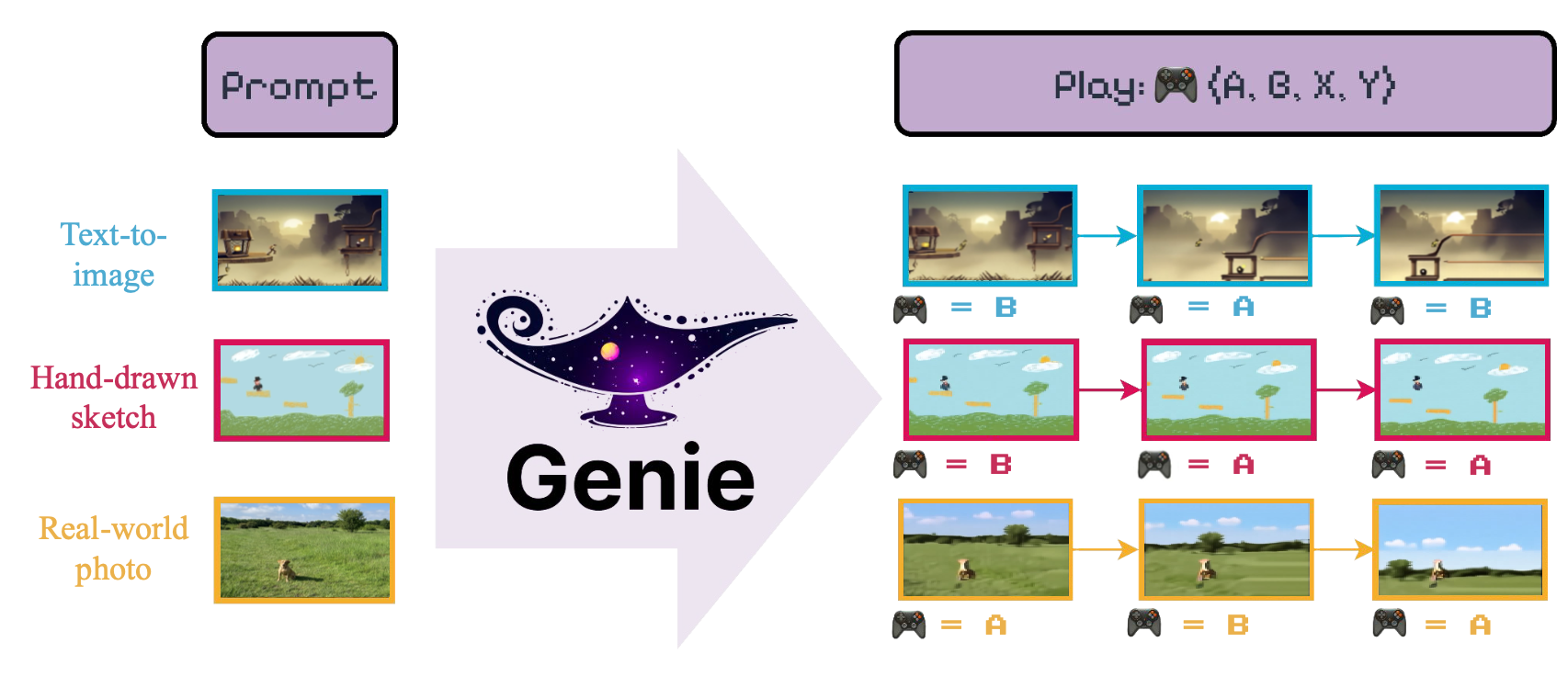
نحن نقدم واجهة LightningCLI لتدريب بسهولة المكونات العديدة لنموذج Genie . على وجه الخصوص ، لتدريب VideoTokenizer يجب على المرء تشغيل ما يلي
python tokenizer.py train -config < path_to_conf_file > لتدريب كل من نموذج LatentAction Dynamics (الاستخدام بدوره من شأنه أن يستفيد من VideoTokenizer مدرب بالكامل) ، يمكن للمرء مرة أخرى تشغيله ببساطة:
python genie.py train -config < path_to_conf_file > نحن نقدم مثال ملفات التكوين في مجلد config .
في الأقسام التالية ، نقدم مثالًا على رموز لبنات البناء الأساسية التي تشكل معًا وحدة Genie الشاملة.
يعتمد Genie على VideoTokenizer يرقص مقاطع فيديو إدخال وعبر encode - quantize قدراتها إلى تحويلها إلى رموز منفصلة. هذه الرموز هي ما تستخدمه وحدة Dynamics لمعالجة مساحة الفيديو الكامنة . تقبل وحدة VideoTokenizer عدة معلمات للتخصيص المكثف ، إليك رمز مثال للاستخدام النموذجي:
 from genie import VideoTokenizer

# Pre-assembled description of MagViT2
# encoder & decoder architecture
from genie import MAGVIT2_ENC_DESC
from genie import MAGVIT2_DEC_DESC

tokenizer = VideoTokenizer (
  # We can pass an arbitrary description of the
  # encoder architecture, see genie.tokenizer.get_module
  # to see which module are supported
  enc_desc = (
    'causal' , { # A CausalConv3d layer
        'in_channels' : 3 ,
        'out_channels' : 64 ,
        'kernel_size' : 3 ,
    }),
    ( 'residual' , { # Residual Block
        'in_channels' : 64 ,
        'kernel_size' : 3 ,
        'downsample' : ( 1 , 2 ), # Optional down-scaling (time, space)
        'use_causal' : True , # Using causal padding
        'use_blur' : True , # Using blur-pooling
    }),
    ( 'residual' , {
        'in_channels' : 64 ,
        'out_channels' : 128 , # Output channels can be different
    }),
    ( 'residual' , {
        'n_rep' : 2 , # We can repeat this block N-times
        'in_channels' : 128 ,
    }),
    ( 'residual' , {
        'in_channels' : 128 ,
        'out_channels' : 256 , # We can mix different output channels...
        'kernel_size' : 3 ,
        'downsample' : 2 , # ...with down-sampling (here time=space=2)
        'use_causal' : True ,
    }),
    ( 'proj_out' , { # Output project to quantization module
        'in_channels' : 256 ,
        'out_channels' : 18 ,
        'num_groups' : 8 ,
        'kernel_size' : 3 ,
    }),
  # Save time, use a pre-made configuration!
  dec_desc = MAGVIT2_DEC_DESC ,

  # Description of GAN discriminator
  disc_kwargs = dict (
      # Discriminator parameters
      inp_size = ( 64 , 64 ), # Size of input frames
      model_dim = 64 ,
      dim_mults = ( 1 , 2 , 4 ),    # Channel multipliers
      down_step = ( None , 2 , 2 ), # Down-sampling steps
      inp_channels = 3 ,
      kernel_size = 3 ,
      num_groups = 8 ,
      act_fn = 'leaky' , # Use LeakyReLU as activation function
      use_blur = True ,  # Use BlurPooling for down-sampling
      use_attn = True ,  # Discriminator can have spatial attention
      num_heads = 4 ,    # Number of (spatial) attention heads
      dim_head = 32 ,    # Dimension of each spatial attention heads
  ),

  # Keyword for the LFQ module
  d_codebook = 18 , # Codebook dimension, should match encoder output channels
  n_codebook = 1 , # Support for multiple codebooks
  lfq_bias = True ,
  lfq_frac_sample = 1. ,
  lfq_commit_weight = 0.25 ,
  lfq_entropy_weight = 0.1 ,
  lfq_diversity_weight = 1. ,
  # Keyword for the different loss
  perceptual_model = 'vgg16' , # We pick VGG-16 for perceptual loss
  # Which layer should we record perceptual features from
  perc_feat_layers = ( 'features.6' , 'features.13' , 'features.18' , 'features.25' ),
  gan_discriminate = 'frames' , # GAN discriminator looks at individual frames
  gan_frames_per_batch = 4 ,  # How many frames to extract from each video to use for GAN
  gan_loss_weight = 1. ,
  perc_loss_weight = 1. ,
  quant_loss_weight = 1. ,
)

batch_size = 4
num_channels = 3
num_frames = 16
img_h , img_w = 64 , 64

# Example video tensor
mock_video = torch . randn (
  batch_size ,
  num_channels ,
  num_frames ,
  img_h ,
  img_w
)

# Tokenize input video
tokens , idxs = tokenizer . tokenize ( mock_video )

# Tokenized video has shape:
# (batch_size, d_codebook, num_frames // down_time, H // down_space, W // down_space)

# To decode the video from tokens use:
rec_video = tokenizer . decode ( tokens )

# To train the tokenizer (do many! times)
loss , aux_losses = tokenizer ( mock_video )
loss . backward () تنفذ Genie نموذجًا LatentAction تتمثل مهمته الوحيدة في إضفاء الطابع الرسمي على دفتر رمز (منفصل) للإجراءات الكامنة. يعد دفتر الرمز هذا صغيرًا حسب التصميم لتشجيع الإجراءات القابلة للتفسير (مثل MOVE_RIGHT ). من أجل تدريب كود كود ، يتم بناء نموذج LatentAction كنموذج VQ-VAE ، حيث يستوعب المشفر إطارات الفيديو (بكسل) ويقوم بإجراء إجراءات (كمية) مثل اللاتينات. بعد ذلك ، فإن وحدة فك الترميز تستوعب تاريخ الإطار السابق والإجراء الحالي للتنبؤ بالإطار التالي. يتم التخلص من كل من المشفر ودلو المشفر في وقت الاستدلال حيث يتم توفير الإجراء من قبل المستخدم.
يتبع نموذج LatentAction تصميمًا مشابهًا كـ VideoTokenizer ، حيث يمكن تحديد بنية التشفير/فك الترميز عبر Blueprint . فيما يلي رمز مثال لتسليط الضوء على المكونات الأساسية:
 from genie import LatentAction
from genie import LATENT_ACT_ENC

model = LatentAction (
  # Use a pre-made configuration...
  enc_desc = LATENT_ACT_ENC ,
  # ...Or specify a brand-new one
  dec_desc = (
    # Latent Action uses space-time transformer
    ( 'space-time_attn' , {
        'n_rep' : 2 ,
        'n_embd' : 256 ,
        'n_head' : 4 ,
        'd_head' : 16 ,
        'has_ext' : True ,
        # Decoder uses latent action as external
        # conditioning for decoding!
        'time_attn_kw'  : { 'key_dim' : 8 },
    }),
    # But we can also down/up-sample to manage resources
    # NOTE: Encoder & Decoder should work nicely together
    #       so that down/up-samples cancel out
    ( 'spacetime_upsample' , {
        'in_channels' : 256 ,
        'kernel_size' : 3 ,
        'time_factor' : 1 ,
        'space_factor' : 2 ,
    }),
    ( 'space-time_attn' , {
        'n_rep' : 2 ,
        'n_embd' : 256 ,
        'n_head' : 4 ,
        'd_head' : 16 ,
        'has_ext' : True ,
        'time_attn_kw'  : { 'key_dim' : 8 },
    }),
  ),
  d_codebook = 8 ,       # Small codebook to incentivize interpretability
  inp_channels = 3 ,     # Input video channel
  inp_shape = ( 64 , 64 ), # Spatial frame dimensions
  n_embd = 256 ,         # Hidden model dimension
  # [...] Other kwargs for controlling LFQ module behavior
)

# Create mock input video
batch_size = 2
video_len = 16
frame_dim = 64 , 64

video = torch . randn ( batch_size , 3 , video_len , * frame_dim )

# Encode the video to extract the latent actions
( actions , encoded ), quant_loss = model . encode ( video )

# Compute the reconstructed video and its loss
recon , loss , aux_losses = model ( video )

# This should work!
assert recon . shape == ( batch_size , 3 , video_len , * frame_dim )

# Train the model
loss . backward () تم تكليف DynamicsModel بالتنبؤ برمز الفيديو التالي استنادًا إلى تاريخ الرمز المميز للفيديو السابق وتاريخ العمل الكامن. تعتمد الهندسة المعمارية على نموذج MaskGIT من Chang et al ، (2022). فيما يلي رمز مثال لتسليط الضوء على المكونات الأساسية:
 from genie import DynamicsModel

blueprint = (
  # Describe a Space-Time Transformer
  ( 'space-time_attn' , {
      'n_rep' : 4 ,     # Number of layers
      'n_embd' : 256 ,  # Hidden dimension
      'n_head' : 4 ,    # Number of attention heads
      'd_head' : 16 ,   # Dimension of each attention head
      'transpose' : False ,
  }),
)

# Create the model
tok_codebook = 16 # Dimension of video tokenizer codebook
act_codebook =  4 # Dimension of latent action codebook
dynamics = DynamicsModel (
    desc = blueprint ,
    tok_vocab = tok_codebook ,
    act_vocab = act_codebook ,
    embed_dim = 256 ,          # Hidden dimension of the model
)

batch_size = 2
num_frames = 16
img_size   = 32

# Create mock token and latent action inputs
mock_tokens = torch . randint ( 0 , tok_codebook , ( batch_size , num_frames , img_size , img_size ))
mock_act_id = torch . randint ( 0 , act_codebook , ( batch_size , num_frames ))

# Compute the reconstruction loss based on Bernoulli
# masking of input tokens
loss = dynamics . compute_loss (
    mock_tokens ,
    mock_act_id ,
)

# Generate the next video token
new_tokens = dynamics . generate (
    mock_tokens ,
    mock_act_id ,
    steps = 5 , # Number of MaskGIT sampling steps
)

assert new_tokes . shape == ( batch_size , num_frame + 1 , img_size , img_size ) تم اختبار الكود باستخدام Python 3.11+ ويتطلب torch 2.0+ (بسبب استخدام الاهتمام السريع). لتثبيت التبعيات المطلوبة ببساطة قم بتشغيل pip install -r requirements.txt
يعتمد هذا الريبو على تطبيق Magvit الجميل من قبل LucidRains وتنفيذ Maskgit من Valeoai.
 @article { bruce2024genie ,
  title = { Genie: Generative Interactive Environments } ,
  author = { Bruce, Jake and Dennis, Michael and Edwards, Ashley and Parker-Holder, Jack and Shi, Yuge and Hughes, Edward and Lai, Matthew and Mavalankar, Aditi and Steigerwald, Richie and Apps, Chris and others } ,
  journal = { arXiv preprint arXiv:2402.15391 } ,
  year = { 2024 }
}
@article { yu2023language ,
title = { Language Model Beats Diffusion--Tokenizer is Key to Visual Generation } ,
author = { Yu, Lijun and Lezama, Jos{'e} and Gundavarapu, Nitesh B and Versari, Luca and Sohn, Kihyuk and Minnen, David and Cheng, Yong and Gupta, Agrim and Gu, Xiuye and Hauptmann, Alexander G and others } ,
journal = { arXiv preprint arXiv:2310.05737 } ,
year = { 2023 }
} @inproceedings { chang2022maskgit ,
title = { Maskgit: Masked generative image transformer } ,
author = { Chang, Huiwen and Zhang, Han and Jiang, Lu and Liu, Ce and Freeman, William T } ,
booktitle = { Proceedings of the IEEE/CVF Conference on Computer Vision and Pattern Recognition } ,
pages = { 11315--11325 } ,
year = { 2022 }
}




