open genie
1.0.0

Dieses Repo enthält die inoffizielle Implementierung von Genie: generative interaktive Umgebungen Bruce et al. (2024), wie von Google DeepMind eingeführt.
Das Ziel des Modells ist es, "[...] die erste generative interaktive Umgebung einzuführen, die auf unbeaufsichtigte Weise aus unbeschriebenen Internetvideos geschult wurde".
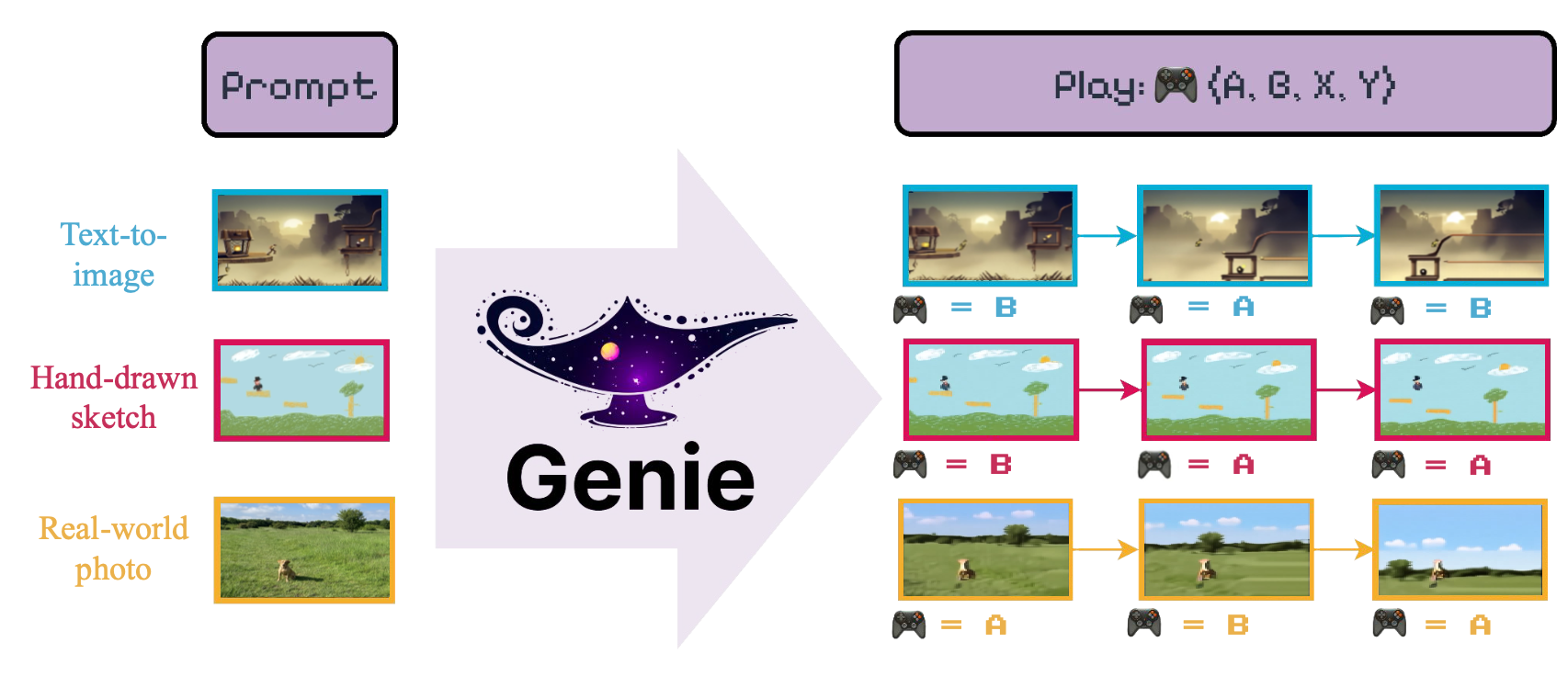
Wir bieten eine LightningCLI -Schnittstelle, um die verschiedenen Komponenten des Genie -Modells problemlos zu trainieren. Insbesondere, um den VideoTokenizer zu trainieren, sollte man Folgendes ausführen
python tokenizer.py train -config < path_to_conf_file > Um sowohl das LatentAction als auch das Dynamics zu trainieren (verwenden Sie wiederum einen voll ausgebildeten VideoTokenizer ), kann man wieder einfach ausgeführt werden:
python genie.py train -config < path_to_conf_file > Wir geben Beispielkonfigurationsdateien im config an.
In den folgenden Abschnitten bieten wir Beispielcodes für die Kernbausteine, die zusammen das Gesamt -Genie -Modul bilden.
Genie verlässt sich auf einen VideoTokenizer , der Eingangsvideos verdaut und über seine encode - quantize Fähigkeiten umwandelt sie in diskrete Token um. Diese Token sind das, was das Dynamics -Modul verwendet, um den latenten Videoraum zu manipulieren. Das VideoTokenizer -Modul akzeptiert mehrere Parameter für eine umfangreiche Anpassung. Hier finden Sie einen Beispielcode für eine typische Verwendung:
 from genie import VideoTokenizer

# Pre-assembled description of MagViT2
# encoder & decoder architecture
from genie import MAGVIT2_ENC_DESC
from genie import MAGVIT2_DEC_DESC

tokenizer = VideoTokenizer (
  # We can pass an arbitrary description of the
  # encoder architecture, see genie.tokenizer.get_module
  # to see which module are supported
  enc_desc = (
    'causal' , { # A CausalConv3d layer
        'in_channels' : 3 ,
        'out_channels' : 64 ,
        'kernel_size' : 3 ,
    }),
    ( 'residual' , { # Residual Block
        'in_channels' : 64 ,
        'kernel_size' : 3 ,
        'downsample' : ( 1 , 2 ), # Optional down-scaling (time, space)
        'use_causal' : True , # Using causal padding
        'use_blur' : True , # Using blur-pooling
    }),
    ( 'residual' , {
        'in_channels' : 64 ,
        'out_channels' : 128 , # Output channels can be different
    }),
    ( 'residual' , {
        'n_rep' : 2 , # We can repeat this block N-times
        'in_channels' : 128 ,
    }),
    ( 'residual' , {
        'in_channels' : 128 ,
        'out_channels' : 256 , # We can mix different output channels...
        'kernel_size' : 3 ,
        'downsample' : 2 , # ...with down-sampling (here time=space=2)
        'use_causal' : True ,
    }),
    ( 'proj_out' , { # Output project to quantization module
        'in_channels' : 256 ,
        'out_channels' : 18 ,
        'num_groups' : 8 ,
        'kernel_size' : 3 ,
    }),
  # Save time, use a pre-made configuration!
  dec_desc = MAGVIT2_DEC_DESC ,

  # Description of GAN discriminator
  disc_kwargs = dict (
      # Discriminator parameters
      inp_size = ( 64 , 64 ), # Size of input frames
      model_dim = 64 ,
      dim_mults = ( 1 , 2 , 4 ),    # Channel multipliers
      down_step = ( None , 2 , 2 ), # Down-sampling steps
      inp_channels = 3 ,
      kernel_size = 3 ,
      num_groups = 8 ,
      act_fn = 'leaky' , # Use LeakyReLU as activation function
      use_blur = True ,  # Use BlurPooling for down-sampling
      use_attn = True ,  # Discriminator can have spatial attention
      num_heads = 4 ,    # Number of (spatial) attention heads
      dim_head = 32 ,    # Dimension of each spatial attention heads
  ),

  # Keyword for the LFQ module
  d_codebook = 18 , # Codebook dimension, should match encoder output channels
  n_codebook = 1 , # Support for multiple codebooks
  lfq_bias = True ,
  lfq_frac_sample = 1. ,
  lfq_commit_weight = 0.25 ,
  lfq_entropy_weight = 0.1 ,
  lfq_diversity_weight = 1. ,
  # Keyword for the different loss
  perceptual_model = 'vgg16' , # We pick VGG-16 for perceptual loss
  # Which layer should we record perceptual features from
  perc_feat_layers = ( 'features.6' , 'features.13' , 'features.18' , 'features.25' ),
  gan_discriminate = 'frames' , # GAN discriminator looks at individual frames
  gan_frames_per_batch = 4 ,  # How many frames to extract from each video to use for GAN
  gan_loss_weight = 1. ,
  perc_loss_weight = 1. ,
  quant_loss_weight = 1. ,
)

batch_size = 4
num_channels = 3
num_frames = 16
img_h , img_w = 64 , 64

# Example video tensor
mock_video = torch . randn (
  batch_size ,
  num_channels ,
  num_frames ,
  img_h ,
  img_w
)

# Tokenize input video
tokens , idxs = tokenizer . tokenize ( mock_video )

# Tokenized video has shape:
# (batch_size, d_codebook, num_frames // down_time, H // down_space, W // down_space)

# To decode the video from tokens use:
rec_video = tokenizer . decode ( tokens )

# To train the tokenizer (do many! times)
loss , aux_losses = tokenizer ( mock_video )
loss . backward () Genie implementiert ein LatentAction , dessen alleinige Aufgabe darin besteht, ein (diskretes) Codebuch mit latenten Aktionen zu formalisieren. Dieses Codebuch ist von Design klein, um interpretierbare Aktionen (z. B. MOVE_RIGHT ) zu fördern. Um ein solches Codebuch zu trainieren, wird das LatentAction als VQ-VAE -Modell erstellt, wobei der Encoder das Video (Pixel) einnimmt und Aktionen (quantisierte) Aktionen als Leitungen erzeugt. Der Decoder hat dann die vorherige Frame -Geschichte und die aktuelle Aktion, um den nächsten Frame vorherzusagen. Sowohl der Encoder als auch der Decoder werden zum Zeitpunkt der Inferenz verworfen, da die Aktion vom Benutzer bereitgestellt wird.
Das LatentAction -Modell folgt einem ähnlichen Design wie der VideoTokenizer , bei dem die Encoder-/Decoder -Architekturen über einen Blueprint angegeben werden können. Hier ist ein Beispielcode, um die Kernkomponenten hervorzuheben:
 from genie import LatentAction
from genie import LATENT_ACT_ENC

model = LatentAction (
  # Use a pre-made configuration...
  enc_desc = LATENT_ACT_ENC ,
  # ...Or specify a brand-new one
  dec_desc = (
    # Latent Action uses space-time transformer
    ( 'space-time_attn' , {
        'n_rep' : 2 ,
        'n_embd' : 256 ,
        'n_head' : 4 ,
        'd_head' : 16 ,
        'has_ext' : True ,
        # Decoder uses latent action as external
        # conditioning for decoding!
        'time_attn_kw'  : { 'key_dim' : 8 },
    }),
    # But we can also down/up-sample to manage resources
    # NOTE: Encoder & Decoder should work nicely together
    #       so that down/up-samples cancel out
    ( 'spacetime_upsample' , {
        'in_channels' : 256 ,
        'kernel_size' : 3 ,
        'time_factor' : 1 ,
        'space_factor' : 2 ,
    }),
    ( 'space-time_attn' , {
        'n_rep' : 2 ,
        'n_embd' : 256 ,
        'n_head' : 4 ,
        'd_head' : 16 ,
        'has_ext' : True ,
        'time_attn_kw'  : { 'key_dim' : 8 },
    }),
  ),
  d_codebook = 8 ,       # Small codebook to incentivize interpretability
  inp_channels = 3 ,     # Input video channel
  inp_shape = ( 64 , 64 ), # Spatial frame dimensions
  n_embd = 256 ,         # Hidden model dimension
  # [...] Other kwargs for controlling LFQ module behavior
)

# Create mock input video
batch_size = 2
video_len = 16
frame_dim = 64 , 64

video = torch . randn ( batch_size , 3 , video_len , * frame_dim )

# Encode the video to extract the latent actions
( actions , encoded ), quant_loss = model . encode ( video )

# Compute the reconstructed video and its loss
recon , loss , aux_losses = model ( video )

# This should work!
assert recon . shape == ( batch_size , 3 , video_len , * frame_dim )

# Train the model
loss . backward () Das DynamicsModel ist beauftragt, das nächste Video -Token auf der Grundlage früherer Video -Token und latenten Aktionsgeschichten vorherzusagen. Die Architektur basiert auf dem MaskGIT -Modell von Chang et al. (2022). Hier ist ein Beispielcode, um die Kernkomponenten hervorzuheben:
 from genie import DynamicsModel

blueprint = (
  # Describe a Space-Time Transformer
  ( 'space-time_attn' , {
      'n_rep' : 4 ,     # Number of layers
      'n_embd' : 256 ,  # Hidden dimension
      'n_head' : 4 ,    # Number of attention heads
      'd_head' : 16 ,   # Dimension of each attention head
      'transpose' : False ,
  }),
)

# Create the model
tok_codebook = 16 # Dimension of video tokenizer codebook
act_codebook =  4 # Dimension of latent action codebook
dynamics = DynamicsModel (
    desc = blueprint ,
    tok_vocab = tok_codebook ,
    act_vocab = act_codebook ,
    embed_dim = 256 ,          # Hidden dimension of the model
)

batch_size = 2
num_frames = 16
img_size   = 32

# Create mock token and latent action inputs
mock_tokens = torch . randint ( 0 , tok_codebook , ( batch_size , num_frames , img_size , img_size ))
mock_act_id = torch . randint ( 0 , act_codebook , ( batch_size , num_frames ))

# Compute the reconstruction loss based on Bernoulli
# masking of input tokens
loss = dynamics . compute_loss (
    mock_tokens ,
    mock_act_id ,
)

# Generate the next video token
new_tokens = dynamics . generate (
    mock_tokens ,
    mock_act_id ,
    steps = 5 , # Number of MaskGIT sampling steps
)

assert new_tokes . shape == ( batch_size , num_frame + 1 , img_size , img_size ) Der Code wurde mit Python 3.11+ getestet und benötigt torch 2.0+ (aufgrund der Verwendung einer schnellen Flash-Ansicht). So installieren Sie die erforderlichen Abhängigkeiten einfach pip install -r requirements.txt aus.
Dieses Repo baut auf der schönen Magvit -Implementierung durch Lucidrains und der Maskgit -Implementierung aus Valeoai auf.
 @article { bruce2024genie ,
  title = { Genie: Generative Interactive Environments } ,
  author = { Bruce, Jake and Dennis, Michael and Edwards, Ashley and Parker-Holder, Jack and Shi, Yuge and Hughes, Edward and Lai, Matthew and Mavalankar, Aditi and Steigerwald, Richie and Apps, Chris and others } ,
  journal = { arXiv preprint arXiv:2402.15391 } ,
  year = { 2024 }
}
@article { yu2023language ,
title = { Language Model Beats Diffusion--Tokenizer is Key to Visual Generation } ,
author = { Yu, Lijun and Lezama, Jos{'e} and Gundavarapu, Nitesh B and Versari, Luca and Sohn, Kihyuk and Minnen, David and Cheng, Yong and Gupta, Agrim and Gu, Xiuye and Hauptmann, Alexander G and others } ,
journal = { arXiv preprint arXiv:2310.05737 } ,
year = { 2023 }
} @inproceedings { chang2022maskgit ,
title = { Maskgit: Masked generative image transformer } ,
author = { Chang, Huiwen and Zhang, Han and Jiang, Lu and Liu, Ce and Freeman, William T } ,
booktitle = { Proceedings of the IEEE/CVF Conference on Computer Vision and Pattern Recognition } ,
pages = { 11315--11325 } ,
year = { 2022 }
}




