lovely tensors
1.0.0

JAXpip install lovely-tensors或者
mamba install lovely-tensors或者
conda install -c conda-forge lovely-tensors您多久發現自己調試Pytorch代碼?您將張量轉換為單元格輸出,然後查看以下內容:
numbers tensor([[[-0.3541, -0.3369, -0.4054, ..., -0.5596, -0.4739, 2.2489],
[-0.4054, -0.4226, -0.4911, ..., -0.9192, -0.8507, 2.1633],
[-0.4739, -0.4739, -0.5424, ..., -1.0390, -1.0390, 2.1975],
...,
[-0.9020, -0.8335, -0.9363, ..., -1.4672, -1.2959, 2.2318],
[-0.8507, -0.7822, -0.9363, ..., -1.6042, -1.5014, 2.1804],
[-0.8335, -0.8164, -0.9705, ..., -1.6555, -1.5528, 2.1119]],
[[-0.1975, -0.1975, -0.3025, ..., -0.4776, -0.3725, 2.4111],
[-0.2500, -0.2325, -0.3375, ..., -0.7052, -0.6702, 2.3585],
[-0.3025, -0.2850, -0.3901, ..., -0.7402, -0.8102, 2.3761],
...,
[-0.4251, -0.2325, -0.3725, ..., -1.0903, -1.0203, 2.4286],
[-0.3901, -0.2325, -0.4251, ..., -1.2304, -1.2304, 2.4111],
[-0.4076, -0.2850, -0.4776, ..., -1.2829, -1.2829, 2.3410]],
[[-0.6715, -0.9853, -0.8807, ..., -0.9678, -0.6890, 2.3960],
[-0.7238, -1.0724, -0.9678, ..., -1.2467, -1.0201, 2.3263],
[-0.8284, -1.1247, -1.0201, ..., -1.2641, -1.1596, 2.3786],
...,
[-1.2293, -1.4733, -1.3861, ..., -1.5081, -1.2641, 2.5180],
[-1.1944, -1.4559, -1.4210, ..., -1.6476, -1.4733, 2.4308],
[-1.2293, -1.5256, -1.5081, ..., -1.6824, -1.5256, 2.3611]]])
看到所有這些數字對您來說真的很有用嗎?
什麼形狀?大小?
什麼是統計數據?
nan還是inf的任何值?
它是一個男人拿著tench的圖像嗎?
import lovely_tensors as lt lt . monkey_patch () numbers # torch.Tensor tensor[3, 196, 196] n=115248 (0.4Mb) x∈[-2.118, 2.640] μ=-0.388 σ=1.073
numbers . rgb更好,是嗎?
numbers [ 1 ,: 6 , 1 ] # Still shows values if there are not too many. tensor[6] x∈[-0.443, -0.197] μ=-0.311 σ=0.091 [-0.197, -0.232, -0.285, -0.373, -0.443, -0.338]
 spicy = numbers [ 0 ,: 12 , 0 ]. clone ()

spicy [ 0 ] *= 10000
spicy [ 1 ] /= 10000
spicy [ 2 ] = float ( 'inf' )
spicy [ 3 ] = float ( '-inf' )
spicy [ 4 ] = float ( 'nan' )

spicy = spicy . reshape (( 2 , 6 ))
spicy # Spicy stuff
tensor[2, 6] n=12 x∈[-3.541e+03, -4.054e-05] μ=-393.842 σ=1.180e+03 +Inf! -Inf! NaN!
torch . zeros ( 10 , 10 ) # A zero tensor - make it obvious tensor[10, 10] n=100 all_zeros
spicy . v # Verbose tensor[2, 6] n=12 x∈[-3.541e+03, -4.054e-05] μ=-393.842 σ=1.180e+03 +Inf! -Inf! NaN!
 tensor([[-3.5405e+03, -4.0543e-05,         inf,        -inf,         nan, -6.1093e-01],
        [-6.1093e-01, -5.9380e-01, -5.9380e-01, -5.4243e-01, -5.4243e-01, -5.4243e-01]])
spicy . p # The plain old way tensor([[-3.5405e+03, -4.0543e-05, inf, -inf, nan, -6.1093e-01],
[-6.1093e-01, -5.9380e-01, -5.9380e-01, -5.4243e-01, -5.4243e-01, -5.4243e-01]])
 named_numbers = numbers . rename ( "C" , "H" , "W" )
named_numbers
/home/xl0/mambaforge/envs/lovely-py31-torch25/lib/python3.10/site-packages/torch/_tensor.py:1420: UserWarning: Named tensors and all their associated APIs are an experimental feature and subject to change. Please do not use them for anything important until they are released as stable. (Triggered internally at ../c10/core/TensorImpl.h:1925.)
return super().rename(names)
tensor[C=3, H=196, W=196] n=115248 (0.4Mb) x∈[-2.118, 2.640] μ=-0.388 σ=1.073
.deeper numbers . deeper tensor[3, 196, 196] n=115248 (0.4Mb) x∈[-2.118, 2.640] μ=-0.388 σ=1.073
tensor[196, 196] n=38416 x∈[-2.118, 2.249] μ=-0.324 σ=1.036
tensor[196, 196] n=38416 x∈[-1.966, 2.429] μ=-0.274 σ=0.973
tensor[196, 196] n=38416 x∈[-1.804, 2.640] μ=-0.567 σ=1.178
 # You can go deeper if you need to
# And we can use `.deeper` with named dimensions.

named_numbers . deeper ( 2 )
tensor[C=3, H=196, W=196] n=115248 (0.4Mb) x∈[-2.118, 2.640] μ=-0.388 σ=1.073
tensor[H=196, W=196] n=38416 x∈[-2.118, 2.249] μ=-0.324 σ=1.036
tensor[W=196] x∈[-1.912, 2.249] μ=-0.673 σ=0.522
tensor[W=196] x∈[-1.861, 2.163] μ=-0.738 σ=0.418
tensor[W=196] x∈[-1.758, 2.198] μ=-0.806 σ=0.397
tensor[W=196] x∈[-1.656, 2.249] μ=-0.849 σ=0.369
tensor[W=196] x∈[-1.673, 2.198] μ=-0.857 σ=0.357
tensor[W=196] x∈[-1.656, 2.146] μ=-0.848 σ=0.372
tensor[W=196] x∈[-1.433, 2.215] μ=-0.784 σ=0.397
tensor[W=196] x∈[-1.279, 2.249] μ=-0.695 σ=0.486
tensor[W=196] x∈[-1.364, 2.249] μ=-0.637 σ=0.539
...
tensor[H=196, W=196] n=38416 x∈[-1.966, 2.429] μ=-0.274 σ=0.973
tensor[W=196] x∈[-1.861, 2.411] μ=-0.529 σ=0.556
tensor[W=196] x∈[-1.826, 2.359] μ=-0.562 σ=0.473
tensor[W=196] x∈[-1.756, 2.376] μ=-0.622 σ=0.458
tensor[W=196] x∈[-1.633, 2.429] μ=-0.664 σ=0.430
tensor[W=196] x∈[-1.651, 2.376] μ=-0.669 σ=0.399
tensor[W=196] x∈[-1.633, 2.376] μ=-0.701 σ=0.391
tensor[W=196] x∈[-1.563, 2.429] μ=-0.670 σ=0.380
tensor[W=196] x∈[-1.475, 2.429] μ=-0.616 σ=0.386
tensor[W=196] x∈[-1.511, 2.429] μ=-0.593 σ=0.399
...
tensor[H=196, W=196] n=38416 x∈[-1.804, 2.640] μ=-0.567 σ=1.178
tensor[W=196] x∈[-1.717, 2.396] μ=-0.982 σ=0.350
tensor[W=196] x∈[-1.752, 2.326] μ=-1.034 σ=0.314
tensor[W=196] x∈[-1.648, 2.379] μ=-1.086 σ=0.314
tensor[W=196] x∈[-1.630, 2.466] μ=-1.121 σ=0.305
tensor[W=196] x∈[-1.717, 2.448] μ=-1.120 σ=0.302
tensor[W=196] x∈[-1.717, 2.431] μ=-1.166 σ=0.314
tensor[W=196] x∈[-1.560, 2.448] μ=-1.124 σ=0.326
tensor[W=196] x∈[-1.421, 2.431] μ=-1.064 σ=0.383
tensor[W=196] x∈[-1.526, 2.396] μ=-1.047 σ=0.417
...
.rgb顏色為重要的Queston-是我們的男人嗎?
numbers . rgb ( numbers ). plt ( numbers + 3 ). plt ( center = "range" ).chans # .chans will map values betwen [-1,1] to colors.
# Make our values fit into that range to avoid clipping.
mean = torch . tensor ( in_stats [ 0 ])[:, None , None ]
std = torch . tensor ( in_stats [ 1 ])[:, None , None ]
numbers_01 = ( numbers * std + mean )
numbers_01 tensor[3, 196, 196] n=115248 (0.4Mb) x∈[0., 1.000] μ=0.361 σ=0.248
numbers_01 . chans # Weights of the second conv layer (64ch -> 128ch) of VGG11,
# grouped per output channel.
weights . chans ( frame_px = 1 , gutter_px = 0 ) lt . chans ( numbers_01 )
numbers . rgb ( in_stats ). fig # matplotlib figure 
( numbers * 0.3 + 0.5 ). chans . fig # matplotlib figure 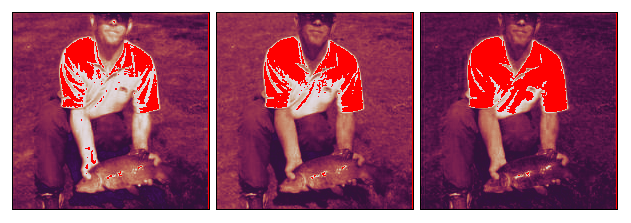
numbers . plt . fig . savefig ( 'pretty.svg' ) # Save it !f ile pretty . svg ; rm pretty . svg pretty.svg: SVG Scalable Vector Graphics image
 fig = plt . figure ( figsize = ( 8 , 3 ))
fig . set_constrained_layout ( True )
gs = fig . add_gridspec ( 2 , 2 )
ax1 = fig . add_subplot ( gs [ 0 , :])
ax2 = fig . add_subplot ( gs [ 1 , 0 ])
ax3 = fig . add_subplot ( gs [ 1 , 1 :])

ax2 . set_axis_off ()
ax3 . set_axis_off ()

numbers_01 . plt ( ax = ax1 )
numbers_01 . rgb ( ax = ax2 )
numbers_01 . chans ( ax = ax3 );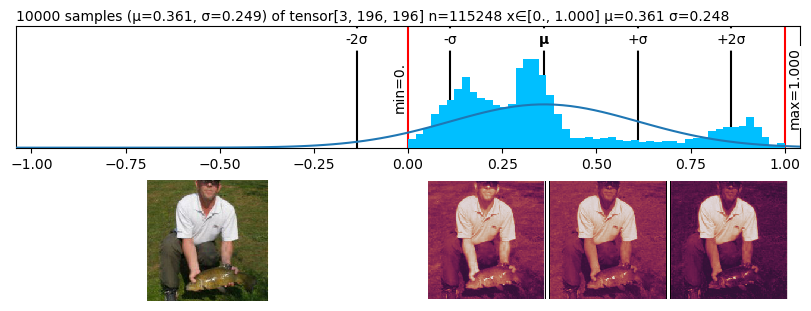
只是起作用。
 def func ( x ):
    return x * 2

if torch . __version__ >= "2.0" :
    func = torch . compile ( func )

func ( torch . tensor ([ 1 , 2 , 3 ]))
tensor[3] i64 x∈[2, 6] μ=4.000 σ=2.000 [2, 4, 6]
可愛的張量安裝了導入掛鉤。設置LOVELY_TENSORS=1 ,它將自動加載,無需修改代碼:>注意:不要在全球設置它,或者您運行的所有Python腳本都會導入LT和Pytorch,這會減慢速度。
 import torch

x = torch . randn ( 4 , 16 )
print ( x )
LOVELY_TENSORS=1 python test.py x: tensor[4, 16] n=64 x∈[-1.652, 1.813] μ=-0.069 σ=0.844
這對於結合更好的例外是特別有用的:
 import torch

x = torch . randn ( 4 , 16 )
print ( f"x: { x } " )

w = torch . randn ( 15 , 8 )
y = torch . matmul ( x , w ) # Dimension mismatch
BETTER_EXCEPTIONS=1 LOVELY_TENSORS=1 python test.py x: tensor[4, 16] n=64 x∈[-1.834, 2.421] μ=0.103 σ=0.896
Traceback (most recent call last):
File "/home/xl0/work/projects/lovely-tensors/test.py", line 7, in <module>
y = torch.matmul(x, w)
│ │ └ tensor[15, 8] n=120 x∈[-2.355, 2.165] μ=0.142 σ=0.989
│ └ tensor[4, 16] n=64 x∈[-1.834, 2.421] μ=0.103 σ=0.896
└ <module 'torch' from '/home/xl0/mambaforge/envs/torch25-py313/lib/python3.12/site-packages/torch/__init__.py'>
RuntimeError: mat1 and mat2 shapes cannot be multiplied (4x16 and 15x8)