lovely tensors
1.0.0

JAXpip install lovely-tensors또는
mamba install lovely-tensors또는
conda install -c conda-forge lovely-tensorsPytorch 코드를 얼마나 자주 디버깅 하시겠습니까? 셀 출력에 텐서를 버리고 다음을 참조하십시오.
numbers tensor([[[-0.3541, -0.3369, -0.4054, ..., -0.5596, -0.4739, 2.2489],
[-0.4054, -0.4226, -0.4911, ..., -0.9192, -0.8507, 2.1633],
[-0.4739, -0.4739, -0.5424, ..., -1.0390, -1.0390, 2.1975],
...,
[-0.9020, -0.8335, -0.9363, ..., -1.4672, -1.2959, 2.2318],
[-0.8507, -0.7822, -0.9363, ..., -1.6042, -1.5014, 2.1804],
[-0.8335, -0.8164, -0.9705, ..., -1.6555, -1.5528, 2.1119]],
[[-0.1975, -0.1975, -0.3025, ..., -0.4776, -0.3725, 2.4111],
[-0.2500, -0.2325, -0.3375, ..., -0.7052, -0.6702, 2.3585],
[-0.3025, -0.2850, -0.3901, ..., -0.7402, -0.8102, 2.3761],
...,
[-0.4251, -0.2325, -0.3725, ..., -1.0903, -1.0203, 2.4286],
[-0.3901, -0.2325, -0.4251, ..., -1.2304, -1.2304, 2.4111],
[-0.4076, -0.2850, -0.4776, ..., -1.2829, -1.2829, 2.3410]],
[[-0.6715, -0.9853, -0.8807, ..., -0.9678, -0.6890, 2.3960],
[-0.7238, -1.0724, -0.9678, ..., -1.2467, -1.0201, 2.3263],
[-0.8284, -1.1247, -1.0201, ..., -1.2641, -1.1596, 2.3786],
...,
[-1.2293, -1.4733, -1.3861, ..., -1.5081, -1.2641, 2.5180],
[-1.1944, -1.4559, -1.4210, ..., -1.6476, -1.4733, 2.4308],
[-1.2293, -1.5256, -1.5081, ..., -1.6824, -1.5256, 2.3611]]])
인간 으로서이 모든 숫자를 보는 것이 정말 유용 했습니까?
모양은 무엇입니까? 크기?
통계는 무엇입니까?
nan 또는 inf 값 중 하나입니까?
텐치를 들고있는 남자의 이미지입니까?
import lovely_tensors as lt lt . monkey_patch () numbers # torch.Tensor tensor[3, 196, 196] n=115248 (0.4Mb) x∈[-2.118, 2.640] μ=-0.388 σ=1.073
numbers . rgb더 나은거야?
numbers [ 1 ,: 6 , 1 ] # Still shows values if there are not too many. tensor[6] x∈[-0.443, -0.197] μ=-0.311 σ=0.091 [-0.197, -0.232, -0.285, -0.373, -0.443, -0.338]
 spicy = numbers [ 0 ,: 12 , 0 ]. clone ()

spicy [ 0 ] *= 10000
spicy [ 1 ] /= 10000
spicy [ 2 ] = float ( 'inf' )
spicy [ 3 ] = float ( '-inf' )
spicy [ 4 ] = float ( 'nan' )

spicy = spicy . reshape (( 2 , 6 ))
spicy # Spicy stuff
tensor[2, 6] n=12 x∈[-3.541e+03, -4.054e-05] μ=-393.842 σ=1.180e+03 +Inf! -Inf! NaN!
torch . zeros ( 10 , 10 ) # A zero tensor - make it obvious tensor[10, 10] n=100 all_zeros
spicy . v # Verbose tensor[2, 6] n=12 x∈[-3.541e+03, -4.054e-05] μ=-393.842 σ=1.180e+03 +Inf! -Inf! NaN!
 tensor([[-3.5405e+03, -4.0543e-05,         inf,        -inf,         nan, -6.1093e-01],
        [-6.1093e-01, -5.9380e-01, -5.9380e-01, -5.4243e-01, -5.4243e-01, -5.4243e-01]])
spicy . p # The plain old way tensor([[-3.5405e+03, -4.0543e-05, inf, -inf, nan, -6.1093e-01],
[-6.1093e-01, -5.9380e-01, -5.9380e-01, -5.4243e-01, -5.4243e-01, -5.4243e-01]])
 named_numbers = numbers . rename ( "C" , "H" , "W" )
named_numbers
/home/xl0/mambaforge/envs/lovely-py31-torch25/lib/python3.10/site-packages/torch/_tensor.py:1420: UserWarning: Named tensors and all their associated APIs are an experimental feature and subject to change. Please do not use them for anything important until they are released as stable. (Triggered internally at ../c10/core/TensorImpl.h:1925.)
return super().rename(names)
tensor[C=3, H=196, W=196] n=115248 (0.4Mb) x∈[-2.118, 2.640] μ=-0.388 σ=1.073
.deeper numbers . deeper tensor[3, 196, 196] n=115248 (0.4Mb) x∈[-2.118, 2.640] μ=-0.388 σ=1.073
tensor[196, 196] n=38416 x∈[-2.118, 2.249] μ=-0.324 σ=1.036
tensor[196, 196] n=38416 x∈[-1.966, 2.429] μ=-0.274 σ=0.973
tensor[196, 196] n=38416 x∈[-1.804, 2.640] μ=-0.567 σ=1.178
 # You can go deeper if you need to
# And we can use `.deeper` with named dimensions.

named_numbers . deeper ( 2 )
tensor[C=3, H=196, W=196] n=115248 (0.4Mb) x∈[-2.118, 2.640] μ=-0.388 σ=1.073
tensor[H=196, W=196] n=38416 x∈[-2.118, 2.249] μ=-0.324 σ=1.036
tensor[W=196] x∈[-1.912, 2.249] μ=-0.673 σ=0.522
tensor[W=196] x∈[-1.861, 2.163] μ=-0.738 σ=0.418
tensor[W=196] x∈[-1.758, 2.198] μ=-0.806 σ=0.397
tensor[W=196] x∈[-1.656, 2.249] μ=-0.849 σ=0.369
tensor[W=196] x∈[-1.673, 2.198] μ=-0.857 σ=0.357
tensor[W=196] x∈[-1.656, 2.146] μ=-0.848 σ=0.372
tensor[W=196] x∈[-1.433, 2.215] μ=-0.784 σ=0.397
tensor[W=196] x∈[-1.279, 2.249] μ=-0.695 σ=0.486
tensor[W=196] x∈[-1.364, 2.249] μ=-0.637 σ=0.539
...
tensor[H=196, W=196] n=38416 x∈[-1.966, 2.429] μ=-0.274 σ=0.973
tensor[W=196] x∈[-1.861, 2.411] μ=-0.529 σ=0.556
tensor[W=196] x∈[-1.826, 2.359] μ=-0.562 σ=0.473
tensor[W=196] x∈[-1.756, 2.376] μ=-0.622 σ=0.458
tensor[W=196] x∈[-1.633, 2.429] μ=-0.664 σ=0.430
tensor[W=196] x∈[-1.651, 2.376] μ=-0.669 σ=0.399
tensor[W=196] x∈[-1.633, 2.376] μ=-0.701 σ=0.391
tensor[W=196] x∈[-1.563, 2.429] μ=-0.670 σ=0.380
tensor[W=196] x∈[-1.475, 2.429] μ=-0.616 σ=0.386
tensor[W=196] x∈[-1.511, 2.429] μ=-0.593 σ=0.399
...
tensor[H=196, W=196] n=38416 x∈[-1.804, 2.640] μ=-0.567 σ=1.178
tensor[W=196] x∈[-1.717, 2.396] μ=-0.982 σ=0.350
tensor[W=196] x∈[-1.752, 2.326] μ=-1.034 σ=0.314
tensor[W=196] x∈[-1.648, 2.379] μ=-1.086 σ=0.314
tensor[W=196] x∈[-1.630, 2.466] μ=-1.121 σ=0.305
tensor[W=196] x∈[-1.717, 2.448] μ=-1.120 σ=0.302
tensor[W=196] x∈[-1.717, 2.431] μ=-1.166 σ=0.314
tensor[W=196] x∈[-1.560, 2.448] μ=-1.124 σ=0.326
tensor[W=196] x∈[-1.421, 2.431] μ=-1.064 σ=0.383
tensor[W=196] x∈[-1.526, 2.396] μ=-1.047 σ=0.417
...
.rgb 색상으로중요한 퀘스트 - 우리의 사람입니까?
numbers . rgb ( numbers ). plt ( numbers + 3 ). plt ( center = "range" ).chans 를 참조하십시오 # .chans will map values betwen [-1,1] to colors.
# Make our values fit into that range to avoid clipping.
mean = torch . tensor ( in_stats [ 0 ])[:, None , None ]
std = torch . tensor ( in_stats [ 1 ])[:, None , None ]
numbers_01 = ( numbers * std + mean )
numbers_01 tensor[3, 196, 196] n=115248 (0.4Mb) x∈[0., 1.000] μ=0.361 σ=0.248
numbers_01 . chans # Weights of the second conv layer (64ch -> 128ch) of VGG11,
# grouped per output channel.
weights . chans ( frame_px = 1 , gutter_px = 0 ) lt . chans ( numbers_01 )
numbers . rgb ( in_stats ). fig # matplotlib figure 
( numbers * 0.3 + 0.5 ). chans . fig # matplotlib figure 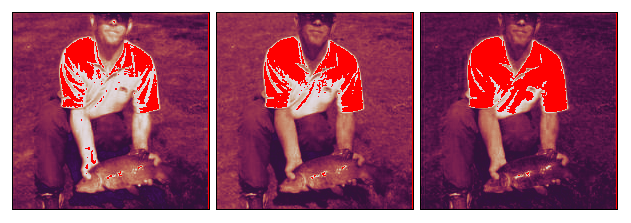
numbers . plt . fig . savefig ( 'pretty.svg' ) # Save it !f ile pretty . svg ; rm pretty . svg pretty.svg: SVG Scalable Vector Graphics image
 fig = plt . figure ( figsize = ( 8 , 3 ))
fig . set_constrained_layout ( True )
gs = fig . add_gridspec ( 2 , 2 )
ax1 = fig . add_subplot ( gs [ 0 , :])
ax2 = fig . add_subplot ( gs [ 1 , 0 ])
ax3 = fig . add_subplot ( gs [ 1 , 1 :])

ax2 . set_axis_off ()
ax3 . set_axis_off ()

numbers_01 . plt ( ax = ax1 )
numbers_01 . rgb ( ax = ax2 )
numbers_01 . chans ( ax = ax3 );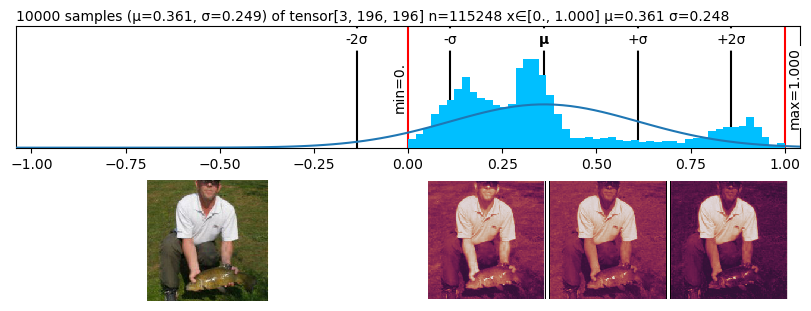
그냥 작동합니다.
 def func ( x ):
    return x * 2

if torch . __version__ >= "2.0" :
    func = torch . compile ( func )

func ( torch . tensor ([ 1 , 2 , 3 ]))
tensor[3] i64 x∈[2, 6] μ=4.000 σ=2.000 [2, 4, 6]
Lovely Tensors는 가져 오기 후크를 설치합니다. LOVELY_TENSORS=1 설정하면 자동으로로드되면 코드를 수정할 필요가 없습니다.> 참고 : 전역으로 설정하지 마십시오. 그렇지 않으면 실행하는 모든 Python 스크립트가 LT 및 Pytorch를 가져 오면 속도가 느려집니다.
 import torch

x = torch . randn ( 4 , 16 )
print ( x )
LOVELY_TENSORS=1 python test.py x: tensor[4, 16] n=64 x∈[-1.652, 1.813] μ=-0.069 σ=0.844
이것은 더 나은 예외와 함께 특히 유용합니다.
 import torch

x = torch . randn ( 4 , 16 )
print ( f"x: { x } " )

w = torch . randn ( 15 , 8 )
y = torch . matmul ( x , w ) # Dimension mismatch
BETTER_EXCEPTIONS=1 LOVELY_TENSORS=1 python test.py x: tensor[4, 16] n=64 x∈[-1.834, 2.421] μ=0.103 σ=0.896
Traceback (most recent call last):
File "/home/xl0/work/projects/lovely-tensors/test.py", line 7, in <module>
y = torch.matmul(x, w)
│ │ └ tensor[15, 8] n=120 x∈[-2.355, 2.165] μ=0.142 σ=0.989
│ └ tensor[4, 16] n=64 x∈[-1.834, 2.421] μ=0.103 σ=0.896
└ <module 'torch' from '/home/xl0/mambaforge/envs/torch25-py313/lib/python3.12/site-packages/torch/__init__.py'>
RuntimeError: mat1 and mat2 shapes cannot be multiplied (4x16 and 15x8)