reformer pytorch
1.4.4

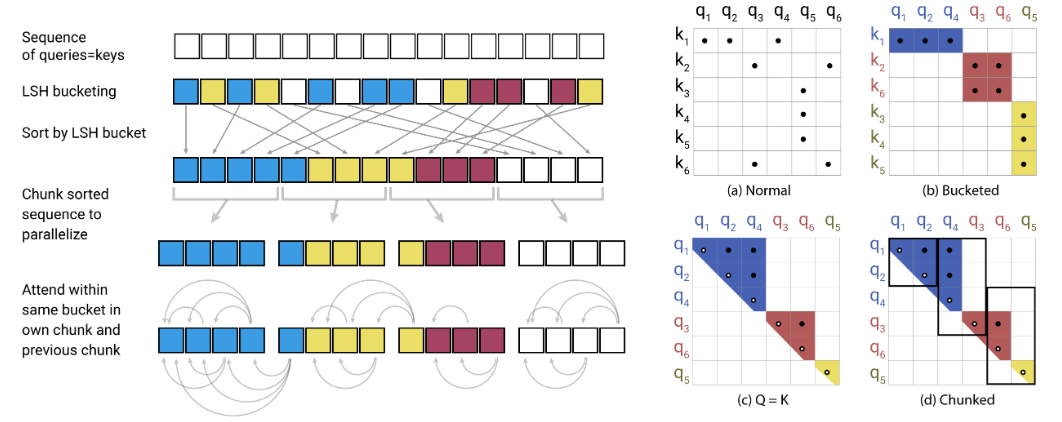
นี่คือการดำเนินการ pytorch ของนักปฏิรูป https://openreview.net/pdf?id=rkgnkkhtvb
มันรวมถึงความสนใจของ LSH เครือข่ายย้อนกลับและ chunking มันได้รับการตรวจสอบแล้วด้วยงานที่ประสบความสำเร็จโดยอัตโนมัติ (Enwik8)
โทเค็น 32K
โทเค็น 81K ที่มีความแม่นยำครึ่งหนึ่ง
$ pip install reformer_pytorchรูปแบบภาษานักปฏิรูปที่เรียบง่าย
 # should fit in ~ 5gb - 8k tokens

import torch
from reformer_pytorch import ReformerLM

model = ReformerLM (
    num_tokens = 20000 ,
    dim = 1024 ,
    depth = 12 ,
    max_seq_len = 8192 ,
    heads = 8 ,
    lsh_dropout = 0.1 ,
    ff_dropout = 0.1 ,
    post_attn_dropout = 0.1 ,
    layer_dropout = 0.1 ,  # layer dropout from 'Reducing Transformer Depth on Demand' paper
    causal = True ,        # auto-regressive or not
    bucket_size = 64 ,     # average size of qk per bucket, 64 was recommended in paper
    n_hashes = 4 ,         # 4 is permissible per author, 8 is the best but slower
    emb_dim = 128 ,        # embedding factorization for further memory savings
    dim_head = 64 ,        # be able to fix the dimension of each head, making it independent of the embedding dimension and the number of heads
    ff_chunks = 200 ,      # number of chunks for feedforward layer, make higher if there are memory issues
    attn_chunks = 8 ,      # process lsh attention in chunks, only way for memory to fit when scaling to 16k tokens
    num_mem_kv = 128 ,       # persistent learned memory key values, from all-attention paper
    full_attn_thres = 1024 , # use full attention if context length is less than set value
    reverse_thres = 1024 ,   # turn off reversibility for 2x speed for sequence lengths shorter or equal to the designated value
    use_scale_norm = False ,  # use scale norm from 'Transformers without tears' paper
    use_rezero = False ,      # remove normalization and use rezero from 'ReZero is All You Need'
    one_value_head = False ,  # use one set of values for all heads from 'One Write-Head Is All You Need'
    weight_tie = False ,           # tie parameters of each layer for no memory per additional depth
    weight_tie_embedding = False , # use token embedding for projection of output, some papers report better results
    n_local_attn_heads = 2 ,       # many papers suggest mixing local attention heads aids specialization and improves on certain tasks
    pkm_layers = ( 4 , 7 ),           # specify layers to use product key memory. paper shows 1 or 2 modules near the middle of the transformer is best
    pkm_num_keys = 128 ,           # defaults to 128, but can be increased to 256 or 512 as memory allows
    use_full_attn = False    # only turn on this flag to override and turn on full attention for all sequence lengths. for comparison with LSH to show that it is working
). cuda ()

x = torch . randint ( 0 , 20000 , ( 1 , 8192 )). long (). cuda ()
y = model ( x ) # (1, 8192, 20000)
นักปฏิรูป (เพียงแค่กองความสนใจ LSH ย้อนกลับได้)
 # should fit in ~ 5gb - 8k embeddings

import torch
from reformer_pytorch import Reformer

model = Reformer (
    dim = 512 ,
    depth = 12 ,
    heads = 8 ,
    lsh_dropout = 0.1 ,
    causal = True
). cuda ()

x = torch . randn ( 1 , 8192 , 512 ). cuda ()
y = model ( x ) # (1, 8192, 512)
ความสนใจในตัวเองด้วย LSH
 import torch
from reformer_pytorch import LSHSelfAttention

attn = LSHSelfAttention (
    dim = 128 ,
    heads = 8 ,
    bucket_size = 64 ,
    n_hashes = 8 ,
    causal = False
)

x = torch . randn ( 10 , 1024 , 128 )
y = attn ( x ) # (10, 1024, 128)
LSH (Hashing Sensitive Hashing)
 import torch
from reformer_pytorch import LSHAttention

attn = LSHAttention (
    bucket_size = 64 ,
    n_hashes = 16 ,
    causal = True
)

qk = torch . randn ( 10 , 1024 , 128 )
v = torch . randn ( 10 , 1024 , 128 )

out , attn , buckets = attn ( qk , v ) # (10, 1024, 128)
# attn contains the unsorted attention weights, provided return_attn is set to True (costly otherwise)
# buckets will contain the bucket number (post-argmax) of each token of each batch ที่เก็บนี้รองรับมาสก์ในลำดับอินพุต input_mask (bx i_seq) , ลำดับบริบท context_mask (bx c_seq) เช่นเดียวกับเมทริกซ์ความสนใจที่ไม่ค่อยได้ใช้เอง input_attn_mask (bx i_seq x i_seq) มาสก์ทำจากบูลีนที่ False หมายถึงการปิดบังก่อนที่จะมี Softmax
หน้ากากสามเหลี่ยมเชิงสาเหตุได้รับการดูแลสำหรับคุณถ้าคุณตั้งค่า causal = True
 import torch
from reformer_pytorch import ReformerLM

CONTEXT_LEN = 512
SEQ_LEN = 8192

model = ReformerLM (
    num_tokens = 20000 ,
    dim = 1024 ,
    depth = 1 ,
    max_seq_len = SEQ_LEN ,
    ff_chunks = 8 ,
    causal = True
)

c = torch . randn ( 1 , CONTEXT_LEN , 1024 )
x = torch . randint ( 0 , 20000 , ( 1 , SEQ_LEN )). long ()

i_mask = torch . ones ( 1 , SEQ_LEN ). bool ()
c_mask = torch . ones ( 1 , CONTEXT_LEN ). bool ()

y = model ( x , keys = c , input_mask = i_mask , context_mask = c_mask )
# masking done correctly in LSH attention การฝังตำแหน่งเริ่มต้นใช้การฝังตัวแบบโรตารี่
อย่างไรก็ตาม ARAN ได้แจ้งให้ฉันทราบว่าทีมนักปฏิรูปใช้การฝังตำแหน่งตามแนวแกนพร้อมผลลัพธ์ที่ยอดเยี่ยมในลำดับที่ยาวนานขึ้น
คุณสามารถเปิดการฝังตำแหน่งตามแนวแกนและปรับรูปร่างและมิติของการฝังแกนตามแนวแกนโดยทำตามคำแนะนำด้านล่าง
 import torch
from reformer_pytorch import ReformerLM

model = ReformerLM (
    num_tokens = 20000 ,
    dim = 1024 ,
    depth = 12 ,
    max_seq_len = 8192 ,
    ff_chunks = 8 ,
    attn_chunks = 2 ,
    causal = True ,
    axial_position_emb = True ,         # set this to True
    axial_position_shape = ( 128 , 64 ),  # the shape must multiply up to the max_seq_len (128 x 64 = 8192)
)

x = torch . randint ( 0 , 20000 , ( 1 , 8192 )). long ()
y = model ( x ) # (1, 8192, 20000)
หากคุณต้องการใช้การฝังตำแหน่งสัมบูรณ์คุณสามารถเปิดใช้งานได้ด้วย absolute_position_emb = True FLAG ในการเริ่มต้น
ตั้งแต่เวอร์ชัน 0.17.0 และการแก้ไขเครือข่ายที่สามารถย้อนกลับได้ Pytorch นักปฏิรูปเข้ากันได้กับ Deepspeed ของ Microsoft! หากคุณมี GPU ในท้องถิ่นหลายตัวคุณสามารถทำตามคำแนะนำ / ตัวอย่างที่นี่
ลำดับนักปฏิรูปเต็ม→ลำดับพูดการแปล
 import torch
from reformer_pytorch import ReformerLM

DE_SEQ_LEN = 4096
EN_SEQ_LEN = 4096

encoder = ReformerLM (
    num_tokens = 20000 ,
    emb_dim = 128 ,
    dim = 1024 ,
    depth = 12 ,
    heads = 8 ,
    max_seq_len = DE_SEQ_LEN ,
    fixed_position_emb = True ,
    return_embeddings = True # return output of last attention layer
). cuda ()

decoder = ReformerLM (
    num_tokens = 20000 ,
    emb_dim = 128 ,
    dim = 1024 ,
    depth = 12 ,
    heads = 8 ,
    max_seq_len = EN_SEQ_LEN ,
    fixed_position_emb = True ,
    causal = True
). cuda ()

x  = torch . randint ( 0 , 20000 , ( 1 , DE_SEQ_LEN )). long (). cuda ()
yi = torch . randint ( 0 , 20000 , ( 1 , EN_SEQ_LEN )). long (). cuda ()

enc_keys = encoder ( x )               # (1, 4096, 1024)
yo = decoder ( yi , keys = enc_keys )   # (1, 4096, 20000)
ภาพนักปฏิรูปเต็มรูปแบบ→คำบรรยายภาพ
 import torch
from torch . nn import Sequential
from torchvision import models
from reformer_pytorch import Reformer , ReformerLM

resnet = models . resnet50 ( pretrained = True )
resnet = Sequential ( * list ( resnet . children ())[: - 4 ])

SEQ_LEN = 4096

encoder = Reformer (
    dim = 512 ,
    depth = 6 ,
    heads = 8 ,
    max_seq_len = 4096
)

decoder = ReformerLM (
    num_tokens = 20000 ,
    dim = 512 ,
    depth = 6 ,
    heads = 8 ,
    max_seq_len = SEQ_LEN ,
    causal = True
)

x  = torch . randn ( 1 , 3 , 512 , 512 )
yi = torch . randint ( 0 , 20000 , ( 1 , SEQ_LEN )). long ()

visual_emb = resnet ( x )
b , c , h , w = visual_emb . shape
visual_emb = visual_emb . view ( 1 , c , h * w ). transpose ( 1 , 2 ) # nchw to nte

enc_keys = encoder ( visual_emb )
yo = decoder ( yi , keys = enc_keys ) # (1, 4096, 20000) มีข้อผิดพลาดในเวอร์ชัน < 0.21.0 โปรดอัปเกรดเป็นเวอร์ชันที่ระบุไว้อย่างน้อยสำหรับนักปฏิรูปตัวเข้ารหัส / ถอดรหัส
ตามความต้องการที่ได้รับความนิยมฉันได้เขียนโค้ดเสื้อคลุมที่ลบงานด้วยตนเองจำนวนมากในการเขียนสถาปัตยกรรมตัวเข้ารหัส / ตัวถอดรหัสทั่วไป ในการใช้งานคุณจะนำเข้าคลาส ReformerEncDec อาร์กิวเมนต์คำหลักของ Encoder จะถูกส่งผ่านด้วยคำนำหน้า enc_ และอาร์กิวเมนต์คำหลักถอดรหัสด้วย dec_ มิติโมเดล ( dim ) จะต้องเป็นคำนำหน้าฟรีและจะถูกแชร์ระหว่างตัวเข้ารหัสและตัวถอดรหัส เฟรมเวิร์กจะดูแลการผ่านหน้ากากอินพุตตัวเข้ารหัสไปยังหน้ากากบริบทถอดรหัสเว้นแต่จะถูกแทนที่อย่างชัดเจน
 import torch
from reformer_pytorch import ReformerEncDec

DE_SEQ_LEN = 4096
EN_SEQ_LEN = 4096

enc_dec = ReformerEncDec (
    dim = 512 ,
    enc_num_tokens = 20000 ,
    enc_depth = 6 ,
    enc_max_seq_len = DE_SEQ_LEN ,
    dec_num_tokens = 20000 ,
    dec_depth = 6 ,
    dec_max_seq_len = EN_SEQ_LEN
). cuda ()

train_seq_in = torch . randint ( 0 , 20000 , ( 1 , DE_SEQ_LEN )). long (). cuda ()
train_seq_out = torch . randint ( 0 , 20000 , ( 1 , EN_SEQ_LEN )). long (). cuda ()
input_mask = torch . ones ( 1 , DE_SEQ_LEN ). bool (). cuda ()

loss = enc_dec ( train_seq_in , train_seq_out , return_loss = True , enc_input_mask = input_mask )
loss . backward ()
# learn

# evaluate with the following
eval_seq_in = torch . randint ( 0 , 20000 , ( 1 , DE_SEQ_LEN )). long (). cuda ()
eval_seq_out_start = torch . tensor ([[ 0. ]]). long (). cuda () # assume 0 is id of start token
samples = enc_dec . generate ( eval_seq_in , eval_seq_out_start , seq_len = EN_SEQ_LEN , eos_token = 1 ) # assume 1 is id of stop token
print ( samples . shape ) # (1, <= 1024) decode the tokens หากต้องการดูประโยชน์ของการใช้ PKM อัตราการเรียนรู้ของค่าจะต้องตั้งค่าสูงกว่าพารามิเตอร์ที่เหลือ (แนะนำให้เป็น 1e-2 )
คุณสามารถทำตามคำแนะนำที่นี่เพื่อตั้งค่าได้อย่างถูกต้อง https://github.com/lucidrains/product-key-memory#learning-rates
โดยค่าเริ่มต้นฟังก์ชั่นการเปิดใช้งานคือ GELU หากคุณต้องการฟังก์ชั่นการเปิดใช้งานทางเลือกคุณสามารถส่งผ่านคลาสไปยังคำหลัก ff_activation
 import torch
from reformer_pytorch import ReformerLM
from torch import nn

model = ReformerLM (
    num_tokens = 20000 ,
    dim = 512 ,
    depth = 6 ,
    max_seq_len = 8192 ,
    ff_chunks = 8 ,
    ff_dropout = 0.1 ,
    ff_mult = 6 ,
    ff_activation = nn . LeakyReLU ,
    ff_glu = True # use GLU in feedforward, from paper 'GLU Variants Improve Transformer'
)

x = torch . randint ( 0 , 20000 , ( 1 , 8192 )). long ()
y = model ( x ) # (1, 8192, 20000) ในการเข้าถึงน้ำหนักความสนใจและการกระจายถังเพียงแค่ห่อโมเดลอินสแตนซ์ด้วยคลาสเครื่อง Recorder
 import torch
from reformer_pytorch import Reformer , Recorder

model = Reformer (
    dim = 512 ,
    depth = 12 ,
    max_seq_len = 8192 ,
    heads = 8 ,
    lsh_dropout = 0.1 ,
    causal = True
). cuda ()

model = Recorder ( model )

x = torch . randn ( 1 , 8192 , 512 ). cuda ()
y = model ( x )

model . recordings [ 0 ] # a list of attention weights and buckets for the first forward pass

model . turn_off () # stop recording
model . turn_on () # start recording
model . clear () # clear the recordings

model = model . eject () # recover the original model and remove all listeners Reformer มาพร้อมกับข้อเสียเปรียบเล็กน้อยว่าลำดับจะต้องหารด้วยขนาดถังอย่างประณีต * 2 ฉันได้จัดหาเครื่องมือตัวช่วยเล็ก ๆ ที่สามารถช่วยให้คุณหมุนรอบความยาวของลำดับไปยังหลายตัวต่อไป
 import torch
from reformer_pytorch import ReformerLM , Autopadder

model = ReformerLM (
    num_tokens = 20000 ,
    dim = 1024 ,
    depth = 12 ,
    max_seq_len = 8192 ,
    heads = 8 ,
    lsh_dropout = 0.1 ,
    causal = True ,
    bucket_size = 63 ,   # odd bucket size
    num_mem_kv = 77     # odd memory key length
). cuda ()

model = Autopadder ( model )

SEQ_LEN = 7777 # odd sequence length
keys = torch . randn ( 1 , 137 , 1024 ) # odd keys length

x = torch . randint ( 0 , 20000 , ( 1 , SEQ_LEN )). long (). cuda ()
y = model ( x , keys = keys ) # (1, 7777, 20000) ผู้ใช้จำนวนมากมีความสนใจในรูปแบบภาษาที่ไม่เร่งรีบ (เช่น GPT-2) นี่คือ wrapper ฝึกอบรมเพื่อให้ง่ายต่อการฝึกอบรมและประเมินเกี่ยวกับลำดับโทเค็นที่เข้ารหัสโดยพลการ คุณจะต้องดูแลการเข้ารหัสและถอดรหัสตัวเอง
 import torch
from torch import randint

from reformer_pytorch import ReformerLM
from reformer_pytorch . generative_tools import TrainingWrapper

model = ReformerLM (
    num_tokens = 20000 ,
    dim = 1024 ,
    depth = 12 ,
    max_seq_len = 4096 ,
    lsh_dropout = 0.1 ,
    causal = True ,
    full_attn_thres = 1024
)

# 0 is used for padding and no loss to be calculated on it
model = TrainingWrapper ( model , ignore_index = 0 , pad_value = 0 )

# the wrapper can handle evenly packed sequences
x_train = randint ( 0 , 20000 , ( 3 , 357 ))

# or if you have a list of uneven sequences, it will be padded for you
x_train = [
    randint ( 0 , 20000 , ( 120 ,)),
    randint ( 0 , 20000 , ( 253 ,)),
    randint ( 0 , 20000 , ( 846 ,))
]

# when training, set return_loss equal to True
model . train ()
loss = model ( x_train , return_loss = True )
loss . backward ()

# when evaluating, just use the generate function, which will default to top_k sampling with temperature of 1.
initial = torch . tensor ([[ 0 ]]). long () # assume 0 is start token
sample = model . generate ( initial , 100 , temperature = 1. , filter_thres = 0.9 , eos_token = 1 ) # assume end token is 1, or omit and it will sample up to 100
print ( sample . shape ) # (1, <=100) token ids Andrea ได้เปิดเผยว่าการใช้ระดับการเพิ่มประสิทธิภาพ O2 เมื่อการฝึกอบรมด้วยความแม่นยำผสมสามารถนำไปสู่ความไม่แน่นอน โปรดใช้ O1 แทนซึ่งสามารถตั้งค่ากับ amp_level ใน Pytorch Lightning หรือ opt_level ในไลบรารี Apex ของ Nvidia
 @inproceedings { kitaev2020reformer ,
    title       = { Reformer: The Efficient Transformer } ,
    author      = { Nikita Kitaev and Lukasz Kaiser and Anselm Levskaya } ,
    booktitle   = { International Conference on Learning Representations } ,
    year        = { 2020 } ,
    url         = { https://openreview.net/forum?id=rkgNKkHtvB }
}
@article { DBLP:journals/corr/abs-1907-01470 ,
author = { Sainbayar Sukhbaatar and
Edouard Grave and
Guillaume Lample and
Herv{'{e}} J{'{e}}gou and
Armand Joulin } ,
title = { Augmenting Self-attention with Persistent Memory } ,
journal = { CoRR } ,
volume = { abs/1907.01470 } ,
year = { 2019 } ,
url = { http://arxiv.org/abs/1907.01470 }
} @article { 1910.05895 ,
author = { Toan Q. Nguyen and Julian Salazar } ,
title = { Transformers without Tears: Improving the Normalization of Self-Attention } ,
year = { 2019 } ,
eprint = { arXiv:1910.05895 } ,
doi = { 10.5281/zenodo.3525484 } ,
} @inproceedings { fan2020reducing ,
title = { Reducing Transformer Depth on Demand with Structured Dropout } ,
author = { Angela Fan and Edouard Grave and Armand Joulin } ,
booktitle = { International Conference on Learning Representations } ,
year = { 2020 } ,
url = { https://openreview.net/forum?id=SylO2yStDr }
} @article { Shazeer2019FastTD ,
title = { Fast Transformer Decoding: One Write-Head is All You Need } ,
author = { Noam Shazeer } ,
journal = { ArXiv } ,
year = { 2019 } ,
volume = { abs/1911.02150 }
} @misc { shazeer2020glu ,
title = { GLU Variants Improve Transformer } ,
author = { Noam Shazeer } ,
year = { 2020 } ,
url = { https://arxiv.org/abs/2002.05202 }
} @misc { roy*2020efficient ,
title = { Efficient Content-Based Sparse Attention with Routing Transformers } ,
author = { Aurko Roy* and Mohammad Taghi Saffar* and David Grangier and Ashish Vaswani } ,
year = { 2020 } ,
url = { https://openreview.net/forum?id=B1gjs6EtDr }
} @misc { bachlechner2020rezero ,
title = { ReZero is All You Need: Fast Convergence at Large Depth } ,
author = { Thomas Bachlechner and Bodhisattwa Prasad Majumder and Huanru Henry Mao and Garrison W. Cottrell and Julian McAuley } ,
year = { 2020 } ,
url = { https://arxiv.org/abs/2003.04887 }
} @misc { lample2019large ,
title = { Large Memory Layers with Product Keys } ,
author = { Guillaume Lample and Alexandre Sablayrolles and Marc'Aurelio Ranzato and Ludovic Denoyer and Hervé Jégou } ,
year = { 2019 } ,
eprint = { 1907.05242 } ,
archivePrefix = { arXiv }
} @misc { bhojanapalli2020lowrank ,
title = { Low-Rank Bottleneck in Multi-head Attention Models } ,
author = { Srinadh Bhojanapalli and Chulhee Yun and Ankit Singh Rawat and Sashank J. Reddi and Sanjiv Kumar } ,
year = { 2020 } ,
eprint = { 2002.07028 }
} @misc { dong2021attention ,
title = { Attention is Not All You Need: Pure Attention Loses Rank Doubly Exponentially with Depth } ,
author = { Yihe Dong and Jean-Baptiste Cordonnier and Andreas Loukas } ,
year = { 2021 } ,
eprint = { 2103.03404 }
} @misc { su2021roformer ,
title = { RoFormer: Enhanced Transformer with Rotary Position Embedding } ,
author = { Jianlin Su and Yu Lu and Shengfeng Pan and Bo Wen and Yunfeng Liu } ,
year = { 2021 } ,
eprint = { 2104.09864 } ,
archivePrefix = { arXiv } ,
primaryClass = { cs.CL }
} @misc { vaswani2017attention ,
title = { Attention Is All You Need } ,
author = { Ashish Vaswani and Noam Shazeer and Niki Parmar and Jakob Uszkoreit and Llion Jones and Aidan N. Gomez and Lukasz Kaiser and Illia Polosukhin } ,
year = { 2017 } ,
eprint = { 1706.03762 } ,
archivePrefix = { arXiv } ,
primaryClass = { cs.CL }
}