reformer pytorch
1.4.4

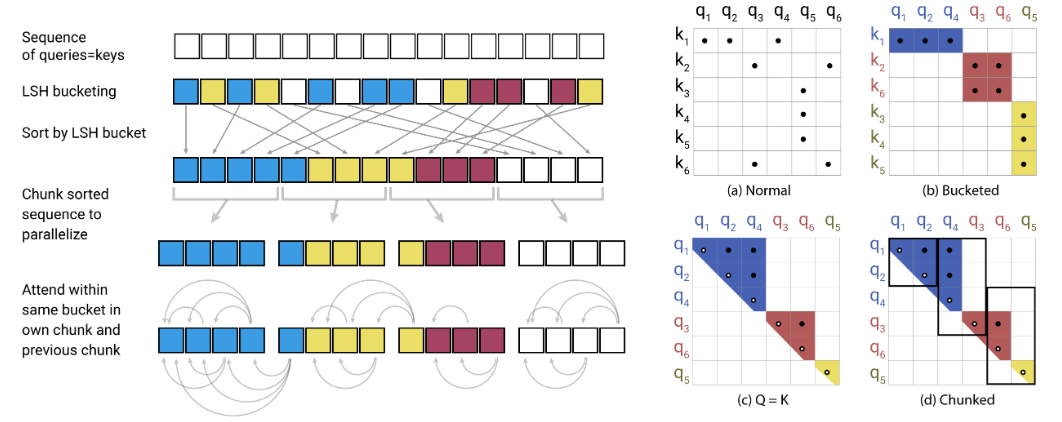
Dies ist eine Pytorch -Implementierung von Reformer https://openreview.net/pdf?id=rkgnkKhtvbb
Es umfasst LSH -Aufmerksamkeit, reversible Netzwerk und Chunking. Es wurde mit einer automatischen Aufgabe (ENWIK8) validiert.
32k Token
81K -Token mit halb Präzision
$ pip install reformer_pytorchEin einfaches Reformer -Sprachmodell
 # should fit in ~ 5gb - 8k tokens

import torch
from reformer_pytorch import ReformerLM

model = ReformerLM (
    num_tokens = 20000 ,
    dim = 1024 ,
    depth = 12 ,
    max_seq_len = 8192 ,
    heads = 8 ,
    lsh_dropout = 0.1 ,
    ff_dropout = 0.1 ,
    post_attn_dropout = 0.1 ,
    layer_dropout = 0.1 ,  # layer dropout from 'Reducing Transformer Depth on Demand' paper
    causal = True ,        # auto-regressive or not
    bucket_size = 64 ,     # average size of qk per bucket, 64 was recommended in paper
    n_hashes = 4 ,         # 4 is permissible per author, 8 is the best but slower
    emb_dim = 128 ,        # embedding factorization for further memory savings
    dim_head = 64 ,        # be able to fix the dimension of each head, making it independent of the embedding dimension and the number of heads
    ff_chunks = 200 ,      # number of chunks for feedforward layer, make higher if there are memory issues
    attn_chunks = 8 ,      # process lsh attention in chunks, only way for memory to fit when scaling to 16k tokens
    num_mem_kv = 128 ,       # persistent learned memory key values, from all-attention paper
    full_attn_thres = 1024 , # use full attention if context length is less than set value
    reverse_thres = 1024 ,   # turn off reversibility for 2x speed for sequence lengths shorter or equal to the designated value
    use_scale_norm = False ,  # use scale norm from 'Transformers without tears' paper
    use_rezero = False ,      # remove normalization and use rezero from 'ReZero is All You Need'
    one_value_head = False ,  # use one set of values for all heads from 'One Write-Head Is All You Need'
    weight_tie = False ,           # tie parameters of each layer for no memory per additional depth
    weight_tie_embedding = False , # use token embedding for projection of output, some papers report better results
    n_local_attn_heads = 2 ,       # many papers suggest mixing local attention heads aids specialization and improves on certain tasks
    pkm_layers = ( 4 , 7 ),           # specify layers to use product key memory. paper shows 1 or 2 modules near the middle of the transformer is best
    pkm_num_keys = 128 ,           # defaults to 128, but can be increased to 256 or 512 as memory allows
    use_full_attn = False    # only turn on this flag to override and turn on full attention for all sequence lengths. for comparison with LSH to show that it is working
). cuda ()

x = torch . randint ( 0 , 20000 , ( 1 , 8192 )). long (). cuda ()
y = model ( x ) # (1, 8192, 20000)
Der Reformer (nur ein Stapel reversibler LSH -Aufmerksamkeit)
 # should fit in ~ 5gb - 8k embeddings

import torch
from reformer_pytorch import Reformer

model = Reformer (
    dim = 512 ,
    depth = 12 ,
    heads = 8 ,
    lsh_dropout = 0.1 ,
    causal = True
). cuda ()

x = torch . randn ( 1 , 8192 , 512 ). cuda ()
y = model ( x ) # (1, 8192, 512)
Selbstaufschlag mit LSH
 import torch
from reformer_pytorch import LSHSelfAttention

attn = LSHSelfAttention (
    dim = 128 ,
    heads = 8 ,
    bucket_size = 64 ,
    n_hashes = 8 ,
    causal = False
)

x = torch . randn ( 10 , 1024 , 128 )
y = attn ( x ) # (10, 1024, 128)
LSH -Aufmerksamkeit (Lokalität sensibler Hashing)
 import torch
from reformer_pytorch import LSHAttention

attn = LSHAttention (
    bucket_size = 64 ,
    n_hashes = 16 ,
    causal = True
)

qk = torch . randn ( 10 , 1024 , 128 )
v = torch . randn ( 10 , 1024 , 128 )

out , attn , buckets = attn ( qk , v ) # (10, 1024, 128)
# attn contains the unsorted attention weights, provided return_attn is set to True (costly otherwise)
# buckets will contain the bucket number (post-argmax) of each token of each batch Dieses Repository unterstützt Masken auf der Eingabesequenz input_mask (bx i_seq) , der Kontextsequenz context_mask (bx c_seq) sowie die selten verwendete vollständige Aufmerksamkeitsmatrix selbst input_attn_mask (bx i_seq x i_seq) , die mit der LSH -Aufmerksamkeit kompatibler gemacht wurden. Masken bestehen aus Booleschen, bei denen False vor dem Softmax das Maskieren bezeichnet.
Die kausale dreieckige Maske wird für Sie gepflegt, wenn Sie causal = True festlegen.
 import torch
from reformer_pytorch import ReformerLM

CONTEXT_LEN = 512
SEQ_LEN = 8192

model = ReformerLM (
    num_tokens = 20000 ,
    dim = 1024 ,
    depth = 1 ,
    max_seq_len = SEQ_LEN ,
    ff_chunks = 8 ,
    causal = True
)

c = torch . randn ( 1 , CONTEXT_LEN , 1024 )
x = torch . randint ( 0 , 20000 , ( 1 , SEQ_LEN )). long ()

i_mask = torch . ones ( 1 , SEQ_LEN ). bool ()
c_mask = torch . ones ( 1 , CONTEXT_LEN ). bool ()

y = model ( x , keys = c , input_mask = i_mask , context_mask = c_mask )
# masking done correctly in LSH attention Bei der Standardpositionseinbettung werden Rotary -Einbettungen verwendet.
Aran hat mir jedoch mitgeteilt, dass das Reformer -Team axiale Position einbettet, die mit großartigen Ergebnissen zu längeren Sequenzen einbettet.
Sie können axiale Positionseinbetten einschalten und die Form und Dimension der axialen Einbettungen einstellen, indem Sie den folgenden Anweisungen folgen.
 import torch
from reformer_pytorch import ReformerLM

model = ReformerLM (
    num_tokens = 20000 ,
    dim = 1024 ,
    depth = 12 ,
    max_seq_len = 8192 ,
    ff_chunks = 8 ,
    attn_chunks = 2 ,
    causal = True ,
    axial_position_emb = True ,         # set this to True
    axial_position_shape = ( 128 , 64 ),  # the shape must multiply up to the max_seq_len (128 x 64 = 8192)
)

x = torch . randint ( 0 , 20000 , ( 1 , 8192 )). long ()
y = model ( x ) # (1, 8192, 20000)
Wenn Sie lieber absolute Positions -Einbettungen verwenden möchten, können Sie sie mit absolute_position_emb = True Flag bei der Initialisierung einschalten.
Seit Version 0.17.0 und einige Korrekturen im reversiblen Netzwerk ist Reformer Pytorch mit Microsofts DeepSpeed kompatibel! Wenn Sie mehrere lokale GPUs haben, können Sie hier die Anweisungen / Beispiele befolgen.
Eine vollständige Reformersequenz → Sequenz, sagen wir Übersetzung
 import torch
from reformer_pytorch import ReformerLM

DE_SEQ_LEN = 4096
EN_SEQ_LEN = 4096

encoder = ReformerLM (
    num_tokens = 20000 ,
    emb_dim = 128 ,
    dim = 1024 ,
    depth = 12 ,
    heads = 8 ,
    max_seq_len = DE_SEQ_LEN ,
    fixed_position_emb = True ,
    return_embeddings = True # return output of last attention layer
). cuda ()

decoder = ReformerLM (
    num_tokens = 20000 ,
    emb_dim = 128 ,
    dim = 1024 ,
    depth = 12 ,
    heads = 8 ,
    max_seq_len = EN_SEQ_LEN ,
    fixed_position_emb = True ,
    causal = True
). cuda ()

x  = torch . randint ( 0 , 20000 , ( 1 , DE_SEQ_LEN )). long (). cuda ()
yi = torch . randint ( 0 , 20000 , ( 1 , EN_SEQ_LEN )). long (). cuda ()

enc_keys = encoder ( x )               # (1, 4096, 1024)
yo = decoder ( yi , keys = enc_keys )   # (1, 4096, 20000)
Ein volles Reformer -Image → Bildunterschrift
 import torch
from torch . nn import Sequential
from torchvision import models
from reformer_pytorch import Reformer , ReformerLM

resnet = models . resnet50 ( pretrained = True )
resnet = Sequential ( * list ( resnet . children ())[: - 4 ])

SEQ_LEN = 4096

encoder = Reformer (
    dim = 512 ,
    depth = 6 ,
    heads = 8 ,
    max_seq_len = 4096
)

decoder = ReformerLM (
    num_tokens = 20000 ,
    dim = 512 ,
    depth = 6 ,
    heads = 8 ,
    max_seq_len = SEQ_LEN ,
    causal = True
)

x  = torch . randn ( 1 , 3 , 512 , 512 )
yi = torch . randint ( 0 , 20000 , ( 1 , SEQ_LEN )). long ()

visual_emb = resnet ( x )
b , c , h , w = visual_emb . shape
visual_emb = visual_emb . view ( 1 , c , h * w ). transpose ( 1 , 2 ) # nchw to nte

enc_keys = encoder ( visual_emb )
yo = decoder ( yi , keys = enc_keys ) # (1, 4096, 20000) Es gibt einen Fehler in Versionen < 0.21.0 . Bitte upgrade auf mindestens die für den Arbeitscoder / Decoder -Reformer angegebene Version.
Nach der populären Nachfrage habe ich einen Wrapper codiert, der eine Menge manueller Arbeit beim Schreiben einer generischen Reformer -Encoder / Decoder -Architektur entfaltet. Um zu verwenden, importieren Sie die ReformerEncDec -Klasse. Die Argumente für Encoder -Schlüsselwort würden mit einem enc_ -Präfix- und Decoder -Keyword -Argumenten mit dec_ übergeben. Die Modellabmessung ( dim ) muss frei sein und wird zwischen Encoder und Decoder geteilt. Das Framework kümmert sich auch um die Übergabe der Encoder -Eingangsmaske an die Decoder -Kontextmaske, sofern nicht explizit überschrieben.
 import torch
from reformer_pytorch import ReformerEncDec

DE_SEQ_LEN = 4096
EN_SEQ_LEN = 4096

enc_dec = ReformerEncDec (
    dim = 512 ,
    enc_num_tokens = 20000 ,
    enc_depth = 6 ,
    enc_max_seq_len = DE_SEQ_LEN ,
    dec_num_tokens = 20000 ,
    dec_depth = 6 ,
    dec_max_seq_len = EN_SEQ_LEN
). cuda ()

train_seq_in = torch . randint ( 0 , 20000 , ( 1 , DE_SEQ_LEN )). long (). cuda ()
train_seq_out = torch . randint ( 0 , 20000 , ( 1 , EN_SEQ_LEN )). long (). cuda ()
input_mask = torch . ones ( 1 , DE_SEQ_LEN ). bool (). cuda ()

loss = enc_dec ( train_seq_in , train_seq_out , return_loss = True , enc_input_mask = input_mask )
loss . backward ()
# learn

# evaluate with the following
eval_seq_in = torch . randint ( 0 , 20000 , ( 1 , DE_SEQ_LEN )). long (). cuda ()
eval_seq_out_start = torch . tensor ([[ 0. ]]). long (). cuda () # assume 0 is id of start token
samples = enc_dec . generate ( eval_seq_in , eval_seq_out_start , seq_len = EN_SEQ_LEN , eos_token = 1 ) # assume 1 is id of stop token
print ( samples . shape ) # (1, <= 1024) decode the tokens Um die Vorteile der Verwendung von PKM zu erkennen, muss die Lernrate der Werte höher eingestellt sein als der Rest der Parameter. (Empfohlen, 1e-2 zu sein)
Sie können die Anweisungen hier befolgen, um sie korrekt festzulegen.
Standardmäßig ist die Aktivierungsfunktion GELU . Wenn Sie eine alternative Aktivierungsfunktion wünschen, können Sie in der Klasse an das Schlüsselwort ff_activation weitergeben.
 import torch
from reformer_pytorch import ReformerLM
from torch import nn

model = ReformerLM (
    num_tokens = 20000 ,
    dim = 512 ,
    depth = 6 ,
    max_seq_len = 8192 ,
    ff_chunks = 8 ,
    ff_dropout = 0.1 ,
    ff_mult = 6 ,
    ff_activation = nn . LeakyReLU ,
    ff_glu = True # use GLU in feedforward, from paper 'GLU Variants Improve Transformer'
)

x = torch . randint ( 0 , 20000 , ( 1 , 8192 )). long ()
y = model ( x ) # (1, 8192, 20000) Um auf die Aufmerksamkeitsgewichte und die Bucket -Verteilung zuzugreifen, wickeln Sie einfach das sofortige Modell mit der Recorder -Wrapper -Klasse ein.
 import torch
from reformer_pytorch import Reformer , Recorder

model = Reformer (
    dim = 512 ,
    depth = 12 ,
    max_seq_len = 8192 ,
    heads = 8 ,
    lsh_dropout = 0.1 ,
    causal = True
). cuda ()

model = Recorder ( model )

x = torch . randn ( 1 , 8192 , 512 ). cuda ()
y = model ( x )

model . recordings [ 0 ] # a list of attention weights and buckets for the first forward pass

model . turn_off () # stop recording
model . turn_on () # start recording
model . clear () # clear the recordings

model = model . eject () # recover the original model and remove all listeners Der Reformer hat einen leichten Nachteil, dass die Sequenz durch die Eimergröße ordentlich teilbar sein muss
 import torch
from reformer_pytorch import ReformerLM , Autopadder

model = ReformerLM (
    num_tokens = 20000 ,
    dim = 1024 ,
    depth = 12 ,
    max_seq_len = 8192 ,
    heads = 8 ,
    lsh_dropout = 0.1 ,
    causal = True ,
    bucket_size = 63 ,   # odd bucket size
    num_mem_kv = 77     # odd memory key length
). cuda ()

model = Autopadder ( model )

SEQ_LEN = 7777 # odd sequence length
keys = torch . randn ( 1 , 137 , 1024 ) # odd keys length

x = torch . randint ( 0 , 20000 , ( 1 , SEQ_LEN )). long (). cuda ()
y = model ( x , keys = keys ) # (1, 7777, 20000) Viele Benutzer interessieren sich nur für ein automatisches Sprachmodell (wie GPT-2). Hier ist eine Trainingsverpackung, mit der Sie es einfach machen können, auf willkürlich verlängerten Sequenzen codierter Token zu trainieren und zu bewerten. Sie müssen sich um die Kodierung und Dekodierung kümmern.
 import torch
from torch import randint

from reformer_pytorch import ReformerLM
from reformer_pytorch . generative_tools import TrainingWrapper

model = ReformerLM (
    num_tokens = 20000 ,
    dim = 1024 ,
    depth = 12 ,
    max_seq_len = 4096 ,
    lsh_dropout = 0.1 ,
    causal = True ,
    full_attn_thres = 1024
)

# 0 is used for padding and no loss to be calculated on it
model = TrainingWrapper ( model , ignore_index = 0 , pad_value = 0 )

# the wrapper can handle evenly packed sequences
x_train = randint ( 0 , 20000 , ( 3 , 357 ))

# or if you have a list of uneven sequences, it will be padded for you
x_train = [
    randint ( 0 , 20000 , ( 120 ,)),
    randint ( 0 , 20000 , ( 253 ,)),
    randint ( 0 , 20000 , ( 846 ,))
]

# when training, set return_loss equal to True
model . train ()
loss = model ( x_train , return_loss = True )
loss . backward ()

# when evaluating, just use the generate function, which will default to top_k sampling with temperature of 1.
initial = torch . tensor ([[ 0 ]]). long () # assume 0 is start token
sample = model . generate ( initial , 100 , temperature = 1. , filter_thres = 0.9 , eos_token = 1 ) # assume end token is 1, or omit and it will sample up to 100
print ( sample . shape ) # (1, <=100) token ids Andrea hat aufgedeckt, dass die Verwendung von O2 -Optimierungsniveau beim Training mit gemischter Präzision zu Instabilität führen kann. Bitte verwenden Sie stattdessen O1, der mit dem amp_level in Pytorch Lightning oder opt_level in der Apex -Bibliothek von Nvidia festgelegt werden kann.
 @inproceedings { kitaev2020reformer ,
    title       = { Reformer: The Efficient Transformer } ,
    author      = { Nikita Kitaev and Lukasz Kaiser and Anselm Levskaya } ,
    booktitle   = { International Conference on Learning Representations } ,
    year        = { 2020 } ,
    url         = { https://openreview.net/forum?id=rkgNKkHtvB }
}
@article { DBLP:journals/corr/abs-1907-01470 ,
author = { Sainbayar Sukhbaatar and
Edouard Grave and
Guillaume Lample and
Herv{'{e}} J{'{e}}gou and
Armand Joulin } ,
title = { Augmenting Self-attention with Persistent Memory } ,
journal = { CoRR } ,
volume = { abs/1907.01470 } ,
year = { 2019 } ,
url = { http://arxiv.org/abs/1907.01470 }
} @article { 1910.05895 ,
author = { Toan Q. Nguyen and Julian Salazar } ,
title = { Transformers without Tears: Improving the Normalization of Self-Attention } ,
year = { 2019 } ,
eprint = { arXiv:1910.05895 } ,
doi = { 10.5281/zenodo.3525484 } ,
} @inproceedings { fan2020reducing ,
title = { Reducing Transformer Depth on Demand with Structured Dropout } ,
author = { Angela Fan and Edouard Grave and Armand Joulin } ,
booktitle = { International Conference on Learning Representations } ,
year = { 2020 } ,
url = { https://openreview.net/forum?id=SylO2yStDr }
} @article { Shazeer2019FastTD ,
title = { Fast Transformer Decoding: One Write-Head is All You Need } ,
author = { Noam Shazeer } ,
journal = { ArXiv } ,
year = { 2019 } ,
volume = { abs/1911.02150 }
} @misc { shazeer2020glu ,
title = { GLU Variants Improve Transformer } ,
author = { Noam Shazeer } ,
year = { 2020 } ,
url = { https://arxiv.org/abs/2002.05202 }
} @misc { roy*2020efficient ,
title = { Efficient Content-Based Sparse Attention with Routing Transformers } ,
author = { Aurko Roy* and Mohammad Taghi Saffar* and David Grangier and Ashish Vaswani } ,
year = { 2020 } ,
url = { https://openreview.net/forum?id=B1gjs6EtDr }
} @misc { bachlechner2020rezero ,
title = { ReZero is All You Need: Fast Convergence at Large Depth } ,
author = { Thomas Bachlechner and Bodhisattwa Prasad Majumder and Huanru Henry Mao and Garrison W. Cottrell and Julian McAuley } ,
year = { 2020 } ,
url = { https://arxiv.org/abs/2003.04887 }
} @misc { lample2019large ,
title = { Large Memory Layers with Product Keys } ,
author = { Guillaume Lample and Alexandre Sablayrolles and Marc'Aurelio Ranzato and Ludovic Denoyer and Hervé Jégou } ,
year = { 2019 } ,
eprint = { 1907.05242 } ,
archivePrefix = { arXiv }
} @misc { bhojanapalli2020lowrank ,
title = { Low-Rank Bottleneck in Multi-head Attention Models } ,
author = { Srinadh Bhojanapalli and Chulhee Yun and Ankit Singh Rawat and Sashank J. Reddi and Sanjiv Kumar } ,
year = { 2020 } ,
eprint = { 2002.07028 }
} @misc { dong2021attention ,
title = { Attention is Not All You Need: Pure Attention Loses Rank Doubly Exponentially with Depth } ,
author = { Yihe Dong and Jean-Baptiste Cordonnier and Andreas Loukas } ,
year = { 2021 } ,
eprint = { 2103.03404 }
} @misc { su2021roformer ,
title = { RoFormer: Enhanced Transformer with Rotary Position Embedding } ,
author = { Jianlin Su and Yu Lu and Shengfeng Pan and Bo Wen and Yunfeng Liu } ,
year = { 2021 } ,
eprint = { 2104.09864 } ,
archivePrefix = { arXiv } ,
primaryClass = { cs.CL }
} @misc { vaswani2017attention ,
title = { Attention Is All You Need } ,
author = { Ashish Vaswani and Noam Shazeer and Niki Parmar and Jakob Uszkoreit and Llion Jones and Aidan N. Gomez and Lukasz Kaiser and Illia Polosukhin } ,
year = { 2017 } ,
eprint = { 1706.03762 } ,
archivePrefix = { arXiv } ,
primaryClass = { cs.CL }
}♥