reformer pytorch
1.4.4

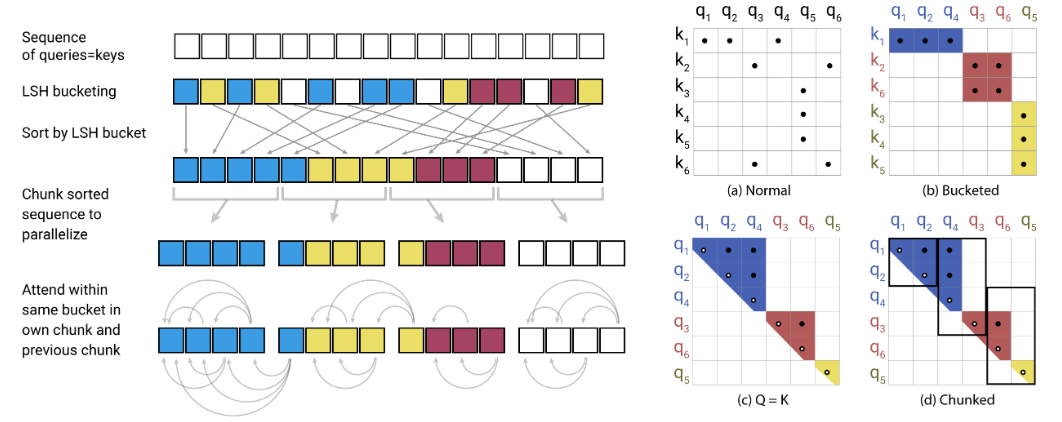
Ceci est une mise en œuvre pytorch de reformer https://openreview.net/pdf?id=rkgnkhtvb
Il comprend l'attention LSH, le réseau réversible et le groupe. Il a été validé avec une tâche auto-régressive (Enwik8).
Jetons 32K
81k jetons avec demi-précision
$ pip install reformer_pytorchUn modèle de langue réformateur simple
 # should fit in ~ 5gb - 8k tokens

import torch
from reformer_pytorch import ReformerLM

model = ReformerLM (
    num_tokens = 20000 ,
    dim = 1024 ,
    depth = 12 ,
    max_seq_len = 8192 ,
    heads = 8 ,
    lsh_dropout = 0.1 ,
    ff_dropout = 0.1 ,
    post_attn_dropout = 0.1 ,
    layer_dropout = 0.1 ,  # layer dropout from 'Reducing Transformer Depth on Demand' paper
    causal = True ,        # auto-regressive or not
    bucket_size = 64 ,     # average size of qk per bucket, 64 was recommended in paper
    n_hashes = 4 ,         # 4 is permissible per author, 8 is the best but slower
    emb_dim = 128 ,        # embedding factorization for further memory savings
    dim_head = 64 ,        # be able to fix the dimension of each head, making it independent of the embedding dimension and the number of heads
    ff_chunks = 200 ,      # number of chunks for feedforward layer, make higher if there are memory issues
    attn_chunks = 8 ,      # process lsh attention in chunks, only way for memory to fit when scaling to 16k tokens
    num_mem_kv = 128 ,       # persistent learned memory key values, from all-attention paper
    full_attn_thres = 1024 , # use full attention if context length is less than set value
    reverse_thres = 1024 ,   # turn off reversibility for 2x speed for sequence lengths shorter or equal to the designated value
    use_scale_norm = False ,  # use scale norm from 'Transformers without tears' paper
    use_rezero = False ,      # remove normalization and use rezero from 'ReZero is All You Need'
    one_value_head = False ,  # use one set of values for all heads from 'One Write-Head Is All You Need'
    weight_tie = False ,           # tie parameters of each layer for no memory per additional depth
    weight_tie_embedding = False , # use token embedding for projection of output, some papers report better results
    n_local_attn_heads = 2 ,       # many papers suggest mixing local attention heads aids specialization and improves on certain tasks
    pkm_layers = ( 4 , 7 ),           # specify layers to use product key memory. paper shows 1 or 2 modules near the middle of the transformer is best
    pkm_num_keys = 128 ,           # defaults to 128, but can be increased to 256 or 512 as memory allows
    use_full_attn = False    # only turn on this flag to override and turn on full attention for all sequence lengths. for comparison with LSH to show that it is working
). cuda ()

x = torch . randint ( 0 , 20000 , ( 1 , 8192 )). long (). cuda ()
y = model ( x ) # (1, 8192, 20000)
Le réformateur (juste une pile d'attention de LSH réversible)
 # should fit in ~ 5gb - 8k embeddings

import torch
from reformer_pytorch import Reformer

model = Reformer (
    dim = 512 ,
    depth = 12 ,
    heads = 8 ,
    lsh_dropout = 0.1 ,
    causal = True
). cuda ()

x = torch . randn ( 1 , 8192 , 512 ). cuda ()
y = model ( x ) # (1, 8192, 512)
Attention personnelle avec LSH
 import torch
from reformer_pytorch import LSHSelfAttention

attn = LSHSelfAttention (
    dim = 128 ,
    heads = 8 ,
    bucket_size = 64 ,
    n_hashes = 8 ,
    causal = False
)

x = torch . randn ( 10 , 1024 , 128 )
y = attn ( x ) # (10, 1024, 128)
LSH (hachage sensible de la localité)
 import torch
from reformer_pytorch import LSHAttention

attn = LSHAttention (
    bucket_size = 64 ,
    n_hashes = 16 ,
    causal = True
)

qk = torch . randn ( 10 , 1024 , 128 )
v = torch . randn ( 10 , 1024 , 128 )

out , attn , buckets = attn ( qk , v ) # (10, 1024, 128)
# attn contains the unsorted attention weights, provided return_attn is set to True (costly otherwise)
# buckets will contain the bucket number (post-argmax) of each token of each batch Ce référentiel prend en charge les masques sur la séquence d'entrée input_mask (bx i_seq) , la séquence de contexte context_mask (bx c_seq) , ainsi que la matrice d'attention complète rarement utilisée lui-même input_attn_mask (bx i_seq x i_seq) , toutes rendues compatibles avec l'attention LSH. Les masques sont faits de booléens où False dénote se masquer avant le softmax.
Le masque triangulaire causal est pris en charge pour vous si vous définissez causal = True .
 import torch
from reformer_pytorch import ReformerLM

CONTEXT_LEN = 512
SEQ_LEN = 8192

model = ReformerLM (
    num_tokens = 20000 ,
    dim = 1024 ,
    depth = 1 ,
    max_seq_len = SEQ_LEN ,
    ff_chunks = 8 ,
    causal = True
)

c = torch . randn ( 1 , CONTEXT_LEN , 1024 )
x = torch . randint ( 0 , 20000 , ( 1 , SEQ_LEN )). long ()

i_mask = torch . ones ( 1 , SEQ_LEN ). bool ()
c_mask = torch . ones ( 1 , CONTEXT_LEN ). bool ()

y = model ( x , keys = c , input_mask = i_mask , context_mask = c_mask )
# masking done correctly in LSH attention L'intégration positionnelle par défaut utilise des incorporations rotatives.
Cependant, Aran m'a informé que l'équipe de réformateurs a utilisé des intérêts de position axiale avec de grands résultats sur des séquences plus longues.
Vous pouvez activer l'incorporation de position axiale et ajuster la forme et la dimension des incorporations axiales en suivant les instructions ci-dessous.
 import torch
from reformer_pytorch import ReformerLM

model = ReformerLM (
    num_tokens = 20000 ,
    dim = 1024 ,
    depth = 12 ,
    max_seq_len = 8192 ,
    ff_chunks = 8 ,
    attn_chunks = 2 ,
    causal = True ,
    axial_position_emb = True ,         # set this to True
    axial_position_shape = ( 128 , 64 ),  # the shape must multiply up to the max_seq_len (128 x 64 = 8192)
)

x = torch . randint ( 0 , 20000 , ( 1 , 8192 )). long ()
y = model ( x ) # (1, 8192, 20000)
Si vous préférez utiliser des incorporations positionnelles absolues, vous pouvez l'activer avec absolute_position_emb = True Flag lors de l'initialisation.
Depuis la version 0.17.0 et quelques corrections du réseau réversible, le réformateur Pytorch est compatible avec Deeppeed de Microsoft! Si vous avez plusieurs GPU locaux, vous pouvez suivre les instructions / exemple ici.
Une séquence de réformateurs complète → séquence, disons la traduction
 import torch
from reformer_pytorch import ReformerLM

DE_SEQ_LEN = 4096
EN_SEQ_LEN = 4096

encoder = ReformerLM (
    num_tokens = 20000 ,
    emb_dim = 128 ,
    dim = 1024 ,
    depth = 12 ,
    heads = 8 ,
    max_seq_len = DE_SEQ_LEN ,
    fixed_position_emb = True ,
    return_embeddings = True # return output of last attention layer
). cuda ()

decoder = ReformerLM (
    num_tokens = 20000 ,
    emb_dim = 128 ,
    dim = 1024 ,
    depth = 12 ,
    heads = 8 ,
    max_seq_len = EN_SEQ_LEN ,
    fixed_position_emb = True ,
    causal = True
). cuda ()

x  = torch . randint ( 0 , 20000 , ( 1 , DE_SEQ_LEN )). long (). cuda ()
yi = torch . randint ( 0 , 20000 , ( 1 , EN_SEQ_LEN )). long (). cuda ()

enc_keys = encoder ( x )               # (1, 4096, 1024)
yo = decoder ( yi , keys = enc_keys )   # (1, 4096, 20000)
Une image de réformateur complète → Légende
 import torch
from torch . nn import Sequential
from torchvision import models
from reformer_pytorch import Reformer , ReformerLM

resnet = models . resnet50 ( pretrained = True )
resnet = Sequential ( * list ( resnet . children ())[: - 4 ])

SEQ_LEN = 4096

encoder = Reformer (
    dim = 512 ,
    depth = 6 ,
    heads = 8 ,
    max_seq_len = 4096
)

decoder = ReformerLM (
    num_tokens = 20000 ,
    dim = 512 ,
    depth = 6 ,
    heads = 8 ,
    max_seq_len = SEQ_LEN ,
    causal = True
)

x  = torch . randn ( 1 , 3 , 512 , 512 )
yi = torch . randint ( 0 , 20000 , ( 1 , SEQ_LEN )). long ()

visual_emb = resnet ( x )
b , c , h , w = visual_emb . shape
visual_emb = visual_emb . view ( 1 , c , h * w ). transpose ( 1 , 2 ) # nchw to nte

enc_keys = encoder ( visual_emb )
yo = decoder ( yi , keys = enc_keys ) # (1, 4096, 20000) Il y a un bug dans les versions < 0.21.0 . Veuillez passer à au moins la version spécifiée pour le réformateur de l'encodeur / décodeur de travail.
À la demande populaire, j'ai codé un emballage qui supprime une grande partie du travail manuel pour rédiger une architecture de codeur / décodeur de réformateur générique. Pour l'utiliser, vous importeriez la classe ReformerEncDec . Les arguments de mots clés de l'encodeur seraient passés avec un préfixe enc_ et des arguments de mots clés de décodeur avec dec_ . La dimension du modèle ( dim ) doit être sans préfixe et sera partagée entre l'encodeur et le décodeur. Le cadre s'occupera également de passer le masque d'entrée du codeur au masque de contexte de décodeur, sauf s'il est explicitement remplacé.
 import torch
from reformer_pytorch import ReformerEncDec

DE_SEQ_LEN = 4096
EN_SEQ_LEN = 4096

enc_dec = ReformerEncDec (
    dim = 512 ,
    enc_num_tokens = 20000 ,
    enc_depth = 6 ,
    enc_max_seq_len = DE_SEQ_LEN ,
    dec_num_tokens = 20000 ,
    dec_depth = 6 ,
    dec_max_seq_len = EN_SEQ_LEN
). cuda ()

train_seq_in = torch . randint ( 0 , 20000 , ( 1 , DE_SEQ_LEN )). long (). cuda ()
train_seq_out = torch . randint ( 0 , 20000 , ( 1 , EN_SEQ_LEN )). long (). cuda ()
input_mask = torch . ones ( 1 , DE_SEQ_LEN ). bool (). cuda ()

loss = enc_dec ( train_seq_in , train_seq_out , return_loss = True , enc_input_mask = input_mask )
loss . backward ()
# learn

# evaluate with the following
eval_seq_in = torch . randint ( 0 , 20000 , ( 1 , DE_SEQ_LEN )). long (). cuda ()
eval_seq_out_start = torch . tensor ([[ 0. ]]). long (). cuda () # assume 0 is id of start token
samples = enc_dec . generate ( eval_seq_in , eval_seq_out_start , seq_len = EN_SEQ_LEN , eos_token = 1 ) # assume 1 is id of stop token
print ( samples . shape ) # (1, <= 1024) decode the tokens Pour voir les avantages de l'utilisation de PKM, le taux d'apprentissage des valeurs doit être fixé plus haut que le reste des paramètres. (Recommandé d'être 1e-2 )
Vous pouvez suivre les instructions ici pour le définir correctement https://github.com/lucidrains/product-key-memory#learning
Par défaut, la fonction d'activation est GELU . Si vous souhaitez une fonction d'activation alternative, vous pouvez transmettre la classe au mot clé ff_activation .
 import torch
from reformer_pytorch import ReformerLM
from torch import nn

model = ReformerLM (
    num_tokens = 20000 ,
    dim = 512 ,
    depth = 6 ,
    max_seq_len = 8192 ,
    ff_chunks = 8 ,
    ff_dropout = 0.1 ,
    ff_mult = 6 ,
    ff_activation = nn . LeakyReLU ,
    ff_glu = True # use GLU in feedforward, from paper 'GLU Variants Improve Transformer'
)

x = torch . randint ( 0 , 20000 , ( 1 , 8192 )). long ()
y = model ( x ) # (1, 8192, 20000) Pour accéder aux poids d'attention et à la distribution du seau, enveloppez simplement le modèle instancié avec la classe de wrapper Recorder .
 import torch
from reformer_pytorch import Reformer , Recorder

model = Reformer (
    dim = 512 ,
    depth = 12 ,
    max_seq_len = 8192 ,
    heads = 8 ,
    lsh_dropout = 0.1 ,
    causal = True
). cuda ()

model = Recorder ( model )

x = torch . randn ( 1 , 8192 , 512 ). cuda ()
y = model ( x )

model . recordings [ 0 ] # a list of attention weights and buckets for the first forward pass

model . turn_off () # stop recording
model . turn_on () # start recording
model . clear () # clear the recordings

model = model . eject () # recover the original model and remove all listeners Le réformateur est livré avec un léger inconvénient que la séquence doit être soigneusement divisible par la taille du seau * 2. J'ai fourni un petit outil d'assistance qui peut vous aider à rouler automatiquement la longueur de séquence au meilleur multiple suivant.
 import torch
from reformer_pytorch import ReformerLM , Autopadder

model = ReformerLM (
    num_tokens = 20000 ,
    dim = 1024 ,
    depth = 12 ,
    max_seq_len = 8192 ,
    heads = 8 ,
    lsh_dropout = 0.1 ,
    causal = True ,
    bucket_size = 63 ,   # odd bucket size
    num_mem_kv = 77     # odd memory key length
). cuda ()

model = Autopadder ( model )

SEQ_LEN = 7777 # odd sequence length
keys = torch . randn ( 1 , 137 , 1024 ) # odd keys length

x = torch . randint ( 0 , 20000 , ( 1 , SEQ_LEN )). long (). cuda ()
y = model ( x , keys = keys ) # (1, 7777, 20000) De nombreux utilisateurs ne sont intéressés que par un modèle de langue auto-régressif (comme GPT-2). Voici un emballage d'entraînement pour faciliter la formation et l'évaluation facilement sur des séquences arbitrairement longues de jetons codés. Vous devrez vous occuper du codage et du décodage.
 import torch
from torch import randint

from reformer_pytorch import ReformerLM
from reformer_pytorch . generative_tools import TrainingWrapper

model = ReformerLM (
    num_tokens = 20000 ,
    dim = 1024 ,
    depth = 12 ,
    max_seq_len = 4096 ,
    lsh_dropout = 0.1 ,
    causal = True ,
    full_attn_thres = 1024
)

# 0 is used for padding and no loss to be calculated on it
model = TrainingWrapper ( model , ignore_index = 0 , pad_value = 0 )

# the wrapper can handle evenly packed sequences
x_train = randint ( 0 , 20000 , ( 3 , 357 ))

# or if you have a list of uneven sequences, it will be padded for you
x_train = [
    randint ( 0 , 20000 , ( 120 ,)),
    randint ( 0 , 20000 , ( 253 ,)),
    randint ( 0 , 20000 , ( 846 ,))
]

# when training, set return_loss equal to True
model . train ()
loss = model ( x_train , return_loss = True )
loss . backward ()

# when evaluating, just use the generate function, which will default to top_k sampling with temperature of 1.
initial = torch . tensor ([[ 0 ]]). long () # assume 0 is start token
sample = model . generate ( initial , 100 , temperature = 1. , filter_thres = 0.9 , eos_token = 1 ) # assume end token is 1, or omit and it will sample up to 100
print ( sample . shape ) # (1, <=100) token ids Andrea a découvert que l'utilisation du niveau d'optimisation de l'O2 lors de l'entraînement avec une précision mixte peut entraîner une instabilité. Veuillez utiliser O1 à la place, qui peut être défini avec l' amp_level dans Pytorch Lightning, ou opt_level dans la bibliothèque Apex de Nvidia.
 @inproceedings { kitaev2020reformer ,
    title       = { Reformer: The Efficient Transformer } ,
    author      = { Nikita Kitaev and Lukasz Kaiser and Anselm Levskaya } ,
    booktitle   = { International Conference on Learning Representations } ,
    year        = { 2020 } ,
    url         = { https://openreview.net/forum?id=rkgNKkHtvB }
}
@article { DBLP:journals/corr/abs-1907-01470 ,
author = { Sainbayar Sukhbaatar and
Edouard Grave and
Guillaume Lample and
Herv{'{e}} J{'{e}}gou and
Armand Joulin } ,
title = { Augmenting Self-attention with Persistent Memory } ,
journal = { CoRR } ,
volume = { abs/1907.01470 } ,
year = { 2019 } ,
url = { http://arxiv.org/abs/1907.01470 }
} @article { 1910.05895 ,
author = { Toan Q. Nguyen and Julian Salazar } ,
title = { Transformers without Tears: Improving the Normalization of Self-Attention } ,
year = { 2019 } ,
eprint = { arXiv:1910.05895 } ,
doi = { 10.5281/zenodo.3525484 } ,
} @inproceedings { fan2020reducing ,
title = { Reducing Transformer Depth on Demand with Structured Dropout } ,
author = { Angela Fan and Edouard Grave and Armand Joulin } ,
booktitle = { International Conference on Learning Representations } ,
year = { 2020 } ,
url = { https://openreview.net/forum?id=SylO2yStDr }
} @article { Shazeer2019FastTD ,
title = { Fast Transformer Decoding: One Write-Head is All You Need } ,
author = { Noam Shazeer } ,
journal = { ArXiv } ,
year = { 2019 } ,
volume = { abs/1911.02150 }
} @misc { shazeer2020glu ,
title = { GLU Variants Improve Transformer } ,
author = { Noam Shazeer } ,
year = { 2020 } ,
url = { https://arxiv.org/abs/2002.05202 }
} @misc { roy*2020efficient ,
title = { Efficient Content-Based Sparse Attention with Routing Transformers } ,
author = { Aurko Roy* and Mohammad Taghi Saffar* and David Grangier and Ashish Vaswani } ,
year = { 2020 } ,
url = { https://openreview.net/forum?id=B1gjs6EtDr }
} @misc { bachlechner2020rezero ,
title = { ReZero is All You Need: Fast Convergence at Large Depth } ,
author = { Thomas Bachlechner and Bodhisattwa Prasad Majumder and Huanru Henry Mao and Garrison W. Cottrell and Julian McAuley } ,
year = { 2020 } ,
url = { https://arxiv.org/abs/2003.04887 }
} @misc { lample2019large ,
title = { Large Memory Layers with Product Keys } ,
author = { Guillaume Lample and Alexandre Sablayrolles and Marc'Aurelio Ranzato and Ludovic Denoyer and Hervé Jégou } ,
year = { 2019 } ,
eprint = { 1907.05242 } ,
archivePrefix = { arXiv }
} @misc { bhojanapalli2020lowrank ,
title = { Low-Rank Bottleneck in Multi-head Attention Models } ,
author = { Srinadh Bhojanapalli and Chulhee Yun and Ankit Singh Rawat and Sashank J. Reddi and Sanjiv Kumar } ,
year = { 2020 } ,
eprint = { 2002.07028 }
} @misc { dong2021attention ,
title = { Attention is Not All You Need: Pure Attention Loses Rank Doubly Exponentially with Depth } ,
author = { Yihe Dong and Jean-Baptiste Cordonnier and Andreas Loukas } ,
year = { 2021 } ,
eprint = { 2103.03404 }
} @misc { su2021roformer ,
title = { RoFormer: Enhanced Transformer with Rotary Position Embedding } ,
author = { Jianlin Su and Yu Lu and Shengfeng Pan and Bo Wen and Yunfeng Liu } ,
year = { 2021 } ,
eprint = { 2104.09864 } ,
archivePrefix = { arXiv } ,
primaryClass = { cs.CL }
} @misc { vaswani2017attention ,
title = { Attention Is All You Need } ,
author = { Ashish Vaswani and Noam Shazeer and Niki Parmar and Jakob Uszkoreit and Llion Jones and Aidan N. Gomez and Lukasz Kaiser and Illia Polosukhin } ,
year = { 2017 } ,
eprint = { 1706.03762 } ,
archivePrefix = { arXiv } ,
primaryClass = { cs.CL }
}♥