reformer pytorch
1.4.4

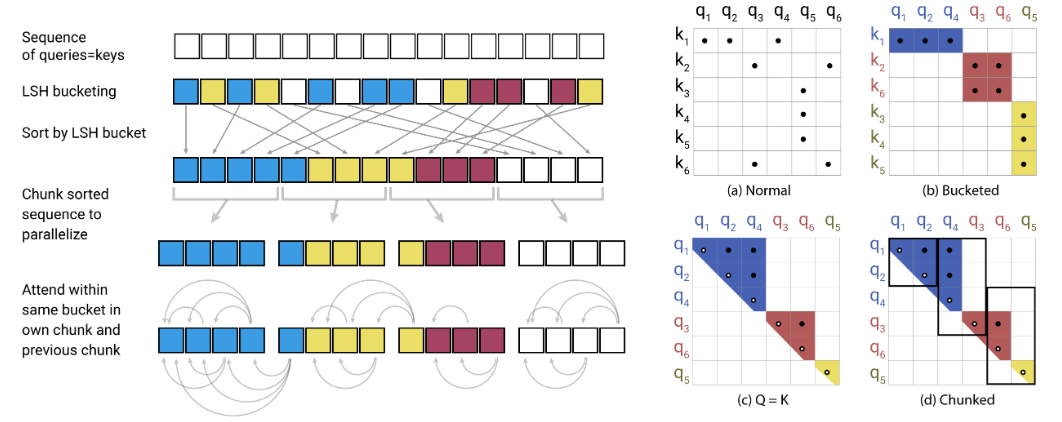
이것은 개혁자 https://openreview.net/pdf?id=rkgnkkhtvb의 pytorch 구현입니다
LSH주의, 가역적 네트워크 및 청킹이 포함됩니다. 자동 반복 과제 (enwik8)로 검증되었습니다.
32k 토큰
절반의 정밀한 81k 토큰
$ pip install reformer_pytorch간단한 개혁자 언어 모델
 # should fit in ~ 5gb - 8k tokens

import torch
from reformer_pytorch import ReformerLM

model = ReformerLM (
    num_tokens = 20000 ,
    dim = 1024 ,
    depth = 12 ,
    max_seq_len = 8192 ,
    heads = 8 ,
    lsh_dropout = 0.1 ,
    ff_dropout = 0.1 ,
    post_attn_dropout = 0.1 ,
    layer_dropout = 0.1 ,  # layer dropout from 'Reducing Transformer Depth on Demand' paper
    causal = True ,        # auto-regressive or not
    bucket_size = 64 ,     # average size of qk per bucket, 64 was recommended in paper
    n_hashes = 4 ,         # 4 is permissible per author, 8 is the best but slower
    emb_dim = 128 ,        # embedding factorization for further memory savings
    dim_head = 64 ,        # be able to fix the dimension of each head, making it independent of the embedding dimension and the number of heads
    ff_chunks = 200 ,      # number of chunks for feedforward layer, make higher if there are memory issues
    attn_chunks = 8 ,      # process lsh attention in chunks, only way for memory to fit when scaling to 16k tokens
    num_mem_kv = 128 ,       # persistent learned memory key values, from all-attention paper
    full_attn_thres = 1024 , # use full attention if context length is less than set value
    reverse_thres = 1024 ,   # turn off reversibility for 2x speed for sequence lengths shorter or equal to the designated value
    use_scale_norm = False ,  # use scale norm from 'Transformers without tears' paper
    use_rezero = False ,      # remove normalization and use rezero from 'ReZero is All You Need'
    one_value_head = False ,  # use one set of values for all heads from 'One Write-Head Is All You Need'
    weight_tie = False ,           # tie parameters of each layer for no memory per additional depth
    weight_tie_embedding = False , # use token embedding for projection of output, some papers report better results
    n_local_attn_heads = 2 ,       # many papers suggest mixing local attention heads aids specialization and improves on certain tasks
    pkm_layers = ( 4 , 7 ),           # specify layers to use product key memory. paper shows 1 or 2 modules near the middle of the transformer is best
    pkm_num_keys = 128 ,           # defaults to 128, but can be increased to 256 or 512 as memory allows
    use_full_attn = False    # only turn on this flag to override and turn on full attention for all sequence lengths. for comparison with LSH to show that it is working
). cuda ()

x = torch . randint ( 0 , 20000 , ( 1 , 8192 )). long (). cuda ()
y = model ( x ) # (1, 8192, 20000)
개혁자 (가역적 인 LSH주의 스택)
 # should fit in ~ 5gb - 8k embeddings

import torch
from reformer_pytorch import Reformer

model = Reformer (
    dim = 512 ,
    depth = 12 ,
    heads = 8 ,
    lsh_dropout = 0.1 ,
    causal = True
). cuda ()

x = torch . randn ( 1 , 8192 , 512 ). cuda ()
y = model ( x ) # (1, 8192, 512)
LSH와의 자기 관심
 import torch
from reformer_pytorch import LSHSelfAttention

attn = LSHSelfAttention (
    dim = 128 ,
    heads = 8 ,
    bucket_size = 64 ,
    n_hashes = 8 ,
    causal = False
)

x = torch . randn ( 10 , 1024 , 128 )
y = attn ( x ) # (10, 1024, 128)
LSH (지역 민감한 해싱)주의
 import torch
from reformer_pytorch import LSHAttention

attn = LSHAttention (
    bucket_size = 64 ,
    n_hashes = 16 ,
    causal = True
)

qk = torch . randn ( 10 , 1024 , 128 )
v = torch . randn ( 10 , 1024 , 128 )

out , attn , buckets = attn ( qk , v ) # (10, 1024, 128)
# attn contains the unsorted attention weights, provided return_attn is set to True (costly otherwise)
# buckets will contain the bucket number (post-argmax) of each token of each batch 이 저장소는 입력 시퀀스 input_mask (bx i_seq) , 컨텍스트 시퀀스 context_mask (bx c_seq) input_attn_mask (bx i_seq x i_seq) 마스크를 지원합니다. 마스크는 부울으로 만들어졌으며, False SoftMax 이전에 마스킹을 나타냅니다.
causal = True 설정하면 인과 적 삼각형 마스크가 모두 당신을 위해 처리됩니다.
 import torch
from reformer_pytorch import ReformerLM

CONTEXT_LEN = 512
SEQ_LEN = 8192

model = ReformerLM (
    num_tokens = 20000 ,
    dim = 1024 ,
    depth = 1 ,
    max_seq_len = SEQ_LEN ,
    ff_chunks = 8 ,
    causal = True
)

c = torch . randn ( 1 , CONTEXT_LEN , 1024 )
x = torch . randint ( 0 , 20000 , ( 1 , SEQ_LEN )). long ()

i_mask = torch . ones ( 1 , SEQ_LEN ). bool ()
c_mask = torch . ones ( 1 , CONTEXT_LEN ). bool ()

y = model ( x , keys = c , input_mask = i_mask , context_mask = c_mask )
# masking done correctly in LSH attention 기본 위치 임베딩은 로터리 임베딩을 사용합니다.
그러나 Aran은 개혁자 팀이 더 긴 시퀀스에서 훌륭한 결과와 함께 축 위치 임베딩을 사용했다고 알려주었습니다.
축 방향 위치 임베딩을 켜고 아래 지침을 따라 축 방향 임베딩의 모양과 치수를 조정할 수 있습니다.
 import torch
from reformer_pytorch import ReformerLM

model = ReformerLM (
    num_tokens = 20000 ,
    dim = 1024 ,
    depth = 12 ,
    max_seq_len = 8192 ,
    ff_chunks = 8 ,
    attn_chunks = 2 ,
    causal = True ,
    axial_position_emb = True ,         # set this to True
    axial_position_shape = ( 128 , 64 ),  # the shape must multiply up to the max_seq_len (128 x 64 = 8192)
)

x = torch . randint ( 0 , 20000 , ( 1 , 8192 )). long ()
y = model ( x ) # (1, 8192, 20000)
오히려 절대 위치 임베딩을 사용하려면 초기화시 absolute_position_emb = True 플래그로 켜질 수 있습니다.
버전 0.17.0 및 가역적 네트워크에 대한 일부 수정 이후 개혁자 Pytorch는 Microsoft의 DeepSpeed와 호환됩니다! 여러 지역 GPU가있는 경우 여기에서 지침 / 예를 따를 수 있습니다.
완전한 개혁자 시퀀스 → 시퀀스는 번역을 말합니다
 import torch
from reformer_pytorch import ReformerLM

DE_SEQ_LEN = 4096
EN_SEQ_LEN = 4096

encoder = ReformerLM (
    num_tokens = 20000 ,
    emb_dim = 128 ,
    dim = 1024 ,
    depth = 12 ,
    heads = 8 ,
    max_seq_len = DE_SEQ_LEN ,
    fixed_position_emb = True ,
    return_embeddings = True # return output of last attention layer
). cuda ()

decoder = ReformerLM (
    num_tokens = 20000 ,
    emb_dim = 128 ,
    dim = 1024 ,
    depth = 12 ,
    heads = 8 ,
    max_seq_len = EN_SEQ_LEN ,
    fixed_position_emb = True ,
    causal = True
). cuda ()

x  = torch . randint ( 0 , 20000 , ( 1 , DE_SEQ_LEN )). long (). cuda ()
yi = torch . randint ( 0 , 20000 , ( 1 , EN_SEQ_LEN )). long (). cuda ()

enc_keys = encoder ( x )               # (1, 4096, 1024)
yo = decoder ( yi , keys = enc_keys )   # (1, 4096, 20000)
완전한 개혁자 이미지 → 캡션
 import torch
from torch . nn import Sequential
from torchvision import models
from reformer_pytorch import Reformer , ReformerLM

resnet = models . resnet50 ( pretrained = True )
resnet = Sequential ( * list ( resnet . children ())[: - 4 ])

SEQ_LEN = 4096

encoder = Reformer (
    dim = 512 ,
    depth = 6 ,
    heads = 8 ,
    max_seq_len = 4096
)

decoder = ReformerLM (
    num_tokens = 20000 ,
    dim = 512 ,
    depth = 6 ,
    heads = 8 ,
    max_seq_len = SEQ_LEN ,
    causal = True
)

x  = torch . randn ( 1 , 3 , 512 , 512 )
yi = torch . randint ( 0 , 20000 , ( 1 , SEQ_LEN )). long ()

visual_emb = resnet ( x )
b , c , h , w = visual_emb . shape
visual_emb = visual_emb . view ( 1 , c , h * w ). transpose ( 1 , 2 ) # nchw to nte

enc_keys = encoder ( visual_emb )
yo = decoder ( yi , keys = enc_keys ) # (1, 4096, 20000) < 0.21.0 버전에는 버그가 있습니다. 작업 인코더 / 디코더 개혁자에 지정된 버전으로 업그레이드하십시오.
대중적인 수요에 의해, 나는 일반적인 개혁자 인코더 / 디코더 아키텍처를 작성할 때 많은 수동 작업을 제거하는 포장지를 코딩했습니다. 사용하려면 ReformerEncDec 클래스를 가져옵니다. ENCODER 키워드 인수는 enc_ 접두사와 DECODER 키워드 인수와 함께 dec_ 과 함께 전달됩니다. 모델 차원 ( dim )은 접두사가 없어야하며 인코더와 디코더간에 공유됩니다. 프레임 워크는 또한 명시 적으로 상정되지 않는 한 인코더 입력 마스크를 디코더 컨텍스트 마스크에 전달하는 것을 처리합니다.
 import torch
from reformer_pytorch import ReformerEncDec

DE_SEQ_LEN = 4096
EN_SEQ_LEN = 4096

enc_dec = ReformerEncDec (
    dim = 512 ,
    enc_num_tokens = 20000 ,
    enc_depth = 6 ,
    enc_max_seq_len = DE_SEQ_LEN ,
    dec_num_tokens = 20000 ,
    dec_depth = 6 ,
    dec_max_seq_len = EN_SEQ_LEN
). cuda ()

train_seq_in = torch . randint ( 0 , 20000 , ( 1 , DE_SEQ_LEN )). long (). cuda ()
train_seq_out = torch . randint ( 0 , 20000 , ( 1 , EN_SEQ_LEN )). long (). cuda ()
input_mask = torch . ones ( 1 , DE_SEQ_LEN ). bool (). cuda ()

loss = enc_dec ( train_seq_in , train_seq_out , return_loss = True , enc_input_mask = input_mask )
loss . backward ()
# learn

# evaluate with the following
eval_seq_in = torch . randint ( 0 , 20000 , ( 1 , DE_SEQ_LEN )). long (). cuda ()
eval_seq_out_start = torch . tensor ([[ 0. ]]). long (). cuda () # assume 0 is id of start token
samples = enc_dec . generate ( eval_seq_in , eval_seq_out_start , seq_len = EN_SEQ_LEN , eos_token = 1 ) # assume 1 is id of stop token
print ( samples . shape ) # (1, <= 1024) decode the tokens PKM 사용의 이점을 보려면 값의 학습 속도가 나머지 매개 변수보다 높아야합니다. ( 1e-2 로 권장)
여기에서 지침을 따라 올바르게 설정할 수 있습니다 https://github.com/lucidrains/product-key-memory#learning-rates
기본적으로 활성화 함수는 GELU 입니다. 대체 활성화 기능을 원한다면 키워드 ff_activation 으로 클래스를 전달할 수 있습니다.
 import torch
from reformer_pytorch import ReformerLM
from torch import nn

model = ReformerLM (
    num_tokens = 20000 ,
    dim = 512 ,
    depth = 6 ,
    max_seq_len = 8192 ,
    ff_chunks = 8 ,
    ff_dropout = 0.1 ,
    ff_mult = 6 ,
    ff_activation = nn . LeakyReLU ,
    ff_glu = True # use GLU in feedforward, from paper 'GLU Variants Improve Transformer'
)

x = torch . randint ( 0 , 20000 , ( 1 , 8192 )). long ()
y = model ( x ) # (1, 8192, 20000) 주의 웨이트 및 버킷 분포에 액세스하려면 인스턴스형 모델을 Recorder 래퍼 클래스로 마무리하십시오.
 import torch
from reformer_pytorch import Reformer , Recorder

model = Reformer (
    dim = 512 ,
    depth = 12 ,
    max_seq_len = 8192 ,
    heads = 8 ,
    lsh_dropout = 0.1 ,
    causal = True
). cuda ()

model = Recorder ( model )

x = torch . randn ( 1 , 8192 , 512 ). cuda ()
y = model ( x )

model . recordings [ 0 ] # a list of attention weights and buckets for the first forward pass

model . turn_off () # stop recording
model . turn_on () # start recording
model . clear () # clear the recordings

model = model . eject () # recover the original model and remove all listeners 개혁자는 버킷 크기 * 2에 의해 시퀀스가 깔끔하게 나눌 수 있어야한다는 약간의 단점을 제공합니다. 나는 다음 최고의 배수로 시퀀스 길이를 자동 라운드에 자동으로 향하는 작은 도구 도구를 제공했습니다.
 import torch
from reformer_pytorch import ReformerLM , Autopadder

model = ReformerLM (
    num_tokens = 20000 ,
    dim = 1024 ,
    depth = 12 ,
    max_seq_len = 8192 ,
    heads = 8 ,
    lsh_dropout = 0.1 ,
    causal = True ,
    bucket_size = 63 ,   # odd bucket size
    num_mem_kv = 77     # odd memory key length
). cuda ()

model = Autopadder ( model )

SEQ_LEN = 7777 # odd sequence length
keys = torch . randn ( 1 , 137 , 1024 ) # odd keys length

x = torch . randint ( 0 , 20000 , ( 1 , SEQ_LEN )). long (). cuda ()
y = model ( x , keys = keys ) # (1, 7777, 20000) 많은 사용자들이 자동 반복 언어 모델 (GPT-2)에만 관심이 있습니다. 다음은 임의로 길이의 인코딩 된 토큰 시퀀스를 쉽게 훈련하고 평가할 수 있도록 훈련 래퍼입니다. 인코딩과 디코딩을 처리해야합니다.
 import torch
from torch import randint

from reformer_pytorch import ReformerLM
from reformer_pytorch . generative_tools import TrainingWrapper

model = ReformerLM (
    num_tokens = 20000 ,
    dim = 1024 ,
    depth = 12 ,
    max_seq_len = 4096 ,
    lsh_dropout = 0.1 ,
    causal = True ,
    full_attn_thres = 1024
)

# 0 is used for padding and no loss to be calculated on it
model = TrainingWrapper ( model , ignore_index = 0 , pad_value = 0 )

# the wrapper can handle evenly packed sequences
x_train = randint ( 0 , 20000 , ( 3 , 357 ))

# or if you have a list of uneven sequences, it will be padded for you
x_train = [
    randint ( 0 , 20000 , ( 120 ,)),
    randint ( 0 , 20000 , ( 253 ,)),
    randint ( 0 , 20000 , ( 846 ,))
]

# when training, set return_loss equal to True
model . train ()
loss = model ( x_train , return_loss = True )
loss . backward ()

# when evaluating, just use the generate function, which will default to top_k sampling with temperature of 1.
initial = torch . tensor ([[ 0 ]]). long () # assume 0 is start token
sample = model . generate ( initial , 100 , temperature = 1. , filter_thres = 0.9 , eos_token = 1 ) # assume end token is 1, or omit and it will sample up to 100
print ( sample . shape ) # (1, <=100) token ids Andrea는 혼합 된 정밀도로 훈련 할 때 O2 최적화 수준을 사용하면 불안정성을 초래할 수 있다고 밝혔다. 대신 O1을 사용하여 Pytorch Lightning의 amp_level 또는 NVIDIA의 APEX 라이브러리에서 opt_level 로 설정할 수 있습니다.
 @inproceedings { kitaev2020reformer ,
    title       = { Reformer: The Efficient Transformer } ,
    author      = { Nikita Kitaev and Lukasz Kaiser and Anselm Levskaya } ,
    booktitle   = { International Conference on Learning Representations } ,
    year        = { 2020 } ,
    url         = { https://openreview.net/forum?id=rkgNKkHtvB }
}
@article { DBLP:journals/corr/abs-1907-01470 ,
author = { Sainbayar Sukhbaatar and
Edouard Grave and
Guillaume Lample and
Herv{'{e}} J{'{e}}gou and
Armand Joulin } ,
title = { Augmenting Self-attention with Persistent Memory } ,
journal = { CoRR } ,
volume = { abs/1907.01470 } ,
year = { 2019 } ,
url = { http://arxiv.org/abs/1907.01470 }
} @article { 1910.05895 ,
author = { Toan Q. Nguyen and Julian Salazar } ,
title = { Transformers without Tears: Improving the Normalization of Self-Attention } ,
year = { 2019 } ,
eprint = { arXiv:1910.05895 } ,
doi = { 10.5281/zenodo.3525484 } ,
} @inproceedings { fan2020reducing ,
title = { Reducing Transformer Depth on Demand with Structured Dropout } ,
author = { Angela Fan and Edouard Grave and Armand Joulin } ,
booktitle = { International Conference on Learning Representations } ,
year = { 2020 } ,
url = { https://openreview.net/forum?id=SylO2yStDr }
} @article { Shazeer2019FastTD ,
title = { Fast Transformer Decoding: One Write-Head is All You Need } ,
author = { Noam Shazeer } ,
journal = { ArXiv } ,
year = { 2019 } ,
volume = { abs/1911.02150 }
} @misc { shazeer2020glu ,
title = { GLU Variants Improve Transformer } ,
author = { Noam Shazeer } ,
year = { 2020 } ,
url = { https://arxiv.org/abs/2002.05202 }
} @misc { roy*2020efficient ,
title = { Efficient Content-Based Sparse Attention with Routing Transformers } ,
author = { Aurko Roy* and Mohammad Taghi Saffar* and David Grangier and Ashish Vaswani } ,
year = { 2020 } ,
url = { https://openreview.net/forum?id=B1gjs6EtDr }
} @misc { bachlechner2020rezero ,
title = { ReZero is All You Need: Fast Convergence at Large Depth } ,
author = { Thomas Bachlechner and Bodhisattwa Prasad Majumder and Huanru Henry Mao and Garrison W. Cottrell and Julian McAuley } ,
year = { 2020 } ,
url = { https://arxiv.org/abs/2003.04887 }
} @misc { lample2019large ,
title = { Large Memory Layers with Product Keys } ,
author = { Guillaume Lample and Alexandre Sablayrolles and Marc'Aurelio Ranzato and Ludovic Denoyer and Hervé Jégou } ,
year = { 2019 } ,
eprint = { 1907.05242 } ,
archivePrefix = { arXiv }
} @misc { bhojanapalli2020lowrank ,
title = { Low-Rank Bottleneck in Multi-head Attention Models } ,
author = { Srinadh Bhojanapalli and Chulhee Yun and Ankit Singh Rawat and Sashank J. Reddi and Sanjiv Kumar } ,
year = { 2020 } ,
eprint = { 2002.07028 }
} @misc { dong2021attention ,
title = { Attention is Not All You Need: Pure Attention Loses Rank Doubly Exponentially with Depth } ,
author = { Yihe Dong and Jean-Baptiste Cordonnier and Andreas Loukas } ,
year = { 2021 } ,
eprint = { 2103.03404 }
} @misc { su2021roformer ,
title = { RoFormer: Enhanced Transformer with Rotary Position Embedding } ,
author = { Jianlin Su and Yu Lu and Shengfeng Pan and Bo Wen and Yunfeng Liu } ,
year = { 2021 } ,
eprint = { 2104.09864 } ,
archivePrefix = { arXiv } ,
primaryClass = { cs.CL }
} @misc { vaswani2017attention ,
title = { Attention Is All You Need } ,
author = { Ashish Vaswani and Noam Shazeer and Niki Parmar and Jakob Uszkoreit and Llion Jones and Aidan N. Gomez and Lukasz Kaiser and Illia Polosukhin } ,
year = { 2017 } ,
eprint = { 1706.03762 } ,
archivePrefix = { arXiv } ,
primaryClass = { cs.CL }
}♥