GPT 4 Domain Specific Language
1.0.0

[NB: Этот репо является продолжением той же задачи вывода, оценка Chatgpt.]
Большие языковые модели (LLMS), такие как GPT-4, CHATGPT и Claude, продемонстрировали впечатляющие способности программирования и способны решать проблемы на широком спектре языков и их таксономий. Несмотря на эти успехи, некоторый скептицизм сохраняется из -за того, что эти модели демонстрируют какую -либо основную оценку синтаксических и эксплуатационных правил, лежащих в основе этих языков ( по сравнению с запоминанием моделей учебных данных).
В этом оперативном репозитории способности программирования GPT-4 исследуются с использованием произвольного языка, специфичного для домена (DSL). DSL представляют собой привлекательный субстрат для изучения возможностей вывода LLM, потому что они являются новыми и с меньшей вероятностью были широко встречаются и запоминаются во время обучения 1 . Таким образом, они обеспечивают более прямую проверку того, в какой степени LLM могут сделать вывод правил новых языков программирования несколькими выстрелами .
Здесь, специфичный для домена языка SIL (язык интеграции симметрии) был выбран по двум причинам. Во-первых, крайне маловероятно, что GPT-4 подвергался воздействию любого значительного объема кода SIL во время обучения, поскольку это внутренний DSL, разработанный в техническом хедж-фонде под названием Symmetry Investments. Во -вторых, как язык программирования, он имеет некоторые интересные особенности для воспроизведения модели (например, это функциональный язык, который подчеркивает выразительность, но не хватает let , как в Haskell или Ocaml).
После некоторого примера подсказки кода GPT-4 пытается написать код в новом функциональном DSL, известном как «SIL».
Ниже приведена набор некоторых подсказок, состоящих из коротких примеров кода SIL, которые подчеркивают его функциональность. После того, как я побудил GPT-4 с задачей и предоставлением образцов кода SIL (см. Ниже; Полная библиотека подсказок и сгенерированных образцов кода также можно найти в этом репо), я попросил его выполнить ряд основных задач программирования в SIL.
В приведенных ниже разделах я показываю некоторые из примеров сценариев кода SIL, с помощью которых была вызвана модель (полный набор примеров можно найти здесь) и ее попытки реализовать различные проблемы в SIL.
Первая подсказка - это сценарий для обработки некоторых функциональности почтового сервера. Таким образом, он сильно отличается от типа проблемы, которую я впоследствии предпринимаю CHATGPT решить, но он иллюстрирует некоторые из синтаксисов, структур данных и функциональных аспектов SIL (например, |> ).
 // example of using IMAP IDLE to run rules on new mail
import imap
moveMessages(session,ids,target) => if (ids.length > 0 ) then imap.moveUIDs(session,ids,target) else false
login = imap.ImapLogin(environment( " IMAP_USER " ),environment( " IMAP_PASS " ))
server = imap.ImapServer( " imap.fastmail.com " , " 993 " )
session = imap.Session(server,login, true ,imap.Options(debugMode: true )) | > imap.openConnection | > imap.login

rules=[ [
	[ " INBOX/0receipts " ,
	[
		" FROM [email protected] " ,
		" FROM interactivebrokers.com " ,
	]],
	[ " Junk " ,
	[
		" FROM Tapatalk " ,
	]],
	[ " INBOX/newsletters " ,
	[
		" FROM [email protected] " ,
		" HEADER X-mailer mailgun " ,
		" HEADER X-mailer WPMailSMTP/Mailer/mailgun 2.4.0 " ,
		" HEADER X-mailer nlserver " ,
		" FROM hbr.org " ,
		" FROM elliottwave.com " ,
		" OR FROM cio.com FROM cio.co.uk " ,
		" FROM substack.com " ,
		" FROM eaglealpha.com " ,
		" FROM haaretz.com " ,
		" FROM gavekal.com " ,
		" FROM go.weka.io " ,
		" FROM marketing.weka.io " ,
		` HEADER list-unsubscribe "" ` ,
		` HEADER list-Id "" ` ,
		` HEADER list-Post "" ` ,
		` HEADER list-owner"" ` ,
		` HEADER Precedence bulk ` ,
		` HEADER Precedence list ` ,
		` HEADER list-bounces "" ` ,
		` HEADER list-help "" ` ,
		` HEADER List-Unsubscribe "" ` ,
		" FROM no-reply " ,
	]],
	[ " INBOX/notifications " ,
	[
		` KEYWORD "$IsNotification" ` ,
		" FROM [email protected] " ,
		" FROM [email protected] " ,
		" FROM skillcast.com " ,
		" FROM reedmac.co.uk " ,
		" FROM [email protected] " ,
		" FROM [email protected] " ,
		" FROM [email protected] " ,
	]],
]

runRules(Session,Rules) => Rules
	| > map(target => [target[ 0 ],(target[ 1 ] | > map(term => imap.search(Session,term).ids))])
	| > mapa(set => moveMessages(Session,set[ 1 ] | > join,set[ 0 ]))

runRulesBox(Session,Rules,Mailbox) => {
	imap.select(Session,Mailbox)
	in runRules (Session,Rules)
}

inboxes=[ " INBOX " ]
result = inboxes | > mapa(inbox => runRulesBox(session,rules,imap.Mailbox(session,inbox)))
print(result)
import parallel;
threadFunction(x) => {
	imap.idle(session)
	in inboxes | > mapa(inbox => runRulesBox(session,rules,imap.Mailbox(session,inbox)))
}
parallel.runEvents((x) => false ,[threadFunction]) Второй пример примера приглашения кода также направлена на то, чтобы выделить некоторые функции этой DSL для модели, и представляет некоторые новые стандартные библиотечные функции, такие как iota и fold .
 import imap
import imap_config
import string

// Get the configuration from the environment and command line.
config = imap_config.getConfig(commandLineArguments)

// -------------------------------------------------------------------------------------------------
// Some helper functions.
//
// Firstly, a function to join an array of strings.

joinFields(flds, sep) => {
  len(flds) > 0 | > enforce( " Cannot join an empty array. " )
  in fold (flds[ 1 :$], (str, fld) => str ~ sep ~ fld, flds[ 0 ])
}

// Secondly, a field formatter which strips the field prefix and pads to a fixed width.
// E.g., ("From: [email protected]" |> fmtField(20)) == "[email protected]         "

fmtField(field, width) => {
  pad(str) => iota(width - len(str)) | > fold((a, i) => a ~ " " , str)
  in field
    | > string .split( " : " )[ 1 :$]
    | > joinFields( " : " )
    | > pad
}

// And thirdly, a function which concatenates the headers into a formatted string.

fmtHeaders(outStr, headers) => {
  outStr ~ "  " ~ joinFields(headers, " | " ) ~ " n "
}

// -------------------------------------------------------------------------------------------------

// Connect to the inbox.
creds = imap.ImapLogin(config.user, config.pass)
server = imap.ImapServer(config.host, config.port)
session =
  imap.Session(server, creds)
  | > imap.openConnection()
  | > imap.login()
inbox = imap.Mailbox(session, " INBOX " )

// Get the number of messages in the inbox.
msgCount = imap.status(session, inbox).messages

// Select the default inbox.
inbox | > imap.examine(session, _)

// Get the headers (date, from and subject) for each message, from oldest to newest, format and
// print them.
headers =
  iota(msgCount)
    | > map(id => " # " ~ toString(id + 1 ))
    | > map(id =>
         imap.fetchFields(session, id, " date from subject " ).lines
           | > map(hdr => fmtField(hdr, 40 )))
    | > fold(fmtHeaders, " INBOX: n " )
print(headers)Третий образец кода дополнительно иллюстрирует некоторые необычные функции этого DSL, с целью, что CHATGPT будет использовать их в своих собственных реализациях.
 // This script will create a report based on a specific example set of automated 'support' emails.
// E.g.,
//
// "support.mbox": 17 messages 17 new
//  N  1 [email protected]     Mon May 11 22:26  28/1369  "Alert: new issue 123"
//  N  2 [email protected]     Tue May 12 12:20  22/933   "Notification: service change"
//  N  3 [email protected]     Tue May 12 12:36  26/1341  "Alert: new issue 124"
//  N  4 [email protected]     Wed May 13 02:13  21/921   "Resolution: issue 124"
//  N  5 [email protected]    Wed May 13 18:53  26/1332  "Email not from robot."
//  N  6 [email protected]     Thu May 14 03:13  27/1339  "Alert: new issue 125"
//  N  7 [email protected]     Thu May 14 08:46  26/1270  "Resolution: issue 123"
//  N  8 [email protected]     Thu May 14 17:06  25/1249  "Alert: new issue 126"
//  N  9 [email protected]     Fri May 15 09:46  24/1185  "Resolution: issue 126"
//  N 10 [email protected]     Fri May 15 12:33  23/1052  "Alert: new issue 127"
//  N 11 [email protected]     Fri May 15 15:20  27/1331  "Notification: service change"
//  N 12 [email protected]     Fri May 15 18:06  23/953   "Resolution: issue 127"
//  N 13 [email protected]     Mon May 18 12:46  27/1218  "Alert: new issue 128"
//  N 14 [email protected]     Mon May 18 15:33  32/1628  "Alert: new issue 129"
//  N 15 [email protected]     Tue May 19 05:26  25/1176  "Resolution: issue 128"
//  N 16 [email protected]     Tue May 19 08:13  26/1312  "Notification: service change"
//  N 17 [email protected]     Tue May 19 11:00  28/1275  "Alert: new issue 130"
//
//
// Each of these automated emails are from `robot` _except_ for message 5.  Messages 2, 8 and 16 are
// from `robot` but are unrelated to issues.
//
// This script will search for emails and match new issue numbers with resolutions to report the
// number of outstanding alerts.

import imap
import * from imap.query
import imap_config

import dates
import string

// Get the configuration from the environment and command line.
config = imap_config.getConfig(commandLineArguments)

// Connect to the inbox.
creds = imap.ImapLogin(config.user, config.pass)
server = imap.ImapServer(config.host, config.port)
session =
  imap.Session(server, creds)
    | > imap.openConnection()
    | > imap.login()
inbox = imap.Mailbox(session, " support " )

// Select the default inbox.
inbox | > imap.examine(session, _)

// These criteria are common for both our searches.
commonCrit = imap.Query()
    | > and(from( ` [email protected] ` ))
    | > and(sentSince(dates. Date ( 2020 , 5 , 13 )))

// Get each of the alerts and resolutions from the past week (13-19 May 2020).
alertMsgIds =
  imap.search(session, imap.Query(subject( " Alert: new issue " )) | > and(commonCrit)).ids
resolutionMsgIds =
  imap.search(session, imap.Query(subject( " Resolution: issue " )) | > and(commonCrit)).ids

// A function to get the alert ID from a message subject.
getAlertId(msgId) => {
  imap.fetchFields(session, toString (msgId), " subject " ).lines[ 0 ]
    | > string .split()[$ - 1 ]
}

// A function to remove an entry from a table whether it's there or not.
removeIfExists(tbl, key) => {
  if find( keys (tbl), key) == [] then
    tbl
  else
    removeEntry(tbl, key)
}

// Now find those alerts which have no resolution.  Firstly the subject for each alert, get the
// issue number end and store it in a table.
allAlertTable = alertMsgIds | > fold((tbl, msgId) => addEntry(tbl, getAlertId(msgId), msgId), {})

// Go through the resolutions and remove their corresponding alerts from the table.
unresolvedAlertTable =
  resolutionMsgIds | > fold((tbl, msgId) => removeIfExists(tbl, getAlertId(msgId)), allAlertTable)

// Create a report with the date of the unresolved alerts.
report =
  keys (unresolvedAlertTable)
    | > map(alertId => {
         msgId = unresolvedAlertTable[alertId] | > toString
       in [ alertId
          , imap.fetchFields(session, msgId, " date " ).lines[ 0 ]
          , imap.fetchText(session, msgId).lines[ 0 ]
          ]
       })
    | > fold((outStr, tuple) => {
         outStr ~ " Issue: " ~ tuple[ 0 ] ~ " n  " ~ tuple[ 1 ] ~ " n  Summary: " ~ tuple[ 2 ] ~ " n "
       }, " n UNRESOLVED ISSUES FROM THE PAST 10 DAYS: nn " )

// Close the session.
imap.closeConnection(session)

// Print the report last.
print(report) В качестве первого упражнения я попросил модель реализовать очень простую реляционную базу данных в SIL с основными функциональными возможностями (обратите внимание, что // обозначает комментирование в SIL).
 import imap
import imap_config
import string

// Get the configuration from the environment and command line.
config = imap_config.getConfig(commandLineArguments)

// Connect to the server.
creds = imap.ImapLogin(config.user, config.pass)
server = imap.ImapServer(config.host, config.port)
session =
  imap.Session(server, creds)
  | > imap.openConnection()
  | > imap.login()

// -------------------------------------------------------------------------------------------------
// Here's an attempt to create something resembling a simple relational database.

// Define two tables, 'Employees' and 'Departments'.
Employees = { " 1 " : [ " Alice " , " Engineering " ], " 2 " : [ " Bob " , " Marketing " ], " 3 " : [ " Charlie " , " Engineering " ] }
Departments = { " Engineering " : [ " Alice " , " Charlie " ], " Marketing " : [ " Bob " ] }

// Function to emulate SQL SELECT operation.
select = (table, id) => {
    table[id] | > enforce( " Id does not exist in table. " )
}

// Function to emulate SQL INSERT operation.
insert = (table, id, values ) => {
    addEntry(table, id, values )
}

// Function to emulate SQL DELETE operation.
delete = (table, id) => {
    removeEntry(table, id)
}

// Function to emulate SQL JOIN operation.
join = (table1, table2, commonField) => {
    // This is a very basic JOIN operation and does not account for multiple matches, etc.
    joinedTable = {}
    for key in keys (table1) {
        value = table1[key][commonField]
        if find( keys (table2), value) != [] {
            joinedTable = addEntry(joinedTable, key, [table1[key], table2[value]])
        }
    }
    joinedTable
}

// Close the session.
imap.closeConnection(session)

// Perform operations.
newEmployee = [ " David " , " Marketing " ]
Employees = insert(Employees, " 4 " , newEmployee)
Departments = insert(Departments, newEmployee[ 1 ], [ " David " ])
print(select(Employees, " 1 " ))
print(join(Employees, Departments, 1 ))Реализация алгоритмов сортировки - это вопрос интервью с архетипическим программным обеспечением. Здесь я попросил GPT-4 внедрить Bubblesort (концептуально самый базовый алгоритм сортировки) в SIL. Ниже приведен ответ:
 // Helper function to bubble up the largest value in one pass
bubble(list) => {
  if length(list) <= 1 then
    list
  else
    if list[ 0 ] > list[ 1 ] then
      [list[ 1 ]] ~ bubble([list[ 0 ]] ~ list[ 2 to $])
    else
      [list[ 0 ]] ~ bubble(list[ 1 to $])
}

// Main BubbleSort function
bubbleSort(list) => {
  bubbled = bubble(list)
  if bubbled == list then
    list
  else
    bubbleSort(bubbled)
} Затем я побудил модель написать сценарий для вычисления медианы списка (сгенерированный ответ ниже). sortList вспомогательных функций, действительно, согласуется с парадигмами функционального программирования, но здесь GPT-4 предполагает существование оператора назначения := .
 // Helper function to sort an array of integers.
sortList(list) => list | > len | > iota | > map(i => list | > min | > snd) | > each((i, minVal) => list := removeIndex(list, minVal))

// Function to compute the median of a set of integers.
computeMedian(list) => {
  // Sort the list in ascending order.
  sortedList = sortList(list)

  // Get the length of the list.
  length = len(sortedList)

  // Check if the length is even.
  isEven = length % 2 == 0

  // If the length is even, the median is the average of the two middle numbers.
  // Otherwise, the median is just the middle number.
  median =
    if isEven then
      (sortedList[length / 2 - 1 ] + sortedList[length / 2 ]) / 2
    else
      sortedList[length / 2 ]

  // Return the median.
  median
} Затем GPT -4 был предложено реализовать алгоритм k -inarest соседей в SIL. Помимо галлюцинации/предположения о существовании модуля, называемого math (который, возможно, является разумным предположением для масштаба этого упражнения), это кажется приемлемым решением, которое соответственно использует функциональные операторы, такие как |> , map и fold .
 import math

distance(p1, p2) => {
  math.sqrt(
    math.pow(p1[ 0 ] - p2[ 0 ], 2 )
    + math.pow(p1[ 1 ] - p2[ 1 ], 2 )
  )
}

majorityVote(labels) => {
  labelCounts = labels | > fold((counts, label) => addEntry(counts, label, get (counts, label, 0 ) + 1 ), {})
  labelCounts | > maxBy((_, count) => count)
}

knn(data, newPoint, k) => {
  distances = data | > map((point, label) => (distance(point, newPoint), label))
  sorted = distances | > sort((a, b) => a[ 0 ] < b[ 0 ])
  nearest = sorted | > take(k)
  labels = nearest | > map((_, label) => label)
  majorityVote(labels)
}
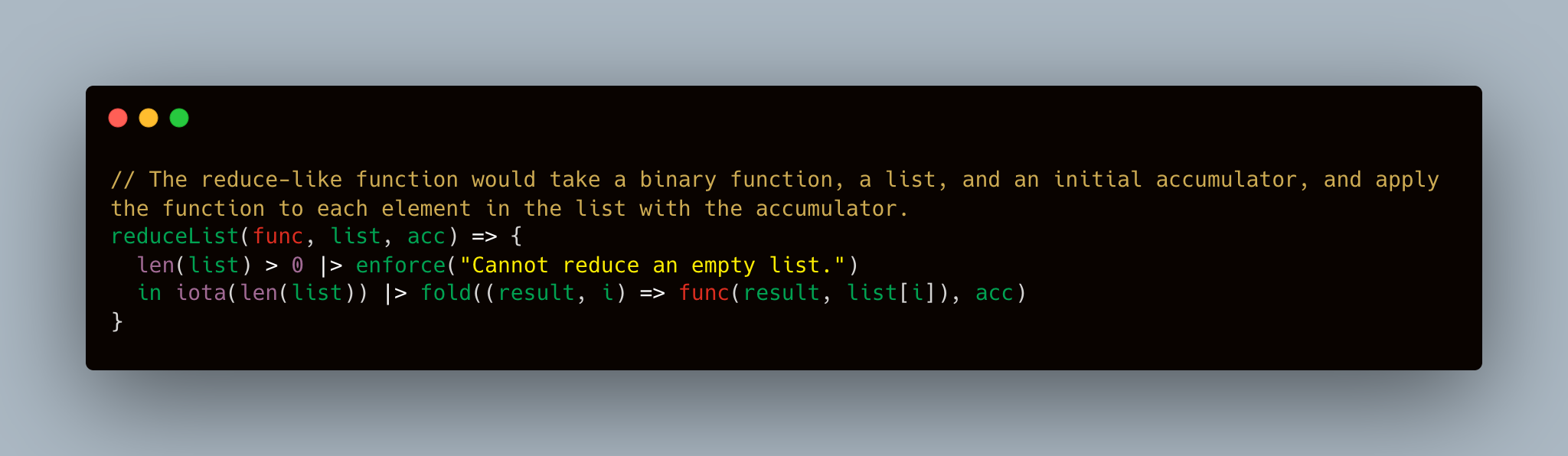
Одной из интересных особенностей функциональных языков является то, что они могут быть очень выразительными. Здесь я побудил GPT-4 реализовать основную map функциональных операторов, filter и reduce (или fold в контексте функциональных языков).
 // map

// The map-like function would take a function and a list, and apply the function to each element in the list.
mapList(func, list) => {
  len(list) > 0 | > enforce( " Cannot map over an empty list. " )
  in iota (len(list)) | > fold((result, i) => addEntry(result, func(list[i])), [])
}

// filter

// The filter-like function would take a predicate and a list, and return a list of elements for which the predicate returns true.
filterList(pred, list) => {
  len(list) > 0 | > enforce( " Cannot filter an empty list. " )
  in iota (len(list)) | > fold((result, i) => if pred(list[i]) then addEntry(result, list[i]) else result, [])
}

// reduce

// The reduce-like function would take a binary function, a list, and an initial accumulator, and apply the function to each element in the list with the accumulator.
reduceList(func, list, acc) => {
  len(list) > 0 | > enforce( " Cannot reduce an empty list. " )
  in iota (len(list)) | > fold((result, i) => func(result, list[i]), acc)
}
Project Euler - это коллекция математических и программных проблем (которые, я думаю, делают интересные подсказки для LLMS). Здесь я подсказываю GPT-4 решить первые две проблемы проекта Euler с использованием SIL.
 // Project Euler problem #1:
// Here, my prompt was to solve the (easy) first problem of the Project Euler series (https://projecteuler.net/problem=1)

// Define a range from 1 to 999.
range = iota( 999 ) | > map(x => x + 1 )

// Define a function to check if a number is a multiple of 3 or 5.
isMultipleOf3Or5 = (num) => num % 3 == 0 || num % 5 == 0

// Filter the range to get only multiples of 3 or 5.
multiples = range | > filter(isMultipleOf3Or5)

// Sum the multiples.
sum = multiples | > fold((a, b) => a + b, 0 )

// Print the sum.
print(sum)
 // Project Euler problem #2:
// This prompt is to solve the second Project Euler problem (https://projecteuler.net/problem=2)

// Define a function to generate the next term in the Fibonacci sequence.
nextFibonacciTerm = (tuple) => [tuple[ 1 ], tuple[ 0 ] + tuple[ 1 ]]

// Start with the first two terms.
initialTerms = [ 1 , 2 ]

// Define a function to generate Fibonacci sequence up to a limit.
generateFibonacci = (limit) => {
  fibonacciSequence = unfold(nextFibonacciTerm, initialTerms, (tuple) => tuple[ 1 ] <= limit)
  fibonacciSequence
}

// Define a function to check if a number is even.
isEven = (num) => num % 2 == 0

// Generate the Fibonacci sequence up to four million.
fibonacciSequence = generateFibonacci( 4000000 )

// Extract the second term from each tuple in the sequence, which is the actual Fibonacci number.
fibonacciNumbers = fibonacciSequence | > map(tuple => tuple[ 1 ])

// Filter the sequence to get only even numbers.
evenFibonacciNumbers = fibonacciNumbers | > filter(isEven)

// Sum the even numbers.
sum = evenFibonacciNumbers | > fold((a, b) => a + b, 0 )

// Print the sum.
print(sum)
Изучение способности LLMS выводить и понимать особенности нового языка программирования несколькими выстрелами , остается открытым и интересным вопросом. Здесь эти возможности были изучены в контексте побуждения GPT-4 для решения побужденных проблем на новом специфическом домене языке (DSL), называемом SIL. DSL являются потенциально полезным испытательным примером для изучения вывода против запоминания в LLMS, так как они часто имеют отличительные особенности и с меньшей вероятностью были широко встречаются во время тренировок (если вообще).
Возможно, наиболее интересным выводом этого упражнения является то, что возможности вывода GPT-4 значительно лучше, чем у CHATGPT при оценке по тем же подсказкам и задачам (см. Аналогичные упражнения с CHATGPT здесь).
Существуют доказательства того, что запоминание LLM способствует частоте презентации примера обучения и количеством соответствующих токенов, используемых для привлечения модели. ↩





